
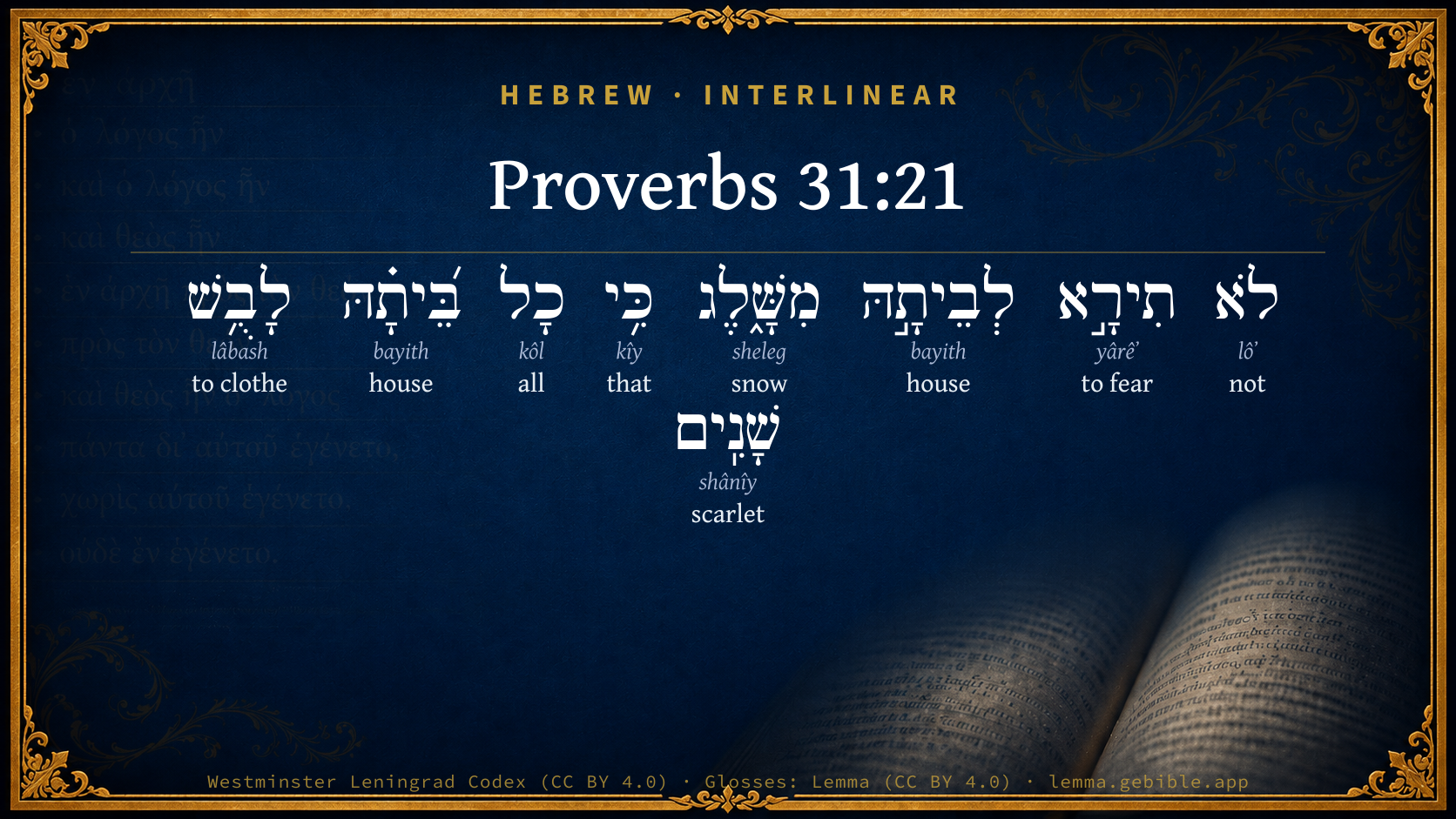
Proverbs 31:21

Hebrew (Westminster Leningrad Codex) Proverbs 31:21 appears in the Hebrew Old Testament. The text above is from the Westminster Leningrad Codex. Each word links to its Strong’s number, a concise gloss, and parsing drawn from the Open Scriptures Hebrew Bible morphology. Click any word for its full Brown-Driver-Briggs (BDB) entry.
Download image
Cite this verse

Proverbs 31:21 (World English Bible). Public Domain. Lemma interlinear Bible study tool, https://lemma.gebible.app/v/proverbs/31/21.

Show BibTeX & RIS
BibTeX
RIS
English Translation
She is not afraid of the snow for her household; For all her household are clothed with scarlet.
World English Bible · Public Domain
Download a study sheet

One document with this verse’s original text, its word-by-word gloss line, the meaning frame, cross-references with their text, attributed commentary, and full source and license credits — printable, and it pastes into notes with its structure intact.

This verse Autodidact and up

Study sheet (.html) Plain text (.txt)

A passage Seminary Student

Up to 50 verses in one chapter. A passage sheet keeps up to 6 commentary sources and 12 cross-references per verse, in the order this page ranks them, and says so on the sheet whenever that leaves anything out. Ask for a single verse and you get the Autodidact verse sheet above.

Everything on this page stays free to read, with no account — the sheet is a download of what is already on screen, not access to it.

Want to remove ads? Support Godless Engineer
Compare translations 3

The same verse in 3 English versions, stacked beneath the original-language interlinear above. Click any original word for its lexicon entry.

Each is an independent rendering of the whole verse — the interlinear is not word-aligned to these translations.

Highlighted words mark where these versions differ — a whole-verse word diff, not a word-by-word alignment.

  • World English Bible Public Domain
    She is not afraid of the snow for her household; For all her household are clothed with scarlet.
  • King James Version Public Domain
    She is not afraid of the snow for her household: for all her household are clothed with scarlet.
  • unfoldingWord Literal Text CC BY-SA 4.0
    She does not fear for her house because of snow, for all her house is clothed crimson.

unfoldingWord Literal Text — © unfoldingWord, licensed CC BY-SA 4.0. Word-aligned USFM3 via Door43 (git.door43.org/unfoldingWord/en_ult).

Versions to compare (up to 4)

3 of 4 selected

Show all 18 translations

Every available English version of this verse, each an independent rendering of the whole verse.

  • World English Bible Public Domain
    She is not afraid of the snow for her household; For all her household are clothed with scarlet.
  • Berean Standard Bible Public Domain
    When it snows, she has no fear for her household, for they are all clothed in scarlet.
  • Majority Standard Bible Public Domain
    When it snows, she has no fear for her household, for they are all clothed in scarlet.
  • King James Version Public Domain
    She is not afraid of the snow for her household: for all her household are clothed with scarlet.
  • American Standard Version (1901) Public Domain
    She is not afraid of the snow for her household; For all her household are clothed with scarlet.
  • Revised Version (1885) Public Domain
    She is not afraid of the snow for her household; for all her household are clothed with scarlet.
  • Geneva Bible (1599) Public Domain
    She feareth not the snowe for her familie: for all her familie is clothed with skarlet.
  • Douay-Rheims (1899) Public Domain
    She shall not fear for her house in the cold of snow: for dl her domestics are clothed with double garments.
  • Young's Literal Translation Public Domain
    She is not afraid of her household from snow, For all her household are clothed `with' scarlet.
  • Literal Standard Version CC BY-SA 4.0
    She is not afraid of her household from snow, || For all her household are clothed [with] scarlet.
  • Unlocked Literal Bible CC BY-SA 4.0
    She is not afraid of the snow for her household, for all her household are clothed in scarlet.
  • unfoldingWord Literal Text CC BY-SA 4.0
    She does not fear for her house because of snow, for all her house is clothed crimson.
  • Darby Bible Public Domain
    She is not afraid of the snow for her household; for all her household are clothed with scarlet.
  • World Messianic Bible Public Domain
    She is not afraid of the snow for her household, for all her household are clothed with scarlet.
  • Webster's Bible Public Domain
    She is not afraid of the snow for her household: for all her household are clothed with scarlet.
  • Free Bible Version CC BY-SA 4.0
    She doesn't worry if it snows, because her whole family has warm clothing.
  • Bible in Basic English Public Domain
    She has no fear of the snow for her family, for all those in her house are clothed in red.
  • JPS Tanakh (1917) Public Domain
    She is not afraid of the snow for her household; for all her household are clothed with scarlet.

Literal Standard Version (2020), Covenant Press — licensed CC BY-SA 4.0. Text via the HelloAO Bible API (eBible.org). Unlocked Literal Bible (unfoldingWord) — licensed CC BY-SA 4.0. Text via the HelloAO Bible API (eBible.org). unfoldingWord Literal Text — © unfoldingWord, licensed CC BY-SA 4.0. Word-aligned USFM3 via Door43 (git.door43.org/unfoldingWord/en_ult). Free Bible Version, Dr. Jonathan Gallagher — licensed CC BY-SA 4.0. Text via the HelloAO Bible API (eBible.org).

Word by word

More ways to search: Search by grammar → Find every occurrence → Compare this word →

Practice this passage: Drill this verse → Learn its vocabulary →

About this verse

These counts appear in no published source. They are computed here, from the morphology-tagged text and Lemma’s own curated glosses. What Lemma adds →

9
words
8
distinct lemmas
Wisdom
section

Notable vocabulary

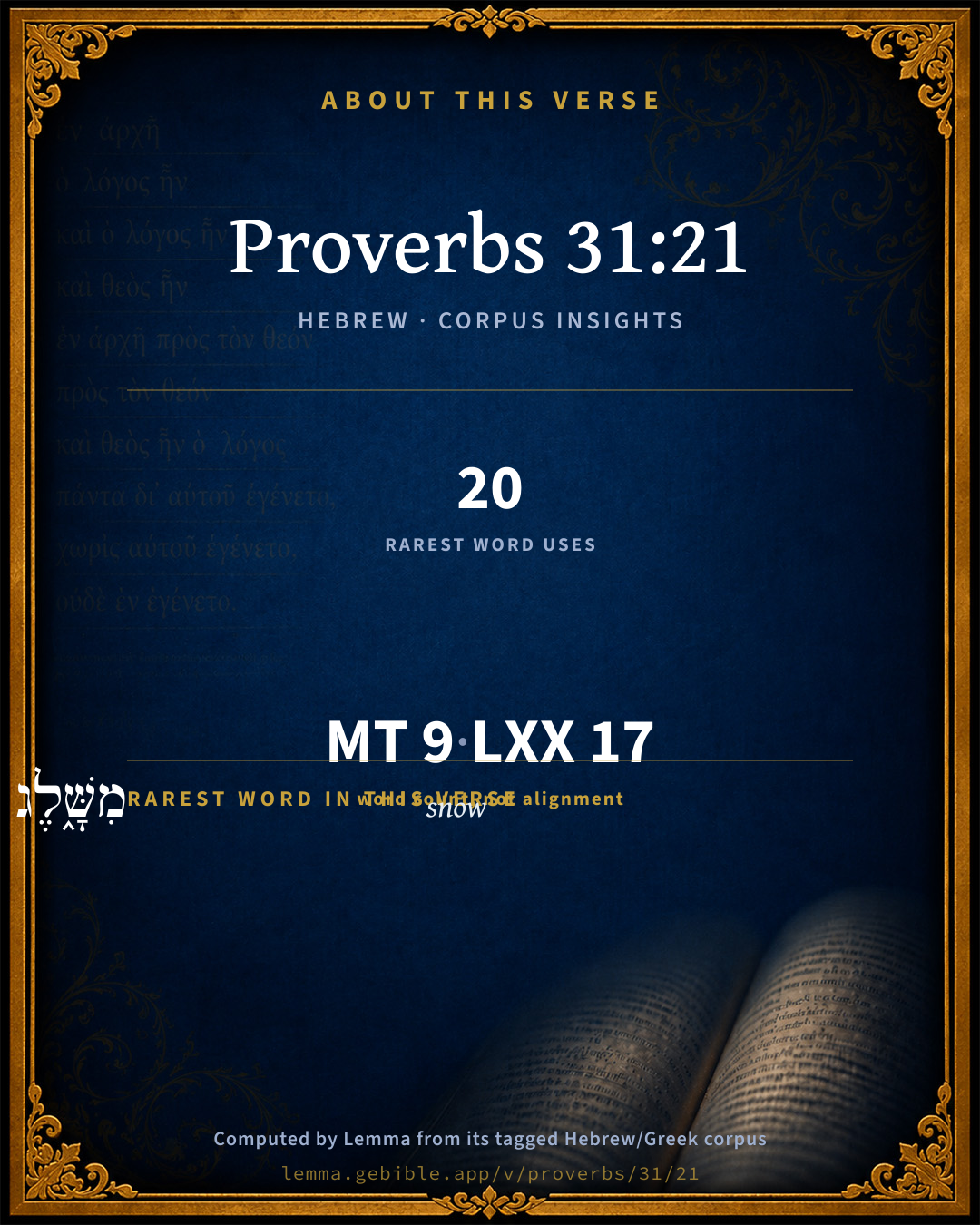
The rarest word here is מִשָּׁ֑לֶג snow H7950 — appearing just 20 times in the whole Hebrew Bible.

Shared distinctive vocabulary

מִשָּׁ֑לֶג snow H7950 occurs in 20 verses of the Hebrew Bible. Also found in:

Grammatical profile

  • 2 verbs
  • 5 nouns
  • 1 conjunction
  • 1 particle

Verb forms

  • תִירָ֣א Qal · Imperfect
  • לָבֻ֥שׁ Qal · Participle Passive

Repetition

A word recurs within this verse — often emphatic in Hebrew:

  • לְבֵיתָ֣הּ house H1004 ×2

Hebrew & Septuagint length

In English translation the verse runs 18 words from the Hebrew and 20 from the Septuagint (LXX English) — closely comparable.

A rough comparison of the two English renderings, which tokenize alike — not a word-level alignment.

Word counts can differ between the Hebrew and the Greek without any difference in meaning — e.g. the Hebrew direct-object marker אֵת has no separate Greek word, and Greek often adds the article ὁ.

In the original languages it is 9 Hebrew tokens and 17 Greek tokens — but the two are counted differently (Hebrew bundles its prefixes and suffixes into one token; the Greek is in lemma form), so that isn’t a like-for-like length.

Cross-references

3

Topical passages linked to Proverbs 31:21 in the Treasury of Scripture Knowledge — connected by theme and wording, ordered by reader-vote popularity; previews shown in the World English Bible.

  • Genesis 45:22 To all of them he gave each man changes of clothing, but to Benjamin he gave three hundred pieces of silver and five changes of clothing.
  • 2 Samuel 1:24 You daughters of Israel, weep over Saul, Who clothed you in scarlet delicately, Who put ornaments of gold on your clothing.
  • Proverbs 25:20 As one who takes away a garment in cold weather, Or vinegar on soda, So is one who sings songs to a heavy heart.

Cross-references courtesy of OpenBible.info (CC BY 4.0).

Hebrew and Greek witnesses Masoretic Hebrew ↔ Greek Septuagint

The same verse in the two great witnesses to the Old Testament, shown verse-for-verse.

These are two independent witnesses, not word-aligned to each other, and the Septuagint is shown in lemma (dictionary) form.

Hebrew Proverbs 31:21 Masoretic · Westminster Leningrad Codex

לֹא תִירָ֣א לְבֵיתָ֣הּ מִשָּׁ֑לֶג כִּ֥י כָל בֵּ֝יתָ֗הּ לָבֻ֥שׁ שָׁנִֽים

She is not afraid of the snow for her household; For all her household are clothed with scarlet.

World English Bible · Public Domain

Greek LXX Proverbs 31:21 Septuagint · lemma form

οὐ φροντίζω ὁ ἐν οἶκος ὁ ἀνήρ αὐτός ὅταν ποῦ χρονίζω πᾶς γάρ ὁ παρά αὐτός ἐνδιδύσκω

Her husband is not anxious about those at home when he tarries anywhere abroad: for all her household are clothed.

LXX2012 (modern English Septuagint) · Public Domain

On this verse, Keil & Delitzsch discusses the Septuagint’s reading. Read the note in Commentary ↓

Hebrew: Westminster Leningrad Codex (CC BY 4.0). Greek: Septuagint (public domain); English from LXX2012 (modern English Septuagint) (Public Domain). How the Septuagint differs from the Hebrew →

Commentary

Notes on Proverbs 31:21 from classic Christian and Jewish commentators (each source and its license shown beneath its notes). The classic Christian expositions comment on the surrounding passage and are grouped to its opening verse, so a note may address several verses; the Jewish commentaries on the Tanakh (Rashi and others) are per-verse, so they appear only where the commentator wrote on this verse.

Lemma curates 59 commentaries, every one of them public domain or Creative Commons licensed, each selected and text-cleaned for this edition rather than reprinted as found. About our sources →

Trapp's Complete Commentary

John Trapp

Pro 31:21 She is not afraid of the snow for her household: for all her household [are] clothed with scarlet.

Ver. 21. She is not afraid of the snow.] As she is liberal to the poor, so her chief care is for those of her own house, that they may be accommodated. For she knows that to stretch beyond the staple were to mar all; and not to provide for her own were to be worse than an infidel. {1Ti 5:8}

John Trapp, A Commentary or Exposition upon All the Books of the Old and New Testament (1647–1656) — public domain. Text from a community e-Sword module.

Joseph Benson's Commentary

Pro 31:21-25. She is not afraid of the snow — Of any injuries of the weather. For her household are clothed with scarlet — She has provided enough, not only for their necessity, and defence against cold and other inconveniences, but also for their delight and ornament. She maketh coverings of tapestry — For the furniture of her house. Her clothing is silk and purple — Which was very agreeable to her high quality, though it doth not justify that luxury in attire which is now usual among persons of far lower ranks, both for wealth and dignity. Her husband is known — Observed and respected, not only for his own worth, but for his wife’s sake; when he sitteth among the elders, &c. — In council or judgment. And delivereth girdles — Curiously wrought of linen and gold, or other precious materials, which, in those parts, were used both by men and women. Strength and honour — Strength of mind, magnanimity, courage, activity; are her clothing — Her ornament and glory; and she shall rejoice in time to come — She lives in constant tranquillity of mind, from a just confidence in God’s gracious providence.

Joseph Benson's Commentary on the Old and New Testaments (1811–1818) — public domain. Text from a community e-Sword module.

Keil & Delitzsch

C. F. Keil & F. Delitzsch

But the poet goes on to describe her fruitful activity in the nearest sphere of her calling:

21 ל She is not afraid of the snow for her house;

For her whole house is clothed in scarlet.

A fall of snow in the rainy season of winter is not rare in Palestine, the Hauran, and neighbouring countries, and is sometimes accompanied with freezing cold.

(Note: Vid., regarding a fall of snow in Jerusalem, the journal Saat auf Hoffnung Jahrg. 3, Heft 3; and in the Hauran Comm. to Job 38:22.)

She sees approaching the cold time of the year without any fear for her house, even though the season bring intense cold; for her whole house, i.e., the whole of the members of her family, are לבשׁ שׁנים. The connection is accusatival (Venet. ἐνδεδυμένος ἐρυθρά), as at Sa2 15:32; Eze 9:2-3. שׁני, from שׁנה, to shine, glance clear, or high red, and is with or without תולעת the name of the colour of the Kermes worm, crimson or scarlet, perhaps to be distinguished from ארגּמן, the red-purple shell colour, and תּכלת, the blue. שׁנים are clothing or material coloured with such שׁני (bright red) (vid., at Isa 1:18). The explanation of the word by dibapha is inadmissible, because the doubled colouring, wherever it is mentioned, always refers to the purple, particularly that of Tyre (dibapha Tyria), not to the scarlet.

(Note: Vid., Blmner's Die gewerbliche Thtigkeit der Vlder des klassischen Alterthums (1869), p. 21f.)

But why does the poet name scarlet-coloured clothing? On account of the contrast to the white snow, says Hitzig, he clothes the family in crimson. But this contrast would be a meaningless freak. Rather it is to be supposed that there is ascribed to the red material a power of retaining the heat, as there is to the white that of keeping off the heat; but evidence for this are wanting. Therefore Rosenmller, Vaihinger, and Bttcher approve of the translation duplicibus (Jerome, Luther) [= with double clothing], because they read, with the lxx, שׁנים.

(Note: The lxx reads together שנים מרבדים, δισσὰς χλαίνας, and brings into Pro 31:21 (her husband remains without care for the members of the family if it does not snow χιονίζη, as it is to be read for χρονίζη) and 22 the husband, who appears to the translator too much kept in the background.)

But, with right, the Syr., Targ. abide by זהוריתא, scarlet. The scarlet clothing is of wool, which as such preserves warmth, and, as high-coloured, appears at the same time dignified (Sa2 1:24).

Keil & Delitzsch — Biblical Commentary on the Old Testament (1861–1891) — public domain (CC PDM 1.0). Text via the HelloAO Bible API. (Old Testament only.)

Geneva Bible (1599)

Geneva Bible translators

Or, with double.

Geneva Bible (1599) marginal notes — public domain. Text via Bolls.life.

Jamieson, Fausset & Brown

Robert Jamieson, A. R. Fausset & David Brown

scarlet--or, "purple," by reason of the dyes used, the best fabrics; as a matter of taste also; the color suits cold.

Jamieson, Fausset & Brown — Commentary Critical and Explanatory on the Whole Bible (1871) — public domain (CC PDM 1.0). Text via the HelloAO Bible API.

Adam Clarke's Commentary

Verse 21. She is not afraid of the snow]

12. She is not anxious relative to the health and comfort of her family in the winter season, having provided clothes sufficient for each in the cold weather, in addition to those which they wore in the warm season.

For all her household are clothed with scarlet.] Not scarlet, for the colour can avail nothing in keeping off the cold; nor would it be a proper colour for the bogs and dirt of winter. But שנים shanim, from שנה shanah, to iterate, to double, signifies not only scarlet, so called from being twice or doubly dyed, but also double garments, not only the ordinary coat but the surtout or great-coat also, or a cloak to cover all. But most probably double garments, or twofold to what they were accustomed to wear, are here intended. If the general clothing be intended, scarlet cannot be the meaning, nor did our translators entirely rely on it; and therefore put double garments, the true meaning, in the margin, from which it cannot be too speedily transferred to the text. The Vulgate has "duplicibus." And my old MS. very properly, Alle forsoth hir hoomli men, ben clothid with double. And Coverdale, with equal propriety, "For all hir householde folkes are duble clothed." But if her husband and children alone are referred to, scarlet, which in the general meaning of the term, may be proper enough; as even in these countries of ours, scarlet, as being a lively bright colour, is used in the winter dresses.

Adam Clarke's Commentary on the Bible (1810–1826) — public domain. Text from a community e-Sword/MySword module.

Ellicott's Commentary for English Readers

(21) She is not afraid of the snow.—Not uncommon in winter-time in Palestine and the neighbouring countries. (Comp. 2Sa_23:20; Psa_147:16.)

All her household are clothed with scarlet, which by its very colour suggests warmth and comfort.

A Bible Commentary for English Readers, edited by Charles John Ellicott (1878–1897) — public domain. Text from a community e-Sword module.

The Cambridge Bible for Schools and Colleges

gen. ed. J. J. S. Perowne

21. scarlet] It has been proposed to change the Heb. vowel-points and render, double garments, or garments of double texture and warmth, δισσὰς χλαίνας, LXX; duplicibus, Vulg. There is no reason, however, to alter the word. There is a touch of poetry in the contrast between the white snow, the emblem of cold, and the scarlet garment, which is the very picture of warmth in its glowing colour. That its texture does not belie its appearance goes without saying.

The Cambridge Bible for Schools and Colleges (gen. ed. J. J. S. Perowne; Cambridge University Press, 1878–1918) — public domain. Text from a community e-Sword module.

John Gill's Exposition

She is not afraid of the snow for her household,.... That her family should suffer through the rigour of a cold season, when it is frost and snow;

for all her household are clothed with scarlet: the Vulgate Latin version renders it, "with double" (u), that is, with double garments; and so the Septuagint and Arabic versions, joining the words to a following verse; and this, by some, is thought to be the better rendering of the words; since the scarlet colour is no fence against cold, no more than any other, whereas double garments are; and which may be applied to the garment of justification, or the robe of Christ's righteousness, as one; and to the garment of sanctification, internal and external, as the other; the one, even the righteousness of Christ, or Christ the Lord our righteousness, is an hiding place from the wind, and a covert from the storm; a sufficient shelter from the cold of snow, and all inclemencies of the weather; by which the vindictive wrath and justice of God may be signified: and the other is a screen from the malicious insinuations and reproaches of men. But had the word been designed to signify "double", it would have been in the "dual" number; as it is not, and is always used in this form for "scarlet"; and so the Targum, Jarchi, and Aben Ezra interpret it; which colour is an emblem of the blood of Christ, by which the church is justified, Rom 5:9; and all the household of faith, the whole family of Christ and household of God, are all justified by the same righteousness of Christ, consisting of his active and passive obedience, for the whole of which his crimson blood is put; it is a garment down to the feet, which covers all his people; they are all made righteous by the one obedience of Christ; they are all clothed in scarlet alike, all kings and priests unto God, all alike justified, and shall be glorified alike. The literal sense is, that if her household are clothed in scarlet in common; much more may it be thought that coarse and suitable garments would be provided for them, to protect them from the cold in winter (w).

(u) "indigitat vestem duplo crassiorem, Stockius, p. 1122. "duplicibus, V. L. Paguinus, Tigurine version, Gataker, Gejerus; "penulis duplicibus", Junius & Tremellius, Piscator; "duplicatis", Cocceius: such as Homer describes, made by ths wife of Hector, Iliad 22. v. 440, 441. see Odyss. 19. v. 225, 226, 241. "change of raiment", David de Pomis, Lexic. fol. 218. 1. (w) Vid. Braunium de Vest. Sacredot. Heb. l. 1. c. 15. p. 309.

John Gill's Exposition of the Whole Bible (1746–1763) — public domain (CC PDM 1.0). Text via the HelloAO Bible API.

Albert Barnes' Notes on the Bible

Scarlet - Probably some well-known articles of dress, at once conspicuous for their color, or, as some think, for their double texture and warmth.

Albert Barnes' Notes on the Bible (1834–1885) — public domain. Text from a community e-Sword/MySword module.

Haydock's Catholic Bible Commentary

Domestics. Hebrew, "house is clothed in purple," which may be understood of the domestics, though it seems more probably to refer to her husband and children.

George Leo Haydock (1774–1849), Haydock's Catholic Family Bible and Commentary, 1859 edition — public domain. Excludes Psalms (Douay-Rheims chapter numbering differs from Protestant) and Deuterocanonical books (Catholic canon only).

Matthew Poole's English Annotations

She is not afraid of the snow, or of any injuries of the weather.

All her household are clothed with scarlet; she hath provided enough, not only for their necessity and defence against cold and other inconveniences, which is here supposed, but also for their delight and ornament; so that not only herself, and husband, and children, but some of the better rank of her servants, wear scarlet; which was more cheap and familiar in those times and countries than now it is with us. Or, as it is rendered in our margin, and by divers others, are clothed with double garments, which is necessary and customary in cold seasons.

Matthew Poole's English Annotations on the Holy Bible (1683–1685) — public domain. Text from a community e-Sword/MySword module.

Whedon's Commentary on the Bible

Daniel D. Whedon

21. Scarlet — שׁנים, (shanim,) a deep red, or bright crimson. This word has troubled the critics. Some suppose it means double garments, or garments of double texture, or changes of clothing; clothed double for the winter. This gives a good sense, though it is not generally accepted by the more modern critics. It may have been “some well known articles of dress conspicuous at once for their colour and their warmth.” — Speaker’s Commentary.

Daniel D. Whedon (gen. ed.), Commentary on the Old and New Testaments (1874–1909) — public domain. Text from a community e-Sword module.

The Pulpit Commentary

LAMED. She is not afraid of the snow for her household. "Show," says Dr. Geikie ("Holy Land," 2:58), "covers the streets of Jerusalem two winters in three, but it generally comes in small quantities, and soon disappears. Yet there are sometimes very snowy winters. That of 1879, for example, left behind it seventeen inches of snow, even where there was no drift, and the strange spectacle of snow lying unmelted for two or three weeks was seen in the hollows on the hillsides. Thousands of years have wrought no change in this aspect of the winter months, for Bennaiah, one of David"s mighty men, "slew a lion in the midst of a pit in the time of snow"." (2Sa_23:20) She has no fears concerning the comfort and health of her family even in the severest winter. For all her household are clothed with scarlet; with warm garments. The word used is (shanim), derived from a verb meaning "to shine," and denoting a crimson or deep scarlet colour. This colour was supposed, and rightly, to absorb and retain heat, as white to repel it; being made of wool, the garments would be warm as well as stately in appearance. St. Jerome has duplicibus ( shenaim), "with double garments," i.e. with one over the other. Warm garments were the more necessary as the only means of heating rooms was the introduction of portable chafing dishes containing bunting charcoal. (see Jer_36:22, etc) The Septuagint has taken liberties with the text, "Her husband is not anxious concerning domestic matters when he tarries anywhere cronizh for which Delitzsch suggests cioniz , for all her household are well clothed." Spiritually, the Church fears not the severity of temptation or the chill of unbelief, when her children take refuge in the blood of Christ.

The Pulpit Commentary (1880–1919), ed. H.D.M. Spence-Jones & Joseph S. Exell — public domain. Text from a community e-Sword module.

John Wesley's Explanatory Notes

Not afraid - Of any injuries of the weather. Are clothed - She hath provided enough, not only for their necessity, but also for their delight and ornament.

John Wesley, Explanatory Notes Upon the Whole Bible (1754–1765) — public domain. Text via the GEBible commentary corpus.

Rashi

Rabbi Shlomo Yitzchaki (Rashi)

She fears not for her house hold For those who live in her house.

for snow For the cold.

are dressed in crimson Colored clothing.

Rashi on the Tanakh — English translations: “The Judaica Press complete Tanach with Rashi, translated by A. J. Rosenberg” (CC BY 4.0); “Pentateuch with Rashi's commentary by M. Rosenbaum and A.M. Silbermann, 1929-1934” (public domain); “The Metsudah Tanach series, Lakewood, N.J” (CC BY 4.0); and “The Book of Joshua, Metsudah Publications, 1997” (CC BY 4.0). Text via Sefaria.

Lesson kit

Teaching starters — assembled from the data on this page, not authored interpretation. Every prompt links to the verse data it draws on. Edit before teaching.

Proverbs, in the Wisdom, opens this verse with 9 words (8 distinct Hebrew lemmas). Its most distinctive word is sheleg (“snow”). A historical commentator’s framing appears above. Read the whole chapter for the surrounding context.

Discussion questions

  1. How does “snow” (sheleg) shape what this verse is saying?
  2. Exodus 4:6 shares the word «snow» with this verse. How do the two illuminate each other?
  3. “house” occurs 2× in this one verse. What is the effect of the repetition?
  4. These translations render this verse differently. What is at stake in choosing one wording over another?
  5. The verb «תִירָ֣א» is Qal Imperfect. How does its form color the action?
  6. Reading how Trapp's Complete Commentary and Joseph Benson's Commentary read this verse, where do the two commentators agree and where do they part?

Things to notice

Reading settings

Reading text

Shown beneath each verse's original-language words.

Old Testament
Old Testament edition

Read the OT as the Masoretic Hebrew (MT) or the Greek Septuagint (LXX).

English shown for the Greek Septuagint (in the Hebrew ↔ Greek comparison).

Comparing translations? Open the Compare panel on any verse page to stack up to four side by side.