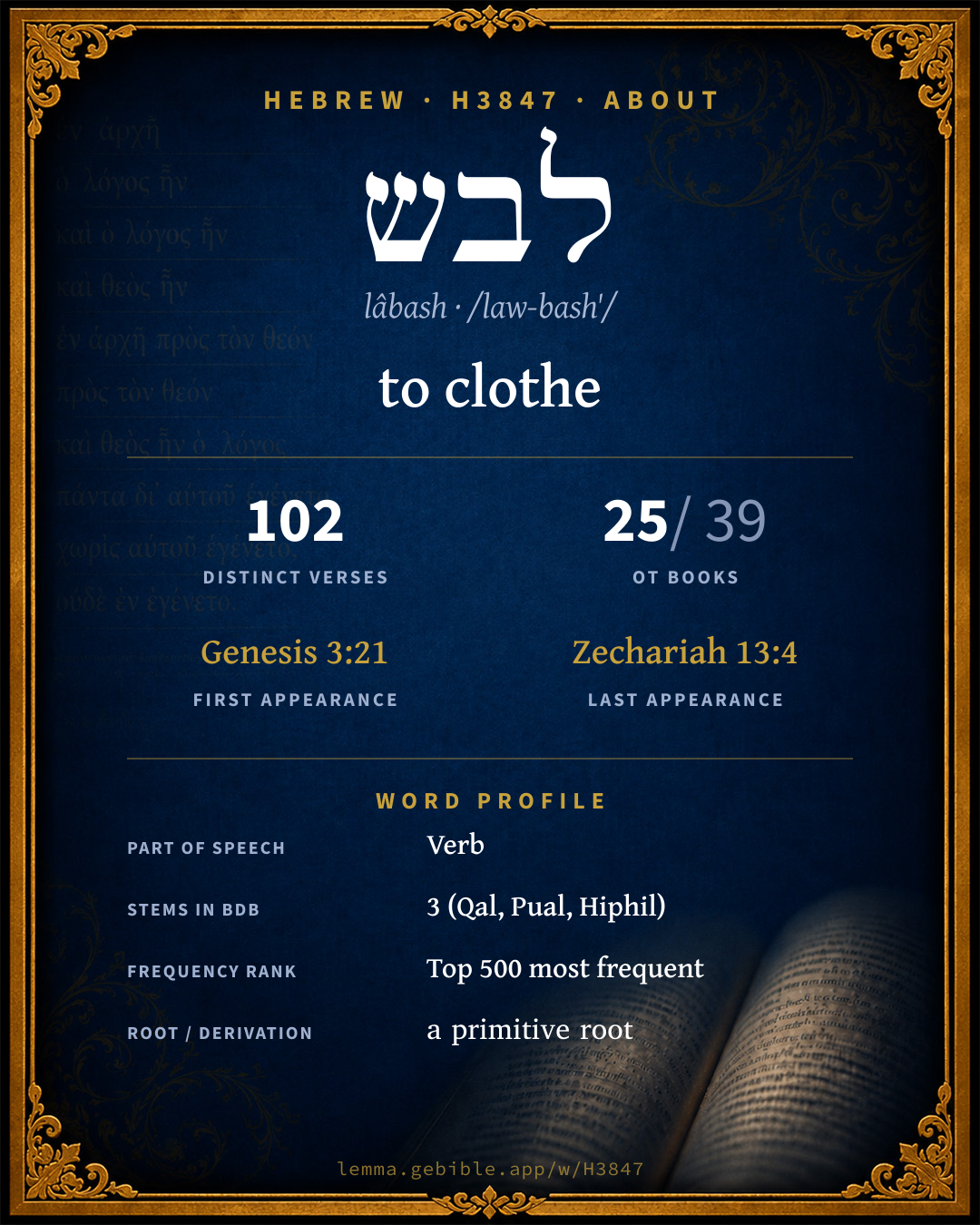
לָבֵשׁ
to clothe
‘to clothe’ is one of 3 main senses fuller range ↓
Full lexicon entry — Brown-Driver-Briggs (BDB)
From Brown-Driver-Briggs (BDB)
Where this word appears
See every Hiphil verb in the Hebrew Bible →
Grammar key — what these labels mean
Part of speech
- Verb
- An action or state-of-being word.
- Adjective
- A word that describes or qualifies a noun.
Stem
- Qal
- The basic, simple active stem — the plain form of the verb (“he wrote”). Here: ‘lit. put on’
- Hiphil
- The causative active stem (“he caused / brought about”). Here: ‘c. 2 acc.’
- Pual
- The passive counterpart of the Piel. Here: ‘only Pt. pl.’
Form
- Imperfect
- An incomplete, ongoing, or future action (“he will / would write”).
- Sequential Imperfect
- An imperfect with prefixed waw — the standard past-narrative form (waw-consecutive imperfect).
- Participle Passive
- A verbal adjective expressing action received (“written”).
- Perfect
- A completed action or state — Hebrew marks aspect (completeness) more than strict tense (“he wrote”).
- Sequential Perfect
- A perfect with prefixed waw continuing a preceding imperfect or command (waw-consecutive perfect).
- Imperative
- A direct command (“write!”).
- Infinitive Construct
- A bound verbal noun, frequently with prepositions (“to write / in writing”).
- Infinitive Absolute
- An unbound verbal noun, often intensifying or standing in for a finite verb.
- Participle Active
- A verbal adjective expressing ongoing or characteristic action (“writing / one who writes”).
- Jussive
- A third- or second-person volitional form expressing wish or command (“let him write”).
State
- Absolute
- The independent form of a noun, not bound to a following word.
- Construct
- A noun bound to a following noun in a possessive / “of” relationship (the construct chain).
Person
- 3rd Person
- The one spoken about (“he / she / it / they”).
- 2nd Person
- The one addressed (“you”).
- 1st Person
- The speaker (“I / we”).
Gender
- Masculine
- Grammatically masculine.
- Common
- Either gender — not distinguished for this form.
- Feminine
- Grammatically feminine.
Number
- Plural
- More than one (in Hebrew, generally three or more).
- Singular
- One.
Every verse where H3847 appears in the Book of Esther — 6 distinct verses. Click any verse to open its interlinear word-by-word view. Verse text shown in the World English Bible for context — . Each verse’s Hebrew form is shown with its reference; the English is not keyword-highlighted, since the data carries no word-level English alignment. Use “Compare translations” on any verse to read it across multiple English versions. This concordance covers the Hebrew Bible; Septuagint (Greek Old Testament) occurrences are not indexed here.
Esther
- Esther 4:1 וַ/יִּלְבַּ֥שׁ conj + Qal wimpf 3ms Now when Mordecai knew all that was done, Mordecai tore his clothes, and put on sackcloth with ashes, and went out into the midst of the city, and cried with a loud and a bitter cry;
- Esther 4:4 לְ/הַלְבִּ֣ישׁ prep + Hiphil inf.cs Esther's maidens and her chamberlains came and told it her; and the queen was exceedingly grieved: and she sent clothing to clothe Mordecai, and to take his sackcloth from off him; but he didn't receive it.
- Esther 5:1 וַ/תִּלְבַּ֤שׁ conj + Qal wimpf 3fs Now it happened on the third day, that Esther put on her royal clothing, and stood in the inner court of the king's house, over against the king's house: and the king sat on his royal throne in the royal house, over against the entrance of the house.
- Esther 6:8 לָֽבַשׁ Qal pf 3ms let royal clothing be brought which the king uses to wear, and the horse that the king rides on, and on the head of which a crown royal is set:
- Esther 6:9 וְ/הִלְבִּ֨ישׁוּ֙ conj + Hiphil wpf 3cp and let the clothing and the horse be delivered to the hand of one of the king's most noble princes, that they may array the man therewith whom the king delights to honor, and cause him to ride on horseback through the street of the city, and proclaim before him, Thus shall it be done to the man whom the king delights to honor.
- Esther 6:11 וַ/יַּלְבֵּ֖שׁ conj + Hiphil wimpf 3ms Then took Haman the clothing and the horse, and arrayed Mordecai, and caused him to ride through the street of the city, and proclaimed before him, Thus shall it be done to the man whom the king delights to honor.
About this entry
At a glance — auto-summarized from this page’s data, not written by a person. Every figure links to its source below. This summary describes the numbers; it doesn’t interpret them.
לבש (lâbash) is a Hebrew verb most often rendered “to clothe.” Debuting at Genesis 3:21, it then recurs through the corpus. The Hebrew Bible uses it across 102 verses — common. Different stems carry different senses — BDB groups them under 3 stems, among them Qal and Pual. Related forms include לבוש, לבש and מלבוש. The sections below give every sense, occurrence, and version rendering.
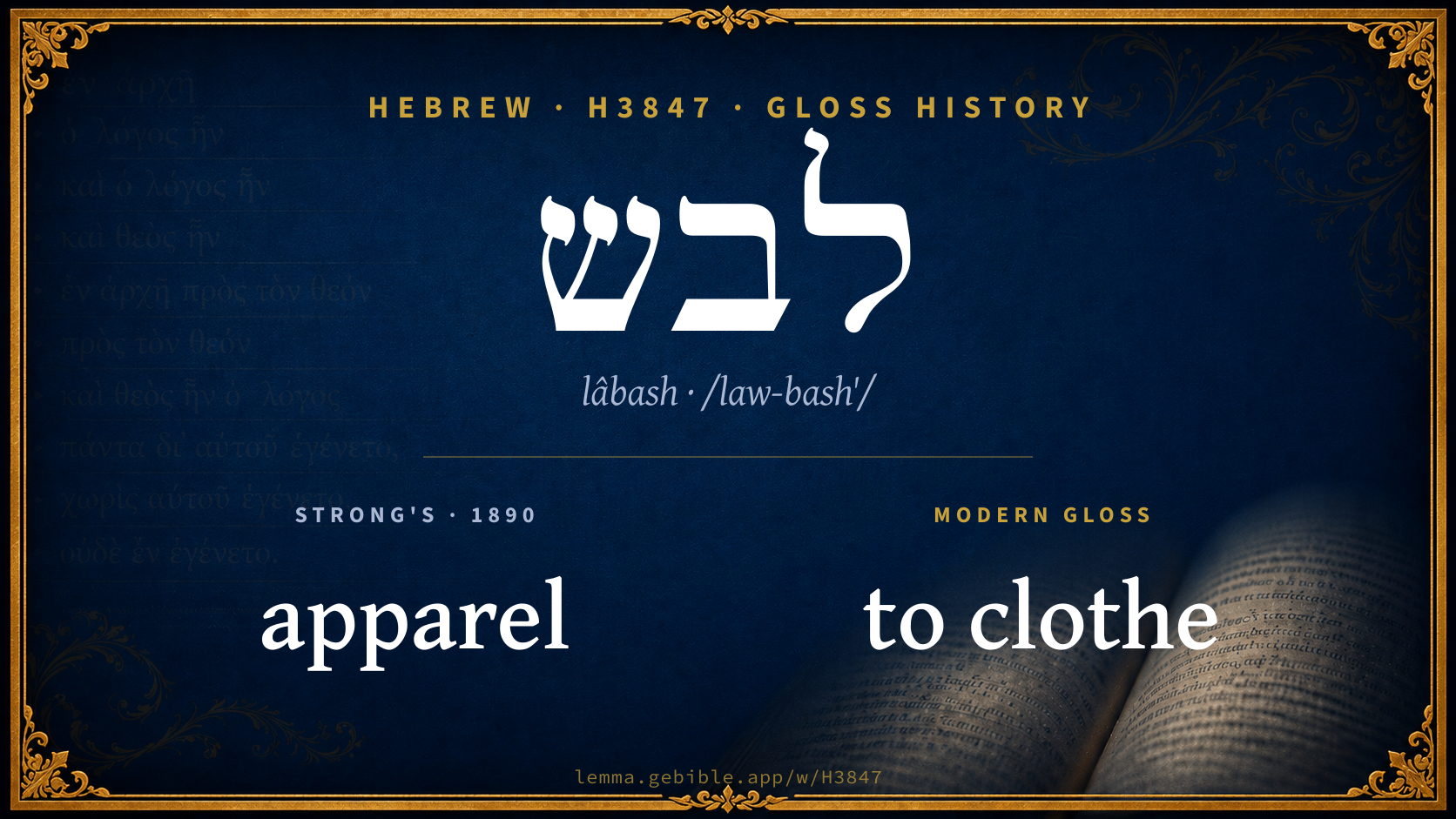
Gloss history
Strong's 1890 vs modern scholarship
About this word
Strong's H3847 catalogs a Hebrew word from the Hebrew Old Testament.
These counts are not copied from any lexicon or concordance. They are computed here, from the morphology-tagged Hebrew Old Testament. What Lemma adds →
- 102
- distinct verses
- The word appears in 102 distinct verses.
- 25 / 39
- OT books
- The word appears in 25 of 39 Old Testament books.
- #390
- by frequency
- Top 500 most frequent Hebrew words (rank 390 of 8,640 Hebrew words by occurrence).
View all 102 occurrences in the concordance →
By section of the Old Testament
By traditional corpus
Conventional, traditional groupings — biblical authorship is debated, so this is a traditional corpus grouping, not an authorship claim. Each share is this word’s portion of its verses in that division of the Hebrew canon. Each figure is a share of the word’s 102 distinct verses.
- Prophets (Nevi'im) 41 verses · 40%
- Writings (Ketuvim) 36 verses · 35%
- Torah (Pentateuch) 25 verses · 25%
How translations render this word
Counts come from each version’s own published word-to-Strong’s tagging or interlinear alignment — an approximate guide to how each version renders this word, not a word-level alignment the data otherwise carries. Because each total is that version’s own tagged count, the per-version totals vary from one another and need not match the appearance or distinct-verse counts above. These counts may also differ from a printed concordance because Lemma counts each distinctly tagged rendering and does not collapse phrase taggings into a single head-word total. This is a fixed set of word-tagged versions (KJV, ASV, BSB, ULT) and does not change with the reading translation you choose elsewhere. Each version’s license is shown beside its name below (and on Sources).
- King James Version: Clothed 14×, Put on 11×, Put 9×
- American Standard Version: Clothed 14×, Put 9×, Put on 9×
- Berean Standard Bible: Clothed 10×, Dressed 10×, Put on 9×
- unfoldingWord Literal Text: Put on 12×, Clothed 9×, Wear 7×
King James Version Public Domain
Renders H3847 across 111 tagged occurrences — most commonly:
Plus other, less common renderings. Plus 51 renderings that appear only once — usually multi-word phrases or single function words the recovered tagging swept in, not distinct renderings. Not rendered by a distinct English word in 1 further occurrence.
American Standard Version Public Domain
Renders H3847 across 111 tagged occurrences — most commonly:
Plus other, less common renderings. Plus 51 renderings that appear only once — usually multi-word phrases or single function words the recovered tagging swept in, not distinct renderings.
Berean Standard Bible Public Domain
Renders H3847 across 109 tagged occurrences — most commonly:
Plus 50 renderings that appear only once — usually multi-word phrases or single function words the recovered tagging swept in, not distinct renderings. Not rendered by a distinct English word in 1 further occurrence.
unfoldingWord Literal Text CC BY-SA 4.0
Renders H3847 across 124 tagged occurrences — most commonly:
Plus other, less common renderings. Plus 54 renderings that appear only once — usually multi-word phrases or single function words the recovered tagging swept in, not distinct renderings.
14 senses and sub-senses in the full BDB
Hebrew verbs can shift meaning by stem (binyan): Qal is the basic action, Niphal is often passive or reflexive, Piel often intensifies or makes it factitive, and Hiphil is typically causative. The senses below are grouped under the stem BDB assigns to each. This entry also uses Pual (the passive of Piel).
What do BDB’s symbols mean?
BDB uses these scholarly abbreviations:
| Symbol | Meaning |
|---|---|
| 𝔊 | the Septuagint (the ancient Greek translation, LXX) |
| 𝔙 | the Vulgate (the Latin translation) |
| 𝔖 | the Syriac version (the Peshitta) |
| 𝔗 | the Targum (the Aramaic translation) |
| ψ | the Psalms |
| √ | root (the underlying root or stem) |
| ‖ | parallel passage (a synonymous or contrasted parallel) |
| † | the dagger: every passage where the word occurs is cited |
The 14 senses and sub-senses the full Brown-Driver-Briggs lexicon distinguishes for this word, in lexicon order (not ranked by frequency), with BDB’s own verbatim wording and sub-sense lettering. Shown in Hebrew script with BDB’s own scholarly abbreviations. The condensed entry is in the Lexicon Entry tab. See also the Forms in the corpus table below.
Qal
- Pf. 3 m.s. לָבֵ֣שׁ, לָ֫בֵ֥שׁ ψ 93:1; לָ֮בַ֤שׁ Jb 7:5 + 2 times; וְלָבַשׁ (cons.) Lv 6:3 + 3 times; sf. וּלְבֵשָׁם (cons.) Lv 16:4; 3 fs. לָֽבְשָׁה Ju 6:34 + 2 times, etc. (Ez 42:14 read prob. וְלָֽבְשׁוּ Qr, for ילבשׁו Kt, but cl. perhaps interpol., v. Co); Impf. 3 ms. יִלְבַּשׁ Dt 22:5 +; sf. וַיִּלְבָּשֵׁנִי Jb 29:14, יִלְבָּשָׁם Ex 29:30; 1 s. sf. אֶלְבָּשֶׁ֑נָּה Ct 5:3; 3 fpl. תִּלְבַּשְׁןָ 2 S 13:18, etc.; Imv. ms. לְבַשׁ 1 K 22:30, etc.; Inf. abs. לָבוֹשׁ Hg 1:6; cstr. לִלְבֹּשׁ Gn 28:20 Lv 21:10; Pt. act. pl. הַלֹּבְשִׁים Zp 1:8; pass. abs. לָבוּשׁ 1 S 17:5; Dn 10:5; לָבֻשׁ Ez 9:2 + 3 times; cstr. לְבוּשׁ Dn 12:6, 7, לְבֻשׁ Ez 9:11 + 3 times; pl. cstr. לְבֻשֵׁי Ez 23:6 + 2 times;— e.g. Psalms 93:1
- a. lit. put on (one’s own) garment (acc.) Gn 38:19; 1 S 28:8; 2 S 14:2; 1 K 22:30 = 2 Ch 18:29, Ex 29:30; Lv 6:3, 4; 16:4(×2), 23, 24, 32; 21:10; Dt 22:5; Ez 44:17, 19, and so 42:14 Qr (v. supr.), Jon 3:5; Ct 5:3; Est 4:1; 5:1; c. acc. garment + עַל־בְּשָׂרוֹ Lv 16:3; of putting on armour Je 46:4; = wear (more or less habitually), c. acc. of garment, Is 4:1; Dt 22:11; Zp 1:8; Zc 13:4; of Jerus. under fig. of woman Je 4:30, of rulers under fig. of shepherds Ez 34:3, cf. כֵּן תִּלְבַּשְׁןָ 2 S 13:18 (no acc.) e.g. Genesis 38:19
- b. very often fig., put on, be clothed with, c. acc. of garment;—לָבַשׁ בְּשָׂרִי רִמָּה Jb 7:5 my flesh is clothed (i.e. covered) with worms; of Jerus., be clothed with inhabitants Is 49:18; of pasture, with flocks ψ 65:14; more often the garment is some abstract quality, e.g. righteousness, majesty, beauty, strength, etc.;—וַיִּלְבַּשׁ צְדָקָה כַּשִּׁרְיָן Is 59:17 he (י׳) hath put on righteousness as a breastplate, cf. v 17 (vengeance), ψ 93:1 (majesty), v 1 (strength), 104:1 (honour and majesty), Is 51:9 (strength); also Jb 40:10; said of men, 2 Ch 6:41 (salvation), ψ 132:9 (righteousness), Jb 29:14 (id.); of Zion Is 52:1(×2); also in bad sense, clothed with terror, trembling, shame, etc., Ez 7:27; 26:16; Jb 8:22; ψ 35:26; 109:29, cf. v 18 (cursing). e.g. Job 7:5
- c. lit. put on, obj. om., נָתַן … בֶּגֶד לִלְבּשׁ Gn 28:20 Jb 27:17; Inf. abs. לָבוֹשׁ Hg 1:6 (there is) a clothing, but he has nothing for warmth. e.g. Genesis 28:20
- d. once c. בְּ, לְבוּשׁ … אֲשֶׁר לָבַשׁ בּוֹ Est 6:8. e.g. Esther 6:8
- e. Pt. pass., clothed with, chiefly Ezek.;—c. acc. of garment, Ez 9:2, 3; Zc 3:3; Pr 31:21; Dn 10:5; of wearing armour 1 S 17:5; cstr. before garment, לְבֻשׁ הַבַּדִּים Ez 9:11; 10:2, 6, 7, cf. 23:6, 12; 38:4; Dn 12:6, 7. e.g. Ezekiel 9:2
- f. fig.:—וְרוּחַ י׳ לָֽבְשָׁה אֶת־גִּדְע֑וֹן Ju 6:34 and the spirit of י׳ clothed itself with Gideon, i.e. (GFM) took possession of him (cf. ܠܒܺܝܫ possessed); so 1 Ch 12:18; 2 Ch 24:20; צֶדֶק לָבַשְׁתִּי וַיִּלְבָּשֵׁנִי Jb 29:14 and it clothed itself in me, as it were, became incarnate in me. e.g. Judges 6:34
Pual
- only Pt. pl. מְלֻבָּשִׁים arrayed, c. acc. of garment 1 K 22:10 = 2 Ch 18:9, 2 Ch 5:12; abs. in full apparel Ezr 3:10. e.g. 1 Kings 22:10
Hiphil
- Pf. 3 ms. sf. הִלְבִּישַׁנִי Is 61:10; 3 fs. הִלְבִּישָׁה Gn 27:16; 2 ms. וְהִלְבַּשְׁתָּ֫ Ex 28:41 + 3 times; sf. וְהִלְבַּשְׁתָּם (consec.) Ex 29:8; Nu 20:26; 1 s. sf. וְהִלְבַּשְׁתִּיו Is 22:21; 3 pl. הִלְבִּישׁוּ 2 Ch 28:15, וְהִלְבִּשׁוּ (consec.) Est 6:9; Impf. 3 ms. וַיַּלְבֵּשׁ Gn 41:42 + 5 times; sf. וַיַּלְבִּשֵׁם Gn 3:21; Lv 8:13; 3 fs. תַּלְבִּישׁ Pr 23:21, etc.; Inf. abs. הַלְבֵּשׁ Zc 3:4; cstr. הַלְבִּישׁ Est 4:4; Pt. sf. הַמַּלְבִּֽשְׁכֶּם 1 S 1:24;—clothe, array with. e.g. Isaiah 61:10
- 1. usually c. 2 acc.,
- a. lit. וַיּלְבֵּשׁ אֹתוֹ בִּגְדֵי־שֵׁשׁ Gn 41:42; 2 S 1:24; Is 22:21; Ex 28:41; 29:5, 8; 40:13, 14 Lv 8:7, 13 Nu 20:26, 28 Zc 3:4, 5; of clothing Jerus. under fig. of infant Ez 16:10; of putting armour on some one 1 S 17:38(×2). e.g. Genesis 41:42
- b. fig., Jb 10:11 thou hast clothed me with skin and flesh; cf. 39:19 (quivering of horse’s neck); Is 50:3; 61:10; ψ 132:16, 18. e.g. Job 10:11
- 2. c. acc. garment only, Gn 27:16 (+ עַל־יָדָיו); fig., Pr 23:21. e.g. Genesis 27:16
- 3. c. acc. pers. only Gn 3:21; 27:15 2 Ch 28:15(×2) Est 4:4; 6:9, 11. e.g. Genesis 3:21
Senses from the full Brown-Driver-Briggs lexicon (Brown, Driver, Briggs; Oxford 1906 — public domain), digitized via Sefaria, supplemented by the OpenScriptures HebrewLexicon (CC BY 4.0). Full attribution on Sources.
Word origin
vb. put on (a garment), wear, clothe, be clothed (NH id.; Aramaic לִבֵישׁ ܠܒܶܫ; Assyrian labâšu; Arabic لَبِسَ; Ethiopic ለብሰ );
— Brown-Driver-Briggs (Oxford 1906, public domain), digitized via Sefaria, supplemented by the OpenScriptures HebrewLexicon (CC BY 4.0). See Sources.
Origin: a primitive root
Jastrow Dictionary
A second Hebrew/Aramaic lexicon for comparison, covering Aramaic and post-biblical (Talmudic, Targumic, Midrashic) usage that the biblical-Hebrew BDB does not. Matched by lemma rather than by Strong’s number, so a lemma may carry more than one Jastrow headword (shown separately below), and the entries cover usage well beyond the Bible.
לָבַשׁ
- (b. h.) [to join closely; denom. לְבוּשׁ garment, whence] לָבֵשׁ, לָבַשׁ to be dressed; to put on (an undergarment), contrad. to עטף, כסה. Y. R. Hash. I, 57ᵇ top אדם … לוֹבֵשׁ שחורים ומתעטף וכ׳ a defendant before a human court puts on dark clothes and wraps himself in dark clothes, …; אבל ישראל אינו כן אלא לוֹבְשִׁים וכ׳ but not so the Israelites (on the New Year), but they put on white (festive) clothes &c. M. Kat. 17ᵃ יִלְבַּשׁ שחורים ויתעטף וכ׳ let him put on dark clothes &c.; Kidd. 40ᵃ; Ḥag. 16ᵃ.—Gen. R. s. 75 לוֹבְשֵׁי ברזל; Yalk. ib. 130 לְבוּשֵׁי, v. בַּרְזֶל. Ex. R. s. 15 בריאים כדי לִלְבּוֹשׁ וכ׳ strong enough to wear helmets &c.; a. fr.—Part. pass. לָבוּשׁ, pl. לְבוּשִׁים. Ib. אחד ערום ואחד ל׳ one (the depth) was naked, the other (the earth) was covered (with water). Pesik. Aḥăré, p. 177ᵇ ל׳ לבנים וכ׳ clad in white and wrapped in white. Yalk. Gen. 130, v. supra; a. fr.
- to invest; part. pass. מְלוּבָּשׁ. B. Bath. 122ᵃ מל׳ אורים וכ׳ invested with the Urim and Tummim. Tosef. Ohol. XIII, 5 [read with R. S. to Ohol. XII, 4) מלבין שׁהוא מלובש בפיקות a bed frame upholstered with tufts.
- to clothe, invest. Ex. R. l. c. הפשיט … והִלְבִּישָׁהּ לחבירו he caused one slave to take off his garment and the other to put it on. Sot. 14ᵃ מה הוא מַלְבִּישׁ … אף אתה הַלְבֵּשׁ וכ׳ as He clothes the naked …, so do thou &c. Tanḥ. Ḥayé 3 ומַלְבִּישָׁן כלי זיין וכ׳ (not ומלביש) and clothes them in armor &c. Ib. (ref. to Ps. CIV, 1) זה העוז שהִלְבַּשְׁתִּיךָ בים that is the strength with which I invested thee at the Red Sea. Ib. מהודך והדרך הִלְבַּשְׁתָּ לראשו וכ׳ part of thy glory and majesty hast thou put on Abraham’s head by granting him the dignity of old age. Yoma 5ᵇ כיצד הִלְבִּישָׁן in what order did Moses clothe them?—Y. Shek. V, 49ᵃ (expl. פנחס המַלְבִּישׁ, ib. V, 1, Mish. ed. על המלבוש) שהיה מַלְבִּישׁ בגדי וכ׳ he invested (the appointed person) with (had in charge) the high priest’s garments; a. fr. e.g. Psalms 104:1
לְבֵשׁ
- Targ. Gen. XXXVIII, 19; a. fr.—Part. לְבִישׁ, לָבִישׁ. Targ. Job XXVII, 17. Targ. Ez. IX, 2; a. fr.—Ber. 28ᵃ מאן דלביש מדא יִלְבַּשׁ מדא ומאן … ואנא אַלְבְּשֵׁיה let him who has been invested with the priest’s cloak wear it; or shall he who is not invested say to him who has been, take off thy cloak, and I will put it on?; i.e. let us respect the hereditary office of the Nasi, v. מַזֶּה. Keth. 54ᵃ לְבִישְׁתִּינְהוּ ואיכסתינהו לכוליה מנא she put on all her dresses and wraps. Sabb. 10ᵇ [read:] מֵילָתָא אַלְּבִישַׁיְיהוּ יקירן (v. Rabb. D. S. a. l. note 30) cloaks are precious on those who are invested with them, i.e. a pupil likes to quote his teacher; a. fr.
- 1. same. Targ. Ps. XCIII, 1; a. e.—Ber. l. c. Ms. M. אַלְבְּשִׁינֵיה, v. supra.
- 2. to clothe. Targ. Ps. CXXXII, 16. Targ. Job XXIX, 14 ואַלְבְּשִׁנָנִי and it clothed (protected) me; a. e.—Kidd. 30ᵇ ונַלְבִּישָׁהּ ונכסייה (not ולבשייה) and let him clothe and cover her. Y. Keth. XII, 35ᵃ top אַלְבְּשׁוּנִי; Y. Kil. IX, 32ᵇ top מלבשוני (corr. acc.), v. בּוּרְדִּיקָא. Tam. 32ᵃ; a. e.—Trnsf. to take hold of, seize. Kidd. 81ᵇ יצר אַלְבְּשָׁהּ (her bashfulness in the presence of her father is a sign that) sensuality has seized her; Keth. 51ᵇ יצר אלבשה passion has overpowered her (she speaks under the influence of sensual excitement).
A Dictionary of the Targumim, the Talmud Babli and Yerushalmi, and the Midrashic Literature (Marcus Jastrow; London, Luzac, 1903) — Public Domain. Digitized via Sefaria. Digitized via Sefaria. Full attribution on Sources.
Forms in the corpus
The 96 distinct written forms H3847 takes in the Hebrew Bible, most frequent first — each parse links to that stem’s occurrences in the concordance. Hebrew forms include their vowel points and cantillation, so a single lemma takes many written forms.
The 60 most common forms are shown; 36 rarer forms follow in the full concordance.
Same root — word family
Other BDB entries built from the same root as H3847, grouped by Strong’s listed origin. These share a root / origin per the lexicon — not necessarily a shared meaning. Each links to that word’s own entry.
Derived from this word
- לבוש lᵉbûwsh H3830 clothing
- לבש lᵉbash H3848 to be clothed
- מלבוש malbûwsh H4403 clothing
- תלבשת talbôsheth H8516 garment
Compare all same-root words → Showing 4 of 5 — not the complete family. They share a root, not necessarily a meaning.
Septuagint verse parallels
This word appears in 95 verses that also exist in the Greek Old Testament (Septuagint), out of the 102 Hebrew verses it occurs in. You can read those verses in Greek by switching the Old Testament edition to the Septuagint.
Read these verses in the Septuagint
- Genesis 3:21
- Exodus 28:41
- Leviticus 6:10
- Numbers 20:26
- Deuteronomy 22:5
- Judges 6:34
- 1 Samuel 17:5
- 2 Samuel 1:24
- 1 Kings 22:10
- 1 Chronicles 12:18
- 2 Chronicles 5:12
- Ezra 3:10
This is a verse-level parallel only — the same verses exist in both the Hebrew and Greek Old Testaments. No word-level Hebrew↔Greek correspondence is claimed: the data carries no such alignment, so no Greek word is shown as this Hebrew word’s translation. Coverage is not total — the Septuagint omits the deuterocanon and renumbers the Psalms, so some Hebrew verses have no direct Greek parallel.