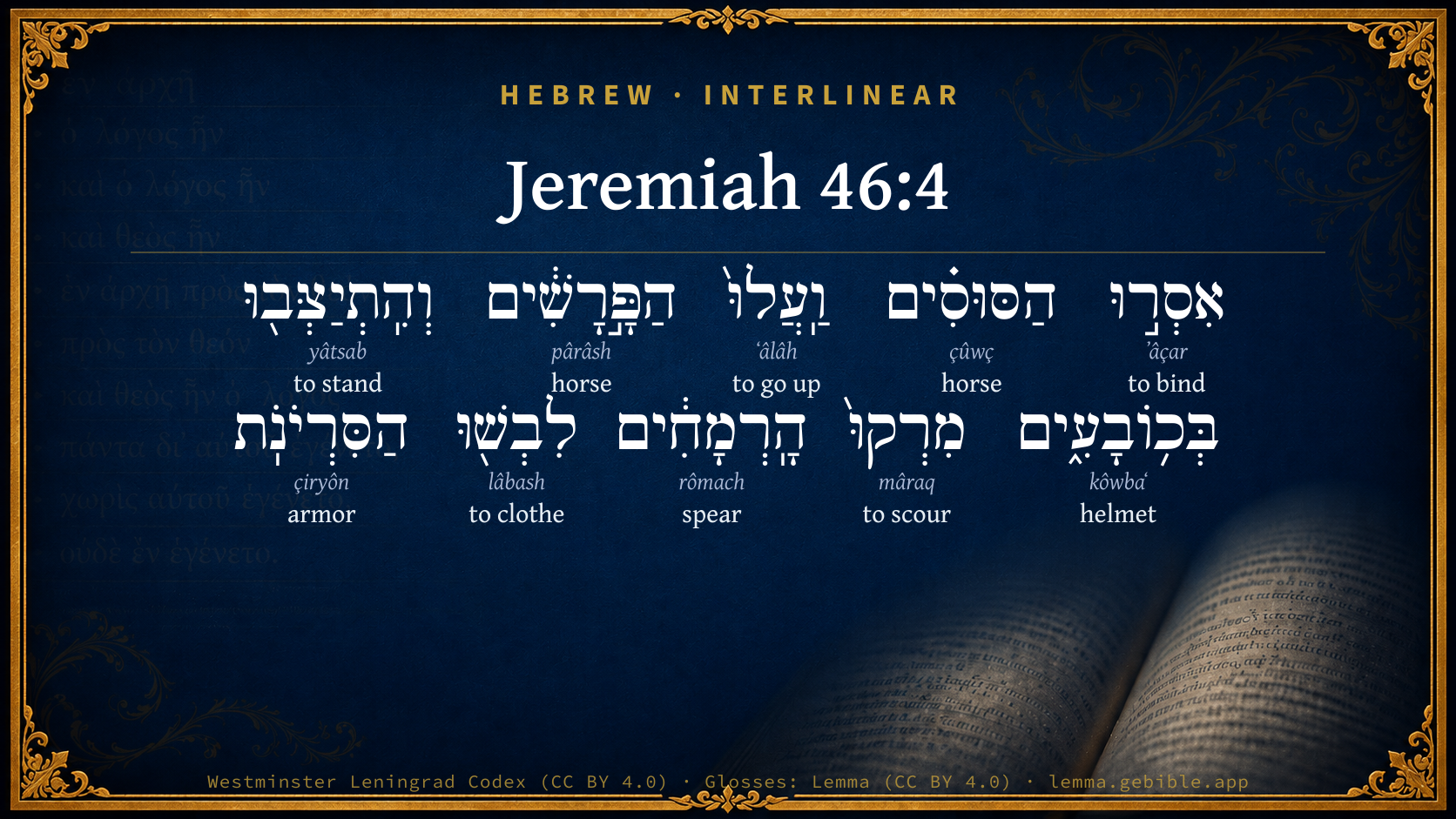
Jeremiah 46:4

Hebrew (Westminster Leningrad Codex) Jeremiah 46:4 appears in the Hebrew Old Testament. The text above is from the Westminster Leningrad Codex. Each word links to its Strong’s number, a concise gloss, and parsing drawn from the Open Scriptures Hebrew Bible morphology. Click any word for its full Brown-Driver-Briggs (BDB) entry.
Download image
Cite this verse

Jeremiah 46:4 (World English Bible). Public Domain. Lemma interlinear Bible study tool, https://lemma.gebible.app/v/jeremiah/46/4.

Show BibTeX & RIS
BibTeX
RIS
English Translation
Harness the horses, and get up, you horsemen, and stand forth with your helmets; furbish the spears, put on the coats of mail.
World English Bible · Public Domain
Highlights
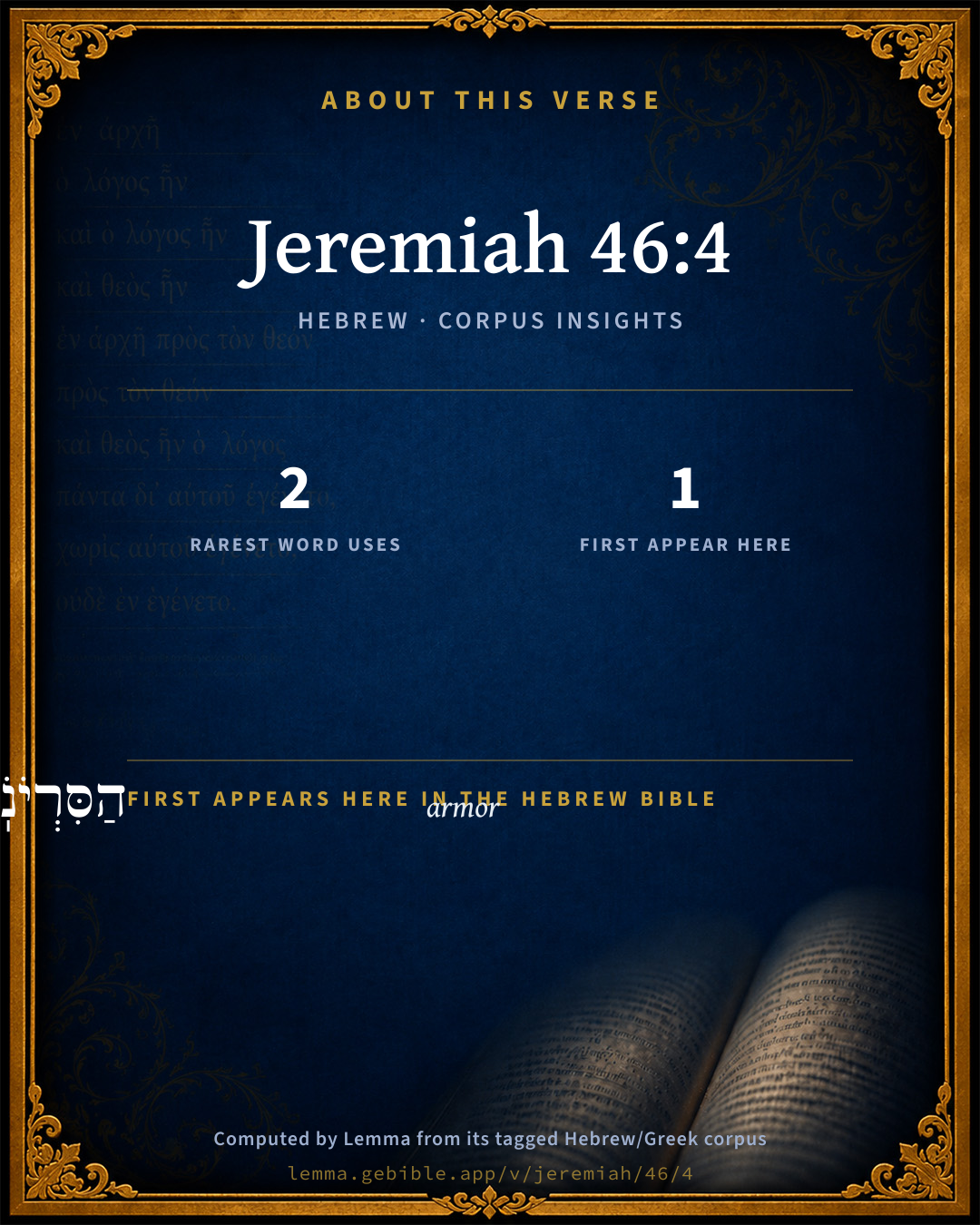
  • 1 first appearance in the Hebrew Bible
Full analysis ↓
Download a study sheet

One document with this verse’s original text, its word-by-word gloss line, the meaning frame, cross-references with their text, attributed commentary, and full source and license credits — printable, and it pastes into notes with its structure intact.

This verse Autodidact and up

Study sheet (.html) Plain text (.txt)

A passage Seminary Student

Up to 50 verses in one chapter. A passage sheet keeps up to 6 commentary sources and 12 cross-references per verse, in the order this page ranks them, and says so on the sheet whenever that leaves anything out. Ask for a single verse and you get the Autodidact verse sheet above.

Everything on this page stays free to read, with no account — the sheet is a download of what is already on screen, not access to it.

Want to remove ads? Support Godless Engineer
Compare translations 3

The same verse in 3 English versions, stacked beneath the original-language interlinear above. Click any original word for its lexicon entry.

Each is an independent rendering of the whole verse — the interlinear is not word-aligned to these translations.

Highlighted words mark where these versions differ — a whole-verse word diff, not a word-by-word alignment.

  • World English Bible Public Domain
    Harness the horses, and get up, you horsemen, and stand forth with your helmets; furbish the spears, put on the coats of mail.
  • King James Version Public Domain
    Harness the horses; and get up, ye horsemen, and stand forth with your helmets; furbish the spears, and put on the brigandines.
  • unfoldingWord Literal Text CC BY-SA 4.0
    Put the harness on the horses; mount up on the horses and take your stand with your helmets on; polish the spears and put on your armor.

unfoldingWord Literal Text — © unfoldingWord, licensed CC BY-SA 4.0. Word-aligned USFM3 via Door43 (git.door43.org/unfoldingWord/en_ult).

Versions to compare (up to 4)

3 of 4 selected

Show all 18 translations

Every available English version of this verse, each an independent rendering of the whole verse.

  • World English Bible Public Domain
    Harness the horses, and get up, you horsemen, and stand forth with your helmets; furbish the spears, put on the coats of mail.
  • Berean Standard Bible Public Domain
    Harness the horses; mount the steeds; take your positions with helmets on! Polish your spears; put on armor!
  • Majority Standard Bible Public Domain
    Harness the horses; mount the steeds; take your positions with helmets on! Polish your spears; put on armor!
  • King James Version Public Domain
    Harness the horses; and get up, ye horsemen, and stand forth with your helmets; furbish the spears, and put on the brigandines.
  • American Standard Version (1901) Public Domain
    Harness the horses, and get up, ye horsemen, and stand forth with your helmets; furbish the spears, put on the coats of mail.
  • Revised Version (1885) Public Domain
    Harness the horses, and get up, ye horsemen, and stand forth with your helmets; furbish the spears, put on the coats of mail.
  • Geneva Bible (1599) Public Domain
    Make readie the horses, and let the horsemen get vp, and stande vp with your sallets, fourbish the speares, and put on the brigandines.
  • Douay-Rheims (1899) Public Domain
    Harness the horses, and get up, ye horsemen: stand forth with helmets, furbish the spears, put on coats of mail.
  • Young's Literal Translation Public Domain
    Gird the horses, and go up, ye horsemen, And station yourselves with helmets, Polish the javelins, put on the coats of mail.
  • Literal Standard Version CC BY-SA 4.0
    Gird the horses, and go up, you horsemen, || And station yourselves with helmets, || Polish the javelins, put on the coats of mail.
  • Unlocked Literal Bible CC BY-SA 4.0
    Put the harness on the horses; mount up on the horses and take your stand with your helmets on; polish the spears and put on your armor.
  • unfoldingWord Literal Text CC BY-SA 4.0
    Put the harness on the horses; mount up on the horses and take your stand with your helmets on; polish the spears and put on your armor.
  • Darby Bible Public Domain
    Harness the horses, and mount ye horsemen, and stand forth with helmets; polish the spears, put on the coats of mail!
  • World Messianic Bible Public Domain
    Harness the horses, and get up, you horsemen, and stand up with your helmets. Polish the spears, put on the coats of mail.
  • Webster's Bible Public Domain
    Harness the horses; and mount, ye horsemen, and stand forth with your helmets; furbish the spears, and put on the coats of mail.
  • Free Bible Version CC BY-SA 4.0
    Put the harnesses on the horses and get into your chariots; take your positions with your helmets on! Sharpen your spears; put on your armor!
  • Bible in Basic English Public Domain
    Make the horses ready, and get up, you horsemen, and take your places with your head-dresses; make the spears sharp and put on the breastplates.
  • JPS Tanakh (1917) Public Domain
    Harness the horses, and mount, ye horsemen, and stand forth with your helmets; furbish the spears, put on the coats of mail.

Literal Standard Version (2020), Covenant Press — licensed CC BY-SA 4.0. Text via the HelloAO Bible API (eBible.org). Unlocked Literal Bible (unfoldingWord) — licensed CC BY-SA 4.0. Text via the HelloAO Bible API (eBible.org). unfoldingWord Literal Text — © unfoldingWord, licensed CC BY-SA 4.0. Word-aligned USFM3 via Door43 (git.door43.org/unfoldingWord/en_ult). Free Bible Version, Dr. Jonathan Gallagher — licensed CC BY-SA 4.0. Text via the HelloAO Bible API (eBible.org).

Word by word

More ways to search: Search by grammar → Find every occurrence → Compare this word →

Practice this passage: Drill this verse → Learn its vocabulary →

הַסִּרְיֹנֹֽת
çiryôn
H5630
“the · armor”
Particle, Definite Article + Noun, Common, Masculine, Plural, Absolute
Part of Speech
Particle + Noun
Type
Common
Gender
Masculine
Number
Plural
State
Absolute
Full BDB Definition

Origin: for H8302

TWOT: 1544

armour
  1. אִסְר֣וּ ʼâçar H631 “bind” Verb, Qal, Imperative, 2nd Person, Masculine, Plural
  2. הַסּוּסִ֗ים çûwç H5483 “the · horses” Particle, Definite Article + Noun, Common, Masculine, Plural, Absolute
  3. וַֽעֲלוּ֙ ʻâlâh H5927 “and · go up” Conjunction + Verb, Qal, Imperative, 2nd Person, Masculine, Plural
  4. הַפָּ֣רָשִׁ֔ים pârâsh H6571 “the · horses” Particle, Definite Article + Noun, Common, Masculine, Plural, Absolute
  5. וְהִֽתְיַצְּב֖וּ yâtsab H3320 “and · stand” Conjunction + Verb, Hithpael, Imperative, 2nd Person, Masculine, Plural
  6. בְּכ֥וֹבָעִ֑ים kôwbaʻ H3553 “in/at · helmets” Preposition + Noun, Common, Masculine, Plural, Absolute
  7. מִרְקוּ֙ mâraq H4838 “scour” Verb, Qal, Imperative, 2nd Person, Masculine, Plural
  8. הָֽרְמָחִ֔ים rômach H7420 “the · spears” Particle, Definite Article + Noun, Common, Masculine, Plural, Absolute
  9. לִבְשׁ֖וּ lâbash H3847 “clothe” Verb, Qal, Imperative, 2nd Person, Masculine, Plural

About this verse

These counts appear in no published source. They are computed here, from the morphology-tagged text and Lemma’s own curated glosses. What Lemma adds →

10
words
10
distinct lemmas
Prophets
section

Notable vocabulary

The rarest word here is הַסִּרְיֹנֹֽת armor H5630 — appearing just 2 times in the whole Hebrew Bible.

First appearance in Scripture

This word makes its first canonical appearance in the Hebrew Bible here:

  • הַסִּרְיֹנֹֽת armor H5630

Shared distinctive vocabulary

הַסִּרְיֹנֹֽת armor H5630 occurs in 2 verses of the Hebrew Bible. Also found in:

Grammatical profile

  • 5 verbs
  • 5 nouns

Verb forms

  • אִסְר֣וּ Qal · Imperative
  • וַֽעֲלוּ֙ Qal · Imperative
  • וְהִֽתְיַצְּב֖וּ Hithpael · Imperative
  • מִרְקוּ֙ Qal · Imperative
  • לִבְשׁ֖וּ Qal · Imperative

Cross-references

7

Topical passages linked to Jeremiah 46:4 in the Treasury of Scripture Knowledge — connected by theme and wording, ordered by reader-vote popularity; previews shown in the World English Bible.

  • Ezekiel 21:9–11 Son of man, prophesy, and say, Thus says Yahweh: Say, A sword, a sword, it is sharpened, and also furbished;
  • Jeremiah 51:3 Against [him who] bends let the archer bend his bow, and against [him who] lifts himself up in his coat of mail: and don't you spare her young men; destroy you utterly all her host.
  • 1 Samuel 17:5 He had a helmet of brass on his head, and he was clad with a coat of mail; and the weight of the coat was five thousand shekels of brass.
  • 1 Samuel 17:38 Saul clad David with his clothing, and he put a helmet of brass on his head, and he clad him with a coat of mail.
  • 2 Chronicles 26:14 Uzziah prepared for them, even for all the host, shields, and spears, and helmets, and coats of mail, and bows, and stones for slinging.
  • Nehemiah 4:16 It happened from that time forth, that half of my servants worked in the work, and half of them held the spears, the shields, and the bows, and the coats of mail; and the rulers were behind all the house of Judah.
  • Ezekiel 21:28 You, son of man, prophesy, and say, Thus says the Lord Yahweh concerning the children of Ammon, and concerning their reproach; and say you, A sword, a sword is drawn, for the slaughter it is furbished, to cause it to devour, that it may be as lightning;

Cross-references courtesy of OpenBible.info (CC BY 4.0).

Hebrew and Greek witnesses Masoretic Hebrew ↔ Greek Septuagint

The same verse in the two great witnesses to the Old Testament, shown verse-for-verse.

These are two independent witnesses, not word-aligned to each other, and the Septuagint is shown in lemma (dictionary) form.

Hebrew Jeremiah 46:4 Masoretic · Westminster Leningrad Codex

אִסְר֣וּ הַסּוּסִ֗ים וַֽעֲלוּ֙ הַפָּ֣רָשִׁ֔ים וְהִֽתְיַצְּב֖וּ בְּכ֥וֹבָעִ֑ים מִרְקוּ֙ הָֽרְמָחִ֔ים לִבְשׁ֖וּ הַסִּרְיֹנֹֽת

Harness the horses, and get up, you horsemen, and stand forth with your helmets; furbish the spears, put on the coats of mail.

World English Bible · Public Domain

Greek LXX Structure differs

In the Septuagint, Jeremiah is about an eighth shorter than the Hebrew and arranges its material differently — the Oracles Against the Nations (Hebrew chapters 46–51) appear in the middle of the Greek book, after 25:13. Because the chapter and verse boundaries do not line up, a verse-for-verse comparison with the Hebrew is not shown.

A verse-for-verse comparison isn’t shown here because the chapters and verses don’t line up. Switch to the LXX edition with the MT / LXX toggle above to read the Greek directly.

Hebrew: Westminster Leningrad Codex (CC BY 4.0). Greek: Septuagint (public domain); English from a public-domain English Septuagint. How the Septuagint differs from the Hebrew →

Targum (Aramaic paraphrase)

1

The Targum is the ancient Jewish Aramaic paraphrase of the Hebrew Scriptures — an interpretive translation, not the Hebrew text itself. Onkelos (literal) and Pseudo-Jonathan (expansive) render the Torah, and Jonathan the Prophets. Coverage is partial: where no permissively-licensed English translation exists for a verse, only the Aramaic is shown. This is verse-level text, not a word-by-word alignment to the Hebrew.

  1. Targum Jonathan Prophets (Joshua–Malachi)
    טַקִיסוּ סוּסְוָתָא וְיִסְקוּן פָּרָשַׁיָא וְיִתְעַתְּדוּן בְּקוּלְסַיָא צַחְצָחוּ מוּרְנְיָתָא לְבִישׁוּ סִרְיָנַיָא:

    (no public-domain English translation for this verse)

    Targum Jonathan — Aramaic: “Mikraot Gedolot” (public domain). English: “Sefaria Community Translation” (CC0 1.0 (public-domain dedication)); “London "Chaldee Paraphrase," 1871” (public domain). Text via Sefaria.

Commentary

Notes on Jeremiah 46:4 from classic Christian and Jewish commentators (each source and its license shown beneath its notes). The classic Christian expositions comment on the surrounding passage and are grouped to its opening verse, so a note may address several verses; the Jewish commentaries on the Tanakh (Rashi and others) are per-verse, so they appear only where the commentator wrote on this verse.

Lemma curates 59 commentaries, every one of them public domain or Creative Commons licensed, each selected and text-cleaned for this edition rather than reprinted as found. About our sources →

Trapp's Complete Commentary

John Trapp

Jer 46:4 Harness the horses; and get up, ye horsemen, and stand forth with [your] helmets; furbish the spears, [and] put on the brigandines.

Ver. 4. Harness the horses.] Those warlike creatures, but yet vain things for safety. {Psa 33:17 Pro 21:31} Egypt was famous for the best horses; {Deu 17:16 1Ki 10:26; 1Ki 10:28} but the Lord delighteth not in the strength of a horse, &c. {Psa 147:10-11}

John Trapp, A Commentary or Exposition upon All the Books of the Old and New Testament (1647–1656) — public domain. Text from a community e-Sword module.

Jamieson, Fausset & Brown

Robert Jamieson, A. R. Fausset & David Brown

Harness the horses--namely, to the war chariots, for which Egypt was famed (Exo 14:7; Exo 15:4).

get up, ye horsemen--get up into the chariots. MAURER, because of the parallel "horses," translates, "Mount the steeds." But it is rather describing the successive steps in equipping the war chariots; first harness the horses to them, then let the horsemen mount them.

brigandines--cuirasses, or coats of mail.

Jamieson, Fausset & Brown — Commentary Critical and Explanatory on the Whole Bible (1871) — public domain (CC PDM 1.0). Text via the HelloAO Bible API.

Adam Clarke's Commentary

Verse 4. Furbish the spears] Cleanse, brighten, and sharpen them; from the Franco-Gallic fourbir, to polish, brighten.

Brigandines.] A coat of mail, especially that which was made scale fashion; one plate overlapping the other, like the scales of fish.

Adam Clarke's Commentary on the Bible (1810–1826) — public domain. Text from a community e-Sword/MySword module.

The Cambridge Bible for Schools and Colleges

gen. ed. J. J. S. Perowne

4. Harness the horses] to the chariots which formed a very important feature of Egyptian armies.

get up, ye horsemen] probably, mount the steeds.

The Cambridge Bible for Schools and Colleges (gen. ed. J. J. S. Perowne; Cambridge University Press, 1878–1918) — public domain. Text from a community e-Sword module.

John Gill's Exposition

Harness the horses,.... Put on their bridles and saddles and gird them: or, "bind the horses" (r); that is, to the chariots; put them to, as we commonly express it: Egypt abounded in horses, and so no doubt brought a large cavalry, and a multitude of chariots, into the field of battle:

and get up, ye horsemen; upon the horses, or into the chariots, and so be ready to receive the enemy, or to attack him:

and stand forth with your helmets; present themselves on horseback, or in their chariots, with their helmets on their heads, to cover them in the day of battle:

furbish the spears; that they may be sharp and piercing, and look bright and glittering, and strike terror in the enemy:

and put on the brigandines; coats of mail, to cover the whole body, which were made of iron, consisting of rings, as Kimchi observes.

(r) "ligate equos", Montanus, Calvin; "alligate", Schmidt.

John Gill's Exposition of the Whole Bible (1746–1763) — public domain (CC PDM 1.0). Text via the HelloAO Bible API.

Albert Barnes' Notes on the Bible

From the infantry the prophet proceeds to the chariots, in which the Egyptians placed great confidence.

Get up, ye horsemen - Or, “mount the steeds.”

Furbish - i. e., polish, sharpen.

Brigandines - In old times brigand meant a soldier, and we still call a division of an army a brigade, and a commander a brigadier, i. e., a brigandier, or captain of brigands. Similarly a brigandine means a soldier’s equipment, and is put here for a coat of mail.

Albert Barnes' Notes on the Bible (1834–1885) — public domain. Text from a community e-Sword/MySword module.

Matthew Poole's English Annotations

Art hath so much improved all things in later ages, that it is very hard to determine of what form the several weapons and pieces of armour, whether offensive or defensive, in use at this time were; the most here mentioned seem to have been defensive, and the whole speech of the prophet directed to the Egyptians seems to be ironical, calling to this army of Pharaoh-necho to get ready to defend themselves, for they were to encounter with an enemy would put them very hard to it, so as they had need to have their helmets, and bucklers, and shields, and brigandines all in a readiness, and know the use of them well; the horses for war had need be harnessed, the spears furbished, and the riders got up.

Matthew Poole's English Annotations on the Holy Bible (1683–1685) — public domain. Text from a community e-Sword/MySword module.

Whedon's Commentary on the Bible

Daniel D. Whedon

4. Harness the horses — That is, to the chariots.

Get up, ye horse-men — The original of this last word means riding-horses in 1Ki_4:26; 1Ki_10:26; Eze_27:14; and Joe_2:4. Hence Keil translates here “mount the steeds.”

Stand forth with your helmets — Implying that battle is at hand.

Brigandines — Coats of mail. Brigand, brigade, brigadier, brigandine, are all words of a family, and the original meaning of brigand (soldier) is a key to the whole.

Daniel D. Whedon (gen. ed.), Commentary on the Old and New Testaments (1874–1909) — public domain. Text from a community e-Sword module.

The Pulpit Commentary

Harness the horses; viz. to the war chariots, for which Egypt was famous. (comp. Exo_14:6, 9 1Ki_10:28, 29 Isa_31:1) Get up, ye horsemen. An equally possible rendering, and one which better suits the parallelism, is, "mount the chargers." Put on the brigandines. "Brigandine" is an archaic word (Hakluyt"s "Voyages"), meaning the armour of a "brigand "or member of a "brigade," or "troop" (comp. Italian, brigata). The Hebrew word means "coats of mail."

The Pulpit Commentary (1880–1919), ed. H.D.M. Spence-Jones & Joseph S. Exell — public domain. Text from a community e-Sword module.

John Wesley's Explanatory Notes

Brigandines - Coats of mail.

John Wesley, Explanatory Notes Upon the Whole Bible (1754–1765) — public domain. Text via the GEBible commentary corpus.

Rashi

Rabbi Shlomo Yitzchaki (Rashi)

polish the spears Heb. מרקו. Cf. “It shall be scoured (וּמֹרַק) and rinsed” (Lev. 6:21), (forbir in O.F., to furbish).

Rashi on the Tanakh — English translations: “The Judaica Press complete Tanach with Rashi, translated by A. J. Rosenberg” (CC BY 4.0); “Pentateuch with Rashi's commentary by M. Rosenbaum and A.M. Silbermann, 1929-1934” (public domain); “The Metsudah Tanach series, Lakewood, N.J” (CC BY 4.0); and “The Book of Joshua, Metsudah Publications, 1997” (CC BY 4.0). Text via Sefaria.

Lesson kit

Teaching starters — assembled from the data on this page, not authored interpretation. Every prompt links to the verse data it draws on. Edit before teaching.

Jeremiah, in the Prophets, opens this verse with 10 words (10 distinct Hebrew lemmas). Its most distinctive word is çiryôn (“armor”). A historical commentator’s framing appears above. Read the whole chapter for the surrounding context.

Discussion questions

  1. What does “armor” (çiryôn) contribute to the verse as a whole?
  2. This is the first place “armor” appears in Scripture (first appears here). What does its debut here establish?
  3. How does Jeremiah 51:3, which shares the word «armor», read alongside this verse?
  4. The translations on this page render this verse differently — a whole-verse word diff, not a word-by-word alignment. What might account for the different wordings?
  5. «אִסְר֣וּ» is a Qal Imperative verb. How does that grammatical form shape the action described?
  6. Compare how Trapp's Complete Commentary and Jamieson, Fausset & Brown read this verse. Where do they agree or differ?

Things to notice

Reading settings

Reading text

Shown beneath each verse's original-language words.

Old Testament
Old Testament edition

Read the OT as the Masoretic Hebrew (MT) or the Greek Septuagint (LXX).

English shown for the Greek Septuagint (in the Hebrew ↔ Greek comparison).

Comparing translations? Open the Compare panel on any verse page to stack up to four side by side.