Song of Solomon 5:3

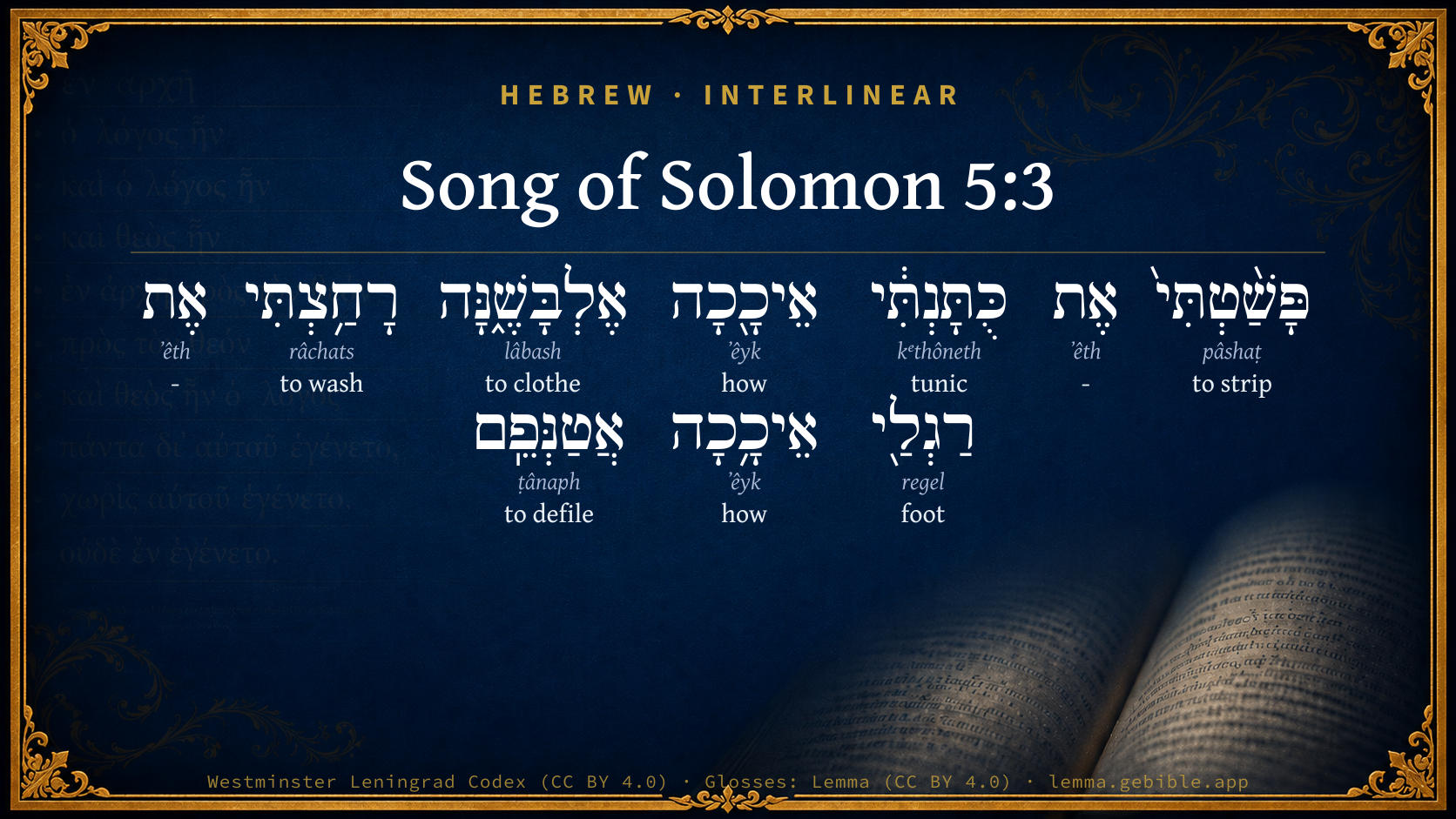
Hebrew (Westminster Leningrad Codex) Song of Solomon 5:3 appears in the Hebrew Old Testament. The text above is from the Westminster Leningrad Codex. Each word links to its Strong’s number, a concise gloss, and parsing drawn from the Open Scriptures Hebrew Bible morphology. Click any word for its full Brown-Driver-Briggs (BDB) entry.
Download image
Cite this verse

Song of Solomon 5:3 (World English Bible). Public Domain. Lemma interlinear Bible study tool, https://lemma.gebible.app/v/song-of-solomon/5/3.

Show BibTeX & RIS
BibTeX
RIS
English Translation
I have taken off my robe. Indeed, must I put it on? I have washed my feet. Indeed, must I soil them?
World English Bible · Public Domain
Highlights
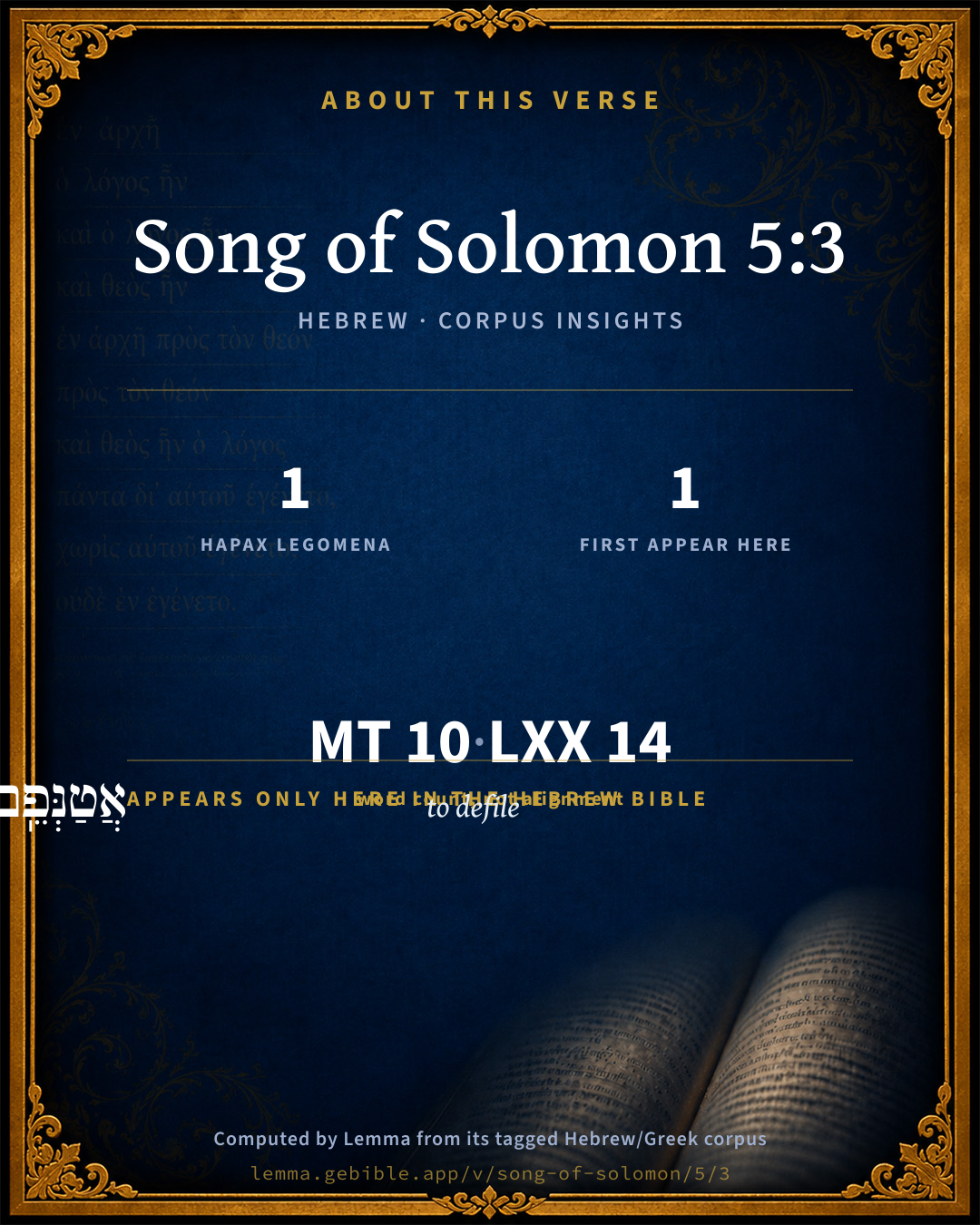
  • 1 hapax legomenon — only here in the Hebrew Bible
  • 1 first appearance in the Hebrew Bible
Full analysis ↓
Download a study sheet

One document with this verse’s original text, its word-by-word gloss line, the meaning frame, cross-references with their text, attributed commentary, and full source and license credits — printable, and it pastes into notes with its structure intact.

This verse Autodidact and up

Study sheet (.html) Plain text (.txt)

A passage Seminary Student

Up to 50 verses in one chapter. A passage sheet keeps up to 6 commentary sources and 12 cross-references per verse, in the order this page ranks them, and says so on the sheet whenever that leaves anything out. Ask for a single verse and you get the Autodidact verse sheet above.

Everything on this page stays free to read, with no account — the sheet is a download of what is already on screen, not access to it.

Want to remove ads? Support Godless Engineer
Compare translations 3

The same verse in 3 English versions, stacked beneath the original-language interlinear above. Click any original word for its lexicon entry.

Each is an independent rendering of the whole verse — the interlinear is not word-aligned to these translations.

Highlighted words mark where these versions differ — a whole-verse word diff, not a word-by-word alignment.

  • World English Bible Public Domain
    I have taken off my robe. Indeed, must I put it on? I have washed my feet. Indeed, must I soil them?
  • King James Version Public Domain
    I have put off my coat; how shall I put it on? I have washed my feet; how shall I defile them?
  • unfoldingWord Literal Text CC BY-SA 4.0
    “I have taken off my robe; how will I put it on? I have washed my feet; how could I get them dirty?”

unfoldingWord Literal Text — © unfoldingWord, licensed CC BY-SA 4.0. Word-aligned USFM3 via Door43 (git.door43.org/unfoldingWord/en_ult).

Versions to compare (up to 4)

3 of 4 selected

Show all 18 translations

Every available English version of this verse, each an independent rendering of the whole verse.

  • World English Bible Public Domain
    I have taken off my robe. Indeed, must I put it on? I have washed my feet. Indeed, must I soil them?
  • Berean Standard Bible Public Domain
    I have taken off my robe—must I put it back on? I have washed my feet—must I soil them again?
  • Majority Standard Bible Public Domain
    I have taken off my robe—must I put it back on? I have washed my feet—must I soil them again?
  • King James Version Public Domain
    I have put off my coat; how shall I put it on? I have washed my feet; how shall I defile them?
  • American Standard Version (1901) Public Domain
    I have put off my garment; how shall I put it on? I have washed my feet; how shall I defile them?
  • Revised Version (1885) Public Domain
    I have put off my coat; how shall I put it on? I have washed my feet; how shall I defile them?
  • Geneva Bible (1599) Public Domain
    I haue put off my coate, howe shall I put it on? I haue washed my feete, howe shall I defile them?
  • Douay-Rheims (1899) Public Domain
    I have put off my garment, how shall I put it on? I have washed my feet, how shall I defile them?
  • Young's Literal Translation Public Domain
    I have put off my coat, how do I put it on? I have washed my feet, how do I defile them?
  • Literal Standard Version CC BY-SA 4.0
    I have put off my coat, how do I put it on? I have washed my feet, how do I defile them?
  • Unlocked Literal Bible CC BY-SA 4.0
    “I have taken off my robe; must I put it on again? I have washed my feet; must I get them dirty?”
  • unfoldingWord Literal Text CC BY-SA 4.0
    “I have taken off my robe; how will I put it on? I have washed my feet; how could I get them dirty?”
  • Darby Bible Public Domain
    -- I have put off my tunic, how should I put it on? I have washed my feet, how should I pollute them? --
  • World Messianic Bible Public Domain
    I have taken off my robe. Indeed, must I put it on? I have washed my feet. Indeed, must I soil them?
  • Webster's Bible Public Domain
    I have put off my coat; how shall I put it on? I have washed my feet; how shall I defile them?
  • Free Bible Version CC BY-SA 4.0
    I replied, “I've already got undressed. I don't have to get dressed again, do I? I've already washed my feet. I don't have to make them dirty again, do I?”
  • Bible in Basic English Public Domain
    I have put off my coat; how may I put it on? My feet are washed; how may I make them unclean?
  • JPS Tanakh (1917) Public Domain
    I have put off my coat; how shall I put it on? I have washed my feet; how shall I defile them?

Literal Standard Version (2020), Covenant Press — licensed CC BY-SA 4.0. Text via the HelloAO Bible API (eBible.org). Unlocked Literal Bible (unfoldingWord) — licensed CC BY-SA 4.0. Text via the HelloAO Bible API (eBible.org). unfoldingWord Literal Text — © unfoldingWord, licensed CC BY-SA 4.0. Word-aligned USFM3 via Door43 (git.door43.org/unfoldingWord/en_ult). Free Bible Version, Dr. Jonathan Gallagher — licensed CC BY-SA 4.0. Text via the HelloAO Bible API (eBible.org).

Word by word

More ways to search: Search by grammar → Find every occurrence → Compare this word →

Practice this passage: Drill this verse → Learn its vocabulary →

אֲטַנְּפֵֽם
ṭânaph
H2936
“to defile · them”
Verb, Piel, Imperfect, 1st Person, Common, Singular + Suffix, Personal, 3rd Person, Masculine, Plural
Part of Speech
Verb
Stem
Piel
Form
Imperfect
Person
1st Person
Gender
Common
Number
Singular
Full BDB Definition

Origin: a primitive root

TWOT: 813

(Piel) to defile, soil
  1. פָּשַׁ֨טְתִּי֙ pâshaṭ H6584 “to strip” Verb, Qal, Perfect, 1st Person, Common, Singular
  2. אֶת ʼêth H853 “-” Particle, Direct Object
  3. כֻּתָּנְתִּ֔י kᵉthôneth H3801 “tunic · my” Noun, Common, Feminine, Singular, Construct + Suffix, Personal, 1st Person, Common, Singular
  4. אֵיכָ֖כָה ʼêyk H349 “how” Particle, Interrogative
  5. אֶלְבָּשֶׁ֑נָּה lâbash H3847 “to clothe · her” Verb, Qal, Imperfect, 1st Person, Common, Singular + Suffix, Personal, 3rd Person, Feminine, Singular
  6. רָחַ֥צְתִּי râchats H7364 “to wash” Verb, Qal, Perfect, 1st Person, Common, Singular
  7. אֶת ʼêth H853 “-” Particle, Direct Object
  8. רַגְלַ֖י regel H7272 “feet · my” Noun, Common, Feminine, Dual, Construct + Suffix, Personal, 1st Person, Common, Singular
  9. אֵיכָ֥כָה ʼêyk H349 “how” Particle, Interrogative

About this verse

These counts appear in no published source. They are computed here, from the morphology-tagged text and Lemma’s own curated glosses. What Lemma adds →

10
words
8
distinct lemmas
Wisdom
section

Notable vocabulary

1 hapax legomenon — a word that appears only here in the entire Hebrew Bible:

  • אֲטַנְּפֵֽם to defile H2936

First appearance in Scripture

This word makes its first canonical appearance in the Hebrew Bible here:

  • אֲטַנְּפֵֽם to defile H2936

Shared distinctive vocabulary

כֻּתָּנְתִּ֔י tunic H3801 occurs in 26 verses of the Hebrew Bible. Also found in:

Grammatical profile

  • 4 verbs
  • 2 nouns
  • 4 particles

Verb forms

  • פָּשַׁ֨טְתִּי֙ Qal · Perfect
  • אֶלְבָּשֶׁ֑נָּה Qal · Imperfect
  • רָחַ֥צְתִּי Qal · Perfect
  • אֲטַנְּפֵֽם Piel · Imperfect

Repetition

A word recurs within this verse — often emphatic in Hebrew:

  • אֵיכָ֖כָה how H349 ×2

Hebrew & Septuagint length

In English translation the verse runs 22 words from the Hebrew and 22 from the Septuagint (LXX English) — the same length.

A rough comparison of the two English renderings, which tokenize alike — not a word-level alignment.

Word counts can differ between the Hebrew and the Greek without any difference in meaning — e.g. the Hebrew direct-object marker אֵת has no separate Greek word, and Greek often adds the article ὁ.

In the original languages it is 10 Hebrew tokens and 14 Greek tokens — but the two are counted differently (Hebrew bundles its prefixes and suffixes into one token; the Greek is in lemma form), so that isn’t a like-for-like length.

Cross-references

7

Topical passages linked to Song of Solomon 5:3 in the Treasury of Scripture Knowledge — connected by theme and wording, ordered by reader-vote popularity; previews shown in the World English Bible.

  • Luke 11:7 and he from within will answer and say, 'Don't bother me. The door is now shut, and my children are with me in bed. I can't get up and give it to you'?
  • Proverbs 3:28 Don't say to your neighbor, "Go, and come again, Tomorrow I will give it to you," When you have it by you.
  • Proverbs 13:4 The soul of the sluggard desires, and has nothing, But the desire of the diligent shall be fully satisfied.
  • Proverbs 22:13 The sluggard says, "There is a lion outside! I will be killed in the streets!"
  • Matthew 25:5 Now while the bridegroom delayed, they all slumbered and slept.
  • Matthew 26:38–43 Then he said to them, "My soul is exceedingly sorrowful, even to death. Stay here, and watch with me."
  • Romans 7:22–23 For I delight in God's law after the inward man,

Cross-references courtesy of OpenBible.info (CC BY 4.0).

Hebrew and Greek witnesses Masoretic Hebrew ↔ Greek Septuagint

The same verse in the two great witnesses to the Old Testament, shown verse-for-verse.

These are two independent witnesses, not word-aligned to each other, and the Septuagint is shown in lemma (dictionary) form.

Hebrew Song of Solomon 5:3 Masoretic · Westminster Leningrad Codex

פָּשַׁ֨טְתִּי֙ אֶת כֻּתָּנְתִּ֔י אֵיכָ֖כָה אֶלְבָּשֶׁ֑נָּה רָחַ֥צְתִּי אֶת רַגְלַ֖י אֵיכָ֥כָה אֲטַנְּפֵֽם

I have taken off my robe. Indeed, must I put it on? I have washed my feet. Indeed, must I soil them?

World English Bible · Public Domain

Greek LXX Song of Solomon 5:3 Septuagint · lemma form

ἐκδύω ὁ χιτών ἐγώ πῶς ἐνδύω αὐτός νίπτω ὁ πούς ἐγώ πῶς μολύνω αὐτός

I have put off my coat; how shall I put it on? I have washed my feet, how shall I defile them?

LXX2012 (modern English Septuagint) · Public Domain

Hebrew: Westminster Leningrad Codex (CC BY 4.0). Greek: Septuagint (public domain); English from LXX2012 (modern English Septuagint) (Public Domain). How the Septuagint differs from the Hebrew →

Commentary

Notes on Song of Solomon 5:3 from classic Christian and Jewish commentators (each source and its license shown beneath its notes). The classic Christian expositions comment on the surrounding passage and are grouped to its opening verse, so a note may address several verses; the Jewish commentaries on the Tanakh (Rashi and others) are per-verse, so they appear only where the commentator wrote on this verse.

Lemma curates 59 commentaries, every one of them public domain or Creative Commons licensed, each selected and text-cleaned for this edition rather than reprinted as found. About our sources →

Trapp's Complete Commentary

John Trapp

Son 5:3 I have put off my coat; how shall I put it on? I have washed my feet; how shall I defile them?

Ver. 3. I have put off my coat.] Thus the flesh shows itself not only weak but wayward, treacherous, and tyrannical; rebel it doth in the best, and reign it would if it might be suffered. This bramble would feign be playing Rex, King, and doth so at other times, till he be well buffeted, as St Paul served it, {1Co 9:27} and brought into subjection. But what a silly excuse maketh the Church here for herself? "Trouble me not, for I am in bed," as he said to his friend. {Luk 11:7} My clothes are off, my feet are washed, and I am composed to a settled rest. But are you so? might Christ have regested. And is that the part and posture of a vigilant Christian? Might it not better have beseemed you to have had your loins girt up, your lamp in your hand, and yourself to have waited for your Lord’s return, that when he came and knocked you might have opened unto him immediately? {Luk 12:35-36} Or, being got to bed, must you needs mend one fault with another? Is it such a pains to start up again and let in such a guest, as comes not to take anything from you, but to enrich you much more than once the ark did Obed Edom? And in this sense some take those words in the former verse, "for mine head is filled with dew," as if Christ came unto her, full of the dew of blessings, to enrich her. Sure it is that Christ is no beggarly or niggardly guest. His "reward is with him"; he brings better commodities than Abraham’s servants did to Laban, or the Queen of Sheba to Solomon - even purest gold, whitest raiment, sovereign eye salve, anything, everything, that heart can wish, or need require. {Rev 3:17; Rev 3:19} How unworthily therefore deal they, and how ill do they provide for themselves that either deny or delay to entertain him, when either by the motions of his Spirit, by the words of his mouth, or by the works of his hands, he knocks at the doors of their hearts, and would come in to them! How do they "make void or reject the counsel of God against themselves" with those unhappy lawyers, {Luk 7:30} being ingrati gratiae Dei, as Ambrose speaketh, and judging themselves unworthy of everlasting life, with those perverse Jews! {Act 13:46} Who can say it is otherwise than righteous that Christ should regest one day upon such ungrateful Gadarenes, "Depart from me ye wicked"; that such as say to him, as Felix did once to Paul, "Go thy way for this time; when I have a convenient season I will call for thee," {Act 24:26} should hear from him, Get you to the gods whom ye have chosen, for I will not help you, &c.; and that those that would not obey this sweet precept, "Open to me," &c., "Come down, Zaccheus, for today I must abide at thy house," {Luk 19:5} should have no other left to obey but that dreadful "Go ye cursed," &c. The Church here did but lust awhile and linger, when she should have been up and about; and she soon rued it dearly, bewailed it bitterly. Now, what was it that she did? Did she rate Christ for coming at such unseasonable hours? did she answer him currishly, or drive him front her door? No, surely; but only pleads excuse, and pretends inconvenience. She had put off her clothes, washed her feet, &c. A great char she had done; and it would have undone her doubtless to have dressed her again, and set her fair feet on the foul ground. There is none so wise as the sluggard. {Pro 26:16} He hath got together a great many excuses, which he thinks will go for wisdom; because by them he thinks to sleep in a whole skin. Sin and shifting came into the world together. But what saith the apostle? Surely his counsel is most excellent, and worthy of all acceptation, "See that ye refuse not him that speaketh," {Heb 12:25} scil., By his blood, Word, sacraments, motions of his Spirit, mercies, &c. "Look to it," as the Greek hath it, "that ye refuse not," παραιτησησθε, "that ye shift him not off" by frivolous pretences and idle excuses, as those recusant guests did, {Mat 22:5} as Moses would have done; {Exo 3:11; Exo 3:14; Exo 4:1; Exo 4:10} and Jeremiah. {Jer 1:6} So again, Heb 2:3, "How shall we escape if we neglect so great salvation?" He saith not, if we reject, renounce, persecute; but if we neglect, let slip, undervalue, &c. If, when God "sends forth his mercy and his truth," {Psa 57:3} and looks that we should send a lamb to that Lamb of God, the ruler of the land; {Isa 16:1} we send messages after him, saying, "We will not have this man to rule over us"; {Luk 19:14} we break his cords, those "cords of love," {Hos 11:4} and kick against his heart; and instead of serving him, "make him to serve with our sins, and even weary him with our iniquities." {Isa 43:24} How shall we escape? What hill shall hide us What will ye do in the end thereof?

John Trapp, A Commentary or Exposition upon All the Books of the Old and New Testament (1647–1656) — public domain. Text from a community e-Sword module.

The Biblical Illustrator

Joseph S. Exell

Son_5:3

I have put off my coat; how shall I put it on?

Profession, tested by the unusual

It is when we are asked to do unusual things that we find out the scope and the value of our Christian profession. How difficult it is to be equally strong at every point! How hard, how impossible, to have a day-and-night religion: a religion that is in the light and in the darkness the same, as watchful at midnight as at midday; as ready to serve in the snows of winter as amid the flowers of the summer-time! So the Shulamite breaks down. She has been rhapsodizing, calling to her Love that He would return to her; and now that He has come she says: I have put off my coat; how shall I put it on? What a refrain to all the wild rhapsody! When the Shulamite cries that her loving and loved one may return, always add, I have put off my coat; how shall I put it on? I have laid myself down; how can I rise again to undo the door?--Oh that he would come at regular times, in the ordinary course of things, that he would not put my love to these unusual and exceptional tests: for twelve hours in the day I should be ready, but having curtained myself round, and lain down to sleep, how can l rise again? Thus all mere sentiment perishes in the using; it is undergoing a continual process of evaporation. Nothing stands seven days a week and four seasons in the year but reasoned love, intelligent apprehension of great principles, distinct inwrought conviction that without Christ life is impossible, or were it possible it would be vain, painful, and useless. Have we any such excuses, or are these complaints historical noises, unknown to us in their practical realization? Let the question find its way into the very middle of the heart. There is an ingenuity of self-excusing, a department in which genius can find ample scope for all its resources. The ailment that would not keep a man from business will confine him all day when it is the Church that requires his attendance, or Christ that asks him to deliver a testimony or render a sacrifice. Who can escape from that suggestion? Who does not so far take Providence into his own hand as to arrange occasionally that his ailments shall come and go by the clock? Who has not found in the weather an excuse to keep him from spiritual exercises that he never would have found there on the business days of the week? How comes it that men look towards the weather quarter on the day of the Son of Man? Where do we begin to economize? Do we begin in the region of luxury? Where is there a man who can truthfully say that when he begins to economize he begins in the wine-cellar? How often have we risen at midnight to help the poor, the helpless, the lost? Of how many meals have we denied our hunger that we might help a hunger greater than our own? How often have we put ourselves out of the way to do that which is good, benevolent, and helpful? (J. Parker, D. D.)

The Biblical Illustrator, edited by Joseph S. Exell (c. 1880s–1900s) — public domain. Text from a community e-Sword module.

Joseph Benson's Commentary

Son 5:3. I have put off my coat — My day clothes, as persons use to do when they go to rest. How shall I put it on? — It is inconvenient and troublesome to do it at this time. I have washed my feet — Which the eastern people commonly did when they went to bed.

Joseph Benson's Commentary on the Old and New Testaments (1811–1818) — public domain. Text from a community e-Sword module.

The Preacher's Complete Homiletical Commentary

Joseph S. Exell (gen. ed.)

THE UNKIND RESPONSE

Son_5:3

SHULAMITE

I have put off my coat;

How shall I put it on?

I have washed my feet;

How shall I defile them?

Sad answer from the beloved spouse of a king. More like the answer in a dream than in reality. The language only of one oppressed with physical or moral sleep. The excuse for not opening at once as silly as it was selfish. No great difficulty in resuming a garment just laid aside. No great sacrifice in soiling the feet by walking across the floor. The effects of spiritual sleep—

(1) To see difficulties in the way of duty where none exist, and greatly to exaggerate those that do. The language only of the sluggard, ‘There is a lion in the street’ (Pro_20:4; Pro_26:3. Hag_1:2-4).

(2) To be unwilling to deny ourselves, or make sacrifices for Christ; and to think those we are called to make much greater than they really are.

(3) To be more careful about personal comfort and carnal case, than about the pleasures of Christ and the interests of His kingdom.

(4) To be oblivious of our own best interests.

(5) To forget our character and condition as believers, and to act in a way entirely inconsistent with it. Too common for believers to act in a way unlike themselves. In a low state of religion this usually the case. The wise virgins too often slumbering with the foolish ones. An early Apostolic rebuke to a Christian Church: ‘Are ye not carnal, and walk as men?’ Possible even for believers to act at times more according to the flesh than the Spirit.

(6) To act rather as in a dream than as one awake. The life and conduct of men in general. Possessed of deathless souls, yet caring only, or most, for a short-lived body. Born for eternity, yet concerned only, or most, for the things of time. Possessing interests inconceivably high, glorious, and important, and yet expending their time and energy on trifles. Sentenced as sinners to eternal damnation, but with the gracious offer of a free pardon; and yet under no concern to secure it. Under the power of a loathsome disease that must, unless removed, exclude them from heaven, and shut them up in hell; and yet slighting the freely proffered services of the only Physician who is able to cure them. The endless glories and felicities of heaven, with peace and comfort in the way to it, procured at an amazing cost by the Son of God, and freely offered, along with Himself, for the immediate acceptance even of the chief of sinners; and yet slighted and refused for the paltry enjoyments of time and ‘the pleasures of sin, which are but for a season.’ The testimony of Scripture true: ‘Madness is in their hearts while they live, and afterwards they go down to the dead’ (Ecc_9:3).

The language of the Spouse an example of the

Excuses,

made for not giving immediate attention to the Saviour’s call, and the concerns of the soul. Such excuses usually either—

(1) Want of time and leisure;

(2) The difficulty and sacrifice involved—as, loss of worldly favour, friendship, or enjoyment; the scoff and ridicule of neighbours and associates; the effort required to keep up a religious profession and attendance upon religious ordinances, &c.; or,

(3) The intention to give more heed to the things of eternity at a future and more favourable opportunity. Such excuses foolish and unreasonable; as—

1. Nothing of an earthly nature can for a moment be compared, in point of importance, with the concerns of eternity. ‘What shall a man be profited if he should gain the whole world and lose his own soul?’ Well-being for eternity obviously, with an immortal soul, the one thing needful.

2. No difficulty involved in accepting Christ and His salvation which His grace will not enable us to overcome; and no sacrifice which will not be infinitely more than compensated. His own testimony true: ‘My yoke is easy, and my burden is light.’ ‘When I sent you without purse or scrip, lacked ye anything? And they said: Nothing, Lord.’

3. The present moment only ours. A more favourable opportunity may never come. Felix never found his ‘more convenient season.’ With our salvation it may be now or never. Delay only hardens the heart, and makes salvation more difficult.

4. Persons of all classes, and in all circumstances and conditions, are continually by their example shewing the practicability and blessedness of receiving Christ and experiencing His salvation.

Main truths suggested by the passage in reference to believers:—

1. The carnal mind remaining in a believer always the same, and as much disinclined to spiritual communion as it was in his unconverted state.

2. That in a believer, through the remains of a carnal nature, which continually subjects him to condemnation, with the increased guilt arising from greater knowledge and past experience of the divine mercy.

3. Only the unchangeableness of Christ’s love, and of the Covenant of grace which has been made with him in Christ, along with the existence of a new and spiritual nature imparted to him at conversion, preserves the believer from final apostacy, and from sinking back into his former state of carnality and unbelief.

The Preacher's Complete Homiletical Commentary (gen. ed. Joseph S. Exell; Funk & Wagnalls, c. 1892) — public domain (pre-1929). A full-Bible homiletical/sermon-outline anthology covering 65 of 66 books (2 John is absent from the source module). Text from a community e-Sword module.

Geneva Bible (1599)

Geneva Bible translators

The spouse confesseth her nakedness, and that of herself she hath nothing, or seeing that she is once made clean, she promiseth not to defile herself again.

Geneva Bible (1599) marginal notes — public domain. Text via Bolls.life.

Adam Clarke's Commentary

Verse 3. I have put off my coat] The bride must have been in a dream or in much disorder of mind to have made the frivolous excuses here mentioned. The words relate to the case of a person who had gone to take rest on his bed. As they wore nothing but sandals, they were obliged to wash their feet previously to their lying down. I have washed my feet, taken off my clothes, and am gone to bed: I cannot therefore be disturbed. A Hindoo always washes his feet before he goes to bed. If called from his bed, he often makes this excuse, I shall daub my feet; and the excuse is reasonable, as the floors are of earth; and they do not wear shoes in the house. - WARD.

Adam Clarke's Commentary on the Bible (1810–1826) — public domain. Text from a community e-Sword/MySword module.

Ellicott's Commentary for English Readers

(3) Coat.—Heb. cutoneth=cetoneth; Gr. χίτων, tunic.

A Bible Commentary for English Readers, edited by Charles John Ellicott (1878–1897) — public domain. Text from a community e-Sword module.

The Cambridge Bible for Schools and Colleges

gen. ed. J. J. S. Perowne

3. As all commentators remark, the reasons for not opening the door are of a very trifling kind, and such as are insurmountable only in dreams.

my coat] or tunic, a garment, generally of linen, worn next the skin by both men and women. The man’s tunic reached to the knee, the woman’s was longer.

how] Heb. ’çkhâkhâh, found elsewhere in the O.T. only in Est_8:6. The use of this form has consequently some bearing on the date of the book. Budde remarks in this connexion that all the words occurring in this passage which are not used elsewhere occur in Judaeo-Aramaic.

I have washed my feet] Budde sees in this phrase an indication that the Shulammite was accustomed to go barefoot; but all wearers of sandals would have to wash their feet as much as those who might go barefoot.

defile them] soil them, Heb. ’ãtannìphçm, found here only in O.T., but occurring in the Heb. of the Mishnah and in the Talmud. The suffix for them here is masculine, though the word for feet is feminine. This is one of the grammatical inaccuracies which are frequent in this book, but this particular irregularity is not uncommon elsewhere.

The Cambridge Bible for Schools and Colleges (gen. ed. J. J. S. Perowne; Cambridge University Press, 1878–1918) — public domain. Text from a community e-Sword module.

Albert Barnes' Notes on the Bible

She makes trivial excuses, as one in a dream.

Albert Barnes' Notes on the Bible (1834–1885) — public domain. Text from a community e-Sword/MySword module.

Haydock's Catholic Bible Commentary

Garment. By this is designated the tunic, which was undermost. (Haydock) --- Feet. People in that climate had their feet bare in the house, and even on journies only wore sandals: so that frequent washing was requisite, Genesis xviii. 4., and 1 Timothy v. 10. These excuses were vain, and Christ would not regard them, Matthew xxv. 1., and Luke xii. 35. (Theodoret) (Calmet) --- The care of souls brings on many external occupations, which contemplative men would decline. (St. Gregory) (Menochius)

George Leo Haydock (1774–1849), Haydock's Catholic Family Bible and Commentary, 1859 edition — public domain. Excludes Psalms (Douay-Rheims chapter numbering differs from Protestant) and Deuterocanonical books (Catholic canon only).

Matthew Poole's English Annotations

I have put off my coat, my day clothes, as persons use to do when they go to rest.

How shall I put it on? it is inconvenient and troublesome to do it at this time. Thus she tacitly reflects upon the Bridegroom for coming to her so unseasonably, and giving her such disturbance, and puts him off to another time, and excuseth her non-admission of him by her present indisposition, and the difficulty of the thing required of her.

I have washed my feet; which the Eastern people commonly did when they went to bed, partly to cool their feet, and partly to cleanse them from that dust and sweat which they had contracted in the day time by labour and travel, as being used to go barefoot.

Matthew Poole's English Annotations on the Holy Bible (1683–1685) — public domain. Text from a community e-Sword/MySword module.

Whedon's Commentary on the Bible

Daniel D. Whedon

3. Coat — The Greeks took from the Phoenicians both the garment and its name — preserved in our word tunic. It was a linen shirt, reaching below the knees, sometimes to the ankles and to the wrists. I have washed, etc.

— The wearing of sandals made the washing of the feet a frequent necessity, and, of course, on retiring at night. These are trifling excuses. The labours of humble life, in which the Beloved is located, give him little leisure or control of his time. Even a late visit, after the toils of the day, perhaps far away, should have been welcomed, in view of its evident cost to him. So she quickly came to think.

Daniel D. Whedon (gen. ed.), Commentary on the Old and New Testaments (1874–1909) — public domain. Text from a community e-Sword module.

The Pulpit Commentary

I have put off my coat; how shall I put it on? I have washed my feet; how shall I defile them? Evidently the meaning is, "I have retired to rest; do not disturb me." She is lying in bed. The cuttoneth, or ctiwn , was the linen garment worn next the body from cathan, "linen." The Arabic kutun is "cotton;" hence the French coton, "calico, or cotton" shift. Shulamith represents herself as failing in love, not meeting the condescension and affection of her lover as she should. Sloth, reluctance, ease, keep her back. "Woe to them that are at ease in Zion!" The scene is, of course, only ideally true; it is not meant to be a description of an actual occurrence. Fancy in dreams stirs up the real nature, though it also disturbs it. Shulamith has forsaken her first love. She relates it with sorrow, but not with despondency. She comes to herself again, and her repentance and restoration are the occasion for pouring out the fulness of her affection, which had never really changed, though it has been checked and restrained by self-indulgence. How true a picture both of the individual soul and of the Church in its decline! "Leave me to myself; let me lie at ease in my luxury and my smooth, conventional ways and self-flattering deceit."

The Pulpit Commentary (1880–1919), ed. H.D.M. Spence-Jones & Joseph S. Exell — public domain. Text from a community e-Sword module.

John Wesley's Explanatory Notes

My coat - My day clothes, as persons use to do when they go to rest. How - It is inconvenient and troublesome to do it at this time. Washed my feet - Which the eastern people commonly did when they went to bed.

John Wesley, Explanatory Notes Upon the Whole Bible (1754–1765) — public domain. Text via the GEBible commentary corpus.

unfoldingWord translationNotes

Door43 World Missions Community

"I have taken off my robe ... dirty?"

This is what the woman thought to herself when she heard the man speak. (Song of Songs 5:2). This could be translated with the woman saying that this is what she was thinking, or the woman could just explain the situation and her thoughts as in the UDB. AT: "I thought to myself, 'I have taken off my robe ... dirty?'" or "I had taken off my robe and I did not want to put it on again. I had washed my feet and I did not want to get them dirty." (See: Direct and Indirect Quotations)

robe

thin linen clothing that people wore on their skin

must I put it on again?

This can be translated as a statement. AT: "I do not want to put it on again." (See: Rhetorical Question)

I have washed my feet

While the word "feet" can be a euphemism for private parts, this probably refers to literal feet. The woman seems more likely to want to make love than to want to refrain from lovemaking because she has just bathed. (See: Euphemism)

must I get them dirty?

This can be translated as a statement. AT: "I do not want to get them dirty."

My beloved put in his hand through the opening of the door latch

Possible interpretations are 1) literal, the lover reaches into the house through a hole in the door in order to open the door or 2) euphemisic, they have begun to make love. (See: Euphemism)

My beloved

This phrase refers to the man whom the woman loves. In some languages it may be more natural for her to refer to him as "my lover." See how you translated this in Song of Songs 1:13. AT: "My dear one" or "My lover"

door latch

"door lock"

translationWords

robe

beloved

heart

unfoldingWord translationNotes — © Distant Shores Media and the Door43 World Missions Community, licensed CC BY-SA 4.0. Source: git.door43.org/Door43/en_tn.

Rashi

Rabbi Shlomo Yitzchaki (Rashi)

I have taken off my tunic i.e., I have already accustomed myself to other ways; I can no longer return to You, as it is stated (Jer. 44:18): “But since we stopped burning incense to the queen of heaven, etc.,” for these ways were proper in their eyes, and the expression, “I have taken off my tunic...I have bathed my feet,” is the language of an adulterous wife, who does not wish to open the door for her husband. And since Scripture commenced with the language of, “I sleep...Hark! My beloved is knocking,” it concludes with an expression apropos to an expression of knocking at the door at the time of retiring to sleep at night.

Rashi on the Tanakh — English translations: “The Judaica Press complete Tanach with Rashi, translated by A. J. Rosenberg” (CC BY 4.0); “Pentateuch with Rashi's commentary by M. Rosenbaum and A.M. Silbermann, 1929-1934” (public domain); “The Metsudah Tanach series, Lakewood, N.J” (CC BY 4.0); and “The Book of Joshua, Metsudah Publications, 1997” (CC BY 4.0). Text via Sefaria.

Lesson kit

Teaching starters — assembled from the data on this page, not authored interpretation. Every prompt links to the verse data it draws on. Edit before teaching.

Song of Solomon, in the Wisdom, opens this verse with 10 words (8 distinct Hebrew lemmas). Its most distinctive word is ṭânaph (“to defile”). A historical commentator’s framing appears above. Read the whole chapter for the surrounding context.

Discussion questions

  1. The word ṭânaph carries the sense “to defile.” How does it shape the verse?
  2. 1 word here appears nowhere else in the Hebrew Bible. Why might the author reach for such rare wording?
  3. This is the first place “to defile” appears in Scripture (first appears here). What does its debut here establish?
  4. How does Genesis 3:21, which shares the word «tunic», read alongside this verse?
  5. What does the repetition of “how” (2× in this one verse) do in this verse?
  6. These translations render this verse differently; the difference is in the English rendering, not the original. What questions does that raise?
  7. «פָּשַׁ֨טְתִּי֙» is a Qal Perfect verb. How does that grammatical form shape the action described?
  8. Compare how Trapp's Complete Commentary and The Biblical Illustrator read this verse. Where do they agree or differ?

Things to notice

  • 1 word in this verse appears nowhere else in the Hebrew Bible.
  • 1 word makes its first canonical appearance in Scripture here.
  • This verse counts 10 Hebrew ↔ 14 Greek words.
  • These translations choose different wording for 13 words in this verse.
  • “how” occurs 2× in this single verse.

Reading settings

Reading text

Shown beneath each verse's original-language words.

Old Testament
Old Testament edition

Read the OT as the Masoretic Hebrew (MT) or the Greek Septuagint (LXX).

English shown for the Greek Septuagint (in the Hebrew ↔ Greek comparison).

Comparing translations? Open the Compare panel on any verse page to stack up to four side by side.