
Psalms 132:9

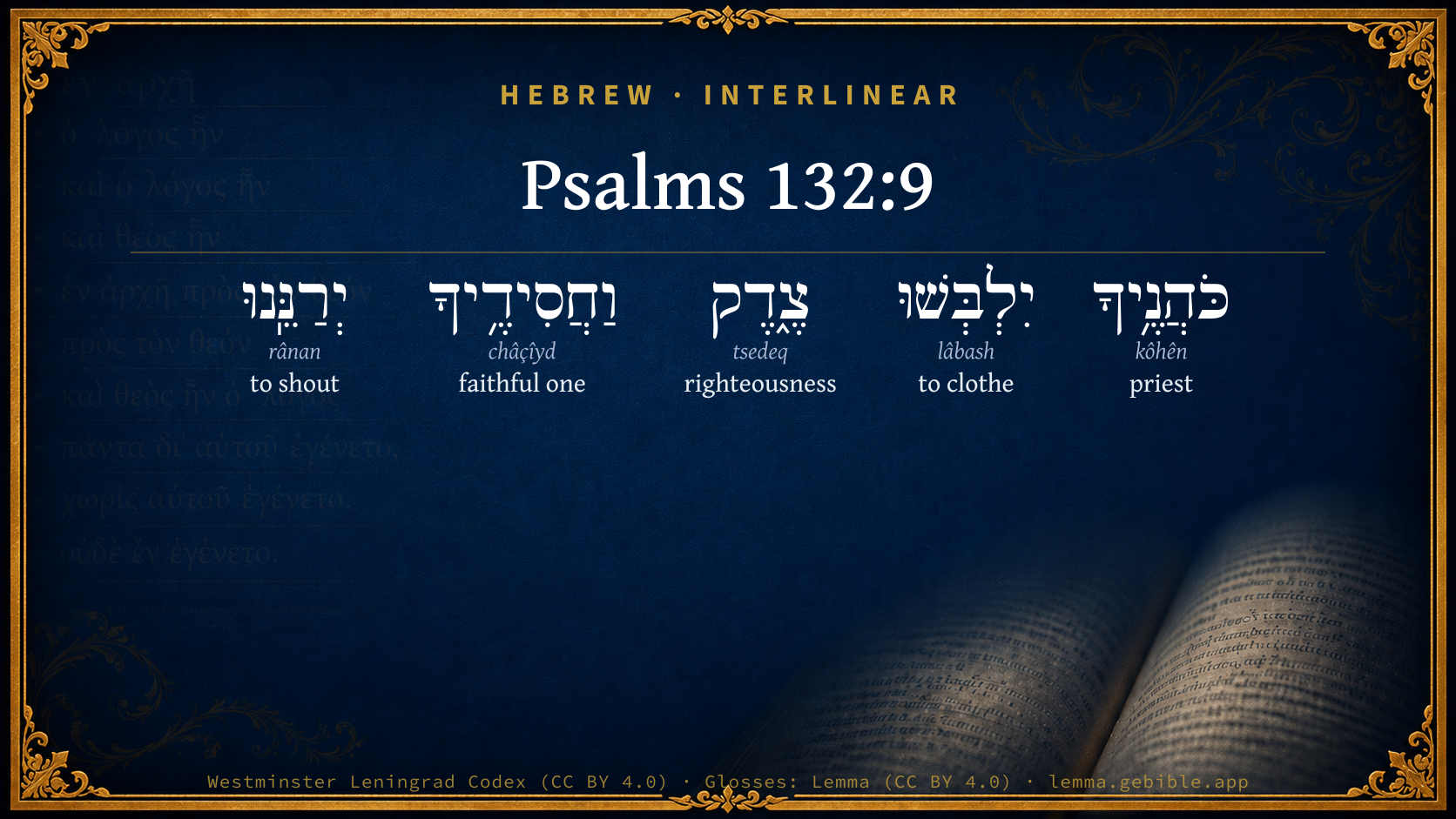
Hebrew (Westminster Leningrad Codex) Psalms 132:9 appears in the Hebrew Old Testament. The text above is from the Westminster Leningrad Codex. Each word links to its Strong’s number, a concise gloss, and parsing drawn from the Open Scriptures Hebrew Bible morphology. Click any word for its full Brown-Driver-Briggs (BDB) entry.
Download image
Cite this verse

Psalms 132:9 (World English Bible). Public Domain. Lemma interlinear Bible study tool, https://lemma.gebible.app/v/psalms/132/9.

Show BibTeX & RIS
BibTeX
RIS
English Translation
Let your priest be clothed with righteousness. Let your saints shout for joy!"
World English Bible · Public Domain
Download a study sheet

One document with this verse’s original text, its word-by-word gloss line, the meaning frame, cross-references with their text, attributed commentary, and full source and license credits — printable, and it pastes into notes with its structure intact.

This verse Autodidact and up

Study sheet (.html) Plain text (.txt)

A passage Seminary Student

Up to 50 verses in one chapter. A passage sheet keeps up to 6 commentary sources and 12 cross-references per verse, in the order this page ranks them, and says so on the sheet whenever that leaves anything out. Ask for a single verse and you get the Autodidact verse sheet above.

Everything on this page stays free to read, with no account — the sheet is a download of what is already on screen, not access to it.

Want to remove ads? Support Godless Engineer
Compare translations 3

The same verse in 3 English versions, stacked beneath the original-language interlinear above. Click any original word for its lexicon entry.

Each is an independent rendering of the whole verse — the interlinear is not word-aligned to these translations.

Highlighted words mark where these versions differ — a whole-verse word diff, not a word-by-word alignment.

  • World English Bible Public Domain
    Let your priest be clothed with righteousness. Let your saints shout for joy!"
  • King James Version Public Domain
    Let thy priests be clothed with righteousness; and let thy saints shout for joy.
  • unfoldingWord Literal Text CC BY-SA 4.0
    Let your priests wear righteousness, and let your faithful shout for joy.

unfoldingWord Literal Text — © unfoldingWord, licensed CC BY-SA 4.0. Word-aligned USFM3 via Door43 (git.door43.org/unfoldingWord/en_ult).

Versions to compare (up to 4)

3 of 4 selected

Show all 17 translations

Every available English version of this verse, each an independent rendering of the whole verse.

  • World English Bible Public Domain
    Let your priest be clothed with righteousness. Let your saints shout for joy!"
  • Berean Standard Bible Public Domain
    May Your priests be clothed with righteousness, and Your saints shout for joy.
  • Majority Standard Bible Public Domain
    May Your priests be clothed with righteousness, and Your saints shout for joy.
  • King James Version Public Domain
    Let thy priests be clothed with righteousness; and let thy saints shout for joy.
  • American Standard Version (1901) Public Domain
    Let thy priest be clothed with righteousness; And let thy saints shout for joy.
  • Revised Version (1885) Public Domain
    Let thy priests be clothed with righteousness; and let thy saints shout for joy.
  • Geneva Bible (1599) Public Domain
    Let thy Priests be clothed with righteousnesse, and let thy Saints reioyce.
  • Young's Literal Translation Public Domain
    Thy priests do put on righteousness, And Thy pious ones cry aloud.
  • Literal Standard Version CC BY-SA 4.0
    Your priests put on righteousness, || And Your pious ones cry aloud.
  • Unlocked Literal Bible CC BY-SA 4.0
    May your priests be clothed with integrity; may your faithful ones shout for joy.
  • unfoldingWord Literal Text CC BY-SA 4.0
    Let your priests wear righteousness, and let your faithful shout for joy.
  • Darby Bible Public Domain
    Let thy priests be clothed with righteousness, and let thy saints shout for joy.
  • World Messianic Bible Public Domain
    Let your priests be clothed with righteousness. Let your holy ones shout for joy!
  • Webster's Bible Public Domain
    Let thy priests be clothed with righteousness; and let thy saints shout for joy.
  • Free Bible Version CC BY-SA 4.0
    May your priests wear goodness like clothing; may your faithful people shout for joy.
  • Bible in Basic English Public Domain
    Let your priests be clothed with righteousness; and let your saints give cries of joy.
  • JPS Tanakh (1917) Public Domain
    Let Thy priests be clothed with righteousness; and let Thy saints shout for joy.

Literal Standard Version (2020), Covenant Press — licensed CC BY-SA 4.0. Text via the HelloAO Bible API (eBible.org). Unlocked Literal Bible (unfoldingWord) — licensed CC BY-SA 4.0. Text via the HelloAO Bible API (eBible.org). unfoldingWord Literal Text — © unfoldingWord, licensed CC BY-SA 4.0. Word-aligned USFM3 via Door43 (git.door43.org/unfoldingWord/en_ult). Free Bible Version, Dr. Jonathan Gallagher — licensed CC BY-SA 4.0. Text via the HelloAO Bible API (eBible.org).

Word by word

More ways to search: Search by grammar → Find every occurrence → Compare this word →

Practice this passage: Drill this verse → Learn its vocabulary →

About this verse

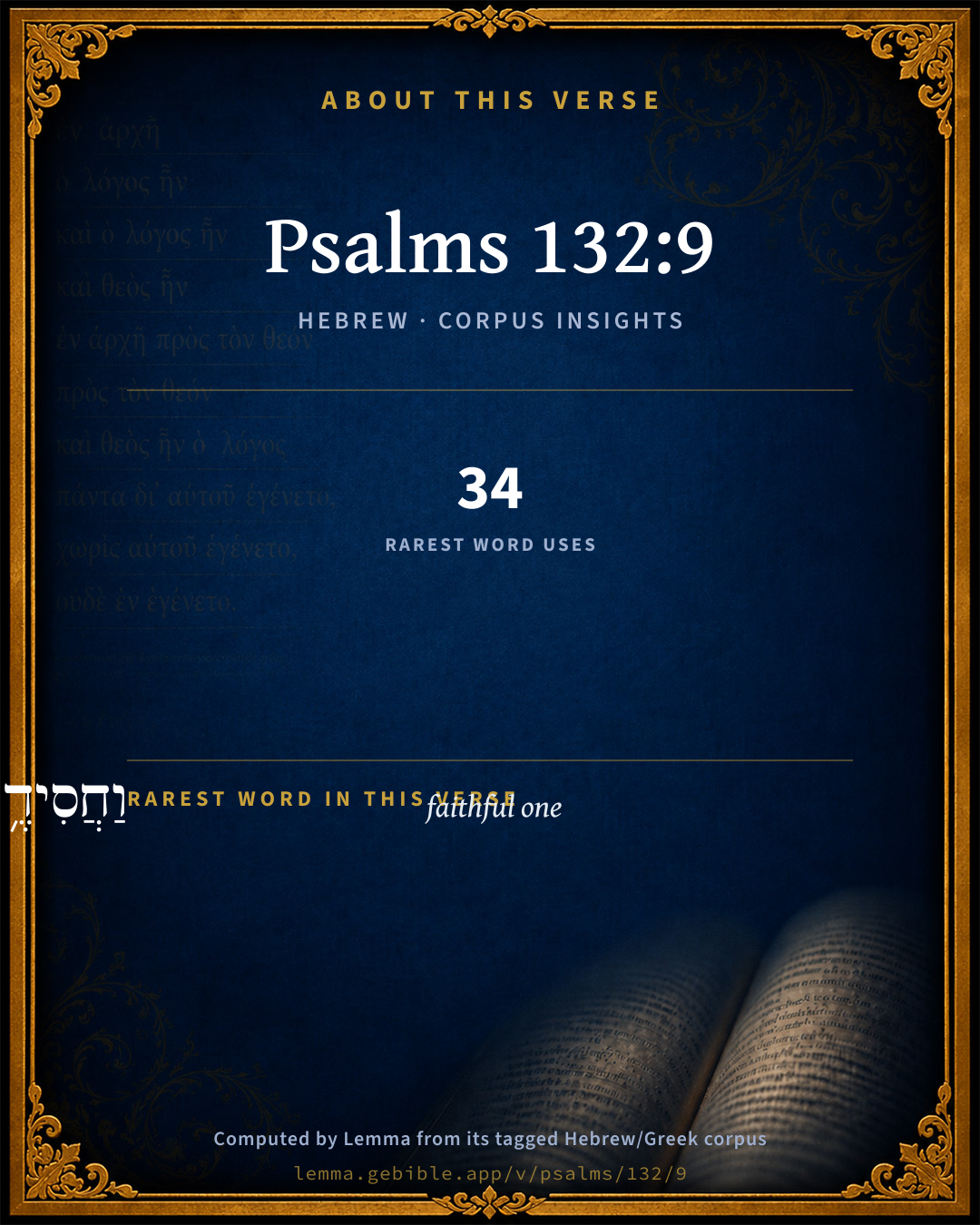
These counts appear in no published source. They are computed here, from the morphology-tagged text and Lemma’s own curated glosses. What Lemma adds →

5
words
5
distinct lemmas
Wisdom
section

Shared distinctive vocabulary

וַחֲסִידֶ֥יךָ faithful one H2623 occurs in 32 verses of the Hebrew Bible. Also found in:

Grammatical profile

  • 2 verbs
  • 2 nouns
  • 1 adjective

Verb forms

  • יִלְבְּשׁוּ Qal · Imperfect
  • יְרַנֵּֽנוּ Piel · Imperfect

Hebrew & Septuagint length

In English translation the verse runs 13 words from the Hebrew and 12 from the Septuagint (LXX English) — closely comparable.

A rough comparison of the two English renderings, which tokenize alike — not a word-level alignment.

Word counts can differ between the Hebrew and the Greek without any difference in meaning — e.g. the Hebrew direct-object marker אֵת has no separate Greek word, and Greek often adds the article ὁ.

Cross-references

18

Topical passages linked to Psalms 132:9 in the Treasury of Scripture Knowledge — connected by theme and wording, ordered by reader-vote popularity; previews shown in the World English Bible.

  • Job 29:14 I put on righteousness, and it clothed me. My justice was as a robe and a diadem.
  • Revelation 19:8 It was given to her that she would array herself in bright, pure, fine linen: for the fine linen is the righteous acts of the saints.
  • Psalms 93:1 Yahweh reigns! He is clothed with majesty! Yahweh is armed with strength. The world also is established. It can't be moved.
  • Psalms 104:1 Bless Yahweh, my soul. Yahweh, my God, you are very great. You are clothed with honor and majesty.
  • Psalms 132:16 Her priests I will also clothe with salvation. Her saints will shout aloud for joy.
  • Isaiah 61:10 I will greatly rejoice in Yahweh, my soul shall be joyful in my God; for he has clothed me with the garments of salvation, he has covered me with the robe of righteousness, as a bridegroom decks himself with a garland, and as a bride adorns herself with her jewels.
  • Zechariah 9:9 Rejoice greatly, daughter of Zion! Shout, daughter of Jerusalem! Behold, your king comes to you! He is righteous, and having salvation; Lowly, and riding on a donkey, Even on a colt, the foal of a donkey.
  • 1 Peter 5:5 Likewise, you younger ones, be subject to the elder. Yes, all of you gird yourselves with humility, to subject yourselves to one another; for "God resists the proud, but gives grace to the humble."
  • Judges 5:31 So let all your enemies perish, Yahweh: But let those who love him be as the sun when he goes forth in his might. The land had rest forty years.
  • Ezra 3:11–12 They sang one to another in praising and giving thanks to Yahweh, [saying], For he is good, for his loving kindness endures forever toward Israel. All the people shouted with a great shout, when they praised Yahweh, because the foundation of the house of Yahweh was laid.
  • Psalms 35:26–27 Let them be disappointed and confounded together who rejoice at my calamity. Let them be clothed with shame and dishonor who magnify themselves against me.
  • Psalms 47:1 Oh clap your hands, all you nations. Shout to God with the voice of triumph!
  • Psalms 68:3 But let the righteous be glad. Let them rejoice before God. Yes, let them rejoice with gladness.
  • Psalms 70:4 Let all those who seek you rejoice and be glad in you. Let those who love your salvation continually say, "Let God be exalted!"
  • Psalms 149:5 Let the saints rejoice in honor. Let them sing for joy on their beds.
  • Isaiah 65:14 behold, my servants shall sing for joy of heart, but you shall cry for sorrow of heart, and shall wail for vexation of spirit.
  • Zephaniah 3:14 Sing, daughter of Zion! Shout, Israel! Be glad and rejoice with all your heart, daughter of Jerusalem.
  • Romans 13:14 But put on the Lord Jesus Christ, and make no provision for the flesh, for its lusts.

Cross-references courtesy of OpenBible.info (CC BY 4.0).

Hebrew and Greek witnesses Masoretic Hebrew ↔ Greek Septuagint

The same verse in the two great witnesses to the Old Testament, shown verse-for-verse.

You’re reading Greek Psalm 131 (Hebrew Psalm 132). The Septuagint counts the superscription, so verse numbers can differ from the Hebrew — chapter-level alignment, not verse-by-verse. Numbering follows Rahlfs.

These are two independent witnesses, not word-aligned to each other, and the Septuagint is shown in lemma (dictionary) form.

Hebrew Psalms 132:9 Masoretic · Westminster Leningrad Codex

כֹּהֲנֶ֥יךָ יִלְבְּשׁוּ צֶ֑דֶק וַחֲסִידֶ֥יךָ יְרַנֵּֽנוּ

Let your priest be clothed with righteousness. Let your saints shout for joy!"

World English Bible · Public Domain

Greek LXX Greek Psalm 131:9 Septuagint · lemma form

ὁ ἱερεύς σύ ἐνδύω δικαιοσύνη καί ὁ ὅσιος σύ ἀγαλλιάομαι

Your priests shall clothe themselves with righteousness; and your saints shall exult.

LXX2012 (modern English Septuagint) · Public Domain

Hebrew: Westminster Leningrad Codex (CC BY 4.0). Greek: Septuagint (public domain); English from LXX2012 (modern English Septuagint) (Public Domain). How the Septuagint differs from the Hebrew →

Commentary

Notes on Psalms 132:9 from classic Christian and Jewish commentators (each source and its license shown beneath its notes). The classic Christian expositions comment on the surrounding passage and are grouped to its opening verse, so a note may address several verses; the Jewish commentaries on the Tanakh (Rashi and others) are per-verse, so they appear only where the commentator wrote on this verse.

Lemma curates 59 commentaries, every one of them public domain or Creative Commons licensed, each selected and text-cleaned for this edition rather than reprinted as found. About our sources →

Trapp's Complete Commentary

John Trapp

Psa 132:9 Let thy priests be clothed with righteousness; and let thy saints shout for joy.

Ver. 9. Let thy priests be clothed with righteousness] i.e. With salvation, as Psa 132:16. No surer sign of God’s gracious presence with a people, than a powerful ministry, clothed with inward purity and holiness, represented by the holy garments.

And let thy saints shout for joy] i.e. Those that are converted by such a ministry, let those that are justified by faith have peace with God, and joy unspeakable, full of glory.

John Trapp, A Commentary or Exposition upon All the Books of the Old and New Testament (1647–1656) — public domain. Text from a community e-Sword module.

The Biblical Illustrator

Joseph S. Exell

Psa_132:9

Let Thy priests be clothed with righteousness.

A righteous pulpit

We hear advocated, on platforms and elsewhere, different kinds of ministry. Some are urgent for a talented ministry. Some are urgent for an educated ministry. They insist on culture. Some are urgent for an evangelical ministry. The great want, however, is a righteous ministry.

I. A ministry that advocates the principles of rectitude. The Sermon on the Mount should be the text and the imperial inspiration of every teacher.

II. A ministry that advocates the principles of rectitude Is an honest way.

1. Conscientiously, believing in them.

2. Consistently, living them.

3. Independently, disregarding alike the frowns and smiles of men. A ministry, in fact, that commends itself to every mans conscience in the sight of God.

III. A ministry that advocates the principles of rectitude for a right purpose. Not for popularity, not for greed, not for sect, but for right. Such a ministry as this the people will believe in, trust, and follow. (David Thomas, D. D.)

And let Thy saints shout for joy.--

The connection between a pious ministry and a happy Church

True piety has ever a cheerful character; our religion has no sympathy with gloom (Pro_3:17). We dare not speak of uninterrupted enjoyment. Christians live too much beneath their privileges to admit of this; and, even though they should attain perfection, how could they escape suffering in a world where sin so much abounds? It would be preposterous to expect it. But, making all deductions, the believer has far more pleasure than the man who rejects the overtures of Divine compassion. Is it not so? Would you not like to know that your sins were pardoned, every one of them, no more to rise up in judgment against you? Would you not like to know that God was your friend, and that He would never leave you nor forsake you? Would you not like to know that the bondage of death is removed, for Jesus has disarmed the grisly monster of his sting? Now, these are some of the benefits of which genuine believers are partakers; and an interest in them is obtained by believing in the Son of God, who is the Strength and the Saviour of suffering man. Would you not be happier, as well as better, could you say, All these are mine? Make the experiment for yourself. Surely it is worth the trial. Linger no longer. Close at once with Gods own free terms. Permit Him to save you in His own way, and there shall be no disappointment. (N. McMichael.)

Joy in the Lord

Joy is both full of insight and medicinal. Our best poets delight to depict its power in each of these ministries. Wordsworth said it was with an eye made quiet by the deep power of joy that he saw into the life of things. Then he felt sensations sweet passing into his pure mind, with tranquil restoration. Then he came to know that blessed mood in which the burden of the mystery of this unintelligible world is lightened; and he became a living soul. If this be the ministry of the joy of nature, surely the joy of the Lord would lighten many dark problems in life, lift many a burden, change the home and the business of many a weary and tried child of God, and fill them with brightness and song.

The Biblical Illustrator, edited by Joseph S. Exell (c. 1880s–1900s) — public domain. Text from a community e-Sword module.

The Treasury of David

Charles H. Spurgeon

Ver. 9. Let thy priests be clothed with righteousness. No garment is so resplendent as that of a holy character. In this glorious robe our great High priest is evermore strayed, and he would have all his people adorned in the same manner. Then only are priests fit to appear before the Lord, and to minister for the profit of the people, when their lives are dignified with goodness. They must ever remember that they are God's priests, and should therefore wear the livery of their Lord, which is holiness: they are not only to have righteousness, but to bc clothed with it, so that upon every part of them righteousness shall be conspicuous. Whoever looks upon God's servants should see holiness if they see nothing else. Now, this righteousness of the ministers of the temple is prayed for in connection with the presence of the Lord; and this instructs us that holiness is only to be found among those who commune with God, and only comes to them through his visitation of their spirits. God will dwell among a holy people; and on the other hand, where God is the people become holy.

And let thy saints shout for joy. Holiness and happiness go together; where the one is found, the other ought never to be far away. Holy persons have a right to great and demonstrative joy: they may shout because of it. Since they are saints, and thy saints, and thou hast come to dwell with them, O Lord, thou hast made it their duty to rejoice, and to let others know of their joy. The sentence, while it may read as a permit, is also a precept: saints are commanded to rejoice in the Lord. Happy religion which makes it a duty to be glad! Where righteousness is the clothing, joy may well be the occupation.

Ver. 9. (first clause). The chief badge and cognizance of the Lord's minister is the true doctrine of justification and obedience of faith in a holy conversation: Let thy priests be clothed with righteousness. David Dickson.

Ver. 9. Let thy priests be clothed with righteousness.

Holiness on the head,

Light and perfections on the breast,

Harmonious bells below, raising the dead

To lead them unto life and rest.

Thus are true Aarons drear, etc.

George Herbert, 1593-1633.

Ver. 9. Saints. If the very names given by God's prophets to his people are such as saints, gracious ones, merciful ones, surely his professed people ought to see to it that they are not cruel, not tender, or unholy. William Swan Plumer.

Ver. 9, 16. Let us notice the prayer, Ps 132:9, with the answer, Ps 132:16. The prayer asks in behalf of the priests righteousness: the answer is, "I will clothe her priests with salvation", i.e., with what shows forth God's gracious character. Caring for the interest of God, the worshipper finds his own interest fully cared for. And now, after spreading the Lord's pledged word (Ps 132:11-12) before him, the worshipper hears the Lord himself utter the reply, q.d., "I will do all that has been sought." A. A. Bonar.

Ver. 9. Consider,

1. The importance of a righteous ministry in the church.

2. The connection between such a ministry and a joyous people.

3. The dependence of both on the gracious working of God. J. F.

Ver. 9. (second clause).

1. Saints.

2. Shouting.

3. Explaining"for joy."

4. Encouraging"Let thy saints shout."

Ver. 9. (second clause). The connection between holiness and joy.

Ver. 9,16. The Spiritual Vestry.

1. The Vestments:

a) Righteousness; for which the costliest stole is a poor substitute.

b) Salvation: learning, oratory, etc., of small account in comparison.

2. The Procuring of the vestments:

a) Must be from God.

b) Earnest prayer should constantly arise from all saints.

3. The Robing:

a) By God's own hand!

b) Their beauty and power who are so invested.

c) The persons are "thy priests." W. B. H.

Ver. 9,16.

1. Priests and Saints.

2. Vestments.

3. "Hymns Ancient and Modern."

4. The Real Presence: God giving the garments and the joy.

Psalms 132:10*

Charles H. Spurgeon's The Treasury of David (1869–1885) — public domain. Psalms only. Text from a community e-Sword/MySword module.

Whedon's Commentary on the Bible

Daniel D. Whedon

9. Priests… saints—These are comprehensive of the visible Church. The “salvation” (Psa_132:9, righteousness) of the former shall secure the “joy” of the latter.

Daniel D. Whedon (gen. ed.), Commentary on the Old and New Testaments (1874–1909) — public domain. Text from a community e-Sword module.

J. A. Alexander on Psalms

Joseph Addison Alexander

9. (Psa 132:9) Let thy priests be clothed with righteousness, and let thy saints shout (or sing). This is the conclusion of the sentence quoted from 2Ch 6:41. Instead of righteousness we there read salvation, which has led some to explain the two words as synonymous, while others understand by righteousness the practical justification which salvation carries with it. Another possible construction is to take the righteousness as that of God, which is displayed in the salvation of his people, and in which his priests, who officially declared it, might be said to clothe themselves. See the same figure in Job 29:14. Saints, gracious ones, or true believers. The parallel passage has, rejoice in good or goodness.

Joseph Addison Alexander, The Psalms Translated and Explained (1850) — public domain. Text from a community e-Sword module.

Tyndale Open Study Notes

Tyndale Open Resources

132:9 The priests were to exhibit righteousness in their lives (132:16; Mal 2:6).

Tyndale Open Study Notes — © Tyndale Open Resources, licensed CC BY-SA 4.0. Text via the HelloAO Bible API.

Geneva Bible (1599)

Geneva Bible translators

Let the effect of thy grace both appear in the Priests and in the people.

Geneva Bible (1599) marginal notes — public domain. Text via Bolls.life.

Adam Clarke's Commentary

Verse 9. Let thy priests be clothed with righteousness] Let them be as remarkable for inward holiness as they are for the splendour of their holy vestments.

Adam Clarke's Commentary on the Bible (1810–1826) — public domain. Text from a community e-Sword/MySword module.

John Calvin's Commentaries

9. Let thy priests, etc. He now prays in general for the prosperity of the Church, as what stood intimately connected with the previous statement, the promotion of our best interests being the great end for which God dwells amongst us. Some construe the words into a wish that the worship of God might be maintained in its purity, and think that the Psalmist prays that the priests might be clothed with holiness in allusion to their sacred garments. Upon a closer view of the words and the whole context, I am rather inclined to be of another opinion, and to consider this a prayer that the righteousness of God might be displayed amongst the people, being as an ornament upon the priests, and communicating joy to all the people. Thus I take righteousness to mean the fruit or effects of righteousness, and this the righteousness of God, not of men. The priests are of course mentioned first, as holding a higher place in the appointed order of the Church; while they have their due place assigned to them, it is still the Church collectively to which the prayer refers as though the Psalmist requested that the glory of this righteousness should be reflected from the priests upon the people generally. God is said to clothe us with his righteousness when he appears as our Savior and help, defends us by his power, and shows in his government of us that we are the objects of his care. The rejoicing which is spoken of must have reference to a life of happiness. And these two things being joined together may convince us that by righteousness nothing else is meant than God’s guardianship and government. Consistently with this we find it said afterwards — “Thy priests shall be clothed with salvation;” and I may add, that Solomon, in the solemn prayer already referred to, (2 Chronicles 6:41,) makes no mention of righteousness, but of salvation. I have repeatedly given the reason why the saints of God are called חסידיםchasidim, or merciful ones, because mercy or beneficence is that grace which assimilates us most to God.

John Calvin's Commentaries (1540-1563) — public domain. Text from the Calvin Translation Society English edition (1840s-50s) via the Christian Classics Ethereal Library (ccel.org). Calvin's coverage is partial (roughly two-thirds of the Bible); uncommented books and verses are honest gaps, never fabricated. The 19th-century editor's footnotes and remarks are omitted so the notes are faithfully Calvin's own voice.

Ellicott's Commentary for English Readers

(9) Clothed with righteousness.—The original is “salvation,” as below in Psa_132:16, though the Hebrew word is slightly varied. This variation, however, is an almost positive proof that the psalmist, not the chronicler, is adopting words for his own purpose.

Possibly the priestly garments are mentioned, not only as symbolic of righteousness, but also as investing whoever possessed them, with supremacy political as well as religious. This is rendered more probable by the express mention of the diadem below (Psa_132:18, see Note). “Whoever had these, the priestly paraphernalia, in his possession, had virtually the appointment to the office (high priest)” (Stanley, J. C. iii. 353). But if so, the Vulgate of the verse, in the form it has passed from the Breviary into Anglican worship, has amply recovered for the verse its larger and deeper spiritual intention: “Endue Thy ministers with righteousness, and make Thy chosen people joyful.”

Saints—chasîdîm. Here very possibly technical of the party so called in the Maccabæan period. (See Note, Psa_16:10.)

A Bible Commentary for English Readers, edited by Charles John Ellicott (1878–1897) — public domain. Text from a community e-Sword module.

The Cambridge Bible for Schools and Colleges

gen. ed. J. J. S. Perowne

9. Let thy priests be clothed with righteousness] May those who minister in the sanctuary be worthy servants of a righteous God, fit representatives of a righteous nation (Isa_26:2)! The white priestly garments were intended to be symbolical of purity of character (Rev_19:8). For the metaphor cp. Job_29:14.

let thy saints &c.] May thy chosen people worship there with jubilant rejoicing! For the meaning of thy saints, i.e. thy beloved, or thy godly ones, see Appendix, Note I.

The Cambridge Bible for Schools and Colleges (gen. ed. J. J. S. Perowne; Cambridge University Press, 1878–1918) — public domain. Text from a community e-Sword module.

John Gill's Exposition

The Lord hath sworn in truth unto David,.... By Nathan the prophet; when he assured him that his house, kingdom, and throne, should be established for ever, Sa2 7:5; and though there is no mention made of the oath of God, no doubt there was one; or however his word was his oath, as Kimchi observes: besides, the Apostle Peter is express for it that there was one, which was added to his word for the confirmation of it; who is said to swear by himself, because there is no greater; and sometimes by one or other of his perfections, as by his holiness elsewhere; so here in or by his truth, his faithfulness, being the God of truth that cannot lie. Or it may be rendered, "the Lord hath sworn truth unto David" (x); that which is truth: and we may be assured he could not possibly assert or swear anything else; see Psa 89:3;

he will not turn from it; change his mind, repent of his oath; make it void, or not fulfil it; for he is unchangeable in his perfections, purposes, and promises; whatever he says and swears to he will certainly perform;

of the fruit of thy body will I set upon thy throne; a king upon thy throne, as the Targum: meaning not Solomon; though it is true that the Lord chose him, above all the sons of David, to be his successor in the kingdom, and did place him upon his throne before his death; but a greater than Solomon is here, even the Messiah; as is clear from the testimony of the Apostle Peter, Act 2:30, by which it appears not only that this promise and oath relate to the Messiah; but that David knew they did, and so understood them; and which have been fulfilled in Jesus of Nazareth: who, as he was notoriously the fruit of David's body according to the flesh, or his human nature; or was of his seed, being born of the Virgin Mary, who lineally descended from him; so he was set upon the throne of David, as it was foretold both by the prophet Isaiah, and by the angel to the virgin, he should, Isa 9:6, Luk 1:32; not in a literal sense; for though he was no doubt right heir to the throne of David so understood, yet his kingdom was not of this world; but he was set as King over God's holy hill of Zion, the church; and reigned over the house of Jacob, the whole Israel of God; the mystical and spiritual Israel, consisting of Jews and Gentiles: his throne, or the seat of his kingdom, is the church; his sceptre the Gospel; his crown the glory true believers in him give him; his laws, by which he rules, are its his word, and written in the hearts of his subjects; and his kingdom shall continue for ever.

(x) "juravit veritatem", V. L. Pagninus, Montanus, Tigurine version, Junius & Tremellius, Gejerus, Michaelis.

John Gill's Exposition of the Whole Bible (1746–1763) — public domain (CC PDM 1.0). Text via the HelloAO Bible API.

Albert Barnes' Notes on the Bible

Let thy priests be clothed with righteousness - This is also substantially the same language that was used by Solomon at the dedication of the temple. See again 2Ch 6:41. The idea is, that in the service of such a God, the priests, the ministers of religion, should be holy. The honor of religion demanded it. It was the first qualification of those who “served the altar;” a qualification without which all other endowments would be valueless. On the word clothed, see the notes at Psa 35:26; compare Psa 65:13; Psa 93:1; Psa 104:1; Isa 61:10; 1Pe 5:5.

And let thy saints shout for joy - Thy holy ones; all who truly worship and honor thee. Let them be happy in such a God; in thy presence; in thy service. The fact that there is a God, and such a God, and that this God is ours - that we may serve him, glorify him, enjoy him - is suited to fill the mind with joy.

Albert Barnes' Notes on the Bible (1834–1885) — public domain. Text from a community e-Sword/MySword module.

Matthew Poole's English Annotations

With righteousness; not only with those outward sacerdotal garments of glory and beauty which thou hast appointed for them, but especially with those inward ornaments of righteousness and true holiness, that so their persons and services may be accepted by thee, both for themselves and for all thy people, and they may be clothed with salvation, as it is expressed here below, Psa 132:16; 2Ch 6:41, which is the effect or consequent of the former clothing. Let thy saints shout for joy; let all thy people have cause of rejoicing in the tokens of thy goodness; which they eminently had at the dedication of the temple, as is noted, 1Ki 8:66.

Matthew Poole's English Annotations on the Holy Bible (1683–1685) — public domain. Text from a community e-Sword/MySword module.

The Pulpit Commentary

Let thy priests be clothed with righteousness. In 2 Chronicles the expression used is "with salvation salvation being the effect, whereof "righteousness" is the cause. And let thy saints shout for joy. 2 Chronicles has, "rejoice in goodness," i.e. rejoice in God"s goodness to them. There is no other sufficient reason for great joy.

The holy clothing.

The allusion is to the way in which the priests of God, in discharging their sacred functions, set forth his righteousness in the salvation of his people. The white garment of the priest is the symbol of the clothing of righteousness. (see Zec_3:3, 4 Rev_19:8) "Fitting attire, figuring the inner still more glorious attire which they should wear, of holiness and obedience to him whom they serve" ("Speaker"s Commentary"). Dr. Bushnell remarks on dress as being the "outward analogon, or figure, of character; dress relates to the form or figure of the body, character to the form or figure of the soul it is, in fact, the dress of the soul. The option we have in one typifies the grander option we have in the other. The right we have in one, above the mere animals, to choose the color, type, and figure of the outward man, foreshadows the nobler right we also have to cast the mould, fashion or despoil the beauty, of the inward man. On the ground of this analogy it is that the Scriptures so frequently make use of dress to signify what lies in character, and represent character, in one way or another, as being the dress of the soul. Thus they speak of the "wedding garment," "the garment of praise," that "of cursing," that "of pride;" "the robe of righteousness," and "of judgment," and "the white robe," and "the best robe" given to the returning prodigal, and "the robe that has been washed," and "judgment put on as a robe," of "white raiment" and "white apparel," of "glorious apparel," of "filthiness," or "righteousnesses that are filthy rags," of "filthiness in the skirts;" and, more inclusively and generally still, of being "clothed with salvation," "with strength and power," "with humility," "with majesty," "with shame," "with fine linen, clean and white, which is the righteousness of saints." All the figures of dress and clothing are used up, in this manner, by the Scriptures, to represent the forms of disgrace and filthiness, or of beauty and glory, into which the inner man of the soul may be fashioned wearing Heaven"s livery, or that of sin. As character is the soul"s dress, and dress analogical to character, whatever has power to produce a character when received, is represented as a dress to be put on." In the references of this psalm to the white clothing of the priests, that clothing is said to represent both "righteousness" and salvation." It may very well be that these are only two terms to represent the same thing, but, at least, they are the same thing seen from different points of view; and we may be right in seeing distinct but related things.

I THE HOLY CLOTHING OF THE PRIESTS SYMBOLIZES SALVATION. The white garments on the cleansed body were associated with the great sacrificial acts, which bore the closest relation to the recovery, restoration, ceremonial redemption, of the people. At the great Day of Atonement, the symbol of all the Divine salvations, the High priest was required to "put on the holy linen coat, and he shall have the linen breeches upon his flesh, and shall be girded with a linen girdle, and with the linen miter shall he be attired: these are holy garments; therefore shall he wash his flesh in water, and so put them on". (Lev_16:4)

II THE HOLY CLOTHING OF THE PRIESTS SYMBOLIZES RIGHTEOUSNESS. Which is the basis, ground, and condition of salvation on man"s side. A man who seeks salvation must want to be what is represented by the priests" white garments. A man who seeks Christ"s salvation can never have it unless he wants to be as pure, as righteous, as Christ. The priest can atone for nobody and nothing unless he is, representatively at least, righteous. And nobody can be atoned for unless he is representatively-and in resolute will and purpose righteous. Man"s righteousness is no ground of acceptance with God, but man"s wish to be righteous is the condition on which alone a sacrifice can be made for him. So when the restored exiles longed and prayed for the renewal of the glories of David"s time, they wanted their priests who represent them clothed with salvation and clothed with righteousness; clothed with righteousness because clothed with salvation, or in order to effect salvation. It will easily be seen how the formal teaching of the "holy clothing" found its spiritual realization in our great High Priest, who, in his righteousness, represents what we would be to the eternal Father, and gains the power and right, through his obedience, sacrifice, and exaltation, to come into our spheres of character, and make us what we would be, and what he is. R.T.

The Pulpit Commentary (1880–1919), ed. H.D.M. Spence-Jones & Joseph S. Exell — public domain. Text from a community e-Sword module.

unfoldingWord translationNotes

Door43 World Missions Community

May your priests be clothed with integrity

Integrity is spoken of as if it were clothing. AT: "May people recognize that your priests have integrity" or "I want people see how your priests always do what is right" (See: Metaphor)

For your servant David's sake

"Because of what happened to your servant David." See how you translated a similar phrase in Psalms 132:1.

do not turn away from your anointed king

Here "turning away" means to reject someone. AT: "do not abandon the king that you anointed" (See: Metaphor)

translationWords

priest

clothe

integrity

faithful

joy

servant

David

turn

anoint

king

unfoldingWord translationNotes — © Distant Shores Media and the Door43 World Missions Community, licensed CC BY-SA 4.0. Source: git.door43.org/Door43/en_tn.

Lesson kit

Teaching starters — assembled from the data on this page, not authored interpretation. Every prompt links to the verse data it draws on. Edit before teaching.

Psalms, in the Wisdom, opens this verse with 5 words (5 distinct Hebrew lemmas). Its most distinctive word is châçîyd (“faithful one”). A historical commentator’s framing appears above. Read the whole chapter for the surrounding context.

Discussion questions

  1. What does “faithful one” (châçîyd) contribute to the verse as a whole?
  2. How does Deuteronomy 33:8, which shares the word «faithful one», read alongside this verse?
  3. These translations render this verse differently. What is at stake in choosing one wording over another?
  4. «יִלְבְּשׁוּ» is a Qal Imperfect verb. How does that grammatical form shape the action described?
  5. Compare how Trapp's Complete Commentary and The Biblical Illustrator read this verse. Where do they agree or differ?

Things to notice

Reading settings

Reading text

Shown beneath each verse's original-language words.

Old Testament
Old Testament edition

Read the OT as the Masoretic Hebrew (MT) or the Greek Septuagint (LXX).

English shown for the Greek Septuagint (in the Hebrew ↔ Greek comparison).

Comparing translations? Open the Compare panel on any verse page to stack up to four side by side.