
Zechariah 13:4

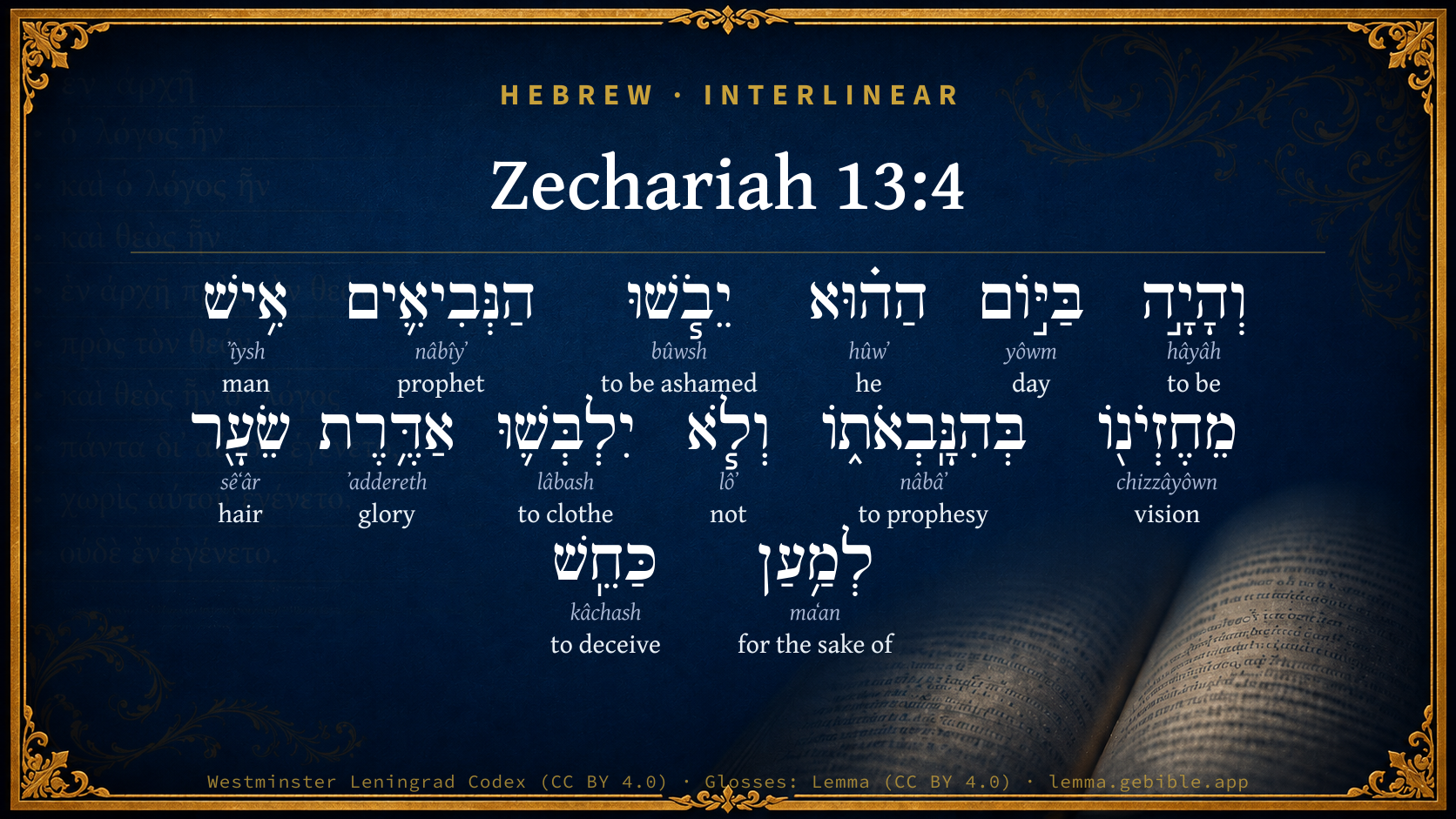
Hebrew (Westminster Leningrad Codex) Zechariah 13:4 appears in the Hebrew Old Testament. The text above is from the Westminster Leningrad Codex. Each word links to its Strong’s number, a concise gloss, and parsing drawn from the Open Scriptures Hebrew Bible morphology. Click any word for its full Brown-Driver-Briggs (BDB) entry.
Download image
Cite this verse

Zechariah 13:4 (World English Bible). Public Domain. Lemma interlinear Bible study tool, https://lemma.gebible.app/v/zechariah/13/4.

Show BibTeX & RIS
BibTeX
RIS
English Translation
It will happen in that day, that the prophets will each be ashamed of his vision, when he prophesies; neither will they wear a hairy mantle to deceive:
World English Bible · Public Domain
Download a study sheet

One document with this verse’s original text, its word-by-word gloss line, the meaning frame, cross-references with their text, attributed commentary, and full source and license credits — printable, and it pastes into notes with its structure intact.

This verse Autodidact and up

Study sheet (.html) Plain text (.txt)

A passage Seminary Student

Up to 50 verses in one chapter. A passage sheet keeps up to 6 commentary sources and 12 cross-references per verse, in the order this page ranks them, and says so on the sheet whenever that leaves anything out. Ask for a single verse and you get the Autodidact verse sheet above.

Everything on this page stays free to read, with no account — the sheet is a download of what is already on screen, not access to it.

Want to remove ads? Support Godless Engineer
Compare translations 3

The same verse in 3 English versions, stacked beneath the original-language interlinear above. Click any original word for its lexicon entry.

Each is an independent rendering of the whole verse — the interlinear is not word-aligned to these translations.

Highlighted words mark where these versions differ — a whole-verse word diff, not a word-by-word alignment.

  • World English Bible Public Domain
    It will happen in that day, that the prophets will each be ashamed of his vision, when he prophesies; neither will they wear a hairy mantle to deceive:
  • King James Version Public Domain
    And it shall come to pass in that day, that the prophets shall be ashamed every one of his vision, when he hath prophesied; neither shall they wear a rough garment to deceive:
  • unfoldingWord Literal Text CC BY-SA 4.0
    And it will be on that day, the prophets will be ashamed, each man of his vision, when he prophesies. And they will not put on a cloak of hair in order to deceive.

unfoldingWord Literal Text — © unfoldingWord, licensed CC BY-SA 4.0. Word-aligned USFM3 via Door43 (git.door43.org/unfoldingWord/en_ult).

Versions to compare (up to 4)

3 of 4 selected

Show all 18 translations

Every available English version of this verse, each an independent rendering of the whole verse.

  • World English Bible Public Domain
    It will happen in that day, that the prophets will each be ashamed of his vision, when he prophesies; neither will they wear a hairy mantle to deceive:
  • Berean Standard Bible Public Domain
    And on that day every prophet who prophesies will be ashamed of his vision, and he will not put on a hairy cloak in order to deceive.
  • Majority Standard Bible Public Domain
    And on that day every prophet who prophesies will be ashamed of his vision, and he will not put on a hairy cloak in order to deceive.
  • King James Version Public Domain
    And it shall come to pass in that day, that the prophets shall be ashamed every one of his vision, when he hath prophesied; neither shall they wear a rough garment to deceive:
  • American Standard Version (1901) Public Domain
    And it shall come to pass in that day, that the prophets shall be ashamed every one of his vision, when he prophesieth; neither shall they wear a hairy mantle to deceive:
  • Revised Version (1885) Public Domain
    And it shall come to pass in that day, that the prophets shall be ashamed every one of his vision, when he prophesieth; neither shall they wear a hairy mantle to deceive:
  • Geneva Bible (1599) Public Domain
    And in that day shall the prophetes be ashamed euery one of his vision, when he hath prophesied: neither shall they weare a rough garment to deceiue.
  • Douay-Rheims (1899) Public Domain
    And it shall come to pass in that day, that the prophets shall be confounded, every one by his own vision, when he shall prophesy, neither shall they be clad with a garment of sackcloth, to deceive:
  • Young's Literal Translation Public Domain
    And it hath come to pass, in that day, Ashamed are the prophets, each of his vision, in his prophesying, And they put not on a hairy robe to deceive.
  • Literal Standard Version CC BY-SA 4.0
    And it has come to pass in that day, || The prophets are ashamed, each of his vision, in his prophesying, || And they do not put on a hairy robe to deceive.
  • Unlocked Literal Bible CC BY-SA 4.0
    On that day each prophet will be ashamed of his vision when he is about to prophesy. These prophets will no longer wear a hairy cloak, in order to deceive the people.
  • unfoldingWord Literal Text CC BY-SA 4.0
    And it will be on that day, the prophets will be ashamed, each man of his vision, when he prophesies. And they will not put on a cloak of hair in order to deceive.
  • Darby Bible Public Domain
    And it shall come to pass in that day, [that] the prophets shall be ashamed every one of his vision, when he prophesieth; neither shall they wear a hairy mantle to deceive.
  • World Messianic Bible Public Domain
    It will happen in that day that the prophets will each be ashamed of his vision when he prophesies; they won’t wear a hairy mantle to deceive,
  • Webster's Bible Public Domain
    And it shall come to pass in that day, that the prophets shall be ashamed every one of his vision, when he hath prophesied; neither shall they wear a rough garment to deceive:
  • Free Bible Version CC BY-SA 4.0
    On that day such prophets will be too humiliated to prophesy their supposed visions. In order to deceive they will not put on their prophet's clothes made of coarse hair.
  • Bible in Basic English Public Domain
    And it will come about in that day that the prophets will be shamed, every man on account of his vision, when he is talking as a prophet; and they will not put on a robe of hair for purposes of deceit:
  • JPS Tanakh (1917) Public Domain
    And it shall come to pass in that day, that the prophets shall be brought to shame every one through his vision, when he prophesieth; neither shall they wear a hairy mantle to deceive;

Literal Standard Version (2020), Covenant Press — licensed CC BY-SA 4.0. Text via the HelloAO Bible API (eBible.org). Unlocked Literal Bible (unfoldingWord) — licensed CC BY-SA 4.0. Text via the HelloAO Bible API (eBible.org). unfoldingWord Literal Text — © unfoldingWord, licensed CC BY-SA 4.0. Word-aligned USFM3 via Door43 (git.door43.org/unfoldingWord/en_ult). Free Bible Version, Dr. Jonathan Gallagher — licensed CC BY-SA 4.0. Text via the HelloAO Bible API (eBible.org).

Word by word

More ways to search: Search by grammar → Find every occurrence → Compare this word →

Practice this passage: Drill this verse → Learn its vocabulary →

מֵחֶזְיֹנ֖וֹ
chizzâyôwn
H2384
“from · vision · his”
Preposition + Noun, Common, Masculine, Singular, Construct + Suffix, Personal, 3rd Person, Masculine, Singular
Part of Speech
Preposition + Noun
Type
Common
Gender
Masculine
Number
Singular
State
Construct
Full BDB Definition

Origin: from H2372

TWOT: 633e

vision - vision (in the ecstatic state) - valley of vision (perhaps figuratively of Jerusalem or Hinnom) - vision (in the night) - vision, oracle, prophecy (in divine communication)
  1. וְהָיָ֣ה hâyâh H1961 “and · to be” Conjunction + Verb, Qal, Sequential Perfect, 3rd Person, Masculine, Singular
  2. בַּיּ֣וֹם yôwm H3117 “in/at the · day” Preposition, Determined + Noun, Common, Masculine, Singular, Absolute
  3. הַה֗וּא hûwʼ H1931 “the · he” Particle, Definite Article + Pronoun, Personal, 3rd Person, Masculine, Singular
  4. יֵבֹ֧שׁוּ bûwsh H954 “to be ashamed” Verb, Qal, Imperfect, 3rd Person, Masculine, Plural
  5. הַנְּבִיאִ֛ים nâbîyʼ H5030 “the · prophets” Particle, Definite Article + Noun, Common, Masculine, Plural, Absolute
  6. אִ֥ישׁ ʼîysh H376 “man” Noun, Common, Masculine, Singular, Absolute
  7. בְּהִנָּֽבְאֹת֑וֹ nâbâʼ H5012 “in/at · to prophesy · him” Preposition + Verb, Niphal, Infinitive Construct + Suffix, Personal, 3rd Person, Masculine, Singular
  8. וְלֹ֧א lôʼ H3808 “and · not” Conjunction + Particle, Negative
  9. יִלְבְּשׁ֛וּ lâbash H3847 “to clothe” Verb, Qal, Imperfect, 3rd Person, Masculine, Plural
  10. אַדֶּ֥רֶת ʼaddereth H155 “glory of” Noun, Common, Feminine, Singular, Construct
  11. שֵׂעָ֖ר sêʻâr H8181 “hair” Noun, Common, Masculine, Singular, Absolute
  12. לְמַ֥עַן maʻan H4616 “for the sake of” Preposition
  13. כַּחֵֽשׁ kâchash H3584 “to deceive” Verb, Piel, Infinitive Construct

About this verse

These counts appear in no published source. They are computed here, from the morphology-tagged text and Lemma’s own curated glosses. What Lemma adds →

14
words
14
distinct lemmas
Prophets
section

Notable vocabulary

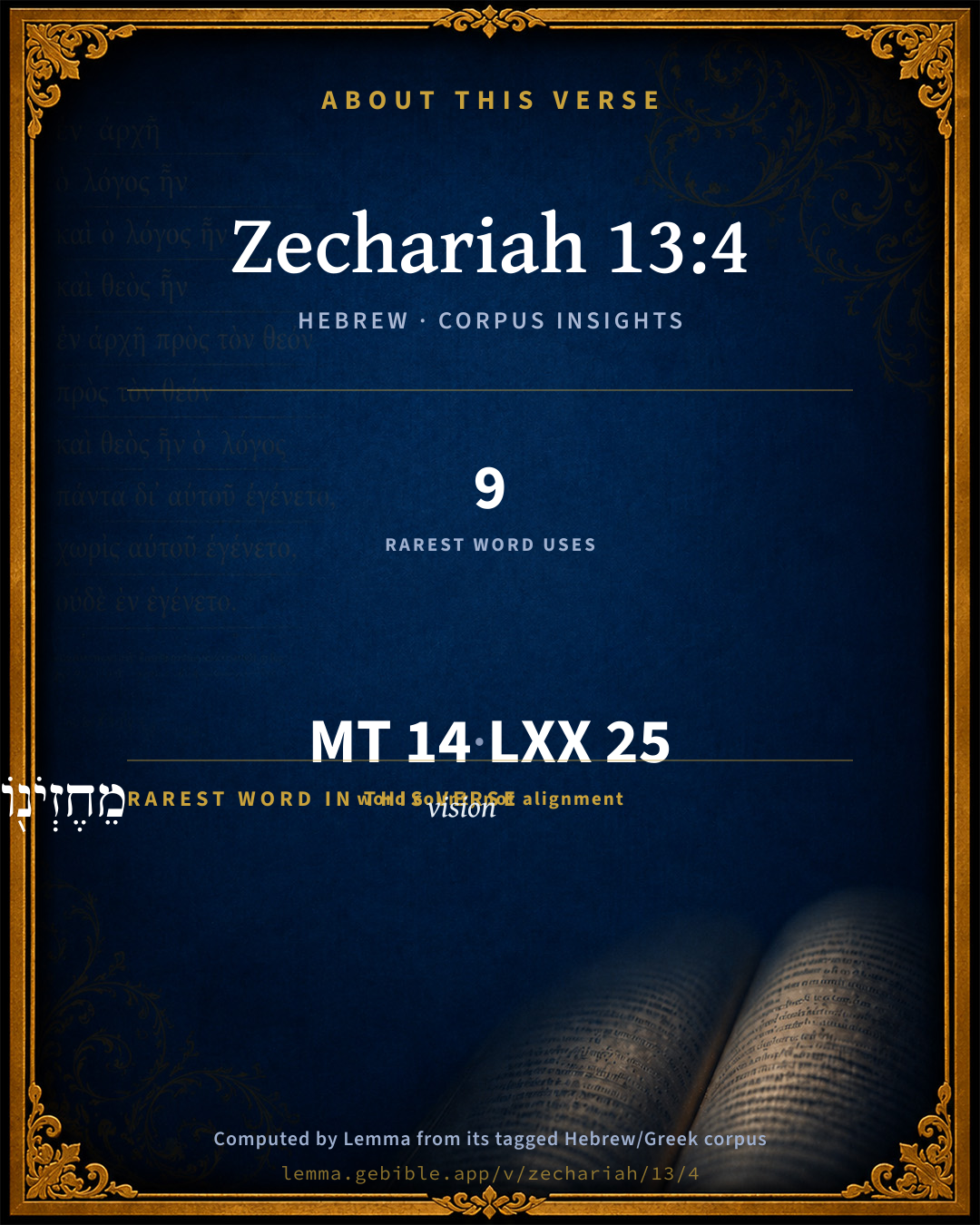
The rarest word here is מֵחֶזְיֹנ֖וֹ vision H2384 — appearing just 9 times in the whole Hebrew Bible.

Shared distinctive vocabulary

מֵחֶזְיֹנ֖וֹ vision H2384 occurs in 9 verses of the Hebrew Bible. Also found in:

Grammatical profile

  • 5 verbs
  • 6 nouns
  • 1 pronoun
  • 1 preposition
  • 1 particle

Verb forms

  • וְהָיָ֣ה Qal · Sequential Perfect
  • יֵבֹ֧שׁוּ Qal · Imperfect
  • בְּהִנָּֽבְאֹת֑וֹ Niphal · Infinitive Construct
  • יִלְבְּשׁ֛וּ Qal · Imperfect
  • כַּחֵֽשׁ Piel · Infinitive Construct

Hebrew & Septuagint length

In English translation the verse runs 28 words from the Hebrew and 37 from the Septuagint (LXX English) — closely comparable.

A rough comparison of the two English renderings, which tokenize alike — not a word-level alignment.

Word counts can differ between the Hebrew and the Greek without any difference in meaning — e.g. the Hebrew direct-object marker אֵת has no separate Greek word, and Greek often adds the article ὁ.

In the original languages it is 14 Hebrew tokens and 25 Greek tokens — but the two are counted differently (Hebrew bundles its prefixes and suffixes into one token; the Greek is in lemma form), so that isn’t a like-for-like length.

Cross-references

9

Topical passages linked to Zechariah 13:4 in the Treasury of Scripture Knowledge — connected by theme and wording, ordered by reader-vote popularity; previews shown in the World English Bible.

  • Micah 3:6–7 "Therefore night is over you, with no vision, And it is dark to you, that you may not divine; And the sun will go down on the prophets, And the day will be black over them.
  • Matthew 3:4 Now John himself wore clothing made of camel's hair, with a leather belt around his waist. His food was locusts and wild honey.
  • 2 Kings 1:8 They answered him, He was a hairy man, and girt with a belt of leather about his loins. He said, It is Elijah the Tishbite.
  • Isaiah 20:2 at that time Yahweh spoke by Isaiah the son of Amoz, saying, Go, and loose the sackcloth from off your loins, and put your shoe from off your foot. He did so, walking naked and barefoot.
  • Revelation 11:3 I will give power to my two witnesses, and they will prophesy one thousand two hundred sixty days, clothed in sackcloth."
  • Jeremiah 6:15 Were they ashamed when they had committed abomination? nay, they were not at all ashamed, neither could they blush: therefore they shall fall among those who fall; at the time that I visit them they shall be cast down, says Yahweh.
  • Mark 1:6 John was clothed with camel's hair and a leather belt around his loins. He ate locusts and wild honey.
  • Jeremiah 2:26 As the thief is ashamed when he is found, so is the house of Israel ashamed; they, their kings, their princes, and their priests, and their prophets;
  • Matthew 11:8–9 But what did you go out to see? A man in soft clothing? Behold, those who wear soft clothing are in king's houses.

Cross-references courtesy of OpenBible.info (CC BY 4.0).

Hebrew and Greek witnesses Masoretic Hebrew ↔ Greek Septuagint

The same verse in the two great witnesses to the Old Testament, shown verse-for-verse.

These are two independent witnesses, not word-aligned to each other, and the Septuagint is shown in lemma (dictionary) form.

Hebrew Zechariah 13:4 Masoretic · Westminster Leningrad Codex

וְהָיָ֣ה בַּיּ֣וֹם הַה֗וּא יֵבֹ֧שׁוּ הַנְּבִיאִ֛ים אִ֥ישׁ מֵחֶזְיֹנ֖וֹ בְּהִנָּֽבְאֹת֑וֹ וְלֹ֧א יִלְבְּשׁ֛וּ אַדֶּ֥רֶת שֵׂעָ֖ר לְמַ֥עַן כַּחֵֽשׁ

It will happen in that day, that the prophets will each be ashamed of his vision, when he prophesies; neither will they wear a hairy mantle to deceive:

World English Bible · Public Domain

Greek LXX Zechariah 13:4 Septuagint · lemma form

καί εἰμί ἐν ὁ ἡμέρα ἐκεῖνος κατααἰσχύνω ὁ προφήτης ἕκαστος ἐκ ὁ ὅρασις αὐτός ἐν ὁ προφητεύω αὐτός καί ἐνδύω δέρρις τρίχινος ἀντί ὅς ψεύδω

And it shall come to pass in that day, that the prophets shall be ashamed every one of his vision when he prophesies; and they shall clothe themselves with a garment of hair, because they have lied.

LXX2012 (modern English Septuagint) · Public Domain

On this verse, The Cambridge Bible for Schools and Colleges discusses the Septuagint’s reading. Read the note in Commentary ↓

Hebrew: Westminster Leningrad Codex (CC BY 4.0). Greek: Septuagint (public domain); English from LXX2012 (modern English Septuagint) (Public Domain). How the Septuagint differs from the Hebrew →

Targum (Aramaic paraphrase)

1

The Targum is the ancient Jewish Aramaic paraphrase of the Hebrew Scriptures — an interpretive translation, not the Hebrew text itself. Onkelos (literal) and Pseudo-Jonathan (expansive) render the Torah, and Jonathan the Prophets. Coverage is partial: where no permissively-licensed English translation exists for a verse, only the Aramaic is shown. This is verse-level text, not a word-by-word alignment to the Hebrew.

  1. Targum Jonathan Prophets (Joshua–Malachi)
    וִיהֵי בְּעִדָנָא הַהִיא יִבְהֲתוּן נְבִיֵי שִׁקְרָא גְבַר מִנְבוּאֲתֵהּ בְּאִתְנַבָּיוּתֵיהּ וְלָא יִתְנַבּוּן עוֹד שְׁקַר בְּדִיל לְאַלְפָא כַּדִיבִין:

    (no public-domain English translation for this verse)

    Targum Jonathan — Aramaic: “Mikraot Gedolot” (public domain). English: “Sefaria Community Translation” (CC0 1.0 (public-domain dedication)); “London "Chaldee Paraphrase," 1871” (public domain). Text via Sefaria.

Commentary

Notes on Zechariah 13:4 from classic Christian and Jewish commentators (each source and its license shown beneath its notes). The classic Christian expositions comment on the surrounding passage and are grouped to its opening verse, so a note may address several verses; the Jewish commentaries on the Tanakh (Rashi and others) are per-verse, so they appear only where the commentator wrote on this verse.

Lemma curates 59 commentaries, every one of them public domain or Creative Commons licensed, each selected and text-cleaned for this edition rather than reprinted as found. About our sources →

Trapp's Complete Commentary

John Trapp

Zec 13:4 And it shall come to pass in that day, [that] the prophets shall be ashamed every one of his vision, when he hath prophesied; neither shall they wear a rough garment to deceive:

Ver. 4. The prophets shall be ashamed every one of his vision] Of their Midianitish dreams, which they had first dreamed, and then told it for gospel to their fond neighbours. They shall be so clearly convinced, that they shall blush and bleed to think how they have been besotted, how many souls they have murdered, how often they have even straddled over hell’s mouth, and yet have been preserved, 2Th 2:10; 2Th 2:12; {See Trapp on "2Th 2:10"} {See Trapp on "2Th 2:10"} This makes them shame and shent {disgrace} themselves in the presence of God and his people, saying, "O my God, I am ashamed, and blush to lift up my face to thee, my God; for our iniquities are increased over our head, and our guilt is grown up to the heavens," Ezr 9:6. This was fulfilled in those scribes and Pharisees that afterwards became believers, and said, with Saint Paul, "Beware of the concision. For we are the circumcision, which worship God in the spirit, and rejoice in Christ Jesus, and have no confidence in the flesh," Php 3:2-3. Luther revolted from the Popish religion which he had held and maintained, taking it for an honour to be called apostate by them; that is, as he interpreted it, one that had fallen from the devil, Qui fidem diabolo datam non servavit. Bugenhagius, when he first read Luther’s book de Captivitate Babylonica, pronounced it to be the most pestilent piece that ever was published; but afterwards, when he had better considered, he grew ashamed of that rash censure, and protested that Luther only was in the right, and all that held not the same that he did were utterly deceived. Latimer was of the like mind after that he had once heard Bilney’s confession. Vergerius, after he had read Luther’s books with purpose to confute them, Denckius and Hetserus, two great Anabaptists in Germany, retracted their former false doctrines, and repented of their licentious and abominable practices (Scultet. Annul.). The former of them, being converted by Oecolampadius, grew ashamed of his pretended visions, and died piously at Basle. The latter was beheaded at Constance for his multiplied adulteries: which first he sought to defend by Scripture, but afterwards died very penitently, confessing his former filthinesses, giving glory to God, and taking shame to himself. These two were learned men, well skilled in the Hebrew; and had joined their forces in translating the prophets into the Dutch tongue. But oh how few such as these and of that sort of people shall a man meet with today! Copp, indeed, that arch-ranter, Venereus ille furcifer, et Cleri dehonestamentum, is said to have newly set forth his recantation, which I have not yet seen, and therefore cannot tell what to say to it. Only I wish he deal not as Bernard Rotman, that first Anabaptist, and Islebius Agricola, that first Antinomian, did in Germany; who both of them, having condemned their own errors, and recanted them in a public auditory, printing their revocation, yet afterwards they relapsed into the same errors, and stoutly stood to them, when Luther was dead and more liberty was afforded, so hard a thing it is to get poison out when once swallowed down; and having once said yea to the devil, though but in a little, to say him nay again, when a man pleaseth; such a man especially, quem puduit non fuisse impudentem (Augustin), who had gloried in his shame and taken pleasure in his unrighteousness, 2Th 2:12 qui noluit solita peccare, who not wishing to become accustomed to sinning, as Seneca saith of some in his time, that is, none of the ordinary sort of sinners, but hath sought to out sin others, as unhappy boys strive who shall go furthest in the dirt.

I will not say but such, by the Almighty power of God, may be reclaimed, and made to see that there is no fruit to be had of those errors and enormities whereof they are now ashamed, since the end of those things (in the desert of them) is death, Rom 6:21-22; but now being made free from sin, and become servants to God, they will have very great cause to be thankful to God for the cure; sith jealousy, frenzy, and heresy are held hardly curable, the leprosy in the head concludes a man utterly unclean, and excludes him the camp. Heresy is by the apostle compared to a precipice, vortex, or whirlpool, that first turns a man round, and then sucks him in, περιφερεσθε, Heb 12:9, and by others to the Syren’s banks, covered with dead men’s bones, to Goodwin’s Sands, that swallow up all ships that come near them, or to the harlot’s house, whence few or none return alive, Pro 7:26-27.

John Trapp, A Commentary or Exposition upon All the Books of the Old and New Testament (1647–1656) — public domain. Text from a community e-Sword module.

Joseph Benson's Commentary

Zec 13:4-5. The prophets shall be ashamed every one of his vision — That is, of the extraordinary communication which he pretended to have received, when he uttered a prophecy which he knew to be false. Neither shall they wear a rough garment to deceive — The true prophets were wont to wear rough or hairy garments, and therefore the false ones did the same, in order to pass off their impostures; but the words here imply that they should do this no longer. But he shall say, I am no prophet — The name they so much affected before, they shall quite disown. I am a husbandman; man taught me to keep cattle from my youth — Disclaiming all pretensions to the character of a prophet, he shall profess himself to be no other than a plain, ordinary labouring man, employed in husbandry from his youth. Mr. Harmer’s observations on this passage, which he justly parallels with the declaration of Amo 1:14, go to show the incompatibility of such active and laborious employments with the retired and sedentary life of those who were trained up in the schools of the prophets, in order to qualify themselves for that profession.

Joseph Benson's Commentary on the Old and New Testaments (1811–1818) — public domain. Text from a community e-Sword module.

Tyndale Open Study Notes

Tyndale Open Resources

13:4-6 God’s total cleansing of his people from their impurities will strike such fear among the people that false prophets will deny or conceal their identity, even lying about the nature and purpose of their activities that might be associated with the prophets of idolatrous cults.

13:4 ashamed to claim the prophetic gift (literally ashamed of his vision): The Old Testament prophet was sometimes identified as a visionary “seer” (see 1 Sam 9:9-19; 2 Kgs 17:13), since divine revelation often came to them in dreams or night visions (e.g., Zech 1:7–6:15). • prophet’s clothes: A coarse cloak of camel or goat hair distinctively garbed the Old Testament Hebrew prophets (see 2 Kgs 1:8; Matt 3:4).

Tyndale Open Study Notes — © Tyndale Open Resources, licensed CC BY-SA 4.0. Text via the HelloAO Bible API.

Geneva Bible (1599)

Geneva Bible translators

God shall make them ashamed of their errors and lies, and bring them to repentance, and they shall no more wear Prophet’s apparel to make their doctrine seem more holy.

Geneva Bible (1599) marginal notes — public domain. Text via Bolls.life.

Jamieson, Fausset & Brown

Robert Jamieson, A. R. Fausset & David Brown

prophets . . . ashamed--of the false prophecies which they have uttered in times past, and which the event has confuted.

rough garment--sackcloth. The badge of a prophet (Kg2 1:8; Isa 20:2), to mark their frugality alike in food and attire (Mat 3:4); also, to be consonant to the mournful warnings which they delivered. It is not the dress that is here condemned, but the purpose for which it was worn, namely, to conceal wolves under sheep's clothing [CALVIN]. The monkish hair-shirt of Popery, worn to inspire the multitude with the impression of superior sanctity, shall be then cast aside.

Jamieson, Fausset & Brown — Commentary Critical and Explanatory on the Whole Bible (1871) — public domain (CC PDM 1.0). Text via the HelloAO Bible API.

Adam Clarke's Commentary

Verse 4. Neither shall they wear a rough garment] A rough garment made of goats' hair, coarse wool, or the coarse pile of the camel, was the ordinary garb of God's prophets. And the false prophets wore the same; for they pretended to the same gifts, and the same spirit, and therefore they wore the same kind of garments. John Baptist had a garment of this kind.

Adam Clarke's Commentary on the Bible (1810–1826) — public domain. Text from a community e-Sword/MySword module.

John Calvin's Commentaries

Zechariah proceeds with the same subject, but in other words and in another mode of speaking, and says, that so great would be the light of knowledge, that those who had previously passed themselves as the luminaries of the Church would be constrained to be ashamed of themselves. And he farther shows how it was that so great and so gross errors had arisen, when the whole of religion had been trodden under foot, and that was because Satan had veiled the eyes and minds of all, so that they could not distinguish between black and white.

And such ignorance has been the source of all errors under the Papacy. How great has been the stupidity of that people, as they have indiscriminately admitted whatever their ungodly teachers have dared to obtrude on them? And in their bishops themselves, and in the whole band of their filthy clergy, how great a sottishness has prevailed, so that they differ nothing from asses? For artisans, and even cowherds, surpass many of the priests and many of the bishops, at least in common prudence. While then there was such ignorance in these asses, there could not have been any difference made between truth and falsehood. And then when they put on fine rings, and adorn themselves with a forked metre and its ornaments, and also display their crook, and appear in all their pontifical splendor, the eyes of the simple are so dazzled, that all think them to be some new gods come down from heaven. Hence these prelates were beyond measure proud, until God stripped off their mask: and now their ignorance is well known, and no one among the common people is now deceived.

How then is it, that many are still immersed in their own errors? Because they wish to be so; they close their own eyes against clear light. The kings themselves, and such as exercise authority in the world, desire to be in their filth, and are indifferent as to any kind of abomination; for they fear lest in case of any innovation the common people should take occasion to raise tumults. As they themselves wish to remain quiet, hence it is that they defend with a diabolical pertinacity those superstitions which are abundantly proved to be so. And the people themselves neither care for God nor for their own salvation. Hence then it is, that almost all, from the least to the greatest, regard these asses, who are called prelates, as the most ignorant, and yet they submit to their tyranny. However this may be, the Lord has yet discovered the shame of those who had been a little while ago almost adored.

This is what Zechariah now declares, Ashamed, he says, shall all the Prophets be in that day, every one for his own vision, when they shall have prophesied. And the concession, of which we have spoken, is not without reason; for when the brawling monks about thirty years ago ascended their pulpits, or the prelates, who theatrically acted their holy rites, there was nothing, but what was divine and from heaven. Hence with great impudence they boasted themselves to be God’s messengers, his ministers, vicars, and pastors; though the name of pastors was almost mean in their esteem; but they were Christ’s vicars, they were his messengers, in short, there was nothing which they dared not to claim for themselves. The Prophet ridicules this sort of pride, and seems to say, “Well, let all their trumperies be prophecies; and all their babblings, let these be for a time counted oracles: but when they shall thus prophesy, the Lord will at length make them ashamed, every one for his vision.”

It follows, And they shall not wear a hairy garment that they may lie; that is, they shall not be solicitous of retaining their honor and fame, but will readily withdraw from courting that renown which they had falsely attained. It appears from this place that Prophets wore sordid and hairy garments. Yet interpreters do not appropriately quote those passages from the Prophets where they are bidden to put on sackcloth and ashes; for Isaiah, while announcing many of his prophecies, did not put on sackcloth and ashes, except when he brought some sad message. The same also may be said of Jeremiah, when he was bidden to go naked. But it was a common thing with the Prophets to be content with a hairy, that is, with a sordid and mean garment. For though there is liberty allowed in external things, yet some moderation ought to be observed; for were I to teach in a military dress, it would be deemed inconsistent with common sense. There is no need of being taught as to what common decency may requite. The true Prophets accustomed themselves to hairy garments in order to show that they were sparing and frugal in their clothing as well as in their diet: but they attached no sanctity to this practice, as though they acquired some eminence by their dress, like the monks at this day, who deem themselves holy on account of their hoods and other trumperies. This was not then the object of the Prophets; but only that by their dress they might show that they had nothing else in view but to serve God, and so to separate themselves from the world, that they might wholly devote themselves to their ministry. Now the false Prophets imitated them; hence Zechariah says, they shall no more wear a hairy garment, that is, they shall no more assume a prophetic habit.

His purpose was, not to condemn the false Prophets for wearing that sort of garment, as some have supposed, who have laid hold of this passage for the purpose of condemning long garments and whatever displeased their morose temper; but the Prophet simply means, that when purity of doctrine shall shine forth, and true religion shall attain its own honor, there will be then no place given to false teachers; for they will of themselves surrender their office, and no longer try to deceive the unwary. This is the real meaning of the Prophet: hence he says, that they may lie. We then see that hairy garments are condemned on account of a certain end — even that rapacious wolves might be concealed under the skin of sheep, that foxes might introduce themselves under an appearance not their own. This design, and not the clothing itself, is what is condemned by Zechariah. He afterwards adds —

John Calvin's Commentaries (1540-1563) — public domain. Text from the Calvin Translation Society English edition (1840s-50s) via the Christian Classics Ethereal Library (ccel.org). Calvin's coverage is partial (roughly two-thirds of the Bible); uncommented books and verses are honest gaps, never fabricated. The 19th-century editor's footnotes and remarks are omitted so the notes are faithfully Calvin's own voice.

Ellicott's Commentary for English Readers

(4) Now he reverts to those who are really false prophets.

A Bible Commentary for English Readers, edited by Charles John Ellicott (1878–1897) — public domain. Text from a community e-Sword module.

The Cambridge Bible for Schools and Colleges

gen. ed. J. J. S. Perowne

4. shall be ashamed] Pusey compares Act_19:18-20.

hath prophesied] Rather, prophesieth, as R. V.

a rough garment] Lit. a cloak of hair: a hairy mantle, R. V. The word for cloak, or cape, is that used for the mantle of Elijah (1Ki_19:13; 1Ki_19:19; 2Ki_2:13-14), “the cape or wrapper, which, with the exception of a strip of skin or leather round his loins, formed, as we have every reason to believe, his sole garment.” Bibl. Dict., Art. Mantle. This cloak or cape was either woven of camels’ hair or was perhaps a sheep’s skin (μηλωτής LXX. Comp. 2Ki_1:8; Gen_25:25; Mat_3:4). It would seem from this passage that it had been worn by succeeding prophets in imitation of Elijah, and so had come to be regarded as the badge of a prophet.

The Cambridge Bible for Schools and Colleges (gen. ed. J. J. S. Perowne; Cambridge University Press, 1878–1918) — public domain. Text from a community e-Sword module.

John Gill's Exposition

And it shall come to pass in that day, that the prophets shall be ashamed, everyone of his vision, when he hath prophesied,.... He shall be ashamed of the doctrines he has delivered, they will appear to all men so ridiculous and absurd; as the doctrines of merit, and the works of supererogation; of transubstantiation and purgatory; of pardons, penance, &c:

neither shall they wear a rough garment to deceive; or, "a hairy garment" (q); such as the first and ancient inhabitants of the earth wore, who used the skins of beasts for covering, as Diodorus Siculus (r) observes: and Pausanias (s) says of the first natives of Locris, not knowing how to weave and make garments, used to cover their bodies, to preserve them from the cold, with the undressed skins of beasts, turning the hair outward, as more becoming: and such a hairy garment, or much like it, Elijah wore; hence he is called a hairy man, Kg2 1:8 and John the Baptist, who came in the power and spirit of that prophet, appeared in a like habit, clothed with camel's hair, Mat 3:4 and in like manner good men, especially in times of distress and trouble, used to wander about in sheepskins and goatskins, Heb 11:37 which seem to be the same sort of raiment: and now, in imitation of such like good men, and true prophets of the Lord, particularly Elijah, the false prophets, as Jarchi and Kimchi observe, in order to deceive the people, and pass for true prophets, put on such rough and hairy garments, as if they were very humble and self denying men. Braunius (t) thinks the prophet may have respect to a custom among the idolatrous prophets, who used to clothe themselves with the skins of the sacrifices, and lie on them in their temples, in order to obtain dreams, and be able to foretell future things; of which See Gill on Amo 2:8 but it seems to have respect to the habits of the monks and friars, and of the different orders by which they are distinguished as religious persons, and gain respect and veneration among men; and under the guise of sanctity and devotion, and of an austere and mortified life, impose their lies and deceptions upon them; but now will lay their habits aside, as being ashamed of their profession and principles.

(q) "pallio pili", Montanus; "piloso", Pagninus; "chlamyde pilosa", Munster; "pallium ex pilis", Cocceius; "pallium pili", Burkius. (r) Bibliothec. l. 1. p. 21. (s) Phocica, sive. l. 10. p. 685. (t) De Vestitu Sacerdot. Heb. l. 1. c. 4. sect. 9. p. 97.

John Gill's Exposition of the Whole Bible (1746–1763) — public domain (CC PDM 1.0). Text via the HelloAO Bible API.

Albert Barnes' Notes on the Bible

The prophets shall be ashamed, every one of them - They who before their conversion, gave themselves to such deceits, shall be ashamed of their deeds; as, after the defeat of the seven sons of the chief priest Sceva, “fear fall on them all, and the name of the Lord Jesus was magnified, and many that believed came and confessed and showed their deeds: many of them also which used curious arts brought their books together and burned them before all, and they counted the price of them, and found it fifty thousand pieces of silver. So mightily,” Luke subjoins, “grew the word of God and prevailed” Act 19:13-20.

Neither shall wear a rough garment to deceive Feigning themselves ascetics and mourners for their people, as the true prophets were in truth. The sackcloth, which the prophets wore Isa 20:2, was a rough garment of hair Isa 22:12; Jer 4:8; Jer 6:26, worn next to the skin 1Ki 21:27; 2Ki 6:30; Job 16:15, whence Elijah was known to Ahaziah, when described as “a hairy man, and girt with a girdle of leather about his loins” 2Ki 1:8. It was a wide garment, enveloping the whole frame, and so, afflictive to the whole body. Jerome: “This was the habit of the prophets, that when they called the people to penitence, they were clothed with sackcloth.”

Albert Barnes' Notes on the Bible (1834–1885) — public domain. Text from a community e-Sword/MySword module.

Haydock's Catholic Bible Commentary

Vision. They shall have no appearance of truth. --- Sackcloth. Hebrew, "hairy skin;" adereth. Such were used by kings, Jonas iii. 6. The people shall not be deceived by such appearances, so that these garments will not be used. The Jews have always been ready to receive impostors, Matthew vii. 15. Yet they shall not be so frequent, or dangerous. The prophets used coarse hairy garments, 4 Kings i. 8.

George Leo Haydock (1774–1849), Haydock's Catholic Family Bible and Commentary, 1859 edition — public domain. Excludes Psalms (Douay-Rheims chapter numbering differs from Protestant) and Deuterocanonical books (Catholic canon only).

Matthew Poole's English Annotations

It shall come to pass; by this means it will come to pass, such sharp reproofs, such impartial threats, such convincing arguments, will have a good effect.

The prophets shall be ashamed; these prophets will see their error, and be ashamed, and give over what they blush at, and is their shame.

Neither shall they wear a rough garment: such garments the true prophets were wont to wear, and these cheats had used them for a cover to their juggling hypocrisy; but when thoroughly convinced, none shall need pull, they will themselves cast off those garments.

To deceive; by first seeming to be more holy and strict than they are; and next, on such ill-grounded opinion of the holiness of their persons, draw them into their opinions, religion, and practice. It is an excellent work of the grace of God to recover deceivers, and to make them turn off the deceiver, and deal plainly and faithfully with others and themselves.

Matthew Poole's English Annotations on the Holy Bible (1683–1685) — public domain. Text from a community e-Sword/MySword module.

Whedon's Commentary on the Bible

Daniel D. Whedon

4. In that day — When all are prophets.

The prophets — Those who until then were members of the prophetic order.

Shall be ashamed every one of his vision — A twofold interpretation is possible; either, they will be put to shame because their visions remain unfulfilled (compare Isa_1:29), or they will be so ashamed of their office that they will withdraw from it. The latter is to be preferred.

When he hath prophesied — Better, when he would prophesy; when the suggestion comes to continue his former activity.

Neither shall they wear a rough garment — R.V., “hairy mantle.” Such mantle was worn by Elijah (2Ki_1:8)

and by John the Baptist (Mat_3:4); it may be that this was the conventional garb of the professional prophet; this they will discard.

To deceive — Any teaching given under the guise of prophecy will be deception, since the era of the prophet as a special teacher has passed.

Daniel D. Whedon (gen. ed.), Commentary on the Old and New Testaments (1874–1909) — public domain. Text from a community e-Sword module.

The Pulpit Commentary

Shall be ashamed. The falsity of their pretensions being now recognized, these prophets shall be ashamed to utter their oracles in public. When he hath prophesied; rather, when he prophesieth. A rough garment; a mantle of hair; Septuagint. derrin tricinhn : Vulgate, pallio saccino. Such was the mantle of Elijah (1Ki_19:13, 19 2Ki_1:8 2Ki_2:13, 2Ki_2:14) and of John the Baptist, (Mat_3:4) and it seems to have become the distinctive badge of the prophet, and was assumed by these pretenders in order to inspire confidence.

The Pulpit Commentary (1880–1919), ed. H.D.M. Spence-Jones & Joseph S. Exell — public domain. Text from a community e-Sword module.

John Wesley's Explanatory Notes

A rough garment - Such as the true prophets were wont to wear.

John Wesley, Explanatory Notes Upon the Whole Bible (1754–1765) — public domain. Text via the GEBible commentary corpus.

unfoldingWord translationNotes

Door43 World Missions Community

each prophet

This implies false prophets. AT: "every false prophet" (See: Assumed Knowledge and Implicit Information)

no longer wear a hairy cloak

Prophets often wore heavy outer garments made of animal hair. (See: Assumed Knowledge and Implicit Information)

I am a man who works the soil

"I am a farmer"

the land became my work while I was still a young man

"I became a farmer when I was young." Some versions of the Bible translate this as "a man sold me as a slave when I was young."

What are these wounds between your arms?

"How did you get those cuts on your chest?" This refers to the apparent custom of false prophets wounding themselves in their ceremonies. (See: Assumed Knowledge and Implicit Information)

he will answer

It is implied that his answer is a lie. AT: "he will lie to him saying" (See: Assumed Knowledge and Implicit Information)

translationWords

prophet

shame

vision

deceive

unfoldingWord translationNotes — © Distant Shores Media and the Door43 World Missions Community, licensed CC BY-SA 4.0. Source: git.door43.org/Door43/en_tn.

Rashi

Rabbi Shlomo Yitzchaki (Rashi)

a hairy mantle So is the custom of those who entice or draw away [the people], to enwrap themselves with mantles as though they are righteous men in order that their lies be accepted.

Rashi on the Tanakh — English translations: “The Judaica Press complete Tanach with Rashi, translated by A. J. Rosenberg” (CC BY 4.0); “Pentateuch with Rashi's commentary by M. Rosenbaum and A.M. Silbermann, 1929-1934” (public domain); “The Metsudah Tanach series, Lakewood, N.J” (CC BY 4.0); and “The Book of Joshua, Metsudah Publications, 1997” (CC BY 4.0). Text via Sefaria.

Lesson kit

Teaching starters — assembled from the data on this page, not authored interpretation. Every prompt links to the verse data it draws on. Edit before teaching.

Zechariah, in the Prophets, opens this verse with 14 words (14 distinct Hebrew lemmas). Its most distinctive word is chizzâyôwn (“vision”). A historical commentator’s framing appears above. Read the whole chapter for the surrounding context.

Discussion questions

  1. What does “vision” (chizzâyôwn) contribute to the verse as a whole?
  2. How does 2 Samuel 7:17, which shares the word «vision», read alongside this verse?
  3. These translations render this verse differently; the difference is in the English rendering, not the original. What questions does that raise?
  4. «וְהָיָ֣ה» is a Qal Sequential Perfect verb. How does that grammatical form shape the action described?
  5. Compare how Trapp's Complete Commentary and Joseph Benson's Commentary read this verse. Where do they agree or differ?

Things to notice

Reading settings

Reading text

Shown beneath each verse's original-language words.

Old Testament
Old Testament edition

Read the OT as the Masoretic Hebrew (MT) or the Greek Septuagint (LXX).

English shown for the Greek Septuagint (in the Hebrew ↔ Greek comparison).

Comparing translations? Open the Compare panel on any verse page to stack up to four side by side.