
Job 29:14

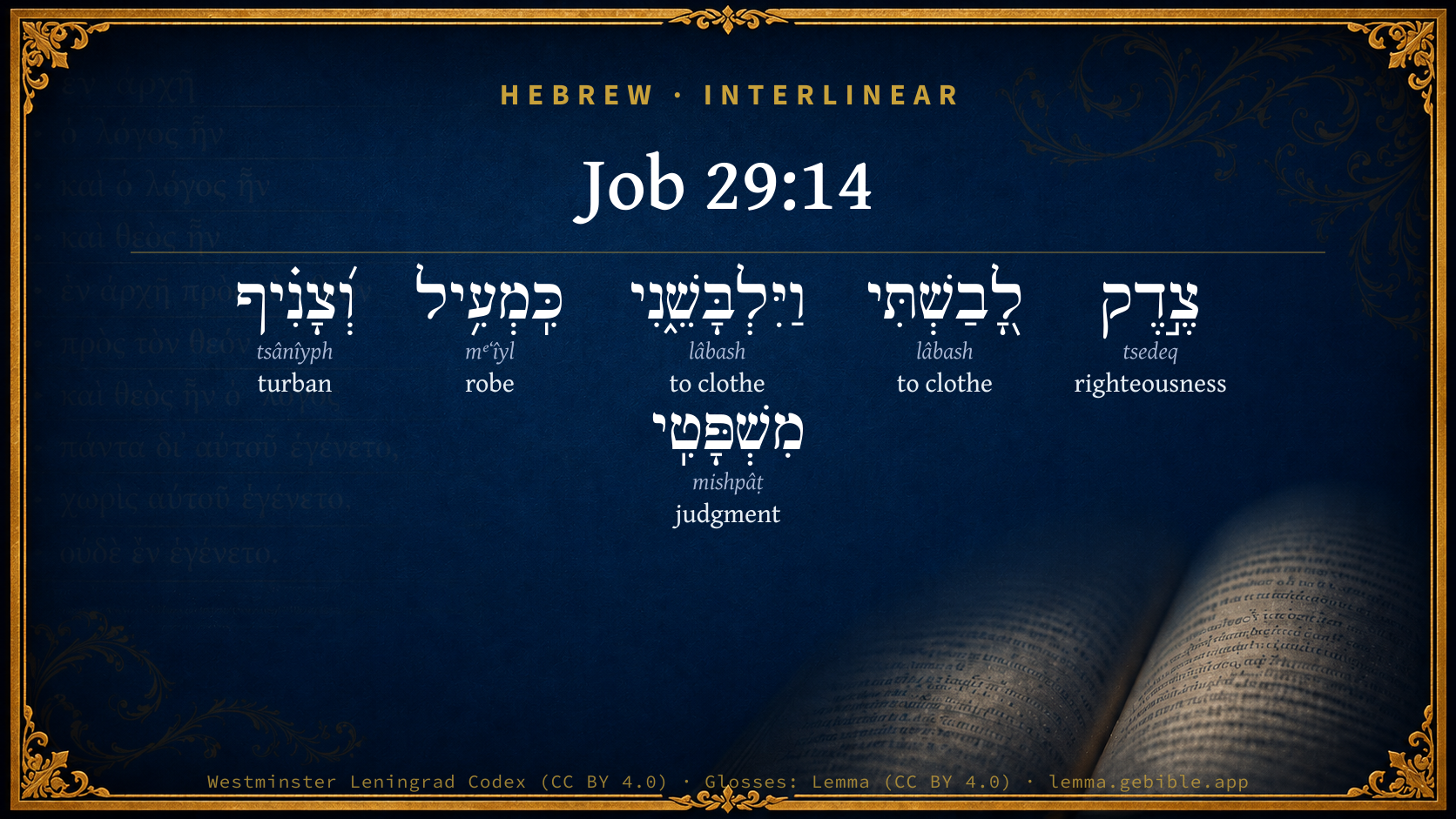
Hebrew (Westminster Leningrad Codex) Job 29:14 appears in the Hebrew Old Testament. The text above is from the Westminster Leningrad Codex. Each word links to its Strong’s number, a concise gloss, and parsing drawn from the Open Scriptures Hebrew Bible morphology. Click any word for its full Brown-Driver-Briggs (BDB) entry.
Download image
Cite this verse

Job 29:14 (World English Bible). Public Domain. Lemma interlinear Bible study tool, https://lemma.gebible.app/v/job/29/14.

Show BibTeX & RIS
BibTeX
RIS
English Translation
I put on righteousness, and it clothed me. My justice was as a robe and a diadem.
World English Bible · Public Domain
Highlights
  • 1 first appearance in the Hebrew Bible
Full analysis ↓
Download a study sheet

One document with this verse’s original text, its word-by-word gloss line, the meaning frame, cross-references with their text, attributed commentary, and full source and license credits — printable, and it pastes into notes with its structure intact.

This verse Autodidact and up

Study sheet (.html) Plain text (.txt)

A passage Seminary Student

Up to 50 verses in one chapter. A passage sheet keeps up to 6 commentary sources and 12 cross-references per verse, in the order this page ranks them, and says so on the sheet whenever that leaves anything out. Ask for a single verse and you get the Autodidact verse sheet above.

Everything on this page stays free to read, with no account — the sheet is a download of what is already on screen, not access to it.

Want to remove ads? Support Godless Engineer
Compare translations 3

The same verse in 3 English versions, stacked beneath the original-language interlinear above. Click any original word for its lexicon entry.

Each is an independent rendering of the whole verse — the interlinear is not word-aligned to these translations.

Highlighted words mark where these versions differ — a whole-verse word diff, not a word-by-word alignment.

  • World English Bible Public Domain
    I put on righteousness, and it clothed me. My justice was as a robe and a diadem.
  • King James Version Public Domain
    I put on righteousness, and it clothed me: my judgment was as a robe and a diadem.
  • unfoldingWord Literal Text CC BY-SA 4.0
    I clothed myself righteousness, and it clothed me; my justice like a robe and a turban.

unfoldingWord Literal Text — © unfoldingWord, licensed CC BY-SA 4.0. Word-aligned USFM3 via Door43 (git.door43.org/unfoldingWord/en_ult).

Versions to compare (up to 4)

3 of 4 selected

Show all 18 translations

Every available English version of this verse, each an independent rendering of the whole verse.

  • World English Bible Public Domain
    I put on righteousness, and it clothed me. My justice was as a robe and a diadem.
  • Berean Standard Bible Public Domain
    I put on righteousness, and it clothed me; justice was my robe and my turban.
  • Majority Standard Bible Public Domain
    I put on righteousness, and it clothed me; justice was my robe and my turban.
  • King James Version Public Domain
    I put on righteousness, and it clothed me: my judgment was as a robe and a diadem.
  • American Standard Version (1901) Public Domain
    I put on righteousness, and it clothed me: My justice was as a robe and a diadem.
  • Revised Version (1885) Public Domain
    I put on righteousness, and it clothed me: my justice was as a robe and a diadem.
  • Geneva Bible (1599) Public Domain
    I put on iustice, and it couered me: my iudgement was as a robe, and a crowne.
  • Douay-Rheims (1899) Public Domain
    I was clad with justice: and I clothed myself with my judgment, as with a robe and a diadem.
  • Young's Literal Translation Public Domain
    Righteousness I have put on, and it clotheth me, As a robe and a diadem my justice.
  • Literal Standard Version CC BY-SA 4.0
    I have put on righteousness, and it clothes me, || My justice as a robe and a crown.
  • Unlocked Literal Bible CC BY-SA 4.0
    I put on righteousness, and it clothed me; my justice was like a robe and a turban.
  • unfoldingWord Literal Text CC BY-SA 4.0
    I clothed myself righteousness, and it clothed me; my justice like a robe and a turban.
  • Darby Bible Public Domain
    I put on righteousness, and it clothed me; my justice was as a mantle and a turban.
  • World Messianic Bible Public Domain
    I put on righteousness, and it clothed me. My justice was as a robe and a diadem.
  • Webster's Bible Public Domain
    I put on righteousness, and it clothed me: my judgment was as a robe and a diadem.
  • Free Bible Version CC BY-SA 4.0
    Being true and acting right were what I wore for clothing.
  • Bible in Basic English Public Domain
    I put on righteousness as my clothing, and was full of it; right decisions were to me a robe and a head-dress.
  • JPS Tanakh (1917) Public Domain
    I put on righteousness, and it clothed itself with me; my justice was as a robe and a diadem.

Literal Standard Version (2020), Covenant Press — licensed CC BY-SA 4.0. Text via the HelloAO Bible API (eBible.org). Unlocked Literal Bible (unfoldingWord) — licensed CC BY-SA 4.0. Text via the HelloAO Bible API (eBible.org). unfoldingWord Literal Text — © unfoldingWord, licensed CC BY-SA 4.0. Word-aligned USFM3 via Door43 (git.door43.org/unfoldingWord/en_ult). Free Bible Version, Dr. Jonathan Gallagher — licensed CC BY-SA 4.0. Text via the HelloAO Bible API (eBible.org).

Word by word

More ways to search: Search by grammar → Find every occurrence → Compare this word →

Practice this passage: Drill this verse → Learn its vocabulary →

About this verse

These counts appear in no published source. They are computed here, from the morphology-tagged text and Lemma’s own curated glosses. What Lemma adds →

6
words
5
distinct lemmas
Wisdom
section

Notable vocabulary

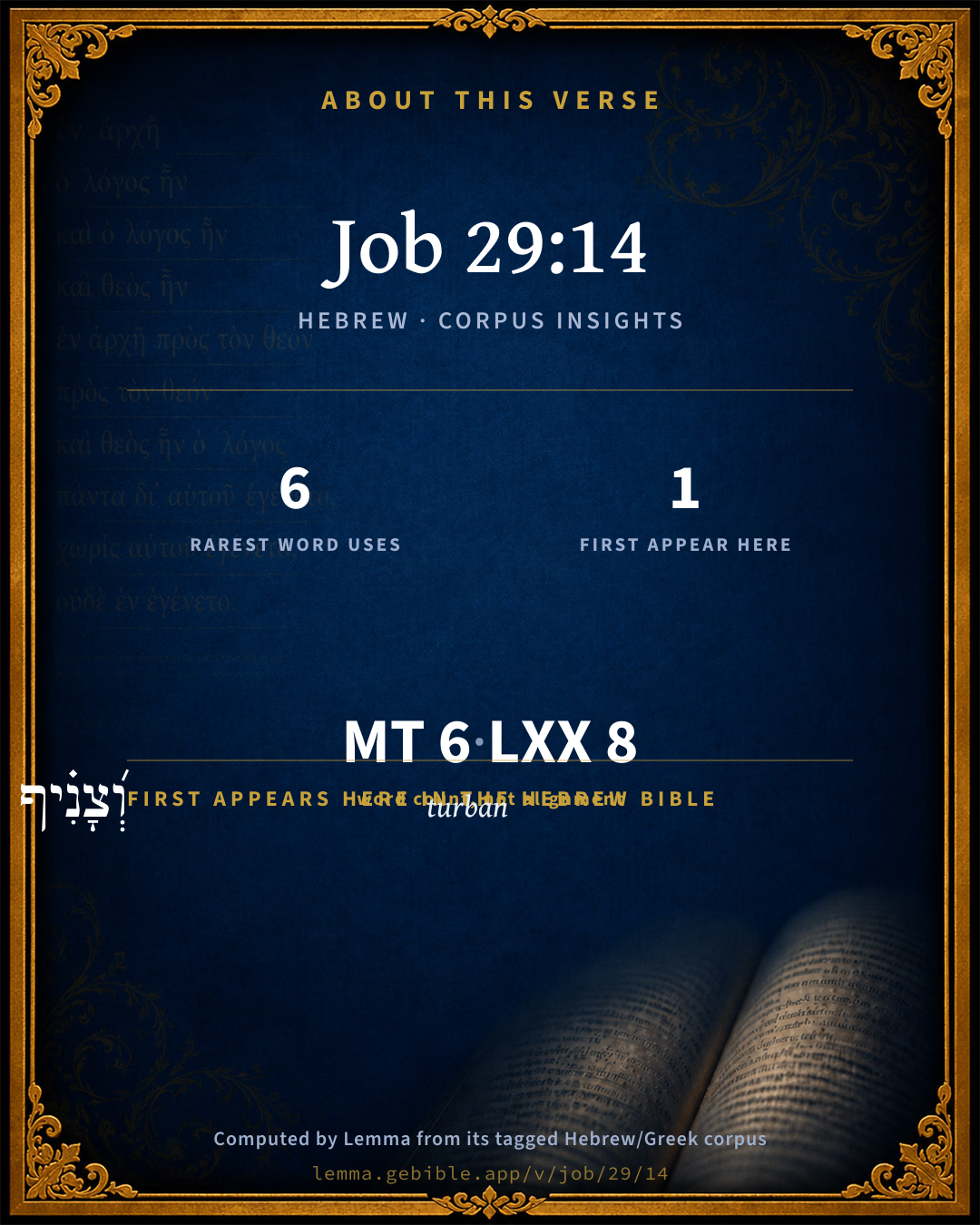
The rarest word here is וְ֝צָנִ֗יף turban H6797 — appearing just 6 times in the whole Hebrew Bible.

First appearance in Scripture

This word makes its first canonical appearance in the Hebrew Bible here:

  • וְ֝צָנִ֗יף turban H6797

Shared distinctive vocabulary

וְ֝צָנִ֗יף turban H6797 occurs in 4 verses of the Hebrew Bible. Also found in:

Grammatical profile

  • 2 verbs
  • 4 nouns

Verb forms

  • לָ֭בַשְׁתִּי Qal · Perfect
  • וַיִּלְבָּשֵׁ֑נִי Qal · Sequential Imperfect

Repetition

A word recurs within this verse — often emphatic in Hebrew:

  • לָ֭בַשְׁתִּי to clothe H3847 ×2

Hebrew & Septuagint length

In English translation the verse runs 17 words from the Hebrew and 13 from the Septuagint (LXX English) — closely comparable.

A rough comparison of the two English renderings, which tokenize alike — not a word-level alignment.

Word counts can differ between the Hebrew and the Greek without any difference in meaning — e.g. the Hebrew direct-object marker אֵת has no separate Greek word, and Greek often adds the article ὁ.

In the original languages it is 6 Hebrew tokens and 8 Greek tokens — but the two are counted differently (Hebrew bundles its prefixes and suffixes into one token; the Greek is in lemma form), so that isn’t a like-for-like length.

Cross-references

12

Topical passages linked to Job 29:14 in the Treasury of Scripture Knowledge — connected by theme and wording, ordered by reader-vote popularity; previews shown in the World English Bible.

  • Isaiah 61:10 I will greatly rejoice in Yahweh, my soul shall be joyful in my God; for he has clothed me with the garments of salvation, he has covered me with the robe of righteousness, as a bridegroom decks himself with a garland, and as a bride adorns herself with her jewels.
  • Isaiah 59:17 He put on righteousness as a breastplate, and a helmet of salvation on his head; and he put on garments of vengeance for clothing, and was clad with zeal as a mantle.
  • Psalms 132:9 Let your priest be clothed with righteousness. Let your saints shout for joy!"
  • Ephesians 6:14 Stand therefore, having the utility belt of truth buckled around your waist, and having put on the breastplate of righteousness,
  • Job 27:6 I hold fast to my righteousness, and will not let it go. My heart shall not reproach me so long as I live.
  • Revelation 19:8 It was given to her that she would array herself in bright, pure, fine linen: for the fine linen is the righteous acts of the saints.
  • Isaiah 62:3 You shall also be a crown of beauty in the hand of Yahweh, and a royal diadem in the hand of your God.
  • 2 Corinthians 6:7 in the word of truth, in the power of God; by the armor of righteousness on the right hand and on the left,
  • 1 Thessalonians 5:8 But let us, since we belong to the day, be sober, putting on the breastplate of faith and love, and, for a helmet, the hope of salvation.
  • Deuteronomy 24:13 you shall surely restore to him the pledge when the sun goes down, that he may sleep in his garment, and bless you: and it shall be righteousness to you before Yahweh your God.
  • Romans 13:14 But put on the Lord Jesus Christ, and make no provision for the flesh, for its lusts.
  • Isaiah 28:5 In that day will Yahweh of Hosts become a crown of glory, and a diadem of beauty, to the residue of his people;

Cross-references courtesy of OpenBible.info (CC BY 4.0).

Hebrew and Greek witnesses Masoretic Hebrew ↔ Greek Septuagint

The same verse in the two great witnesses to the Old Testament, shown verse-for-verse.

These are two independent witnesses, not word-aligned to each other, and the Septuagint is shown in lemma (dictionary) form.

Hebrew Job 29:14 Masoretic · Westminster Leningrad Codex

צֶ֣דֶק לָ֭בַשְׁתִּי וַיִּלְבָּשֵׁ֑נִי כִּֽמְעִ֥יל וְ֝צָנִ֗יף מִשְׁפָּטִֽי

I put on righteousness, and it clothed me. My justice was as a robe and a diadem.

World English Bible · Public Domain

Greek LXX Job 29:14 Septuagint · lemma form

δικαιοσύνη δέ ἐνδύω ἀμφιάζω δέ κρίμα ἴσος διπλοΐς

Also I put on righteousness, and clothed myself with judgment like a mantle.

LXX2012 (modern English Septuagint) · Public Domain

Hebrew: Westminster Leningrad Codex (CC BY 4.0). Greek: Septuagint (public domain); English from LXX2012 (modern English Septuagint) (Public Domain). How the Septuagint differs from the Hebrew →

Commentary

Notes on Job 29:14 from classic Christian and Jewish commentators (each source and its license shown beneath its notes). The classic Christian expositions comment on the surrounding passage and are grouped to its opening verse, so a note may address several verses; the Jewish commentaries on the Tanakh (Rashi and others) are per-verse, so they appear only where the commentator wrote on this verse.

Lemma curates 59 commentaries, every one of them public domain or Creative Commons licensed, each selected and text-cleaned for this edition rather than reprinted as found. About our sources →

Trapp's Complete Commentary

John Trapp

Job 29:14 I put on righteousness, and it clothed me: my judgment [was] as a robe and a diadem.

Ver. 14. I put on righteousness, and it clothed me] It was not ambition, popularity, or self-interest that put Job upon these and the following good practices and proceedings, but the care he had of discharging his trust, and the pure love he bare to justice and upright dealing, Fontem horum officiorum aperit (Merlin). For although he desired more to be loved than honoured (as it is said of Trajan the emperor), yet he would not do anything of popularity or partiality, by writhing or warping, but retained the gravity of the law; which is a heart without affection, an eye without lust, a mind without passion, a treasurer which keepeth for every man what he hath, and distributeth to every man what he ought to have, Fιλουμενος μαλλον η πιμωμενος εχαιρε (Dio). Job did put on righteousness, and it put on him; so the Hebrew hath it. By which similitude he declareth that he could as little be drawn from doing justice as he could go abroad without his clothes, or suffer them to be pulled off him, Declinatione et detorsione iudicii (Merlin).

My judgment was as a robe and a diadem] Righteousness is that whereby the innocent is delivered, judgment is that whereby the guilty person is punished, saith Brentius. With these was Job arrayed and adorned far better than was Alcisthenes the Sybarite with his cloak, sold by Dionysius to the Carthaginians for a hundred and twenty talents (Athenaeus); or Hanun with his solid gold diadem, "the weight whereof was a talent of gold with the precious stones," 2Sa 12:30. Some judges have nothing more to commend them than their robes, which are oft lined with rapine and robbery. So were not Job’s; he made the like use of them that old Eleazar did of his hoariness, he would not do anything that might seem to be evil, because he would not spot his white head; no more would Job, lest he should stain his purple, disgrace his diadem. He knew that dignitas in indigno est ornamentum in luto, Ruledom without righteousness is but eminent dishonour (Salvian).

John Trapp, A Commentary or Exposition upon All the Books of the Old and New Testament (1647–1656) — public domain. Text from a community e-Sword module.

The Biblical Illustrator

Joseph S. Exell

Job_29:14-17

I put on righteousness.

Ad magistratum

When others do us open wrong, it is not vanity, but charity, to do ourselves open right. And whatsoever appearance of folly or vain boasting there is in so doing, they are chargeable with all that compel us thereunto, and not we. It was neither pride nor passion in Job, but such a compulsion as this, that made him so often proclaim his own righteousness. It seemeth Job was a good man, as well as a great; and being good, he was by so much the better, by how much he was the greater. The grieved spirit of Job uttered these words for his own justification; but the blessed Spirit of God hath since written them for our instruction; to teach us, from Jobs example, how to use that measure of greatness and power which He hath given us, be it more, or be it less, to His glory and the common good. We have to learn the principal duties which concern those that live in any degree of efficiency or authority. Those duties are four.

I. A care, and love, and zeal of justice. This is the chief business of the magistrate. I put on righteousness, and it clothed me. The metaphor of clothing is much used in the Scriptures in this notion as it is applied to the soul, and things appertaining to the soul. We clothe ourselves either for necessity, to cover our nakedness; for security or defence against enemies; or for state and solemnity, for distinction of offices and degrees. Jobs words intimate the great love he had unto justice, and the great delight he took therein. And it is the master duty of the magistrate to do justice, and to delight in it. He must make it his chief business, and yet count it his lightsome recreation. Magistrates may learn from the examples of Job, of Solomon, and of Jesus Christ Himself. Justice is a thing in itself most excellent; from it there redoundeth much glory to God; to ourselves so much comfort, and to others so much benefit.

II. Compassion to the poor and distressed. Mens necessities are many, and of great variety; but most of them spring from one of these two defects, ignorance, or want of skill; and impotence, or want of power: here signified by blindness and lameness. A magistrate can be eyes to the blind, by giving sound and honest counsel to the simple. He can be feet to the lame, by giving countenance and assistance in just and honest causes; and father to the poor, by giving convenient safety and protection to those in distress. The preeminence of magistrates consisteth in their ability to do good and help the distressed, more than others. As they receive power from God, so they receive honours and service and tributes from their people for the maintenance of that power. God hath imprinted in the natural conscience of every man notions of fear, and honour, and reverence, and obedience, and subjection, and contribution, and other duties to be performed towards kings, magistrates, and other superiors. Mercy and justice must go together, and help to temper the one the other. The magistrate must be a father to the poor, to protect him from injuries, and to relieve his necessities, but not to maintain him in idleness. He must make provision to set him on work; and give him sharp correction should he grow idle, dissolute, or stubborn.

III. Pains and patience in examination of causes. The cause which I knew not, I searched out. In the administration of justice the magistrate must make no difference between rich and poor, far or near, friend or foe. The special duty imposed on magistrates is diligence, and patience, and care to hear, and examine, and inquire into the truth of things, and into the equity of mens causes. Truth often lieth, as it were, in the bottom of a pit, and has to be found and brought to light. Innocency itself is often laden with false accusations.

IV. Stoutness and courage in execution of justice. I brake the jaws of the wicked. Job alludes to savage beasts, beasts of prey; types of the greedy and violent ones of the world. For breaking the jaws of the wicked there is required a stout heart and an undaunted courage. This is necessary for the magistrates work and for the maintenance of his dignity. Inferences--

1. Of direction; for the choice and appointment of magistrates according to the above four properties.

2. Of reproof; for a just rebuke of such magistrates as fail in any of these four duties.

3. Of exhortation; to those who are, or shall be magistrates, to carry themselves therein according to these four rules. (Bishop Sanderson.)

Sermon on the election of a Lord Mayor

Jobs reflections on the flourishing estate he had once enjoyed did at the same time afflict and encourage him.

I. What a public blessing a good magistrate is: a blessing as extensive as the community to which he belongs; a blessing which includes all other blessings whatsoever that relate to this life. The benefits of a just and good government to those who are so happy as to be under it, like health to vigorous bodies, or fruitful seasons in temperate climes, are such common and familiar blessings that they are seldom either valued or relished as they ought to be.

II. The outward marks of distinction and splendour which are allotted to the magistrate. Of these the robe and diadem, mentioned by Job, are illustrations. It was intended thus--

1. To excite the magistrate to a due degree of vigilance and concern for the public good. The magistrate was made great, to inspire him with resolutions of living suitably to his high profession and calling.

2. To secure the magistrates person, in which the public tranquillity and safety are always involved.

3. To ensure that the magistrate is had in due estimation and reverence by all those who are subject to him. It is in the civil government, as in the offices of religion; which, were they stript of all the external decencies of worship, would not make a due impression on the minds of those who assist at them. The solemnities that encompass the magistrate, add dignity to all his actions, and weight to all his words and opinions.

4. To aid the magistrate to reverence himself. He who esteems and reverences himself will not fail to take the truest methods towards procuring esteem and reverence from others.

III. The duties of the magistrate. The chief honour of the magistrate consists in maintaining the dignity of his character by suitable actions, and in discharging the high trust that is reposed in him, with integrity, wisdom, and courage. Reputation is the great engine by which those who are possessed of power must make that power serviceable to the ends and uses of government. The rods and axes of princes and their deputies may awe many into obedience; but the fame of their goodness, and justice, and other virtues will work on more; will make men not only obedient, but willing to obey. An established character spreads the influence of such as move in a high sphere, on all around and beneath them. The actions of men in high stations are all conspicuous, and liable to be scanned and sifted. They cannot hide themselves from the eyes of the world as private men can. Great places are never well filled but by great minds; and it is as natural to a great mind to seek honour by a due discharge of a high trust, as it is to little men to make less advantages of it. A good magistrate must be endued with a public spirit, and be free from all narrow and selfish views. He must impartially distribute justice, without respect of persons, interests, or opinions. Courtesy and condescension is another happy quality of a magistrate. Bounty also, and a generous contempt of that in which too many men place their happiness, must come in to heighten his character. Of all good qualities, that which recommends and adorns the magistrate most, is his care of religion; which, as it is the most valuable thing in the world, so it gives the truest value to them, who promote the esteem and practice of it, by their example, authority, influence, and encouragement. (F. Atterbury, D. D.)

The Biblical Illustrator, edited by Joseph S. Exell (c. 1880s–1900s) — public domain. Text from a community e-Sword module.

Joseph Benson's Commentary

Job 29:14. I put on righteousness, and it clothed me — As a garment covers the whole body, and is worn continually all the day long, so I was constantly just in the whole course of my administrations, public and private; and I never put off this clothing, out of partiality to myself, or respect to the persons of others, as the manner of many judges is. My judgment was as a robe and diadem — My judgments, or decrees, were so equal and righteous, that they never brought shame and reproach upon me, but rather honour and reputation; and I looked upon them as a greater ornament than the purple robe or the diadem.

Joseph Benson's Commentary on the Old and New Testaments (1811–1818) — public domain. Text from a community e-Sword module.

Tyndale Open Study Notes

Tyndale Open Resources

29:14 Job described his righteousness in royal terms. A robe is a common biblical image for righteousness (Ps 132:9; Isa 59:17; 61:10; Rom 13:14; Rev 19:8).

Tyndale Open Study Notes — © Tyndale Open Resources, licensed CC BY-SA 4.0. Text via the HelloAO Bible API.

Geneva Bible (1599)

Geneva Bible translators

I delighted to do justice, as others did to wear costly apparel.

Geneva Bible (1599) marginal notes — public domain. Text via Bolls.life.

Jamieson, Fausset & Brown

Robert Jamieson, A. R. Fausset & David Brown

(Isa 61:10; Ch1 12:18).

judgment--justice.

diadem--tiara. Rather, "turban," "head-dress." It and the full flowing outer mantle or "robe," are the prominent characteristics of an Oriental grandee's or high priest's dress (Zac 3:5). So Job's righteousness especially characterized him.

Jamieson, Fausset & Brown — Commentary Critical and Explanatory on the Whole Bible (1871) — public domain (CC PDM 1.0). Text via the HelloAO Bible API.

Ellicott's Commentary for English Readers

(14) I put on righteousness.—Comp. Isa_61:10; Isa_28:5; Isa_62:3; 2Ti_4:8; Jas_1:12; 1Pe_5:4; 1Th_2:19. His judgment, the result of his personal righteousness, was as a robe of honour and a crown of glory to him.

It clothed me.—Literally, it clothed itself with me. First, righteousness is the garment, and then he is the garment to righteousness. (Compare the expressions “Put ye on the Lord Jesus Christ,” Rom_13:14, and 2Co_5:2-4, and the Hebrew of Psa_143:9, where “I flee unto thee to hide me” is, I have covered myself with thee, or, have hidden me with thee.) This is the Gospel truth of the interchange of sin and righteousness between Christ and the believer. He bears our sins; we are clothed with the robe of His righteousness.

A Bible Commentary for English Readers, edited by Charles John Ellicott (1878–1897) — public domain. Text from a community e-Sword module.

The Cambridge Bible for Schools and Colleges

gen. ed. J. J. S. Perowne

14. and it clothed me] Rather, and it clothed itself in me. Job clothed himself with righteousness, so that as a man he was lost in the justice that clothed him; and justice clothed itself in him—he on the other hand was justice become a person.

The Cambridge Bible for Schools and Colleges (gen. ed. J. J. S. Perowne; Cambridge University Press, 1878–1918) — public domain. Text from a community e-Sword module.

John Gill's Exposition

I put on righteousness, and it clothed me,.... Not the righteousness of his living Redeemer, the robe of righteousness and garment of salvation he had from him; though he had put on that by faith, and it was his clothing in the sight of God, which covered his person, and covered all his sins from the avenging eye of divine justice; and in which he was presented before God unblamable and irreprovable in his sight, and with which he was adorned and beautified, being made perfectly comely through it, and completely justified by it; but legal righteousness in the administration of his office as a magistrate; he put it on, that is, he exercised it, and he exercised it constantly from morning tonight, and day after day; as a man puts on his clothes in a morning, and keeps them on all the day, and which he is always repeating; and it was as visible in him, and to be seen and observed by all, as the clothes on his back; and it covered him all over as a garment does; no blemish was to be seen in him, or blame to be cast upon him, throughout the whole course of his administration; and this was a fence unto him against all calumny and reproach, as garments are against the inclemency of the weather; see Sa1 12:3; so a godly conversation in the exercise of graces and virtues, and in the performance of duties both to God and man, is sometimes expressed by a putting them on, as garments are put on; see Eph 4:24; and these are an outward clothing to appear in before men, and should be shown forth with meekness and wisdom, so as to be beheld by men; and should be continually exercised and constantly performed; and then they are a covering with respect to men, and they appear harmless, blameless, and without rebuke, in the midst of a crooked and perverse generation; and thus, by well doing, put to silence the ignorance of foolish men, and such to the blush, those who falsely accuse their good conversation: and this in every sense was Job's case:

my judgment was as a robe and diadem; such as the high priest among the Jews wore in the execution of his office, which made him look grand and majestic; and it was usual in Job's time, as it is in ours, and has been the custom in all ages and countries, for judges and civil magistrates to be clothed in a different manner from others, as it is proper they should, to command an awe and reverence of them among the common people, and make them respectable to them: but Job did not so much regard his purple robe he was clad in, or the distinguishing turban he wore on his head, or whatever it was, and which might bear some resemblance to a mitre or a diadem; as it was his great concern to administer justice, which he reckoned his greatest honour, and was more ornamental to him than all the showy ensigns of his office; and it was this which gave him honour and esteem among all sorts of men, high and low: and his regard to the poor, before observed, did not arise from a foolish commiseration of them as poor men, and in order to get himself a name for his pity to them, but proceeded upon a principle of justice and equity, which he made the rule of his administration; he did not countenance the poor in his cause right or wrong; not the quality of the person, but the righteousness of his cause, was what he attended to; and he took his part not merely because he was a poor man, but seeing his cause was just.

John Gill's Exposition of the Whole Bible (1746–1763) — public domain (CC PDM 1.0). Text via the HelloAO Bible API.

Albert Barnes' Notes on the Bible

I put on righteousness - Or “justice” - as a magistrate, and in all his transactions with his fellow-men. It is common to compare moral conduct or traits of character with various articles of apparel; compare Isa 11:5, note; Isa 61:10, note.

And it clothed me - It was my covering; I was adorned with it. So we speak of being “clothed with humility;” and so, also, of the “garments of salvation.”

My judgment - Or rather justice - particularly as a magistrate.

Was as a robe - The word “robe” (מעיל me‛ı̂yl) denotes the “mantle” or outer garment that is worn by an Oriental. It constitutes the most elegant part of his dress; Notes at Isa 6:1. The idea is, that his strict justice was to him what the full flowing robe was in apparel. It was that for which he was best known; that by which he was distinguished, as one would be by an elegant and costly robe.

And a diadem - Or, “turban”. The word used here צניף tsânı̂yph - is from צנף tsânaph, to roll, or wind around, and is applied to the turban, because it was thus wound around the head. It is applied to the mitre of the high priest Zec 3:5, and may also be to a diadem or crown. It more properly here, however, denotes the “turban,” which in the East is an essential part of dress. The idea is, that he was fully clad or adorned with justice.

Albert Barnes' Notes on the Bible (1834–1885) — public domain. Text from a community e-Sword/MySword module.

Matthew Poole's English Annotations

It clothed me: as a garment covers the whole body, and is worn continually all the day long; so I was constantly just in the whole course of all my administrations, public and private, and never put off this garment out of a partial respect to myself, or to the persons of other men, as the manner of many judges is.

My judgment was as a robe and diadem; my judgments or decrees were so equal and righteous, that they never brought shame and reproach upon me, but always honour and great reputation.

Matthew Poole's English Annotations on the Holy Bible (1683–1685) — public domain. Text from a community e-Sword/MySword module.

Whedon's Commentary on the Bible

Daniel D. Whedon

14. And it clothed me — לבשׁ, to put on, clothe; the same word in both clauses of the sentence. The righteousness he put on renewed and transformed his being into its own pure nature: — It (righteousness) put on me. “Job means to say, without and within was I righteous.” — Hahn. The same word is used of the Spirit of Jehovah when he makes man the organ for the manifestation of his power. Jdg_6:34; 1Ch_12:18. On the other hand, sin is like the burning garment of Nessus — it changes man’s entire nature into its own miserable likeness.

Diadem — Tiara or turban. This consisted of costly cloths, wound around the head. According to Niebuhr, the head-dress worn by Arabians of fashion is both complicated and imposing. “They wear fifteen caps, one over another, some of which are indeed of linen, but the rest of thick cloth or cotton. That which covers all the rest is usually richly embroidered with gold, and has always some sentence of the Koran embroidered upon it.” See farther, Travels, 2:233.

Judgment — Integrity is comely attire for the entire man. Job carries forward to a climax the beautiful figure in the first clause, of clothing and adornment for the soul. (Comp. Isa_11:5; Isa_51:9; Isa_59:17.) Spotless integrity was his royal robe, מעיל, (see note, Job_1:20,) and a diadem or crown for his brow.

Daniel D. Whedon (gen. ed.), Commentary on the Old and New Testaments (1874–1909) — public domain. Text from a community e-Sword module.

The Pulpit Commentary

I put on righteousness, and it clothed me. (comp. Isa_61:10 Psa_132:9, etc.) Job "put on righteousness;" i.e. made it as the garment wherewith he clothed himself withal, (Psa_109:18, Psa_109:19) covered up with it all his own natural imperfections, and made it part and parcel of his being. It was a beautiful covering, and, when once he had put it on, it clung to him, and could not be removed. It "clothed him," or rather, if we translate the Hebrew literally, "clothed itself with him." putting him on, as he had put it on. It was not merely external; it was internal, a habit of his soul and spirit. My judgment was as a robe and a diadem; rather, my justice (see the Revised Version). My "justice," or "righteousness" (for the words are synonymous), was at once my robe and my crown, my necessary clothing and my ornament. (comp. Isa_61:10, "He hath clothed me with the garments of salvation, he hath covered me with the robe of righteousness, as a bridegroom decketh himself with ornaments, and as a bride adorneth herself with her jewels

Clothed with righteousness.

I RIGHTEOUSNESS CLOTHES A MAN AS WITH A GARMENT.

1. It covers. If a man has but a good character, we can pardon much else in him. He may be weak, foolish, unfortunate. He may have failed in the world, and have come down to poverty. Yet he is not in rags. A royal robe covers him, and, in the eyes of those who can appreciate true worth, this is the one thing seen about him.

2. It protects. The garment is to keep off the chill winds and damping mists and scorching sun. Righteousness is more than a stout garment. It is a piece of armour a breastplate, protecting the heart. (Eph_6:14) When once a man is assured of the integrity of his cause he can look the whole world in the face; he can dare to go through fire and water; he is strong and safe where one with an evil conscience may well tremble and cower.

3. It adorns. This righteousness is not only decent and comforting, like a thick, warm, homespun garment; it is more beautiful than a king"s clothing of purple and silk and gold embroidery. There is no beauty so fair as that of goodness.

4. It cannot be hidden. It is not a secret confined to the heart. It must be there first, it must spring from the heart. But it is not hidden within. Character is visible, like a garment worn in the street.

II THE RIGHTEOUSNESS WHICH THUS CLOTHES MUST BE REAL. It is only the perversity of an erroneous theology that could ever make it necessary to utter so obvious a sentence as this. There is a way of referring to the imputed righteousness of Christ as though this dispensed with the necessity of our being ourselves righteous. Surely such a doctrine would be immoral. In what respects could this so-called robe of righteousness be distinguished from the hypocrite"s cloak? If Christ"s righteousness were only to hide our unrighteousness without curing it, not only would a great deception be practiced, but no real good would be done. The result would be an unmitigated evil. For what is our curse and our ruin? Is it not our sin? If so, nothing can benefit us that does not destroy that sin. Therefore an attempt to cover it up and leave it unaltered will do us no good, but will injure us by drugging our conscience and giving us a false assurance. In Eastern cities an open drain runs down the middle of the street, and is not so offensive as one might think, because it is always being oxidized and purified by the fresh air. We cover over our drains, but make ventilating holes in our streets, through which gases of concentrated foulness, unmixed with pure air, are continually rising among the passers-by. Have we gained much?

III ONLY CHRIST CAN CLOTHE US WITH RIGHTEOUSNESS. Self-righteousness is a delusion. We cannot make ourselves righteous, nor can any law put us right with God. St. Paul demonstrated this in the opening chapters of his Epistle to the Romans. But he also showed that God had given us righteousness in Christ. (Rom_3:21, Rom_3:22) Now, this comes first of all in forgiveness. We are then put in a right relation with God, before we have overcome all the sin that dwells within us. Christ is the promise of our future righteousness. In this way his righteousness means much to us. God cannot be taken in by any fiction. He can only regard us just as we are. But he can treat us for Christ"s sake better than we deserve. So through Christ we are placed in right relations with God, and those right relations are the channels through which real righteousness comes into us. W.F.A.

The Pulpit Commentary (1880–1919), ed. H.D.M. Spence-Jones & Joseph S. Exell — public domain. Text from a community e-Sword module.

John Wesley's Explanatory Notes

Put on, &c. - Perhaps he did not wear these: but his steady justice was to him instead of all those ornaments.

John Wesley, Explanatory Notes Upon the Whole Bible (1754–1765) — public domain. Text via the GEBible commentary corpus.

unfoldingWord translationNotes

Door43 World Missions Community

I put on righteousness, and it clothed me

People often spoke of righteousness as if it were clothing. AT: "I did what was righteous, and it was like clothing that I put on" (See: Metaphor)

my justice was like a robe and a turban

People often spoke of justice as if it were clothing. AT: "I did what was just, and it was like a robe and a turban on me" (See: Simile)

turban

a long cloth that men wrap around their heads and wear as a hat

I was eyes to blind people

This represents helping blind people. AT: "I was like eyes for blind people" or "I guided blind people" (See: Metaphor)

I was feet to lame people

This represents helping blind people. AT: "I was like feet for lame people" or "I supported lame people" (See: Metaphor)

I was a father to needy people

Here "I was a father" represents providing for people. AT: "I provided for needy people as a father provides for his children" (See: Metaphor)

translationWords

righteous

clothe

just

robe

unfoldingWord translationNotes — © Distant Shores Media and the Door43 World Missions Community, licensed CC BY-SA 4.0. Source: git.door43.org/Door43/en_tn.

Rashi

Rabbi Shlomo Yitzchaki (Rashi)

I put on righteousness and it clothed me I pursued righteousness and it is present with me as a coat and a turban, which are beautiful ornaments; so was my judgment beautiful and pure.

Rashi on the Tanakh — English translations: “The Judaica Press complete Tanach with Rashi, translated by A. J. Rosenberg” (CC BY 4.0); “Pentateuch with Rashi's commentary by M. Rosenbaum and A.M. Silbermann, 1929-1934” (public domain); “The Metsudah Tanach series, Lakewood, N.J” (CC BY 4.0); and “The Book of Joshua, Metsudah Publications, 1997” (CC BY 4.0). Text via Sefaria.

Lesson kit

Teaching starters — assembled from the data on this page, not authored interpretation. Every prompt links to the verse data it draws on. Edit before teaching.

Job, in the Wisdom, opens this verse with 6 words (5 distinct Hebrew lemmas). Its most distinctive word is tsânîyph (“turban”). A historical commentator’s framing appears above. Read the whole chapter for the surrounding context.

Discussion questions

  1. What does “turban” (tsânîyph) contribute to the verse as a whole?
  2. This is the first place “turban” appears in Scripture (first appears here). What does its debut here establish?
  3. How does Isaiah 3:23, which shares the word «turban», read alongside this verse?
  4. What does the repetition of “to clothe” (2× in this one verse) do in this verse?
  5. These translations render this verse differently; the difference is in the English rendering, not the original. What questions does that raise?
  6. «לָ֭בַשְׁתִּי» is a Qal Perfect verb. How does that grammatical form shape the action described?
  7. Compare how Trapp's Complete Commentary and The Biblical Illustrator read this verse. Where do they agree or differ?

Things to notice

Reading settings

Reading text

Shown beneath each verse's original-language words.

Old Testament
Old Testament edition

Read the OT as the Masoretic Hebrew (MT) or the Greek Septuagint (LXX).

English shown for the Greek Septuagint (in the Hebrew ↔ Greek comparison).

Comparing translations? Open the Compare panel on any verse page to stack up to four side by side.