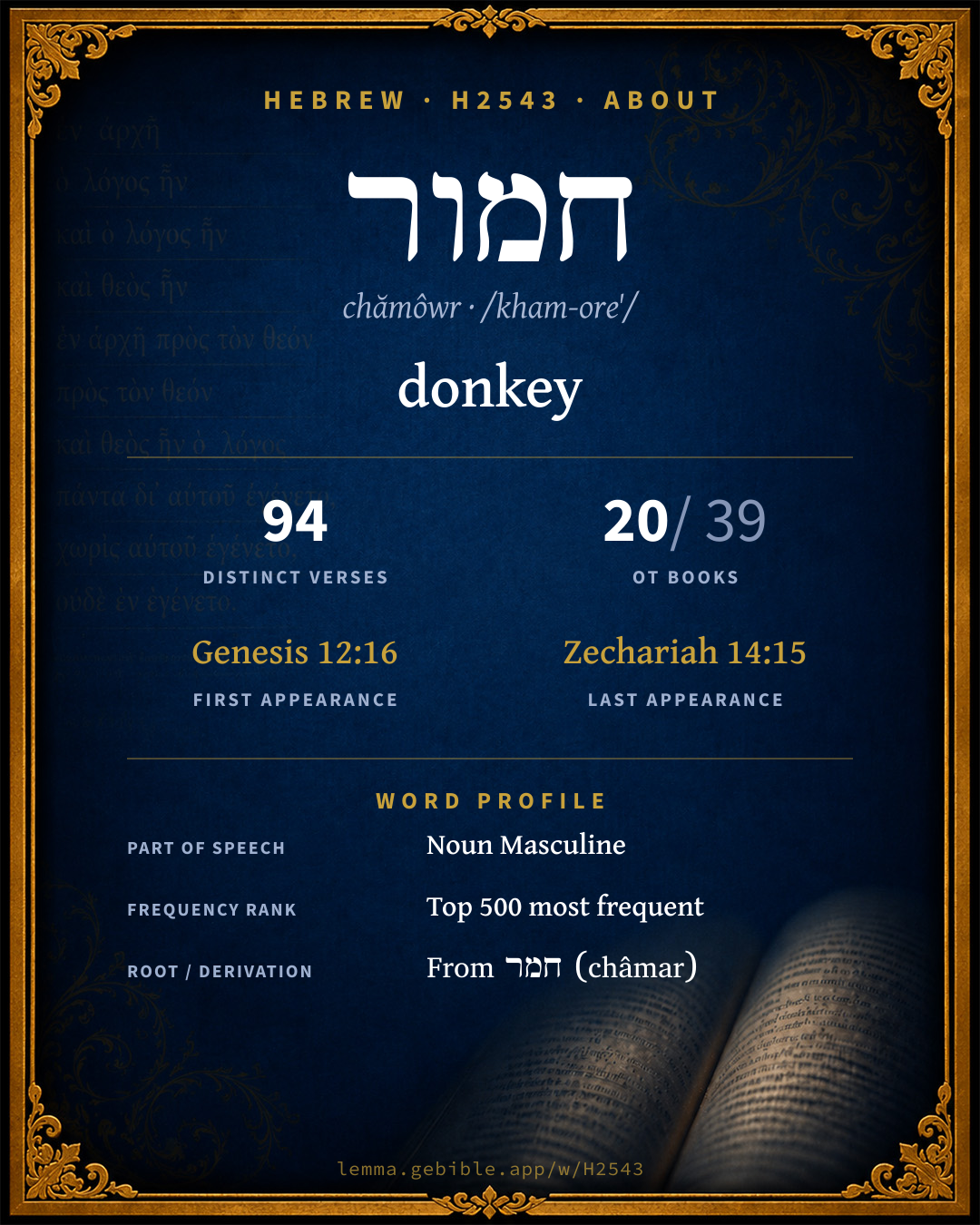
חֲמוֹר
donkey
Full lexicon entry — Brown-Driver-Briggs (BDB)
From Brown-Driver-Briggs (BDB)
Where this word appears
See every Absolute-state word in the Hebrew Bible →
Grammar key — what these labels mean
Part of speech
- Noun
- A naming word — a person, place, thing, or idea.
Noun type
- Common
- A common noun — a general class of person, place, or thing (“king,” “city,” “water”), not a specific name.
State
- Absolute
- The independent form of a noun, not bound to a following word.
- Construct
- A noun bound to a following noun in a possessive / “of” relationship (the construct chain).
Gender
- Both
- Attested as both masculine and feminine.
Number
- Singular
- One.
- Plural
- More than one (in Hebrew, generally three or more).
Grammatical forms
- Noun, Common, Both, Singular, Absolute 44 times (45%)
- Noun, Common, Both, Plural, Absolute 27 times (28%)
- Noun, Common, Both, Singular, Construct 17 times (18%)
- Noun, Common, Both, Plural, Construct 9 times (9%)
Parsed forms decoded from the imported morphology (morphhb / Westminster Leningrad Codex — WLC text public domain, morphhb tagging CC BY 4.0), counted across 97 parsed occurrences — not distinct verses.
Every verse where H2543 appears — 94 distinct verses across 20 books. Click any verse to open its interlinear word-by-word view. Verse text shown in the World English Bible for context — . Each verse’s Hebrew form is shown with its reference; the English is not keyword-highlighted, since the data carries no word-level English alignment. Use “Compare translations” on any verse to read it across multiple English versions. This concordance covers the Hebrew Bible; Septuagint (Greek Old Testament) occurrences are not indexed here.
Genesis 17 verses
- Genesis 12:16 וַ/חֲמֹרִ֔ים conj + n c bp He dealt well with Abram for her sake. He had sheep, and oxen, and male donkeys, and men-servants, and maid-servants, and female donkeys, and camels.
- Genesis 22:3 חֲמֹר֔/וֹ n c bs cs + sfx pers 3ms Abraham rose early in the morning, and saddled his donkey, and took two of his young men with him, and Isaac his son. He split the wood for the burnt offering, and rose up, and went to the place of which God had told him.
- Genesis 22:5 הַ/חֲמ֔וֹר ptcl def.art + n c bs Abraham said to his young men, "Stay here with the donkey. The boy and I will go yonder. We will worship, and come back to you.
- Genesis 24:35 וַ/חֲמֹרִֽים conj + n c bp Yahweh has blessed my master greatly. He has become great. He has given him flocks and herds, silver and gold, men-servants and maid-servants, and camels and donkeys.
- Genesis 30:43 וַ/חֲמֹרִֽים conj + n c bp The man increased exceedingly, and had large flocks, maid-servants and men-servants, and camels and donkeys.
- Genesis 32:5 וַ/חֲמ֔וֹר conj + n c bs I have oxen, donkeys, flocks, men-servants, and maid-servants. I have sent to tell my lord, that I may find favor in your sight.'"
- Genesis 34:28 חֲמֹרֵי/הֶּ֑ם n c bp cs + sfx pers 3mp They took their flocks, their herds, their donkeys, that which was in the city, that which was in the field;
- Genesis 36:24 הַ/חֲמֹרִ֖ים ptcl def.art + n c bp These are the children of Zibeon: Aiah and Anah. This is Anah who found the hot springs in the wilderness, as he fed the donkeys of Zibeon his father.
- Genesis 42:26 חֲמֹרֵי/הֶ֑ם n c bp cs + sfx pers 3mp They loaded their donkeys with their grain, and departed from there.
- Genesis 42:27 לַ/חֲמֹר֖/וֹ prep + n c bs cs + sfx pers 3ms As one of them opened his sack to give his donkey food in the lodging-place, he saw his money. Behold, it was in the mouth of his sack.
- Genesis 43:18 חֲמֹרֵֽי/נוּ n c bp cs + sfx pers 1cp The men were afraid, because they were brought to Joseph's house; and they said, "Because of the money that was returned in our sacks at the first time are we brought in; that he may seek occasion against us, and fall on us, and take us for bondservants, along with our donkeys."
- Genesis 43:24 לַ/חֲמֹֽרֵי/הֶֽם prep + n c bp cs + sfx pers 3mp The man brought the men into Joseph's house, and gave them water, and they washed their feet. He gave their donkeys fodder.
- Genesis 44:3 וַ/חֲמֹרֵי/הֶֽם conj + n c bp cs + sfx pers 3mp As soon as the morning was light, the men were sent away, they and their donkeys.
- Genesis 44:13 חֲמֹר֔/וֹ n c bs cs + sfx pers 3ms Then they tore their clothes, and loaded every man his donkey, and returned to the city.
- Genesis 45:23 חֲמֹרִ֔ים n c bp To his father, he sent after this manner: ten donkeys loaded with the good things of Egypt, and ten female donkeys loaded with grain and bread and provision for his father by the way.
- Genesis 47:17 וּ/בַ/חֲמֹרִ֑ים conj + prep det + n c bp They brought their cattle to Joseph, and Joseph gave them bread in exchange for the horses, and for the flocks, and for the herds, and for the donkeys: and he fed them with bread in exchange for all their cattle for that year.
- Genesis 49:14 חֲמֹ֣ר n c bs cs "Issachar is a strong donkey, Lying down between the saddlebags.
Exodus 12 verses
- Exodus 4:20 הַ/חֲמֹ֔ר ptcl def.art + n c bs Moses took his wife and his sons, and set them on a donkey, and he returned to the land of Egypt. Moses took God's rod in his hand.
- Exodus 9:3 בַּֽ/חֲמֹרִים֙ prep det + n c bp behold, the hand of Yahweh is on your cattle which are in the field, on the horses, on the donkeys, on the camels, on the herds, and on the flocks with a very grievous pestilence.
- Exodus 13:13 חֲמֹר֙ n c bs Every firstborn of a donkey you shall redeem with a lamb; and if you will not redeem it, then you shall break its neck; and you shall redeem all the firstborn of man among your sons.
- Exodus 20:17 וַ/חֲמֹר֔/וֹ conj + n c bs cs + sfx pers 3ms "You shall not covet your neighbor's house. You shall not covet your neighbor's wife, nor his man-servant, nor his maid-servant, nor his ox, nor his donkey, nor anything that is your neighbor's."
- Exodus 21:33 חֲמֽוֹר n c bs "If a man opens a pit, or if a man digs a pit and doesn't cover it, and a bull or a donkey falls into it,
- Exodus 22:4 חֲמ֛וֹר n c bs If the stolen property is found in his hand alive, whether it is ox, donkey, or sheep, he shall pay double.
- Exodus 22:9 חֲ֠מוֹר n c bs For every matter of trespass, whether it be for ox, for donkey, for sheep, for clothing, or for any kind of lost thing, about which one says, 'This is mine,' the cause of both parties shall come before God. He whom God condemns shall pay double to his neighbor.
- Exodus 22:10 חֲמ֨וֹר n c bs "If a man delivers to his neighbor a donkey, an ox, a sheep, or any animal to keep, and it dies or is injured, or driven away, no man seeing it;
- Exodus 23:4 חֲמֹר֖/וֹ n c bs cs + sfx pers 3ms "If you meet your enemy's ox or his donkey going astray, you shall surely bring it back to him again.
- Exodus 23:5 חֲמ֣וֹר n c bs cs If you see the donkey of him who hates you fallen down under his burden, don't leave him, you shall surely help him with it.
- Exodus 23:12 וַ/חֲמֹרֶ֔/ךָ conj + n c bs cs + sfx pers 2ms "Six days you shall do your work, and on the seventh day you shall rest, that your ox and your donkey may have rest, and the son of your handmaid, and the alien may be refreshed.
- Exodus 34:20 חֲמוֹר֙ n c bs The firstborn of a donkey you shall redeem with a lamb: and if you will not redeem it, then you shall break its neck. All the firstborn of your sons you shall redeem. No one shall appear before me empty.
Numbers 6 verses
- Numbers 16:15 חֲמ֨וֹר n c bs Moses was very angry, and said to Yahweh, "Don't respect their offering: I have not taken one donkey from them, neither have I hurt one of them."
- Numbers 31:28 הַ/חֲמֹרִ֖ים ptcl def.art + n c bp Levy a tribute to Yahweh of the men of war who went out to battle: one soul of five hundred, [both] of the persons, and of the oxen, and of the donkeys, and of the flocks:
- Numbers 31:30 הַ/חֲמֹרִ֥ים ptcl def.art + n c bp Of the children of Israel's half, you shall take one drawn out of every fifty, of the persons, of the oxen, of the donkeys, and of the flocks, [even] of all the cattle, and give them to the Levites, who keep the charge of the tent of Yahweh.
- Numbers 31:34 וַ/חֲמֹרִ֕ים conj + n c bp and seventy-one thousand donkeys,
- Numbers 31:39 וַ/חֲמֹרִ֕ים conj + n c bp The donkeys were thirty thousand five hundred; of which Yahweh's tribute was sixty-one.
- Numbers 31:45 וַ/חֲמֹרִ֕ים conj + n c bp and thirty thousand five hundred donkeys,
Deuteronomy 6 verses
- Deuteronomy 5:14 וַ/חֲמֹֽרְ/ךָ֜ conj + n c bs cs + sfx pers 2ms but the seventh day is a Sabbath to Yahweh your God: [in it] you shall not do any work, you, nor your son, nor your daughter, nor your man-servant, nor your maid-servant, nor your ox, nor your donkey, nor any of your cattle, nor your stranger who is within your gates; that your man-servant and your maid-servant may rest as well as you.
- Deuteronomy 5:21 וַ/חֲמֹר֔/וֹ conj + n c bs cs + sfx pers 3ms "Neither shall you covet your neighbor's wife; neither shall you desire your neighbor's house, his field, or his man-servant, or his maid-servant, his ox, or his donkey, or anything that is your neighbor's."
- Deuteronomy 22:3 לַ/חֲמֹר֗/וֹ prep + n c bs cs + sfx pers 3ms So shall you do with his donkey; and so shall you do with his garment; and so shall you do with every lost thing of your brother's, which he has lost, and you have found: you may not hide yourself.
- Deuteronomy 22:4 חֲמ֨וֹר n c bs cs You shall not see your brother's donkey or his ox fallen down by the way, and hide yourself from them: you shall surely help him to lift them up again.
- Deuteronomy 22:10 וּ/בַ/חֲמֹ֖ר conj + prep det + n c bs You shall not plow with an ox and a donkey together.
- Deuteronomy 28:31 חֲמֹֽרְ/ךָ֙ n c bs cs + sfx pers 2ms Your ox shall be slain before your eyes, and you shall not eat of it: your donkey shall be violently taken away from before your face, and shall not be restored to you: your sheep shall be given to your enemies, and you shall have none to save you.
Joshua 4 verses
- Joshua 6:21 וַ/חֲמ֖וֹר conj + n c bs They utterly destroyed all that was in the city, both man and woman, both young and old, and ox, and sheep, and donkey, with the edge of the sword.
- Joshua 7:24 חֲמֹר֨/וֹ n c bs cs + sfx pers 3ms Joshua, and all Israel with him, took Achan the son of Zerah, and the silver, and the mantle, and the wedge of gold, and his sons, and his daughters, and his oxen, and his donkeys, and his sheep, and his tent, and all that he had: and they brought them up to the valley of Achor.
- Joshua 9:4 לַ/חֲמ֣וֹרֵי/הֶ֔ם prep + n c bp cs + sfx pers 3mp they also resorted to a ruse, and went and made as if they had been ambassadors, and took old sacks on their donkeys, and wine-skins, old and torn and bound up,
- Joshua 15:18 הַ/חֲמ֑וֹר ptcl def.art + n c bs It happened, when she came [to him], that she moved him to ask of her father a field: and she alighted from off her donkey; and Caleb said, What would you?
Judges 9 verses
- Judges 1:14 הַ/חֲמ֑וֹר ptcl def.art + n c bs It happened, when she came [to him], that she moved him to ask of her father a field: and she alighted from off her donkey; and Caleb said to her, What would you?
- Judges 6:4 וַ/חֲמֽוֹר conj + n c bs and they encamped against them, and destroyed the increase of the earth, until you come to Gaza, and left no sustenance in Israel, neither sheep, nor ox, nor donkey.
- Judges 15:15 חֲמ֖וֹר n c bs He found a fresh jawbone of a donkey, and put forth his hand, and took it, and struck a thousand men therewith.
- Judges 15:16 הַ/חֲמ֔וֹר הַ/חֲמ֔וֹר ptcl def.art + n c bs ptcl def.art + n c bs Samson said, With the jawbone of a donkey, heaps on heaps, With the jawbone of a donkey I have struck a thousand men.
- Judges 19:3 חֲמֹרִ֑ים n c bp Her husband arose, and went after her, to speak kindly to her, to bring her again, having his servant with him, and a couple of donkeys: and she brought him into her father's house; and when the father of the young lady saw him, he rejoiced to meet him.
- Judges 19:10 חֲמוֹרִים֙ n c bp But the man wouldn't stay that night, but he rose up and departed, and came over against Jebus (the same is Jerusalem): and there were with him a couple of donkeys saddled; his concubine also was with him.
- Judges 19:19 לַ/חֲמוֹרֵ֔י/נוּ prep + n c bp cs + sfx pers 1cp Yet there is both straw and provender for our donkeys; and there is bread and wine also for me, and for your handmaid, and for the young man who is with your servants: there is no want of anything.
- Judges 19:21 לַ/חֲמוֹרִ֑ים prep det + n c bp So he brought him into his house, and gave the donkeys fodder; and they washed their feet, and ate and drink.
- Judges 19:28 הַ/חֲמ֔וֹר ptcl def.art + n c bs He said to her, Up, and let us be going; but none answered: then he took her up on the donkey; and the man rose up, and got him to his place.
1 Samuel 10 verses
- 1 Samuel 8:16 חֲמוֹרֵי/כֶ֖ם n c bp cs + sfx pers 2mp He will take your men-servants, and your maid-servants, and your best young men, and your donkeys, and put them to his work.
- 1 Samuel 12:3 וַ/חֲמ֧וֹר conj + n c bs cs Here I am: witness against me before Yahweh, and before his anointed: whose ox have I taken? or whose donkey have I taken? or whom have I defrauded? whom have I oppressed? or of whose hand have I taken a ransom to blind my eyes therewith? and I will restore it you.
- 1 Samuel 15:3 חֲמֽוֹר n c bs Now go and strike Amalek, and utterly destroy all that they have, and don't spare them; but kill both man and woman, infant and suckling, ox and sheep, camel and donkey.
- 1 Samuel 16:20 חֲמ֥וֹר n c bs Jesse took a donkey loaded with bread, and a bottle of wine, and a kid, and sent them by David his son to Saul.
- 1 Samuel 22:19 וַ/חֲמ֛וֹר conj + n c bs Nob, the city of the priests, struck he with the edge of the sword, both men and women, children and nursing babies, and oxen and donkeys and sheep, with the edge of the sword.
- 1 Samuel 25:18 הַ/חֲמֹרִֽים ptcl def.art + n c bp Then Abigail made haste, and took two hundred loaves, and two bottles of wine, and five sheep ready dressed, and five measures of parched grain, and one hundred clusters of raisins, and two hundred cakes of figs, and laid them on donkeys.
- 1 Samuel 25:20 הַ/חֲמ֗וֹר ptcl def.art + n c bs It was so, as she rode on her donkey, and came down by the covert of the mountain, that behold, David and his men came down toward her; and she met them.
- 1 Samuel 25:23 הַ/חֲמ֑וֹר ptcl def.art + n c bs When Abigail saw David, she hurried, and alighted from her donkey, and fell before David on her face, and bowed herself to the ground.
- 1 Samuel 25:42 הַ/חֲמ֔וֹר ptcl def.art + n c bs Abigail hurried, and arose, and rode on a donkey, with five ladies of hers who followed her; and she went after the messengers of David, and became his wife.
- 1 Samuel 27:9 וַ/חֲמֹרִ֤ים conj + n c bp David struck the land, and saved neither man nor woman alive, and took away the sheep, and the oxen, and the donkeys, and the camels, and the clothing; and he returned, and came to Achish.
2 Samuel 4 verses
- 2 Samuel 16:1 חֲמֹרִ֜ים n c bp When David was a little past the top [of the ascent], behold, Ziba the servant of Mephibosheth met him, with a couple of donkeys saddled, and on them two hundred loaves of bread, and one hundred clusters of raisins, and one hundred summer fruits, and a bottle of wine.
- 2 Samuel 16:2 הַ/חֲמוֹרִ֨ים ptcl def.art + n c bp The king said to Ziba, What do you mean by these? Ziba said, The donkeys are for the king's household to ride on; and the bread and summer fruit for the young men to eat; and the wine, that such as are faint in the wilderness may drink.
- 2 Samuel 17:23 הַ/חֲמ֗וֹר ptcl def.art + n c bs When Ahithophel saw that his counsel was not followed, he saddled his donkey, and arose, and got him home, to his city, and set his house in order, and hanged himself; and he died, and was buried in the tomb of his father.
- 2 Samuel 19:26 הַ/חֲמ֨וֹר ptcl def.art + n c bs He answered, My lord, O king, my servant deceived me: for your servant said, I will saddle me a donkey, that I may ride thereon, and go with the king; because your servant is lame.
1 Kings 7 verses
- 1 Kings 2:40 חֲמֹר֔/וֹ n c bs cs + sfx pers 3ms Shimei arose, and saddled his donkey, and went to Gath to Achish, to seek his servants; and Shimei went, and brought his servants from Gath.
- 1 Kings 13:13 הַ/חֲמ֑וֹר הַ/חֲמ֔וֹר ptcl def.art + n c bs ptcl def.art + n c bs He said to his sons, Saddle me the donkey. So they saddled him the donkey; and he rode thereon.
- 1 Kings 13:23 הַ/חֲמ֔וֹר ptcl def.art + n c bs It happened, after he had eaten bread, and after he had drunk, that he saddled for him the donkey, [to wit], for the prophet whom he had brought back.
- 1 Kings 13:24 וְ/הַ/חֲמוֹר֙ conj + ptcl def.art + n c bs When he was gone, a lion met him by the way, and killed him: and his body was cast in the way, and the donkey stood by it; the lion also stood by the body.
- 1 Kings 13:27 הַ/חֲמ֑וֹר ptcl def.art + n c bs He spoke to his sons, saying, Saddle me the donkey. They saddled it.
- 1 Kings 13:28 וַֽ/חֲמוֹר֙ הַ/חֲמֽוֹר conj + n c bs ptcl def.art + n c bs He went and found his body cast in the way, and the donkey and the lion standing by the body: the lion had not eaten the body, nor torn the donkey.
- 1 Kings 13:29 הַ/חֲמ֖וֹר ptcl def.art + n c bs The prophet took up the body of the man of God, and laid it on the donkey, and brought it back; and he came to the city of the old prophet, to mourn, and to bury him.
2 Kings 3 verses
- 2 Kings 6:25 חֲמוֹר֙ n c bs There was a great famine in Samaria: and, behold, they besieged it, until a donkey's head was sold for eighty [pieces] of silver, and the fourth part of a kab of dove's dung for five [pieces] of silver.
- 2 Kings 7:7 חֲמֹ֣רֵי/הֶ֔ם n c bp cs + sfx pers 3mp Therefore they arose and fled in the twilight, and left their tents, and their horses, and their donkeys, even the camp as it was, and fled for their life.
- 2 Kings 7:10 וְ/הַ/חֲמ֣וֹר conj + ptcl def.art + n c bs So they came and called to the porter of the city; and they told them, saying, We came to the camp of the Syrians, and, behold, there was no man there, neither voice of man, but the horses tied, and the donkeys tied, and the tents as they were.
1 Chronicles 2 verses
- 1 Chronicles 5:21 וַ/חֲמוֹרִ֖ים conj + n c bp They took away their cattle; of their camels fifty thousand, and of sheep two hundred fifty thousand, and of donkeys two thousand, and of men one hundred thousand.
- 1 Chronicles 12:40 בַּ/חֲמוֹרִ֣ים prep det + n c bp Moreover those who were near to them, [even] as far as Issachar and Zebulun and Naphtali, brought bread on donkeys, and on camels, and on mules, and on oxen, food of meal, cakes of figs, and clusters of raisins, and wine, and oil, and oxen, and sheep in abundance: for there was joy in Israel.
2 Chronicles 1 verse
Ezra 1 verse
Nehemiah 3 verses
- Nehemiah 7:68 חֲמֹרִ֕ים n c bp Their horses were seven hundred thirty-six; their mules, two hundred forty-five;
- Nehemiah 7:69 חמרים n c bp [their] camels, four hundred thirty-five; [their] donkeys, six thousand seven hundred twenty.
- Nehemiah 13:15 הַ/חֲמֹרִ֟ים ptcl def.art + n c bp In those days saw I in Judah some men treading wine-presses on the Sabbath, and bringing in sheaves, and lading donkeys [therewith]; as also wine, grapes, and figs, and all manner of burdens, which they brought into Jerusalem on the Sabbath day: and I testified [against them] in the day in which they sold food.
Job 1 verse
Proverbs 1 verse
Isaiah 3 verses
- Isaiah 1:3 וַ/חֲמ֖וֹר conj + n c bs The ox knows his owner, And the donkey his master's crib; But Israel doesn't know, My people don't consider.
- Isaiah 21:7 חֲמ֖וֹר n c bs and when he sees a troop, horsemen in pairs, a troop of donkeys, a troop of camels, he shall listen diligently with much heed.
- Isaiah 32:20 וְ/הַ/חֲמֽוֹר conj + ptcl def.art + n c bs Blessed are you who sow beside all waters, who send forth the feet of the ox and the donkey.
Jeremiah 1 verse
Ezekiel 1 verse
Zechariah 2 verses
- Zechariah 9:9 חֲמ֔וֹר n c bs Rejoice greatly, daughter of Zion! Shout, daughter of Jerusalem! Behold, your king comes to you! He is righteous, and having salvation; Lowly, and riding on a donkey, Even on a colt, the foal of a donkey.
- Zechariah 14:15 וְ/הַ/חֲמ֔וֹר conj + ptcl def.art + n c bs So will be the plague of the horse, of the mule, of the camel, and of the donkey, and of all the animals that will be in those camps, as that plague.
About this entry
At a glance — auto-summarized from this page’s data, not written by a person. Every figure links to its source below. This summary describes the numbers; it doesn’t interpret them.
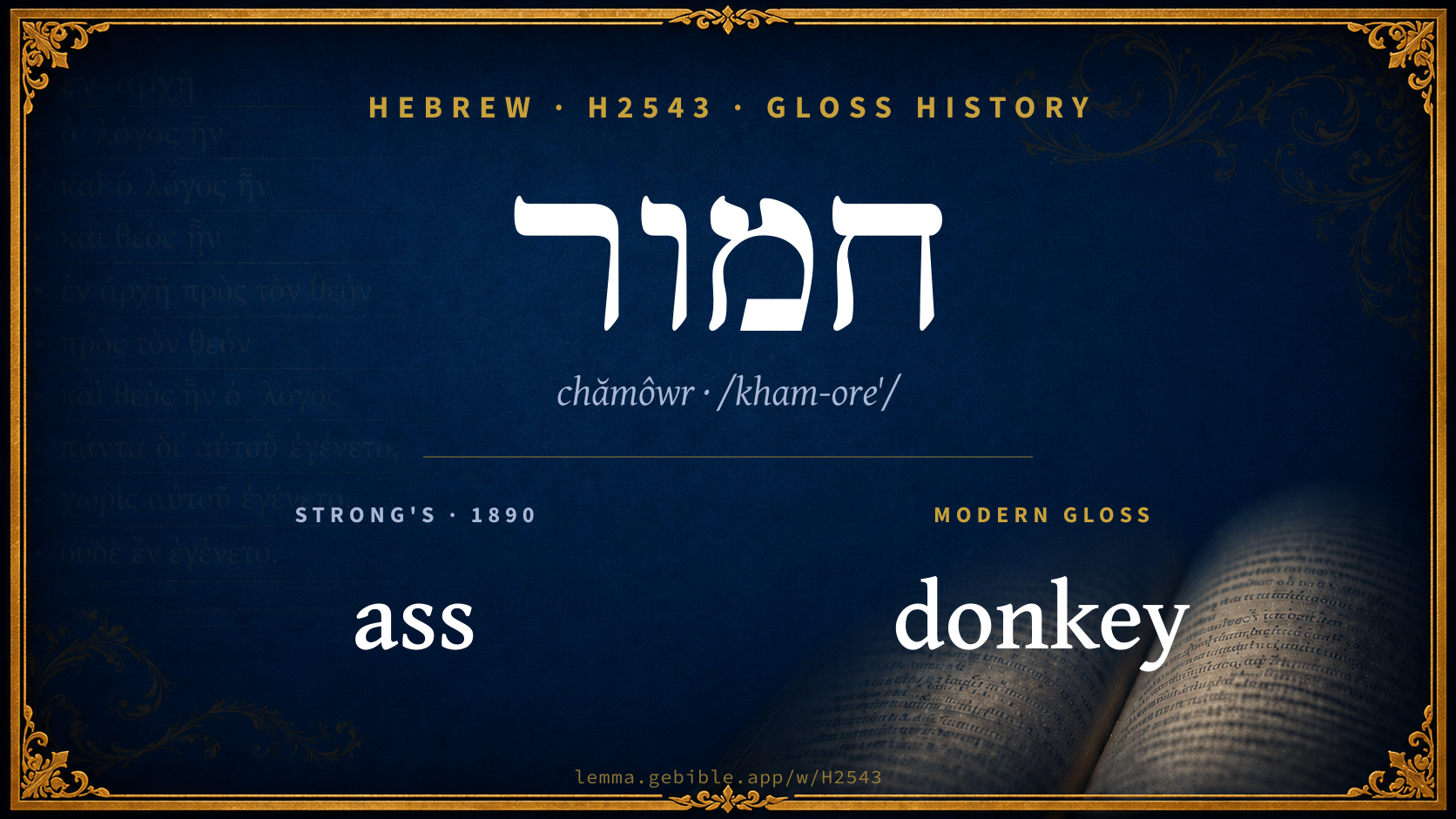
“donkey” is the headline sense of the Hebrew noun חמור (chămôwr). Older and newer Bibles part ways — “ass” in the King James Version, “donkey” (Berean Standard Bible) in modern versions. See the renderings breakdown. It appears 94 verses across 20 books of the Hebrew Bible, among its moderately common vocabulary. Scripture first uses it in Genesis 12:16. It shares a root with חמר, חמר and חמר. See the sense tree, 94-verse concordance, and the renderings breakdown below.
Gloss history
Strong's 1890 vs modern scholarship
About this word
Strong's H2543 catalogs a Hebrew word from the Hebrew Old Testament.
These counts are not copied from any lexicon or concordance. They are computed here, from the morphology-tagged Hebrew Old Testament. What Lemma adds →
- 94
- distinct verses
- The word appears in 94 distinct verses.
- 20 / 39
- OT books
- The word appears in 20 of 39 Old Testament books.
- #432
- by frequency
- Top 500 most frequent Hebrew words (rank 432 of 8,640 Hebrew words by occurrence).
View all 94 occurrences in the concordance →
By section of the Old Testament
By traditional corpus
Conventional, traditional groupings — biblical authorship is debated, so this is a traditional corpus grouping, not an authorship claim. Each share is this word’s portion of its verses in that division of the Hebrew canon. Each figure is a share of the word’s 94 distinct verses.
- Prophets (Nevi'im) 44 verses · 47%
- Torah (Pentateuch) 41 verses · 44%
- Writings (Ketuvim) 9 verses · 10%
How translations render this word
Counts come from each version’s own published word-to-Strong’s tagging or interlinear alignment — an approximate guide to how each version renders this word, not a word-level alignment the data otherwise carries. Because each total is that version’s own tagged count, the per-version totals vary from one another and need not match the appearance or distinct-verse counts above. These counts may also differ from a printed concordance because Lemma counts each distinctly tagged rendering and does not collapse phrase taggings into a single head-word total. This is a fixed set of word-tagged versions (KJV, ASV, BSB, ULT) and does not change with the reading translation you choose elsewhere. Each version’s license is shown beside its name below (and on Sources).
BDB lists this Strong’s number as 3 distinct words (homographs). Each count above pools all of them and is not split by sense — see the Senses section below. A low-frequency rendering may belong to a different one of those words, not the primary meaning.
- King James Version†: Ass 46×, Asses 37×, Or his ass 2×
- American Standard Version†: Ass 44×, Asses 33×, Couple of asses 2×
- Berean Standard Bible†: Donkey 44×, Donkeys 44×, Or donkey 4×
- unfoldingWord Literal Text†: Donkey 52×, Donkeys 33×, Donkey of 3×
King James Version Public Domain
Renders H2543 across 96† tagged occurrences — most commonly:
Plus 11 renderings that appear only once — usually multi-word phrases or single function words the recovered tagging swept in, not distinct renderings.
American Standard Version Public Domain
Renders H2543 across 96† tagged occurrences — most commonly:
Plus 15 renderings that appear only once — usually multi-word phrases or single function words the recovered tagging swept in, not distinct renderings.
Berean Standard Bible Public Domain
Renders H2543 across 96† tagged occurrences — most commonly:
Plus 4 renderings that appear only once — usually multi-word phrases or single function words the recovered tagging swept in, not distinct renderings.
unfoldingWord Literal Text CC BY-SA 4.0
Renders H2543 across 99† tagged occurrences — most commonly:
Plus 9 renderings that appear only once — usually multi-word phrases or single function words the recovered tagging swept in, not distinct renderings.
9 senses and sub-senses in the full BDB
What do BDB’s symbols mean?
BDB uses these scholarly abbreviations:
| Symbol | Meaning |
|---|---|
| 𝔊 | the Septuagint (the ancient Greek translation, LXX) |
| 𝔙 | the Vulgate (the Latin translation) |
| 𝔖 | the Syriac version (the Peshitta) |
| 𝔗 | the Targum (the Aramaic translation) |
| ψ | the Psalms |
| √ | root (the underlying root or stem) |
| ‖ | parallel passage (a synonymous or contrasted parallel) |
| † | the dagger: every passage where the word occurs is cited |
The 9 senses and sub-senses the full Brown-Driver-Briggs lexicon distinguishes for this word, in lexicon order (not ranked by frequency), with BDB’s own verbatim wording and sub-sense lettering. Shown in Hebrew script with BDB’s own scholarly abbreviations. The condensed entry is in the Lexicon Entry tab. See also the Forms in the corpus table below.
חמור I [m.] heap, abs. ח׳ with du. חֲמֹרָתָ֑יִם (Baer חֲמֹרֹת׳), as if from חֲמֹרָה
חמור II
- 1. as (valuable) property, with oxen, sheep, camels, slaves, etc. Gn 12:16; 24:35; 30:43; 47:17 Ex 9:3 (all J) Ex 20:17 (E), 21:23; 22:3, 8, 9; 23:4, 5, 12; Nu 16:15; Jos 6:21; 7:24 (all JE); note also Ex 13:13 = 34:20 (JE; firstlings belongs to י׳); Gn 36:24; Nu 31:28, 30, 34, 39, 45 (all P); Dt 5:14, 18; 22:3, 4; 28:31; Ju 6:4; 1 S 8:16; 12:3; 15:3; 22:19; 27:9; 1 Ch 5:21 Ezr 2:67 = Ne 7:68 (Baer), Zc 14:15; coll. Gn 32:5 (J; ‖ שׁוֹר, צֹאן, עֶבֶד, שִׁפְחָה), but pl. (similar ‖) Gn 34:28 (P), 47:17 (J); cf. also ח׳ יְתוֹמִים 24:3 the orphans’ ass (‖ שׁוֹר אַלְמָנָה); as knowing its master’s crib Is 1:3 (‖ שׁוֹר); found in camp 2 K 7:7, 10 (both ‖ סוּסִים); as harnessed מֶתֶג לַח׳ Pr 26:3 (‖ סוּם). e.g. Genesis 12:16
- 2. used for riding:
- a. by women Ex 4:20 (J), Jos 15:18 (JE) = Ju 1:14; 1 S 25:20, 23, 42, cf. 2 Ch 28:15. e.g. Exodus 4:20
- b. by men 2 S 16:2; 17:23; 19:27; 1 K 2:40; 13:13(×2), 23, 24, 27, 28(×2) Is 21:7; Zc 9:9. e.g. 2 Samuel 16:2
- c. צֶמֶד חמורים a pair of asses 2 S 16:1 (for burdens and for riding); for man and woman Ju 19:3, 10, 19, 21; carrying dead body v 28, cf. ח׳ 1 K 13:29. e.g. 2 Samuel 16:1
- 3. beast of burden Gn 22:3, 5 (cf. v 6), 42:26, 27; 45:23 (all E) 43:18, 24; 44:3, 13 (all J), Jos 9:4 (JE), 1 S 25:18; 1 Ch 12:41; Ne 13:15 (cf. also צֶמֶד ח׳ 2 S 16:1 supr.); metaph. of Issachar ח׳ גָּ֑רֶם Gn 49:14 (poem), an ass of (strong) bones.—ח׳ לֶחֶם 1 S 16:20 read prob. חֲמִשָּׁה five, or better עֲשָׂרָה ten, v. We Dr. e.g. Genesis 22:3
- 4. used in tillage Is 32:20; not to be used in ploughing with an ox (שׁוֹר) Dt 22:10. e.g. Isaiah 32:20
- 5. parts of body of ass mentioned are: לְחִי ח׳ Ju 15:15, 16 jawbone, Samson’s weapon; רֹאשׁ ח׳ 2 K 6:25 eaten in famine; בְּשַׂר ח׳ Ez 23:20 genital organ of ass (contempt. sim.) e.g. Judges 15:15
- 6. קְבוּרַת ח׳ Je 22:19 burial of an ass, in fig. of ignominious treatment of a corpse. Also she-ass 2 S 19:27 (cf. Mishn. AZ. vi). e.g. Jeremiah 22:19
חמור III m. father of Shechem (he-ass
Senses from the full Brown-Driver-Briggs lexicon (Brown, Driver, Briggs; Oxford 1906 — public domain), digitized via Sefaria, supplemented by the OpenScriptures HebrewLexicon (CC BY 4.0). Full attribution on Sources.
Word origin
I. n.[m.] heap, abs. ח׳ with du. חֲמֹרָתָ֑יִם (Baer חֲמֹרֹת׳), as if from חֲמֹרָה;—בִּלְחִי הַחֲמוֹר חֲמוֹר חֲמֹרָתָ֑יִם Ju 15:16 with the ass’s jawbone, a heap, two heaps, i.e. so many slain.
II. n.m. Gn 45:23 (he)-ass (NH id. (sometimes female, but this regularly חֲמוֹרָה); Aramaic חֲמָרָא, ܚܡܳܪܳܐ; Arabic حِمَارٌ, Palm. חמרא ReckendorfZMG 1888, 404; Assyrian imêru, SchrCOT Gloss.;—name from reddish colour)—abs. חֲמוֹר Gn 22:5 + 43 times; חֲמֹר Ex 13:13 Dt 22:10; cstr. חֲמוֹר Ex 23:5 + 4 times; חֲמֹר Gn 49:14; sf. חֲמֹרְךָ Dt 5:14; 28:31; חֲמֹרֶ֑ךָ Ex 23:12; חֲמֹרוֹ Gn 22:3 + 8 times; pl. חֲמוֹרִים Ju 19:10 + 9 times; חֲמֹרִים Gn 12:16 + 16 times; sf. חֲמוֹרֵינוּ Ju 19:19; חֲמֹרֵינוּ Gn 43:18; חֲמוֹרֵיכֶם 1 S 8:16; חֲמֹרֵיהֶם Gn 34:28 + 4 times; חֲמוֹרֵיהֶם Jos 9:4;—ass (he-ass; אתון = she-ass) found in all periods (coll. only Gn 32:6 Is 21:7);—
III. n.pr.m. father of Shechem (he-ass; v. RSK 220; Sem i. 449)—Gn 33:19; 34:2, 4, 6, 8, 13, 18(×2), 20, 24, 26; Jos 24:32; Ju 9:28.
— Brown-Driver-Briggs (Oxford 1906, public domain), digitized via Sefaria, supplemented by the OpenScriptures HebrewLexicon (CC BY 4.0). See Sources.
Derived from חמר (châmar) (H2560) — to boil.
Jastrow Dictionary
A second Hebrew/Aramaic lexicon for comparison, covering Aramaic and post-biblical (Talmudic, Targumic, Midrashic) usage that the biblical-Hebrew BDB does not. Matched by lemma rather than by Strong’s number, so a lemma may carry more than one Jastrow headword (shown separately below), and the entries cover usage well beyond the Bible.
חֲמוֹר
- c. (b. h.; v. חָמַר II a.
- 1. [load-carrier, cmp. גָּמָל.] ass. Nidd. 31ᵃ, v. גָּרַם. Sabb. 152ᵃ דעל ח׳ וכ׳ he who rides an ass is a freeman. B. Bath. 143ᵃ את וח׳ thou and the ass (shall own my property, a form of donation implying a rational and an irrational being).—Bekh. I, 2 ח׳ שילדה וכ׳ if an ass gave birth to &c. Snh. 33ᵃ הלכה חֲמוֹרְךָ וכ׳ thy ass is gone, Tarfon! (I shall have to make compensation for erroneous judgment); a. fr.
- 2. (cmp. various uses of horse) a contrivance for working-men, rest, jack, stocks &c. Kel. XIV, 3 ח׳ של נפחין the smiths’ ass (‘on which the smith sits while using its head as an anvil’, Maim.; ‘the rest of the bellows’, R. S.). Ib. XVIII, 3 וח׳ a stand on which the bedstead is placed. Gen. R. s. 65, end ח׳ של חרשים carpenters’ sawing-jack (an instrument for torture); Gen. R. s. 70 (alluding to Prov. XXVII, 22) אפי׳ … בח׳ של חרשים וכ׳ even if you put the wicked man on a carpenter’s jack, you cannot make anything useful out of him (sufferings will have no effect on him); Yalk. Kings 201; Yalk. Prov. 961; (Pesik. Shek., p. 15ᵃ במכתש).—Pl. חֲמוֹרִים. Sabb. 112ᵇ. Gen. R. s. 75; a. fr.—Denom. חַמָּר, חִמִּר.—Fem. חֲמוֹרָה. Tosef. Kil. V, 5. e.g. Proverbs 27:22
חָמוּר
- (חָמַר I) heavy, weighty, important; strict, severe, stringent, restrictive. Kel. I, 4 ח׳ שבכולם וכ׳ the most stringent of all are the laws concerning corpses.—איסור ח׳, v. אִיסּוּר.—Snh. 50ᵃ שריפה ח׳ וכ׳ death by burning is a severer punishment than &c. Ib. IX, 4, a. e. נידון בח׳ he suffers the severer penalty of the two. Ab. II, 1 כבחמורה as in the observance of a difficult commandment (requiring self-denial); a. fr.—Pl. חֲמוּרִים, חֲמוּרִין, f. חֲמוּרוֹת. Ḥull. XII, 5; a. fr.—Y. Snh. X, 28ᵇ top חֲמוּרוֹתָיו של וכ׳ (not חומר׳) the heaviest sins that Jeroboam committed.—דורשי חֲמוּרוֹת, v. חוֹמֶר II. קלים וחֲמוּרִים, v. חוֹמֶר I.
A Dictionary of the Targumim, the Talmud Babli and Yerushalmi, and the Midrashic Literature (Marcus Jastrow; London, Luzac, 1903) — Public Domain. Digitized via Sefaria. Digitized via Sefaria. Full attribution on Sources.
Forms in the corpus
The 69 distinct written forms H2543 takes in the Hebrew Bible, most frequent first — each parse links to that state’s occurrences in the concordance. Hebrew forms include their vowel points and cantillation, so a single lemma takes many written forms.
The 60 most common forms are shown; 9 rarer forms follow in the full concordance.
Same root — word family
Other BDB entries built from the same root as H2543, grouped by Strong’s listed origin. These share a root / origin per the lexicon — not necessarily a shared meaning. Each links to that word’s own entry.
Derives from
Shares the same root
- חמר chemer H2561 wine
- חמר chômer H2563 mortar
- חמר chêmâr H2564 bitumen
- חמרה chămôrâh H2565 heap
- יחמור yachmûwr H3180 roebuck
Proper names from this root
People and places named from this root — a name, not an additional meaning of the word.
Compare all same-root words → Showing 4 of 9 — not the complete family. 2 of the same-root words are proper names (people or places). They share a root, not necessarily a meaning.
Septuagint verse parallels
This word appears in 90 verses that also exist in the Greek Old Testament (Septuagint), out of the 94 Hebrew verses it occurs in. You can read those verses in Greek by switching the Old Testament edition to the Septuagint.
Read these verses in the Septuagint
- Genesis 12:16
- Exodus 4:20
- Numbers 16:15
- Deuteronomy 5:14
- Joshua 6:21
- Judges 1:14
- 1 Samuel 8:16
- 2 Samuel 16:1
- 1 Kings 2:40
- 2 Kings 6:25
- 1 Chronicles 5:21
- 2 Chronicles 28:15
This is a verse-level parallel only — the same verses exist in both the Hebrew and Greek Old Testaments. No word-level Hebrew↔Greek correspondence is claimed: the data carries no such alignment, so no Greek word is shown as this Hebrew word’s translation. Coverage is not total — the Septuagint omits the deuterocanon and renumbers the Psalms, so some Hebrew verses have no direct Greek parallel.