Proverbs 27:22

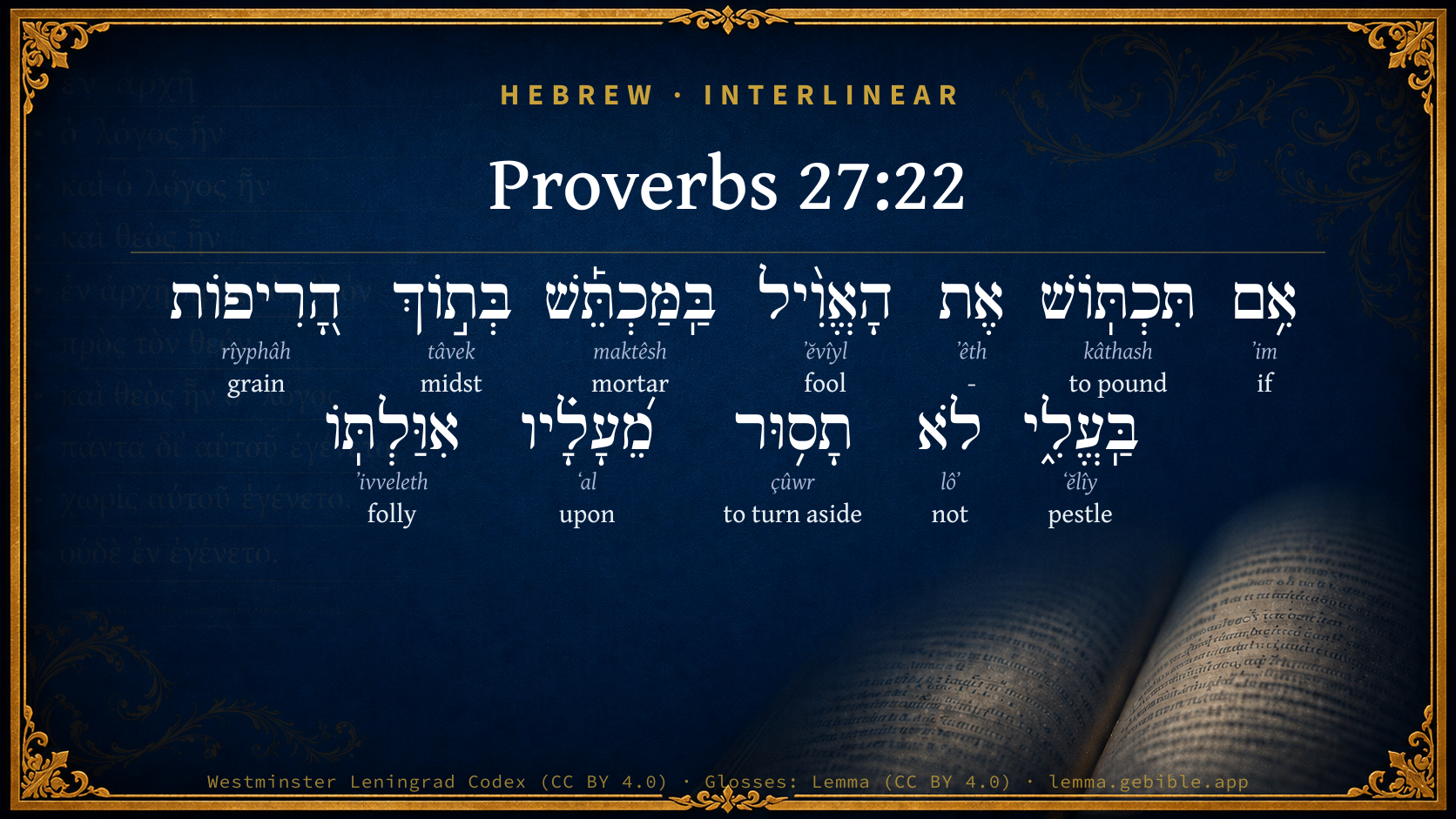
Hebrew (Westminster Leningrad Codex) Proverbs 27:22 appears in the Hebrew Old Testament. The text above is from the Westminster Leningrad Codex. Each word links to its Strong’s number, a concise gloss, and parsing drawn from the Open Scriptures Hebrew Bible morphology. Click any word for its full Brown-Driver-Briggs (BDB) entry.
Download image
Cite this verse

Proverbs 27:22 (World English Bible). Public Domain. Lemma interlinear Bible study tool, https://lemma.gebible.app/v/proverbs/27/22.

Show BibTeX & RIS
BibTeX
RIS
English Translation
Though you grind a fool in a mortar with a pestle along with grain, Yet his foolishness will not be removed from him.
World English Bible · Public Domain
Highlights
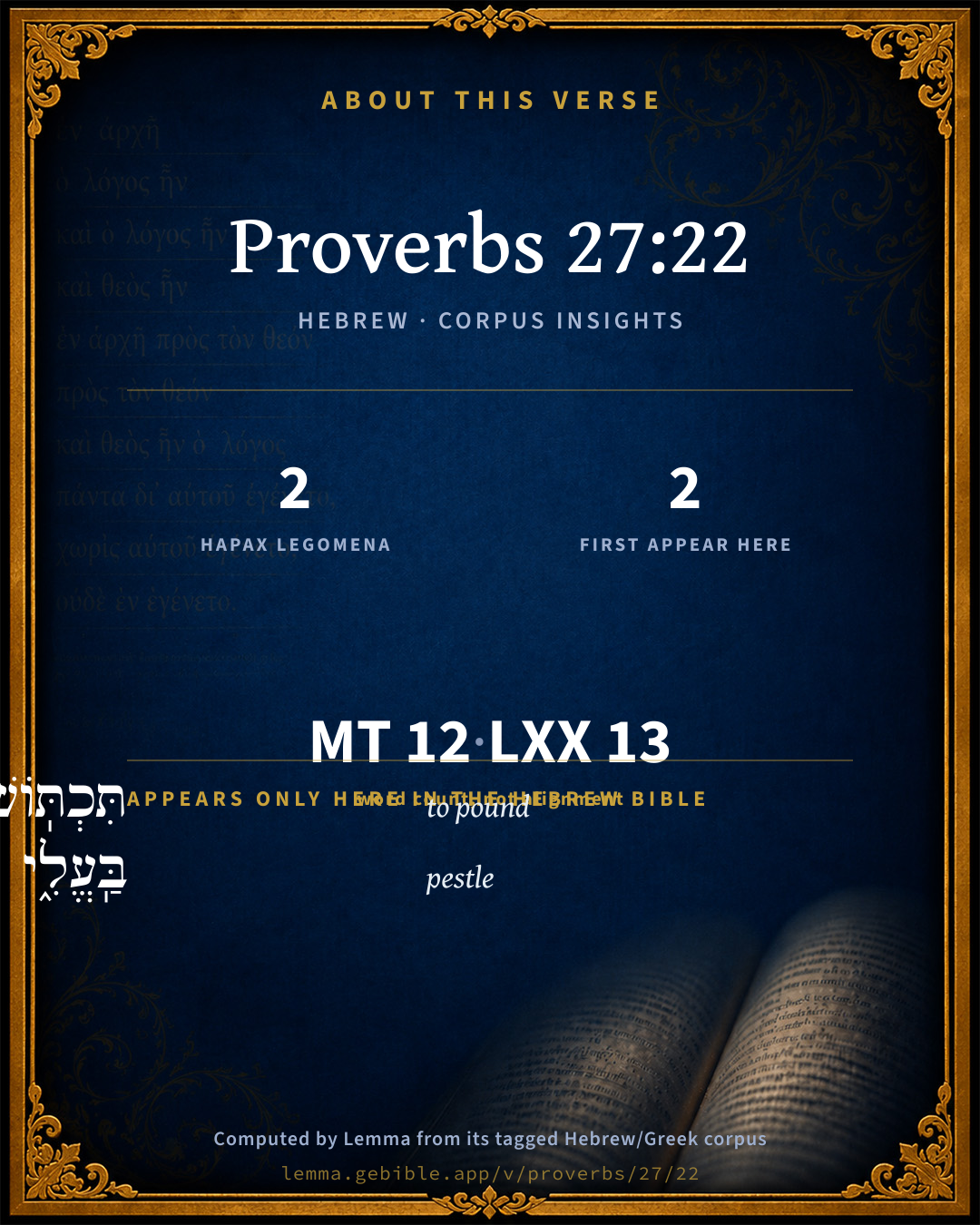
  • 2 hapax legomena — only here in the Hebrew Bible
  • 2 first appearances in the Hebrew Bible
Full analysis ↓
Download a study sheet

One document with this verse’s original text, its word-by-word gloss line, the meaning frame, cross-references with their text, attributed commentary, and full source and license credits — printable, and it pastes into notes with its structure intact.

This verse Autodidact and up

Study sheet (.html) Plain text (.txt)

A passage Seminary Student

Up to 50 verses in one chapter. A passage sheet keeps up to 6 commentary sources and 12 cross-references per verse, in the order this page ranks them, and says so on the sheet whenever that leaves anything out. Ask for a single verse and you get the Autodidact verse sheet above.

Everything on this page stays free to read, with no account — the sheet is a download of what is already on screen, not access to it.

Want to remove ads? Support Godless Engineer
Compare translations 3

The same verse in 3 English versions, stacked beneath the original-language interlinear above. Click any original word for its lexicon entry.

Each is an independent rendering of the whole verse — the interlinear is not word-aligned to these translations.

Highlighted words mark where these versions differ — a whole-verse word diff, not a word-by-word alignment.

  • World English Bible Public Domain
    Though you grind a fool in a mortar with a pestle along with grain, Yet his foolishness will not be removed from him.
  • King James Version Public Domain
    Though thou shouldest bray a fool in a mortar among wheat with a pestle, yet will not his foolishness depart from him.
  • unfoldingWord Literal Text CC BY-SA 4.0
    Even if you pound a fool in a mortar with a pestle in the midst of ground grains, his folly will not turn away from on him.

unfoldingWord Literal Text — © unfoldingWord, licensed CC BY-SA 4.0. Word-aligned USFM3 via Door43 (git.door43.org/unfoldingWord/en_ult).

Versions to compare (up to 4)

3 of 4 selected

Show all 18 translations

Every available English version of this verse, each an independent rendering of the whole verse.

  • World English Bible Public Domain
    Though you grind a fool in a mortar with a pestle along with grain, Yet his foolishness will not be removed from him.
  • Berean Standard Bible Public Domain
    Though you grind a fool like grain with mortar and a pestle, yet his folly will not depart from him.
  • Majority Standard Bible Public Domain
    Though you grind a fool like grain with mortar and a pestle, yet his folly will not depart from him.
  • King James Version Public Domain
    Though thou shouldest bray a fool in a mortar among wheat with a pestle, yet will not his foolishness depart from him.
  • American Standard Version (1901) Public Domain
    Though thou shouldest bray a fool in a mortar with a pestle along with bruised grain, Yet will not his foolishness depart from him.
  • Revised Version (1885) Public Domain
    Though thou shouldest bray a fool in a mortar with a pestle among bruised corn, yet will not his foolishness depart from him.
  • Geneva Bible (1599) Public Domain
    Though thou shouldest bray a foole in a morter among wheate brayed with a pestell, yet will not his foolishnes depart from him.
  • Douay-Rheims (1899) Public Domain
    Though thou shouldst bray a fool in the mortar, as when a pestle striketh upon sodden barley, his folly would not be taken from him.
  • Young's Literal Translation Public Domain
    If thou dost beat the foolish in a mortar, Among washed things -- with a pestle, His folly turneth not aside from off him.
  • Literal Standard Version CC BY-SA 4.0
    If you beat the foolish in a mortar, || Among washed things—with a pestle, || His folly does not turn aside from off him.
  • Unlocked Literal Bible CC BY-SA 4.0
    Even if you crush a fool with the pestle—along with the grain— yet his foolishness will not leave him.
  • unfoldingWord Literal Text CC BY-SA 4.0
    Even if you pound a fool in a mortar with a pestle in the midst of ground grains, his folly will not turn away from on him.
  • Darby Bible Public Domain
    If thou shouldest bray a fool in a mortar among wheat with a pestle, yet will not his folly depart from him.
  • World Messianic Bible Public Domain
    Though you grind a fool in a mortar with a pestle along with grain, yet his foolishness will not be removed from him.
  • Webster's Bible Public Domain
    Though thou shouldst bray a fool in a mortar among wheat with a pestle, yet his foolishness will not depart from him.
  • Free Bible Version CC BY-SA 4.0
    Even if you ground stupid people in a mortar, crushing them like grain with the pestle, you can't get rid of stupidity from them.
  • Bible in Basic English Public Domain
    Even if a foolish man is crushed with a hammer in a vessel among crushed grain, still his foolish ways will not go from him.
  • JPS Tanakh (1917) Public Domain
    Though thou shouldest bray a fool in a mortar with a pestle among groats, yet will not his foolishness depart from him.

Literal Standard Version (2020), Covenant Press — licensed CC BY-SA 4.0. Text via the HelloAO Bible API (eBible.org). Unlocked Literal Bible (unfoldingWord) — licensed CC BY-SA 4.0. Text via the HelloAO Bible API (eBible.org). unfoldingWord Literal Text — © unfoldingWord, licensed CC BY-SA 4.0. Word-aligned USFM3 via Door43 (git.door43.org/unfoldingWord/en_ult). Free Bible Version, Dr. Jonathan Gallagher — licensed CC BY-SA 4.0. Text via the HelloAO Bible API (eBible.org).

Word by word

More ways to search: Search by grammar → Find every occurrence → Compare this word →

Practice this passage: Drill this verse → Learn its vocabulary →

תִּכְתּֽוֹשׁ
kâthash
H3806
“to pound”
Verb, Qal, Imperfect, 2nd Person, Masculine, Singular
Part of Speech
Verb
Stem
Qal
Form
Imperfect
Person
2nd Person
Gender
Masculine
Number
Singular
Full BDB Definition

Origin: a primitive root

TWOT: 1061

(Qal) to pound, mix by pounding, pound fine, bray
  1. אִ֥ם ʼim H518 “if” Conjunction
  2. אֶת ʼêth H853 “-” Particle, Direct Object
  3. הָאֱוִ֨יל ʼĕvîyl H191 “the · fool” Particle, Definite Article + Adjective, Adjective, Masculine, Singular, Absolute
  4. בַּֽמַּכְתֵּ֡שׁ maktêsh H4388 “in/at the · mortar” Preposition, Determined + Noun, Common, Masculine, Singular, Absolute
  5. בְּת֣וֹךְ tâvek H8432 “in/at · midst of” Preposition + Noun, Common, Masculine, Singular, Construct
  6. הָ֭רִיפוֹת rîyphâh H7383 “the · grain” Particle, Definite Article + Noun, Common, Feminine, Plural, Absolute
  7. בַּֽעֱלִ֑י ʻĕlîy H5940 “in/at the · pestle” Preposition, Determined + Noun, Common, Masculine, Singular, Absolute
  8. לֹא lôʼ H3808 “not” Particle, Negative
  9. תָס֥וּר çûwr H5493 “to turn aside” Verb, Qal, Imperfect, 3rd Person, Feminine, Singular
  10. מֵ֝עָלָ֗יו ʻal H5921 “from · upon · him” Preposition + Preposition + Suffix, Personal, 3rd Person, Masculine, Singular
  11. אִוַּלְתּֽוֹ ʼivveleth H200 “folly · his” Noun, Common, Feminine, Singular, Construct + Suffix, Personal, 3rd Person, Masculine, Singular

About this verse

These counts appear in no published source. They are computed here, from the morphology-tagged text and Lemma’s own curated glosses. What Lemma adds →

12
words
12
distinct lemmas
Wisdom
section

Notable vocabulary

2 hapax legomena — words that appear only here in the entire Hebrew Bible:

  • תִּכְתּֽוֹשׁ to pound H3806
  • בַּֽעֱלִ֑י pestle H5940

First appearance in Scripture

These words make their first canonical appearance in the Hebrew Bible here:

  • תִּכְתּֽוֹשׁ to pound H3806
  • בַּֽעֱלִ֑י pestle H5940

Shared distinctive vocabulary

בַּֽמַּכְתֵּ֡שׁ mortar H4388 occurs in 2 verses of the Hebrew Bible. Also found in:

Grammatical profile

  • 2 verbs
  • 5 nouns
  • 1 adjective
  • 1 preposition
  • 1 conjunction
  • 2 particles

Verb forms

  • תִּכְתּֽוֹשׁ Qal · Imperfect
  • תָס֥וּר Qal · Imperfect

Hebrew & Septuagint length

In English translation the verse runs 23 words from the Hebrew and 24 from the Septuagint (LXX English) — closely comparable.

A rough comparison of the two English renderings, which tokenize alike — not a word-level alignment.

Word counts can differ between the Hebrew and the Greek without any difference in meaning — e.g. the Hebrew direct-object marker אֵת has no separate Greek word, and Greek often adds the article ὁ.

In the original languages it is 12 Hebrew tokens and 13 Greek tokens — but the two are counted differently (Hebrew bundles its prefixes and suffixes into one token; the Greek is in lemma form), so that isn’t a like-for-like length.

Cross-references

9

Topical passages linked to Proverbs 27:22 in the Treasury of Scripture Knowledge — connected by theme and wording, ordered by reader-vote popularity; previews shown in the World English Bible.

  • Proverbs 23:35 "They hit me, and I was not hurt; They beat me, and I don't feel it! When will I wake up? I can do it again. I can find another."
  • Jeremiah 5:3 O Yahweh, don't your eyes look on truth? you have stricken them, but they were not grieved; you have consumed them, but they have refused to receive correction: they have made their faces harder than a rock; they have refused to return.
  • Isaiah 1:5 Why should you be beaten more, That you revolt more and more? The whole head is sick, And the whole heart faint.
  • Revelation 16:10–11 The fifth poured out his bowl on the throne of the beast, and his kingdom was darkened. They gnawed their tongues because of the pain,
  • Exodus 12:30 Pharaoh rose up in the night, he, and all his servants, and all the Egyptians; and there was a great cry in Egypt, for there was not a house where there was not one dead.
  • Exodus 14:5 It was told the king of Egypt that the people had fled; and the heart of Pharaoh and of his servants was changed towards the people, and they said, "What is this we have done, that we have let Israel go from serving us?"
  • Jeremiah 44:15–16 Then all the men who knew that their wives burned incense to other gods, and all the women who stood by, a great assembly, even all the people who lived in the land of Egypt, in Pathros, answered Jeremiah, saying,
  • Exodus 15:9 The enemy said, 'I will pursue, I will overtake, I will divide the spoil. My desire shall be satisfied on them. I will draw my sword, my hand shall destroy them.'
  • 2 Chronicles 28:22–23 In the time of his distress did he trespass yet more against Yahweh, this same king Ahaz.

Cross-references courtesy of OpenBible.info (CC BY 4.0).

Hebrew and Greek witnesses Masoretic Hebrew ↔ Greek Septuagint

The same verse in the two great witnesses to the Old Testament, shown verse-for-verse.

These are two independent witnesses, not word-aligned to each other, and the Septuagint is shown in lemma (dictionary) form.

Hebrew Proverbs 27:22 Masoretic · Westminster Leningrad Codex

אִ֥ם תִּכְתּֽוֹשׁ אֶת הָאֱוִ֨יל בַּֽמַּכְתֵּ֡שׁ בְּת֣וֹךְ הָ֭רִיפוֹת בַּֽעֱלִ֑י לֹא תָס֥וּר מֵ֝עָלָ֗יו אִוַּלְתּֽוֹ

Though you grind a fool in a mortar with a pestle along with grain, Yet his foolishness will not be removed from him.

World English Bible · Public Domain

Greek LXX Proverbs 27:22 Septuagint · lemma form

ἐάν μαστιγόω ἄφρων ἐν μέσος συνέδριον ἀτιμάζω οὐ μή περιἔρχομαι ὁ ἀφροσύνη αὐτός

Though you scourge a fool, disgracing him in the midst of the council, you will still in no wise remove his folly from him.

LXX2012 (modern English Septuagint) · Public Domain

On this verse, Whedon's Commentary on the Bible discusses the Septuagint’s reading. Read the note in Commentary ↓

Hebrew: Westminster Leningrad Codex (CC BY 4.0). Greek: Septuagint (public domain); English from LXX2012 (modern English Septuagint) (Public Domain). How the Septuagint differs from the Hebrew →

Commentary

Notes on Proverbs 27:22 from classic Christian and Jewish commentators (each source and its license shown beneath its notes). The classic Christian expositions comment on the surrounding passage and are grouped to its opening verse, so a note may address several verses; the Jewish commentaries on the Tanakh (Rashi and others) are per-verse, so they appear only where the commentator wrote on this verse.

Lemma curates 59 commentaries, every one of them public domain or Creative Commons licensed, each selected and text-cleaned for this edition rather than reprinted as found. About our sources →

Trapp's Complete Commentary

John Trapp

Pro 27:22 Though thou shouldest bray a fool in a mortar among wheat with a pestle, [yet] will not his foolishness depart from him.

Ver. 22. Though thou shouldst bray a fool, &c.] The cypress tree, the more it is watered the more it is withered. So it is with the wicked. Humbled they are, but not humble; low, but not lowly; "wearied" in sin, as Babylon was "in the greatness of her way," {Isa 47:13} but not weary of it. Of these Augustine, Perdidistis, saith he, utilitatem calamitatis, miserrimi factis estis, et pessimi permansistis, {a} ye have lost the fruit of your afflictions; ye have suffered much, and are never the better. "By this the iniquity of Jacob shall be purged, and this is all the fruit, the taking away of his sin." {Isa 27:9} And if this be not done, God will say, as once, "In thy filthiness is lewdness. Because I have purged thee, and thou wast not purged, thou shalt have thy will, thou shalt not be purged"; but then I will have my will too, for "I will cause my fury to rest upon thee." {Eze 24:13} How likest thou that?

{a} De Civ. Dei, lib. i. cap. 33.

John Trapp, A Commentary or Exposition upon All the Books of the Old and New Testament (1647–1656) — public domain. Text from a community e-Sword module.

Joseph Benson's Commentary

Pro 27:22. Though thou shouldest bray, &c. — “The folly and wickedness of some men are so incurable, that though unto reproofs, and chidings, and threatenings, you should add stripes and blows, they would not grow a whit the wiser or better for it.” Not natural, but moral and wilful fools are here intended, who, by long continuance in sin, are hardened and stupified, and so are become incorrigible under all the means of amendment.

Joseph Benson's Commentary on the Old and New Testaments (1811–1818) — public domain. Text from a community e-Sword module.

Tyndale Open Study Notes

Tyndale Open Resources

27:22 Foolishness is deeply ingrained in the character of a fool.

Tyndale Open Study Notes — © Tyndale Open Resources, licensed CC BY-SA 4.0. Text via the HelloAO Bible API.

Matthew Henry's Commentary

Solomon had said (Pro 22:15), The foolishness which is bound in the heart of a child may be driven out by the rod of correction, for then the mind is to be moulded, the vicious habits not having taken root; but here he shows that, if it be not done then, it will be next to impossible to do it afterwards; if the disease be inveterate, there is a danger of its being incurable. Can the Ethiopian change his skin? Observe, 1. Some are so bad that rough and severe methods must be used with them, after gentle means have been tried in vain; they must be brayed in a mortar. God will take this way with them by his judgments; the magistrates must take this way with them by the rigour of the law. Force must be used with those that will not be ruled by reason, and love, and their own interest. 2. Some are so incorrigibly bad that even those rough and severe methods do not answer the end, their foolishness will not depart from them, so fully are their hearts set in them to do evil; they are often under the rod and yet not humbled, in the furnace and yet not refined, but, like Ahaz, trespass yet more (Ch2 28:22); and what remains then but that they should be rejected as reprobate silver?

Matthew Henry's Commentary on the Whole Bible (1708–1710) — public domain (CC PDM 1.0). Text via the HelloAO Bible API.

Jamieson, Fausset & Brown

Robert Jamieson, A. R. Fausset & David Brown

The obstinate wickedness of such is incurable by the heaviest inflictions.

Jamieson, Fausset & Brown — Commentary Critical and Explanatory on the Whole Bible (1871) — public domain (CC PDM 1.0). Text via the HelloAO Bible API.

Adam Clarke's Commentary

Verse 22. Though thou shouldest bray a fool] Leaving all other conjectures, of which commentators are full, I would propose, that this is a metaphor taken from pounding metallic ores in very large mortars, such as are still common in the East, in order that, when subjected to the action of the fire, the metal may be the more easily separated from the ore. However you may try, by precept or example, or both, to instruct a stupid man, your labour is lost; his foolishness cannot be separated from him. You may purge metals of all their dross; but you cannot purge the fool of his folly.

Adam Clarke's Commentary on the Bible (1810–1826) — public domain. Text from a community e-Sword/MySword module.

Ellicott's Commentary for English Readers

(22) Though thou shouldest bray (i.e., pound) a fool (a self-willed, headstrong person) in a mortar among wheat with a pestle.—This would separate completely the husks from the wheat; but obstinacy has become a part of such a man’s nature, and cannot be got rid of even by such violent measures.

A Bible Commentary for English Readers, edited by Charles John Ellicott (1878–1897) — public domain. Text from a community e-Sword module.

The Cambridge Bible for Schools and Colleges

gen. ed. J. J. S. Perowne

22. wheat] Rather, bruised corn. In the only other place in which it occurs (2Sa_17:19) the word is rendered ground corn, A.V., and bruised corn, R.V. See note there in this Series.

Pro_27:23-27. The praises of agriculture, or of pastoral life.

It well repays the diligence bestowed upon it (Pro_27:23), and is more reliable in its nature than other kinds of wealth, and even than a kingly crown (Pro_27:24). No sooner is one crop carried than another begins to grow, and the harvest of the earth is sure (Pro_27:25). The flocks, ever increasing, supply clothing, and equal in value the land which supports them (Pro_27:26), while their produce will maintain in plenty their owner and his household (Pro_27:27).

The Cambridge Bible for Schools and Colleges (gen. ed. J. J. S. Perowne; Cambridge University Press, 1878–1918) — public domain. Text from a community e-Sword module.

John Gill's Exposition

For riches are not for ever,.... A man cannot be assured of the continuance of them; they are uncertain things, here today and gone tomorrow: wherefore, though a man has a considerable share of them, yet should follow one calling or another; particularly husbandry is recommended, or keeping sheep and cattle, which are increasing; by which means his substance will be continued and augmented, which otherwise is not to be depended on, but in a diligent attendance to business;

and doth the crown endure to every generation? the royal crown, that is not to be depended upon; a king that wears a crown is not sure he shall always wear it, or that it shall be continued to his family one generation after another. And it is suggested, that it is not even beneath such persons to have a regard to their flocks and herds, and the increase of their riches in this way: the Chinese kings, many of them, formerly employed themselves in husbandry, and set examples of industry and diligence to their subjects (t); King Hezekiah provided himself possessions of flocks and herds in abundance, Ch2 32:28.

(t) Vid. Martin. Hist. Sinica, p. 92, 93, 326.

John Gill's Exposition of the Whole Bible (1746–1763) — public domain (CC PDM 1.0). Text via the HelloAO Bible API.

Albert Barnes' Notes on the Bible

Bray - To pound wheat in a mortar with a pestle, in order to free the wheat from its husks and impurities, is to go through a far more elaborate process than threshing. But the folly of the fool is not thus to be got rid of. It sticks to him to the last; all discipline, teaching, experience seem to be wasted on him.

Albert Barnes' Notes on the Bible (1834–1885) — public domain. Text from a community e-Sword/MySword module.

Haydock's Catholic Bible Commentary

Mortar. Such were used by those who could not afford handmills. (Calmet)

George Leo Haydock (1774–1849), Haydock's Catholic Family Bible and Commentary, 1859 edition — public domain. Excludes Psalms (Douay-Rheims chapter numbering differs from Protestant) and Deuterocanonical books (Catholic canon only).

Matthew Poole's English Annotations

Not a natural, but a moral and wilful fool, who by long continuance in sin is hardened and stupefied, and so incorrigible under all the means of amendment.

Matthew Poole's English Annotations on the Holy Bible (1683–1685) — public domain. Text from a community e-Sword/MySword module.

Whedon's Commentary on the Bible

Daniel D. Whedon

22. Bray — Pound, beat.

Wheat — Any kind of grain, or anything pounded or bruised. “Barley, after being soaked in water, was [partially] dried in the sun, and then pounded in a mortar with a wooden pestle till the husk came off.” The sentiment of the proverb is: No punishment, however severe, can cure a fool of his folly. It might be thought improbable that any persons were ever punished by being pounded in a mortar: but sundry travellers, as Baron du Tott, Volney, and Knolles, testify that such a mode of punishment was in use among the Turks. Volney suggests that it came into vogue as a means of reaching those persons, the shedding of whose blood was not permitted by the letter of the law. “As for the guards of the towers,” says Knolles, “who had let Prince Koreskie (a prisoner) escape, some of them were impaled, and some were pounded or beaten to pieces in great mortars of iron, wherein they do usually pound their rice to reduce it to meal.” There are, however, no historic traces of this mode of punishment in Jewish history. The Septuagint knows nothing of “braying in a mortar;” but has instead, “Though thou scourge a fool, disgracing him in the midst of the council.”

Daniel D. Whedon (gen. ed.), Commentary on the Old and New Testaments (1874–1909) — public domain. Text from a community e-Sword module.

The Pulpit Commentary

Though thou shouldest bray a fool in a mortar among wheat with a pestle. "To bray" is to pound or beat small. "Wheat," twOpyri, riphoth, (only in 2Sa_17:19) "bruised corn." Vulgate, In pila quasi ptisanas (barley groats) feriente; Aquila and Theodotion, En mesw emptissomenwn "In the midst of grains of corn being pounded." The LXX, reading, differently, has, "Though thou scourge a fool, disgracing him (en mesw sunedriou ) in the midst of the congregation." Of course, the process of separating the husks from the corn by the use of pestle and mortar is much more delicate and careful than threshing in the usual clumsy way; hence is expressed the idea that the most elaborate pains are wasted on the incorrigible fool. (see on Pro_1:20) His foolishness will not depart from him. An obstinate, self-willed, unprincipled man cannot be reformed by any means; his folly has become a second nature, and is not to be eliminated by any teaching, discipline, or severity. There is, too, a judicial blindness, when, after repeated warnings wilfully rejected and scorned, the sinner is left to himself, given over to a reprobate mind "Whoso teacheth a fool," Siracides pronounces, "is as one that glueth a potsherd together, and as he that waketh one from a sound sleep" (Ecc 22:7). Again, "The inner parts of a fool are like a broken vessel, and he will hold no knowledge as long as he liveth" (Ecc 21:14). In Turkey, we are told, great criminals were beaten to pieces in huge mortars of iron, in which they usually pounded rice. "You cannot straighten a dog"s tail, try as you may," says a Telugu maxim (Lane). There is a saying of Schiller"s which is quite proverbial, "Heaven and earth fight in vain against a dunce." Horace, "Epist.," 1:10, 24"Naturam expellas furca, tamen usque recurret.

Juvenal, "Sat.," 13:239"Tamen ad mores natura recurrit Damnatos, fixa et mutari nescia.

The Pulpit Commentary (1880–1919), ed. H.D.M. Spence-Jones & Joseph S. Exell — public domain. Text from a community e-Sword module.

Keil & Delitzsch

C. F. Keil & F. Delitzsch

22 Though thou bruise a fool in a mortar among grit with a pestle,

Yet would not his folly depart from him.

According to the best accredited accentuations, אם־תּכתּושׁ has Illuj. and בּמּכתּשׁ has Pazer, not Rebia, which would separate more than the Dechi, and disturb the sequence of the thoughts. The first line is long; the chief disjunctive in the sphere of the Athnach is Dechi of 'הר, this disjoins more than the Pazer of 'בּם, and this again more than the Legarmeh of את־האויל. The ה of הרפות does not belong to the stem of the word (Hitzig), but is the article; רפות (from רוּף, to shake, to break; according to Schultens, from רפת, to crumble, to cut in pieces, after the form קיטור, which is improbable) are bruised grains of corn (peeled grain, grit), here they receive this name in the act of being bruised; rightly Aquila and Theodotion, ἐν μέσῳ ἐμπτισσομένων (grains of corn in the act of being pounded or bruised), and the Venet. μέσον τῶν πτισανῶν.

(Note: The lxx translates ἐν μέσῳ συνεδρίου, and has thereby misled the Syr., and mediately the Targum.)

In בּעלי (thus to be written after Michlol 43b, not בּעלי, as Heidenheim writes it without any authority) also the article is contained. מכתשׁ is the vessel, and the ב of בעלי is Beth instrumenti; עלי (of lifting up for the purpose of bruising) is the club, pestle (Luther: stempffel = pounder); in the Mishna, Beza i. 5, this word denotes a pounder for the cutting out of flesh. The proverb interprets itself: folly has become to the fool as a second nature, and he is not to be delivered from it by the sternest discipline, the severest means that may be tried; it is not indeed his substance (Hitzig), but an inalienable accident of his substance.

Keil & Delitzsch — Biblical Commentary on the Old Testament (1861–1891) — public domain (CC PDM 1.0). Text via the HelloAO Bible API. (Old Testament only.)

Bridges on Proverbs

Charles Bridges

The allusion is to the Eastern mode of beating off the husk from the corn by braying it in a mortar.†1 Yet the husk sticks not so close to the grain, as foolishness to the fool. The beating of the mortar may separate the one. The other will not depart by repeated strokes. Much is said of the effectiveness of correction.†2 But of itself it works nothing. What can it do for the fool, that despises it?†3 "The rod" as an ordinary means, "will drive foolishness out of the heart of a child."†4 But the child is here become a man in strength of habit, and stubbornness of will. As soon, therefore, "can the Ethiopian change his skin, or the leopard his spots," as those can do good, "who are accustomed to do evil." (Jer 13:23 .)

Examples of this incurable hardness abound. The deluge — that besom of divine vengeance — destroyed the race, not the foolishness, of man. Nay — God himself declared its inefficacy for this end. (Gen 8:21 .) Pharaoh was once and again brayed in the mortar; yet did not his foolishness depart from him.†5 Ahaz under the same infliction "trespassed yet more against the LORD," and stands out as a beacon to all ages — "This is that king Ahaz"!†6 "Why should ye be stricken any more?" — was the desponding complaint of God concerning his Israel.†7 The deepest infliction of chastisement produces only the fruit of blasphemy and hardened impenitence.†8 If Manasseh’s foolishness, when brayed in the mortar, departed from him;†9 this was not the innate power of affliction, but the superadded power of Sovereign Grace, which can turn any evil, even sin itself, to eternal good. The belief in the necessary working of affliction for our saving good is a fatal delusion. Never did it of itself bring one soul to God. In all cases, it is only what God is pleased to make it. It may even be tenfold more severe. The blows may be so mighty, as to make the most stupefied soul quiver with intense feeling. Still if the rock be broken, the broken pieces will retain all their native hardness. The man may be crushed, yet not humbled. Still will he cling to his foolishness; and part with Christ and heaven, rather than with that which is interwoven into every part of his nature. Was it not thus — Christian — with thyself, till Omnipotent love awakened, what chastisement alone could never have stirred, the cry of unreserved submission? — ’Lord! spare me not; bruise me; humble me; do anything with me, but leave me under my sins. Who can deliver me, if thou dost not?’ Most welcome is the "bemoaning" of the penitent child to his yearning father. "Thou hast chastised me, and I was chastised, as a bullock unaccustomed to the yoke: turn thou me, and I shall be turned; for thou art the LORD my God. Surely after I was turned, I repented; and after that I was instructed, I smote upon my thigh; I was ashamed, yea, even confounded, because I did bear the reproach of my youth. Is Ephraim my dear son? Is he a pleasant child? For since I spake against him, I do earnestly remember him still; therefore my bowels are troubled for him: I will surely have mercy upon him, saith the LORD."†10

Footnotes:

†1 Many commentators conceive a reference to this mode of punishment still practiced in the East. See Calmet — Parkhurst. Horne’s Introduction, iii. 157. Burder’s Oriental Customs. But perhaps the figurative allusion is more simple.

†2 Pro 23:13-14; Pro 29:15, Pro 29:17 .

†3 Pro 12:1; Pro 15:10 .

†4 Pro 22:15.

†5 Exo 9:27; Exo 10:16 ; Exo 12:29-32 ; Exo 14:5 .

†6 2Ch 28:22 .

†7 Isa 1:5. Compare Isa 9:13 . Jer 5:3 ; Jer 44:9-10, Jer 44:15-16. Eze 24:13 . Amo 4:11-12 .

†8 Rev 16:10-11.

†9 2Ch 33:12-13 .

†10 Jer 31:18-20. Compare Hos 14:1-4 . Luk 15:18-24 .

Charles Bridges, An Exposition of the Book of Proverbs (1846) — public domain. Text from a community e-Sword module.

Rashi

Rabbi Shlomo Yitzchaki (Rashi)

grain Heb. הריפות, wheat crushed in a mortar.

in a mortar Heb. במכתש, a mortar, in French mortier; Morser in German.

with a pestle Heb. בעלי, a pestle, pilon in French, Stossel in German. Since they lift it up (מעלין) and beat with it, it is called עלי.

Rashi on the Tanakh — English translations: “The Judaica Press complete Tanach with Rashi, translated by A. J. Rosenberg” (CC BY 4.0); “Pentateuch with Rashi's commentary by M. Rosenbaum and A.M. Silbermann, 1929-1934” (public domain); “The Metsudah Tanach series, Lakewood, N.J” (CC BY 4.0); and “The Book of Joshua, Metsudah Publications, 1997” (CC BY 4.0). Text via Sefaria.

Lesson kit

Teaching starters — assembled from the data on this page, not authored interpretation. Every prompt links to the verse data it draws on. Edit before teaching.

Proverbs, in the Wisdom, opens this verse with 12 words (12 distinct Hebrew lemmas). Its most distinctive word is kâthash (“to pound”). A historical commentator’s framing appears above. Read the whole chapter for the surrounding context.

Discussion questions

  1. What does “to pound” (kâthash) contribute to the verse as a whole?
  2. This verse holds 2 words here found nowhere else in the Hebrew Bible. What might the rare words draw attention to?
  3. 2 words here appear for the first time in Scripture. What is being introduced at this debut?
  4. Judges 15:19 shares the word «mortar» with this verse. How do the two illuminate each other?
  5. The translations on this page render this verse differently — a whole-verse word diff, not a word-by-word alignment. What might account for the different wordings?
  6. The verb «תִּכְתּֽוֹשׁ» is Qal Imperfect. How does its form color the action?
  7. Reading how Trapp's Complete Commentary and Joseph Benson's Commentary read this verse, where do the two commentators agree and where do they part?

Things to notice

Reading settings

Reading text

Shown beneath each verse's original-language words.

Old Testament
Old Testament edition

Read the OT as the Masoretic Hebrew (MT) or the Greek Septuagint (LXX).

English shown for the Greek Septuagint (in the Hebrew ↔ Greek comparison).

Comparing translations? Open the Compare panel on any verse page to stack up to four side by side.