
1 Kings 13:27

Hebrew (Westminster Leningrad Codex) 1 Kings 13:27 appears in the Hebrew Old Testament. The text above is from the Westminster Leningrad Codex. Each word links to its Strong’s number, a concise gloss, and parsing drawn from the Open Scriptures Hebrew Bible morphology. Click any word for its full Brown-Driver-Briggs (BDB) entry.
Download image
Cite this verse

1 Kings 13:27 (World English Bible). Public Domain. Lemma interlinear Bible study tool, https://lemma.gebible.app/v/1-kings/13/27.

Show BibTeX & RIS
BibTeX
RIS
English Translation
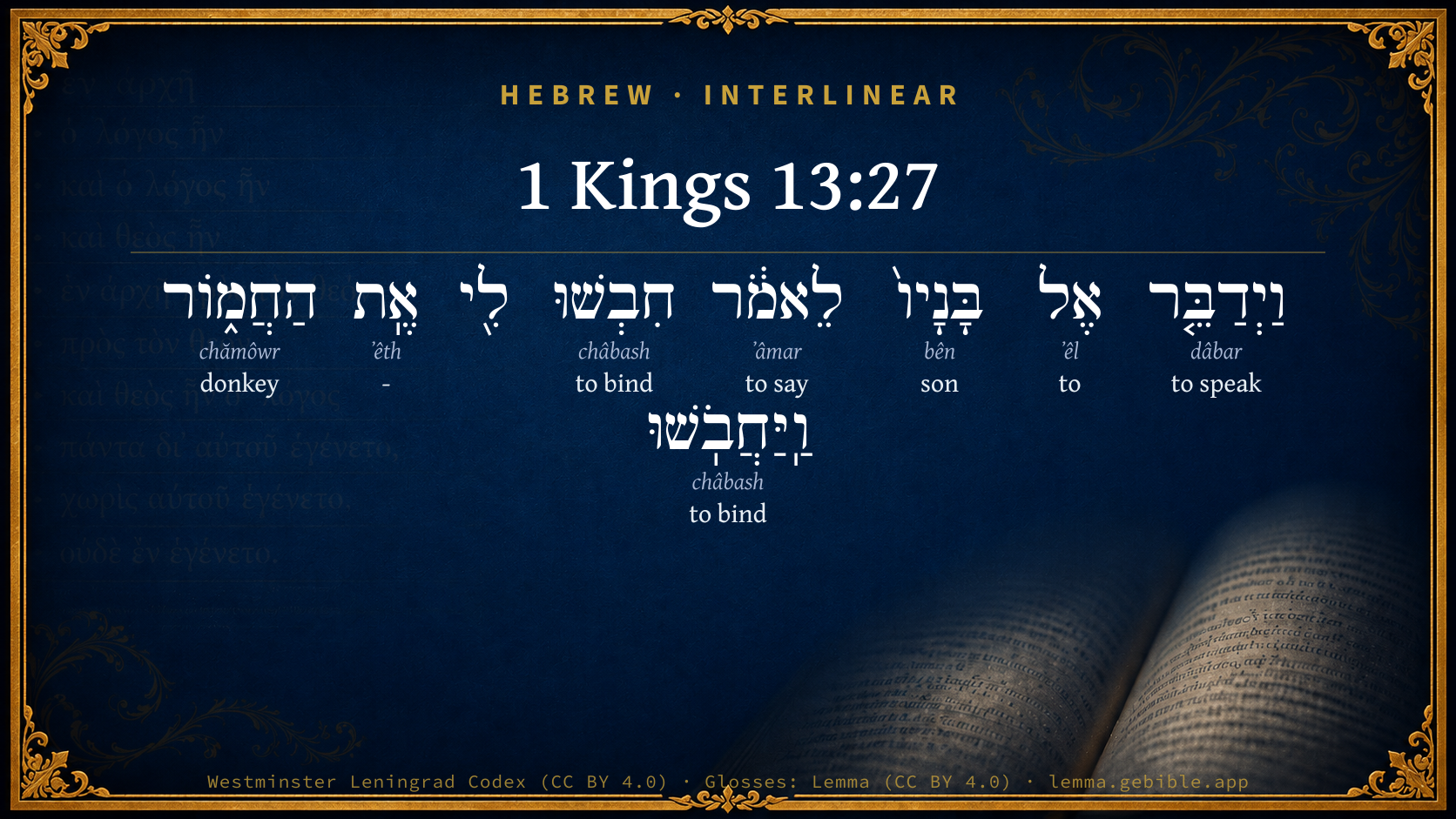
He spoke to his sons, saying, Saddle me the donkey. They saddled it.
World English Bible · Public Domain
Download a study sheet

One document with this verse’s original text, its word-by-word gloss line, the meaning frame, cross-references with their text, attributed commentary, and full source and license credits — printable, and it pastes into notes with its structure intact.

This verse Autodidact and up

Study sheet (.html) Plain text (.txt)

A passage Seminary Student

Up to 50 verses in one chapter. A passage sheet keeps up to 6 commentary sources and 12 cross-references per verse, in the order this page ranks them, and says so on the sheet whenever that leaves anything out. Ask for a single verse and you get the Autodidact verse sheet above.

Everything on this page stays free to read, with no account — the sheet is a download of what is already on screen, not access to it.

Want to remove ads? Support Godless Engineer
Compare translations 3

The same verse in 3 English versions, stacked beneath the original-language interlinear above. Click any original word for its lexicon entry.

Each is an independent rendering of the whole verse — the interlinear is not word-aligned to these translations.

Highlighted words mark where these versions differ — a whole-verse word diff, not a word-by-word alignment.

  • World English Bible Public Domain
    He spoke to his sons, saying, Saddle me the donkey. They saddled it.
  • King James Version Public Domain
    And he spake to his sons, saying, Saddle me the ass. And they saddled him.
  • unfoldingWord Literal Text CC BY-SA 4.0
    And he spoke to his sons, saying, “Saddle the donkey for me.” And they saddled it.

unfoldingWord Literal Text — © unfoldingWord, licensed CC BY-SA 4.0. Word-aligned USFM3 via Door43 (git.door43.org/unfoldingWord/en_ult).

Versions to compare (up to 4)

3 of 4 selected

Show all 18 translations

Every available English version of this verse, each an independent rendering of the whole verse.

  • World English Bible Public Domain
    He spoke to his sons, saying, Saddle me the donkey. They saddled it.
  • Berean Standard Bible Public Domain
    Then the old prophet instructed his sons, “Saddle the donkey for me.” So they saddled it,
  • Majority Standard Bible Public Domain
    Then the old prophet instructed his sons, “Saddle the donkey for me.” So they saddled it,
  • King James Version Public Domain
    And he spake to his sons, saying, Saddle me the ass. And they saddled him.
  • American Standard Version (1901) Public Domain
    And he spake to his sons, saying, Saddle me the ass. And they saddled it.
  • Revised Version (1885) Public Domain
    And he spake to his sons, saying, Saddle me the ass. And they saddled it.
  • Geneva Bible (1599) Public Domain
    And he spake to his sonnes, saying, Saddle me the asse. And they sadled him.
  • Douay-Rheims (1899) Public Domain
    And he said to his sons: Saddle me an ass. And when they had saddled it,
  • Young's Literal Translation Public Domain
    And he speaketh unto his sons saying, `Saddle for me the ass,' and they saddle `it'.
  • Literal Standard Version CC BY-SA 4.0
    And he speaks to his sons saying, “Saddle the donkey for me,” and they saddle [it].
  • Unlocked Literal Bible CC BY-SA 4.0
    So the old prophet spoke to his sons, saying, “Saddle my donkey,” and they saddled it.
  • unfoldingWord Literal Text CC BY-SA 4.0
    And he spoke to his sons, saying, “Saddle the donkey for me.” And they saddled it.
  • Darby Bible Public Domain
    And he spoke to his sons saying, Saddle me the ass; and they saddled it.
  • World Messianic Bible Public Domain
    He said to his sons, saying, “Saddle the donkey for me,” and they saddled it.
  • Webster's Bible Public Domain
    And he spoke to his sons, saying, Saddle me the ass. And they saddled him.
  • Free Bible Version CC BY-SA 4.0
    The prophet told his sons, “Saddle up a donkey for me.” So they saddled a donkey,
  • Bible in Basic English Public Domain
    And he said to his sons, Make ready the ass for me. And they did so.
  • JPS Tanakh (1917) Public Domain
    And he spoke to his sons, saying: 'Saddle me the ass.' And they saddled it.

Literal Standard Version (2020), Covenant Press — licensed CC BY-SA 4.0. Text via the HelloAO Bible API (eBible.org). Unlocked Literal Bible (unfoldingWord) — licensed CC BY-SA 4.0. Text via the HelloAO Bible API (eBible.org). unfoldingWord Literal Text — © unfoldingWord, licensed CC BY-SA 4.0. Word-aligned USFM3 via Door43 (git.door43.org/unfoldingWord/en_ult). Free Bible Version, Dr. Jonathan Gallagher — licensed CC BY-SA 4.0. Text via the HelloAO Bible API (eBible.org).

Word by word

More ways to search: Search by grammar → Find every occurrence → Compare this word →

Practice this passage: Drill this verse → Learn its vocabulary →

חִבְשׁוּ
châbash
H2280
“bind”
Verb, Qal, Imperative, 2nd Person, Masculine, Plural
Part of Speech
Verb
Stem
Qal
Form
Imperative
Person
2nd Person
Gender
Masculine
Number
Plural
Full BDB Definition

Origin: a primitive root

TWOT: 599

to tie, bind, bind on, bind up, saddle, restrain, bandage, govern - (Qal) - to bind, bind on - to bind up - (Piel) to bind, restrain - (Pual) to be bound up
  1. וַיְדַבֵּ֤ר dâbar H1696 “and · to speak” Conjunction + Verb, Piel, Sequential Imperfect, 3rd Person, Masculine, Singular
  2. אֶל ʼêl H413 “to” Preposition
  3. בָּנָיו֙ bên H1121 “sons · his” Noun, Common, Masculine, Plural, Construct + Suffix, Personal, 3rd Person, Masculine, Singular
  4. לֵאמֹ֔ר ʼâmar H559 “to say” Preposition + Verb, Qal, Infinitive Construct
  5. אֶֽת ʼêth H853 “-” Particle, Direct Object
  6. הַחֲמ֑וֹר chămôwr H2543 “the · donkey” Particle, Definite Article + Noun, Common, Both, Singular, Absolute
  7. וַֽיַּחֲבֹֽשׁוּ châbash H2280 “and · to bind” Conjunction + Verb, Qal, Sequential Imperfect, 3rd Person, Masculine, Plural

About this verse

These counts appear in no published source. They are computed here, from the morphology-tagged text and Lemma’s own curated glosses. What Lemma adds →

9
words
7
distinct lemmas
Historical
section

Shared distinctive vocabulary

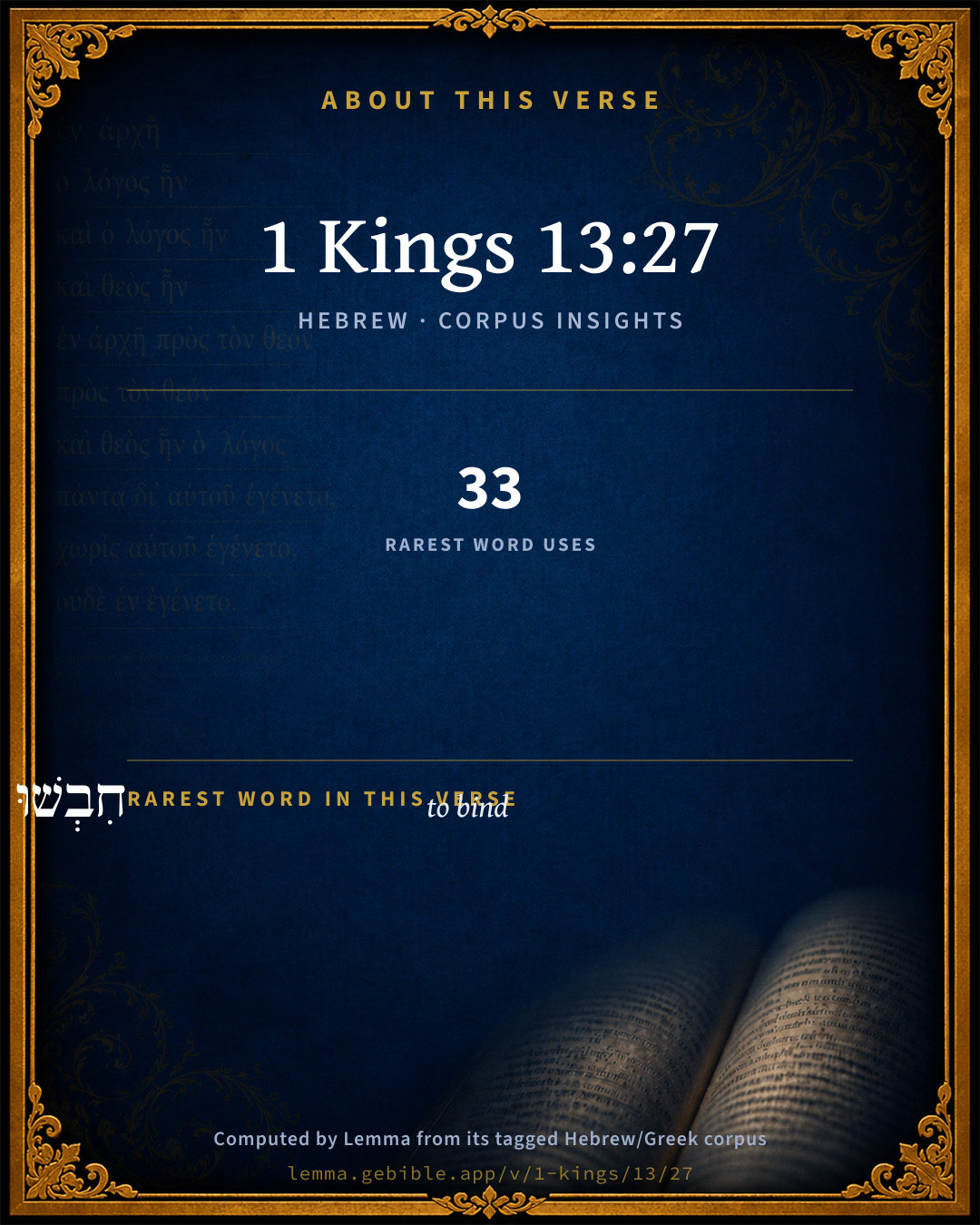
חִבְשׁוּ to bind H2280 occurs in 30 verses of the Hebrew Bible. Also found in:

Grammatical profile

  • 4 verbs
  • 2 nouns
  • 2 prepositions
  • 1 particle

Verb forms

  • וַיְדַבֵּ֤ר Piel · Sequential Imperfect
  • לֵאמֹ֔ר Qal · Infinitive Construct
  • חִבְשׁוּ Qal · Imperative
  • וַֽיַּחֲבֹֽשׁוּ Qal · Sequential Imperfect

Repetition

A word recurs within this verse — often emphatic in Hebrew:

  • חִבְשׁוּ to bind H2280 ×2

Hebrew & Septuagint length

In English translation the verse runs 13 words from the Hebrew and 15 from the Septuagint (LXX English) — closely comparable.

A rough comparison of the two English renderings, which tokenize alike — not a word-level alignment.

Word counts can differ between the Hebrew and the Greek without any difference in meaning — e.g. the Hebrew direct-object marker אֵת has no separate Greek word, and Greek often adds the article ὁ.

Hebrew and Greek witnesses Masoretic Hebrew ↔ Greek Septuagint

The same verse in the two great witnesses to the Old Testament, shown verse-for-verse.

These are two independent witnesses, not word-aligned to each other, and the Septuagint is shown in lemma (dictionary) form.

Hebrew 1 Kings 13:27 Masoretic · Westminster Leningrad Codex

וַיְדַבֵּ֤ר אֶל בָּנָיו֙ לֵאמֹ֔ר חִבְשׁוּ לִ֖י אֶֽת הַחֲמ֑וֹר וַֽיַּחֲבֹֽשׁוּ

He spoke to his sons, saying, Saddle me the donkey. They saddled it.

World English Bible · Public Domain

Greek LXX 1 Kings 13:27 Septuagint · lemma form
And he spoke to his sons, saying, Saddle me the ass, and they saddled it.

LXX2012 (modern English Septuagint) · Public Domain

Hebrew: Westminster Leningrad Codex (CC BY 4.0). Greek: Septuagint (public domain); English from LXX2012 (modern English Septuagint) (Public Domain). How the Septuagint differs from the Hebrew →

Targum (Aramaic paraphrase)

1

The Targum is the ancient Jewish Aramaic paraphrase of the Hebrew Scriptures — an interpretive translation, not the Hebrew text itself. Onkelos (literal) and Pseudo-Jonathan (expansive) render the Torah, and Jonathan the Prophets. Coverage is partial: where no permissively-licensed English translation exists for a verse, only the Aramaic is shown. This is verse-level text, not a word-by-word alignment to the Hebrew.

  1. Targum Jonathan Prophets (Joshua–Malachi)
    וּמַלֵיל עִם בְּנוֹהִי לְמֵימַר זָרִיזוּ לִי יַת חֲמָרָא וְזָרִיזוּ:

    (no public-domain English translation for this verse)

    Targum Jonathan — Aramaic: “Mikraot Gedolot” (public domain). English: “Sefaria Community Translation” (CC0 1.0 (public-domain dedication)); “London "Chaldee Paraphrase," 1871” (public domain). Text via Sefaria.

Commentary

Notes on 1 Kings 13:27 from classic Christian and Jewish commentators (each source and its license shown beneath its notes). The classic Christian expositions comment on the surrounding passage and are grouped to its opening verse, so a note may address several verses; the Jewish commentaries on the Tanakh (Rashi and others) are per-verse, so they appear only where the commentator wrote on this verse.

Lemma curates 59 commentaries, every one of them public domain or Creative Commons licensed, each selected and text-cleaned for this edition rather than reprinted as found. About our sources →

Trapp's Complete Commentary

John Trapp

1Ki 13:27 And he spake to his sons, saying, Saddle me the ass. And they saddled [him].

Ver. 27. And they saddled him.] See 1Ki 13:13.

John Trapp, A Commentary or Exposition upon All the Books of the Old and New Testament (1647–1656) — public domain. Text from a community e-Sword module.

John Gill's Exposition

And he laid his carcass in his own grave,.... Which he had prepared for himself; for, as he came from Samaria, it could not be the sepulchre of his fathers; and this was showing all the respect, and doing all the honour to him, he well could:

and they mourned over him; the prophet and his sons: saying,

alas, my brother; which was an usual form of lamentation at funerals in later times, see Jer 22:18.

John Gill's Exposition of the Whole Bible (1746–1763) — public domain (CC PDM 1.0). Text via the HelloAO Bible API.

Matthew Poole's English Annotations

Being secure as to himself, because so many others had been there without any harm; and because he perceived the prophet’s death was a judgment of God, and that for special reasons.

Matthew Poole's English Annotations on the Holy Bible (1683–1685) — public domain. Text from a community e-Sword/MySword module.

Whedon's Commentary on the Bible

Daniel D. Whedon

27. Saddle me the ass — Another ass, belonging probably to the sons of the old prophet.

Daniel D. Whedon (gen. ed.), Commentary on the Old and New Testaments (1874–1909) — public domain. Text from a community e-Sword module.

The Pulpit Commentary

And he spake to his sons, saying, Saddle me the ass. And they saddled him.

The Pulpit Commentary (1880–1919), ed. H.D.M. Spence-Jones & Joseph S. Exell — public domain. Text from a community e-Sword module.

Keil & Delitzsch

C. F. Keil & F. Delitzsch

He thereupon had his ass saddled, and went and found the corpse and the ass standing by it, without the lion having eaten the corpse or torn the ass in pieces; and he lifted the corpse upon his ass, and brought it into his own city, and laid the corpse in his grave with the customary lamentation: אחו הוי, alas, my brother! (cf., Jer 22:18), and then gave this command to his sons: "When I die, bury me in the grave in which the man of God is buried, let my bones rest beside his bones; for the word which he proclaimed in the word of Jehovah upon the altar at Bethel and upon all the houses of the high places in the cities of Samaria will take place" (i.e., will be fulfilled). The expression "cities of Samaria" belongs to the author of these books, and is used proleptically of the kingdom of the ten tribes, which did not receive this name till after the building of the city of Samaria as the capital of the kingdom and the residence of the kings of Israel (Kg1 16:24). There is a prophetic element in the words "upon all the houses of the high places," etc., inasmuch as the only other erection at that time beside the one at Bethel was a temple of the high places at Dan. But after such a beginning the multiplication of them might be foreseen with certainty, even without any higher illumination.

The conduct of the old prophet at Bethel appears so strange, that Josephus and the Chald., and most of the Rabbins and of the earlier commentators both Catholic and Protestant, have regarded him as a false prophet, who tried to lay a trap for the prophet from Judah, in order to counteract the effect of his prophecy upon the king and the people. But this assumption cannot be reconciled with either the divine revelation which came to him at the table, announcing to the Judaean prophet the punishment of his transgression of the commandment of God, and was so speedily fulfilled (Kg1 13:20-24); or with the honour which he paid to the dead man after this punishment had fallen upon him, by burying him in his own grave; and still less with his confirmation of his declaration concerning the altar at Bethel (Kg1 13:29-32). We must therefore follow Ephr. Syr., Theodor., Hengstenberg, and others, and regard the old prophet as a true prophet, who with good intentions, and not "under the influence of human envy" (Thenius), but impelled by the desire to enter into a closer relation to the man of God from Judah and to strengthen himself through his prophetic gifts, urged him to enter his house. The fact that he made use of sinful means in order to make more sure of securing the end desired, namely, of the false pretence that he had been directed by an angel to do this, may be explained, as Hengstenberg suggests (Dissert. vol. ii. p. 149), on the ground that when Jeroboam introduced his innovations, he had sinned by keeping silence, and that the appearance of the Judaean prophet had brought him to a consciousness of this sin, so that he had been seized with shame on account of his fall, and was anxious to restore himself to honour in his own eyes and those of others by intercourse with this witness to the truth. But however little the lie itself can be excused or justified, we must not attribute to him alone the consequences by which the lie was followed in the case of the Judaean prophet. For whilst he chose reprehensible means of accomplishing what appeared to be a good end, namely, to raise himself again by intercourse with a true prophet, and had no wish to injure the other in any way, the Judaean prophet allowed himself to be seduced to a transgression of the clear and definite prohibition of God simply by the sensual desire for bodily invigoration by meat and drink, and had failed to consider that the divine revelation which he had received could not be repealed by a pretended revelation from an angel, because the word of God does not contradict itself. He was therefore obliged to listen to a true revelation from God from the moth of the man whose pretended revelation from an angel he had too carelessly believed, namely, to the announcement of punishment for his disobedience towards the commandment of God, which punishment he immediately afterwards endured, "for the destruction of the flesh, but for the preservation of the spirit: Co1 15:5" (Berleb. Bible). That the punishment fell upon him alone and not upon the old prophet of Bethel also, and that for apparently a smaller crime, may be accounted for "not so much from the fact that the old prophet had lied with a good intention (this might hold good of the other also), as from the fact that it was needful to deal strictly with the man who had just received a great and holy commission from the Lord" (O. v. Gerlach). It is true that no bodily punishment fell upon the old prophet, but this punishment he received instead, that with his lie he was put to shame, and that his conscience must have accused him of having occasioned the death of the man of God from Judah. He was thereby to be cured of his weakness, that he might give honour to the truth of the testimony of God. "Thus did the wondrous providence of God know how to direct all things most gloriously, so that the bodily destruction of the one contributed to the spiritual and eternal preservation of the soul of the other" (Berleb. Bible). - Concerning the design of these marvellous events, H. Witsius has the following remarks in his Miscell. ss. i. p. 118 (ed. nov. 1736): "So many wondrous events all occurring in one result caused the prophecy against the altar at Bethel to be preserved in the mouths and memories of all, and the mission of this prophet to become far more illustrious. Thus, although the falsehood of the old man of Bethel brought disgrace upon himself, it injured no one but the man of God whose credulity was too great; and, under the overruling providence of God, it contributed in the most signal manner to the confirmation and publication of the truth."

(Note: Compare with this the remark of Theodoret in his quaest. 43 in 3 libr. Reb.: "In my opinion this punishment served to confirm the declaration concerning the altar. For it was not possible for the statement of such a man to be concealed: and this was sufficient to fill with terror those who heard it; for if partaking of food contrary to the command of God, and that not of his own accord, but under a deception, brought such retribution upon a righteous man, to what punishments would they be exposed who had forsaken the God who made them, and worshipped the likenesses of irrational creatures?")

The heaping up of the marvellous corresponded to the great object of the mission of the man of God out of Judah, through which the Lord would enter an energetic protest against the idolatrous worship of Jeroboam at its first introduction, to guard those who feared God in Israel, of whom there were not a few (Ch2 11:16; Kg2 18:3; Kg2 19:18), from falling away from Him by joining in the worship of the calves, and to take away every excuse from the ungodly who participated therein.

Keil & Delitzsch — Biblical Commentary on the Old Testament (1861–1891) — public domain (CC PDM 1.0). Text via the HelloAO Bible API. (Old Testament only.)

Lesson kit

Teaching starters — assembled from the data on this page, not authored interpretation. Every prompt links to the verse data it draws on. Edit before teaching.

1 Kings, in the Historical, opens this verse with 9 words (7 distinct Hebrew lemmas). Its most distinctive word is châbash (“to bind”). A historical commentator’s framing appears above. Read the whole chapter for the surrounding context.

Discussion questions

  1. The word châbash carries the sense “to bind.” How does it shape the verse?
  2. Genesis 22:3 shares the word «to bind» with this verse. How do the two illuminate each other?
  3. “to bind” occurs 2× in this one verse. What is the effect of the repetition?
  4. These translations render this verse differently. What is at stake in choosing one wording over another?
  5. The verb «וַיְדַבֵּ֤ר» is Piel Sequential Imperfect. How does its form color the action?
  6. Reading how Trapp's Complete Commentary and John Gill's Exposition read this verse, where do the two commentators agree and where do they part?

Things to notice

  • These translations choose different wording for 5 words in this verse.
  • “to bind” occurs 2× in this single verse.
  • 7 distinct Hebrew lemmas span 9 words in this verse.

Reading settings

Reading text

Shown beneath each verse's original-language words.

Old Testament
Old Testament edition

Read the OT as the Masoretic Hebrew (MT) or the Greek Septuagint (LXX).

English shown for the Greek Septuagint (in the Hebrew ↔ Greek comparison).

Comparing translations? Open the Compare panel on any verse page to stack up to four side by side.