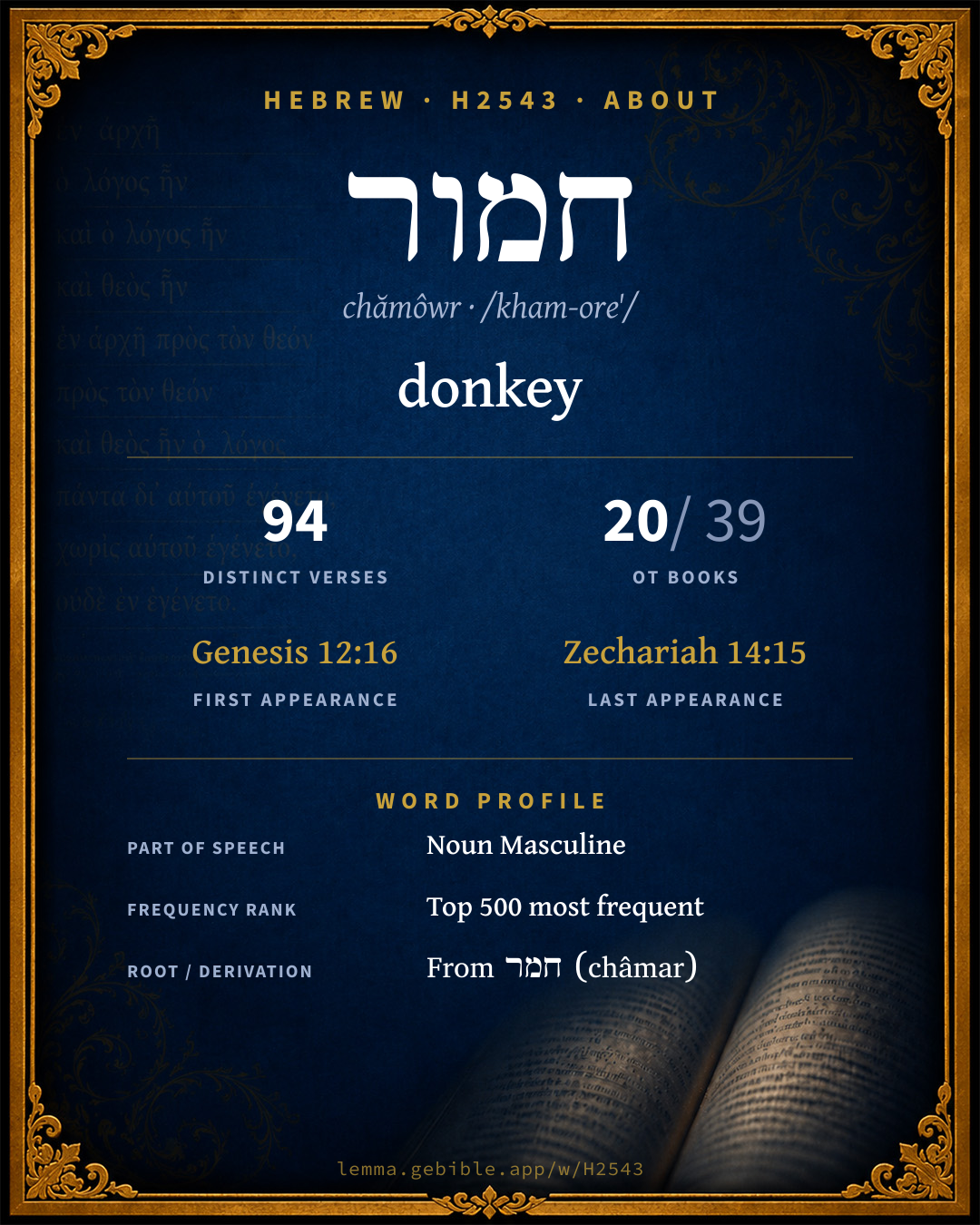
חֲמוֹר
donkey
Full lexicon entry — Brown-Driver-Briggs (BDB)
From Brown-Driver-Briggs (BDB)
Where this word appears
Grammar key — what these labels mean
Part of speech
- Noun
- A naming word — a person, place, thing, or idea.
Noun type
- Common
- A common noun — a general class of person, place, or thing (“king,” “city,” “water”), not a specific name.
State
- Absolute
- The independent form of a noun, not bound to a following word.
- Construct
- A noun bound to a following noun in a possessive / “of” relationship (the construct chain).
Gender
- Both
- Attested as both masculine and feminine.
Number
- Singular
- One.
- Plural
- More than one (in Hebrew, generally three or more).
Every verse where H2543 appears in the Book of 2 Chronicles — 1 distinct verse. Click any verse to open its interlinear word-by-word view. Verse text shown in the World English Bible for context — . Each verse’s Hebrew form is shown with its reference; the English is not keyword-highlighted, since the data carries no word-level English alignment. Use “Compare translations” on any verse to read it across multiple English versions. This concordance covers the Hebrew Bible; Septuagint (Greek Old Testament) occurrences are not indexed here.
2 Chronicles
About this entry
At a glance — auto-summarized from this page’s data, not written by a person. Every figure links to its source below. This summary describes the numbers; it doesn’t interpret them.
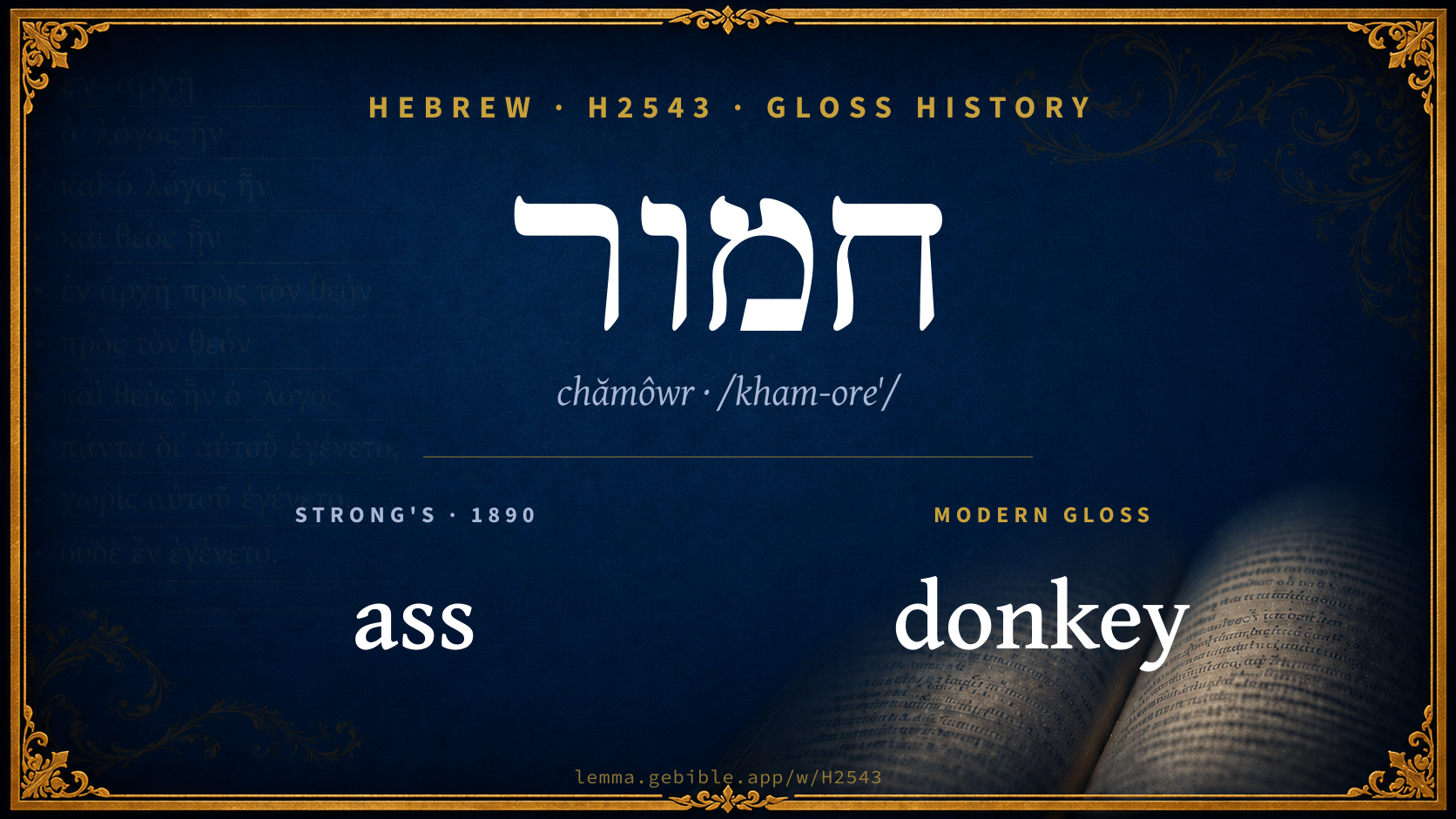
“donkey” is the headline sense of the Hebrew noun חמור (chămôwr). Older and newer Bibles part ways — “ass” in the King James Version, “donkey” (Berean Standard Bible) in modern versions. See the renderings breakdown. It appears 94 verses across 20 books of the Hebrew Bible, among its moderately common vocabulary. Scripture first uses it in Genesis 12:16. It shares a root with חמר, חמר and חמר. See the sense tree, 94-verse concordance, and the renderings breakdown below.
Gloss history
Strong's 1890 vs modern scholarship
About this word
Strong's H2543 catalogs a Hebrew word from the Hebrew Old Testament.
These counts are not copied from any lexicon or concordance. They are computed here, from the morphology-tagged Hebrew Old Testament. What Lemma adds →
- 94
- distinct verses
- The word appears in 94 distinct verses.
- 20 / 39
- OT books
- The word appears in 20 of 39 Old Testament books.
- #432
- by frequency
- Top 500 most frequent Hebrew words (rank 432 of 8,640 Hebrew words by occurrence).
View all 94 occurrences in the concordance →
By section of the Old Testament
By traditional corpus
Conventional, traditional groupings — biblical authorship is debated, so this is a traditional corpus grouping, not an authorship claim. Each share is this word’s portion of its verses in that division of the Hebrew canon. Each figure is a share of the word’s 94 distinct verses.
- Prophets (Nevi'im) 44 verses · 47%
- Torah (Pentateuch) 41 verses · 44%
- Writings (Ketuvim) 9 verses · 10%
How translations render this word
Counts come from each version’s own published word-to-Strong’s tagging or interlinear alignment — an approximate guide to how each version renders this word, not a word-level alignment the data otherwise carries. Because each total is that version’s own tagged count, the per-version totals vary from one another and need not match the appearance or distinct-verse counts above. These counts may also differ from a printed concordance because Lemma counts each distinctly tagged rendering and does not collapse phrase taggings into a single head-word total. This is a fixed set of word-tagged versions (KJV, ASV, BSB, ULT) and does not change with the reading translation you choose elsewhere. Each version’s license is shown beside its name below (and on Sources).
BDB lists this Strong’s number as 3 distinct words (homographs). Each count above pools all of them and is not split by sense — see the Senses section below. A low-frequency rendering may belong to a different one of those words, not the primary meaning.
- King James Version†: Ass 46×, Asses 37×, Or his ass 2×
- American Standard Version†: Ass 44×, Asses 33×, Couple of asses 2×
- Berean Standard Bible†: Donkey 44×, Donkeys 44×, Or donkey 4×
- unfoldingWord Literal Text†: Donkey 52×, Donkeys 33×, Donkey of 3×
King James Version Public Domain
Renders H2543 across 96† tagged occurrences — most commonly:
Plus 11 renderings that appear only once — usually multi-word phrases or single function words the recovered tagging swept in, not distinct renderings.
American Standard Version Public Domain
Renders H2543 across 96† tagged occurrences — most commonly:
Plus 15 renderings that appear only once — usually multi-word phrases or single function words the recovered tagging swept in, not distinct renderings.
Berean Standard Bible Public Domain
Renders H2543 across 96† tagged occurrences — most commonly:
Plus 4 renderings that appear only once — usually multi-word phrases or single function words the recovered tagging swept in, not distinct renderings.
unfoldingWord Literal Text CC BY-SA 4.0
Renders H2543 across 99† tagged occurrences — most commonly:
Plus 9 renderings that appear only once — usually multi-word phrases or single function words the recovered tagging swept in, not distinct renderings.
9 senses and sub-senses in the full BDB
What do BDB’s symbols mean?
BDB uses these scholarly abbreviations:
| Symbol | Meaning |
|---|---|
| 𝔊 | the Septuagint (the ancient Greek translation, LXX) |
| 𝔙 | the Vulgate (the Latin translation) |
| 𝔖 | the Syriac version (the Peshitta) |
| 𝔗 | the Targum (the Aramaic translation) |
| ψ | the Psalms |
| √ | root (the underlying root or stem) |
| ‖ | parallel passage (a synonymous or contrasted parallel) |
| † | the dagger: every passage where the word occurs is cited |
The 9 senses and sub-senses the full Brown-Driver-Briggs lexicon distinguishes for this word, in lexicon order (not ranked by frequency), with BDB’s own verbatim wording and sub-sense lettering. Shown in Hebrew script with BDB’s own scholarly abbreviations. The condensed entry is in the Lexicon Entry tab. See also the Forms in the corpus table below.
חמור I [m.] heap, abs. ח׳ with du. חֲמֹרָתָ֑יִם (Baer חֲמֹרֹת׳), as if from חֲמֹרָה
חמור II
- 1. as (valuable) property, with oxen, sheep, camels, slaves, etc. Gn 12:16; 24:35; 30:43; 47:17 Ex 9:3 (all J) Ex 20:17 (E), 21:23; 22:3, 8, 9; 23:4, 5, 12; Nu 16:15; Jos 6:21; 7:24 (all JE); note also Ex 13:13 = 34:20 (JE; firstlings belongs to י׳); Gn 36:24; Nu 31:28, 30, 34, 39, 45 (all P); Dt 5:14, 18; 22:3, 4; 28:31; Ju 6:4; 1 S 8:16; 12:3; 15:3; 22:19; 27:9; 1 Ch 5:21 Ezr 2:67 = Ne 7:68 (Baer), Zc 14:15; coll. Gn 32:5 (J; ‖ שׁוֹר, צֹאן, עֶבֶד, שִׁפְחָה), but pl. (similar ‖) Gn 34:28 (P), 47:17 (J); cf. also ח׳ יְתוֹמִים 24:3 the orphans’ ass (‖ שׁוֹר אַלְמָנָה); as knowing its master’s crib Is 1:3 (‖ שׁוֹר); found in camp 2 K 7:7, 10 (both ‖ סוּסִים); as harnessed מֶתֶג לַח׳ Pr 26:3 (‖ סוּם). e.g. Genesis 12:16
- 2. used for riding:
- a. by women Ex 4:20 (J), Jos 15:18 (JE) = Ju 1:14; 1 S 25:20, 23, 42, cf. 2 Ch 28:15. e.g. Exodus 4:20
- b. by men 2 S 16:2; 17:23; 19:27; 1 K 2:40; 13:13(×2), 23, 24, 27, 28(×2) Is 21:7; Zc 9:9. e.g. 2 Samuel 16:2
- c. צֶמֶד חמורים a pair of asses 2 S 16:1 (for burdens and for riding); for man and woman Ju 19:3, 10, 19, 21; carrying dead body v 28, cf. ח׳ 1 K 13:29. e.g. 2 Samuel 16:1
- 3. beast of burden Gn 22:3, 5 (cf. v 6), 42:26, 27; 45:23 (all E) 43:18, 24; 44:3, 13 (all J), Jos 9:4 (JE), 1 S 25:18; 1 Ch 12:41; Ne 13:15 (cf. also צֶמֶד ח׳ 2 S 16:1 supr.); metaph. of Issachar ח׳ גָּ֑רֶם Gn 49:14 (poem), an ass of (strong) bones.—ח׳ לֶחֶם 1 S 16:20 read prob. חֲמִשָּׁה five, or better עֲשָׂרָה ten, v. We Dr. e.g. Genesis 22:3
- 4. used in tillage Is 32:20; not to be used in ploughing with an ox (שׁוֹר) Dt 22:10. e.g. Isaiah 32:20
- 5. parts of body of ass mentioned are: לְחִי ח׳ Ju 15:15, 16 jawbone, Samson’s weapon; רֹאשׁ ח׳ 2 K 6:25 eaten in famine; בְּשַׂר ח׳ Ez 23:20 genital organ of ass (contempt. sim.) e.g. Judges 15:15
- 6. קְבוּרַת ח׳ Je 22:19 burial of an ass, in fig. of ignominious treatment of a corpse. Also she-ass 2 S 19:27 (cf. Mishn. AZ. vi). e.g. Jeremiah 22:19
חמור III m. father of Shechem (he-ass
Senses from the full Brown-Driver-Briggs lexicon (Brown, Driver, Briggs; Oxford 1906 — public domain), digitized via Sefaria, supplemented by the OpenScriptures HebrewLexicon (CC BY 4.0). Full attribution on Sources.
Word origin
I. n.[m.] heap, abs. ח׳ with du. חֲמֹרָתָ֑יִם (Baer חֲמֹרֹת׳), as if from חֲמֹרָה;—בִּלְחִי הַחֲמוֹר חֲמוֹר חֲמֹרָתָ֑יִם Ju 15:16 with the ass’s jawbone, a heap, two heaps, i.e. so many slain.
II. n.m. Gn 45:23 (he)-ass (NH id. (sometimes female, but this regularly חֲמוֹרָה); Aramaic חֲמָרָא, ܚܡܳܪܳܐ; Arabic حِمَارٌ, Palm. חמרא ReckendorfZMG 1888, 404; Assyrian imêru, SchrCOT Gloss.;—name from reddish colour)—abs. חֲמוֹר Gn 22:5 + 43 times; חֲמֹר Ex 13:13 Dt 22:10; cstr. חֲמוֹר Ex 23:5 + 4 times; חֲמֹר Gn 49:14; sf. חֲמֹרְךָ Dt 5:14; 28:31; חֲמֹרֶ֑ךָ Ex 23:12; חֲמֹרוֹ Gn 22:3 + 8 times; pl. חֲמוֹרִים Ju 19:10 + 9 times; חֲמֹרִים Gn 12:16 + 16 times; sf. חֲמוֹרֵינוּ Ju 19:19; חֲמֹרֵינוּ Gn 43:18; חֲמוֹרֵיכֶם 1 S 8:16; חֲמֹרֵיהֶם Gn 34:28 + 4 times; חֲמוֹרֵיהֶם Jos 9:4;—ass (he-ass; אתון = she-ass) found in all periods (coll. only Gn 32:6 Is 21:7);—
III. n.pr.m. father of Shechem (he-ass; v. RSK 220; Sem i. 449)—Gn 33:19; 34:2, 4, 6, 8, 13, 18(×2), 20, 24, 26; Jos 24:32; Ju 9:28.
— Brown-Driver-Briggs (Oxford 1906, public domain), digitized via Sefaria, supplemented by the OpenScriptures HebrewLexicon (CC BY 4.0). See Sources.
Derived from חמר (châmar) (H2560) — to boil.
Jastrow Dictionary
A second Hebrew/Aramaic lexicon for comparison, covering Aramaic and post-biblical (Talmudic, Targumic, Midrashic) usage that the biblical-Hebrew BDB does not. Matched by lemma rather than by Strong’s number, so a lemma may carry more than one Jastrow headword (shown separately below), and the entries cover usage well beyond the Bible.
חֲמוֹר
- c. (b. h.; v. חָמַר II a.
- 1. [load-carrier, cmp. גָּמָל.] ass. Nidd. 31ᵃ, v. גָּרַם. Sabb. 152ᵃ דעל ח׳ וכ׳ he who rides an ass is a freeman. B. Bath. 143ᵃ את וח׳ thou and the ass (shall own my property, a form of donation implying a rational and an irrational being).—Bekh. I, 2 ח׳ שילדה וכ׳ if an ass gave birth to &c. Snh. 33ᵃ הלכה חֲמוֹרְךָ וכ׳ thy ass is gone, Tarfon! (I shall have to make compensation for erroneous judgment); a. fr.
- 2. (cmp. various uses of horse) a contrivance for working-men, rest, jack, stocks &c. Kel. XIV, 3 ח׳ של נפחין the smiths’ ass (‘on which the smith sits while using its head as an anvil’, Maim.; ‘the rest of the bellows’, R. S.). Ib. XVIII, 3 וח׳ a stand on which the bedstead is placed. Gen. R. s. 65, end ח׳ של חרשים carpenters’ sawing-jack (an instrument for torture); Gen. R. s. 70 (alluding to Prov. XXVII, 22) אפי׳ … בח׳ של חרשים וכ׳ even if you put the wicked man on a carpenter’s jack, you cannot make anything useful out of him (sufferings will have no effect on him); Yalk. Kings 201; Yalk. Prov. 961; (Pesik. Shek., p. 15ᵃ במכתש).—Pl. חֲמוֹרִים. Sabb. 112ᵇ. Gen. R. s. 75; a. fr.—Denom. חַמָּר, חִמִּר.—Fem. חֲמוֹרָה. Tosef. Kil. V, 5. e.g. Proverbs 27:22
חָמוּר
- (חָמַר I) heavy, weighty, important; strict, severe, stringent, restrictive. Kel. I, 4 ח׳ שבכולם וכ׳ the most stringent of all are the laws concerning corpses.—איסור ח׳, v. אִיסּוּר.—Snh. 50ᵃ שריפה ח׳ וכ׳ death by burning is a severer punishment than &c. Ib. IX, 4, a. e. נידון בח׳ he suffers the severer penalty of the two. Ab. II, 1 כבחמורה as in the observance of a difficult commandment (requiring self-denial); a. fr.—Pl. חֲמוּרִים, חֲמוּרִין, f. חֲמוּרוֹת. Ḥull. XII, 5; a. fr.—Y. Snh. X, 28ᵇ top חֲמוּרוֹתָיו של וכ׳ (not חומר׳) the heaviest sins that Jeroboam committed.—דורשי חֲמוּרוֹת, v. חוֹמֶר II. קלים וחֲמוּרִים, v. חוֹמֶר I.
A Dictionary of the Targumim, the Talmud Babli and Yerushalmi, and the Midrashic Literature (Marcus Jastrow; London, Luzac, 1903) — Public Domain. Digitized via Sefaria. Digitized via Sefaria. Full attribution on Sources.
Forms in the corpus
The 69 distinct written forms H2543 takes in the Hebrew Bible, most frequent first — each parse links to that state’s occurrences in the concordance. Hebrew forms include their vowel points and cantillation, so a single lemma takes many written forms.
The 60 most common forms are shown; 9 rarer forms follow in the full concordance.
Same root — word family
Other BDB entries built from the same root as H2543, grouped by Strong’s listed origin. These share a root / origin per the lexicon — not necessarily a shared meaning. Each links to that word’s own entry.
Derives from
Shares the same root
- חמר chemer H2561 wine
- חמר chômer H2563 mortar
- חמר chêmâr H2564 bitumen
- חמרה chămôrâh H2565 heap
- יחמור yachmûwr H3180 roebuck
Proper names from this root
People and places named from this root — a name, not an additional meaning of the word.
Compare all same-root words → Showing 4 of 9 — not the complete family. 2 of the same-root words are proper names (people or places). They share a root, not necessarily a meaning.
Septuagint verse parallels
This word appears in 90 verses that also exist in the Greek Old Testament (Septuagint), out of the 94 Hebrew verses it occurs in. You can read those verses in Greek by switching the Old Testament edition to the Septuagint.
Read these verses in the Septuagint
- Genesis 12:16
- Exodus 4:20
- Numbers 16:15
- Deuteronomy 5:14
- Joshua 6:21
- Judges 1:14
- 1 Samuel 8:16
- 2 Samuel 16:1
- 1 Kings 2:40
- 2 Kings 6:25
- 1 Chronicles 5:21
- 2 Chronicles 28:15
This is a verse-level parallel only — the same verses exist in both the Hebrew and Greek Old Testaments. No word-level Hebrew↔Greek correspondence is claimed: the data carries no such alignment, so no Greek word is shown as this Hebrew word’s translation. Coverage is not total — the Septuagint omits the deuterocanon and renumbers the Psalms, so some Hebrew verses have no direct Greek parallel.