Ezekiel 23:20

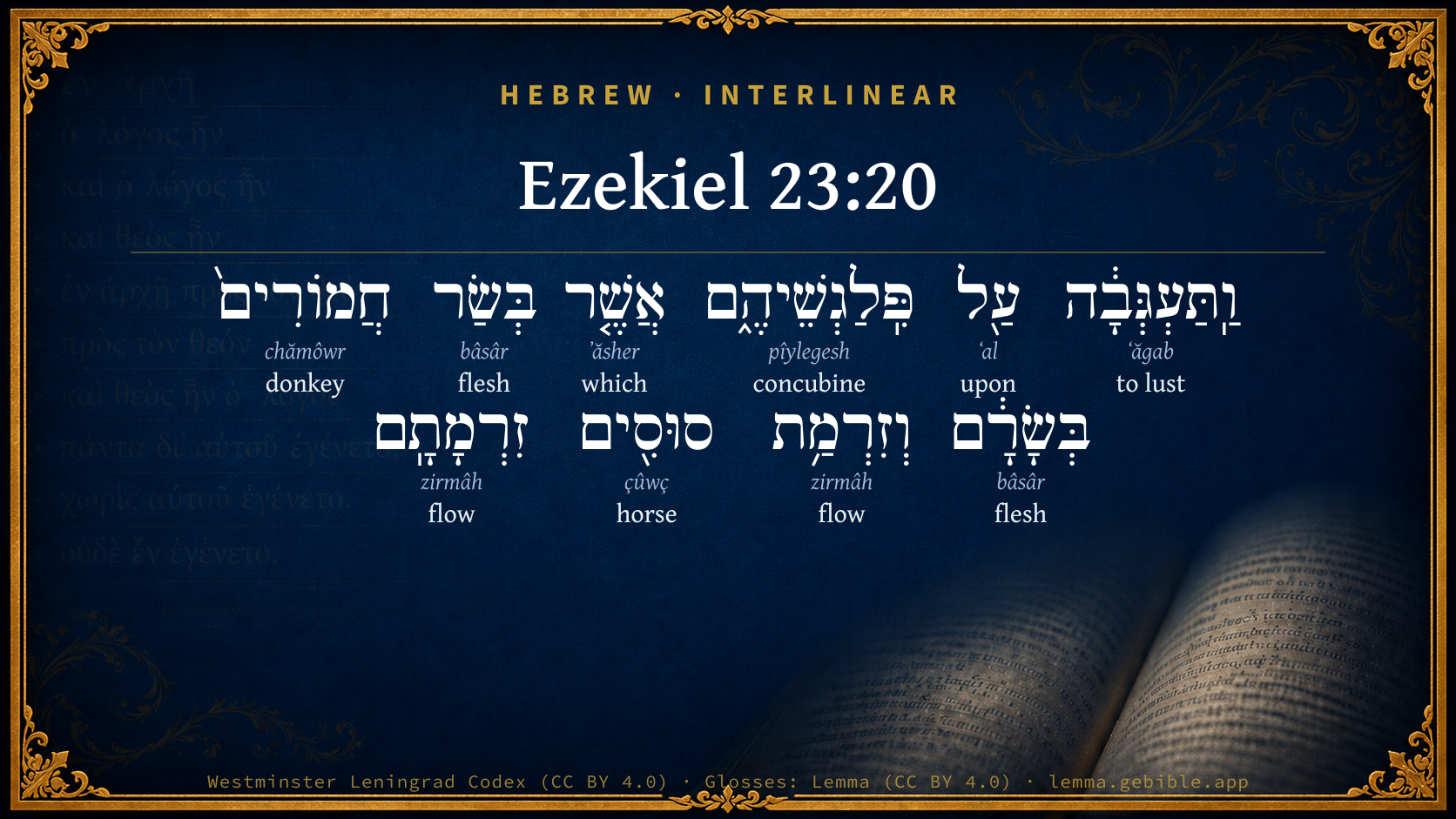
Hebrew (Westminster Leningrad Codex) Ezekiel 23:20 appears in the Hebrew Old Testament. The text above is from the Westminster Leningrad Codex. Each word links to its Strong’s number, a concise gloss, and parsing drawn from the Open Scriptures Hebrew Bible morphology. Click any word for its full Brown-Driver-Briggs (BDB) entry.
Download image
Cite this verse

Ezekiel 23:20 (World English Bible). Public Domain. Lemma interlinear Bible study tool, https://lemma.gebible.app/v/ezekiel/23/20.

Show BibTeX & RIS
BibTeX
RIS
English Translation
She doted on their paramours, whose flesh is as the flesh of donkeys, and whose issue is like the issue of horses.
World English Bible · Public Domain
Highlights
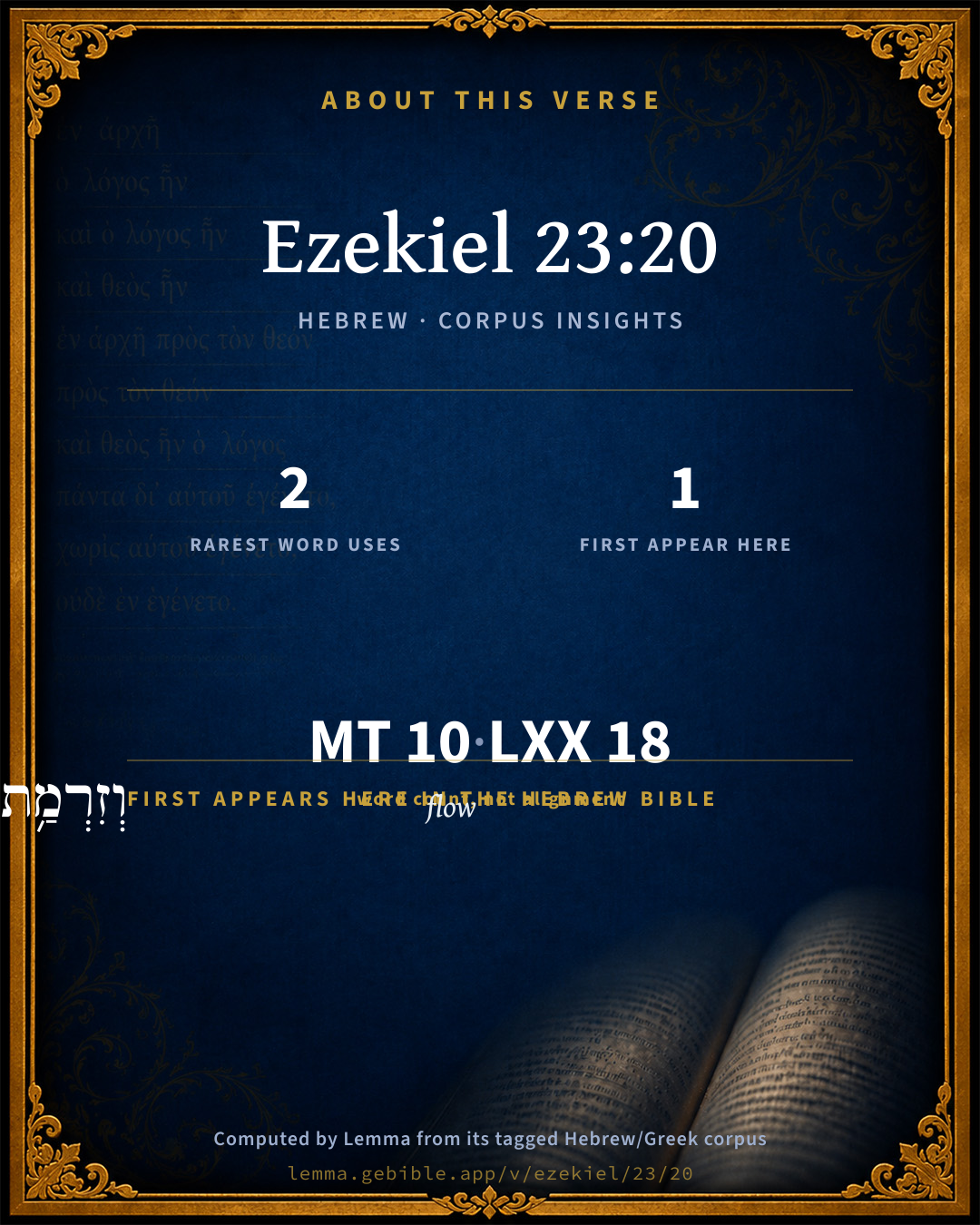
  • 1 first appearance in the Hebrew Bible
Full analysis ↓
Download a study sheet

One document with this verse’s original text, its word-by-word gloss line, the meaning frame, cross-references with their text, attributed commentary, and full source and license credits — printable, and it pastes into notes with its structure intact.

This verse Autodidact and up

Study sheet (.html) Plain text (.txt)

A passage Seminary Student

Up to 50 verses in one chapter. A passage sheet keeps up to 6 commentary sources and 12 cross-references per verse, in the order this page ranks them, and says so on the sheet whenever that leaves anything out. Ask for a single verse and you get the Autodidact verse sheet above.

Everything on this page stays free to read, with no account — the sheet is a download of what is already on screen, not access to it.

Want to remove ads? Support Godless Engineer
Compare translations 3

The same verse in 3 English versions, stacked beneath the original-language interlinear above. Click any original word for its lexicon entry.

Each is an independent rendering of the whole verse — the interlinear is not word-aligned to these translations.

Highlighted words mark where these versions differ — a whole-verse word diff, not a word-by-word alignment.

  • World English Bible Public Domain
    She doted on their paramours, whose flesh is as the flesh of donkeys, and whose issue is like the issue of horses.
  • King James Version Public Domain
    For she doted upon their paramours, whose flesh is as the flesh of asses, and whose issue is like the issue of horses.
  • unfoldingWord Literal Text CC BY-SA 4.0
    So she lusted for her lovers, whose private parts were like those of donkeys, and whose reproductive emissions were like those of horses.

unfoldingWord Literal Text — © unfoldingWord, licensed CC BY-SA 4.0. Word-aligned USFM3 via Door43 (git.door43.org/unfoldingWord/en_ult).

Versions to compare (up to 4)

3 of 4 selected

Show all 18 translations

Every available English version of this verse, each an independent rendering of the whole verse.

  • World English Bible Public Domain
    She doted on their paramours, whose flesh is as the flesh of donkeys, and whose issue is like the issue of horses.
  • Berean Standard Bible Public Domain
    and lusted after their lovers, whose genitals were like those of donkeys and whose emission was like that of stallions.
  • Majority Standard Bible Public Domain
    and lusted after their lovers, whose genitals were like those of donkeys and whose emission was like that of stallions.
  • King James Version Public Domain
    For she doted upon their paramours, whose flesh is as the flesh of asses, and whose issue is like the issue of horses.
  • American Standard Version (1901) Public Domain
    And she doted upon their paramours, whose flesh is as the flesh of asses, and whose issue is like the issue of horses.
  • Revised Version (1885) Public Domain
    And she doted upon their paramours, whose flesh is as the flesh of asses, and whose issue is like the issue of horses.
  • Geneva Bible (1599) Public Domain
    For she doted vpon their seruants whose members are as the members of asses, and whose yssue is like the yssue of horses.
  • Douay-Rheims (1899) Public Domain
    And she was mad with lust after lying with them whose flesh is as the flesh of asses: and whose issue as the issue of horses.
  • Young's Literal Translation Public Domain
    And she doteth on their paramours, Whose flesh `is' the flesh of asses, And the issue of horses -- their issue.
  • Literal Standard Version CC BY-SA 4.0
    And she lusts on their lovers, || Whose flesh [is] the flesh of donkeys, || And the emission of horses—their emission.
  • Unlocked Literal Bible CC BY-SA 4.0
    So she lusted for her lovers, whose private parts were like those of donkeys, and whose reproductive emissions were like those of horses.
  • unfoldingWord Literal Text CC BY-SA 4.0
    So she lusted for her lovers, whose private parts were like those of donkeys, and whose reproductive emissions were like those of horses.
  • Darby Bible Public Domain
    and she lusted after their paramours, whose flesh is [as] the flesh of asses, and whose issue is [as] the issue of horses.
  • World Messianic Bible Public Domain
    She lusted after their lovers, whose flesh is as the flesh of donkeys, and whose issue is like the issue of horses.
  • Webster's Bible Public Domain
    For she doted upon their paramours, whose flesh is as the flesh of asses, and whose issue is like the issue of horses.
  • Free Bible Version CC BY-SA 4.0
    She wanted to have sex with her lovers who had genitals like donkeys and who ejaculated like stallions.
  • Bible in Basic English Public Domain
    And she was full of desire for her lovers, whose flesh is like the flesh of asses and whose seed is like the seed of horses.
  • JPS Tanakh (1917) Public Domain
    And she doted upon concubinage with them, whose flesh is as the flesh of asses, and whose issue is like the issue of horses.

Literal Standard Version (2020), Covenant Press — licensed CC BY-SA 4.0. Text via the HelloAO Bible API (eBible.org). Unlocked Literal Bible (unfoldingWord) — licensed CC BY-SA 4.0. Text via the HelloAO Bible API (eBible.org). unfoldingWord Literal Text — © unfoldingWord, licensed CC BY-SA 4.0. Word-aligned USFM3 via Door43 (git.door43.org/unfoldingWord/en_ult). Free Bible Version, Dr. Jonathan Gallagher — licensed CC BY-SA 4.0. Text via the HelloAO Bible API (eBible.org).

Word by word

More ways to search: Search by grammar → Find every occurrence → Compare this word →

Practice this passage: Drill this verse → Learn its vocabulary →

וְזִרְמַ֥ת
zirmâh
H2231
“and · flow of”
Conjunction + Noun, Common, Feminine, Singular, Construct
Part of Speech
Conjunction + Noun
Type
Common
Gender
Feminine
Number
Singular
State
Construct
Full BDB Definition

Origin: from H2230

TWOT: 581b

flow, issue - issue (of seminal discharge)
  1. וַֽתַּעְגְּבָ֔ה ʻăgab H5689 “and · to lust” Conjunction + Verb, Qal, Sequential Imperfect, 3rd Person, Feminine, Singular + Suffix, h
  2. עַ֖ל ʻal H5921 “upon” Preposition
  3. פִּֽלַגְשֵׁיהֶ֑ם pîylegesh H6370 “concubines · their” Noun, Common, Feminine, Plural, Construct + Suffix, Personal, 3rd Person, Masculine, Plural
  4. אֲשֶׁ֤ר ʼăsher H834 “which” Particle, Relative
  5. בְּשַׂר bâsâr H1320 “flesh of” Noun, Common, Masculine, Singular, Construct
  6. חֲמוֹרִים֙ chămôwr H2543 “donkeys” Noun, Common, Both, Plural, Absolute
  7. בְּשָׂרָ֔ם bâsâr H1320 “flesh · their” Noun, Common, Masculine, Singular, Construct + Suffix, Personal, 3rd Person, Masculine, Plural
  8. סוּסִ֖ים çûwç H5483 “horses” Noun, Common, Masculine, Plural, Absolute
  9. זִרְמָתָֽם zirmâh H2231 “flow · their” Noun, Common, Feminine, Singular, Construct + Suffix, Personal, 3rd Person, Masculine, Plural

About this verse

These counts appear in no published source. They are computed here, from the morphology-tagged text and Lemma’s own curated glosses. What Lemma adds →

10
words
8
distinct lemmas
Prophets
section

Notable vocabulary

The rarest word here is וְזִרְמַ֥ת flow H2231 — appearing just 2 times in the whole Hebrew Bible.

First appearance in Scripture

This word makes its first canonical appearance in the Hebrew Bible here:

  • וְזִרְמַ֥ת flow H2231

Grammatical profile

  • 1 verb
  • 7 nouns
  • 1 preposition
  • 1 particle

Verb forms

  • וַֽתַּעְגְּבָ֔ה Qal · Sequential Imperfect

Repetition

Words recur within this verse — often emphatic in Hebrew:

  • בְּשַׂר flesh H1320 ×2
  • וְזִרְמַ֥ת flow H2231 ×2

Hebrew & Septuagint length

In English translation the verse runs 22 words from the Hebrew and 24 from the Septuagint (LXX English) — closely comparable.

A rough comparison of the two English renderings, which tokenize alike — not a word-level alignment.

Word counts can differ between the Hebrew and the Greek without any difference in meaning — e.g. the Hebrew direct-object marker אֵת has no separate Greek word, and Greek often adds the article ὁ.

In the original languages it is 10 Hebrew tokens and 18 Greek tokens — but the two are counted differently (Hebrew bundles its prefixes and suffixes into one token; the Greek is in lemma form), so that isn’t a like-for-like length.

Cross-references

4

Topical passages linked to Ezekiel 23:20 in the Treasury of Scripture Knowledge — connected by theme and wording, ordered by reader-vote popularity; previews shown in the World English Bible.

  • Ezekiel 16:26 You have also committed sexual immorality with the Egyptians, your neighbors, great of flesh; and have multiplied your prostitution, to provoke me to anger.
  • Ezekiel 17:15 But he rebelled against him in sending his ambassadors into Egypt, that they might give him horses and much people. Shall he prosper? shall he escape who does such things? shall he break the covenant, and yet escape?
  • Jeremiah 5:8 They were as fed horses roaming at large; everyone neighed after his neighbor's wife.
  • Ezekiel 16:20 Moreover you have taken your sons and your daughters, whom you have borne to me, and these have you sacrificed to them to be devoured. Were your prostitution a small matter,

Cross-references courtesy of OpenBible.info (CC BY 4.0).

Hebrew and Greek witnesses Masoretic Hebrew ↔ Greek Septuagint

The same verse in the two great witnesses to the Old Testament, shown verse-for-verse.

These are two independent witnesses, not word-aligned to each other, and the Septuagint is shown in lemma (dictionary) form.

Hebrew Ezekiel 23:20 Masoretic · Westminster Leningrad Codex

וַֽתַּעְגְּבָ֔ה עַ֖ל פִּֽלַגְשֵׁיהֶ֑ם אֲשֶׁ֤ר בְּשַׂר חֲמוֹרִים֙ בְּשָׂרָ֔ם וְזִרְמַ֥ת סוּסִ֖ים זִרְמָתָֽם

She doted on their paramours, whose flesh is as the flesh of donkeys, and whose issue is like the issue of horses.

World English Bible · Public Domain

Greek LXX Ezekiel 23:20 Septuagint · lemma form

καί ἐπιτίθημι ἐπί ὁ χαλδαῖος ὅς εἰμί ὡς ὄνος ὁ σάρξ αὐτός καί αἰδοῖος ἵππος ὁ αἰδοῖος αὐτός

and you did dote upon the Chaldeans, whose flesh is as the flesh of the asses, and their members as the members of horses.

LXX2012 (modern English Septuagint) · Public Domain

On this verse, John Gill's Exposition discusses the Septuagint’s reading. Read the note in Commentary ↓

Hebrew: Westminster Leningrad Codex (CC BY 4.0). Greek: Septuagint (public domain); English from LXX2012 (modern English Septuagint) (Public Domain). How the Septuagint differs from the Hebrew →

Targum (Aramaic paraphrase)

1

The Targum is the ancient Jewish Aramaic paraphrase of the Hebrew Scriptures — an interpretive translation, not the Hebrew text itself. Onkelos (literal) and Pseudo-Jonathan (expansive) render the Torah, and Jonathan the Prophets. Coverage is partial: where no permissively-licensed English translation exists for a verse, only the Aramaic is shown. This is verse-level text, not a word-by-word alignment to the Hebrew.

  1. Targum Jonathan Prophets (Joshua–Malachi)
    וְאִתְרְעִיאַת לְמֶהֱוֵי שְׁמוֹטָא לְהוֹן דִבְסַר חֲמָרִין בִּסְרֵיהוֹן וְצַחֲנַת סוּסְוָן צַחֲנַתְהוֹן:

    (no public-domain English translation for this verse)

    Targum Jonathan — Aramaic: “Mikraot Gedolot” (public domain). English: “Sefaria Community Translation” (CC0 1.0 (public-domain dedication)); “London "Chaldee Paraphrase," 1871” (public domain). Text via Sefaria.

Commentary

Notes on Ezekiel 23:20 from classic Christian and Jewish commentators (each source and its license shown beneath its notes). The classic Christian expositions comment on the surrounding passage and are grouped to its opening verse, so a note may address several verses; the Jewish commentaries on the Tanakh (Rashi and others) are per-verse, so they appear only where the commentator wrote on this verse.

Lemma curates 59 commentaries, every one of them public domain or Creative Commons licensed, each selected and text-cleaned for this edition rather than reprinted as found. About our sources →

Trapp's Complete Commentary

John Trapp

Eze 23:20 For she doted upon their paramours, whose flesh [is as] the flesh of asses, and whose issue [is like] the issue of horses.

Ver. 20. Whose flesh is as the flesh of asses.] Qui sunt bene mentulati (honos sit nutibus) et qui semine abundant. Commodus the emperor, who had never a good property in him, was for this called the Ass, as Jerome noteth.

And whose issue is as the issue of horses.] Fluxus equorum est fluxus eorum - that is, they are extremely libidinous and superstitious, so that there is no ho with them. Circumfluunt et exundant omni scelere et impietate copiosissime.

John Trapp, A Commentary or Exposition upon All the Books of the Old and New Testament (1647–1656) — public domain. Text from a community e-Sword module.

Jamieson, Fausset & Brown

Robert Jamieson, A. R. Fausset & David Brown

their paramours--that is, her paramours among them (the Egyptians); she doted upon their persons as her paramours (Eze 23:5, Eze 23:12, Eze 23:16).

flesh--the membrum virile (very large in the ass). Compare Lev 15:2, Margin; Eze 16:26.

issue of horses--the seminal issue. The horse was made by the Egyptians the hieroglyphic for a lustful person.

Jamieson, Fausset & Brown — Commentary Critical and Explanatory on the Whole Bible (1871) — public domain (CC PDM 1.0). Text via the HelloAO Bible API.

Adam Clarke's Commentary

Verse 20. She doted upon their paramours] פלגשיהם pillagsheyhem, their harlots or concubines. Anciently harlot meant in our language either the male or female prostitute.

Whose flesh is as the flesh of asses] See on Eze 16:25.

Adam Clarke's Commentary on the Bible (1810–1826) — public domain. Text from a community e-Sword/MySword module.

Ellicott's Commentary for English Readers

(20) Their paramours.—The word is masculine, as indicating the abominable sins copied by the Israelites from the heathen, and asses and horses are introduced to show the intensity of lust. (Comp. Jer_5:8.)

A Bible Commentary for English Readers, edited by Charles John Ellicott (1878–1897) — public domain. Text from a community e-Sword module.

John Gill's Exposition

For she doted upon their paramours,.... Or "concubines" (z); the neighbouring nations and allies of the Egyptians, whose friendship the Jews courted, and whose idols they served: the Septuagint and Arabic versions wrongly read the Chaldeans:

whose flesh is as the flesh of asses, and whose issue is like the issue of horses; by "flesh" is meant the "membrum virile", which in asses is very large, and therefore dedicated to Priapus by the Heathens; and vast is the profusion of seed in coitus by horses, to which the flesh and issue of the Egyptian paramours are compared; who were very libidinous, and therefore desirable to insatiable women; all which serves to express the eagerness of the people of the Jews after idolatry.

(z) "equecubinas eorum", Vatablus, so Junius & Tremellius, Polanus; "concubitores", Munster, Tigurine version; "cinaedos", Castalio; and, as Ben Melech observes, these were men, and not women.

John Gill's Exposition of the Whole Bible (1746–1763) — public domain (CC PDM 1.0). Text via the HelloAO Bible API.

Haydock's Catholic Bible Commentary

Asses. He means the Egyptians, (chap. xvi. 26.) in whom the kings of Juda trusted. (Calmet)

George Leo Haydock (1774–1849), Haydock's Catholic Family Bible and Commentary, 1859 edition — public domain. Excludes Psalms (Douay-Rheims chapter numbering differs from Protestant) and Deuterocanonical books (Catholic canon only).

Matthew Poole's English Annotations

Doted: see Eze 23:5.

Upon their paramours; Egyptians, and the nations that were confederate with the Egyptians; looking on them as able to defend by their power, enrich by their trade, and make prosperous by their friendship.

Whose flesh, & c.: in these terms the prophet expresseth the vehement desire of the Jews to Egyptian idolatry, compared to whoredom, and may, for aught I know, tax the lustful impudence of some of the Jewish women in their corporal uncleannesses with the Egyptians, who were it seems (by report of authors) naturally disposed for that vice, and fittest for unsatiable, lustful women: see Eze 16:26.

Matthew Poole's English Annotations on the Holy Bible (1683–1685) — public domain. Text from a community e-Sword/MySword module.

Whedon's Commentary on the Bible

Daniel D. Whedon

20. Compare notes Eze_16:26, and see Jer_5:8. The coarsest and most fleshly abominations just suited her taste.

Daniel D. Whedon (gen. ed.), Commentary on the Old and New Testaments (1874–1909) — public domain. Text from a community e-Sword module.

The Pulpit Commentary

She doted on her paramours. Commonly the word is used of a concubine. (Gen_22:24; Jud_1:8:31) Here it is used in scorn of the Egyptian princes whose favor Judah courted, reminding us of Homer"s jAcaiidev oujket jAcaioi, as indicating their political weakness. All that need be said of the comparison that follows is that here also Ezekiel follows in the footsteps of Jeremiah. (Jer_5:8) What isindicated is that Judah threw herself into the idolatrous ritual of Egypt with an almost orgiastic passion. The harlot nation returned, as it were, to her first love, and renewed the whoredoms of her youth.

The Pulpit Commentary (1880–1919), ed. H.D.M. Spence-Jones & Joseph S. Exell — public domain. Text from a community e-Sword module.

John Wesley's Explanatory Notes

Paramours - The nations, that were confederate with the Egyptians.

John Wesley, Explanatory Notes Upon the Whole Bible (1754–1765) — public domain. Text via the GEBible commentary corpus.

unfoldingWord translationNotes

Door43 World Missions Community

General Information:

Yahweh continues his metaphor in which he speaks of the cities of Jerusalem and Samaria as if they were two prostitutes. This metaphor continues through Ezekiel 23:34. (See: Metaphor)

whose private parts were like those of donkeys

This compares the size of the mens' private parts to those of a donkey to show how wicked Oholibah's desires were. This is an exaggeration as they could not be as large as those of a donkey. AT: "whose private parts were very long, like those of a donkey" (See: Simile and Hyperbole and Generalization)

whose reproductive emissions were like those of horses

This compares the volume of the mens' emissions to those of a horse to show how wicked Oholibah's desires were. This is an exaggeration as they could not be like those of a horse. AT: "whose reproductive emissions were huge, like those of a horse" (See: Simile and Hyperbole and Generalization)

translationWords

donkey

shame

unfoldingWord translationNotes — © Distant Shores Media and the Door43 World Missions Community, licensed CC BY-SA 4.0. Source: git.door43.org/Door43/en_tn.

Rashi

Rabbi Shlomo Yitzchaki (Rashi)

And she lusted for their concubinage [Heb. פִּלַּגְשֵׁיהֶם,] for their concubinage, to be a concubine to them.

those whose flesh is the flesh of donkeys [i.e.,] the phallus.

and...is the issue of horses An expression of a profusion of sexual intercourse, for they engage in sexual intercourse more than any other male animals.

זִרְמַת refers to the stream of semen, like (Habakkuk 3:10): “A stream (זֶרֶם) of water passed.”

Rashi on the Tanakh — English translations: “The Judaica Press complete Tanach with Rashi, translated by A. J. Rosenberg” (CC BY 4.0); “Pentateuch with Rashi's commentary by M. Rosenbaum and A.M. Silbermann, 1929-1934” (public domain); “The Metsudah Tanach series, Lakewood, N.J” (CC BY 4.0); and “The Book of Joshua, Metsudah Publications, 1997” (CC BY 4.0). Text via Sefaria.

Lesson kit

Teaching starters — assembled from the data on this page, not authored interpretation. Every prompt links to the verse data it draws on. Edit before teaching.

Ezekiel, in the Prophets, opens this verse with 10 words (8 distinct Hebrew lemmas). Its most distinctive word is zirmâh (“flow”). A historical commentator’s framing appears above. Read the whole chapter for the surrounding context.

Discussion questions

  1. How does “flow” (zirmâh) shape what this verse is saying?
  2. The word “flow” first appears here in Scripture. What is being introduced at this debut?
  3. Ezekiel 16:26 shares this passage’s theme. How do the two illuminate each other?
  4. “flesh” occurs 2× in this one verse. What is the effect of the repetition?
  5. These translations render this verse differently; the difference is in the English rendering, not the original. What questions does that raise?
  6. The verb «וַֽתַּעְגְּבָ֔ה» is Qal Sequential Imperfect. How does its form color the action?
  7. Reading how Trapp's Complete Commentary and Jamieson, Fausset & Brown read this verse, where do the two commentators agree and where do they part?

Things to notice

Reading settings

Reading text

Shown beneath each verse's original-language words.

Old Testament
Old Testament edition

Read the OT as the Masoretic Hebrew (MT) or the Greek Septuagint (LXX).

English shown for the Greek Septuagint (in the Hebrew ↔ Greek comparison).

Comparing translations? Open the Compare panel on any verse page to stack up to four side by side.