
Isaiah 32:20

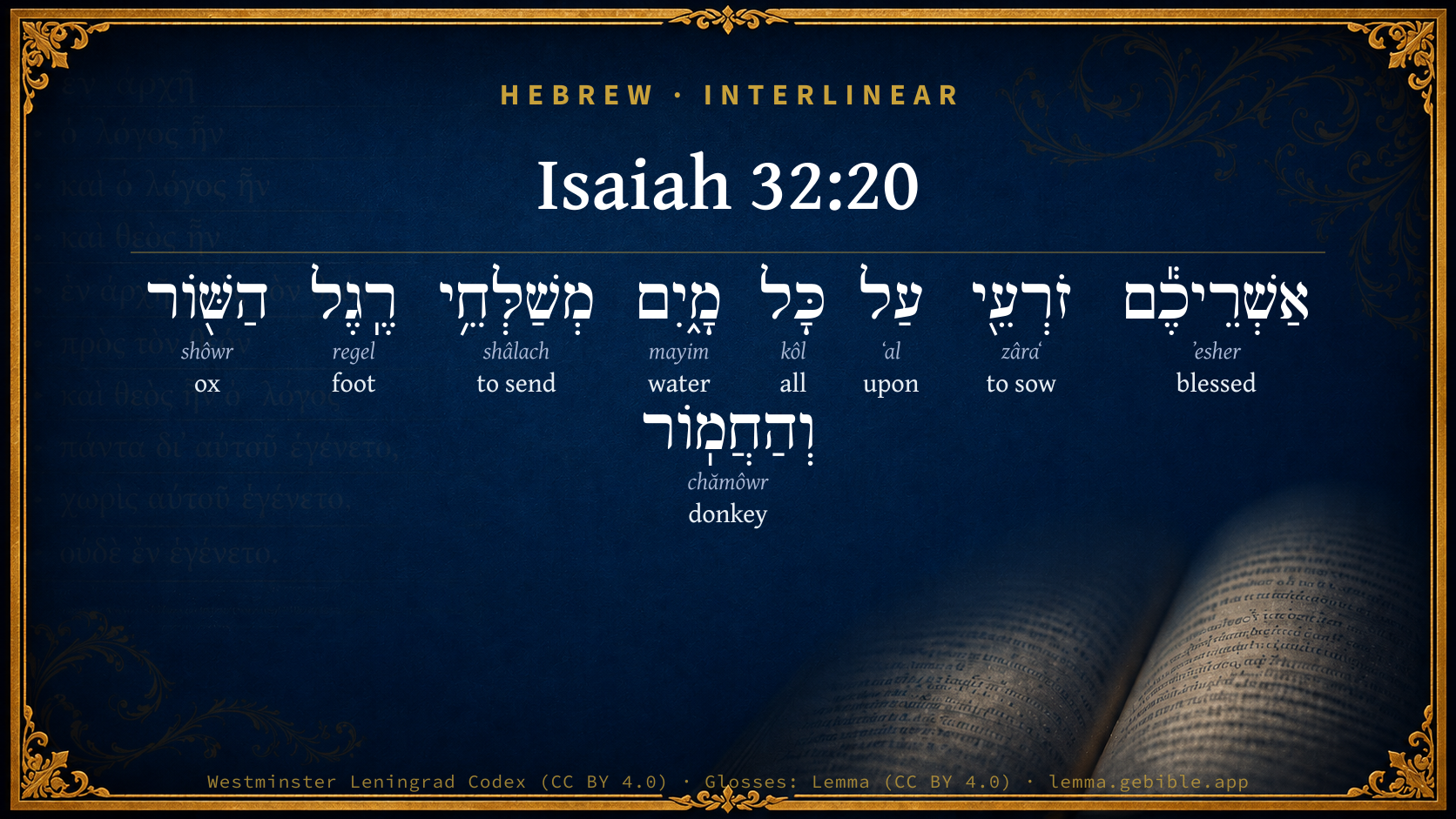
Hebrew (Westminster Leningrad Codex) Isaiah 32:20 appears in the Hebrew Old Testament. The text above is from the Westminster Leningrad Codex. Each word links to its Strong’s number, a concise gloss, and parsing drawn from the Open Scriptures Hebrew Bible morphology. Click any word for its full Brown-Driver-Briggs (BDB) entry.
Download image
Cite this verse

Isaiah 32:20 (World English Bible). Public Domain. Lemma interlinear Bible study tool, https://lemma.gebible.app/v/isaiah/32/20.

Show BibTeX & RIS
BibTeX
RIS
English Translation
Blessed are you who sow beside all waters, who send forth the feet of the ox and the donkey.
World English Bible · Public Domain
Download a study sheet

One document with this verse’s original text, its word-by-word gloss line, the meaning frame, cross-references with their text, attributed commentary, and full source and license credits — printable, and it pastes into notes with its structure intact.

This verse Autodidact and up

Study sheet (.html) Plain text (.txt)

A passage Seminary Student

Up to 50 verses in one chapter. A passage sheet keeps up to 6 commentary sources and 12 cross-references per verse, in the order this page ranks them, and says so on the sheet whenever that leaves anything out. Ask for a single verse and you get the Autodidact verse sheet above.

Everything on this page stays free to read, with no account — the sheet is a download of what is already on screen, not access to it.

Want to remove ads? Support Godless Engineer
Compare translations 3

The same verse in 3 English versions, stacked beneath the original-language interlinear above. Click any original word for its lexicon entry.

Each is an independent rendering of the whole verse — the interlinear is not word-aligned to these translations.

Highlighted words mark where these versions differ — a whole-verse word diff, not a word-by-word alignment.

  • World English Bible Public Domain
    Blessed are you who sow beside all waters, who send forth the feet of the ox and the donkey.
  • King James Version Public Domain
    Blessed are ye that sow beside all waters, that send forth thither the feet of the ox and the ass.
  • unfoldingWord Literal Text CC BY-SA 4.0
    The happiness of you sowers beside all waters, senders of the foot of the ox and the donkey!

unfoldingWord Literal Text — © unfoldingWord, licensed CC BY-SA 4.0. Word-aligned USFM3 via Door43 (git.door43.org/unfoldingWord/en_ult).

Versions to compare (up to 4)

3 of 4 selected

Show all 18 translations

Every available English version of this verse, each an independent rendering of the whole verse.

  • World English Bible Public Domain
    Blessed are you who sow beside all waters, who send forth the feet of the ox and the donkey.
  • Berean Standard Bible Public Domain
    Blessed are those who sow beside abundant waters, who let the ox and donkey range freely.
  • Majority Standard Bible Public Domain
    Blessed are those who sow beside abundant waters, who let the ox and donkey range freely.
  • King James Version Public Domain
    Blessed are ye that sow beside all waters, that send forth thither the feet of the ox and the ass.
  • American Standard Version (1901) Public Domain
    Blessed are yet that sow beside all waters, that send forth the feet of the ox and the ass.
  • Revised Version (1885) Public Domain
    Blessed are ye that sow beside all waters, that send forth the feet of the ox and the ass.
  • Geneva Bible (1599) Public Domain
    Blessed are ye that sowe vpon all waters, and driue thither the feete of the oxe and the asse.
  • Douay-Rheims (1899) Public Domain
    Blessed are ye that sow upon all waters, sending thither the foot of the ox and the ass.
  • Young's Literal Translation Public Domain
    Happy `are' ye sowing by all waters, Sending forth the foot of the ox and the ass!
  • Literal Standard Version CC BY-SA 4.0
    Blessed [are] you sowing by all waters, || Sending forth the foot of the ox and the donkey!
  • Unlocked Literal Bible CC BY-SA 4.0
    you who sow beside all the streams will be blessed, you who send out your ox and donkey to graze.
  • unfoldingWord Literal Text CC BY-SA 4.0
    The happiness of you sowers beside all waters, senders of the foot of the ox and the donkey!
  • Darby Bible Public Domain
    Blessed are ye that sow beside all waters, that send forth the feet of the ox and the ass.
  • World Messianic Bible Public Domain
    Blessed are you who sow beside all waters, who send out the feet of the ox and the donkey.
  • Webster's Bible Public Domain
    Blessed are ye that sow beside all waters, that send forth thither the feet of the ox and the ass.
  • Free Bible Version CC BY-SA 4.0
    you will be happy as you sow your crops beside the waters and let your cattle and donkeys roam freely.
  • Bible in Basic English Public Domain
    Happy are you who are planting seed by all the waters, and sending out the ox and the ass.
  • JPS Tanakh (1917) Public Domain
    Happy are ye that sow beside all waters, that send forth freely the feet of the ox and the ass.

Literal Standard Version (2020), Covenant Press — licensed CC BY-SA 4.0. Text via the HelloAO Bible API (eBible.org). Unlocked Literal Bible (unfoldingWord) — licensed CC BY-SA 4.0. Text via the HelloAO Bible API (eBible.org). unfoldingWord Literal Text — © unfoldingWord, licensed CC BY-SA 4.0. Word-aligned USFM3 via Door43 (git.door43.org/unfoldingWord/en_ult). Free Bible Version, Dr. Jonathan Gallagher — licensed CC BY-SA 4.0. Text via the HelloAO Bible API (eBible.org).

Word by word

More ways to search: Search by grammar → Find every occurrence → Compare this word →

Practice this passage: Drill this verse → Learn its vocabulary →

About this verse

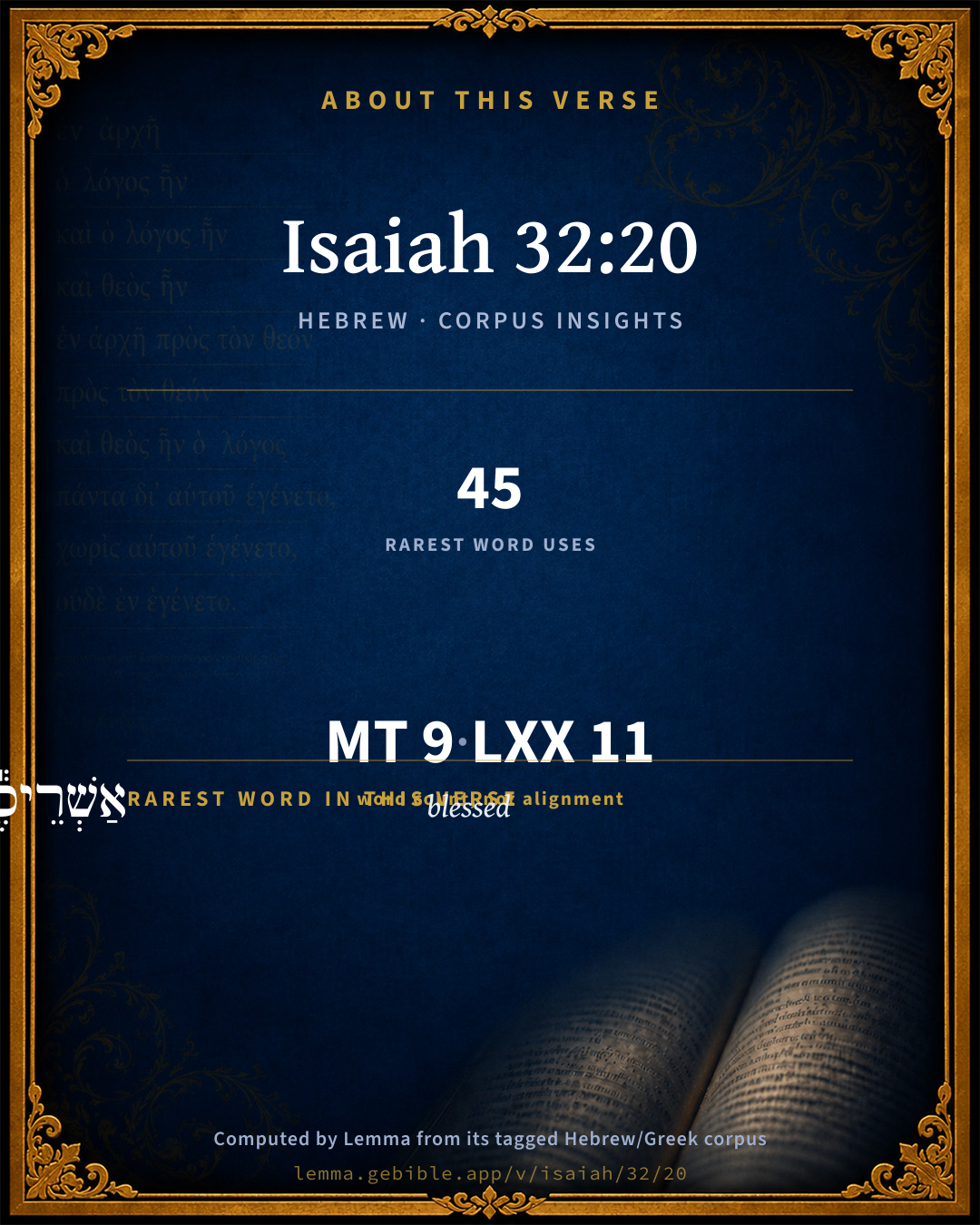
These counts appear in no published source. They are computed here, from the morphology-tagged text and Lemma’s own curated glosses. What Lemma adds →

9
words
9
distinct lemmas
Prophets
section

Shared distinctive vocabulary

אַשְׁרֵיכֶ֕ם blessed H835 occurs in 42 verses of the Hebrew Bible. Also found in:

Grammatical profile

  • 2 verbs
  • 6 nouns
  • 1 preposition

Verb forms

  • זֹרְעֵ֖י Qal · Participle Active
  • מְשַׁלְּחֵ֥י Piel · Participle Active

Hebrew & Septuagint length

In English translation the verse runs 19 words from the Hebrew and 14 from the Septuagint (LXX English) — closely comparable.

A rough comparison of the two English renderings, which tokenize alike — not a word-level alignment.

Word counts can differ between the Hebrew and the Greek without any difference in meaning — e.g. the Hebrew direct-object marker אֵת has no separate Greek word, and Greek often adds the article ὁ.

In the original languages it is 9 Hebrew tokens and 11 Greek tokens — but the two are counted differently (Hebrew bundles its prefixes and suffixes into one token; the Greek is in lemma form), so that isn’t a like-for-like length.

Cross-references

10

Topical passages linked to Isaiah 32:20 in the Treasury of Scripture Knowledge — connected by theme and wording, ordered by reader-vote popularity; previews shown in the World English Bible.

  • Ecclesiastes 11:1 Cast your bread on the waters; For you shall find it after many days.
  • Isaiah 30:23–24 He will give the rain for your seed, with which you shall sow the ground; and bread of the increase of the ground, and it shall be fat and plenteous. In that day shall your cattle feed in large pastures;
  • Isaiah 55:10–11 For as the rain comes down and the snow from the sky, and doesn't return there, but waters the earth, and makes it bring forth and bud, and gives seed to the sower and bread to the eater;
  • Isaiah 19:5–7 The waters shall fail from the sea, and the river shall be wasted and become dry.
  • Acts 2:41 Then those who gladly received his word were baptized. There were added that day about three thousand souls.
  • Acts 4:4 But many of those who heard the word believed, and the number of the men came to be about five thousand.
  • Acts 5:14 More believers were added to the Lord, multitudes of both men and women.
  • 1 Corinthians 3:6 I planted. Apollos watered. But God gave the increase.
  • 1 Corinthians 9:9–11 For it is written in the law of Moses, "You shall not muzzle an ox while it treads out the grain." Is it for the oxen that God cares,
  • James 3:18 Now the fruit of righteousness is sown in peace by those who make peace.

Cross-references courtesy of OpenBible.info (CC BY 4.0).

Hebrew and Greek witnesses Masoretic Hebrew ↔ Greek Septuagint

The same verse in the two great witnesses to the Old Testament, shown verse-for-verse.

These are two independent witnesses, not word-aligned to each other, and the Septuagint is shown in lemma (dictionary) form.

Hebrew Isaiah 32:20 Masoretic · Westminster Leningrad Codex

אַשְׁרֵיכֶ֕ם זֹרְעֵ֖י עַל כָּל מָ֑יִם מְשַׁלְּחֵ֥י רֶֽגֶל הַשּׁ֖וֹר וְהַחֲמֽוֹר

Blessed are you who sow beside all waters, who send forth the feet of the ox and the donkey.

World English Bible · Public Domain

Greek LXX Isaiah 32:20 Septuagint · lemma form

μακάριος ὁ σπείρω ἐπί πᾶς ὕδωρ ὅς βοῦς καί ὄνος πατέω

Blessed are they that sow by every water, where the ox and ass tread.

LXX2012 (modern English Septuagint) · Public Domain

Hebrew: Westminster Leningrad Codex (CC BY 4.0). Greek: Septuagint (public domain); English from LXX2012 (modern English Septuagint) (Public Domain). How the Septuagint differs from the Hebrew →

Targum (Aramaic paraphrase)

1

The Targum is the ancient Jewish Aramaic paraphrase of the Hebrew Scriptures — an interpretive translation, not the Hebrew text itself. Onkelos (literal) and Pseudo-Jonathan (expansive) render the Torah, and Jonathan the Prophets. Coverage is partial: where no permissively-licensed English translation exists for a verse, only the Aramaic is shown. This is verse-level text, not a word-by-word alignment to the Hebrew.

  1. Targum Jonathan Prophets (Joshua–Malachi)
    טוּבֵיכוֹן צַדִיקַיָא עֲבַדְתּוּן לְכוֹן עוֹבָדִין טָבִין דְאַתּוּן דָמָן לִדְזַרְעִין עַל שַׁקְיָא מְשַׁלְחִין לְאַדְרָכָא בְּתוֹרַיָא וּלְמִכְנַשׁ בְּחַמְרַיָא:

    Blessed are ye, O just, ye work out for yourselves good works: because ye are like those, who sow by watered places, sending the oxen to tread out the corn, and asses to gather it in.

    Targum Jonathan — Aramaic: “Mikraot Gedolot” (public domain). English: “Sefaria Community Translation” (CC0 1.0 (public-domain dedication)); “London "Chaldee Paraphrase," 1871” (public domain). Text via Sefaria.

Commentary

Notes on Isaiah 32:20 from classic Christian and Jewish commentators (each source and its license shown beneath its notes). The classic Christian expositions comment on the surrounding passage and are grouped to its opening verse, so a note may address several verses; the Jewish commentaries on the Tanakh (Rashi and others) are per-verse, so they appear only where the commentator wrote on this verse.

Lemma curates 59 commentaries, every one of them public domain or Creative Commons licensed, each selected and text-cleaned for this edition rather than reprinted as found. About our sources →

Trapp's Complete Commentary

John Trapp

Isa 32:20 Blessed [are] ye that sow beside all waters, that send forth [thither] the feet of the ox and the ass.

Ver. 20. Blessed are ye that sow beside all waters.] Conclusionem texit ipse propheta. The prophet concludeth with an exclamation, as admiring the happiness of such as should live till the commonwealth should be thus restored; but especially when Christ should come in the power and purity of his ordinances, filling his people with the fruits of righteousness, and fattening them for the purpose with those waters of the sanctuary, as Nile doth the land of Egypt, &c. Oh, the heaped up happiness of such! O terque quaterque beati! Say, "They sow in tears, yet they shall reap in joy"; {Psa 126:5} say, They "send thither the feet of the ox and the ass," those laborious and useful creatures, to ear the ground, and fit it for receipt of seed; {Psa 144:14} they "shall surely eat the fruit of their labours"; {Psa 128:2} they "shall reap in due time if they faint not." {Gal 6:9} His faecunda sine dubio messis indulgentiae orietur, saith Arnobius; their "labour cannot be in vain in the Lord." {1Co 15:58}

John Trapp, A Commentary or Exposition upon All the Books of the Old and New Testament (1647–1656) — public domain. Text from a community e-Sword module.

The Biblical Illustrator

Joseph S. Exell

Isa_32:20

Blessed are ye that sow beside all waters

Times of peace should be improved

The war is now over; Asher has been crushed like a serpent, and this sweet voice is heard when the enemy has been driven out of the land.

Understand that times of peace are to be times of cultivation. We are not to be great only in war. (Jos. Parker, D. D.)

Moral cultivation

The allusion in this verse is supposed by some to be to pasturage, by others to tillage. Lowth follows Chardin in applying the words to the practice of treading the ground by the feet of cattle before planting rice; Henderson to the act of setting them at liberty from the rope with which they were tied by the foot. Knobel understands the verse as contrasting the condition of those who lived at liberty, on the seaside or by rivers, with theirs who were pent up and besieged in cities. Hitzig supposes a particular allusion to the case of those who had escaped with their possessions from Jerusalem. Hendewerk applies the verse to the happy external condition of the people in the days of the Messiah. Henderson says it beautifully exhibits the free and unrestrained exertions of the apostles and other missionaries in sowing the seed of the kingdom in every part of the world. Ewald explains it exclusively of moral cultivation, as implying that none can expect to reap good without diligently sowing it. Of all these explanations the last may be considered as approaching nearest to the truth, because it requires least to be supplied by the imagination. Taking the whole connection into view, the meaning of this last verse seems to be, that as great revolutions are to be expected, arising wholly or in part from moral causes, they alone are safe, for the present and the future, who with patient assiduity perform what is required; and provide, by the discharge of actual duty, for contingencies which can neither be escaped, nor provided for in any other manner. (J. A. Alexander.)

Missionary operations in the Christian dispensation

It has been granted to Isaiah to look into the future, and he foresaw the call of the Gentiles and the Christian dispensation. There he beheld the messengers of the Lord receiving their commission, Go ye and teach all nations; and he pronounced them to be blessed as compared with himself, sent to a single people, rebellious and gainsaying. This he expresses in metaphorical language, and by reference to a process of husbandry, or to the manner of sowing grain, particularly rice, which still prevails in Eastern countries, and with which the Israelites were familiar. The mode of proceeding is thus described:--The sowers cast their seed upon the waters, when, by the swelling of the river, the waters cover the land. Beasts of burden are employed to tread down the mud or slime, to render it capable of receiving the seed as it sinks. (W. F. Hook, D. D.)

Sowing beside all waters

There is spiritual seed to be sown. It is to be sown by the side of all waters. It is, however, sown in vain, unless the moral soil be cultivated in which it is designed to take root.

I. THE NATURE OF THE SEED WE HAVE TO SOW. Our Lord and Master, when explaining the parable of the Sower and the seed to His disciples, saith, the seed is the Word o God.

1. The ministers of Christ are the sowers of the seed.

2. But they are not so exclusively. To sow the seed is in some measure the duty of all who name the name of Christ; of the parent especially to his child, and of every Christian in his daily conversation and walk.

II. THE IMPORTANCE OF WATCHING THE TIMES, AND OF AVAILING OURSELVES OF THE OPPORTUNITIES PROVIDENTIALLY OPENED TO US, FOR SOWING THE SEED. In every nation, and in every clime, it is indeed as much the farmers duty to watch the seasons as it is to sow the seed. And in spiritual husbandry, this it is that distinguishes the sober-minded Christian from the mere fanatic. But this is not the only lesson that we are to deduce from our text. We are to sow beside all waters.

III. THE CONDITIONS UNDER WHICH THE SOWING OF IT RESULTS IN A MORAL, SPIRITUAL, AND HEAVENLY HARVEST. God requires the spiritual seed to be sown; He requires the spiritual seed to take root in the heart, before the harvest of grace can be realised, or the fruit be produced. It is by meditation that we tread down the seed into the heart and soul. (W. F. Hook, D. D.)

The blessedness of communicating the privileges of the Gospel to others

I. Blessed are they in this work; for in acting thus THEY ARE INSTRUMENTS OF GODS MERCY TO MEN.

II. Blessed are they, IN REFERENCE TO THE STATE OF RELIGION WITHIN THEMSELVES.

III. May we not add, as another ground of blessedness, THE PRAYERS OF THOSE WHO ARE BROUGHT TO THE KNOWLEDGE OF THE SAVIOUR BY MISSIONARY EFFORTS? (H. Raikes, M. A.)

The work of the evangel

I. It is a SOWING WORK. Of all mere human works, this is--

1. The most Divine. The seed, the soil, are all of God.

2. The most righteous. Statesmen, merchants, warriors, may question the rectitude of their work, but the agriculturist has no reason to doubt.

3. The most useful. The farmer feeds the world.

4. The most believing. The man who commits the precious grain to the earth has strong faith in the laws of nature.

II. It is a BLESSED WORK. Blessed is he.

1. He is blessed by the gratitude of society. All are indebted to his services.

2. He is blessed with the approval of his own conscience. He feels that in sowing he is doing his duty.

3. He is blessed by the smiles of his God.

III. It is an UNRESTRICTED WORK. All waters. The meaning is, all well-watered places. The word beside would be better translated upon. Scatter seed upon all suitable spots. The evangel has unlimited scope for his operations. His field of labour is the world, and he is commanded to be instant in season and out of season. (Homilist.)

The blessedness of sowing beside all waters

I. They who wish to be useful should never forget the many favourable opportunities for sowing good seed on THE CLEAR AND UNRUFFLED WATERS OF CHILDHOOD.

II. Another opportunity for scattering precious seed is on THE TROUBLED WATERS OF STRIFE.

III. Another opportunity is upon THE STAGNANT AND MUDDY WATERS OF DOUBT AND UNBELIEF.

IV. If we are really anxious to do good in our day and generation, there will be times when WORDS OF COMFORT MAY BE SPOKEN TO BEWILDERED

SOULS ABOUT TO EMBARK UPON THE NARROW SEA WHICH DIVIDES THIS WORLD FROM THE NEXT. (J. N. Norton.)

Sowing beside all waters

1. Here is an assertion of that universal law that operates in the whole domain of human life--the law of consequent following precedent, of effect being the child of cause, of our sowing determining our reaping, of our character and conduct evolving our destiny.

2. Blessed are ye that sow beside all waters. Why? Not because the sowing is itself an absolute benediction. Oftentimes it is attended with a great deal of pain, and labour, and anxiety, and sacrifice. It is the casting away of that which is in itself of great value. The sowing is blessed because it is a prophecy of the increase of that which we sow, the promise of the reward of our labour and our sacrifice.

3. We are very apt to say, I shall attain this and that, acquire this and that by the goodness of God. We do well to say this. But we must not forget that the mercy and goodness of God alone will do nothing for us. It is Gods mercy and goodness, plus our own will, energy, and conduct, that will determine our destiny, and evolve our circumstances, and ripen our harvests.

4. The skill of the farmer lies in his knowledge of the relation of his seed to the soil, to the season, and the atmosphere, and the conditions of the growth and development of the seed. The highest wisdom of life is the knowledge of the relation of conduct to character, and of character to destroy: the perception of the conditions under which h e s highest elements are perfected and its fruit-bearing qualities ripened. That is the mystic meaning Of the benediction of my text: there is the secret of the blessedness of every Sower.

5. Do we know what Gods purpose in our life is? Along what lines would He have us develop? What does He wish human life to be? I would answer these questions first, and then show how the working of the human with the Divine fulfils the purposes and plans of God. I do not think that He wants us to go hungry or poorly clad in the biting cold; I do not think that we are fulfilling His purpose when we sigh over accidents that are traceable to human causes. It is anything but piety to sit down in poverty, rags, and dirt, and say, The will of the Lord be done. His will is our wellbeing--body, soul, and spirit. I want to point out what lines of conduct will contribute to the forming of such a Character and the developing of such circumstances as God approves.

I. I would speak of ACTIVITY as fruit-bearing seed that ripens into a harvest of blessedness. I do not mean busyness in any realm of life that may present itself. What I mean is activity in righteous pursuits, in holy ambitions, in legitimate callings; activity in things that pertain to human improvement, human comfort and well-being; things that belong to the many phases of lifes wondrous economy; things that tend to the uplifting of human lives, to the amelioration of human woes, to the lightening of human burdens, to the redeeming of human souls from tyranny, falsehood, and wrong.

II. The next fruit-bearing quality of which I would speak is LEARNING. There is a trite old saying, Never too late- to learn, which in most lives has little or no practical application. Do not let learning end at the schoolroom, net yourself some task to learn that shall explain some of the mysteries of life to you. Go apart from the madding crowds ignoble strife, and there open the windows of your mind, till that light which never was on sea or land shall flood it and make it luminous as with the sunshine of God. Every task you set yourself to learn, and learn it; every mystery that you make plain to yourself by processes of reasoning and study; every new fact that you gain by search and research in the domain of knowledge will not only make you wiser, but better; and, perhaps, after much pain and labour, you shall find the task ripening into a harvest that shall make the autumn of life golden.

III. I would mention also THE PRESERVATION OF HEALTH as that which will bear abundant fruitage in our happiness and well-being. A sound mind in a sound body is doubtless Gods will concerning us. And towards attaining that we can do more for ourselves than all the physicians in the world can do for us. Blessed is every man that sows his lifes seeds in fertile places; he is promoting the Divine economy, he is carrying out the purposes of God on earth. (W. J. Hocking.)

Sowing beside all waters

I. THE CHARACTERS HERE DESCRIBED. Sowers. A sower implies seed. There is only one granary in which the living seed of the kingdom is treasured, namely, the Bible.

1. The true spiritual sower, having first of all received himself the seed, will manifest a real love for the work. He will go forth willingly, conscientiously, and lovingly, to scatter broadcast the precious treasure, not merely on well-cultivated patches of human soil, but beside all waters, finding very often his chiefest joy in sowing the unlikeliest patches.

2. The true, spiritual sower will also have faith in his work.

3. He will not only have faith in the seed, but also in the soil. The farmer who does not believe the soil capable of producing fruit will certainly not waste time in its cultivation. If we did not believe that between every human heart and the Gospel seed there was such affinity that it could not help taking root therein, we should most certainly give up our toil.

4. The true, spiritual sower will often encounter difficulties in his work.

5. The spiritual sower is earths truest philanthropist.

II. OUR SPHERE OF OPERATION. Beside all waters. Wherever there is a solitary spot capable of receiving the good and living seed--whether at home or abroad, in dens of squalor or palaces of luxury and ease, in the crowded city or the rural village--we are commanded to go and plant it there.

III. THE BENEDICTION HERE PRONOUNCED. Blessed are they that sow beside all waters.

1. The work itself is its own reward.

2. The spiritual sower enjoys the benediction of others.

3. He has the smile and benediction of Him in whose service he is engaged. (J. W.Atkinson.)

Sowing beside all waters

Isaiah ever had an eye to the golden age. In view of the successful issue of the coming struggle, he intimates the wisdom of going on with seed sowing. They are blessed who are not hindered by fear. May we not learn the wisdom of hopefulness? The man who believes in Divine faithfulness has every reason to be an optimist. This subject is capable of application in various ways. The optimism of Isaiah, Christ, Paul, and John needs cultivation.

1. Those who give any thought to the social problems of the age are met by many difficulties and discouragements. So much want to be relieved, so many wrongs to be righted. Pessimism says, Society is going to the dogs; let it go. Optimism says, Ill save it if I can. Present social inequalities and woes should not make us hopeless. Jehovah was more mighty than Sennacherib. He is more mighty than all the forces arrayed against true liberty. Having faith in God we may sow the seeds of social reform.

2. In evangelistic and missionary work a spirit of optimism is essential. With Divine promises of power and blessing we may hopefully sow. Concerning foreign missions, Pessimism says, It is a waste of life, money, energy; but the man whose faith in God is strong, points to the golden age when all shall know the Lord.

3. Considering our own life and experience this same hopefulness is essential. Is life worth living? Yes, if for no other reason because in it we may sow for a golden harvest. (T. S. Williams, M. A.)

Selfishness in service

Some one tells of a physician, who, at the beginning of his career, made a resolution that he would undertake no cases but those with which he was certain he could succeed. While this would mean the loss of a good deal of money, he shrewdly calculated on getting it back a hundredfold in the reputation of skill which such a course would bring him. The idea is wholly selfish. He preferred to let men, whom he might possibly have saved, die, rather than run the risk of having the brightness of his reputation dimmed. (Christian Endeavour.)

Usefulness!

Is there a word in our language which expresses more than that? What images of the good, the devoted, and the self-sacrificing does it not bring up vividly before us! We see Thomas Cranfield, the tailor, labouring among the bricklayers in the cause of Sunday schools; John Pounds, the cobbler, who founded ragged schools; Sarah Martin, the dressmaker of Yarmouth, the devoted visitor to the workhouse and the jail; and Thomas Dakin, the Greenwich pensioner and distributor of tracts. Among these, in the higher walks of life, we recognise Howard, the philanthropist, over whose grave, in Russia, was engraved the motto which kings might envy, He lived for others; Clarkson, Wilberforce, and a host of honoured statesmen; the Thorntons, and a multitude of other merchant princes; Washington and Wellington, and Havelock and Scott, who, while they were leaders in the armies of this world, were proud to be humble privates in the armies of the Lord of hosts. (J. N. Norton.)

Where shall we sow?

Beside all waters. Some waters are clear and sparkling, and the murmur of their ripple gladdens the ear, sow there, of course. But there are turbid, angry waters, fouled and polluted, sow beside them also. Into the bright, sunny, prattling lives of the little ones cast the precious seed, but also, all the more lovingly and skifully, when the swollen torrents of sin rush past. God is able to make it grow and take root there; and also beside the stagnant pools of stolid atheism. Thou canst not tell whether shall prosper, either this or that. (G. Soltau.)

The catechism

Many striking incidents are related of good Father Nash, one of the early heralds of the Cross in the more destitute and neglected regions of the Diocese of New York, who has been made to figure with such effect in Fenimore Coopers famous romance, The Pioneers. On a certain occasion, when a number of clergymen were assembled for some purpose, and conversation began to flag, one of them, who was almost too diligent a farmer for the good of the Church, entertained the company with an account of his agricultural operations, and, among other things, of his successful management of sheep. Father Nash, whose whole heart was devoted to his Heavenly Masters work, felt little interest in all this, and when the enthusiastic farmer-pastor turned to him and asked, What do you feed your lambs with? the worthy missionary could not resist the temptation of administering a mild rebuke, and answered--With Catechism! (J. N. Norton.)

Tact in seed-sowing

A young friend was invited to spend the evening with Dr and Mrs. Horace Bushnell. She was a girl of fine intelligence and character, but not at that time religious. When, therefore, she was invited to tea by Mrs. Bushnell, she accepted with considerable misgiving, lest the evening should be made the occasion of such exhortations as were then too commonly the only subject of ministerial intercourse with the unconverted. To her great relief, however, the time was spent in the pleasantest social intercourse, free from all remarks of a personal nature. Dr. B., of course, saw her safely home when the evening was over, and as the night was one of brilliant starlight, the talk on the way was naturally of astronomy, and of the law-abiding order of the universe. He spoke eloquently of the great harmony of the spheres, and of the perfect manner in which each little star fulfilled its destiny, and swung in the Divine order of its orbit. Sarah, he said, turning to her with a winning smile, I want to see you in your place. No other word turned the suggestion into a homily, and her quick intelligence was thrilled and won by a thought which seemed in that quiet hour to have dropped upon her from the skies. He had simply let the occasion speak its own thought. (Dr. Bushnells Life.)

.

The Biblical Illustrator, edited by Joseph S. Exell (c. 1880s–1900s) — public domain. Text from a community e-Sword module.

Joseph Benson's Commentary

Isa 32:20. Blessed are ye that sow, &c. — As the barren forest shall be destroyed, so the fruitful field shall be improved and bring forth much fruit, which is signified by a declaration of the blessedness of them that sow in it; beside all waters — In all moist and flat grounds which are likely to yield good fruit; or, in every well-watered place, as Bishop Lowth renders it, who quotes Sir John Chardin as observing, that the place exactly answers the manner of planting rice in the East; concerning which, see the note on Ecc 11:1. But this passage, as well as that in the foregoing verses, is to be understood mystically of the times of the gospel, and of the great and happy success of the ministers of it, whose spiritual sowing of the word, accompanied with the influences of the Holy Ghost, produced much fruit in the Gentile nations, to the glory of God and their own comfort.

Joseph Benson's Commentary on the Old and New Testaments (1811–1818) — public domain. Text from a community e-Sword module.

The Preacher's Complete Homiletical Commentary

Joseph S. Exell (gen. ed.)

SPIRITUAL HUSBANDRY

Isa_32:20. Blessed are ye that sow beside all waters, that send forth thither the feet of the ox and the ass.

Two explanations of this description of agricultural life. The first refers it to the practice of literally sowing on the waters. In some parts of the East, particularly in the sowing of rice, the time chosen is when the rivers overflow their banks. Cattle are turned into the wet land to tread it and prepare it for the seed, which is then cast upon the water. It subsides into the ground and yields a quick harvest. If this is the allusion, the corresponding passage will be Ecc_11:1. The other explanation refers it to the sowing of seed in soil that is well watered by its proximity to some river, and to such a state of security that the oxen and asses may be turned upon the land to feed at large, without fences to limit their excursions. Either way the general idea is the same. It is the close of the beautiful description of peaceful prosperity after the return from captivity. The land would be cultivated in security, the harvests gathered in peace; a splendid contrast to the desolation of a country which has been the seat of war.

We apply the text to the privilege of labouring for the production of a moral harvest in human souls by the teaching of the gospel of Jesus Christ. Here is—

I. AN ANALOGY BETWEEN THE MATERIAL AND THE SPIRITUAL HUSBANDRY. Our present subject is not our own spiritual culture, although that is of supreme importance and the primary qualification for the cultivation of other souls. We are always sowing seed, the fruit of which is in our character and destiny, in time and eternity (Gal_6:7-8).

The analogy between the moral and material husbandry is very obvious (1Co_3:6-9; 1Co_9:10-11; Jas_3:18; Mat_13:3-32). This is the great work committed to the Church. We are to tell the story of God’s love; to make known the ruin; to proclaim the salvation; to persuade men.

Now, this supposes several things:—

1. Opportunity. By the restoration of Israel to their own land, they would have the opportunity of which they had been long deprived. There have been times when endeavours to teach God’s word was prohibited. In some lands it is so still. There are persons who will not hear. There are classes and circles, higher and lower, which are inaccessible to you. None of us is responsible for sowing the seed when there is no opportunity. But in so far as opportunity exists, or can be made, it behoves all to avail themselves of it to the full extent of their power. Mothers have the opportunity with their children. Sunday-school teachers. Doors opening in heathen lands.

2. Capacity. To sow a field requires some knowledge of the kind of work. City men would make sorry work. So the spiritual sowing requires some capacity. Two mistakes may be made. There is the mistake of those who think any kind of work will do; and of those who estimate the requirements so highly and their own power so humbly that they never venture anything. The latter deterrent operates largely. It falls in with the love of ease. It is sometimes said that the extension of popular education demands a higher class of Sunday-school teachers, for instance, than sufficed some time ago. Many Christians think their own education inadequate. It is a mistake. If we cannot realise our ideal, let us do our best. Besides, experience does not show that boys and girls are ahead of teachers of average intelligence. And spiritual earnestness is a greater qualification than even intellectual endowment. Capacity for Christian work, like any other, perhaps more than any other, increases by exercise.

3. Interest. He who would succeed must be interested in his work. He who dislikes it or is indifferent to its results will not do it well Commonly what was undertaken merely as an occupation, or for advantage, becomes a pleasure. The various labours of the husbandman interest him. And this is essential to the spiritual sower. There must be a disposition for the work. It presents attractions only to such as are in sympathy with its great ends. There must be sincere belief of the truth, thorough conviction of its necessity to man, and a benevolent desire for the widest dissemination of its blessings. Working in this spirit, your interest in it will constantly deepen. By the prospect of harvest you will be animated. With the heart in the work and the love of Christ in the heart, the sowing time will be full of spiritual interest.

4. Diligence. “All waters.” This suggests earnestness, energy, promptitude. Throw all your energy into this work. The husbandman watches everything that bears on his husbandry. Business men spare no pains in working out their arrangements. We must be equally diligent.

II. THE BLESSEDNESS OF BEING ENGAGED IN THE SPIRITUAL HUSBANDRY.

1. In the work itself. It becomes a pleasure. Knowledge and experience of the truth increase by communication, as seed by being sown. Spiritual enjoyment is deepened. Christian character grows. Many can say the sowing days are the happiest.

2. In the consciousness of usefulness. It is not labour in vain. Assured that we shall reap if we faint not. Already there are signs. Evil is prevented. One and another are being trained to goodness. The future career of those among whom you sow will be influenced in the most valuable way. Some will have their passage to the grave helped. The future world will be brightened to them, as well as the present.

3. In the Master’s approbation. As the work goes on, the consciousness of this is a blessedness. And when this world is left behind, His “well done.”

Address—

1. Those who are sowing, with words of encouragement.

2. Those who ought to be, with words of exhortation.—J. Rawlinson.

THE USE OF OPPORTUNITIES

Isa_32:20. Blessed are they that sow beside all waters, &c.

I. We may use the language of the text as a warning against the neglect of the least opportunity of usefulness to others. The prophet pronounces a blessing upon those who are prepared to scatter seed, not only where there is a probable prospect of a rich harvest, but upon whatsoever soil God shall bring them in contact with. It is not only by the waters that are sweet and sparkling that the sowing is to be carried on, but beside the floods that seem likely to overwhelm. We are to maintain a lively sense of our obligation to do good unto all men as we have opportunity. Even those who are alive to the reality of the effect which one man’s life and conversation may have upon another, nay, who are desirous to be useful to their brethren in Christ, are under a great temptation to be ruled by predilections for or against particular persons, and to regard some as too proud, too insincere, too thoughtless to reward their labour. Or their affections are so absorbed in one or two individuals, united with them by blood or friendship, that they are rendered comparatively indifferent about the influence they may exert upon others. But whether we choose or no, our power for good or evil extends over all who come within our shadow, and we should neglect no opportunity to make it a power for good (H. E. I. 1857–65, 4596).

II. We should not neglect any opportunity of securing benefit for ourselves. Every period of existence is to be spent unto God. Swift and resistless the waters of life glide on. But beside them all, the Christian sows his good seed. Equally in youth, middle age, and in advancing years, whatsoever his hand finds to do, he does it heartily, as unto the Lord; and in each he reaps a harvest according to his sowing in that which preceded it. Blessed through eternity will he be who sowed wisely and liberally beside all the waters of life.—J. R. Woodford, M.A.: Sermons preached in Bristol, pp. 228–243.

It should be the ambition of us all to be useful. The difference between one man who lives a useful, and another who lives a useless life, is simply this—the one improves his opportunities for doing good and making others happy, while he ministers to his own well-being; and the other lives only for himself, and reaps the barren harvest of his selfishness. Life comes but once to each of us, and blessed are they who, bearing this ever in mind, are careful to “sow beside all waters.”

I. Those who wish to be useful should never forget the many favourable opportunities for sowing seed on the clear and untroubled waters of childhood.

II. Another opportunity for scattering precious seed is on the troubled waters of strife (Mat_5:9).

III. Another, on the stagnant and muddy waters of doubt and unbelief. It often happens that the Christian is obliged to listen to the vapid and senseless discourse of those who seek to bring the religion of the Son of God into contempt, and if he would be prepared for such occasions of seed-sowing, he ought to be a diligent student of the Word of God, and of such works as will give him a right understanding of it.

IV. There will be times when words of comfort may be spoken to bewildered souls about to embark on “the narrow sea” which divides this world from the next.—John N. Norton: Golden Truths, pp. 73–81.

The Preacher's Complete Homiletical Commentary (gen. ed. Joseph S. Exell; Funk & Wagnalls, c. 1892) — public domain (pre-1929). A full-Bible homiletical/sermon-outline anthology covering 65 of 66 books (2 John is absent from the source module). Text from a community e-Sword module.

Geneva Bible (1599)

Geneva Bible translators

The fields shall be so rank, that they shall send out their cattle to eat up the first crop, which abundance shall be signs of God’s love and favor toward them.

That is, upon fat ground and well watered, which bringeth forth in abundance, or in places which before were covered with waters, and now made dry for your uses.

Geneva Bible (1599) marginal notes — public domain. Text via Bolls.life.

Jamieson, Fausset & Brown

Robert Jamieson, A. R. Fausset & David Brown

While the enemy shall be brought "low," the Jews shall cultivate their land in undisturbed prosperity.

all waters--well-watered places (Isa 30:25). The Hebrew translation, "beside," ought rather to be translated, "upon" (Ecc 11:1), where the meaning is, "Cast thy seed upon the waters when the river overflows its banks; the seed will sink into the mud and will spring up when the waters subside, and you will find it after many days in a rich harvest." Before sowing, they send oxen, &c., into the water to tread the ground for sowing. CASTALIO thinks there is an allusion to the Mosaic precept, not to plough with an ox and ass together, mystically implying that the Jew was to have no intercourse with Gentiles; the Gospel abolishes this distinction (Col 3:11); thus the sense here is, Blessed are ye that sow the gospel seed without distinction of race in the teachers or the taught. But there is no need of supposing that the ox and ass here are yoked together; they are probably "sent forth" separately, as in Isa 30:24.

Next: Isaiah Chapter 33

Jamieson, Fausset & Brown — Commentary Critical and Explanatory on the Whole Bible (1871) — public domain (CC PDM 1.0). Text via the HelloAO Bible API.

Adam Clarke's Commentary

Verse 20. That sow beside all waters - "Who sow your seed in every well-watered place"] Sir John Chardin's note on this place is: - "This exactly answers the manner of planting rice; for they sow it upon the water, and before sowing, while the earth is covered with water, they cause the ground to be trodden by oxen, horses, and asses, who go mid-leg deep; and this is the way of preparing the ground for sowing. As they sow the rice on the water, they transplant it in the water." Harmer's Observ. vol. i. p. 280. "Rice is the food of two-thirds of mankind." Dr. Arbuthnot. "It is cultivated in most of the eastern countries." Miller. "It is good for all, and at all times." Sir J. Chardin, ib. "Le ris, qui est leur principal aliment et leur froment (i.e., des Siamois,) n'est jamais assez arrose; il croit au milieu de l'eau, et les campagnes ou on le cultive ressemblent plutot a de marets que non pas a des terres qu'on laboure aver la charue. Le ris a bien cette force, que quoy qu'il y ait six ou sept pieds d'eau sur lui, il pousse toujours sa tige au dessus; et le tuyau qui le porte s'eleve et croit a proportion de la hauteur de l'eau qui noye son champ. Voyage de l'Eveque de Beryte, p. 144. Paris, 1666. - L. "Rice, which is the principal grain and aliment of the Siamese, can never be too much watered. It grows in the water, and the fields where it is sown resemble marshes rather than fields cultivated by ploughing. Rice has that property that although it be covered with water six or seven feet deep, yet it raises its stalk above it; and this grows long in proportion to the depth of the water by which the field is inundated."

Adam Clarke's Commentary on the Bible (1810–1826) — public domain. Text from a community e-Sword/MySword module.

Ellicott's Commentary for English Readers

(20) Blessed are ye that sow beside all waters.—The picture of a golden age of agriculture receives its final touch. The whole land should be irrigated by calmly flowing streams, and men should cast their seed broadcast, and the oxen and the asses should draw the plough over a rich and fertile land. The whole land should be under tillage, instead of being left to supply (as in Isa_7:21-22) a poor and meagre pasturage, or to bring forth nothing but the “thorns and briars” of Isa_32:13. It is obvious that here also a spiritual meaning underlies the literal.

A Bible Commentary for English Readers, edited by Charles John Ellicott (1878–1897) — public domain. Text from a community e-Sword module.

The Cambridge Bible for Schools and Colleges

gen. ed. J. J. S. Perowne

20. The prophet apostrophises the happy agricultural population of the renovated land of Israel. The sentiment may be in part due to his own delight in the avocations of the husbandman, but it has to be remembered that agricultural prosperity naturally holds a prominent place in Messianic prophecy, as the antithesis to the false refinements and military pomp of the civilisation that is to be swept away. The features of the description are, the happiness of the people, the abundance of water for the irrigation of the fields, and immunity from danger, so that “the ox and the ass” can be safely driven out to pasture, without fear of their not returning (cf. ch. Isa_1:3). The “thither” of the A.V. is a misleading insertion.

The Cambridge Bible for Schools and Colleges (gen. ed. J. J. S. Perowne; Cambridge University Press, 1878–1918) — public domain. Text from a community e-Sword module.

John Gill's Exposition

Blessed are ye that sow beside all waters,.... In places well watered and moistened, and so fit to receive the seed sown, which grows up, and brings forth much fruit, and amply rewards the pains of the sower, who on that account is happy. These words are directed to the ministers of the Gospel in the latter day; the word is compared to seed, and the preachers of it to sowers of seed, who have a commission to preach the Gospel to every creature; and in the latter day, in the spiritual reign of Christ, to which the whole paragraph refers, they will sow the seed of the word "by many waters"; or among great multitudes of people, signified hereby, and with great success, great numbers both of Jews and Gentiles will be converted:

that send forth thither the feet of the ox and the ass; which were used in ploughing and tilling the earth, and in making it fit to sow the seed in it, and to eat off the heads of grain when it is grown thick and full, which some think is here meant; and the one might also be used to gather it in when ripe, and the other to tread and thresh it, as the Targum and Jarchi interpret it; there being a law given the Jews, that these two should not work together, Deu 22:10 and from hence it may be concluded, that these words refer to a time when this law should be abolished; and the Jews themselves apply it to the times of the Messiah (r); and it undoubtedly points to Gospel times, and even to those times when the Jews shall be converted, and great numbers among the Gentiles also, who shall join together in spreading the Gospel, and in promoting the interest of Christ.

(r) Debarim Rabba, sect. 6. fol. 241. 4.

Next: Isaiah Chapter 33

John Gill's Exposition of the Whole Bible (1746–1763) — public domain (CC PDM 1.0). Text via the HelloAO Bible API.

Albert Barnes' Notes on the Bible

Blessed are ye - The sense of this verse is, that while the enemies of the Jews would be overthrown, they themselves would be permitted to cultivate their lands in security. Instead of predicting this directly, the prophet implies that this would occur, by declaring that those who were permitted to do this were happy.

That sow beside all waters - Hebrew, ‘Upon (על ‛al) all waters.’ This may mean that they selected places near running streams as being most fertile; or it may refer, as Lowth supposes, to the manner of sowing grain, and particularly rice, in eastern countries. This is done by casting the seed upon the water. This custom is referred to in Ecc 11:1 : ‘Cast thy bread,’ that is, thy seed, ‘upon the waters, for thou shalt find it after many days;’ that is, cast thy seed upon the waters when the river overflows the banks, and the seed will sink into the slime and mud, and will spring up when the waters subside, and you will find it again after many days in a rich and luxuriant harvest. Sir John Chardin thus describes this mode of sowing: They sow it (the rice) upon the water; and before sowing, while the earth is covered with water, they cause the ground to be trodden by oxen, horses, and asses, who go mid-leg deep; and this is the way they prepare the ground for sowing’ (Harmer’s Obs. vol. i. p. 280).

That send forth thither the feet of the ox and the ass - That is, for the purpose of treading the earth while the water is on it, and preparing it for the seed. In this way the ground would need no plowing, but the seed would fall into the slime, and be sufficiently covered when the waters should subside. The idea in this verse is, that there would be a state of security succeeding the destruction of their enemies; and that they would be permitted to pursue the cultivation of the soil, unannoyed and undisturbed.

Albert Barnes' Notes on the Bible (1834–1885) — public domain. Text from a community e-Sword/MySword module.

Haydock's Catholic Bible Commentary

Waters. Fruitful soils, abounding with cattle. (Calmet) --- Both Jews and Gentiles shall submit to Christ. (Clement of Alexandria, Strom. vi.) (St. Jerome)

George Leo Haydock (1774–1849), Haydock's Catholic Family Bible and Commentary, 1859 edition — public domain. Excludes Psalms (Douay-Rheims chapter numbering differs from Protestant) and Deuterocanonical books (Catholic canon only).

Matthew Poole's English Annotations

Blessed are ye that sow: as the barren forest shall be destroyed with hail, Isa 32:19, so the fruitful field shall be improved, and bring forth much fruit; which is signified by a declaration of the blessedness of them that sow in it.

Beside all waters; in all moist and fat grounds, which are like to yield good fruit. But this passage, as well as others in the foregoing verses, is to be understood mystically, and seems to respect the times of the gospel. The prophet reflecting upon his own unsuccessful labours, of which he complains, Isa 49:4, and elsewhere, and foreseeing by, the Spirit the great and happy success of his successors, the ministers of the gospel, tacitly bewails his own unhappiness, who sowed his seed upon dry and barren ground, by congratulating the happiness of the apostles, who sowed their seed more generally, upon all fit grounds, without any distinction between Jews and Gentiles; and who found the ground, to wit, the hearts of the people, more moistened and softened, and better prepared to receive the good seed of God’s word.

The ox and the ass; which creatures they employed in ploughing and sowing the ground, Deu 22:10; Psa 144:14; Isa 30:24.

Matthew Poole's English Annotations on the Holy Bible (1683–1685) — public domain. Text from a community e-Sword/MySword module.

Whedon's Commentary on the Bible

Daniel D. Whedon

20. Blessed are ye that sow — In the coming happy times, when great activity shall be among God’s people in planting his principles everywhere.

Beside — Better, upon all waters. The allusion may be to the practice in overflowing river countries, like Egypt and Mesopotamia, of sowing rice in the still waters at each overflow, and then sending cattle — the ox and the ass — freely to tread in the grain. The idea is — still using the above practice as a figure — that the passage relates wholly to moral cultivation; that the planting of the truth is to be universal; that these truths are free as the air for all men, just as “the ox and the ass” are free to range in patches of planted rice lands, or in extended pasture lands. No doubt the verse implies the happy moral condition of coming times, and the free activity of enterprises to improve mankind generally.

Daniel D. Whedon (gen. ed.), Commentary on the Old and New Testaments (1874–1909) — public domain. Text from a community e-Sword module.

The Pulpit Commentary

Blessed are ye that sow beside all waters. The idyllic picture, begun in ver. 15, terminates here. The people of the kingdom have a well-watered land, (Isa_30:25) where they live peacefully, sowing their seed beside the water-courses, and having abundant pasture for their peaceful beasts the ox and the ass. (comp. Isa_30:24) A spiritual meaning doubtless underlies the literal sense.

Fruitful labor.

"Blessed are ye that sow beside all waters." There will he widespread desolation," says the prophet; "the fields will be untilled, the land will he covered with briars and thorns; but a glorious change shall come over the scene the "wilderness shall become a fruitful field" (ver. 15), the happy scenes of industry will again be witnessed, the arts and industries of agriculture will revive and flourish in all their former fullness. Happy will be the land that shall put forth its whole strength in the field; "blessed are they that sow beside all waters." "Two general truths spring from this passage.

I THAT THEY ARE BLESSED WHO PUT FORTH ALL THE POWERS WITH WHICH THEY ARE ENDOWED. It should be the happiness of Israel in its time of restoration to leave no soil uncultivated that would yield produce; they would sow beside all waters. All its inhabitants, with all their agricultural implements, would be busy in the open fields; no strength left unexercised in the homes; no weapons left unused in the storehouses. Unhappy indeed is

(1) the country whose population is doomed to enforced idleness, whose looms are still, whose ploughs are rusting in the homestead;

(2) the family where sons and daughters are letting their various faculties lie idle, when they might be put forth to their own great advantage and for the good of others;

(3) the man whose individual powers are slumbering in his soul, unspent and undeveloped. Blessed are they who expend all the resources they possess, who cultivate all their skill of hand, who develop all their strength of mind, who so put out all their talents that the whole energies of their spiritual nature will be employed, increased, perfected. By sowing beside all waters is meant sowing seed in well-watered, and therefore fruitful, soil. The expression consequently contains the idea

II THAT THEY ARE BLESSED WHO ARE ENGAGED IN REMUNERATIVE LABOR. This is peculiarly true of the Christian workman.

1. He had the very best seed to sow: truth, which God took centuries to prepare, which is the purchase of a Savior"s tears and blood, which is exquisitely adapted to the soil for which it is intended.

2. He has well-watered, i.e. fertile, responsive soil in which to place it. He has, amongst others:

(1) The virgin soil of youth. Youth may often be inattentive, frivolous, unstable; nevertheless it is docile, affectionate, trustful, tender-hearted.

(2) The prepared soil of affliction. When God has chastened the soul with his fatherly hand, there is a softness of spirit, an impressionableness of heart which makes words of comfort, of exhortation, of warning peculiarly welcome.

(3) The productive soil of poverty. From the days when "the common people heard Jesus gladly," and when it was said "to the poor the gospel is preached," to these times in which we live, the poor have been comparatively rich in faith and hope. By those to whom the riches and enjoyments of earth are denied, the treasures of truth and the blessedness of the kingdom of God are likely to be prized and gained. Blessed are the who sow such fertile soils, for theirs is not only the blessing which comes to all faithful laborers the approval of Christ and their own spiritual advancement but the great "joy of harvest," the joy which fills the husbandman"s heart when he "comes again" from the "heavy-fruited" fields, "bringing his sheaves with him. C.

Sowing freely.

This is part of the description of restored prosperity when the national troubles are removed. "While the enemy shall be brought low, the Jews shall cultivate their land in undisturbed prosperity." The Assyrians must have almost entirely stopped all agricultural processes, and this involved terrible losses and sufferings. In explanation of the figure of the text it is suggested that, where the seed is sown in the soil covered by water, it was customary to send oxen into the water to tread the ground before the seed was cast, so as to prevent it from being washed away by the subsidence of the waters. This, however, applies to such countries as Egypt, and to such crops as rice. The point set forth by the text seems to be that quiet and persistent continuance in duty, in daily toil, may be the most efficient expression of our trust in God. Regarding the sower as a type of the Christian worker, we may note the following things.

I THE SOWER IS A MAN IN TRUST. He has the seed-corn for next year"s harvest. The food of the people depends, in measure, on each one"s faithfulness to his trust. The Christian is a man put in trust. He has what is for the blessing of men. Truth, more precious than seeds. Powers of sympathy and love that bring bountiful harvests. Wealth, and knowledge, and position, and opportunities, that may all prove life-giving to men. Above all, he has the trust of the gospel.

II THE SOWER IS REQUIRED TO SOW ALL HE HAS IN TRUST. He is not to live on the seed. He is not to store it up safely. He is not to use it for any objects of his own. He must not delay in fulfilling his master"s will with the seed. It was given to him that he might sow it all in the soil. So God would have the Christian put to use every talent, every trust, he has committed to him. In this our Lord is our example. Everything God gave him he gave away: love, truth, comfort, healing, pity, time, strength, character, life, all, he gave away. In him there was no getting to keep; only getting to give.

III THE SOWER IS REQUIRED TO SOW FREELY. "Beside all waters." Not too nicely examining the conditions of the soil; not selecting just the deep and prepared earth, but scattering freely, and scattering wide. The Christian never knows where, in God"s fields, the richest harvests will be reaped. So he sows all over the field, sows in perseverance, and sows in faith.

In conclusion, it may be shown that the true sower is much more concerned with the excellence of his sowing than with the results that may attend it. These he must leave altogether in the hands of him who surely will not "let his work return unto him void. R.T.

The Pulpit Commentary (1880–1919), ed. H.D.M. Spence-Jones & Joseph S. Exell — public domain. Text from a community e-Sword module.

John Wesley's Explanatory Notes

Blessed - As the barren forest shall be destroyed, so the fruitful field shall be improved, and bring forth much fruit; which is signified by a declaration of the blessedness of them that sow in it. Waters - In all moist grounds, which are like to yield good fruit. But this also is to be understood of the times of the gospel, and of the great and happy success of the ministers of it. The ox - Which they employed in plowing and sowing the ground.

John Wesley, Explanatory Notes Upon the Whole Bible (1754–1765) — public domain. Text via the GEBible commentary corpus.

Keil & Delitzsch

C. F. Keil & F. Delitzsch

In the face of this double judgment, the prophet congratulates those who will live to see the times after the judgment. "Blessed are ye that sow by all waters, and let the foot of the oxen and asses rove in freedom." Those who lived to see these times would be far and wide the lords of a quiet and fruitful land, cleared of its foes, and of all disturbers of peace. They would sow wherever they pleased, by all the waters that fertilized the soil, and therefore in a soil of the most productive kind, and one that required little if any trouble to cultivate. And inasmuch as everything would be in the most copious abundance, they would no longer need to watch with anxiety lest their oxen and asses should stray into the corn-fields, but would be able to let them wander wherever they pleased. There cannot be the slightest doubt that this is the correct explanation of the verse, according to Isa 30:23-25 (compare also Isa 7:21.).

This concludes the four woes, from which the fifth, that immediately follows, is distinguished by the fact, that in the former the Assyrian troubles are still in the future, whereas the fifth places us in the very midst of them. The prophet commenced (Isa 28:1-4) with the destruction of Samaria; he then threatened Judah and Jerusalem also. But it is uncommonly difficult to combine the different features of the threat into a complete picture. Sifting even to a small remnant is a leading thought, which runs through the threat. And we also read throughout the whole, that Asshur will meet with its own destruction in front of that very Jerusalem which it is seeking to destroy. But the prophet also knows, on the one hand, that Jerusalem is besieged by the Assyrians, and will not be rescued till the besieged city has been brought to the last extremity (Isa 29:1., Isa 31:4.); and, on the other hand, that this will reach even to the falling of the towers (Isa 30:25), the overthrow of the wall of the state (Isa 30:13-14), the devastation of the land, and the destruction of Jerusalem itself (Isa 32:12.); and for both of these he fixes the limit of a year (Isa 29:1; Isa 32:10). This double threat may be explained in the following manner. The judgments which Israel has still to endure, and the period of glory that will follow them, lie before the mental eye of the prophet like a long deep diorama. While threatening the existing generation, he penetrates more or less deeply into the judgments which lie in perspective before him. He threatens at one time merely a siege that will continue till it is brought to the utmost extremity; at another time utter destruction. But the imperial power intended, by which this double calamity is to be brought upon Judah, must be Assyria; since the prophet knew of no other in the earliest years of Hezekiah, when these threatening addresses were uttered. And this gives rise to another difficulty. Not only was the worst prediction - namely, that of the destruction of Jerusalem - not fulfilled; but even the milder prophecy - namely, that of a siege, which would bring them to the deepest distress - was not accomplished. There never was any actual siege of Jerusalem by the Assyrians. The explanation of this is, that, according to Jer 18:7-8, and Jer 18:9, Jer 18:10, neither the threatenings of punishment nor the promises of blessing uttered by the prophets were so unconditional, that they were certain to be fulfilled and that with absolute necessity, at such and such a time, or upon such and such a generation. The threatened punishment might be repealed or modified, if repentance ensued on the part of the persons threatened (Jon 3:4; Kg1 21:29; Kg2 22:15-20; Ch2 12:5-8). The words of the prophecy did not on that account fall to the ground. If they produced repentance, they answered the very purpose for which they were intended; but if the circumstances which called for punishment should return, their force returned as well in all its fulness. If the judgment was one irrevocably determined, it was merely delayed by this, to be discharged upon the generation which should be ripest for it. And we have also an express historical testimony, which shows that this is the way in which the non-fulfilment of what Isaiah threatened as about to take place within a year is to be accounted for. Not only Isaiah, but also his contemporary Micah, threatened, that along with the judgment upon Samaria, the same judgment would also burst upon Jerusalem. Zion would be ploughed as a field, Jerusalem would be laid in ruins, and the temple mountain would be turned into a wooded height (Mic 3:12). This prophecy belongs to the first year of Hezekiah's reign, for it was then that the book of Micah was composed. But we read in Jer 26:18-19, that, in their alarm at this prophecy, Hezekiah and all Judah repented, and that Jehovah withdrew His threat in consequence. Thus, in the very first year of Hezekiah, a change for the better took place in Judah; and this was necessarily followed by the withdrawal of Isaiah's threatenings, just as those threatenings had co-operated in the production of this conversion (see Caspari, Micha, p. 160ff.). Not one of the three threats (Isa 29:1-4; Isa 32:9-14; Mic 3:12), which form an ascending climax, was fulfilled. Previous threatenings so far recovered their original force, when the insincerity of the conversion became apparent, that the Assyrians did unquestionably march through Judah, devastating everything as they went along. But because of Hezekiah's self-humiliation and faith, the threat was turned from that time forward into a promise. In direct opposition to his former threatening, Isaiah now promised that Jerusalem would not be besieged by the Assyrians (Isa 37:33-35), but that, before the siege was actually established, Assyria would fall under the walls of Jerusalem.

Keil & Delitzsch — Biblical Commentary on the Old Testament (1861–1891) — public domain (CC PDM 1.0). Text via the HelloAO Bible API. (Old Testament only.)

J. A. Alexander on Isaiah

Joseph Addison Alexander

“Blessed are ye that sow beside all waters, that send forth the foot of the ox and the ass.” The allusion in this verse is supposed by some to be to pasturage, by others to tillage. There is still more diversity of judgment with respect to the application of the metaphor. Taking the whole connection into view, the meaning of this last verse seems to be, that as great revolutions are to be expected, arising wholly or in part from moral causes, they alone are safe, for the present and the future, who with patient assiduity perform what is required and provide, by the discharge of actual duty, for contingencies which can neither be escaped nor provided for in any other manner.

Joseph Addison Alexander, The Prophecies of Isaiah (1846–1847; New York: Scribner, 1870–1878) — public domain. Text from a community e-Sword module.

Rashi

Rabbi Shlomo Yitzchaki (Rashi)

Fortunate are you Israel, that the sowing of your righteousness has succeeded like those who sow by all waters. From now on, you shall reap and gather the grain of your good reward; you shall send forth the feet of the ox to thresh the grain, and the donkey to bring it into the house. So did Jonathan render it: You shall receive the reward of your good work.

Rashi on the Tanakh — English translations: “The Judaica Press complete Tanach with Rashi, translated by A. J. Rosenberg” (CC BY 4.0); “Pentateuch with Rashi's commentary by M. Rosenbaum and A.M. Silbermann, 1929-1934” (public domain); “The Metsudah Tanach series, Lakewood, N.J” (CC BY 4.0); and “The Book of Joshua, Metsudah Publications, 1997” (CC BY 4.0). Text via Sefaria.

Ibn Ezra

Rabbi Abraham ibn Ezra

Beside all waters, that shall come.

That send forth the feet of the ox and the ass. Comp. 30:24; all these chapters from xxiv.—xxxvi. form one continuous prophecy.

Ibn Ezra on the Tanakh — English translations: “Sefaria Community Translation” (CC0 1.0 (public-domain dedication)); “Yalkut, Sifsei Chachomim Chumash, Metsudah Publications, 2009” (CC BY 4.0); and “Commentary of Ibn Ezra on Isaiah - trans. by M. Friedlander, 1873” (public domain). Text via Sefaria.

Lesson kit

Teaching starters — assembled from the data on this page, not authored interpretation. Every prompt links to the verse data it draws on. Edit before teaching.

Isaiah, in the Prophets, opens this verse with 9 words (9 distinct Hebrew lemmas). Its most distinctive word is ʼesher (“blessed”). A historical commentator’s framing appears above. Read the whole chapter for the surrounding context.

Discussion questions

  1. How does “blessed” (ʼesher) shape what this verse is saying?
  2. Deuteronomy 33:29 shares the word «blessed» with this verse. How do the two illuminate each other?
  3. These translations render this verse differently; the difference is in the English rendering, not the original. What questions does that raise?
  4. The verb «זֹרְעֵ֖י» is Qal Participle Active. How does its form color the action?
  5. Reading how Trapp's Complete Commentary and The Biblical Illustrator read this verse, where do the two commentators agree and where do they part?

Things to notice

Reading settings

Reading text

Shown beneath each verse's original-language words.

Old Testament
Old Testament edition

Read the OT as the Masoretic Hebrew (MT) or the Greek Septuagint (LXX).

English shown for the Greek Septuagint (in the Hebrew ↔ Greek comparison).

Comparing translations? Open the Compare panel on any verse page to stack up to four side by side.