
Deuteronomy 22:10

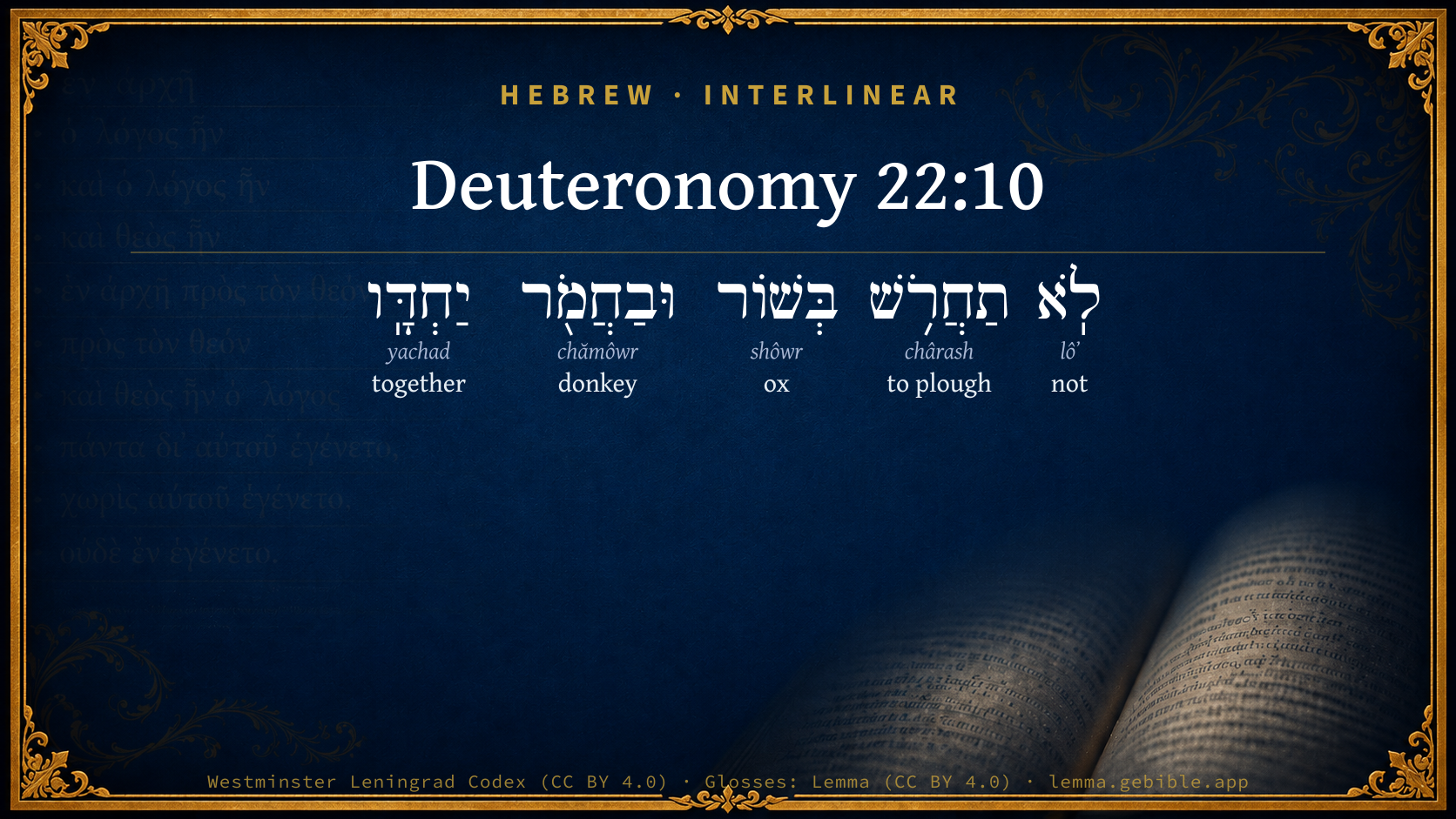
Hebrew (Westminster Leningrad Codex) Deuteronomy 22:10 appears in the Hebrew Old Testament. The text above is from the Westminster Leningrad Codex. Each word links to its Strong’s number, a concise gloss, and parsing drawn from the Open Scriptures Hebrew Bible morphology. Click any word for its full Brown-Driver-Briggs (BDB) entry.
Download image
Cite this verse

Deuteronomy 22:10 (World English Bible). Public Domain. Lemma interlinear Bible study tool, https://lemma.gebible.app/v/deuteronomy/22/10.

Show BibTeX & RIS
BibTeX
RIS
English Translation
You shall not plow with an ox and a donkey together.
World English Bible · Public Domain
Download a study sheet

One document with this verse’s original text, its word-by-word gloss line, the meaning frame, cross-references with their text, attributed commentary, and full source and license credits — printable, and it pastes into notes with its structure intact.

This verse Autodidact and up

Study sheet (.html) Plain text (.txt)

A passage Seminary Student

Up to 50 verses in one chapter. A passage sheet keeps up to 6 commentary sources and 12 cross-references per verse, in the order this page ranks them, and says so on the sheet whenever that leaves anything out. Ask for a single verse and you get the Autodidact verse sheet above.

Everything on this page stays free to read, with no account — the sheet is a download of what is already on screen, not access to it.

Want to remove ads? Support Godless Engineer
Compare translations 3

The same verse in 3 English versions, stacked beneath the original-language interlinear above. Click any original word for its lexicon entry.

Each is an independent rendering of the whole verse — the interlinear is not word-aligned to these translations.

Highlighted words mark where these versions differ — a whole-verse word diff, not a word-by-word alignment.

  • World English Bible Public Domain
    You shall not plow with an ox and a donkey together.
  • King James Version Public Domain
    Thou shalt not plow with an ox and an ass together.
  • unfoldingWord Literal Text CC BY-SA 4.0
    You shall not plow with an ox and a donkey together.

unfoldingWord Literal Text — © unfoldingWord, licensed CC BY-SA 4.0. Word-aligned USFM3 via Door43 (git.door43.org/unfoldingWord/en_ult).

Versions to compare (up to 4)

3 of 4 selected

Show all 18 translations

Every available English version of this verse, each an independent rendering of the whole verse.

  • World English Bible Public Domain
    You shall not plow with an ox and a donkey together.
  • Berean Standard Bible Public Domain
    Do not plow with an ox and a donkey yoked together.
  • Majority Standard Bible Public Domain
    Do not plow with an ox and a donkey yoked together.
  • King James Version Public Domain
    Thou shalt not plow with an ox and an ass together.
  • American Standard Version (1901) Public Domain
    Thou shalt not plow with an ox and an ass together.
  • Revised Version (1885) Public Domain
    Thou shalt not plow with an ox and an ass together.
  • Geneva Bible (1599) Public Domain
    Thou shalt not plow with an oxe and an asse together.
  • Douay-Rheims (1899) Public Domain
    Thou shalt not plough with an ox and an ass together.
  • Young's Literal Translation Public Domain
    `Thou dost not plow with an ox and with an ass together.
  • Literal Standard Version CC BY-SA 4.0
    You do not plow with an ox and with a donkey together.
  • Unlocked Literal Bible CC BY-SA 4.0
    You must not plow with an ox and a donkey together.
  • unfoldingWord Literal Text CC BY-SA 4.0
    You shall not plow with an ox and a donkey together.
  • Darby Bible Public Domain
    Thou shalt not plough with an ox and an ass together.
  • World Messianic Bible Public Domain
    You shall not plow with an ox and a donkey together.
  • Webster's Bible Public Domain
    Thou shalt not plow with an ox and an ass together.
  • Free Bible Version CC BY-SA 4.0
    Don't harness an ox and a donkey together when you plow.
  • Bible in Basic English Public Domain
    Do not do your ploughing with an ox and an ass yoked together.
  • JPS Tanakh (1917) Public Domain
    Thou shalt not plow with an ox and an ass together.

Literal Standard Version (2020), Covenant Press — licensed CC BY-SA 4.0. Text via the HelloAO Bible API (eBible.org). Unlocked Literal Bible (unfoldingWord) — licensed CC BY-SA 4.0. Text via the HelloAO Bible API (eBible.org). unfoldingWord Literal Text — © unfoldingWord, licensed CC BY-SA 4.0. Word-aligned USFM3 via Door43 (git.door43.org/unfoldingWord/en_ult). Free Bible Version, Dr. Jonathan Gallagher — licensed CC BY-SA 4.0. Text via the HelloAO Bible API (eBible.org).

Word by word

More ways to search: Search by grammar → Find every occurrence → Compare this word →

Practice this passage: Drill this verse → Learn its vocabulary →

תַחֲרֹ֥שׁ
chârash
H2790
“to plough”
Verb, Qal, Imperfect, 2nd Person, Masculine, Singular
Part of Speech
Verb
Stem
Qal
Form
Imperfect
Person
2nd Person
Gender
Masculine
Number
Singular
Full BDB Definition

Origin: a primitive root

TWOT: 760 , 761

to cut in, plough, engrave, devise - (Qal) - to cut in, engrave - to plough - to devise - (Niphal) to be ploughed - (Hiphil) to plot evil - to be silent, be dumb, be speechless, be deaf - (Qal) - to be silent - to be deaf - (Hiphil) - to be silent, keep quiet - to make silent - to be deaf, show deafness - (Hithpael) to remain silent
  1. לֹֽא lôʼ H3808 “not” Particle, Negative
  2. בְּשׁוֹר shôwr H7794 “in/at · ox” Preposition + Noun, Common, Masculine, Singular, Absolute
  3. וּבַחֲמֹ֖ר chămôwr H2543 “and · in/at the · donkey” Conjunction + Preposition, Determined + Noun, Common, Both, Singular, Absolute
  4. יַחְדָּֽו yachad H3162 “together” Adverb

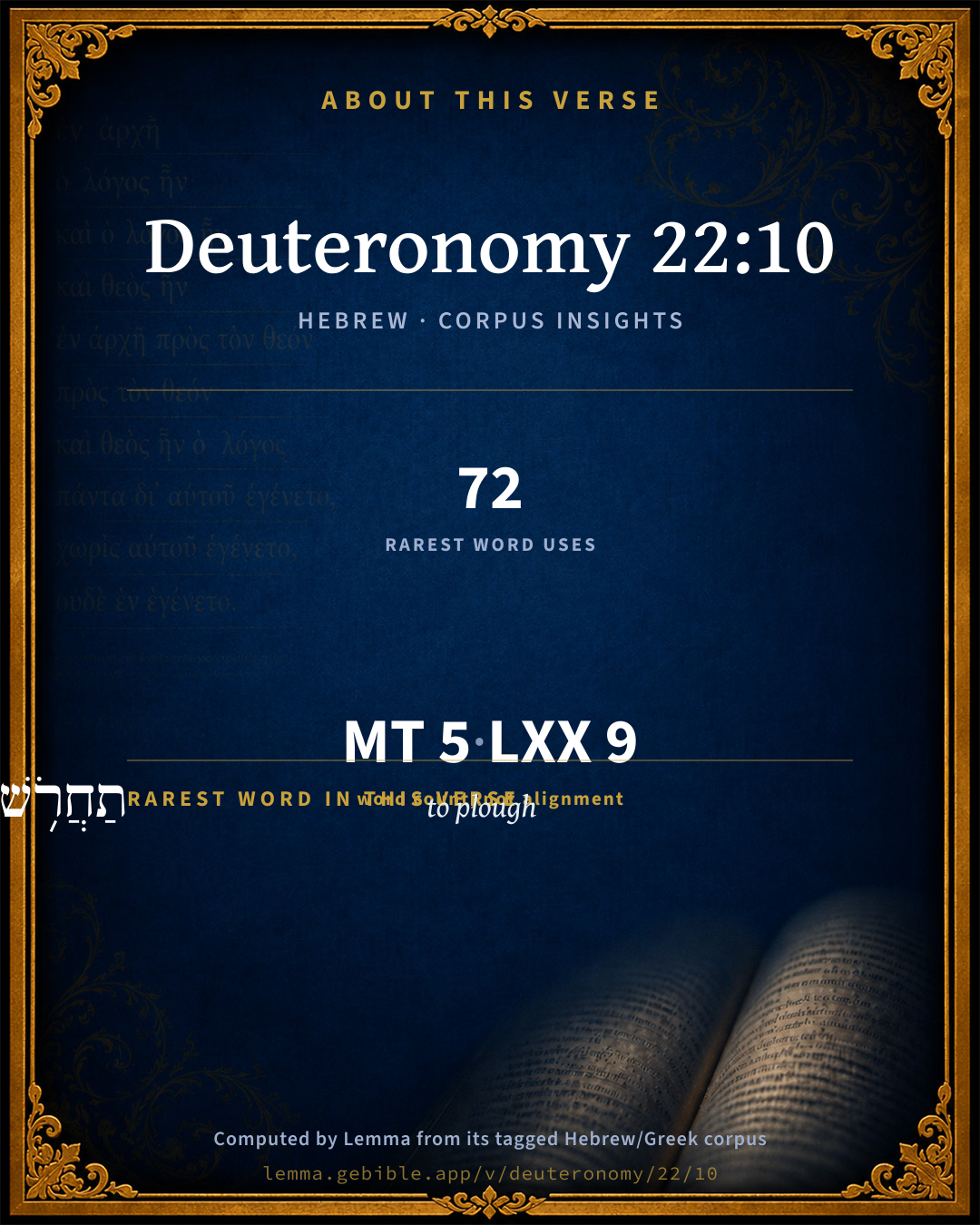
About this verse

These counts appear in no published source. They are computed here, from the morphology-tagged text and Lemma’s own curated glosses. What Lemma adds →

5
words
5
distinct lemmas
Pentateuch
section

Grammatical profile

  • 1 verb
  • 2 nouns
  • 1 adverb
  • 1 particle

Verb forms

  • תַחֲרֹ֥שׁ Qal · Imperfect

Hebrew & Septuagint length

In English translation the verse runs 11 words from the Hebrew and 11 from the Septuagint (LXX English) — the same length.

A rough comparison of the two English renderings, which tokenize alike — not a word-level alignment.

Word counts can differ between the Hebrew and the Greek without any difference in meaning — e.g. the Hebrew direct-object marker אֵת has no separate Greek word, and Greek often adds the article ὁ.

In the original languages it is 5 Hebrew tokens and 9 Greek tokens — but the two are counted differently (Hebrew bundles its prefixes and suffixes into one token; the Greek is in lemma form), so that isn’t a like-for-like length.

Cross-references

1

Topical passages linked to Deuteronomy 22:10 in the Treasury of Scripture Knowledge — connected by theme and wording, ordered by reader-vote popularity; previews shown in the World English Bible.

  • 2 Corinthians 6:14–16 Don't be unequally yoked with unbelievers, for what fellowship have righteousness and iniquity? Or what communion has light with darkness?

Cross-references courtesy of OpenBible.info (CC BY 4.0).

Hebrew and Greek witnesses Masoretic Hebrew ↔ Greek Septuagint

The same verse in the two great witnesses to the Old Testament, shown verse-for-verse.

These are two independent witnesses, not word-aligned to each other, and the Septuagint is shown in lemma (dictionary) form.

Hebrew Deuteronomy 22:10 Masoretic · Westminster Leningrad Codex

לֹֽא תַחֲרֹ֥שׁ בְּשׁוֹר וּבַחֲמֹ֖ר יַחְדָּֽו

You shall not plow with an ox and a donkey together.

World English Bible · Public Domain

Greek LXX Deuteronomy 22:10 Septuagint · lemma form

οὐ ἀροτριάω ἐν μόσχος καί ὄνος ἐπί ὁ αὐτός

You shall not plow with an ox and an ass together.

LXX2012 (modern English Septuagint) · Public Domain

Hebrew: Westminster Leningrad Codex (CC BY 4.0). Greek: Septuagint (public domain); English from LXX2012 (modern English Septuagint) (Public Domain). How the Septuagint differs from the Hebrew →

Targum (Aramaic paraphrase)

2

The Targum is the ancient Jewish Aramaic paraphrase of the Hebrew Scriptures — an interpretive translation, not the Hebrew text itself. Onkelos (literal) and Pseudo-Jonathan (expansive) render the Torah, and Jonathan the Prophets. Coverage is partial: where no permissively-licensed English translation exists for a verse, only the Aramaic is shown. This is verse-level text, not a word-by-word alignment to the Hebrew.

  1. Targum Onkelos Torah (Genesis–Deuteronomy)
    לָא תִרְדֵי בְתוֹרָא וּבַחֲמָרָא כַּחֲדָא

    (no public-domain English translation for this verse)

    Targum Onkelos — Aramaic: “Onkelos Genesis” (public domain); “Onkelos Exodus” (public domain); “Onkelos Leviticus” (public domain); “Onkelos Numbers” (public domain); “Onkelos Deuteronomy” (public domain). English: “Sefaria Community Translation” (CC0 1.0 (public-domain dedication)); “J.W. Etheridge. The Targums of Onkelos and Jonathan Ben Uzziel on the Pentateuch. London: Longmans, Green, 1862” (public domain). Text via Sefaria.

  2. Targum Pseudo-Jonathan Torah (Genesis–Deuteronomy)
    לָא תֶהֱווֹן רַדְיַין בְּתוֹרָא וּבְחַמְרָא וּבְכָל בִּרְיָיתָא בִּתְרֵין זְיָנִין קְטִירִין כַּחֲדָא

    You shall not plough with an ox and an ass nor with any animals of two species bound together.

    Targum Pseudo-Jonathan — Aramaic: “Targum Jonathan on Genesis” (public domain); “Targum Jonathan on Exodus” (public domain); “Targum Jonathan on Leviticus” (public domain); “Targum Jonathan on Numbers” (public domain); “Targum Jonathan on Deuteronomy” (public domain). English: “The Targum of Jonathan ben Uzziel, trans. J. W. Etheridge, London, 1862” (public domain). Text via Sefaria.

Commentary

Notes on Deuteronomy 22:10 from classic Christian and Jewish commentators (each source and its license shown beneath its notes). The classic Christian expositions comment on the surrounding passage and are grouped to its opening verse, so a note may address several verses; the Jewish commentaries on the Tanakh (Rashi and others) are per-verse, so they appear only where the commentator wrote on this verse.

Lemma curates 59 commentaries, every one of them public domain or Creative Commons licensed, each selected and text-cleaned for this edition rather than reprinted as found. About our sources →

Trapp's Complete Commentary

John Trapp

Deu 22:10 Thou shalt not plow with an ox and an ass together.

Ver. 10. Thou shalt not plough.] These laws were made to set forth how God abhorreth all mixtures in religion, and how carefully men should keep their minds from being "corrupted from the simplicity that is in Christ." {2Co 11:3}

John Trapp, A Commentary or Exposition upon All the Books of the Old and New Testament (1647–1656) — public domain. Text from a community e-Sword module.

The Biblical Illustrator

Joseph S. Exell

Deu_22:10

Thou shalt not plow with an ox and an ass together.

A law for the ox and the ass

There was a reason for this prohibition. The step of an ox and an ass being different, they could not pull together without causing one another much exertion and weariness. The work would be nearly twice as hard for the ox and the ass as it would be for two oxen or two asses. The law teaches us to consider differences in human beings, and not to yoke those who differ from one another to the same tasks. The law forbidding the people to plough with an ox and an ass applies to children. Injury is done to children when they are treated as though they had precisely the same bodily and mental capabilities. Children are so variously constituted, that what one boy can do with case in school work is to another boy a difficult labour. The sum in arithmetic which is to one a pleasure is to another a torture. The seemingly dull boy is not to be reproached because he cannot do what his bright companion can do. Some day the apparently stupid fellow may awake to intellectual activity, and get a long way before the boy who, for a time, made rapid progress in scholarship. The ass, which could not keep pace with the ox in dragging the plough, has sometimes developed into a steed grand as the war horse described in the Book of Job. Children should not be put to trades Irrespective of their gifts and preferences. The timid, shrinking boy should not be mated with the bold, adventurous type in employments needing a daring spirit. The bold, adventurous boy, whose heart is already on the ships deck, and who dreams day and night of voyages over great spaces of ocean to the region of the walrus and white bear, or to the clime of the palm and the tamarind, should not be kept behind a grocers counter. What is right for one is not necessarily right for another. Fathers and mothers should honour individuality in their boys and girls, and not fret because their children do not pull together in the same yoke. The law forbidding the Israelites to plough with an ox and an ass applies to young people. They are not to be treated religiously as though they were all in the same condition, and had all to pass through a like process to become disciples of Christ. Hard theologians and unthinking revivalists have done harm to such young people by passing on them a sweeping condemnation, and insisting that there is no true conversion without agonies of repentance and ecstasies of joy. No distinction has been made between them and those guilty of flagrant sins, and they have been cruelly yoked with the very worst of mankind. The law forbidding the Israelites to plough with an ox and an ass applies to men and women. All the members of the Church are not to be expected to manifest their religion precisely in the same way. Some are naturally lively and joyful; before their conversion they were noted for their cheerful disposition. It is as impossible for them to be dull as it is for the sun to be dull when shining in the blue of an unclouded sky. It is as impossible for them to be silent as it is for larks and linnets to be silent when May is kissing the April buds into flower. It would be as bad as yoking the ox and the ass together to insist that they must repress their jubilant feelings and be quiet as Christians whose voices are never heard in religious demonstration. It would be equally cruel to insist that those quiet Christians must break through their natural gravity, and manifest the enthusiasm which is ever pealing out song after song, hallelujah after hallelujah. Violence is not to be done to natural feeling by forcing everyone to the same kind of Christian work. The timid and retiring are not to be compelled to pull in the same yoke with the brave and bold. (J. Marrat.)

The Biblical Illustrator, edited by Joseph S. Exell (c. 1880s–1900s) — public domain. Text from a community e-Sword module.

Tyndale Open Study Notes

Tyndale Open Resources

22:10 Plowing with an ox and a donkey would be inefficient; this example illustrates the principle of separation and order (see also 2 Cor 6:14-18).

Tyndale Open Study Notes — © Tyndale Open Resources, licensed CC BY-SA 4.0. Text via the HelloAO Bible API.

Jamieson, Fausset & Brown

Robert Jamieson, A. R. Fausset & David Brown

Thou shalt not plough with an ox and an ass together--Whether this association, like the mixture of seeds, had been dictated by superstitious motives and the prohibition was symbolical, designed to teach a moral lesson (Co2 6:14), may or may not have been the case. But the prohibition prevented a great inhumanity still occasionally practised by the poorer sort in Oriental countries. An ox and ass, being of different species and of very different characters, cannot associate comfortably, nor unite cheerfully in drawing a plough or a wagon. The ass being much smaller and his step shorter, there would be an unequal and irregular draft. Besides, the ass, from feeding on coarse and poisonous weeds, has a fetid breath, which its yoke fellow seeks to avoid, not only as poisonous and offensive, but producing leanness, or, if long continued, death; and hence, it has been observed always to hold away its head from the ass and to pull only with one shoulder.

Jamieson, Fausset & Brown — Commentary Critical and Explanatory on the Whole Bible (1871) — public domain (CC PDM 1.0). Text via the HelloAO Bible API.

Adam Clarke's Commentary

Verse 10. Thou shalt not plough with an ox and an ass] It is generally supposed that mixtures of different sorts in seed, breed, c., were employed for superstitious purposes, and therefore prohibited in this law. It is more likely, however, that there was a physical reason for this two beasts of a different species cannot associate comfortably together, and on this ground never pull pleasantly either in cart or plough; and every farmer knows that it is of considerable consequence to the comfort of the cattle to put those together that have an affection for each other. This may be very frequently remarked in certain cattle, which, on this account, are termed true yoke-fellows. After all, it is very probable that the general design was to prevent improper alliances in civil and religious life. And to this St. Paul seems evidently to refer, 2Co 6:14: Be ye not unequally yoked with unbelievers; which is simply to be understood as prohibiting all intercourse between Christians and idolaters in social, matrimonial, and religious life. And to teach the Jews the propriety of this, a variety of precepts relative to improper and heterogeneous mixtures were interspersed through their law, so that in civil and domestic life they might have them ever before their eyes.

Adam Clarke's Commentary on the Bible (1810–1826) — public domain. Text from a community e-Sword/MySword module.

The Cambridge Bible for Schools and Colleges

gen. ed. J. J. S. Perowne

10. an ox and an ass together] This is frequently seen in Palestine, as also a camel with one or other of these two. Note that the ox was ‘clean,’ the ass ‘unclean.’ D does not, like H, prohibit cross-breeding. Mules were common in Israel from David’s time, see Jerus. i. 326 f. On cross-breeding at the present day in Palestine see Musil, Ethn. Ber. 291.

The Cambridge Bible for Schools and Colleges (gen. ed. J. J. S. Perowne; Cambridge University Press, 1878–1918) — public domain. Text from a community e-Sword module.

John Gill's Exposition

Thou shalt not plough with an ox and an ass together,.... They might be used separately, but not together; nor was it uncommon in some countries for asses to be employed in ploughing as well as oxen. Pliny (h) makes mention of some fruitful land in Africa, which when it was dry weather could not be ploughed by oxen, but after showers of rain might be ploughed by a mean little ass; so Leo Africanus (i) says, the Africans only use horses and asses in ploughing. The reason why they were not to be put together was either (as some think) lest the law should be broken which forbids the gendering of cattle with a divers kind, Lev 19:19 but Aben Ezra thinks the reason is, because the strength of an ass is not equal to the strength of an ox; and therefore he supposes this law is made from the mercy and commiseration of God extended to all his creatures; though perhaps the better reason is, because the one was a clean creature, and the other an unclean, and this instance is put for all others; and with which agree the Jewish canons, which run thus,"cattle with cattle, wild beasts with wild beasts, unclean with unclean, clean with clean (i.e. these may be put together); but unclean with clean, and clean with unclean, are forbidden to plough with, to draw with, or to be led together (k).''The mystery of this is, that godly and ungodly persons are not to be yoked together in religious fellowship: see Co2 6:14.

(h) Nat. Hist. l. 17. c. 5. (i) Descriptio Africae, l. 2. p. 104. (k) Misn. Celaim, c. 8. sect. 2.

John Gill's Exposition of the Whole Bible (1746–1763) — public domain (CC PDM 1.0). Text via the HelloAO Bible API.

Haydock's Catholic Bible Commentary

Plough. In Leviticus xix. 19, this law is expressed, so as to forbid the procreation of mongrels. See Judges xiv. 18. People who have treated on agriculture observe, that it is a pernicious practice to make animals of unequal size and speed work together. (Columella vi. 2.) --- St. Paul explains to us the mystical sense of this passage. Bear not the yoke together with infidels, 2 Corinthians vi. 14. (Calmet) --- Marry not with such. (Haydock) --- Employ not in the sacred ministry the imprudent and wicked with those of a virtuous disposition. (St. Gregory, Mor. i. 16.)

George Leo Haydock (1774–1849), Haydock's Catholic Family Bible and Commentary, 1859 edition — public domain. Excludes Psalms (Douay-Rheims chapter numbering differs from Protestant) and Deuterocanonical books (Catholic canon only).

Matthew Poole's English Annotations

Either,

1. Because the one was a clean beast, the other unclean; whereby God would teach men to avoid polluting themselves by the touch of unclean persons or things, 2Co 6:14. Or,

2. Because of their unequal strength, whereby the weaker, the ass, would be oppressed and overwrought. Or,

3. For mystical reasons, of which see on Deu 22:9; Lev 19:19.

Matthew Poole's English Annotations on the Holy Bible (1683–1685) — public domain. Text from a community e-Sword/MySword module.

John Wesley's Explanatory Notes

An ox and an ass - Because the one was a clean beast, the other unclean whereby God would teach men to avoid polluting themselves by the touch of unclean persons or things.

John Wesley, Explanatory Notes Upon the Whole Bible (1754–1765) — public domain. Text via the GEBible commentary corpus.

Rashi

Rabbi Shlomo Yitzchaki (Rashi)

לא תחרש בשור ובחמור THOU SHALT NOT PLOUGH WITH AN OX AND WITH AN ASS [TOGETHER] — The same law applies to any two different kinds of animals in existence; the same law applies also to merely driving them together (when not ploughing) whilst they are yoked together as a pair carrying any load (Sifrei Devarim 232:1-2; cf. Kilayim 8:2 and 3; Bava Metzia 8b).

Rashi on the Tanakh — English translations: “The Judaica Press complete Tanach with Rashi, translated by A. J. Rosenberg” (CC BY 4.0); “Pentateuch with Rashi's commentary by M. Rosenbaum and A.M. Silbermann, 1929-1934” (public domain); “The Metsudah Tanach series, Lakewood, N.J” (CC BY 4.0); and “The Book of Joshua, Metsudah Publications, 1997” (CC BY 4.0). Text via Sefaria.

Ramban (Nachmanides)

Rabbi Moshe ben Nachman (Ramban / Nachmanides)

He states, Thou shalt not plow with an ox and an ass together. The same law applies to all diverse species of animals. It is an explanatory commandment of the prohibitions, Thou shalt not let thy cattle gender with a diverse kind, for it is the custom of tillers of their soil to bring their working animals into the same stall and gender them. And in the matter of sha’atneiz [a garment of mingled stuff] he explained here that it applies only to [a combination of] wool and linen. He mentioned Thou shalt not wear in order to teach that coming upon thee [Neither shall there ‘come upon thee’ a garment of two kinds of stuff] is forbidden only if it is worn as a garment [indicated by the term “wear” used in the verse before us].

Ramban (Nachmanides) on the Tanakh — English translation: “Commentary on the Torah by Ramban (Nachmanides). Translated and annotated by Charles B. Chavel. New York, Shilo Pub. House, 1971-1976” (CC BY 4.0). Text via Sefaria.

Lesson kit

Teaching starters — assembled from the data on this page, not authored interpretation. Every prompt links to the verse data it draws on. Edit before teaching.

Deuteronomy, in the Pentateuch, opens this verse with 5 words (5 distinct Hebrew lemmas). Its most distinctive word is chârash (“to plough”). A historical commentator’s framing appears above. Read the whole chapter for the surrounding context.

Discussion questions

  1. The word chârash carries the sense “to plough.” How does it shape the verse?
  2. 2 Corinthians 6:14–16 shares this passage’s theme. How do the two illuminate each other?
  3. These translations render this verse differently; the difference is in the English rendering, not the original. What questions does that raise?
  4. The verb «תַחֲרֹ֥שׁ» is Qal Imperfect. How does its form color the action?
  5. Reading how Trapp's Complete Commentary and The Biblical Illustrator read this verse, where do the two commentators agree and where do they part?

Things to notice

Reading settings

Reading text

Shown beneath each verse's original-language words.

Old Testament
Old Testament edition

Read the OT as the Masoretic Hebrew (MT) or the Greek Septuagint (LXX).

English shown for the Greek Septuagint (in the Hebrew ↔ Greek comparison).

Comparing translations? Open the Compare panel on any verse page to stack up to four side by side.