
Judges 19:10

Hebrew (Westminster Leningrad Codex) Judges 19:10 appears in the Hebrew Old Testament. The text above is from the Westminster Leningrad Codex. Each word links to its Strong’s number, a concise gloss, and parsing drawn from the Open Scriptures Hebrew Bible morphology. Click any word for its full Brown-Driver-Briggs (BDB) entry.
Download image
Cite this verse

Judges 19:10 (World English Bible). Public Domain. Lemma interlinear Bible study tool, https://lemma.gebible.app/v/judges/19/10.

Show BibTeX & RIS
BibTeX
RIS
English Translation
But the man wouldn't stay that night, but he rose up and departed, and came over against Jebus (the same is Jerusalem): and there were with him a couple of donkeys saddled; his concubine also was with him.
World English Bible · Public Domain
Highlights
  • 1 first appearance in the Hebrew Bible
Full analysis ↓
Download a study sheet

One document with this verse’s original text, its word-by-word gloss line, the meaning frame, cross-references with their text, attributed commentary, and full source and license credits — printable, and it pastes into notes with its structure intact.

This verse Autodidact and up

Study sheet (.html) Plain text (.txt)

A passage Seminary Student

Up to 50 verses in one chapter. A passage sheet keeps up to 6 commentary sources and 12 cross-references per verse, in the order this page ranks them, and says so on the sheet whenever that leaves anything out. Ask for a single verse and you get the Autodidact verse sheet above.

Everything on this page stays free to read, with no account — the sheet is a download of what is already on screen, not access to it.

Want to remove ads? Support Godless Engineer
Compare translations 3

The same verse in 3 English versions, stacked beneath the original-language interlinear above. Click any original word for its lexicon entry.

Each is an independent rendering of the whole verse — the interlinear is not word-aligned to these translations.

Highlighted words mark where these versions differ — a whole-verse word diff, not a word-by-word alignment.

  • World English Bible Public Domain
    But the man wouldn't stay that night, but he rose up and departed, and came over against Jebus (the same is Jerusalem): and there were with him a couple of donkeys saddled; his concubine also was with him.
  • King James Version Public Domain
    But the man would not tarry that night, but he rose up and departed, and came over against Jebus, which is Jerusalem; and there were with him two asses saddled, his concubine also was with him.
  • unfoldingWord Literal Text CC BY-SA 4.0
    But the man was not willing to lodge, so he arose and he went. And he came to before Jebus (it Jerusalem). Now with him the pair of donkeys, saddled, and his concubine with him.

unfoldingWord Literal Text — © unfoldingWord, licensed CC BY-SA 4.0. Word-aligned USFM3 via Door43 (git.door43.org/unfoldingWord/en_ult).

Versions to compare (up to 4)

3 of 4 selected

Show all 18 translations

Every available English version of this verse, each an independent rendering of the whole verse.

  • World English Bible Public Domain
    But the man wouldn't stay that night, but he rose up and departed, and came over against Jebus (the same is Jerusalem): and there were with him a couple of donkeys saddled; his concubine also was with him.
  • Berean Standard Bible Public Domain
    But the man was unwilling to spend the night. He got up and departed, and arrived opposite Jebus (that is, Jerusalem), with his two saddled donkeys and his concubine.
  • Majority Standard Bible Public Domain
    But the man was unwilling to spend the night. He got up and departed, and arrived opposite Jebus (that is, Jerusalem), with his two saddled donkeys and his concubine.
  • King James Version Public Domain
    But the man would not tarry that night, but he rose up and departed, and came over against Jebus, which is Jerusalem; and there were with him two asses saddled, his concubine also was with him.
  • American Standard Version (1901) Public Domain
    But the man would not tarry that night, but he rose up and departed, and came over against Jebus (the same is Jerusalem): and there were with him a couple of asses saddled; his concubine also was with him.
  • Revised Version (1885) Public Domain
    But the man would not tarry that night, but he rose up and departed, and came over against Jebus (the same is Jerusalem): and there were with him a couple of asses saddled; his concubine also was with him.
  • Geneva Bible (1599) Public Domain
    But the man would not tarry, but arose and departed, and came ouer against Iebus, (which is Ierusalem) and his two asses laden, and his concubine were with him.
  • Douay-Rheims (1899) Public Domain
    His son in law would not consent to his words: but forthwith went forward and came over against Jebus, which by another name is called Jerusalem, leading with him two asses laden, and his concubine.
  • Young's Literal Translation Public Domain
    And the man hath not been willing to lodge all night, and he riseth, and goeth, and cometh in till over-against Jebus (It `is' Jerusalem), and with him `are' a couple of asses saddled; and his concubine `is' with him.
  • Literal Standard Version CC BY-SA 4.0
    And the man has not been willing to lodge all night, and he rises, and goes, and comes in until [he is] opposite Jebus (it [is] Jerusalem), and a couple of saddled donkeys [are] with him; and his concubine [is] with him.
  • Unlocked Literal Bible CC BY-SA 4.0
    But the Levite was not willing to spend the night. He got up and left. He went toward Jebus (that is Jerusalem). He had a pair of saddled donkeys—and his concubine was with him.
  • unfoldingWord Literal Text CC BY-SA 4.0
    But the man was not willing to lodge, so he arose and he went. And he came to before Jebus (it Jerusalem). Now with him the pair of donkeys, saddled, and his concubine with him.
  • Darby Bible Public Domain
    But the man would not spend the night; he rose up and departed, and arrived opposite Jebus (that is, Jerusalem). He had with him a couple of saddled asses, and his concubine was with him.
  • World Messianic Bible Public Domain
    But the man wouldn’t stay that night, but he rose up and went near Jebus (also called Jerusalem). With him were a couple of saddled donkeys. His concubine also was with him.
  • Webster's Bible Public Domain
    But the man would not tarry that night, but he arose and departed, and came over against Jebus, which is Jerusalem; and there were with him two asses saddled, his concubine also was with him.
  • Free Bible Version CC BY-SA 4.0
    But the man didn't want to spend another night, so he got up and left. He headed towards the town of Jebus (now called Jerusalem) with his two saddled donkeys and his concubine.
  • Bible in Basic English Public Domain
    But the man would not be kept there that night, and he got up and went away and came opposite to Jebus (which is Jerusalem); and he had with him the two asses, ready for travelling, and his woman.
  • JPS Tanakh (1917) Public Domain
    But the man would not tarry that night, but he rose up and departed, and came over against Jebus — the same is Jerusalem; and there were with him a couple of asses saddled; his concubine also was with him.

Literal Standard Version (2020), Covenant Press — licensed CC BY-SA 4.0. Text via the HelloAO Bible API (eBible.org). Unlocked Literal Bible (unfoldingWord) — licensed CC BY-SA 4.0. Text via the HelloAO Bible API (eBible.org). unfoldingWord Literal Text — © unfoldingWord, licensed CC BY-SA 4.0. Word-aligned USFM3 via Door43 (git.door43.org/unfoldingWord/en_ult). Free Bible Version, Dr. Jonathan Gallagher — licensed CC BY-SA 4.0. Text via the HelloAO Bible API (eBible.org).

Word by word

More ways to search: Search by grammar → Find every occurrence → Compare this word →

Practice this passage: Drill this verse → Learn its vocabulary →

יְב֔וּס
Yᵉbûwç
H2982
“Jebus”
Noun, Proper
Part of Speech
Noun
Type
Proper
Full BDB Definition

Origin: from H947

TWOT: None

Jebus = "threshing place" - an early name for Jerusalem, the city of the Jebusites; also 'Jebusi'
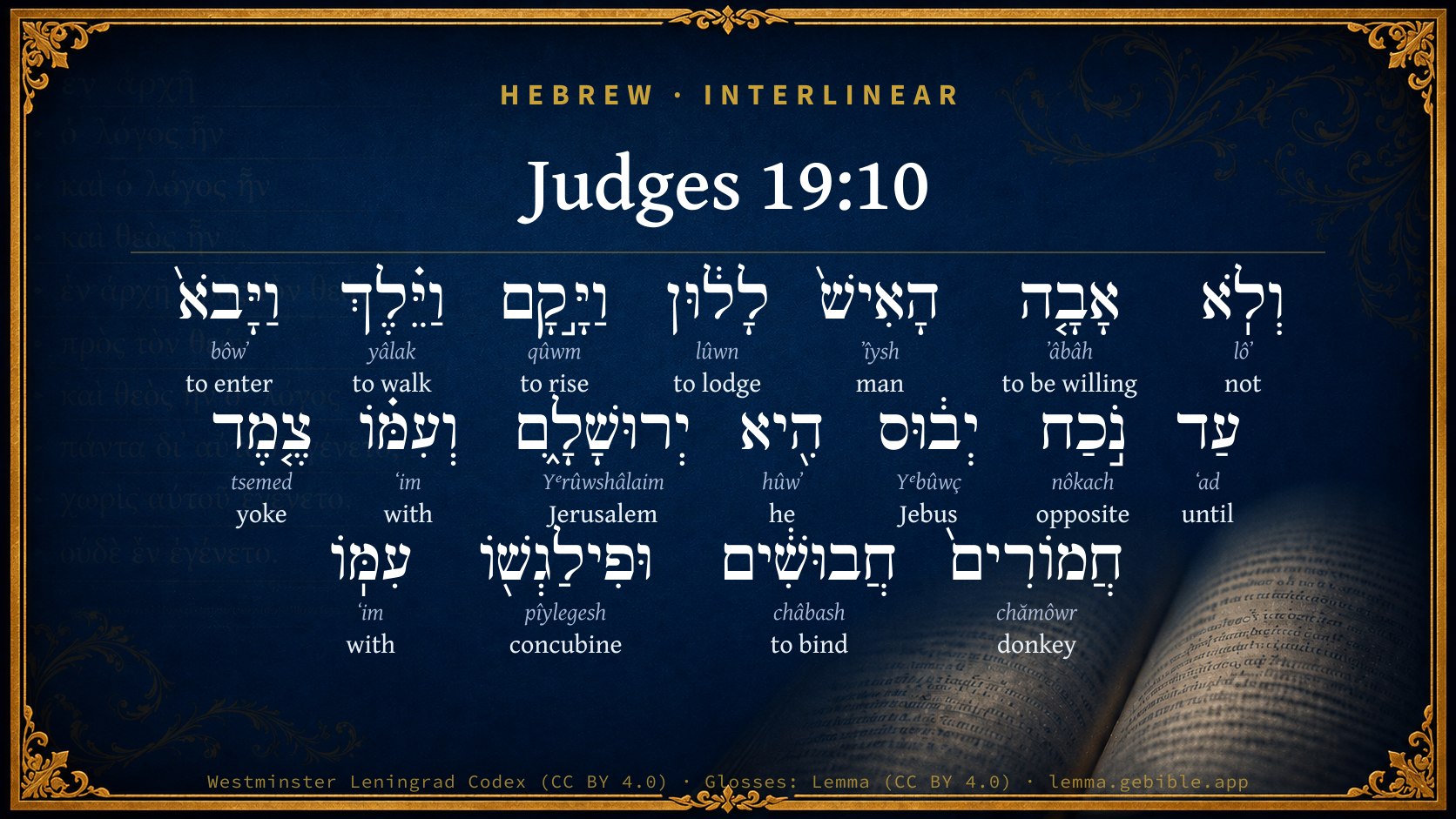
  1. וְלֹֽא lôʼ H3808 “and · not” Conjunction + Particle, Negative
  2. אָבָ֤ה ʼâbâh H14 “to be willing” Verb, Qal, Perfect, 3rd Person, Masculine, Singular
  3. הָאִישׁ֙ ʼîysh H376 “the · man” Particle, Definite Article + Noun, Common, Masculine, Singular, Absolute
  4. לָל֔וּן lûwn H3885 “to lodge” Preposition + Verb, Qal, Infinitive Construct
  5. וַיָּ֣קָם qûwm H6965 “and · to rise” Conjunction + Verb, Qal, Sequential Imperfect, 3rd Person, Masculine, Singular
  6. וַיֵּ֗לֶךְ yâlak H3212 “and · to walk” Conjunction + Verb, Qal, Sequential Imperfect, 3rd Person, Masculine, Singular
  7. וַיָּבֹא֙ bôwʼ H935 “and · to enter” Conjunction + Verb, Qal, Sequential Imperfect, 3rd Person, Masculine, Singular
  8. עַד ʻad H5704 “until” Preposition
  9. נֹ֣כַח nôkach H5227 “opposite” Preposition
  10. הִ֖יא hûwʼ H1931 “he” Pronoun, Personal, 3rd Person, Feminine, Singular
  11. יְרוּשָׁלִָ֑ם Yᵉrûwshâlaim H3389 “Jerusalem” Noun, Proper
  12. וְעִמּ֗וֹ ʻim H5973 “and · with · him” Conjunction + Preposition + Suffix, Personal, 3rd Person, Masculine, Singular
  13. צֶ֤מֶד tsemed H6776 “yoke of” Noun, Common, Masculine, Singular, Construct
  14. חֲמוֹרִים֙ chămôwr H2543 “donkeys” Noun, Common, Both, Plural, Absolute
  15. חֲבוּשִׁ֔ים châbash H2280 “bound” Verb, Qal, Participle Passive, Masculine, Plural, Absolute
  16. וּפִילַגְשׁ֖וֹ pîylegesh H6370 “and · concubine · his” Conjunction + Noun, Common, Feminine, Singular, Construct + Suffix, Personal, 3rd Person, Masculine, Singular
  17. עִמּֽוֹ ʻim H5973 “with · him” Preposition + Suffix, Personal, 3rd Person, Masculine, Singular

About this verse

These counts appear in no published source. They are computed here, from the morphology-tagged text and Lemma’s own curated glosses. What Lemma adds →

18
words
17
distinct lemmas
Historical
section

Notable vocabulary

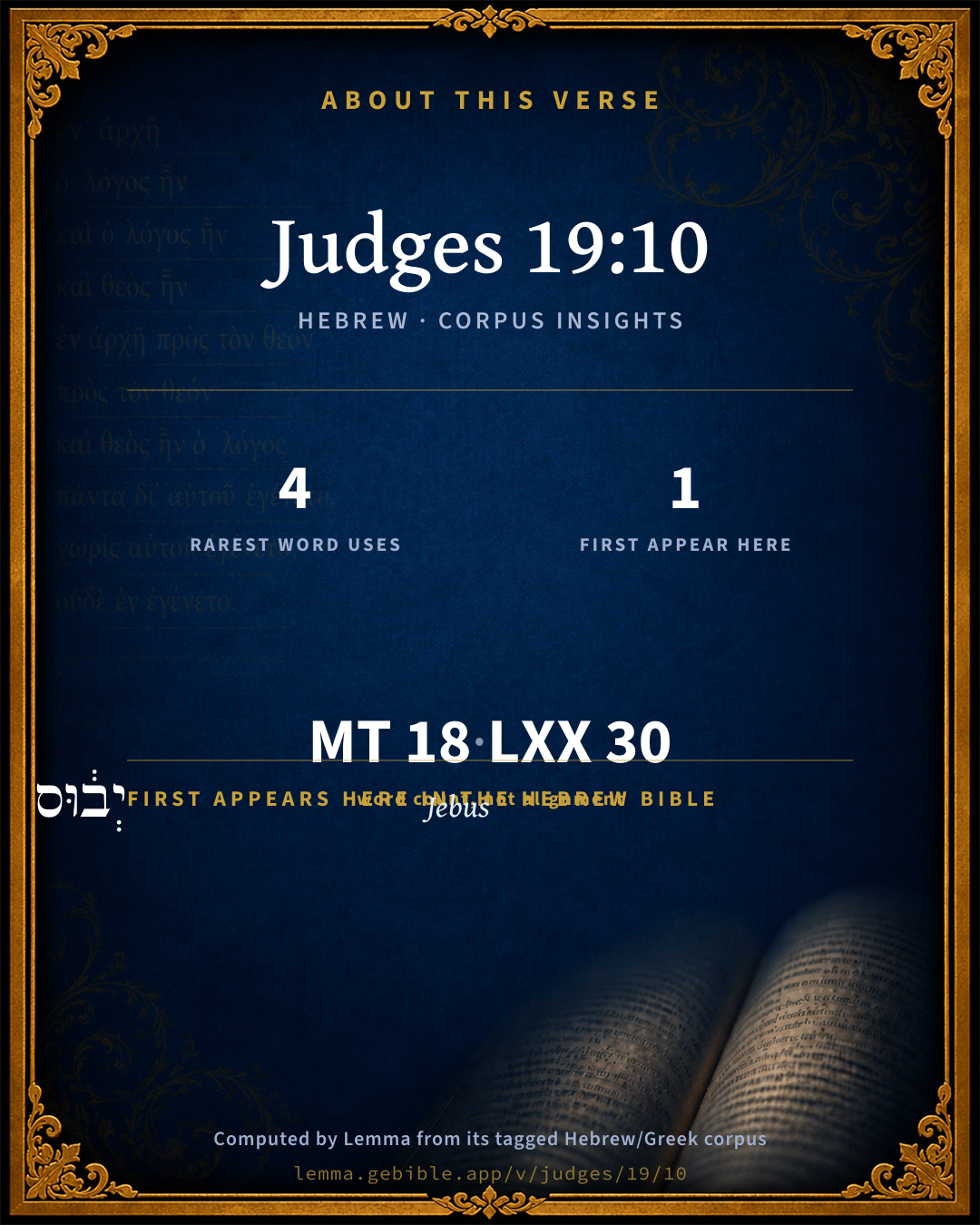
The rarest word here is יְב֔וּס Jebus H2982 — appearing just 4 times in the whole Hebrew Bible.

First appearance in Scripture

This word makes its first canonical appearance in the Hebrew Bible here:

  • יְב֔וּס Jebus H2982

Shared distinctive vocabulary

יְב֔וּס Jebus H2982 occurs in 4 verses of the Hebrew Bible. Also found in:

Grammatical profile

  • 6 verbs
  • 6 nouns
  • 1 pronoun
  • 4 prepositions
  • 1 particle

Verb forms

  • אָבָ֤ה Qal · Perfect
  • לָל֔וּן Qal · Infinitive Construct
  • וַיָּ֣קָם Qal · Sequential Imperfect
  • וַיֵּ֗לֶךְ Qal · Sequential Imperfect
  • וַיָּבֹא֙ Qal · Sequential Imperfect
  • חֲבוּשִׁ֔ים Qal · Participle Passive

Repetition

A word recurs within this verse — often emphatic in Hebrew:

  • וְעִמּ֗וֹ with H5973 ×2

Hebrew & Septuagint length

In English translation the verse runs 38 words from the Hebrew and 38 from the Septuagint (LXX English) — the same length.

A rough comparison of the two English renderings, which tokenize alike — not a word-level alignment.

Word counts can differ between the Hebrew and the Greek without any difference in meaning — e.g. the Hebrew direct-object marker אֵת has no separate Greek word, and Greek often adds the article ὁ.

In the original languages it is 18 Hebrew tokens and 30 Greek tokens — but the two are counted differently (Hebrew bundles its prefixes and suffixes into one token; the Greek is in lemma form), so that isn’t a like-for-like length.

Cross-references

6

Topical passages linked to Judges 19:10 in the Treasury of Scripture Knowledge — connected by theme and wording, ordered by reader-vote popularity; previews shown in the World English Bible.

  • Joshua 15:8 and the border went up by the valley of the son of Hinnom to the side of the Jebusite southward (the same is Jerusalem); and the border went up to the top of the mountain that lies before the valley of Hinnom westward, which is at the uttermost part of the valley of Rephaim northward;
  • Joshua 15:63 As for the Jebusites, the inhabitants of Jerusalem, the children of Judah couldn't drive them out: but the Jebusites dwell with the children of Judah at Jerusalem to this day.
  • Joshua 18:28 and Zelah, Eleph, and the Jebusite (the same is Jerusalem), Gibeath, [and] Kiriath; fourteen cities with their villages. This is the inheritance of the children of Benjamin according to their families.
  • Judges 1:8 The children of Judah fought against Jerusalem, and took it, and struck it with the edge of the sword, and set the city on fire.
  • 2 Samuel 5:6 The king and his men went to Jerusalem against the Jebusites, the inhabitants of the land, who spoke to David, saying, Except you take away the blind and the lame, you shall not come in here; thinking, David can't come in here.
  • 1 Chronicles 11:4–5 David and all Israel went to Jerusalem (the same is Jebus); and the Jebusites, the inhabitants of the land, were there.

Cross-references courtesy of OpenBible.info (CC BY 4.0).

Hebrew and Greek witnesses Masoretic Hebrew ↔ Greek Septuagint

The same verse in the two great witnesses to the Old Testament, shown verse-for-verse.

These are two independent witnesses, not word-aligned to each other, and the Septuagint is shown in lemma (dictionary) form.

Hebrew Judges 19:10 Masoretic · Westminster Leningrad Codex

וְלֹֽא אָבָ֤ה הָאִישׁ֙ לָל֔וּן וַיָּ֣קָם וַיֵּ֗לֶךְ וַיָּבֹא֙ עַד נֹ֣כַח יְב֔וּס הִ֖יא יְרוּשָׁלִָ֑ם וְעִמּ֗וֹ צֶ֤מֶד חֲמוֹרִים֙ חֲבוּשִׁ֔ים וּפִילַגְשׁ֖וֹ עִמּֽוֹ

But the man wouldn't stay that night, but he rose up and departed, and came over against Jebus (the same is Jerusalem): and there were with him a couple of donkeys saddled; his concubine also was with him.

World English Bible · Public Domain

Greek LXX Judges 19:10 Septuagint · lemma form

καί οὐ εὐδοκέω ὁ ἀνήρ αὐλίζω καί ἀναἵστημι καί ἀποἔρχομαι καί ἔρχομαι ἕως ἀπέναντι ιεβους οὗτος εἰμί ἰερουσαλήμ καί μετά αὐτός ζεῦγος ὄνος ἐπισάττω καί ὁ παλλακή αὐτός μετά αὐτός

But the man would not lodge there, but he arose and departed, and came to the part opposite Jebus, (this is Jerusalem,) and there was with him a pair of asses saddled, and his concubine was with him.

LXX2012 (modern English Septuagint) · Public Domain

Hebrew: Westminster Leningrad Codex (CC BY 4.0). Greek: Septuagint (public domain); English from LXX2012 (modern English Septuagint) (Public Domain). How the Septuagint differs from the Hebrew →

Targum (Aramaic paraphrase)

1

The Targum is the ancient Jewish Aramaic paraphrase of the Hebrew Scriptures — an interpretive translation, not the Hebrew text itself. Onkelos (literal) and Pseudo-Jonathan (expansive) render the Torah, and Jonathan the Prophets. Coverage is partial: where no permissively-licensed English translation exists for a verse, only the Aramaic is shown. This is verse-level text, not a word-by-word alignment to the Hebrew.

  1. Targum Jonathan Prophets (Joshua–Malachi)
    וְלָא אֲבָא גַבְרָא לִמְבָת וְקָם וַאֲזַל וַאֲתָא עַד לָקֳבֵיל יְבוּס הִיא יְרוּשְׁלֵם וְעִמֵיהּ זוּג חֲמָרִין חֲשִׁיקִין וּלְחֵינָתֵיהּ עִמֵיהּ:

    (no public-domain English translation for this verse)

    Targum Jonathan — Aramaic: “Mikraot Gedolot” (public domain). English: “Sefaria Community Translation” (CC0 1.0 (public-domain dedication)); “London "Chaldee Paraphrase," 1871” (public domain). Text via Sefaria.

Commentary

Notes on Judges 19:10 from classic Christian and Jewish commentators (each source and its license shown beneath its notes). The classic Christian expositions comment on the surrounding passage and are grouped to its opening verse, so a note may address several verses; the Jewish commentaries on the Tanakh (Rashi and others) are per-verse, so they appear only where the commentator wrote on this verse.

Lemma curates 59 commentaries, every one of them public domain or Creative Commons licensed, each selected and text-cleaned for this edition rather than reprinted as found. About our sources →

The Cambridge Bible for Schools and Colleges

gen. ed. J. J. S. Perowne

10. Jebus] Only here and in 1Ch_11:4-5 as the old name of Jerusalem. Long before the Israelite occupation, however, the Amarna tablets c. 1400 b.c. refer to the city as Urusalim (Nos. 180, 181, 183, 185 Winckler); and the O.T. itself gives early evidence for the antiquity of the name, Jdg_1:7-8; Jdg_1:21, Jos_15:63 JE, 2Sa_5:6. We are told that the Jebusites lived there, Jdg_1:21, Josh. l.c., 2 Sam. l.c., and it may have been possible to speak of the Jebusite, meaning Jerusalem (in P, Jos_15:8; Jos_18:28; Jos_18:16); but Jebus is merely an inference from the name of the inhabitants, not a survival from prehistoric times. Lagrange indeed thinks that the way in which the servant alludes to this city of the Jebusites implies that the text originally read Jerusalem in Jdg_19:10-11, and that Jebus is due to a copyist who wished to correct the reading in accordance with his theory. See G. A. Smith, Jerusalem, i. pp. 266 f.

The Cambridge Bible for Schools and Colleges (gen. ed. J. J. S. Perowne; Cambridge University Press, 1878–1918) — public domain. Text from a community e-Sword module.

Trapp's Complete Commentary

John Trapp

Jdg 19:10 But the man would not tarry that night, but he rose up and departed, and came over against Jebus, which [is] Jerusalem; and [there were] with him two asses saddled, his concubine also [was] with him.

Ver. 10. But he rose up and departed.] Such contentment doth sincere affection find in the presence of those we love, that death itself hath no other name than Departing.

John Trapp, A Commentary or Exposition upon All the Books of the Old and New Testament (1647–1656) — public domain. Text from a community e-Sword module.

Jamieson, Fausset & Brown

Robert Jamieson, A. R. Fausset & David Brown

the man . . . departed, and came over against Jebus--The note, "which is Jerusalem," must have been inserted by Ezra or some later hand. Jebus being still, though not entirely (Jdg 1:8) in the possession of the old inhabitants, the Levite resisted the advice of his attendant to enter it and determined rather to press forward to pass the night in Gibeah, which he knew was occupied by Israelites. The distance from Beth-lehem to Jerusalem is about six miles. The event showed that it would have been better to have followed the advice of his attendant--to have trusted themselves among aliens than among their own countrymen.

Jamieson, Fausset & Brown — Commentary Critical and Explanatory on the Whole Bible (1871) — public domain (CC PDM 1.0). Text via the HelloAO Bible API.

Ellicott's Commentary for English Readers

(10) Jebus, which is Jerusalem.—See Jdg_1:8; Jos_15:8.

Saddled.—Rather, loaded (Vulg., onustos).

A Bible Commentary for English Readers, edited by Charles John Ellicott (1878–1897) — public domain. Text from a community e-Sword module.

John Gill's Exposition

But the man would not tarry that night,.... He was determined upon his journey; he perceived there was no end of the solicitations of his father-in-law, and did not know how long he intended to detain him, and therefore was resolved not to hearken to him any longer:

but he rose up and departed; rose up from his seat, took his leave of his father-in-law, and proceeded on his journey:

and came over against Jebus, which is Jerusalem; which was then called Jebus, because inhabited by the Jebusites, as appears from the following verse; this was about six miles from Bethlehem (p); so far they were come on in their journey homewards:

and there were with him two asses saddled; which he brought with him when he came to Bethlehem, Jdg 19:3 now said to be "saddled", either for him and his concubine to ride on; or they were bound or girt, as the word signifies, being loaded with bread, and wine, and provender; or it may be one of them was for him and his concubine to ride on by turns, and the other to carry the provisions:

and his concubine also was with him; matters being now made up between them, she had agreed to go with him, and did, which was the end of his coming to her father's house; and therefore this is observed on that account, as well as for what follows in the tragical part of this history.

(p) Hieron. de loc. Heb. fol. 89. E.

John Gill's Exposition of the Whole Bible (1746–1763) — public domain (CC PDM 1.0). Text via the HelloAO Bible API.

Haydock's Catholic Bible Commentary

Jebus was about six short miles from Bethlehem, and as many from Gabaa. It had not yet fallen into the hands of Juda (Calmet) and Benjamin, (Haydock) or they had been expelled again, so that the old inhabitants held possession of it at this time, (Calmet) as they did of the citadel till the reign of David. See chap. i. 6, 21. (Haydock) --- Concubine. She was his lawful wife: but even lawful wives are frequently in Scripture called concubines. See above, chap. viii. 31. (Challoner) --- Ver. 2.

George Leo Haydock (1774–1849), Haydock's Catholic Family Bible and Commentary, 1859 edition — public domain. Excludes Psalms (Douay-Rheims chapter numbering differs from Protestant) and Deuterocanonical books (Catholic canon only).

Whedon's Commentary on the Bible

Daniel D. Whedon

10. Jebus — The ancient name of Jerusalem. See at Jos_15:63, and chap. Jdg_1:21. This was a journey of about two hours north of Beth-lehem.

Daniel D. Whedon (gen. ed.), Commentary on the Old and New Testaments (1874–1909) — public domain. Text from a community e-Sword module.

The Pulpit Commentary

Jebus. See Jud_1:21, note. Jerusalem is numbered among Joshua"s conquests at Jos_10:23 Jos_12:10. But from this verse it would appear that the Israelite population had withdrawn and left the city to be entirely occupied by the Jebusites, who held it till the time of David. (2Sa_5:6) Jerusalem is only about two hours from Bethlehem.

The Pulpit Commentary (1880–1919), ed. H.D.M. Spence-Jones & Joseph S. Exell — public domain. Text from a community e-Sword module.

unfoldingWord translationNotes

Door43 World Missions Community

that is Jerusalem

"which was later called Jerusalem"

He had a pair of saddled donkeys

This can be stated in active form. AT: "He put saddles on his two donkeys" (See: Active or Passive)

Come, let us

This is an idiom used to make a suggestion. AT: "I suggest that we" (See: Idiom)

turn aside to

This means to take a break from their journey and stop somewhere along the route. AT: "stop at" (See: Idiom)

translationWords

Levi

Jebus

Jerusalem

donkey

concubine

servant

lord

unfoldingWord translationNotes — © Distant Shores Media and the Door43 World Missions Community, licensed CC BY-SA 4.0. Source: git.door43.org/Door43/en_tn.

Lesson kit

Teaching starters — assembled from the data on this page, not authored interpretation. Every prompt links to the verse data it draws on. Edit before teaching.

Judges, in the Historical, opens this verse with 18 words (17 distinct Hebrew lemmas). Its most distinctive word is Yᵉbûwç (“Jebus”). A historical commentator’s framing appears above. Read the whole chapter for the surrounding context.

Discussion questions

  1. The word Yᵉbûwç carries the sense “Jebus.” How does it shape the verse?
  2. This is the first place “Jebus” appears in Scripture (first appears here). What does its debut here establish?
  3. How does Judges 19:11, which shares the word «Jebus», read alongside this verse?
  4. What does the repetition of “with” (2× in this one verse) do in this verse?
  5. These translations render this verse differently; the difference is in the English rendering, not the original. What questions does that raise?
  6. «אָבָ֤ה» is a Qal Perfect verb. How does that grammatical form shape the action described?
  7. Compare how The Cambridge Bible for Schools and Colleges and Trapp's Complete Commentary read this verse. Where do they agree or differ?

Things to notice

Reading settings

Reading text

Shown beneath each verse's original-language words.

Old Testament
Old Testament edition

Read the OT as the Masoretic Hebrew (MT) or the Greek Septuagint (LXX).

English shown for the Greek Septuagint (in the Hebrew ↔ Greek comparison).

Comparing translations? Open the Compare panel on any verse page to stack up to four side by side.