
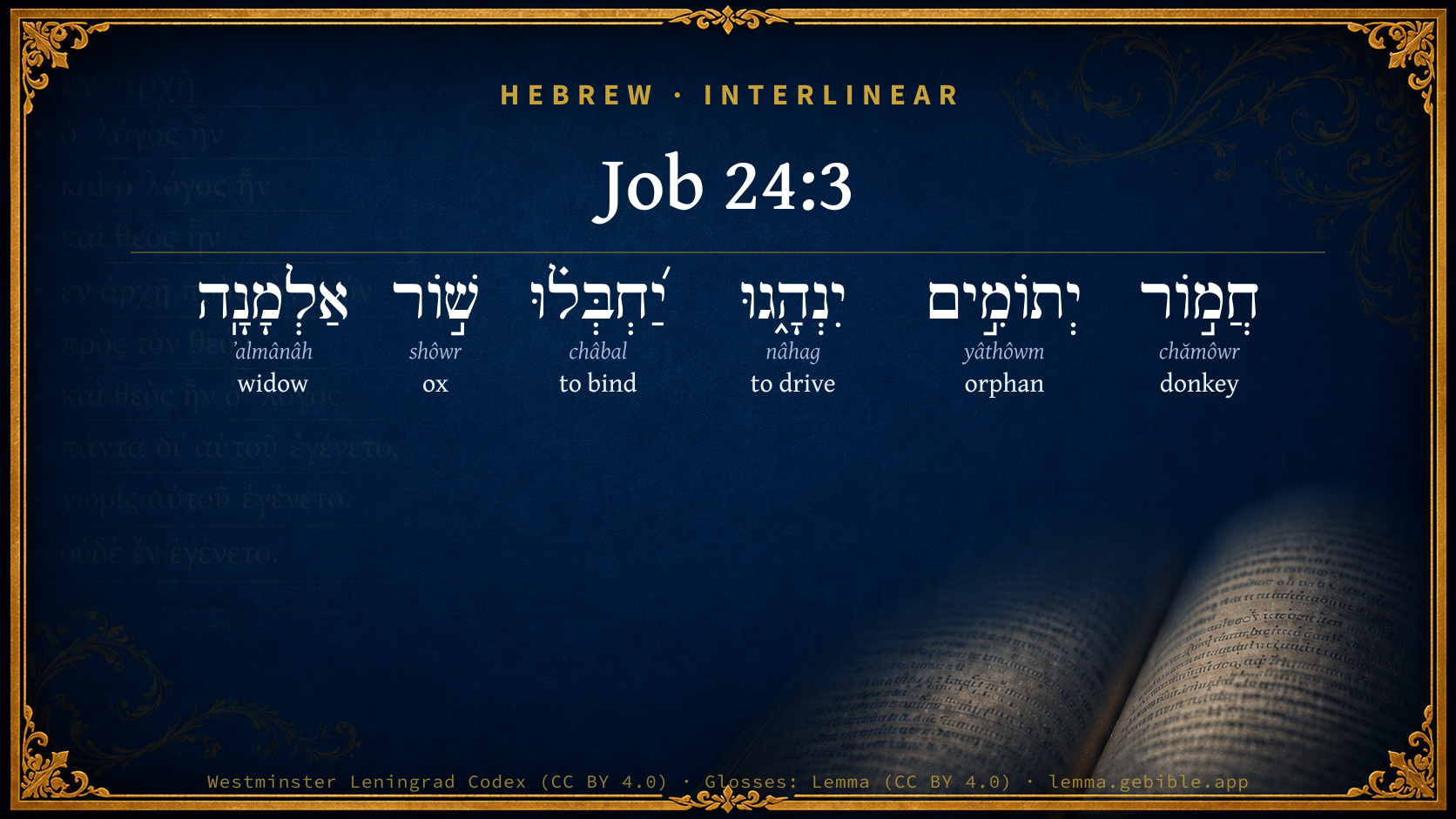
Job 24:3

Hebrew (Westminster Leningrad Codex) Job 24:3 appears in the Hebrew Old Testament. The text above is from the Westminster Leningrad Codex. Each word links to its Strong’s number, a concise gloss, and parsing drawn from the Open Scriptures Hebrew Bible morphology. Click any word for its full Brown-Driver-Briggs (BDB) entry.
Download image
Cite this verse

Job 24:3 (World English Bible). Public Domain. Lemma interlinear Bible study tool, https://lemma.gebible.app/v/job/24/3.

Show BibTeX & RIS
BibTeX
RIS
English Translation
They drive away the donkey of the fatherless, And they take the widow's ox for a pledge.
World English Bible · Public Domain
Download a study sheet

One document with this verse’s original text, its word-by-word gloss line, the meaning frame, cross-references with their text, attributed commentary, and full source and license credits — printable, and it pastes into notes with its structure intact.

This verse Autodidact and up

Study sheet (.html) Plain text (.txt)

A passage Seminary Student

Up to 50 verses in one chapter. A passage sheet keeps up to 6 commentary sources and 12 cross-references per verse, in the order this page ranks them, and says so on the sheet whenever that leaves anything out. Ask for a single verse and you get the Autodidact verse sheet above.

Everything on this page stays free to read, with no account — the sheet is a download of what is already on screen, not access to it.

Want to remove ads? Support Godless Engineer
Compare translations 3

The same verse in 3 English versions, stacked beneath the original-language interlinear above. Click any original word for its lexicon entry.

Each is an independent rendering of the whole verse — the interlinear is not word-aligned to these translations.

Highlighted words mark where these versions differ — a whole-verse word diff, not a word-by-word alignment.

  • World English Bible Public Domain
    They drive away the donkey of the fatherless, And they take the widow's ox for a pledge.
  • King James Version Public Domain
    They drive away the ass of the fatherless, they take the widow's ox for a pledge.
  • unfoldingWord Literal Text CC BY-SA 4.0
    The donkey of the fatherless they lead away; they take in pledge the ox of the widow.

unfoldingWord Literal Text — © unfoldingWord, licensed CC BY-SA 4.0. Word-aligned USFM3 via Door43 (git.door43.org/unfoldingWord/en_ult).

Versions to compare (up to 4)

3 of 4 selected

Show all 18 translations

Every available English version of this verse, each an independent rendering of the whole verse.

  • World English Bible Public Domain
    They drive away the donkey of the fatherless, And they take the widow's ox for a pledge.
  • Berean Standard Bible Public Domain
    They drive away the donkey of the fatherless and take the widow’s ox in pledge.
  • Majority Standard Bible Public Domain
    They drive away the donkey of the fatherless and take the widow’s ox in pledge.
  • King James Version Public Domain
    They drive away the ass of the fatherless, they take the widow's ox for a pledge.
  • American Standard Version (1901) Public Domain
    They drive away the ass of the fatherless; They take the widow's ox for a pledge.
  • Revised Version (1885) Public Domain
    They drive away the ass of the fatherless, they take the widow’s ox for a pledge.
  • Geneva Bible (1599) Public Domain
    They leade away the asse of the fatherles: and take the widowes oxe to pledge.
  • Douay-Rheims (1899) Public Domain
    They have driven away the ass of the fatherless, and have taken away the widow's ox for a pledge.
  • Young's Literal Translation Public Domain
    The ass of the fatherless they lead away, They take in pledge the ox of the widow,
  • Literal Standard Version CC BY-SA 4.0
    They lead away the donkey of the fatherless, || They take in pledge the ox of the widow,
  • Unlocked Literal Bible CC BY-SA 4.0
    They drive away the donkey of those without fathers; they take the widow's ox as security.
  • unfoldingWord Literal Text CC BY-SA 4.0
    The donkey of the fatherless they lead away; they take in pledge the ox of the widow.
  • Darby Bible Public Domain
    They drive away the ass of the fatherless, they take the widow's ox for a pledge;
  • World Messianic Bible Public Domain
    They drive away the donkey of the fatherless, and they take the widow’s ox for a pledge.
  • Webster's Bible Public Domain
    They drive away the ass of the fatherless, they take the widow's ox for a pledge.
  • Free Bible Version CC BY-SA 4.0
    They steal the orphan's donkey; they take the widow's ox as security for a debt.
  • Bible in Basic English Public Domain
    They send away the ass of him who has no father, they take the widow's ox for debt.
  • JPS Tanakh (1917) Public Domain
    They drive away the ass of the fatherless, they take the widow's ox for a pledge.

Literal Standard Version (2020), Covenant Press — licensed CC BY-SA 4.0. Text via the HelloAO Bible API (eBible.org). Unlocked Literal Bible (unfoldingWord) — licensed CC BY-SA 4.0. Text via the HelloAO Bible API (eBible.org). unfoldingWord Literal Text — © unfoldingWord, licensed CC BY-SA 4.0. Word-aligned USFM3 via Door43 (git.door43.org/unfoldingWord/en_ult). Free Bible Version, Dr. Jonathan Gallagher — licensed CC BY-SA 4.0. Text via the HelloAO Bible API (eBible.org).

Word by word

More ways to search: Search by grammar → Find every occurrence → Compare this word →

Practice this passage: Drill this verse → Learn its vocabulary →

יַ֝חְבְּל֗וּ
châbal
H2254
“to bind”
Verb, Qal, Imperfect, 3rd Person, Masculine, Plural
Part of Speech
Verb
Stem
Qal
Form
Imperfect
Person
3rd Person
Gender
Masculine
Number
Plural
Full BDB Definition

Origin: a primitive root

TWOT: 592 , 593 , 594 , 595

to bind - (Qal) - to bind - to take a pledge, lay to pledge - (Qal) to hold by a pledge, take in pledge, hold in pledge - (Niphal) to give a pledge, become pledged - to destroy, spoil, deal corruptly, offend - (Qal) to spoil, corrupt, offend - (Niphal) to be ruined - (Piel) to destroy, ruin - (Pual) to be ruined, be broken - to bring forth, travail - (Piel) to writhe, twist, travail
  1. חֲמ֣וֹר chămôwr H2543 “donkey of” Noun, Common, Both, Singular, Construct
  2. יְתוֹמִ֣ים yâthôwm H3490 “orphans” Noun, Common, Masculine, Plural, Absolute
  3. יִנְהָ֑גוּ nâhag H5090 “to drive” Verb, Qal, Imperfect, 3rd Person, Masculine, Plural
  4. שׁ֣וֹר shôwr H7794 “ox of” Noun, Common, Masculine, Singular, Construct
  5. אַלְמָנָֽה ʼalmânâh H490 “widow” Noun, Common, Feminine, Singular, Absolute

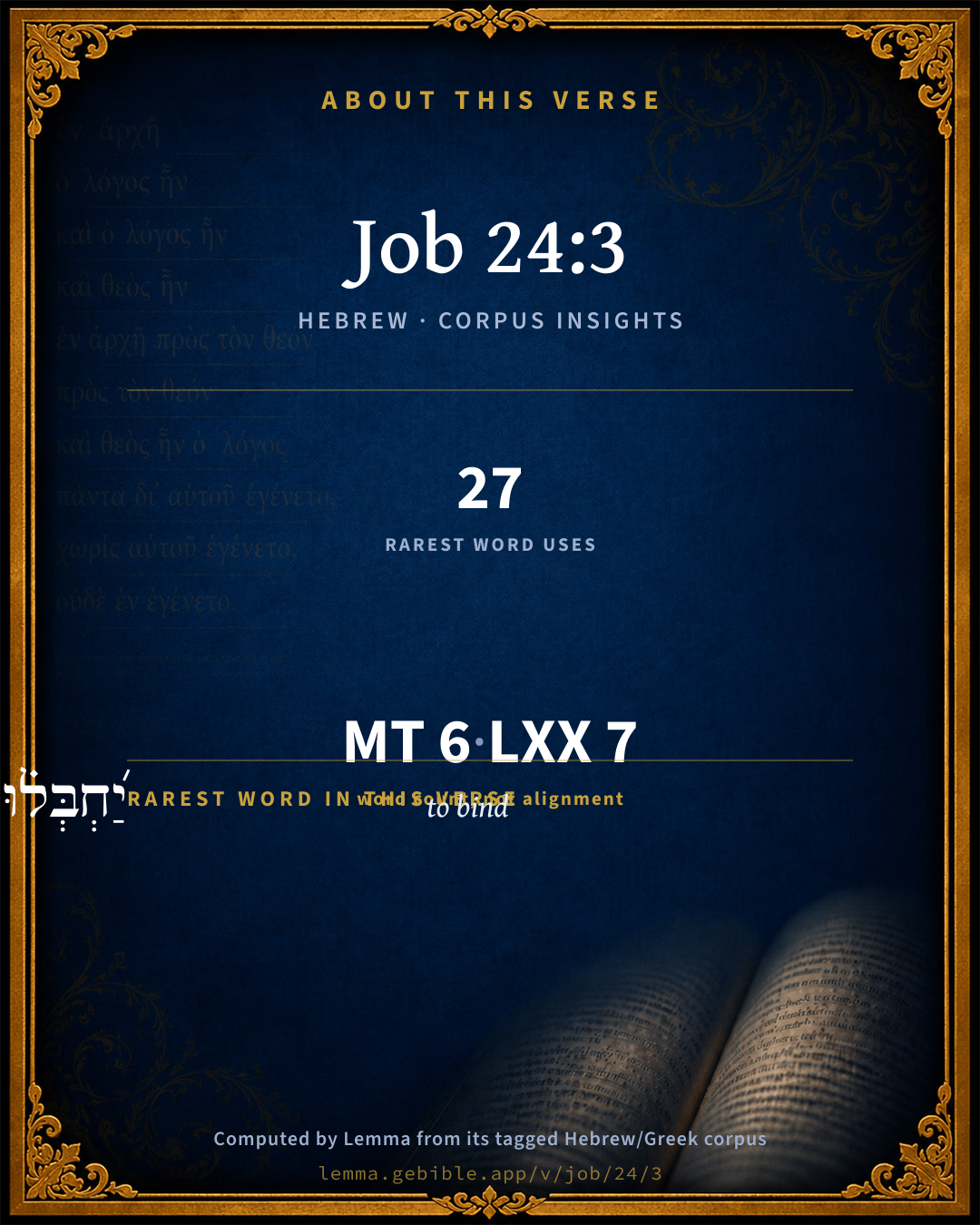
About this verse

These counts appear in no published source. They are computed here, from the morphology-tagged text and Lemma’s own curated glosses. What Lemma adds →

6
words
6
distinct lemmas
Wisdom
section

Shared distinctive vocabulary

יַ֝חְבְּל֗וּ to bind H2254 occurs in 23 verses of the Hebrew Bible. Also found in:

Grammatical profile

  • 2 verbs
  • 4 nouns

Verb forms

  • יִנְהָ֑גוּ Qal · Imperfect
  • יַ֝חְבְּל֗וּ Qal · Imperfect

Hebrew & Septuagint length

In English translation the verse runs 17 words from the Hebrew and 17 from the Septuagint (LXX English) — the same length.

A rough comparison of the two English renderings, which tokenize alike — not a word-level alignment.

Word counts can differ between the Hebrew and the Greek without any difference in meaning — e.g. the Hebrew direct-object marker אֵת has no separate Greek word, and Greek often adds the article ὁ.

In the original languages it is 6 Hebrew tokens and 7 Greek tokens — but the two are counted differently (Hebrew bundles its prefixes and suffixes into one token; the Greek is in lemma form), so that isn’t a like-for-like length.

Cross-references

6

Topical passages linked to Job 24:3 in the Treasury of Scripture Knowledge — connected by theme and wording, ordered by reader-vote popularity; previews shown in the World English Bible.

  • Deuteronomy 24:6 No man shall take the mill or the upper millstone to pledge; for he takes [a man's] life to pledge.
  • Deuteronomy 24:10–13 When you do lend your neighbor any manner of loan, you shall not go into his house to get his pledge.
  • Deuteronomy 24:17–21 You shall not wrest the justice [due] to the foreigner, [or] to the fatherless, nor take the widow's clothing to pledge;
  • 1 Samuel 12:3 Here I am: witness against me before Yahweh, and before his anointed: whose ox have I taken? or whose donkey have I taken? or whom have I defrauded? whom have I oppressed? or of whose hand have I taken a ransom to blind my eyes therewith? and I will restore it you.
  • Job 22:6–9 For you have taken pledges from your brother for nothing, And stripped the naked of their clothing.
  • Job 31:16–17 "If I have withheld the poor from their desire, Or have caused the eyes of the widow to fail,

Cross-references courtesy of OpenBible.info (CC BY 4.0).

Hebrew and Greek witnesses Masoretic Hebrew ↔ Greek Septuagint

The same verse in the two great witnesses to the Old Testament, shown verse-for-verse.

These are two independent witnesses, not word-aligned to each other, and the Septuagint is shown in lemma (dictionary) form.

Hebrew Job 24:3 Masoretic · Westminster Leningrad Codex

חֲמ֣וֹר יְתוֹמִ֣ים יִנְהָ֑גוּ יַ֝חְבְּל֗וּ שׁ֣וֹר אַלְמָנָֽה

They drive away the donkey of the fatherless, And they take the widow's ox for a pledge.

World English Bible · Public Domain

Greek LXX Job 24:3 Septuagint · lemma form

ὑποζύγιον ὀρφανός ἀποἄγω καί βοῦς χήρα ἐνεχυράζω

They have led away, the ass of the fatherless, and taken the widow's ox for a pledge.

LXX2012 (modern English Septuagint) · Public Domain

Hebrew: Westminster Leningrad Codex (CC BY 4.0). Greek: Septuagint (public domain); English from LXX2012 (modern English Septuagint) (Public Domain). How the Septuagint differs from the Hebrew →

Commentary

Notes on Job 24:3 from classic Christian and Jewish commentators (each source and its license shown beneath its notes). The classic Christian expositions comment on the surrounding passage and are grouped to its opening verse, so a note may address several verses; the Jewish commentaries on the Tanakh (Rashi and others) are per-verse, so they appear only where the commentator wrote on this verse.

Lemma curates 59 commentaries, every one of them public domain or Creative Commons licensed, each selected and text-cleaned for this edition rather than reprinted as found. About our sources →

Trapp's Complete Commentary

John Trapp

Job 24:3 They drive away the ass of the fatherless, they take the widow’s ox for a pledge.

Ver. 3. They drive away the ass of the fatherless] The only ass of orphans, those helpless, shiftless creatures, so merciless are these abigei, which is no small aggravation of their injustice. {see 2Sa 12:3} For all sins are not equal, as the Stoics once held, but lighter or heavier according to their circumstances. To rob the rich is a great offence, but to pillage the poor is far greater.

They take the widow’s ox for a pledge] Without which she cannot plough; or, her cow, as some render it, without which she and her children cannot live. A poor body’s livelihood is his life (as that poor widow’s was ολον τον βιον, Mar 12:44, and the like is said of the haemorrhoisse, Luk 8:43), crush this snail in his shell, and you kill him. Now therefore albeit it be not unlawful to take a pledge for security in some cases; yet courtesy must be used, and mercy must be shown to orphans, widows, strangers, and such like, because they are God’s clients, and he hath taken them into his special care and tuition.

John Trapp, A Commentary or Exposition upon All the Books of the Old and New Testament (1647–1656) — public domain. Text from a community e-Sword module.

Joseph Benson's Commentary

Job 24:3-4. They drive away the ass of the fatherless — Whose helpless condition required their pity and mercy. He says, the ass, to aggravate their sin, in that they robbed him who had but one ass. They take the widow’s ox — Thereby depriving her, not only of the ox itself, but of all the benefit of its labours, by which her life was sustained; for a pledge — Contrary to God’s law, first written in men’s hearts, and afterward in the Holy Scriptures, Exo 22:26. They turn the needy out of the way — Out of the way of piety and virtue. They engage them to take evil courses by their examples, or promises, or threatenings. Or, out of their right, of which they deprive them, by subtlety or power. Or, rather, as the word מדרךְ, middarech, more properly signifies, and as the next clause explains it, out of the highway, out of the path or place in which these oppressors walk and range. These needy persons labour to keep out of their way for fear of their further injuries and oppressions. The poor of the earth hide themselves, &c. — For fear of these wicked tyrants and persecutors.

Joseph Benson's Commentary on the Old and New Testaments (1811–1818) — public domain. Text from a community e-Sword module.

Tyndale Open Study Notes

Tyndale Open Resources

24:3 The law did not allow seizing necessary belongings as security or collateral for a loan (22:6-9; Deut 24:6, 10-13, 17-21).

Tyndale Open Study Notes — © Tyndale Open Resources, licensed CC BY-SA 4.0. Text via the HelloAO Bible API.

Jamieson, Fausset & Brown

Robert Jamieson, A. R. Fausset & David Brown

pledge--alluding to Job 22:6. Others really do, and with impunity, that which Eliphaz falsely charges the afflicted Job with.

Jamieson, Fausset & Brown — Commentary Critical and Explanatory on the Whole Bible (1871) — public domain (CC PDM 1.0). Text via the HelloAO Bible API.

Ellicott's Commentary for English Readers

(3) They drive away the ass.—The ass and the ox, the fatherless and the widow presumably having no more than one. He first describes the oppression of the country, and then that of the city (Job_24:12). We seem here to catch a glimpse of the sufferings of some oppressed and subject aboriginal race, such as the Canaanites may have been to the Jews, though there is probably no allusion to them. But, at all events, the writer and the speaker seem to have been familiar with some such abject and servile race, who haunted the desert and suffered at the hands of the more powerful tribes. Man’s inhumanity to man is, unhappily, a crime of very long standing.

A Bible Commentary for English Readers, edited by Charles John Ellicott (1878–1897) — public domain. Text from a community e-Sword module.

The Cambridge Bible for Schools and Colleges

gen. ed. J. J. S. Perowne

3. By “the ass” and “the ox” is meant the single ass and ox which the fatherless and widow possess, needful for working their small field or affording them scanty nourishment. When deprived of these they are brought to complete destitution, and removed from the land.

The Cambridge Bible for Schools and Colleges (gen. ed. J. J. S. Perowne; Cambridge University Press, 1878–1918) — public domain. Text from a community e-Sword module.

John Gill's Exposition

They drive away the ass of the fatherless,.... Who are left destitute of friends, and have none to take care of them, and provide for them; and who having one ass to carry their goods for them from place to place, or to ride upon, which though a creature of no great worth, yet of some usefulness, this they drove away from its pasture, or however from its right owner; and who having but one, it was the more cruel and inhuman to take it from him, see, Sa2 12:3;

they take the widow's ox for a pledge; or oxen, the singular for the plural, with which her lands were ploughed, for a single ox could be but of little service: some render it "a cow" (h), by the milk of which she and her family were chiefly supported, as many poor country families are by the means of a good milch cow; and to take this, on which her livelihood depended, and retain for a pledge, was very barbarous; when the law concerning pledges took place among the Jews, in the times of Moses, which it seems was in being before with others, whatsoever was useful to persons, either to keep them warm, or by which they got their bread, were not to be taken, at least not detained for a pledge, see Exo 22:26.

(h) "pro bove foemina, vacca", Bolducius.

John Gill's Exposition of the Whole Bible (1746–1763) — public domain (CC PDM 1.0). Text via the HelloAO Bible API.

Albert Barnes' Notes on the Bible

They drive away the ass of the fatherless - Of the orphan, who cannot protect himself, and whose only property may consist in this useful animal. Injury done to an orphan is always regarded as a crime of special magnitude, for they are unable to protect themselves; see the notes at Job 22:9.

They take the widow’s ox for a pledge - See the notes at Job 22:6. The widow was dependent on her ox to till the ground, and hence, the crime of taking it away in pledge for the payment of a debt.

Albert Barnes' Notes on the Bible (1834–1885) — public domain. Text from a community e-Sword/MySword module.

Matthew Poole's English Annotations

The ass, either the asses, the singular number being used collectively. Or he saith the ass, to aggravate their sin, that they robbed him who had but one ass. Compare 1Sa 12:2-4.

The fatherless; whose helpless condition required their pity and mercy.

The widow’s ox; thereby depriving her not only of the ox itself, but of all the benefit of its labours, by which she sustained her life.

For a pledge; contrary to God’s law, first written in men’s hearts, and afterwards in Holy Scripture, Exo 22:26,27; Deu 24:6,10, &c.

Matthew Poole's English Annotations on the Holy Bible (1683–1685) — public domain. Text from a community e-Sword/MySword module.

The Pulpit Commentary

They drive away the ass of the fatherless. This was another form of oppression. "Whose ox have I taken? or whose ass have I taken? or whom have I defrauded? whom have I oppressed?" says Samuel, on laying down his judgeship. (1Sa_12:3) The "fatherless" were particularly liable to such ill treatment, seeing that they had lost their natural protector. They take the widow"s ox for a pledge. It may be true that this was nowhere a legal offence, not even among the Hebrews (Lee); but it was a real act of oppression, and forms a fitting counterpart to the injury done to the orphan. (On the natural tendency of selfish men to bear hard on these two classes, see Exo_22:22 Deu_24:17 Psa_94:6 Isa_1:23 Isa_10:2 Jer_5:28 Zec_7:10)

The Pulpit Commentary (1880–1919), ed. H.D.M. Spence-Jones & Joseph S. Exell — public domain. Text from a community e-Sword module.

John Wesley's Explanatory Notes

Pledge - Contrary to God's law, first written in mens hearts, and afterwards in holy scripture, Exod. xxii, 26, 27.

John Wesley, Explanatory Notes Upon the Whole Bible (1754–1765) — public domain. Text via the GEBible commentary corpus.

Rashi

Rabbi Shlomo Yitzchaki (Rashi)

They lead away the orphan’s donkey and commit all the evils stated in the chapter. The end of the matter is that “God does not impute it for unseemliness” (verse 12), to let them know their iniquity and to furnish them with their recompense.

Rashi on the Tanakh — English translations: “The Judaica Press complete Tanach with Rashi, translated by A. J. Rosenberg” (CC BY 4.0); “Pentateuch with Rashi's commentary by M. Rosenbaum and A.M. Silbermann, 1929-1934” (public domain); “The Metsudah Tanach series, Lakewood, N.J” (CC BY 4.0); and “The Book of Joshua, Metsudah Publications, 1997” (CC BY 4.0). Text via Sefaria.

Lesson kit

Teaching starters — assembled from the data on this page, not authored interpretation. Every prompt links to the verse data it draws on. Edit before teaching.

Job, in the Wisdom, opens this verse with 6 words (6 distinct Hebrew lemmas). Its most distinctive word is châbal (“to bind”). A historical commentator’s framing appears above. Read the whole chapter for the surrounding context.

Discussion questions

  1. The word châbal carries the sense “to bind.” How does it shape the verse?
  2. Exodus 22:26 shares the word «to bind» with this verse. How do the two illuminate each other?
  3. These translations render this verse differently; the difference is in the English rendering, not the original. What questions does that raise?
  4. The verb «יִנְהָ֑גוּ» is Qal Imperfect. How does its form color the action?
  5. Reading how Trapp's Complete Commentary and Joseph Benson's Commentary read this verse, where do the two commentators agree and where do they part?

Things to notice

Reading settings

Reading text

Shown beneath each verse's original-language words.

Old Testament
Old Testament edition

Read the OT as the Masoretic Hebrew (MT) or the Greek Septuagint (LXX).

English shown for the Greek Septuagint (in the Hebrew ↔ Greek comparison).

Comparing translations? Open the Compare panel on any verse page to stack up to four side by side.