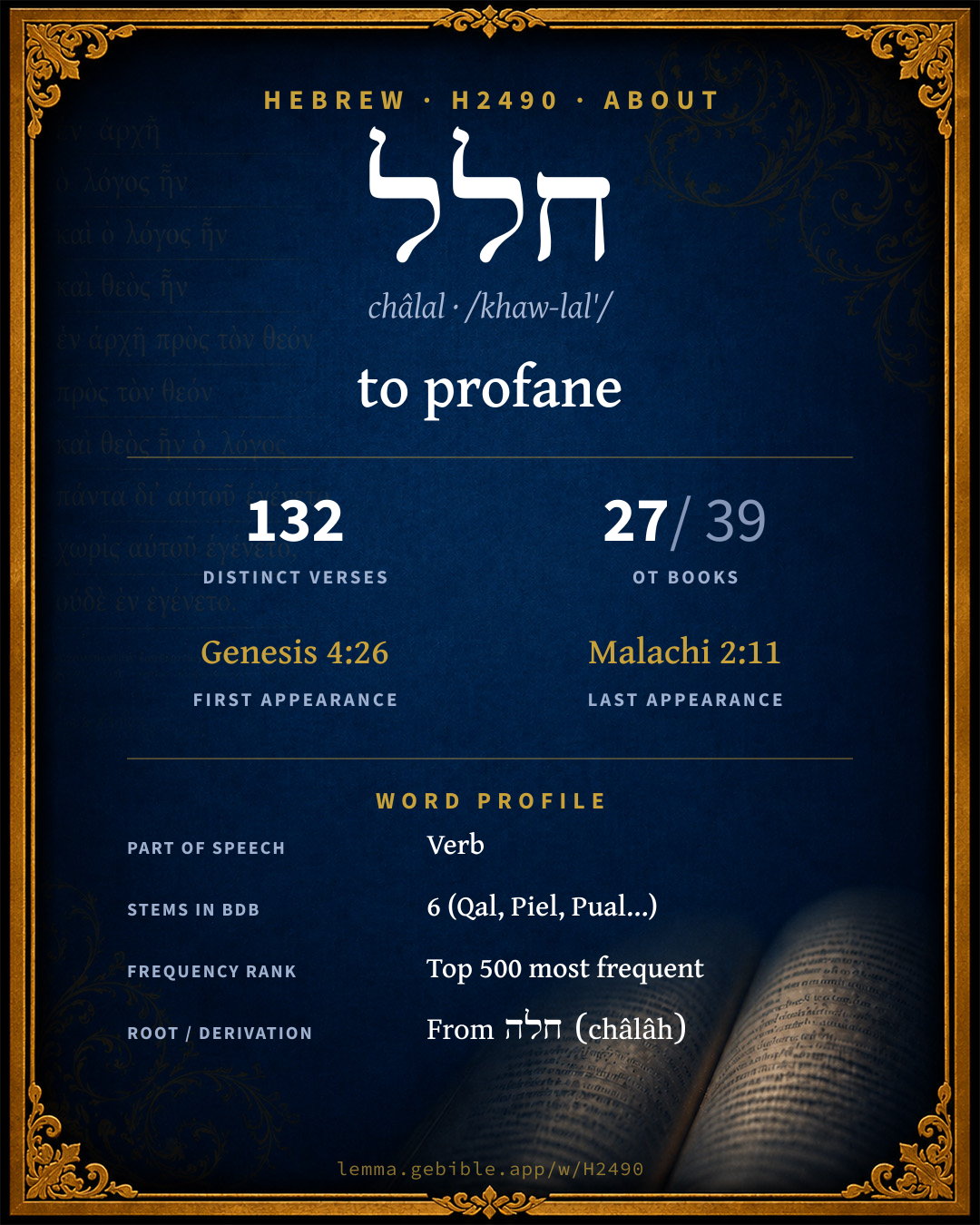
חָלַל
to profane
also: defile, pollute, desecrate, begin fuller range ↓
Full lexicon entry — Brown-Driver-Briggs (BDB)
From Brown-Driver-Briggs (BDB)
Where this word appears
See every Piel verb in the Hebrew Bible →
Grammar key — what these labels mean
Part of speech
- Verb
- An action or state-of-being word.
Stem
- Hiphil
- The causative active stem (“he caused / brought about”). Here: ‘begin’
- Piel
- An intensive or resultative active stem. Here: ‘pl.’
- Niphal
- Usually the simple passive or reflexive of the Qal (“he was written”). Here: ‘reflex. pollute’
- Qal
- The basic, simple active stem — the plain form of the verb (“he wrote”). Here: ‘pl.’
- Pual
- The passive counterpart of the Piel.
- Hophal
- The passive counterpart of the Hiphil (“he was caused to…”).
- Polal
- The passive counterpart of the Polel.
Form
- Perfect
- A completed action or state — Hebrew marks aspect (completeness) more than strict tense (“he wrote”).
- Sequential Imperfect
- An imperfect with prefixed waw — the standard past-narrative form (waw-consecutive imperfect).
- Sequential Perfect
- A perfect with prefixed waw continuing a preceding imperfect or command (waw-consecutive perfect).
- Infinitive Construct
- A bound verbal noun, frequently with prepositions (“to write / in writing”).
- Imperfect
- An incomplete, ongoing, or future action (“he will / would write”).
- Imperative
- A direct command (“write!”).
- Participle Active
- A verbal adjective expressing ongoing or characteristic action (“writing / one who writes”).
- Participle Passive
- A verbal adjective expressing action received (“written”).
- Infinitive Absolute
- An unbound verbal noun, often intensifying or standing in for a finite verb.
- Jussive
- A third- or second-person volitional form expressing wish or command (“let him write”).
State
- Absolute
- The independent form of a noun, not bound to a following word.
- Construct
- A noun bound to a following noun in a possessive / “of” relationship (the construct chain).
Person
- 3rd Person
- The one spoken about (“he / she / it / they”).
- 1st Person
- The speaker (“I / we”).
- 2nd Person
- The one addressed (“you”).
Gender
- Masculine
- Grammatically masculine.
- Common
- Either gender — not distinguished for this form.
- Feminine
- Grammatically feminine.
Number
- Singular
- One.
- Plural
- More than one (in Hebrew, generally three or more).
10 distinct verses where H2490 appears in the Niphal stem, across 3 books. Filtered view — show all forms. Click any verse to open its interlinear word-by-word view. Verse text shown in the World English Bible for context — . Each verse’s Hebrew form is shown with its reference; the English is not keyword-highlighted, since the data carries no word-level English alignment. Use “Compare translations” on any verse to read it across multiple English versions. This concordance covers the Hebrew Bible; Septuagint (Greek Old Testament) occurrences are not indexed here.
Leviticus 2 verses
- Leviticus 21:4 לְ/הֵ֖חַלּֽ/וֹ prep + Niphal inf.cs + sfx pers 3ms He shall not defile himself, being a chief man among his people, to profane himself.
- Leviticus 21:9 תֵחֵ֖ל מְחַלֶּ֔לֶת Niphal impf 3fs Piel ptcp.act fs "'The daughter of any priest, if she profanes herself by playing the prostitute, she profanes her father: she shall be burned with fire.
Isaiah 1 verse
Ezekiel 7 verses
- Ezekiel 7:24 וְ/נִחֲל֖וּ conj + Niphal wpf 3cp Therefore I will bring the worst of the nations, and they shall possess their houses: I will also make the pride of the strong to cease; and their holy places shall be profaned.
- Ezekiel 20:9 הֵחֵ֛ל Niphal inf.cs But I worked for my name's sake, that it should not be profaned in the sight of the nations, among which they were, in whose sight I made myself known to them, in bringing them forth out of the land of Egypt.
- Ezekiel 20:14 הֵחֵל֙ Niphal inf.cs But I worked for my name's sake, that it should not be profaned in the sight of the nations, in whose sight I brought them out.
- Ezekiel 20:22 הֵחֵל֙ Niphal inf.cs Nevertheless I withdrew my hand, and worked for my name's sake, that it should not be profaned in the sight of the nations, in whose sight I brought them forth.
- Ezekiel 22:16 וְ/נִחַ֥לְתְּ conj + Niphal wpf 2fs You shall be profaned in yourself, in the sight of the nations; and you shall know that I am Yahweh.
- Ezekiel 22:26 וַ/יְחַלְּל֣וּ וָ/אֵחַ֖ל conj + Piel wimpf 3mp conj + Niphal wimpf 1cs Her priests have done violence to my law, and have profaned my holy things: they have made no distinction between the holy and the common, neither have they caused men to discern between the unclean and the clean, and have hid their eyes from my Sabbaths, and I am profaned among them.
- Ezekiel 25:3 נִחָ֗ל Niphal pf 3ms and tell the children of Ammon, Hear the word of the Lord Yahweh: Thus says the Lord Yahweh, Because you said, Aha, against my sanctuary, when it was profaned; and against the land of Israel, when it was made desolate; and against the house of Judah, when they went into captivity:
About this entry
At a glance — auto-summarized from this page’s data, not written by a person. Every figure links to its source below. This summary describes the numbers; it doesn’t interpret them.
חלל — transliterated châlal — is a Hebrew verb carrying the sense “to profane.” The verb spans 6 stems, from Qal to Piel. With 132 verses in 27 books, it is a common word in the Hebrew Bible. Debuting at Genesis 4:26, it then recurs through the corpus. Sharing its root, it stands alongside חלה, חלא and חלי. Each statement above links to its evidence; the full detail follows below.
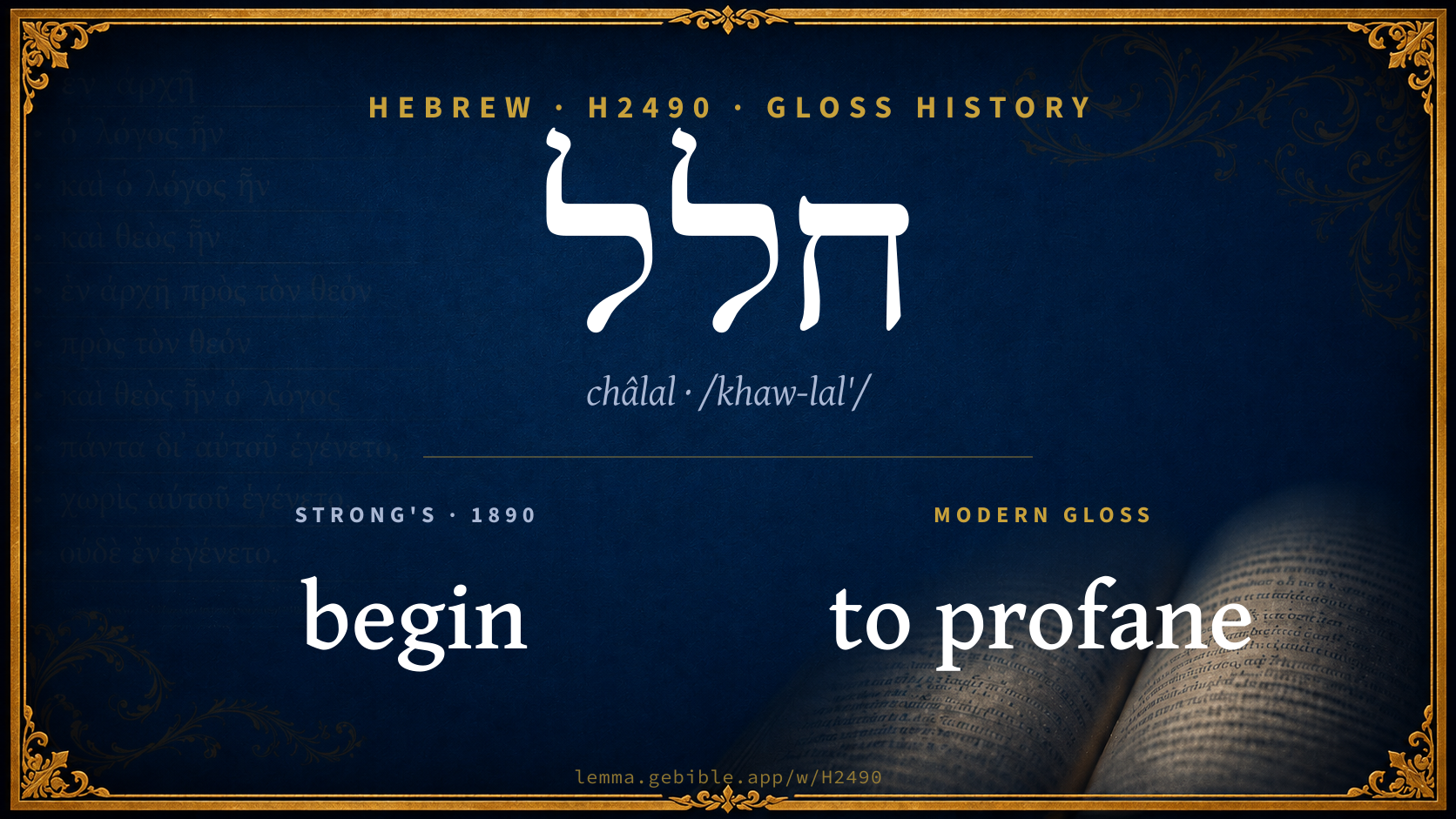
Gloss history
Strong's 1890 vs modern scholarship
About this word
Strong's H2490 catalogs a Hebrew word from the Hebrew Old Testament.
These counts are not copied from any lexicon or concordance. They are computed here, from the morphology-tagged Hebrew Old Testament. What Lemma adds →
- 132
- distinct verses
- The word appears in 132 distinct verses.
- 27 / 39
- OT books
- The word appears in 27 of 39 Old Testament books.
- #314
- by frequency
- Top 500 most frequent Hebrew words (rank 314 of 8,640 Hebrew words by occurrence).
View all 132 occurrences in the concordance →
Most concentrated in
- Ezekiel 31 verses 23%
- Leviticus 15 verses 11%
- 2 Chronicles 9 verses 7%
By section of the Old Testament
By traditional corpus
Conventional, traditional groupings — biblical authorship is debated, so this is a traditional corpus grouping, not an authorship claim. Each share is this word’s portion of its verses in that division of the Hebrew canon. Each figure is a share of the word’s 132 distinct verses.
- Prophets (Nevi'im) 66 verses · 50%
- Torah (Pentateuch) 37 verses · 28%
- Writings (Ketuvim) 29 verses · 22%
How translations render this word
Counts come from each version’s own published word-to-Strong’s tagging or interlinear alignment — an approximate guide to how each version renders this word, not a word-level alignment the data otherwise carries. Because each total is that version’s own tagged count, the per-version totals vary from one another and need not match the appearance or distinct-verse counts above. These counts may also differ from a printed concordance because Lemma counts each distinctly tagged rendering and does not collapse phrase taggings into a single head-word total. This is a fixed set of word-tagged versions (KJV, ASV, BSB, ULT) and does not change with the reading translation you choose elsewhere. Each version’s license is shown beside its name below (and on Sources).
BDB lists this Strong’s number as 3 distinct words (homographs). Each count above pools all of them and is not split by sense — see the Senses section below. A low-frequency rendering may belong to a different one of those words, not the primary meaning.
- King James Version†: Began 20×, Profane 7×, He began 6×
- American Standard Version†: Began 18×, Profane 9×, He began 6×
- Berean Standard Bible†: Began 17×, Profane 11×, Profaned 6×
- unfoldingWord Literal Text†: Profane 20×, Began 17×, He began 6×
King James Version Public Domain
Renders H2490 across 141† tagged occurrences — most commonly:
Plus other, less common renderings. Plus 71 renderings that appear only once — usually multi-word phrases or single function words the recovered tagging swept in, not distinct renderings.
American Standard Version Public Domain
Renders H2490 across 142† tagged occurrences — most commonly:
Plus other, less common renderings. Plus 72 renderings that appear only once — usually multi-word phrases or single function words the recovered tagging swept in, not distinct renderings.
Berean Standard Bible Public Domain
Renders H2490 across 138† tagged occurrences — most commonly:
Plus other, less common renderings. Plus 62 renderings that appear only once — usually multi-word phrases or single function words the recovered tagging swept in, not distinct renderings. Not rendered by a distinct English word in 3 further occurrences.
unfoldingWord Literal Text CC BY-SA 4.0
Renders H2490 across 162† tagged occurrences — most commonly:
Plus other, less common renderings. Plus 61 renderings that appear only once — usually multi-word phrases or single function words the recovered tagging swept in, not distinct renderings.
25 senses and sub-senses in the full BDB
Hebrew verbs can shift meaning by stem (binyan): Qal is the basic action, Niphal is often passive or reflexive, Piel often intensifies or makes it factitive, and Hiphil is typically causative. The senses below are grouped under the stem BDB assigns to each. This entry also uses Pual (the passive of Piel) and Hophal (the passive of Hiphil).
What do BDB’s symbols mean?
BDB uses these scholarly abbreviations:
| Symbol | Meaning |
|---|---|
| 𝔊 | the Septuagint (the ancient Greek translation, LXX) |
| 𝔙 | the Vulgate (the Latin translation) |
| 𝔖 | the Syriac version (the Peshitta) |
| 𝔗 | the Targum (the Aramaic translation) |
| ψ | the Psalms |
| √ | root (the underlying root or stem) |
| ‖ | parallel passage (a synonymous or contrasted parallel) |
| † | the dagger: every passage where the word occurs is cited |
The 25 senses and sub-senses the full Brown-Driver-Briggs lexicon distinguishes for this word, in lexicon order (not ranked by frequency), with BDB’s own verbatim wording and sub-sense lettering. Shown in Hebrew script with BDB’s own scholarly abbreviations. The condensed entry is in the Lexicon Entry tab. See also the Forms in the corpus table below.
חלל I bore, pierce (Arabic خَلَّ perforate, pierce through, transfix, Ethiopic ኅለት (hollow) reed
Qal
- Pf. לִבִּי חָלַל בְּקִרְבִּי my heart is pierced (wounded) within me ψ 109:22 (? lit. one has pierced my heart; or read Pu. חֻלַּל?); Inf. cstr. חַלּוֹתִי הִיא ψ 77:11 it is my piercing, my wound my woe; Hu. Pe Bi Che read חֲלוֹתִי my sickness). e.g. Psalms 109:22
Piel
- Pt. pl. (Baer) בְּיַד מְחַללֶי֑ךָ Ez 28:9 in the hand of the ones wounding thee (Sm Co read מְחוֹלְלֶ֑ךָ). e.g. Ezekiel 28:9
Pual
- Pt. מְחֻלֲלֵי הֶרֶב pierced by the sword Ez 32:26. Poʿel. Pf. 3 fs. חֹלֲלָה יָדוֹ נָחָשׁ בָּרִחַ Jb 26:13 his hand pierced the fleeing serpent; רַב־מְחוֹלֵל כֹּל Pr 26:10 an archer piercing all (v. חול) Pt. f. מְחוֹלֶלֶת תַּנִּין Is 51:9 who pierced the dragon. Poʿal. Pt. מְחֹלָל מִפְּשָׁעֵינוּ Is 53:5 pierced, wounded because of our transgressions (of the servant of י׳, ‖ מְדֻכָּא מֵעֲוֹנֹתֵינוּ). e.g. Ezekiel 32:26
חלל II denom. play the pipe, pipe
Qal
- Pt. pl. וְשָׁרִים כְּחֹלֲלִים ψ 87:7 as well the singers as the pipe-players, cf. AV; Pôʿlel Pt. from i. חוּל dancers. e.g. Psalms 87:7
Piel
- Pt. וְהָעָם מְחַלְּלִים בַּחֲלִלִים 1 K 1:40 and the people piped with pipes (cf. Assyrian ḫâlalu, according to Dl in ZimBP 117). e.g. 1 Kings 1:40
חלל III pollute, defile, profane
Niphal
- Pf. נִחָ֑ל Ez 25:3, נִחַלְתְּ (-תִּי Co) Ez 22:16, נִחֲלוּ Ez 7:24; Impf. יֵחָ֑ל Is 48:11, תֵּחֵל Lv 21:9, וָאֵחַל Ez 22:26; Inf. הֵחֵל Ez 20:9, 14, 22, sf. לְהֵחַלּוֹ Lv 21:4.— e.g. Ezekiel 25:3
- 1. reflex. pollute, defile oneself
- a. ritually, by contact with dead ‖ טמא, Lv 21:4 (H) e.g. Leviticus 21:4
- b. sexually ‖ זנה Lv 21:9 (H). e.g. Leviticus 21:9
- 2. Pass., be polluted, defiled, of holy places Ez 7:24; 25:3, name of God Ez 20:9, 14, 22 Is 48:11 and even God himself Ez 22:16, 26. e.g. Ezekiel 7:24
Piel
- Pf. חִלֵּל Lv 19:8 + 3 times; sf. חִלְּלוֹ Dt 20:6; 2 ms. חִלַּלְתָּ Gn 49:4 + 3 times; 2 fs. חִלָּ֑לְתְּ Ez 22:8; 3 pl. sf. חִלְּלוּהֻ֯ Ez 7:21 etc., + 16 times Pf.; Impf. יְחַלֵּל Lv 21:12, 15, 23; sf. יְחַלְּלֶנּוּ Dt 20:6; pl. יְחַלְּלוּ Lv 21:6 + 4 times, יְחַלֵּ֑לוּ ψ 89:32 etc., + 13 times Impf.; Inf. חַלֵּל Am 2:7 + 4 times; חַלְּלוֹ Ez 23:39 + 4 times; חַלְּלָם Je 16:18; Pt. מְחַלֵּל Ez 24:21 pl. מְחַלְּלִים Mal 1:12 Ne 13:17; sf. מְחַלֲלֶיהָ Ex 31:14; f. מְחַלֶּלֶת Lv 21:9;— e.g. Leviticus 19:8
- 1. defile, pollute:
- a. sexually, Gn 49:4 (poem) = 1 Ch 5:1 (the father’s bed); a woman = זנה Lv 19:29; 21:9 (H); זַרְעוֹ Lv 21:15 (H). e.g. Genesis 49:4
- b. ceremonially, profane, the altar by a tool Ex 20:25 (JE); sacred places Lv 21:12, 23 (H), Ez 7:21, 22(×2), 23:39; 24:21; 44:7 Zp 3:4 Mal 2:11 ψ 74:7 Dn 11:31; the holy land Je 16:18; sacred things Lv 19:8; 22:9, 15 (H) Nu 18:32 (P) Ez 22:26; the sabbath Ex 31:14 (P), Is 56:2, 6 Ez 20:13, 16, 21, 24; 22:8; 23:38 Ne 13:17, 18; and so the sanctity of the prince of Tyre who made himself God, and his holy places, Ez 28:7, 16, 18. e.g. Exodus 20:22
- c. the name of God Lv 18:21; 19:12; 20:3; 21:6; 22:2, 32 (all H), Am 2:7 Je 34:16 Ez 20:39; 36:20, 21, 22, 23 Mal 1:12, God himself Ez 13:19. e.g. Leviticus 18:21
- d. י׳ defiles or profanes his inheritance by giving it over to Babylon Is 47:6; the princes of the sanctuary by giving them to Chaldeans Is 43:28. e.g. Isaiah 47:6
- 2. violate the honour of, dishonour, י׳ subj., crown of Davidic kingdom ψ 89:40 (sq. לארץ pregn.), kingdom of Judah La 2:2; the גאון כל צבי Is 23:9. e.g. Psalms 89:40
- 3. violate a covenant ψ 55:21; 89:35 Mal 2:10, the חקות of God ψ 89:32. e.g. Psalms 55:21
- 4. treat a vineyard as common (v. חֹל) by beginning to use its fruit Dt 20:6(×2); 28:30 Je 31:5 (v. the law Lv 19:23–25, H). e.g. Deuteronomy 20:6
Pual
- Pt. שְׁמִי הַגָּדוֹל הַמְֿחֻלָּל בַּגּוֹיִם Ez 36:23 my great name which is profaned among the nations. e.g. Ezekiel 36:23
Hiphil
- 1.
- a. Impf. לֹא אַחֵל אֶת־שֶׁם־קָדְשִׁי עוֹד Ez 39:7 I will not let my holy name be profaned any more; cp. 20:9. e.g. Ezekiel 39:7
- b. לֹא יַחֵל דְּבָרוֹ he shall not violate his word Nu 30:3 (P). e.g. Numbers 30:3
- 2. begin, Pf. הֵחֵל Gn 6:1 + 15 times, הֵחֵ֫לָּה Ju 20:40, הַחִלּוֹתָ Dt 3:24 Est 6:13, הַחִלֹּתִי Dt 2:31 1 S 22:15, הֵחֵ֫לּוּ Ezr 3:6 + 6 times; Impf. יָחֵל Ju 10:18; 13:5, וַיָּ֫חֶל Gn 9:20 + 5 times, 3 fs. וַ֫תָּחֶל Ju 13:25; 16:19, 2 ms. תָּחֵל Dt 16:9, אָחֵל Dt 2:25 Jos 3:7, וַיָּחֵ֫לּוּ Ju 20:31 + 3 times, וַתְּחִלֶּינָה Gn 41:54, תָּחֵ֫לּוּ Ez 9:6; Imv. הָחֵל Dt 2:24, 31; Inf. cstr. הָחֵל 1 S 3:12 + 2 times; sf. הַחִלָּם Gn 11:6; Pt. מֵחֵל Je 25:29;—begin, Nu 17:11, 12 (P) Dt 16:9 2 Ch 29:27(×2); so 2 S 24:15 𝔊 We Dr. (𝔊 inserts וְהַמַּגֵּפָה הֵחֵ֫לָּה בָּעָם bef. וַיָּ֫מָת); c. Inf. (ל) begin to Gn 41:54 (E), Gn 6:1; 10:8 = 1 Ch 1:10, Gn 11:6 Nu 25:1 (all J), Dt 2:25, 31; 3:24; 16:9 Jos 3:7 (D), Ju 10:18; 13:5, 25; 16:19, 22; 20:31, 39, 40 1 S 3:2; 14:35; 22:15 2 K 10:32; 15:37 1 Ch 27:24 2 Ch 3:1, 2; 29:17; 31:7, 10, 21; 34:3(×2) Ezr 3:6 Ne 4:1 Est 6:13; 9:23; Je 25:29 Jon 3:4; c. ו consec. Gn 9:20 (J) Ezr 3:8; c. בְּ begin with Gn 44:12 (J), Ez 9:6, 2 Ch 20:22; so 2 S 24:5, read וַיָּחֵ֫לּוּ for וַיַּחֲנוּ 𝔊L We Dr; c. מן begin from Ez 9:6; הָחֵל רָשׁ begin! possess! Dt 2:24, 31; הָחֵל וְכַלֵּה beginning and ending 1 S 3:12 (i.e. accomplishing my full purpose, v. Dr). e.g. Genesis 6:1
Hophal
- Pf. אָו הוּחַל לִקְרֹא בְּשֵׁם י׳ then it was begun (= men began) to call on the name of י׳ Gn 4:26 (J). e.g. Genesis 4:26
- —וַיָּחֵלּוּ מְעַט מִמַּשָּׂא Ho 8:10 begin to be minished by reason of the burden RV Hi al.; Wü Now read וְיָחִלוּ (I. חול, חיל)—for om. of dagh. v. also וְיָחֵלוּ of Cod. Bab.—shall be in anguish a little for the burden, so Ra AV; Ew וְיָחִלוּ that they may wait (?) a little; 𝔊 וחדלו מעט ממשׁח cease a little from anointing, so Che We, this probably best. e.g. Hosea 8:10
Senses from the full Brown-Driver-Briggs lexicon (Brown, Driver, Briggs; Oxford 1906 — public domain), digitized via Sefaria, supplemented by the OpenScriptures HebrewLexicon (CC BY 4.0). Full attribution on Sources.
Word origin
I. vb. bore, pierce (Arabic خَلَّ perforate, pierce through, transfix, Ethiopic ኅለት (hollow) reed; Aramaic חֲלַל hollow out, חֲלִילָא pipe; ܚܠܻܝܠܴܐ adj. hollow, ܚܠܳܠܴܐ cave, ܚܶܠܬܳܐ sheath, etc.; NH in deriv. חָלָל n. hollow, adj. slain, חָלִיל pipe);—
II. vb.denom. play the pipe, pipe—
III. vb. pollute, defile, profane; Hiph. also begin (lit. untie, loosen, open, v. Arabic) (Arabic خَلَّ untie, undo, become free, lawful, free from obligation or tie; iv. make lawful; x. esteem lawful or free, profane, desecrate, violate; NH חלל be profane, desecrated (also Pi. Hiph. transit.), cf. Aramaic חֲלַל; ܚܰܠܶܠ Pa. is purify, ܐܰܚܶܠ Aph. is profane)—
— Brown-Driver-Briggs (Oxford 1906, public domain), digitized via Sefaria, supplemented by the OpenScriptures HebrewLexicon (CC BY 4.0). See Sources.
Derived from חלה (châlâh) (H2470) — to be sick.
Jastrow Dictionary
A second Hebrew/Aramaic lexicon for comparison, covering Aramaic and post-biblical (Talmudic, Targumic, Midrashic) usage that the biblical-Hebrew BDB does not. Matched by lemma rather than by Strong’s number, so a lemma may carry more than one Jastrow headword (shown separately below), and the entries cover usage well beyond the Bible.
חָלַל
- H. Dict.10 s. vv. חלל I, II)
- 1. (v. חוּל) to roll, turn. Ber. 32ᵃ (ref. to ייחל, Ex. XXXII, 11) שחַל עליהם מדת הדין למדת הרחמים Ms. M. (v. חָלָה) he (Moses) turned justice into mercy in their behalf; Yalk. Ex. 392 הֵחֵל (Hif.).—[Tanḥ. Yithro 1 מת חולל, read וחָלָל.] e.g. Exodus 32:11
- 2. to bore, hollow, pierce, v. חָלִיל, חָלָל I. I.
- 3. to surround; to place outside a circle, v. חוֹל III, חִילּוֹנִי.
- (v. חָלָל I) to be cut all around, be severed. Naz. 54ᵃ (ref. to Num. XIX, 18) בחלל זה אבר הנ׳ מן החי וכ׳ ‘on something severed’, that means a limb which has been cut off a living body, and on which there was not flesh enough to have made healing possible; במת זה אבר הנ׳ וכ׳ ‘on something dead’, that means a limb severed from a corpse; ib. 53ᵇ e.g. Numbers 19:18
- to become חוּלִּין, to cease to be sacred. Shebi. I, 8 עד שיֵחוֹלּוּ until the fruits become available for private use; Y. ib. 33ᶜ top מהו עד שיח׳ עד שיפדו או עד שיעשו חולין וכ׳ what does ad sheyeḥôllu mean? Until they are redeemed (in the fourth year), or until they become ḥullin of themselves (in the fifth year)?
- 1. [ [to set in motion,] to begin. Sifré Num. 134 (ref. to Deut. III, 24) אתה הֲחִילּוֹתָ וכ׳ thou hast begun to open the door &c. Dem. VII, 4 ומֵיחֵל ושותה Y. ed. (v. Rabb. D. S. a. l. note) and he may at once commence drinking (Maim.; v. infra). e.g. Deuteronomy 3:24
- 2. to make חוּלִּין; to break a vow; to profane. Ber. l. c. (ref. to Num. XXX, 3) הוא אינו מֵיחֵל אבל אחרים מְחַלִּין לו he himself cannot break a vow, but others may break it for him (absolve him; Ḥag. 10ᵃ … מיחל … מוֹחֲלִין; Ex. R. s. 43 מוחל אבל … חכם מוֹחֵל, corr. acc.). Dem. l. c. ומיחל ושותה and thus he redeems, and he may drink (R. S.); Tosef. ib. VIII, 7 ומ׳ ושותה מיד.—Kidd. 77ᵃ (ref. to Lev. XXI, 15) מֵיחֵל he produces profanation (begets degraded priests), v. חָלָל II.—3) to turn, change. Yalk. Ex. 392, v. supra. e.g. Numbers 30:3
- 1. to break a vow, to profane, to desecrate; to degrade. Deut. R. s. 2 (play on החלת, Deut. III, 24) חִלַּלְתָּ וכ׳ hast thou not broken the oath? (Sifré Num. 134 הֲחִלּוֹתָ, v. supra). Ab. III, 11 המְחַלֵּל את הקדשים who treats profanely sacred things (causes them to be carried out and burnt). Ab. Zar. 28ᵃ מְחַלְּלִין עליה וכ׳ you may desecrate the Sabbath for the sake of curing it; a. fr.—Esp. to cause the loss of the priestly status. Macc. 2ᵃ המְחַלֵּל אינו מִתְחַלֵּל he (the priest marrying a divorced woman) who causes the loss of priestly status (to his issue) does not lose the priestly status himself; הבא לחַלֵּל ולא חִילֵּל he who intended to cause the loss of priestly status (by false testimony) and did not succeed. e.g. Deuteronomy 3:24
- 2. (v. Deut. XIV, 24, sq.) to redeem, to make available for private use. Maas. Sh. I, 2; a. fr. e.g. Deuteronomy 14:24
- 1. to be removed from the priestly status, become a חָלָל. Kidd. 77ᵃ (ref. to Lev. XXI, 15 ‘he shall not degrade’) לא יְחוּלָּל זה וכ׳ no degradation shall be caused—which can only refer to a person who had a status and now becomes degraded (i.e. his wife). e.g. Leviticus 21:15
- 2. to be redeemed, to become secular again. Part. מְחוּלָּל, f. מְחוּלֶּלֶת. Dem. V, 1, a. fr. ומח׳ על המעות and it is redeemed by setting aside its value. Maas. Sh. II, 10 מה … סלע זו ח׳ עליו (not על זו, v. Rabb. D. S. a. l.) this Sela (which has been set apart as an equivalent for second tithes) shall be redeemed against the wine which the clean (sons of mine) may drink in Jerusalem, i.e. I buy with this Sela only that portion of the wine which the clean may drink. Ib. הרי מעות האלו מְחוּלָּלִים וכ׳ that money (dedicated for purchasing equivalents in Jerusalem) shall be redeemed against thy fruits; a. v. fr.
- 3. to be loosely joined, to be a movable link. Sabb. 52ᵇ במְחוּלָּלִין referring to movable links, (v. חוּלְיָא I). Y. Pes. I, 27ᶜ top במְחוּלָּלוֹת when the vessels can be rolled about, opp. אפוצות close together (v. חִלְחֵל).
- 1. [ [to be perforated,] (of bowels) to be loose. Esth. R. to I, 8 שיִתְחַלְּלוּ מעיו.
- 2. to be profaned, desecrated, degraded. Ab. I, 11. Macc. 2ᵃ, v. supra. Yeb. 79ᵃ ואל יתְחַלֵּל וכ׳ rather than that the name of the Lord be profaned in public; a. fr.
חֲלַל I
- 1. to perforate, v. חָלֵיל.
- 2. to degrade, profane. Part. pass. חָלִיל, f. חֲלִילָא. Targ. O. Lev. XXI, 14.
- 3. (denom. of חוּלָּא) to be profaned. Targ. Ez. XXII, 26 וְחַלַת.
- 1. to desecrate, profane, degrade. Targ. Prov. XXX, 9; a. e.—Part. pass. מְחַלַּל, f. מְחַלְלָא, מְחַלָּא. Targ. O. Lev. XXI, 7 (ed. Berl. מַחְלָא, Regia מְחָלָא).—Y. Kil. IX, 32ᵇ top, a. e. דילמא דחַלְּלִינָן וכ׳ did we perhaps desecrate the Sabbath?—Ber. 6ᵃ מְחַלְּלֵי Ms. (ed. מחליין); a. e.
- 2. to redeem. B. Mets. 44ᵇ טבעא אפירא לא מְחַלְּלִינָן we dare not redeem coins with goods.
- same, to desecrate. Targ. O. Lev. XIX, 8. Targ. Am. II, 7 לאָחָלָא (ed. Lag. לאפסא); a. fr.—Part. pass. f. מַחְלָא, v. supra.
- , אִתְּחַל to be profaned. Targ. Ez. XXXVI, 23 (not אַתְּחַל). Ib. VII, 24; a. fr.—Snh. 51ᵃ היכא דמִיתַּחֲלָא השתא if she degraded herself now; מית׳ וקיימא she was degraded before this.
חֲלַל II
- (cmp. חלחל), (mostly) Pa. חַלֵּיל (v. preced.) [to turn in a hollow space,] to wash, rinse. Targ. II Chr. IV, 6. Targ. Lev. I, 9; a. fr.—Ḥull. 113ᵃ דחַלְּלֵי בי טבחא when they washed the meat in the slaughter house.
- same. Targ. Ruth III, 3.—Ḥull. 95ᵇ top מַחְלִיל רישא וכ׳ (or מְחַלֵּיל) Ar. (ed. מחוור) he was washing an animal’s head in the river, v. חֲוַר
חָלָל I
- cut all around, beheaded, in gen. slain. Sot. 45ᵇ (ref. to Deut. XXI, 1) ח׳ ולא חנוק slain but not strangled, ח׳ ולא מפרפר וכ׳ slain but not rolling in dying agony. Ib. IX, 4 ממקום שנעשה ח׳ מצוארו from the place where he has been cut, that means, (the measurement starts) from his throat, v. חָלָל III. Y. Naz. VII, 56ᶜ (ref. to Num. XIX, 18) בח׳ כל שהוא ח׳ beḥalal means whoever is slain, בח׳ זה אבר וכ׳ beḥalal means a severed limb … without sufficient flesh, v. חָלַל, Nif.—Ḥull. 3ᵃ, a. e. (ref. to Num. XIX, 16) חרב הרי הוא כח׳ a sword (with which a person has been killed) has the same levitical status as a slain body. Koh. R. to VIII, 10; Yalk. Ps. 808, a. e. (play on מתחולל Job XV, 20) מת וח׳ (the wicked man even in his life-time) is dead and beheaded; Tanḥ. Yithro 1 מת חולל (corr. acc.); ib. ed. Bub.; a. fr.—Pl. חֲלָלִים. Sot. 45ᵃ; a. e. e.g. Deuteronomy 21:1
חָלָל II
- [put outside,] ḥalal, one unfit for priesthood on account of his father’s illegitimate connection (Lev. XXI, 7; 14, sq.). Kidd. IV, 6. Snh. 51ᵃ; a. fr.—Pl. חֲלָלִים, חֲלָלִין. Kidd. 77ᵃ, v. מִקְוֵה; a. e.—Fem. חֲלָלָה the female issue of a priest’s illegitimate connection, or a priest’s wife illegitimately married to him. Ib. ח׳ מוזכרת, v. זָכַר; a. fr.—Pl. חֲלָלוֹת. Ib., v. מִקְוֵה; a. e. e.g. Leviticus 21:7
חָלָל III
- (חָלַל)
- 1. cavity, empty space, hollow; throat; inside. Ukts. II, 8 ממעך את חֲלָלָהּ you squeeze its cavity (compress it); Y. Yoma VIII, 44ᵈ bot. (v. Löw, Pfl. p. 123). Ab. Zar. 28ᵃ מכה של ח׳ an internal sore (as in the mouth, throat &c.). Y. ib. II, 40ᵈ top; Y. Sabb. XIV, 14ᵈ top כל שהוא מן הח׳ ולפנים וכ׳ whatever is in the throat and farther inside may be cured on the Sabbath, opp. to מן השפה; cmp. Sot. 45ᵇ quot. s. v. חָלָל I. Ḥull. III, 1 if the heart is perforated לבית חֲלָלוֹ up to its chamber. Ber. 19ᵇ ח׳ טפח a hollow space of one hand-breadth. Ḥull. 44ᵇ. Pes. 54ᵃ חֲלָלָהּ the formation of its interior; a. fr.—Pl. חֲלָלִים. Ber. 60ᵇ, v. חָלוּל.
- 2. (cmp. חַלְחוֹלִית) intricacy, devices. Sabb. 11ᵃ חֲלָלָהּ של רשות the devices of political government.
A Dictionary of the Targumim, the Talmud Babli and Yerushalmi, and the Midrashic Literature (Marcus Jastrow; London, Luzac, 1903) — Public Domain. Digitized via Sefaria. Digitized via Sefaria. Full attribution on Sources.
Forms in the corpus
The 117 distinct written forms H2490 takes in the Hebrew Bible, most frequent first — each parse links to that stem’s occurrences in the concordance. Hebrew forms include their vowel points and cantillation, so a single lemma takes many written forms.
The 60 most common forms are shown; 57 rarer forms follow in the full concordance.
Same root — word family
Other BDB entries built from the same root as H2490, grouped by Strong’s listed origin. These share a root / origin per the lexicon — not necessarily a shared meaning. Each links to that word’s own entry.
Derives from
Shares the same root
- חלא châlâʼ H2456 to be sick
- חלי chălîy H2481 ornament
- חלי chŏlîy H2483 sickness
- מחלה machăleh H4245 disease
- מחלי machluy H4251 sickness
Derived from this word
- חל chôl H2455 profane
- חלה challâh H2471 cake
- חליל châlîyl H2485 flute
- חלל châlâl H2491 slain
- מחלה mᵉchillâh H4247 hole
- תחלה tᵉchillâh H8462 beginning
Proper names from this root
People and places named from this root — a name, not an additional meaning of the word.
- מחלה Machlâh H4244 Mahlah
- מחלון Machlôwn H4248 Mahlon
- מחלי Machlîy H4249 Mahli
- מחלת machălath H4257 Mahalath
- חלילה châlîylâh H2486 God forbid
Compare all same-root words → Showing 4 of 18 — not the complete family. 5 of the same-root words are proper names (people or places). They share a root, not necessarily a meaning.
Septuagint verse parallels
This word appears in 121 verses that also exist in the Greek Old Testament (Septuagint), out of the 132 Hebrew verses it occurs in. You can read those verses in Greek by switching the Old Testament edition to the Septuagint.
Read these verses in the Septuagint
- Genesis 4:26
- Exodus 20:25
- Leviticus 18:21
- Numbers 18:32
- Deuteronomy 2:24
- Joshua 3:7
- Judges 10:18
- 1 Samuel 3:2
- 1 Kings 1:40
- 2 Kings 10:32
- 1 Chronicles 1:10
- 2 Chronicles 3:1
This is a verse-level parallel only — the same verses exist in both the Hebrew and Greek Old Testaments. No word-level Hebrew↔Greek correspondence is claimed: the data carries no such alignment, so no Greek word is shown as this Hebrew word’s translation. Coverage is not total — the Septuagint omits the deuterocanon and renumbers the Psalms, so some Hebrew verses have no direct Greek parallel.