
Isaiah 43:28

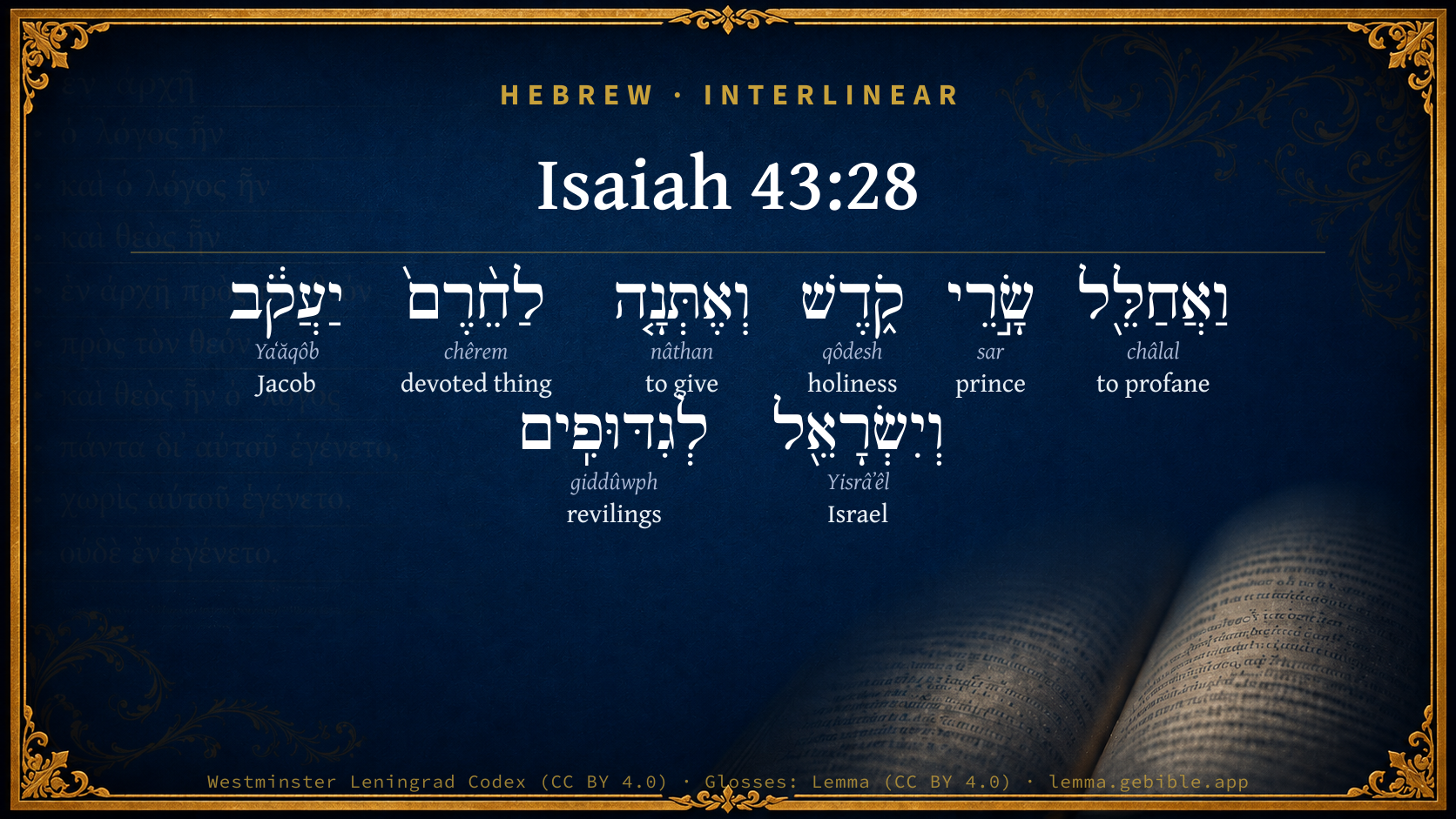
Hebrew (Westminster Leningrad Codex) Isaiah 43:28 appears in the Hebrew Old Testament. The text above is from the Westminster Leningrad Codex. Each word links to its Strong’s number, a concise gloss, and parsing drawn from the Open Scriptures Hebrew Bible morphology. Click any word for its full Brown-Driver-Briggs (BDB) entry.
Download image
Cite this verse

Isaiah 43:28 (World English Bible). Public Domain. Lemma interlinear Bible study tool, https://lemma.gebible.app/v/isaiah/43/28.

Show BibTeX & RIS
BibTeX
RIS
English Translation
Therefore I will profane the princes of the sanctuary; and I will make Jacob a curse, and Israel a reviling.
World English Bible · Public Domain
Highlights
  • 1 first appearance in the Hebrew Bible
Full analysis ↓
Download a study sheet

One document with this verse’s original text, its word-by-word gloss line, the meaning frame, cross-references with their text, attributed commentary, and full source and license credits — printable, and it pastes into notes with its structure intact.

This verse Autodidact and up

Study sheet (.html) Plain text (.txt)

A passage Seminary Student

Up to 50 verses in one chapter. A passage sheet keeps up to 6 commentary sources and 12 cross-references per verse, in the order this page ranks them, and says so on the sheet whenever that leaves anything out. Ask for a single verse and you get the Autodidact verse sheet above.

Everything on this page stays free to read, with no account — the sheet is a download of what is already on screen, not access to it.

Want to remove ads? Support Godless Engineer
Compare translations 3

The same verse in 3 English versions, stacked beneath the original-language interlinear above. Click any original word for its lexicon entry.

Each is an independent rendering of the whole verse — the interlinear is not word-aligned to these translations.

Highlighted words mark where these versions differ — a whole-verse word diff, not a word-by-word alignment.

  • World English Bible Public Domain
    Therefore I will profane the princes of the sanctuary; and I will make Jacob a curse, and Israel a reviling.
  • King James Version Public Domain
    Therefore I have profaned the princes of the sanctuary, and have given Jacob to the curse, and Israel to reproaches.
  • unfoldingWord Literal Text CC BY-SA 4.0
    So I profaned the princes of the sanctuary, and I gave Jacob to devotion and Israel to revilings.”

unfoldingWord Literal Text — © unfoldingWord, licensed CC BY-SA 4.0. Word-aligned USFM3 via Door43 (git.door43.org/unfoldingWord/en_ult).

Versions to compare (up to 4)

3 of 4 selected

Show all 18 translations

Every available English version of this verse, each an independent rendering of the whole verse.

  • World English Bible Public Domain
    Therefore I will profane the princes of the sanctuary; and I will make Jacob a curse, and Israel a reviling.
  • Berean Standard Bible Public Domain
    So I will disgrace the princes of your sanctuary, and I will devote Jacob to destruction and Israel to reproach.”
  • Majority Standard Bible Public Domain
    So I will disgrace the princes of your sanctuary, and I will devote Jacob to destruction and Israel to reproach.”
  • King James Version Public Domain
    Therefore I have profaned the princes of the sanctuary, and have given Jacob to the curse, and Israel to reproaches.
  • American Standard Version (1901) Public Domain
    Therefore I will profane the princes of the sanctuary; and I will make Jacob a curse, and Israel a reviling.
  • Revised Version (1885) Public Domain
    Therefore I will profane the princes of the sanctuary, and I will make Jacob a curse, and Israel a reviling.
  • Geneva Bible (1599) Public Domain
    Therefore I haue prophaned the rulers of the Sanctuarie, and haue made Iaakob a curse, and Israel a reproche.
  • Douay-Rheims (1899) Public Domain
    And I have profaned the holy princes, I have given Jacob to slaughter, and Israel to reproach.
  • Young's Literal Translation Public Domain
    And I pollute princes of the sanctuary, And I give Jacob to destruction, and Israel to revilings!
  • Literal Standard Version CC BY-SA 4.0
    And I defile princes of the sanctuary, || And I give Jacob to destruction, and Israel to revilings!
  • Unlocked Literal Bible CC BY-SA 4.0
    Therefore I will defile the holy officials; I will hand Jacob over to complete destruction, and Israel to abusive humiliation.”
  • unfoldingWord Literal Text CC BY-SA 4.0
    So I profaned the princes of the sanctuary, and I gave Jacob to devotion and Israel to revilings.”
  • Darby Bible Public Domain
    And I have profaned the princes of the sanctuary, and have given Jacob to the ban, and Israel to reproaches.
  • World Messianic Bible Public Domain
    Therefore I will profane the princes of the sanctuary; and I will make Jacob a curse, and Israel an insult.”
  • Webster's Bible Public Domain
    Therefore I have profaned the princes of the sanctuary, and have given Jacob to the curse, and Israel to reproaches.
  • Free Bible Version CC BY-SA 4.0
    So I treated the priests of the sanctuary with contempt, and I handed Jacob over to be destroyed, and Israel to be scorned.”
  • Bible in Basic English Public Domain
    Your chiefs have made my holy place unclean, so I have made Jacob a curse, and Israel a thing of shame.
  • JPS Tanakh (1917) Public Domain
    Therefore I have profaned the princes of the sanctuary, and I have given Jacob to condemnation, and Israel to reviling.

Literal Standard Version (2020), Covenant Press — licensed CC BY-SA 4.0. Text via the HelloAO Bible API (eBible.org). Unlocked Literal Bible (unfoldingWord) — licensed CC BY-SA 4.0. Text via the HelloAO Bible API (eBible.org). unfoldingWord Literal Text — © unfoldingWord, licensed CC BY-SA 4.0. Word-aligned USFM3 via Door43 (git.door43.org/unfoldingWord/en_ult). Free Bible Version, Dr. Jonathan Gallagher — licensed CC BY-SA 4.0. Text via the HelloAO Bible API (eBible.org).

Word by word

More ways to search: Search by grammar → Find every occurrence → Compare this word →

Practice this passage: Drill this verse → Learn its vocabulary →

About this verse

These counts appear in no published source. They are computed here, from the morphology-tagged text and Lemma’s own curated glosses. What Lemma adds →

8
words
8
distinct lemmas
Prophets
section

Notable vocabulary

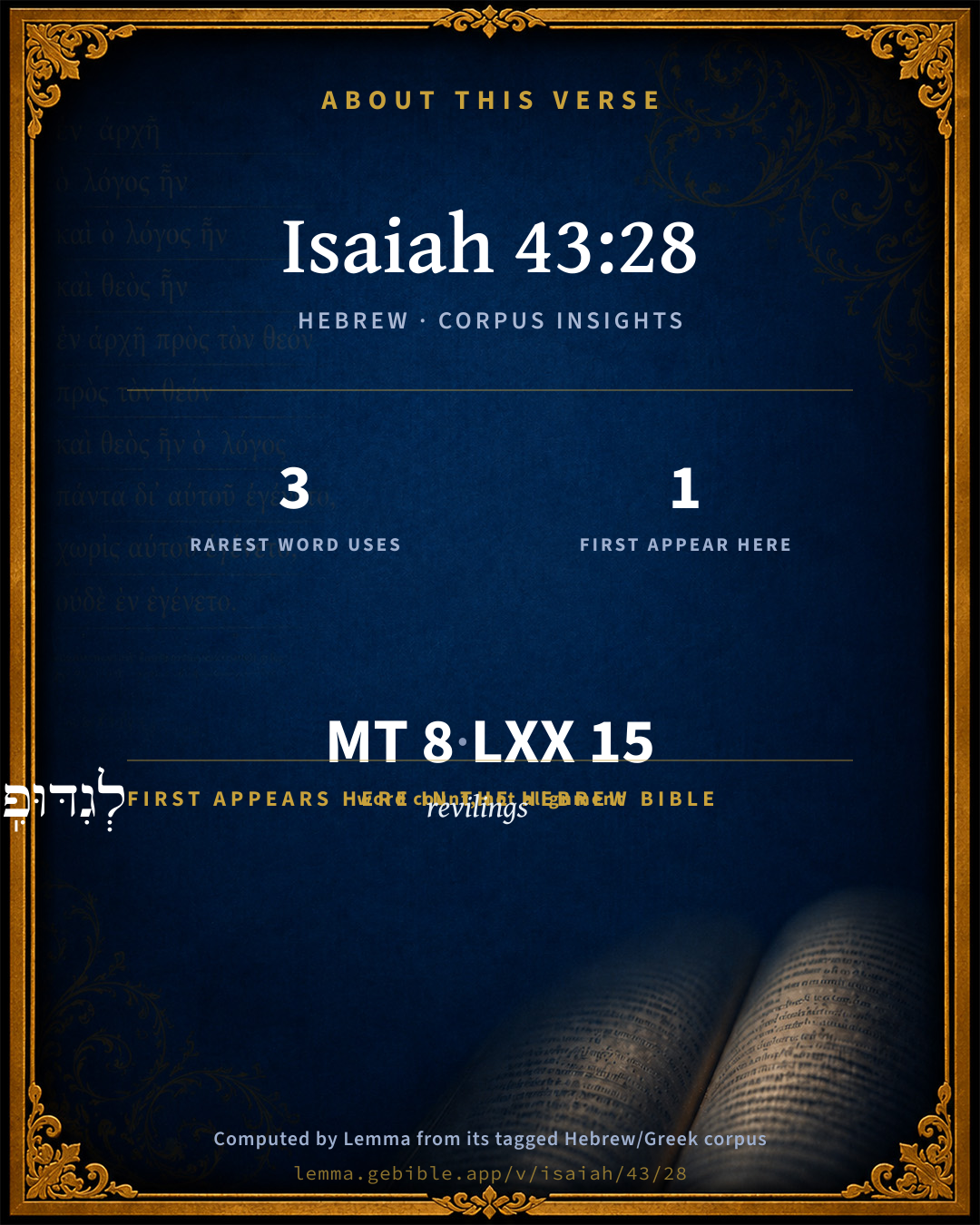
The rarest word here is לְגִדּוּפִֽים revilings H1421 — appearing just 3 times in the whole Hebrew Bible.

First appearance in Scripture

This word makes its first canonical appearance in the Hebrew Bible here:

  • לְגִדּוּפִֽים revilings H1421

Shared distinctive vocabulary

לְגִדּוּפִֽים revilings H1421 occurs in 3 verses of the Hebrew Bible. Also found in:

Grammatical profile

  • 2 verbs
  • 6 nouns

Verb forms

  • וַאֲחַלֵּ֖ל Piel · Imperfect
  • וְאֶתְּנָ֤ה Qal · Cohortative

Hebrew & Septuagint length

In English translation the verse runs 20 words from the Hebrew and 19 from the Septuagint (LXX English) — closely comparable.

A rough comparison of the two English renderings, which tokenize alike — not a word-level alignment.

Word counts can differ between the Hebrew and the Greek without any difference in meaning — e.g. the Hebrew direct-object marker אֵת has no separate Greek word, and Greek often adds the article ὁ.

In the original languages it is 8 Hebrew tokens and 15 Greek tokens — but the two are counted differently (Hebrew bundles its prefixes and suffixes into one token; the Greek is in lemma form), so that isn’t a like-for-like length.

Cross-references

18

Topical passages linked to Isaiah 43:28 in the Treasury of Scripture Knowledge — connected by theme and wording, ordered by reader-vote popularity; previews shown in the World English Bible.

  • Jeremiah 24:9 I will even give them up to be tossed back and forth among all the kingdoms of the earth for evil; to be a reproach and a proverb, a taunt and a curse, in all places where I shall drive them.
  • Isaiah 65:15 You shall leave your name for a curse to my chosen; and the Lord Yahweh will kill you; and he will call his servants by another name:
  • Zechariah 8:13 It shall come to pass that, as you were a curse among the nations, house of Judah and house of Israel, so will I save you, and you shall be a blessing. Don't be afraid. Let your hands be strong."
  • Deuteronomy 28:15–20 But it shall come to pass, if you will not listen to the voice of Yahweh your God, to observe to do all his commandments and his statutes which I command you this day, that all these curses shall come on you, and overtake you.
  • Psalms 79:4 We have become a reproach to our neighbors, A scoffing and derision to those who are around us.
  • Isaiah 47:6 I was angry with my people, I profaned my inheritance, and gave them into your hand: you did show them no mercy; on the aged have you very heavily laid your yoke.
  • Lamentations 2:2 The Lord has swallowed up all the habitations of Jacob, and has not pitied: He has thrown down in his wrath the strongholds of the daughter of Judah; He has brought them down to the ground; he has profaned the kingdom and the princes of it.
  • 1 Thessalonians 2:16 forbidding us to speak to the Gentiles that they may be saved; to fill up their sins always. But wrath has come on them to the uttermost.
  • Deuteronomy 29:21–28 Yahweh will set him apart to evil out of all the tribes of Israel, according to all the curses of the covenant that is written in this book of the law.
  • 2 Samuel 1:21 You mountains of Gilboa, Let there be no dew nor rain on you, neither fields of offerings: For there the shield of the mighty was vilely cast away, The shield of Saul, not anointed with oil.
  • Psalms 82:6–7 I said, "You are gods, All of you are sons of the Most High.
  • Psalms 89:39 You have renounced the covenant of your servant. You have defiled his crown in the dust.
  • Isaiah 42:24–25 Who gave Jacob for a spoil, and Israel to the robbers? Didn't Yahweh? he against whom we have sinned, and in whose ways they would not walk, neither were they obedient to his law.
  • Lamentations 2:6–7 He has violently taken away his tent, as if it were of a garden; he has destroyed his place of assembly: Yahweh has caused solemn assembly and Sabbath to be forgotten in Zion, Has despised in the indignation of his anger the king and the priest.
  • Lamentations 4:20 The breath of our nostrils, the anointed of Yahweh, was taken in their pits; Of whom we said, Under his shadow we shall live among the nations.
  • Ezekiel 5:15 So it shall be a reproach and a taunt, an instruction and an astonishment, to the nations that are round about you, when I shall execute judgments on you in anger and in wrath, and in wrathful rebukes; (I, Yahweh, have spoken it;)
  • Daniel 9:14 Therefore has Yahweh watched over the evil, and brought it on us; for Yahweh our God is righteous in all his works which he does, and we have not obeyed his voice.
  • Luke 21:21–24 Then let those who are in Judea flee to the mountains. Let those who are in the midst of her depart. Let those who are in the country not enter therein.

Cross-references courtesy of OpenBible.info (CC BY 4.0).

Hebrew and Greek witnesses Masoretic Hebrew ↔ Greek Septuagint

The same verse in the two great witnesses to the Old Testament, shown verse-for-verse.

These are two independent witnesses, not word-aligned to each other, and the Septuagint is shown in lemma (dictionary) form.

Hebrew Isaiah 43:28 Masoretic · Westminster Leningrad Codex

וַאֲחַלֵּ֖ל שָׂ֣רֵי קֹ֑דֶשׁ וְאֶתְּנָ֤ה לַחֵ֨רֶם֙ יַעֲקֹ֔ב וְיִשְׂרָאֵ֖ל לְגִדּוּפִֽים

Therefore I will profane the princes of the sanctuary; and I will make Jacob a curse, and Israel a reviling.

World English Bible · Public Domain

Greek LXX Isaiah 43:28 Septuagint · lemma form

καί μιαίνω ὁ ἄρχων ὁ ἅγιος ἐγώ καί δίδωμι ἀποὀλλύω ἰακώβ καί ἰσραήλ εἰς ὀνειδισμός

And the princes have defiled my sanctuaries: so I gave Jacob to enemies to destroy, and Israel to reproach.

LXX2012 (modern English Septuagint) · Public Domain

On this verse, Adam Clarke's Commentary discusses the Septuagint’s reading. Read the note in Commentary ↓

Hebrew: Westminster Leningrad Codex (CC BY 4.0). Greek: Septuagint (public domain); English from LXX2012 (modern English Septuagint) (Public Domain). How the Septuagint differs from the Hebrew →

Targum (Aramaic paraphrase)

1

The Targum is the ancient Jewish Aramaic paraphrase of the Hebrew Scriptures — an interpretive translation, not the Hebrew text itself. Onkelos (literal) and Pseudo-Jonathan (expansive) render the Torah, and Jonathan the Prophets. Coverage is partial: where no permissively-licensed English translation exists for a verse, only the Aramaic is shown. This is verse-level text, not a word-by-word alignment to the Hebrew.

  1. Targum Jonathan Prophets (Joshua–Malachi)
    וְאַפֵּיס רַבְרְבֵי קוּדְשָׁא וְאֶמְסַר לְקַטָלָא יַעֲקֹב וְיִשְׂרָאֵל לְחִסוּדִין:

    Therefore I have profaned the princes of the sanctuary, and I have delivered Jacob to the slaughter, and Israel to reproaches.”

    Targum Jonathan — Aramaic: “Mikraot Gedolot” (public domain). English: “Sefaria Community Translation” (CC0 1.0 (public-domain dedication)); “London "Chaldee Paraphrase," 1871” (public domain). Text via Sefaria.

Commentary

Notes on Isaiah 43:28 from classic Christian and Jewish commentators (each source and its license shown beneath its notes). The classic Christian expositions comment on the surrounding passage and are grouped to its opening verse, so a note may address several verses; the Jewish commentaries on the Tanakh (Rashi and others) are per-verse, so they appear only where the commentator wrote on this verse.

Lemma curates 59 commentaries, every one of them public domain or Creative Commons licensed, each selected and text-cleaned for this edition rather than reprinted as found. About our sources →

Trapp's Complete Commentary

John Trapp

Isa 43:28 Therefore I have profaned the princes of the sanctuary, and have given Jacob to the curse, and Israel to reproaches.

Ver. 28. Therefore I have profaned the princes of the sanctuary.] Or, Of holiness; that is, those that under a pretence of religion affected a kind of hierarchy, as did the scribes and Pharisees, who, with the whole Jewish state, were taken away by the Romans, both their place and their nation, as they had feared. {Joh 11:48}

John Trapp, A Commentary or Exposition upon All the Books of the Old and New Testament (1647–1656) — public domain. Text from a community e-Sword module.

The Biblical Illustrator

Joseph S. Exell

Isa_43:28

Therefore I have profaned the princes of the sanctuary

Holy princes

Then I profaned holy princes, and gave up Jacob to the ban, and Israel to revilings.

Holy princes are the hierarchs (1Ch_24:5), the highest spiritual authorities in distinction from the secular. Their profanation consisted in their being ruthlessly dragged into a foreign land, where their official work ceased of necessity. So the heads of religion fared, and the whole nation, bearing the honourable names of Jacob and Israel, fell victim to the cursing and revilings of heathen nations. (F. Delitzsch, D. D.)

.

The Biblical Illustrator, edited by Joseph S. Exell (c. 1880s–1900s) — public domain. Text from a community e-Sword module.

Geneva Bible (1599)

Geneva Bible translators

That is, rejected, abhorred, and destroyed them in the wilderness and at other times.

Geneva Bible (1599) marginal notes — public domain. Text via Bolls.life.

Jamieson, Fausset & Brown

Robert Jamieson, A. R. Fausset & David Brown

profaned the princes-- (Psa 89:39; Lam 2:2, Lam 2:6-7). I have esteemed, or treated, them as persons not sacred. I have left them to suffer the same treatment as the common people, stripped of their holy office and in captivity.

princes of the sanctuary--"governors of" it (Ch1 24:5); directing its holy services; priests.

curse--Hebrew, cherim, a "solemn anathema," or "excommunication."

reproaches-- (Psa 123:3-4).

Next: Isaiah Chapter 44

Jamieson, Fausset & Brown — Commentary Critical and Explanatory on the Whole Bible (1871) — public domain (CC PDM 1.0). Text via the HelloAO Bible API.

Adam Clarke's Commentary

Verse 28. I have profaned the princes of the sanctuary - "Thy princes have profaned my sanctuary"] Instead of ואחלל שרי vaachallel sarey, read ויחללו שריך vayechalelu sareycha. So the Syriac and Septuagint, και εμιαναν οἱ αρχοντες τα ἁγια μου, "the rulers have defiled my holy things." קדשי kodshi, Houbigant. οι αρχοντεςσου, "thy rulers," MSS. Pachom. and I. D. II. and Marchal.

To reproaches - "To reproach"] לגדופה ligeduphah, in the singular number; so an ancient MS. and the Septuagint, Syriac, and Vulgate. And, alas! what a curse do they still bear, and what reproach do they still suffer! No national crimes have ever equalled those of the Jewish nation, for no nation ever had such privileges to neglect, despise, sin against. When shall this severity of God towards this people have an end? Answ. Whenever, with one heart, they turn to him, and receive the doctrine of the Lord Jesus; and not till then.

Adam Clarke's Commentary on the Bible (1810–1826) — public domain. Text from a community e-Sword/MySword module.

Ellicott's Commentary for English Readers

(28) I have profaned the princes of the sanctuary.—Better, holy princes. The title is given to the chief priests in 1Ch_24:5. In the exile their priestly functions were in abeyance. They were practically desecrated.

The curse.—The cherem, or ban, answering to the anathema. The state described answers to that of Hos_3:4.

A Bible Commentary for English Readers, edited by Charles John Ellicott (1878–1897) — public domain. Text from a community e-Sword module.

The Cambridge Bible for Schools and Colleges

gen. ed. J. J. S. Perowne

28. Therefore I have profaned] is better than R.V. “Therefore I will profane,” although it requires the change of a vowel. The verb (like the one following) is pointed as a cohortative, and as this appears sometimes to express the idea of compulsion (see Driver, Tenses, §§ 51–53) we may perhaps venture to render: and so I had to profane.

the princes of the sanctuary] Better: consecrated princes. The priests are so named in 1Ch_24:5; it is doubtful whether here priests or kings or both are meant, the consecration by anointing being common to both.

and have given … curse] Render: and had to deliver (see on last clause) Jacob to the ban. R.V. changes the translation for the worse.

The Cambridge Bible for Schools and Colleges (gen. ed. J. J. S. Perowne; Cambridge University Press, 1878–1918) — public domain. Text from a community e-Sword module.

Albert Barnes' Notes on the Bible

Therefore I have profaned - The princes of the sanctuary, that is, the priests, were by their office regarded as sacred, or set apart to the service of God. To depose them from that office, to subject them to punishment, and to send them into captivity, was, therefore, regarded as profaning them. They were stripped of their office, and robes, and honors, and reduced to the same condition, and compelled to meet with the same treatment, as the common people. The sense is, that he had made them common (for so the word חלל châlal is used in Exo 31:14; Exo 19:22; Lev 19:8; Lev 21:9; Mal 1:12; Mal 2:2); he did not regard their office; he used them all alike.

The princes of the sanctuary - Margin, ‘Holy princes.’ It means, either those who presided over and directed the services of the sanctuary, called in 1Ch 24:5, ‘governors of the sanctuary;’ or those who were holy in office. The Septuagint renders it, Οἱ ἄρχοντες τὰ ἅγια μον Hoi archontes ta hagia mou - ‘Who preside over my holy things,’ or my sanctuary. Vulgate, Principes sanctos - ‘Holy princes.’ The Syriac, ‘Thy princes have profaned the sanctuary.’ The sense is, that God had disregarded the official character of those who were set apart to the sacred office, and had punished them in common with the people at large for their sins.

And have given Jacob to the curse - The Septuagint renders it, ‘I have given Jacob to be destroyed’ (ἀπωλέσαι apōlesai). The Hebrew word here (חרם chērem), is that which is commonly used to denote a solemn anathema, excommunication, or devotion to destruction (see the note at Isa 34:5).

To reproaches - The reproach, contempt, and scorn which they met with in their captivity, and in a land of strangers (compare Psa 137:3-4).

Thus far God states the reasons why he had punished the nation. It had been on account of the national irreligion and sins, and the destruction had come upon all, but pre-eminently on the priests and the rulers. In the arbitrary division which is made in the Bible into chapters, a very improper separation has been made by making the chapter close here. The sense of the whole passage is materially injured by this division, and the scope of the whole argument is forgotten. The design of the entire argument is, to show that God would not leave his people; that though he punished them, he would not utterly destroy them; and that he would appear again for their rescue, and restore them to their own land. This argument is prosecuted in the following chapter; and in the commencement of that chapter the thought is pursued, that though God had thus punished them, yet he would appear and save them. The beginning of that chapter is properly the continuation and completion of the argument urged here, and this chapter should have closed at what is now Isa 44:5.

Albert Barnes' Notes on the Bible (1834–1885) — public domain. Text from a community e-Sword/MySword module.

Haydock's Catholic Bible Commentary

Profaned, or declared such, (Haydock) Nadab, &c., (Leviticus x. 1.; Calmet) or Moses and Aaron. (Menochius) --- Septuagint, "and the princes defiled my holy things." (Haydock) --- Slaughter. Hebrew, "anathema." Yet I will re-establish all. (Calmet)

George Leo Haydock (1774–1849), Haydock's Catholic Family Bible and Commentary, 1859 edition — public domain. Excludes Psalms (Douay-Rheims chapter numbering differs from Protestant) and Deuterocanonical books (Catholic canon only).

Matthew Poole's English Annotations

I have profaned; as they have made themselves profane, so I have dealt with them as such, without any regard to the sacredness and dignity of their functions. I have exposed them to contempt and destruction.

The princes of the sanctuary; the highest and best of your priests, whose persons were most sacred, and therefore supposed by themselves and others to be the furthest from danger.

To the curse; to utter destruction, to which persons or things accursed were devoted, of which this Hebrew word is constantly used. To reproaches; to be the objects of their enemies’ scorn and reproaches.

Matthew Poole's English Annotations on the Holy Bible (1683–1685) — public domain. Text from a community e-Sword/MySword module.

Whedon's Commentary on the Bible

Daniel D. Whedon

28. Therefore I have profaned — Have esteemed less than sacred.

The princes of the sanctuary — Because of the stains upon them. Your princes in themselves are of little honour to you. The so-called least sin is my abhorrence. It is such in the gross as sends Jacob to the curse. The curse of exile becomes a solemn anathema.

Israel to reproaches — That is, such as are endured in exile life.

Daniel D. Whedon (gen. ed.), Commentary on the Old and New Testaments (1874–1909) — public domain. Text from a community e-Sword module.

The Pulpit Commentary

Therefore I have profaned the princes of the sanctuary. The "princes of the sanctuary" (literally, "princes of holiness") are the principal members of the priesthood, who were carried into captivity with the rest of the people, (2Ki_25:18) and deprived of their functions, as a part of the punishment due to Israel for its sins. Israel itself was at the same time given to the curse of a severe bondage and to the reproaches of the neighboring nation.

The Pulpit Commentary (1880–1919), ed. H.D.M. Spence-Jones & Joseph S. Exell — public domain. Text from a community e-Sword module.

John Wesley's Explanatory Notes

Therefore - I have exposed them to contempt and destruction. Princes - The highest and best of your priests. Curse - To utter destruction, to which persons or things accursed were devoted.

John Wesley, Explanatory Notes Upon the Whole Bible (1754–1765) — public domain. Text via the GEBible commentary corpus.

Keil & Delitzsch

C. F. Keil & F. Delitzsch

Consequently the all-holy One was obliged to do what had taken place. "Then I profaned holy princes, and gave up Jacob to the curse, and Israel to blasphemies." ואחלל might be an imperfect, like ואכל, "I ate," in Isa 44:19, and ואבּיט, "I looked," in Isa 63:5; but ואתּנה by the side of it shows that the pointing sprang out of the future interpretation contained in the Targum; so that as the latter is to be rejected, we must substitute ואחלל, ואתּנה (Ges. 49, 2). The "holy princes" (sârē qōdesh) are the hierarchs, as in Ch1 24:5, the supreme spiritual rulers as distinguished from the temporal rulers. The profanation referred to was the fact that they were ruthlessly hurried off into a strange land, where their official labours were necessarily suspended. This was the fate of the leaders of the worship; and the whole nation, which bore the honourable names of Jacob and Israel, was give up to the ban (chērem) and the blasphemies (giddūphı̄m) of the nations of the world.

Keil & Delitzsch — Biblical Commentary on the Old Testament (1861–1891) — public domain (CC PDM 1.0). Text via the HelloAO Bible API. (Old Testament only.)

J. A. Alexander on Isaiah

Joseph Addison Alexander

“And I will profane the holy chiefs, and will give up Jacob to the curse and Israel to reproaches.” The character just given of the people in all ages is urged not only as a proof that God’s compassion must be perfectly gratuitous, but also as a reason for the strokes which they experienced. This last phrase is descriptive of the same persons called interpreters in v. 27, namely, all the official representatives and leaders of the holy (i.e., consecrated and peculiar) people.

Joseph Addison Alexander, The Prophecies of Isaiah (1846–1847; New York: Scribner, 1870–1878) — public domain. Text from a community e-Sword module.

Rashi

Rabbi Shlomo Yitzchaki (Rashi)

And I profane the holy princes because of your iniquities.

Rashi on the Tanakh — English translations: “The Judaica Press complete Tanach with Rashi, translated by A. J. Rosenberg” (CC BY 4.0); “Pentateuch with Rashi's commentary by M. Rosenbaum and A.M. Silbermann, 1929-1934” (public domain); “The Metsudah Tanach series, Lakewood, N.J” (CC BY 4.0); and “The Book of Joshua, Metsudah Publications, 1997” (CC BY 4.0). Text via Sefaria.

Ibn Ezra

Rabbi Abraham ibn Ezra

The princes of the sanctuary. The priests; comp. 1 Chron. 24:5

Yet now hear, etc. This evil I have brought upon thee for thy wickedness,

Ibn Ezra on the Tanakh — English translations: “Sefaria Community Translation” (CC0 1.0 (public-domain dedication)); “Yalkut, Sifsei Chachomim Chumash, Metsudah Publications, 2009” (CC BY 4.0); and “Commentary of Ibn Ezra on Isaiah - trans. by M. Friedlander, 1873” (public domain). Text via Sefaria.

Lesson kit

Teaching starters — assembled from the data on this page, not authored interpretation. Every prompt links to the verse data it draws on. Edit before teaching.

Isaiah, in the Prophets, opens this verse with 8 words (8 distinct Hebrew lemmas). Its most distinctive word is giddûwph (“revilings”). A historical commentator’s framing appears above. Read the whole chapter for the surrounding context.

Discussion questions

  1. The word giddûwph carries the sense “revilings.” How does it shape the verse?
  2. The word “revilings” first appears here in Scripture. What is being introduced at this debut?
  3. Isaiah 51:7 shares the word «revilings» with this verse. How do the two illuminate each other?
  4. These translations render this verse differently. What is at stake in choosing one wording over another?
  5. The verb «וַאֲחַלֵּ֖ל» is Piel Imperfect. How does its form color the action?
  6. Reading how Trapp's Complete Commentary and The Biblical Illustrator read this verse, where do the two commentators agree and where do they part?

Things to notice

Reading settings

Reading text

Shown beneath each verse's original-language words.

Old Testament
Old Testament edition

Read the OT as the Masoretic Hebrew (MT) or the Greek Septuagint (LXX).

English shown for the Greek Septuagint (in the Hebrew ↔ Greek comparison).

Comparing translations? Open the Compare panel on any verse page to stack up to four side by side.