
Ezekiel 7:24

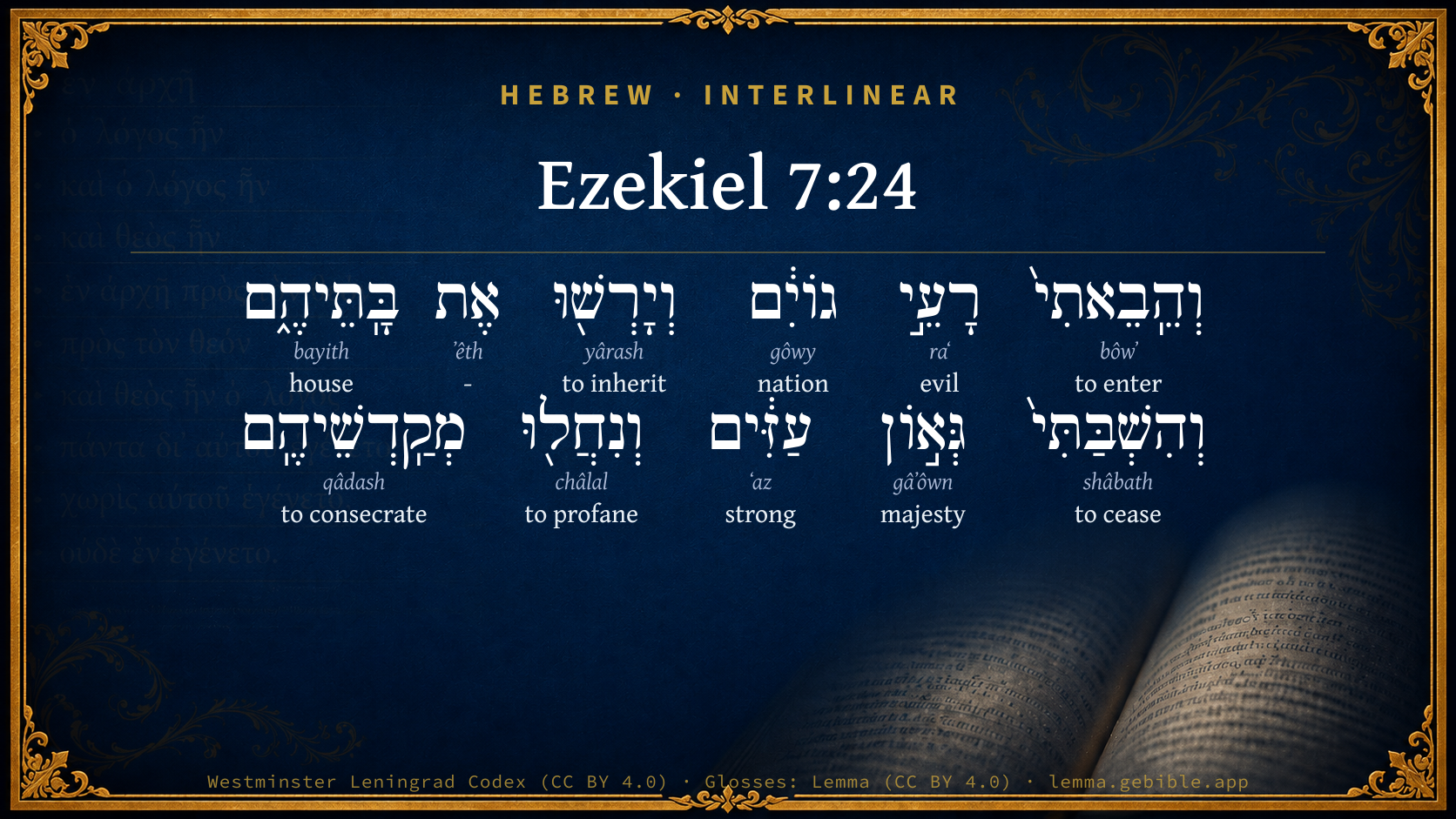
Hebrew (Westminster Leningrad Codex) Ezekiel 7:24 appears in the Hebrew Old Testament. The text above is from the Westminster Leningrad Codex. Each word links to its Strong’s number, a concise gloss, and parsing drawn from the Open Scriptures Hebrew Bible morphology. Click any word for its full Brown-Driver-Briggs (BDB) entry.
Download image
Cite this verse

Ezekiel 7:24 (World English Bible). Public Domain. Lemma interlinear Bible study tool, https://lemma.gebible.app/v/ezekiel/7/24.

Show BibTeX & RIS
BibTeX
RIS
English Translation
Therefore I will bring the worst of the nations, and they shall possess their houses: I will also make the pride of the strong to cease; and their holy places shall be profaned.
World English Bible · Public Domain
Download a study sheet

One document with this verse’s original text, its word-by-word gloss line, the meaning frame, cross-references with their text, attributed commentary, and full source and license credits — printable, and it pastes into notes with its structure intact.

This verse Autodidact and up

Study sheet (.html) Plain text (.txt)

A passage Seminary Student

Up to 50 verses in one chapter. A passage sheet keeps up to 6 commentary sources and 12 cross-references per verse, in the order this page ranks them, and says so on the sheet whenever that leaves anything out. Ask for a single verse and you get the Autodidact verse sheet above.

Everything on this page stays free to read, with no account — the sheet is a download of what is already on screen, not access to it.

Want to remove ads? Support Godless Engineer
Compare translations 3

The same verse in 3 English versions, stacked beneath the original-language interlinear above. Click any original word for its lexicon entry.

Each is an independent rendering of the whole verse — the interlinear is not word-aligned to these translations.

Highlighted words mark where these versions differ — a whole-verse word diff, not a word-by-word alignment.

  • World English Bible Public Domain
    Therefore I will bring the worst of the nations, and they shall possess their houses: I will also make the pride of the strong to cease; and their holy places shall be profaned.
  • King James Version Public Domain
    Wherefore I will bring the worst of the heathen, and they shall possess their houses: I will also make the pomp of the strong to cease; and their holy places shall be defiled.
  • unfoldingWord Literal Text CC BY-SA 4.0
    So I will bring the most wicked of the nations, and they will possess their houses, and I will bring an end to the pride of the mighty, for their holy places will be defiled!

unfoldingWord Literal Text — © unfoldingWord, licensed CC BY-SA 4.0. Word-aligned USFM3 via Door43 (git.door43.org/unfoldingWord/en_ult).

Versions to compare (up to 4)

3 of 4 selected

Show all 18 translations

Every available English version of this verse, each an independent rendering of the whole verse.

  • World English Bible Public Domain
    Therefore I will bring the worst of the nations, and they shall possess their houses: I will also make the pride of the strong to cease; and their holy places shall be profaned.
  • Berean Standard Bible Public Domain
    So I will bring the most wicked of nations to take possession of their houses. I will end the pride of the mighty, and their holy places will be profaned.
  • Majority Standard Bible Public Domain
    So I will bring the most wicked of nations to take possession of their houses. I will end the pride of the mighty, and their holy places will be profaned.
  • King James Version Public Domain
    Wherefore I will bring the worst of the heathen, and they shall possess their houses: I will also make the pomp of the strong to cease; and their holy places shall be defiled.
  • American Standard Version (1901) Public Domain
    Wherefore I will bring the worst of the nations, and they shall possess their houses: I will also make the pride of the strong to cease; and their holy places shall be profaned.
  • Revised Version (1885) Public Domain
    Wherefore I will bring the worst of the heathen, and they shall possess their houses: I will also make the pride of the strong to cease; and their holy places shall be profaned.
  • Geneva Bible (1599) Public Domain
    Wherefore I will bring the most wicked of the heathen, and they shall possesse their houses: I will also make the pompe of the mightie to cease, and their holie places shalbe defiled.
  • Douay-Rheims (1899) Public Domain
    And I will bring the worse of the nations, and they shall possess their houses: and I will make the pride of the mighty to cease, and they shall possess their sanctuary.
  • Young's Literal Translation Public Domain
    And I have brought in the wicked of the nations, And they have possessed their houses, And I have caused to cease the excellency of the strong, And polluted have been those sanctifying them.
  • Literal Standard Version CC BY-SA 4.0
    And I have brought in the wicked of the nations, || And they have possessed their houses, || And I have caused the excellence of the strong to cease, || And those sanctifying them have been defiled.
  • Unlocked Literal Bible CC BY-SA 4.0
    So I will bring the most wicked of the nations, and they will possess their houses, and I will bring an end to the pride of the mighty, for their holy places will be defiled!
  • unfoldingWord Literal Text CC BY-SA 4.0
    So I will bring the most wicked of the nations, and they will possess their houses, and I will bring an end to the pride of the mighty, for their holy places will be defiled!
  • Darby Bible Public Domain
    Therefore will I bring the worst of the nations, and they shall possess their houses; and I will make the pride of the strong to cease; and their sanctuaries shall be profaned.
  • World Messianic Bible Public Domain
    Therefore I will bring the worst of the nations, and they will possess their houses. I will also make the pride of the strong to cease. Their holy places will be profaned.
  • Webster's Bible Public Domain
    Wherefore I will bring the worst of the heathen, and they shall possess their houses: I will also make the pomp of the strong to cease, and their holy places shall be defiled.
  • Free Bible Version CC BY-SA 4.0
    So I'm going to bring the most evil of all the nations to take over their houses. I will put an end to the pride of the powerful, and their holy places will be made unclean.
  • Bible in Basic English Public Domain
    For this reason I will send the worst of the nations and they will take their houses for themselves: I will make the pride of their strength come to an end; and their holy places will be made unclean.
  • JPS Tanakh (1917) Public Domain
    Wherefore I will bring the worst of the nations, and they shall possess their houses; I will also make the pride of the strong to cease; and their holy places shall be profaned.

Literal Standard Version (2020), Covenant Press — licensed CC BY-SA 4.0. Text via the HelloAO Bible API (eBible.org). Unlocked Literal Bible (unfoldingWord) — licensed CC BY-SA 4.0. Text via the HelloAO Bible API (eBible.org). unfoldingWord Literal Text — © unfoldingWord, licensed CC BY-SA 4.0. Word-aligned USFM3 via Door43 (git.door43.org/unfoldingWord/en_ult). Free Bible Version, Dr. Jonathan Gallagher — licensed CC BY-SA 4.0. Text via the HelloAO Bible API (eBible.org).

Word by word

More ways to search: Search by grammar → Find every occurrence → Compare this word →

Practice this passage: Drill this verse → Learn its vocabulary →

עַזִּ֔ים
ʻaz
H5794
“strong”
Adjective, Adjective, Masculine, Plural, Absolute
Part of Speech
Adjective
Type
Adjective
Gender
Masculine
Number
Plural
State
Absolute
Full BDB Definition

Origin: from H5810

TWOT: 1596a

strong, mighty, fierce
  1. וְהֵֽבֵאתִי֙ bôwʼ H935 “and · to enter” Conjunction + Verb, Hiphil, Sequential Perfect, 1st Person, Common, Singular
  2. רָעֵ֣י raʻ H7451 “evil of” Adjective, Adjective, Masculine, Plural, Construct
  3. גוֹיִ֔ם gôwy H1471 “nations” Noun, Common, Masculine, Plural, Absolute
  4. וְיָרְשׁ֖וּ yârash H3423 “and · to inherit” Conjunction + Verb, Qal, Sequential Perfect, 3rd Person, Common, Plural
  5. אֶת ʼêth H853 “-” Particle, Direct Object
  6. בָּֽתֵּיהֶ֑ם bayith H1004 “houses · their” Noun, Common, Masculine, Plural, Construct + Suffix, Personal, 3rd Person, Masculine, Plural
  7. וְהִשְׁבַּתִּי֙ shâbath H7673 “and · to cease” Conjunction + Verb, Hiphil, Sequential Perfect, 1st Person, Common, Singular
  8. גְּא֣וֹן gâʼôwn H1347 “majesty of” Noun, Common, Masculine, Singular, Construct
  9. וְנִחֲל֖וּ châlal H2490 “and · to profane” Conjunction + Verb, Niphal, Sequential Perfect, 3rd Person, Common, Plural
  10. מְקַֽדְשֵׁיהֶֽם qâdash H6942 “consecrated ones · their” Noun, Common, Masculine, Plural, Construct + Suffix, Personal, 3rd Person, Masculine, Plural

About this verse

These counts appear in no published source. They are computed here, from the morphology-tagged text and Lemma’s own curated glosses. What Lemma adds →

11
words
11
distinct lemmas
Prophets
section

Notable vocabulary

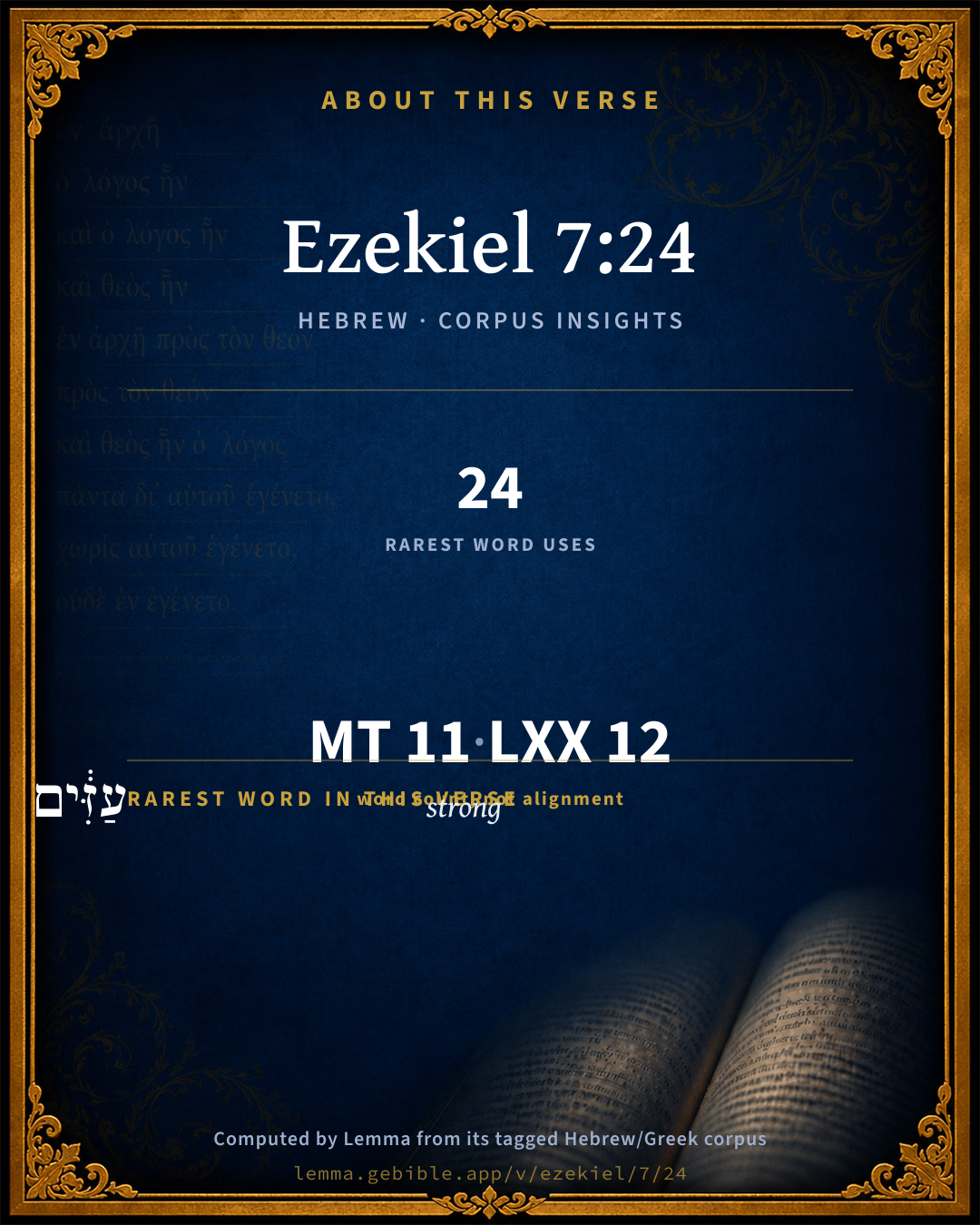
The rarest word here is עַזִּ֔ים strong H5794 — appearing just 24 times in the whole Hebrew Bible.

Shared distinctive vocabulary

עַזִּ֔ים strong H5794 occurs in 24 verses of the Hebrew Bible. Also found in:

Grammatical profile

  • 4 verbs
  • 4 nouns
  • 2 adjectives
  • 1 particle

Verb forms

  • וְהֵֽבֵאתִי֙ Hiphil · Sequential Perfect
  • וְיָרְשׁ֖וּ Qal · Sequential Perfect
  • וְהִשְׁבַּתִּי֙ Hiphil · Sequential Perfect
  • וְנִחֲל֖וּ Niphal · Sequential Perfect

Hebrew & Septuagint length

In English translation the verse runs 33 words from the Hebrew and 17 from the Septuagint (LXX English) — the Septuagint runs noticeably shorter here. See the side-by-side →

A rough comparison of the two English renderings, which tokenize alike — not a word-level alignment.

Word counts can differ between the Hebrew and the Greek without any difference in meaning — e.g. the Hebrew direct-object marker אֵת has no separate Greek word, and Greek often adds the article ὁ.

In the original languages it is 11 Hebrew tokens and 12 Greek tokens — but the two are counted differently (Hebrew bundles its prefixes and suffixes into one token; the Greek is in lemma form), so that isn’t a like-for-like length.

Cross-references

14

Topical passages linked to Ezekiel 7:24 in the Treasury of Scripture Knowledge — connected by theme and wording, ordered by reader-vote popularity; previews shown in the World English Bible.

  • Ezekiel 28:7 therefore, behold, I will bring strangers on you, the terrible of the nations; and they shall draw their swords against the beauty of your wisdom, and they shall defile your brightness.
  • Psalms 106:41 He gave them into the hand of the nations. Those who hated them ruled over them.
  • Ezekiel 21:31 I will pour out my indignation on you; I will blow on you with the fire of my wrath; and I will deliver you into the hand of brutish men, skillful to destroy.
  • Ezekiel 33:28 I will make the land a desolation and an astonishment; and the pride of her power shall cease; and the mountains of Israel shall be desolate, so that none shall pass through.
  • 2 Chronicles 7:19–20 But if you turn away, and forsake my statutes and my commandments which I have set before you, and shall go and serve other gods, and worship them;
  • Psalms 83:12 Who said, "Let us take possession Of God's pasturelands."
  • Isaiah 5:14 Therefore Sheol has enlarged its desire, And opened its mouth without measure; And their glory, their multitude, their pomp, and he who rejoices among them, descend into it.
  • Jeremiah 4:7 A lion is gone up from his thicket, and a destroyer of nations; he is on his way, he is gone forth from his place, to make your land desolate, that your cities be laid waste, without inhabitant.
  • Jeremiah 6:12 Their houses shall be turned to others, their fields and their wives together; for I will stretch out my hand on the inhabitants of the land, says Yahweh.
  • Jeremiah 12:12 Destroyers are come on all the bare heights in the wilderness; for the sword of Yahweh devours from the one end of the land even to the other end of the land: no flesh has peace.
  • Lamentations 5:2 Our inheritance is turned to strangers, Our houses to aliens.
  • Ezekiel 21:2 Son of man, set your face toward Jerusalem, and drop [your word] toward the sanctuaries, and prophesy against the land of Israel;
  • Ezekiel 24:21 Speak to the house of Israel, Thus says the Lord Yahweh: Behold, I will profane my sanctuary, the pride of your power, the desire of your eyes, and that which your soul pities; and your sons and your daughters whom you have left behind shall fall by the sword.
  • Habakkuk 1:6–10 For, behold, I raise up the Chaldeans, that bitter and hasty nation, that march through the breadth of the earth, to possess dwelling places that are not theirs.

Cross-references courtesy of OpenBible.info (CC BY 4.0).

Hebrew and Greek witnesses Masoretic Hebrew ↔ Greek Septuagint

The same verse in the two great witnesses to the Old Testament, shown verse-for-verse.

Here the Septuagint runs noticeably shorter than the Hebrew — LXX2012 (modern English Septuagint) 17 words vs World English Bible 33. A rough length comparison of the two English translations, not a word-level alignment — read both below.

These are two independent witnesses, not word-aligned to each other, and the Septuagint is shown in lemma (dictionary) form.

Hebrew Ezekiel 7:24 Masoretic · Westminster Leningrad Codex

וְהֵֽבֵאתִי֙ רָעֵ֣י גוֹיִ֔ם וְיָרְשׁ֖וּ אֶת בָּֽתֵּיהֶ֑ם וְהִשְׁבַּתִּי֙ גְּא֣וֹן עַזִּ֔ים וְנִחֲל֖וּ מְקַֽדְשֵׁיהֶֽם

Therefore I will bring the worst of the nations, and they shall possess their houses: I will also make the pride of the strong to cease; and their holy places shall be profaned.

World English Bible · Public Domain

Greek LXX Ezekiel 7:24 Septuagint · lemma form

καί ἀποστρέφω ὁ φρύαγμα ὁ ἰσχύς αὐτός καί μιαίνω ὁ ἅγιος αὐτός

And I will turn back the boasting of their strength; and their holy things shall be defiled.

LXX2012 (modern English Septuagint) · Public Domain

On this verse, The Cambridge Bible for Schools and Colleges discusses the Septuagint’s reading. Read the note in Commentary ↓

Hebrew: Westminster Leningrad Codex (CC BY 4.0). Greek: Septuagint (public domain); English from LXX2012 (modern English Septuagint) (Public Domain). How the Septuagint differs from the Hebrew →

Targum (Aramaic paraphrase)

1

The Targum is the ancient Jewish Aramaic paraphrase of the Hebrew Scriptures — an interpretive translation, not the Hebrew text itself. Onkelos (literal) and Pseudo-Jonathan (expansive) render the Torah, and Jonathan the Prophets. Coverage is partial: where no permissively-licensed English translation exists for a verse, only the Aramaic is shown. This is verse-level text, not a word-by-word alignment to the Hebrew.

  1. Targum Jonathan Prophets (Joshua–Malachi)
    וְאַיְתֵי מַבְאִשֵׁי עַמְמַיָא וְיַחְסְנוּן יַת בָּתֵּיהוֹן וַאֲבַטֵיל רְבוּת רַשִׁיעִין וְיִתָּחֲלוּן מִקְדָשֵׁיהוֹן:

    (no public-domain English translation for this verse)

    Targum Jonathan — Aramaic: “Mikraot Gedolot” (public domain). English: “Sefaria Community Translation” (CC0 1.0 (public-domain dedication)); “London "Chaldee Paraphrase," 1871” (public domain). Text via Sefaria.

Commentary

Notes on Ezekiel 7:24 from classic Christian and Jewish commentators (each source and its license shown beneath its notes). The classic Christian expositions comment on the surrounding passage and are grouped to its opening verse, so a note may address several verses; the Jewish commentaries on the Tanakh (Rashi and others) are per-verse, so they appear only where the commentator wrote on this verse.

Lemma curates 59 commentaries, every one of them public domain or Creative Commons licensed, each selected and text-cleaned for this edition rather than reprinted as found. About our sources →

Trapp's Complete Commentary

John Trapp

Eze 7:24 Wherefore I will bring the worst of the heathen, and they shall possess their houses: I will also make the pomp of the strong to cease; and their holy places shall be defiled.

Ver. 24. Wherefore I will bring the worst of the heathen.] Velut carnifices; who may plunder you to the life, and take away your lives. {Hab 1:6-7; Hab 1:9} The Jews were bad enough, but the Chaldees were worse, if worse might be; malignants above measure, Poneropolitans, breathing devils. A hard knot must have a harder wedge, as the proverb is.

I will also make the pomp of the strong to cease.] I will crush the crests of those potentates, and lay them low. See Isa 14:11-12.

Their holy places shall be defiled.] Sacella et lararia eorum; their chapels or oratories made in or near unto their houses for divine worship.

John Trapp, A Commentary or Exposition upon All the Books of the Old and New Testament (1647–1656) — public domain. Text from a community e-Sword module.

Geneva Bible (1599)

Geneva Bible translators

Which was the Temple that was divided into three parts, Ps. 63:35.

Geneva Bible (1599) marginal notes — public domain. Text via Bolls.life.

Jamieson, Fausset & Brown

Robert Jamieson, A. R. Fausset & David Brown

worst of the heathen--literally, "wicked of the nations"; the giving up of Israel to their power will convince the Jews that this is a final overthrow.

pomp of . . . strong--the pride wherewith men "stiff of forehead" despise the prophet.

holy places--the sacred compartments of the temple (Psa 68:35; Jer 51:51) [CALVIN]. God calls it "their holy places," because they had so defiled it that He regarded it no longer as His. However, as the defilement of the temple has already been mentioned (Eze 7:20, Eze 7:22), and "their sacred places" are introduced as a new subject, it seems better to understand this of the places dedicated to their idols. As they defiled God's sanctuary, He will defile their self-constituted "sacred places."

Jamieson, Fausset & Brown — Commentary Critical and Explanatory on the Whole Bible (1871) — public domain (CC PDM 1.0). Text via the HelloAO Bible API.

Adam Clarke's Commentary

Verse 24. The worst of the heathen] The Chaldeans; the most cruel and idolatrous of all nations.

Adam Clarke's Commentary on the Bible (1810–1826) — public domain. Text from a community e-Sword/MySword module.

John Calvin's Commentaries

He repeats what he had said, that enemies would come who should be ministers of God’s vengeance. And again we learn from this place, that even the impious are impelled by the hand and secret direction of God, so that they cannot move a finger but by his will. He had formerly said that he would give the Jews into the hands of strangers; but what now? I will cause them to come, says he, as if he would stretch out his hand to them, and induce them. We see, therefore, that God holds the impious under his guidance, as it were, for executing his judgments; but we must consider the difference which I have lately laid down; for God so works by them, as still to have nothing in common with them. For they are carried on by a depraved impulse; but God has a method, wonderful and incomprehensible by us, which impels them hither and thither, so that he does not involve himself in any alliance with their fault. For he calls them the perverse nation, that the Jews might know that the last slaughter was approaching, since they should have to do with the most cruel enemies. He says, shall possess their homes, and because the pride of the people might seem an obstacle to God’s exacting the deserved penalty, therefore he adds, I will make the pride of the powerful to cease, says he; for as long as the Jews were swollen with haughtiness and self-confidence, the Prophet could not profit them at all. Therefore he says, that God would make their haughtiness to cease, by which they were vainly puffed up as long as God sustained or bore with them. At length he adds, their sanctuaries shall be polluted This passage confirms the opinion which I formerly approved. For Ezekiel speaks of the pollution of the sanctuary as of a new thing. For he here draws away from them the vain hope by which they deceived themselves, when they boasted that they dwelt under God’s guardianship, since the temple protected themselves and the city. Jeremiah reproves them for trusting in lying words, while they declare that they have the Lord’s temple —

“The temple of the Lord, The temple of the Lord.” (Jeremiah 7:4.)

Our Prophet does not speak openly, but he doubtless shows that their security was false, while they oppose the temple to God, as if the temple were a shield to repel his vengeance. God, indeed, dwelt in the temple, but this condition was added, that he was to be purely worshipped there. But when the temple was polluted, God departed from it, as we shall afterwards see. For this reason the Prophet says, the enemies should come who should pollute and contaminate the holy places of the people Hitherto he had not spoken of the temple, but he now adds, the temple, that the Jews should not rashly boast in the name of God, as if they held him fixed to themselves. It follows —

John Calvin's Commentaries (1540-1563) — public domain. Text from the Calvin Translation Society English edition (1840s-50s) via the Christian Classics Ethereal Library (ccel.org). Calvin's coverage is partial (roughly two-thirds of the Bible); uncommented books and verses are honest gaps, never fabricated. The 19th-century editor's footnotes and remarks are omitted so the notes are faithfully Calvin's own voice.

Ellicott's Commentary for English Readers

(24) Worst of the heathen.—Worst refers to the power and thoroughness of their work against the Israelites. (Comp. Deu_28:49-50; also Lev_26:19, where the word here rendered “pomp of the strong” is translated “pride of power.”) Both passages are the warnings, long ages ago, of the judgments now declared to be close at hand. “Their holy places;” no longer God’s, since He has abandoned them for the sin of the people. (See Eze_11:23.)

A Bible Commentary for English Readers, edited by Charles John Ellicott (1878–1897) — public domain. Text from a community e-Sword module.

The Cambridge Bible for Schools and Colleges

gen. ed. J. J. S. Perowne

24. worst of the heathen] Cf. Eze_28:7, Eze_30:11 the terrible of the nations. Jer_6:23; Hab_1:7.

the pomp of the strong] Or, pride. In Eze_24:21 the pride of their strength, and so LXX. here. Cf. Eze_33:28; Lev_26:19. The spelling of “sanctuaries” is an Aramaism.

The Cambridge Bible for Schools and Colleges (gen. ed. J. J. S. Perowne; Cambridge University Press, 1878–1918) — public domain. Text from a community e-Sword module.

John Gill's Exposition

Destruction cometh,.... Upon the temple, city, nation, and people; the king of Babylon, the destroyer of the Gentiles, and now of the Jews, being on his way, Jer 4:7;

and they shall seek peace, and there shall be none; that is, the Jews will seek to make peace with the Chaldeans; but the latter will not hearken to them, but go on with the siege, till they have taken the city, put part to the sword, and carried the other captive.

John Gill's Exposition of the Whole Bible (1746–1763) — public domain (CC PDM 1.0). Text via the HelloAO Bible API.

Albert Barnes' Notes on the Bible

The worst of the pagan - The most cruel and terrible of nations - the Chaldaeans.

The pomp of the strong - Compare Lev 26:19 “The strong” are those who pride themselves in imaginary strength.

Their holy places - What elsewhere is called “God’s Holy place” is here “their holy places,” because God disowns the profaned sanctuary. In the marginal rendering “they” must mean “the worst of the pagan.”

Albert Barnes' Notes on the Bible (1834–1885) — public domain. Text from a community e-Sword/MySword module.

Haydock's Catholic Bible Commentary

Sanctuary; the temple of God, or of idols, chap. vi. 3.

George Leo Haydock (1774–1849), Haydock's Catholic Family Bible and Commentary, 1859 edition — public domain. Excludes Psalms (Douay-Rheims chapter numbering differs from Protestant) and Deuterocanonical books (Catholic canon only).

Matthew Poole's English Annotations

The worst; the most violent, proud, and bloody men; such the Chaldeans showed themselves.

Possess; not only dwell in their houses, but by right of conquest account them their own, and descending to theirs after them.

The pomp; the excellency, magnificence, and glory, whatever they boasted of; either literally, the pride, or figuratively, the temple that the Jews gloried in.

Of the strong; of the Jews, who thought Jerusalem too well fortified by art and nature, and the Divine presence, it being the city of God, ever to be overthrown.

Their holy places; all that pertains to their religion, and exercise of it, persons. places, things, which now by their abuse of them are theirs, not mine, shall be polluted.

Matthew Poole's English Annotations on the Holy Bible (1683–1685) — public domain. Text from a community e-Sword/MySword module.

Whedon's Commentary on the Bible

Daniel D. Whedon

24. The worst of the heathen — Compare Eze_28:7; Eze_30:11. Jeremiah had said (Jer_6:23) the Chaldeans “are cruel, and have no mercy,” and Habakkuk (Hab_1:7), “they are terrible and dreadful.” These Chaldeans shall take possession of the palaces and holy places of the Israelitish nobles, and “the pride of their strength shall cease.”

Daniel D. Whedon (gen. ed.), Commentary on the Old and New Testaments (1874–1909) — public domain. Text from a community e-Sword module.

The Pulpit Commentary

The worst of the heathen; literally, evil ones of the nations with the superlative implied rather than expressed. For the thought, Deu_28:50; Lam_5:11-13; Jer_6:23. The Chaldeans were probably most prominent in the prophet"s thoughts, but Eze_35:5 and Psa_137:7 suggest that there was a side glance at the Edomites. The pomp of the strong, etc. Another echo of Lev_26:31. The "pomp" is that of Judah trusting in her strength. The "holy places" find their chief representative in the temple, but, as the word is used also of a non-Jehovistic worship, (Amo_7:9) may include whatever the people looked on as sanctuaries the "high places" and the like. The Vulgate gives possidebuut sanctuaria; the Revised Version margin, they that sanctify them; but the Authorized Version is probably right in both cases. Luther renders ihre kirchen, which reminds us of Act_19:37.

The Pulpit Commentary (1880–1919), ed. H.D.M. Spence-Jones & Joseph S. Exell — public domain. Text from a community e-Sword module.

John Wesley's Explanatory Notes

The pomp - The magnificence and glory, wherein they boasted; or the temple that the Jews gloried in.

John Wesley, Explanatory Notes Upon the Whole Bible (1754–1765) — public domain. Text via the GEBible commentary corpus.

Rashi

Rabbi Shlomo Yitzchaki (Rashi)

the most wicked of the nations Heb. רָעֵי גוֹיִם. The most wicked and cruel of the nations.

and they will deliver as an inheritance Heb. וְנִחֲלוּ, they will give over to others as an inheritance.

their meeting places Heb. מְקַדְשֵׁיהֶם. The temples of the high places, where they would gather at appointed times; an expression of a house of their appointment.

Rashi on the Tanakh — English translations: “The Judaica Press complete Tanach with Rashi, translated by A. J. Rosenberg” (CC BY 4.0); “Pentateuch with Rashi's commentary by M. Rosenbaum and A.M. Silbermann, 1929-1934” (public domain); “The Metsudah Tanach series, Lakewood, N.J” (CC BY 4.0); and “The Book of Joshua, Metsudah Publications, 1997” (CC BY 4.0). Text via Sefaria.

Lesson kit

Teaching starters — assembled from the data on this page, not authored interpretation. Every prompt links to the verse data it draws on. Edit before teaching.

Ezekiel, in the Prophets, opens this verse with 11 words (11 distinct Hebrew lemmas). Its most distinctive word is ʻaz (“strong”). The Greek Septuagint runs shorter here. A historical commentator’s framing appears above. Read the whole chapter for the surrounding context.

Discussion questions

  1. The word ʻaz carries the sense “strong.” How does it shape the verse?
  2. Genesis 49:3 shares the word «strong» with this verse. How do the two illuminate each other?
  3. Compared with the Hebrew, the Septuagint runs shorter here. What questions does that raise?
  4. These translations render this verse differently. What is at stake in choosing one wording over another?
  5. The verb «וְהֵֽבֵאתִי֙» is Hiphil Sequential Perfect. How does its form color the action?
  6. Reading how Trapp's Complete Commentary and Geneva Bible (1599) read this verse, where do the two commentators agree and where do they part?

Things to notice

Reading settings

Reading text

Shown beneath each verse's original-language words.

Old Testament
Old Testament edition

Read the OT as the Masoretic Hebrew (MT) or the Greek Septuagint (LXX).

English shown for the Greek Septuagint (in the Hebrew ↔ Greek comparison).

Comparing translations? Open the Compare panel on any verse page to stack up to four side by side.