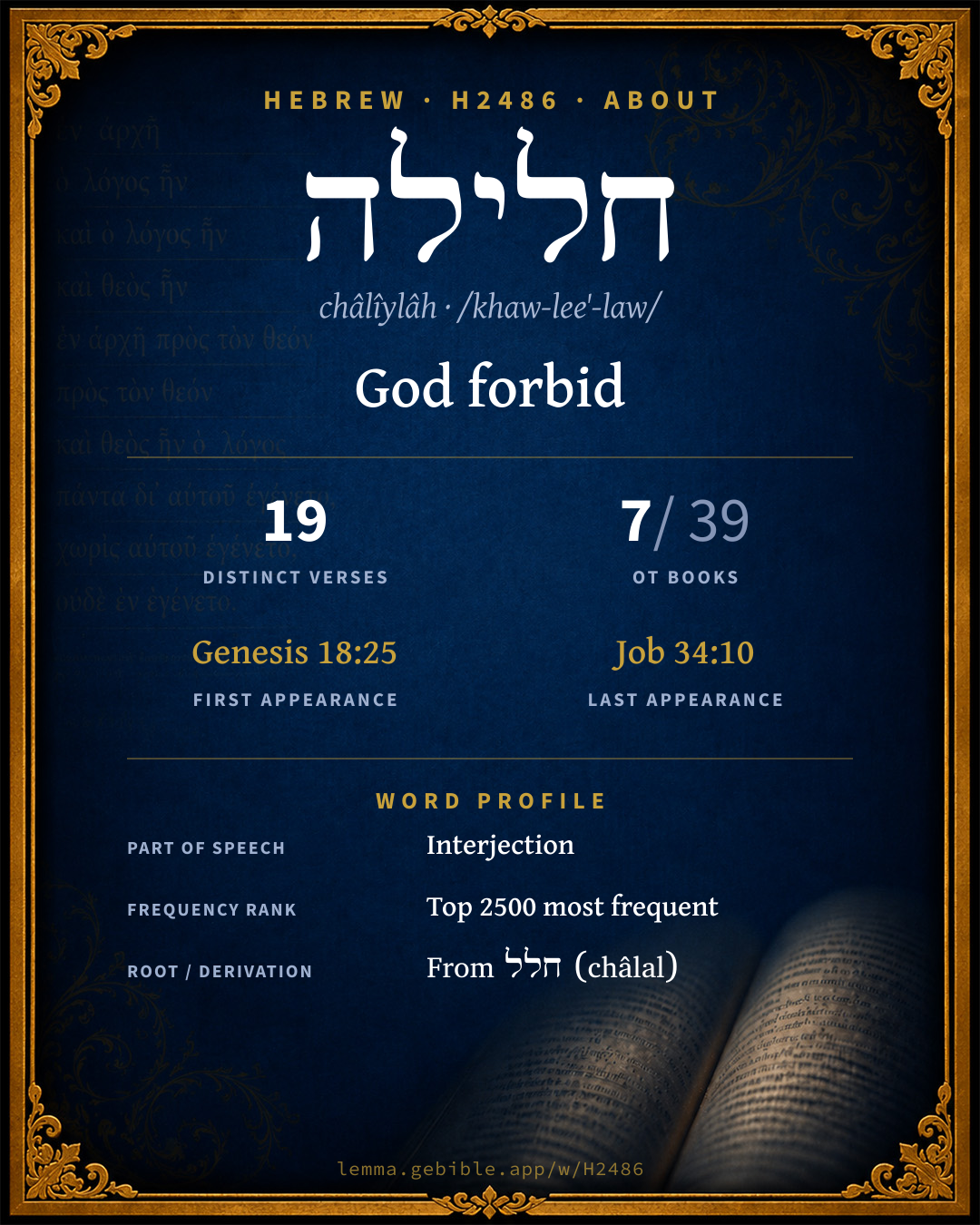
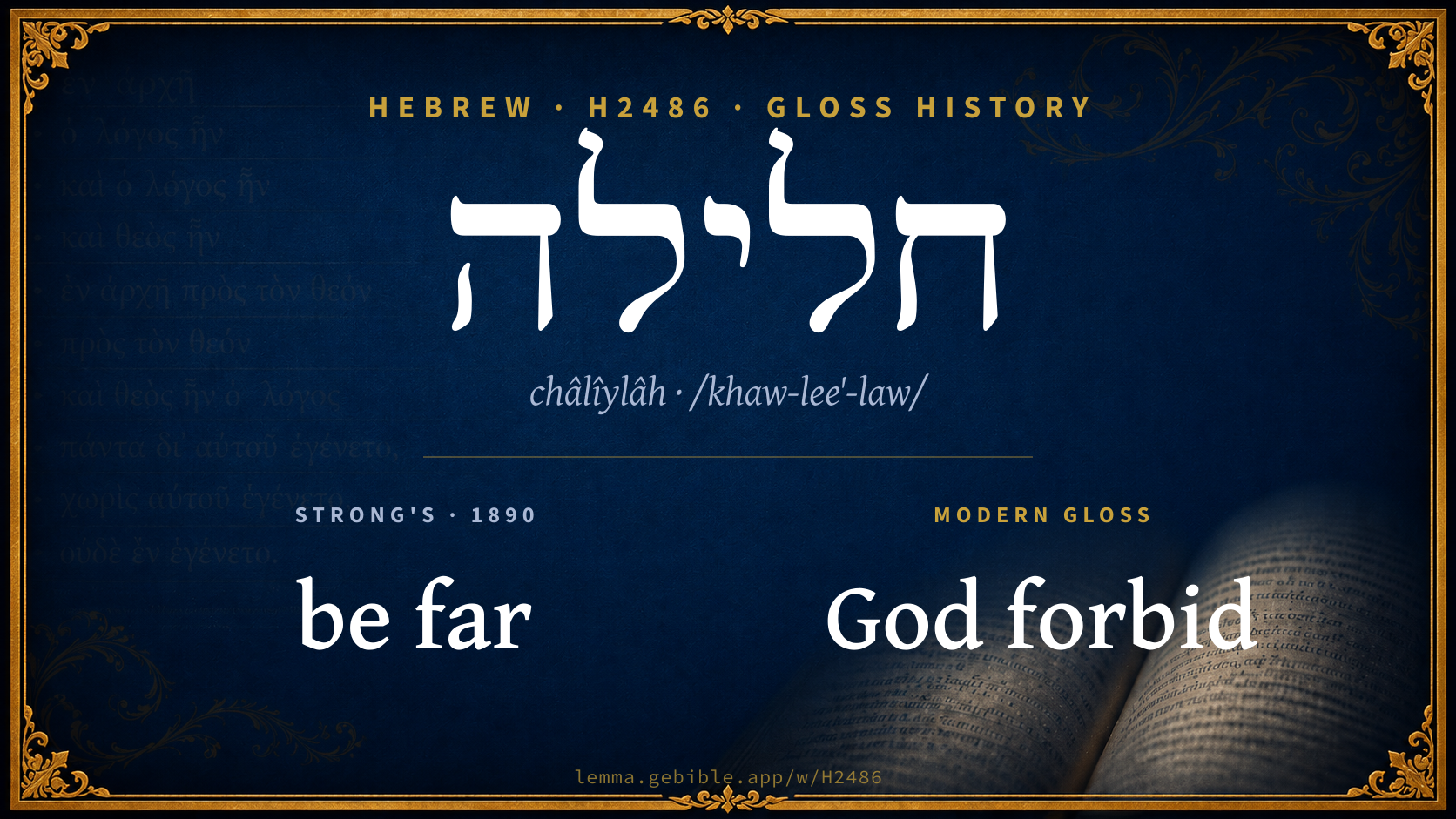
חָלִ֫ילָה
God forbid
Full lexicon entry — Brown-Driver-Briggs (BDB)
From Brown-Driver-Briggs (BDB)
Where this word appears
Grammar key — what these labels mean
Part of speech
- Particle
- A short function word — article, negation, interrogative, the sign of the direct object, and the like.
Every verse where H2486 appears — 19 distinct verses across 7 books. Click any verse to open its interlinear word-by-word view. Verse text shown in the World English Bible for context — . Each verse’s Hebrew form is shown with its reference; the English is not keyword-highlighted, since the data carries no word-level English alignment. Use “Compare translations” on any verse to read it across multiple English versions. This concordance covers the Hebrew Bible; Septuagint (Greek Old Testament) occurrences are not indexed here.
Genesis 3 verses
- Genesis 18:25 חָלִ֨לָ/ה חָלִ֣לָ/ה ptcl intj + sfx h ptcl intj + sfx h Be it far from you to do things like that, to kill the righteous with the wicked, that so the righteous should be as the wicked. May that be far from you. Shouldn't the Judge of all the earth do right?"
- Genesis 44:7 חָלִ֨ילָ/ה֙ ptcl intj + sfx h They said to him, "Why does my lord speak such words as these? Far be it from your servants that they should do such a thing!
- Genesis 44:17 חָלִ֣ילָ/ה ptcl intj + sfx h He said, "Far be it from me that I should do so. The man in whose hand the cup is found, he will be my bondservant; but as for you, go up in peace to your father."
Joshua 2 verses
- Joshua 22:29 חָלִילָ/ה֩ ptcl intj + sfx dem Far be it from us that we should rebel against Yahweh, and turn away this day from following Yahweh, to build an altar for burnt-offering, for meal-offering, or for sacrifice, besides the altar of Yahweh our God that is before his tent.
- Joshua 24:16 חָלִ֣ילָ/ה ptcl intj + sfx h The people answered, Far be it from us that we should forsake Yahweh, to serve other gods;
1 Samuel 8 verses
- 1 Samuel 2:30 חָלִ֣ילָ/ה ptcl intj + sfx h Therefore Yahweh, the God of Israel, says, I said indeed that your house, and the house of your father, should walk before me forever: but now Yahweh says, Be it far from me; for those who honor me I will honor, and those who despise me shall be lightly esteemed.
- 1 Samuel 12:23 חָלִ֤ילָ/ה ptcl intj + sfx h Moreover as for me, far be it from me that I should sin against Yahweh in ceasing to pray for you: but I will instruct you in the good and the right way.
- 1 Samuel 14:45 חָלִ֗ילָ/ה ptcl intj + sfx h The people said to Saul, Shall Jonathan die, who has worked this great salvation in Israel? Far from it: as Yahweh lives, there shall not one hair of his head fall to the ground; for he has worked with God this day. So the people rescued Jonathan, that he didn't die.
- 1 Samuel 20:2 חָלִילָ/ה֮ ptcl intj + sfx h He said to him, "Far from it; you shall not die: behold, my father does nothing either great or small, but that he discloses it to me; and why should my father hide this thing from me? It is not so."
- 1 Samuel 20:9 חָלִ֣ילָ/ה ptcl intj + sfx h Jonathan said, Far be it from you; for if I should at all know that evil were determined by my father to come on you, then wouldn't I tell you that?
- 1 Samuel 22:15 חָלִ֣ילָ/ה ptcl intj + sfx h Have I today begun to inquire of God for him? be it far from me: don't let the king impute anything to his servant, nor to all the house of my father; for your servant knows nothing of all this, less or more.
- 1 Samuel 24:6 חָלִ֧ילָ/ה ptcl intj + sfx h He said to his men, Yahweh forbid that I should do this thing to my lord, Yahweh's anointed, to put forth my hand against him, seeing he is Yahweh's anointed.
- 1 Samuel 26:11 חָלִ֤ילָ/ה ptcl intj + sfx dem Yahweh forbid that I should put forth my hand against Yahweh's anointed: but now please take the spear that is at his head, and the jar of water, and let us go.
2 Samuel 2 verses
- 2 Samuel 20:20 חָלִ֤ילָ/ה חָלִ֨ילָ/ה֙ ptcl intj + sfx h ptcl intj + sfx h Joab answered, Far be it, far be it from me, that I should swallow up or destroy.
- 2 Samuel 23:17 חָלִילָ/ה֩ ptcl intj + sfx h He said, Be it far from me, Yahweh, that I should do this: [shall I drink] the blood of the men who went in jeopardy of their lives? therefore he would not drink it. These things did the three mighty men.
1 Kings 1 verse
1 Chronicles 1 verse
Job 2 verses
- Job 27:5 חָלִ֣ילָ/ה ptcl intj + sfx h Far be it from me that I should justify you. Until I die I will not put away my integrity from me.
- Job 34:10 חָלִ֖לָ/ה ptcl intj + sfx h "Therefore listen to me, you men of understanding: Far be it from God, that he should do wickedness, From the Almighty, that he should commit iniquity.
About this entry
At a glance — auto-summarized from this page’s data, not written by a person. Every figure links to its source below. This summary describes the numbers; it doesn’t interpret them.
“God forbid” is the headline sense of the Hebrew name חלילה (châlîylâh). Scripture first uses it in Genesis 18:25. It appears 19 verses across 7 books of the Hebrew Bible, among its uncommon vocabulary. More than a third of its appearances fall in 1 Samuel. See 19-verse concordance and the renderings breakdown below.
Gloss history
Strong's 1890 vs modern scholarship
About this word
Strong's H2486 catalogs a Hebrew word from the Hebrew Old Testament.
These counts are not copied from any lexicon or concordance. They are computed here, from the morphology-tagged Hebrew Old Testament. What Lemma adds →
- 19
- distinct verses
- The word appears in 19 distinct verses.
- 7 / 39
- OT books
- The word appears in 7 of 39 Old Testament books.
- #1,462
- by frequency
- Top 2500 most frequent Hebrew words (rank 1,462 of 8,640 Hebrew words by occurrence).
View all 19 occurrences in the concordance →
By section of the Old Testament
By traditional corpus
Conventional, traditional groupings — biblical authorship is debated, so this is a traditional corpus grouping, not an authorship claim. Each share is this word’s portion of its verses in that division of the Hebrew canon. Each figure is a share of the word’s 19 distinct verses.
- Prophets (Nevi'im) 13 verses · 68%
- Torah (Pentateuch) 3 verses · 16%
- Writings (Ketuvim) 3 verses · 16%
How translations render this word
Counts come from each version’s own published word-to-Strong’s tagging or interlinear alignment — an approximate guide to how each version renders this word, not a word-level alignment the data otherwise carries. Because each total is that version’s own tagged count, the per-version totals vary from one another and need not match the appearance or distinct-verse counts above. These counts may also differ from a printed concordance because Lemma counts each distinctly tagged rendering and does not collapse phrase taggings into a single head-word total. This is a fixed set of word-tagged versions (KJV, ASV, BSB, ULT) and does not change with the reading translation you choose elsewhere. Each version’s license is shown beside its name below (and on Sources).
BDB lists this Strong’s number as 2 distinct words (homographs). Each count above pools all of them and is not split by sense — see the Senses section below. A low-frequency rendering may belong to a different one of those words, not the primary meaning.
- King James Version†: God forbid 8×, Forbid 4×, Far be it 3×
- American Standard Version†: Far be it 5×, Forbid 4×, Far 3×
- Berean Standard Bible†: Far be it 12×, Forbid 3×, Never 2×
- unfoldingWord Literal Text†: Profane 15×, Far be it 4×, Sacrilege 2×
King James Version Public Domain
Renders H2486 across 21† tagged occurrences — most commonly:
Plus 2 renderings that appear only once — usually multi-word phrases or single function words the recovered tagging swept in, not distinct renderings.
American Standard Version Public Domain
Renders H2486 across 21† tagged occurrences — most commonly:
Plus 5 renderings that appear only once — usually multi-word phrases or single function words the recovered tagging swept in, not distinct renderings.
Berean Standard Bible Public Domain
Renders H2486 across 21† tagged occurrences — most commonly:
Plus 4 renderings that appear only once — usually multi-word phrases or single function words the recovered tagging swept in, not distinct renderings.
unfoldingWord Literal Text CC BY-SA 4.0
Renders H2486 across 21† tagged occurrences — most commonly:
Senses in the full BDB
What do BDB’s symbols mean?
BDB uses these scholarly abbreviations:
| Symbol | Meaning |
|---|---|
| 𝔊 | the Septuagint (the ancient Greek translation, LXX) |
| 𝔙 | the Vulgate (the Latin translation) |
| 𝔖 | the Syriac version (the Peshitta) |
| 𝔗 | the Targum (the Aramaic translation) |
| ψ | the Psalms |
| √ | root (the underlying root or stem) |
| ‖ | parallel passage (a synonymous or contrasted parallel) |
| † | the dagger: every passage where the word occurs is cited |
The 0 senses and sub-senses the full Brown-Driver-Briggs lexicon distinguishes for this word, in lexicon order (not ranked by frequency), with BDB’s own verbatim wording and sub-sense lettering. Shown in Hebrew script with BDB’s own scholarly abbreviations. The condensed entry is in the Lexicon Entry tab. See also the Forms in the corpus table below.
חלילה I flute, pipe, ח׳ 1 S 10
חלילה II subst. c. ה loc., used as exclam. lit. ad profanum! i.e. far be it (for me, thee, etc.)! (v. BaNB 136)
Senses from the full Brown-Driver-Briggs lexicon (Brown, Driver, Briggs; Oxford 1906 — public domain), digitized via Sefaria, supplemented by the OpenScriptures HebrewLexicon (CC BY 4.0). Full attribution on Sources.
Word origin
I. n.m. flute, pipe, ח׳ 1 S 10:5 Is 5:12; 30:29; pl. חֲלִלִים 1 K 1:40 Je 48:36(×2).
I. subst. c. ה loc., used as exclam. lit. ad profanum! i.e. far be it (for me, thee, etc.)! (v. BaNB 136)—ח׳ Gn 44:7 + 17 times, חָלִלָה Gn 18:25 + 2 times—alone, 1 S 14:45; 20:2; elsewhere c. לְ pers.: Gn 18:25b (J), 1 S 2:30; 20:9; 22:15; + מִן and inf. of act deprecated Gn 18:25a; 44:7, 17 (all J), Jos 24:16 (E), 1 S 12:23 2 S 23:17; + מִמֶּנּוּ ל (peculiarly) Jos 22:29 (P; = from it, even to rebel); + אִם (= surely not) 2 S 20:20 (ח׳ ח׳), Jb 27:5; strengthened idiom. by מיהוה, ח׳לִי מִיּ׳ sq. מִן and inf. 1 S 26:11 1 K 21:3 + 2 S 23:17 (read מיהוה, 𝔊L 𝔖 𝔗) = 1 Ch 11:19 (מאלהי) sq. אִם 1 S 24:7; ח׳ לָאֵל מֵרֶשַׁע Jb 34:10.
— Brown-Driver-Briggs (Oxford 1906, public domain), digitized via Sefaria, supplemented by the OpenScriptures HebrewLexicon (CC BY 4.0). See Sources.
Derived from חלל (châlal) (H2490) — to profane.
Jastrow Dictionary
A second Hebrew/Aramaic lexicon for comparison, covering Aramaic and post-biblical (Talmudic, Targumic, Midrashic) usage that the biblical-Hebrew BDB does not. Matched by lemma rather than by Strong’s number, so a lemma may carry more than one Jastrow headword (shown separately below), and the entries cover usage well beyond the Bible.
חָלִילָה
- adv. (v. preced.)
- 1. round about, in turn. Succ. V, 6 חוזרין ח׳ they take turns all around. Keth. X, 6. Tosef. Zeb. I, 1 חזרנו ח׳ we are moving in a circle, i.e. this way of arguing will lead to no conclusion; Zeb. 10ᵇ חוזרני ח׳ ed. I am moving &c.; a. e.
- 2. (b. h.; outside, foreign to. Gen. R. s. 49; Yalk. ib. 83 (expl. חללה, Gen. XVIII, 25), v. בָּרָאָה, a. חוֹל III; Tanḥ. Vayera 8 חֲלָלָה כתיב it may be read ḥălalah (desecration), לא חול הוא לך is it not too profane for thee? e.g. Genesis 18:25
A Dictionary of the Targumim, the Talmud Babli and Yerushalmi, and the Midrashic Literature (Marcus Jastrow; London, Luzac, 1903) — Public Domain. Digitized via Sefaria. Digitized via Sefaria. Full attribution on Sources.
Forms in the corpus
The 10 distinct written forms H2486 takes in the Hebrew Bible, most frequent first — each parse links to that state’s occurrences in the concordance. Hebrew forms include their vowel points and cantillation, so a single lemma takes many written forms.
| Form | Parsing | Example | Uses |
|---|---|---|---|
| חָלִ֣ילָ/ה | Particle, Interjection | Genesis 44:17 | 6 |
| חָלִ֤ילָ/ה | Particle, Interjection | 1 Kings 21:3 | 4 |
| חָלִילָ/ה֩ | Particle, Interjection | 1 Chronicles 11:19 | 3 |
| חָלִ֨ילָ/ה֙ | Particle, Interjection | Genesis 44:7 | 2 |
| חָלִ֖לָ/ה | Particle, Interjection | Job 34:10 | 1 |
| חָלִ֗ילָ/ה | Particle, Interjection | 1 Samuel 14:45 | 1 |
| חָלִ֣לָ/ה | Particle, Interjection | Genesis 18:25 | 1 |
| חָלִ֧ילָ/ה | Particle, Interjection | 1 Samuel 24:6 | 1 |
| חָלִ֨לָ/ה | Particle, Interjection | Genesis 18:25 | 1 |
| חָלִילָ/ה֮ | Particle, Interjection | 1 Samuel 20:2 | 1 |
Same root — word family
Other BDB entries built from the same root as H2486, grouped by Strong’s listed origin. These share a root / origin per the lexicon — not necessarily a shared meaning. Each links to that word’s own entry.
Derives from
Shares the same root
- חל chôl H2455 profane
- חלה challâh H2471 cake
- חליל châlîyl H2485 flute
- חלל châlâl H2491 slain
- מחלה mᵉchillâh H4247 hole
- תחלה tᵉchillâh H8462 beginning
Compare all same-root words → Showing 4 of 8 — not the complete family. They share a root, not necessarily a meaning.
Septuagint verse parallels
This word appears in 19 verses that also exist in the Greek Old Testament (Septuagint), out of the 19 Hebrew verses it occurs in. You can read those verses in Greek by switching the Old Testament edition to the Septuagint.
Read these verses in the Septuagint
This is a verse-level parallel only — the same verses exist in both the Hebrew and Greek Old Testaments. No word-level Hebrew↔Greek correspondence is claimed: the data carries no such alignment, so no Greek word is shown as this Hebrew word’s translation. Coverage is not total — the Septuagint omits the deuterocanon and renumbers the Psalms, so some Hebrew verses have no direct Greek parallel.