
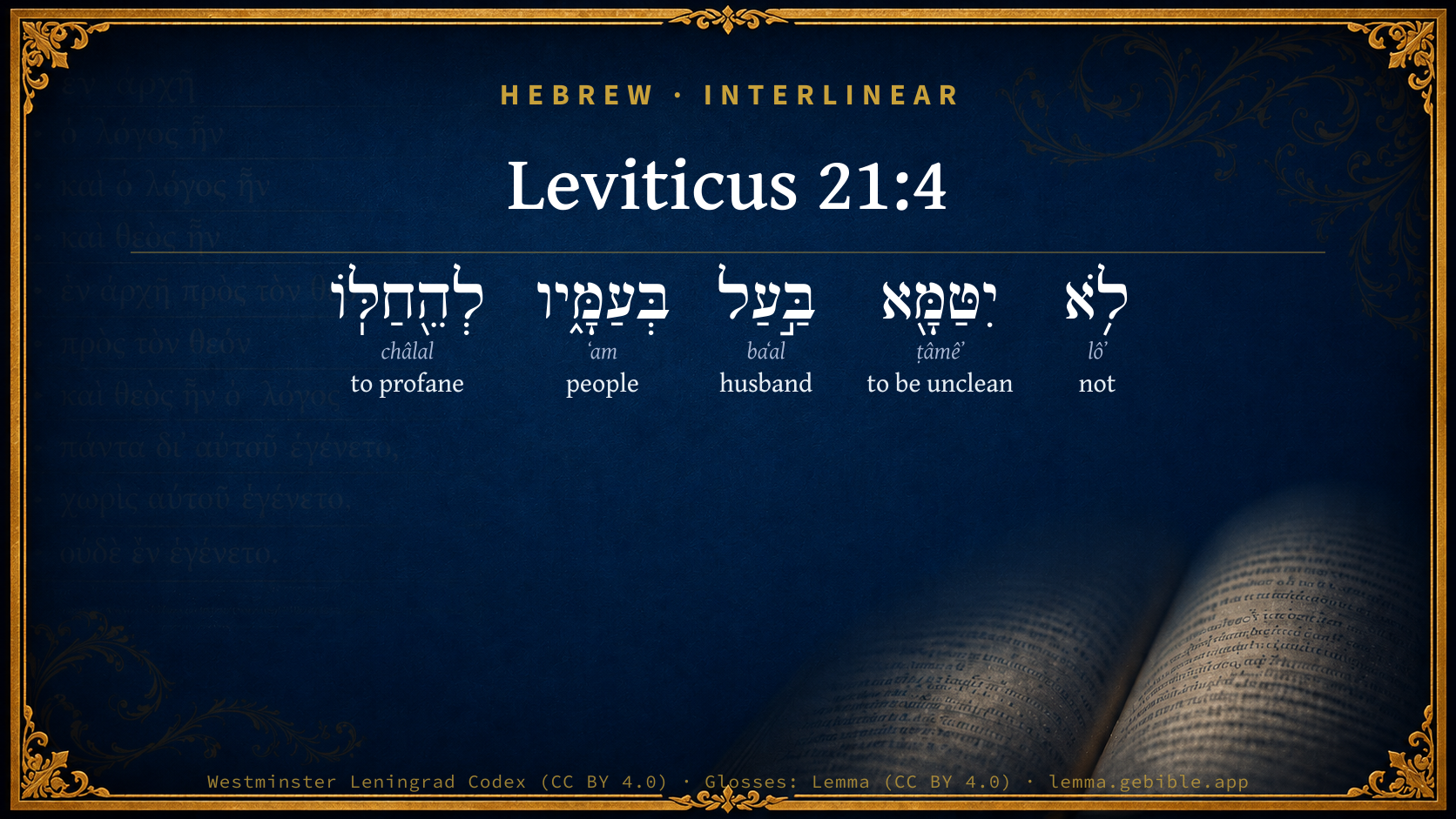
Leviticus 21:4

Hebrew (Westminster Leningrad Codex) Leviticus 21:4 appears in the Hebrew Old Testament. The text above is from the Westminster Leningrad Codex. Each word links to its Strong’s number, a concise gloss, and parsing drawn from the Open Scriptures Hebrew Bible morphology. Click any word for its full Brown-Driver-Briggs (BDB) entry.
Download image
Cite this verse

Leviticus 21:4 (World English Bible). Public Domain. Lemma interlinear Bible study tool, https://lemma.gebible.app/v/leviticus/21/4.

Show BibTeX & RIS
BibTeX
RIS
English Translation
He shall not defile himself, being a chief man among his people, to profane himself.
World English Bible · Public Domain
Download a study sheet

One document with this verse’s original text, its word-by-word gloss line, the meaning frame, cross-references with their text, attributed commentary, and full source and license credits — printable, and it pastes into notes with its structure intact.

This verse Autodidact and up

Study sheet (.html) Plain text (.txt)

A passage Seminary Student

Up to 50 verses in one chapter. A passage sheet keeps up to 6 commentary sources and 12 cross-references per verse, in the order this page ranks them, and says so on the sheet whenever that leaves anything out. Ask for a single verse and you get the Autodidact verse sheet above.

Everything on this page stays free to read, with no account — the sheet is a download of what is already on screen, not access to it.

Want to remove ads? Support Godless Engineer
Compare translations 3

The same verse in 3 English versions, stacked beneath the original-language interlinear above. Click any original word for its lexicon entry.

Each is an independent rendering of the whole verse — the interlinear is not word-aligned to these translations.

Highlighted words mark where these versions differ — a whole-verse word diff, not a word-by-word alignment.

  • World English Bible Public Domain
    He shall not defile himself, being a chief man among his people, to profane himself.
  • King James Version Public Domain
    But he shall not defile himself, being a chief man among his people, to profane himself.
  • unfoldingWord Literal Text CC BY-SA 4.0
    He shall not make himself unclean a husband among his people, to profane himself.

unfoldingWord Literal Text — © unfoldingWord, licensed CC BY-SA 4.0. Word-aligned USFM3 via Door43 (git.door43.org/unfoldingWord/en_ult).

Versions to compare (up to 4)

3 of 4 selected

Show all 18 translations

Every available English version of this verse, each an independent rendering of the whole verse.

  • World English Bible Public Domain
    He shall not defile himself, being a chief man among his people, to profane himself.
  • Berean Standard Bible Public Domain
    He is not to defile himself for those related to him by marriage, and so profane himself.
  • Majority Standard Bible Public Domain
    He is not to defile himself for those related to him by marriage, and so profane himself.
  • King James Version Public Domain
    But he shall not defile himself, being a chief man among his people, to profane himself.
  • American Standard Version (1901) Public Domain
    He shall not defile himself, `being' a chief man among his people, to profane himself.
  • Revised Version (1885) Public Domain
    He shall not defile himself, being a chief man among his people, to profane himself.
  • Geneva Bible (1599) Public Domain
    He shall not lament for the Prince among his people, to pollute him selfe.
  • Douay-Rheims (1899) Public Domain
    But not even for the prince of his people shall he do any thing that may make him unclean.
  • Young's Literal Translation Public Domain
    `A master `priest' doth not defile himself among his people -- to pollute himself;
  • Literal Standard Version CC BY-SA 4.0
    A master [priest] does not defile himself among his people—to defile himself;
  • Unlocked Literal Bible CC BY-SA 4.0
    But he must not make himself unclean for other relatives and so defile himself.
  • unfoldingWord Literal Text CC BY-SA 4.0
    He shall not make himself unclean a husband among his people, to profane himself.
  • Darby Bible Public Domain
    He shall not make himself unclean [who is] a chief among his peoples, to profane himself.
  • World Messianic Bible Public Domain
    He shall not defile himself, being a chief man among his people, to profane himself.
  • Webster's Bible Public Domain
    But he shall not defile himself, being a chief man among his people, to profane himself.
  • Free Bible Version CC BY-SA 4.0
    He must not make himself unclean for those only related to him by marriage—he is not to make himself ceremonially impure.
  • Bible in Basic English Public Domain
    But let him, being a chief among his people, not make himself unclean in such a way as to put shame on himself.
  • JPS Tanakh (1917) Public Domain
    He shall not defile himself, being a chief man among his people, to profane himself.

Literal Standard Version (2020), Covenant Press — licensed CC BY-SA 4.0. Text via the HelloAO Bible API (eBible.org). Unlocked Literal Bible (unfoldingWord) — licensed CC BY-SA 4.0. Text via the HelloAO Bible API (eBible.org). unfoldingWord Literal Text — © unfoldingWord, licensed CC BY-SA 4.0. Word-aligned USFM3 via Door43 (git.door43.org/unfoldingWord/en_ult). Free Bible Version, Dr. Jonathan Gallagher — licensed CC BY-SA 4.0. Text via the HelloAO Bible API (eBible.org).

Word by word

More ways to search: Search by grammar → Find every occurrence → Compare this word →

Practice this passage: Drill this verse → Learn its vocabulary →

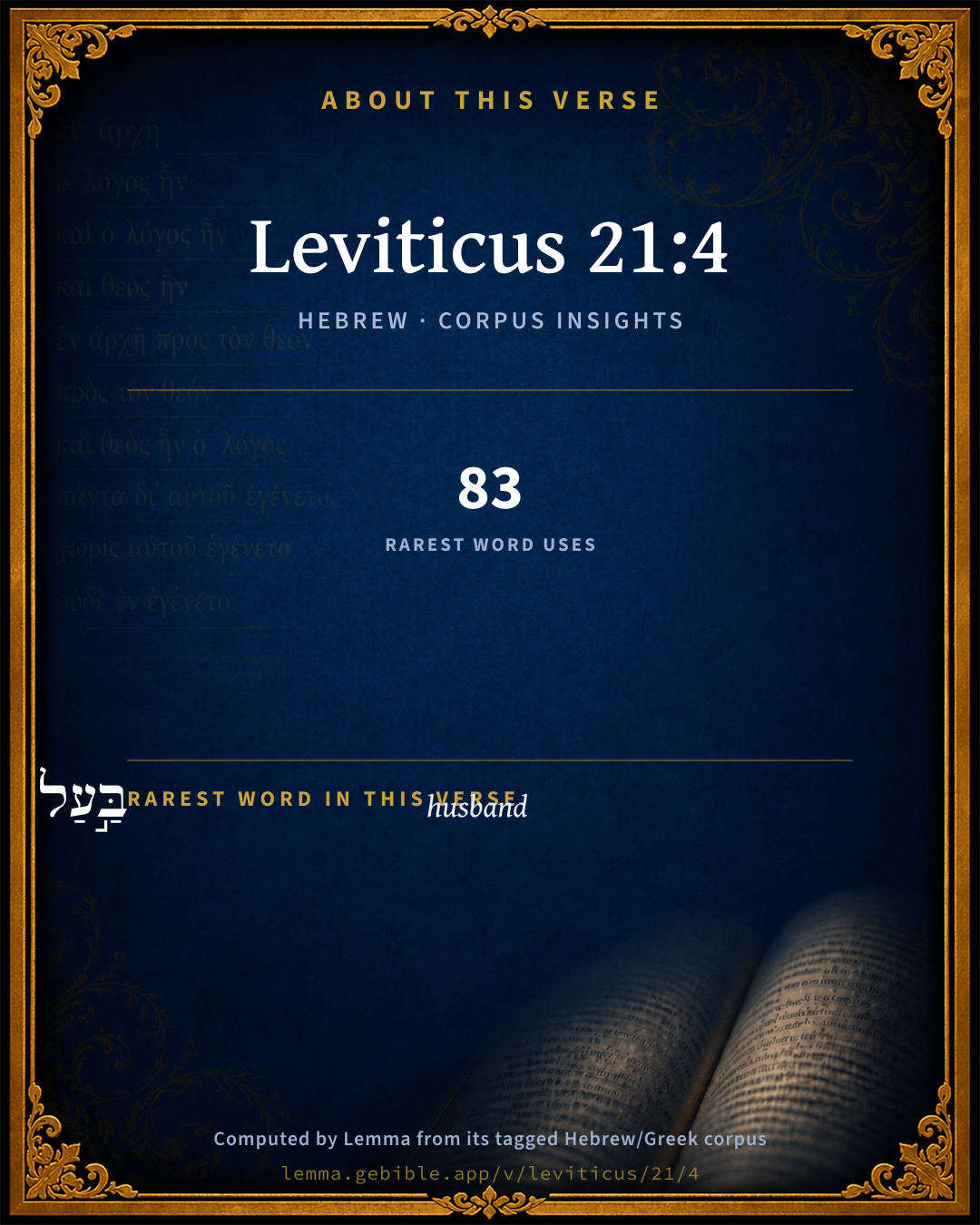
About this verse

These counts appear in no published source. They are computed here, from the morphology-tagged text and Lemma’s own curated glosses. What Lemma adds →

5
words
5
distinct lemmas
Pentateuch
section

Grammatical profile

  • 2 verbs
  • 2 nouns
  • 1 particle

Verb forms

  • יִטַּמָּ֖א Hithpael · Imperfect
  • לְהֵ֖חַלּֽוֹ Niphal · Infinitive Construct

Hebrew & Septuagint length

In English translation the verse runs 15 words from the Hebrew and 12 from the Septuagint (LXX English) — closely comparable.

A rough comparison of the two English renderings, which tokenize alike — not a word-level alignment.

Word counts can differ between the Hebrew and the Greek without any difference in meaning — e.g. the Hebrew direct-object marker אֵת has no separate Greek word, and Greek often adds the article ὁ.

Cross-references

1

Topical passages linked to Leviticus 21:4 in the Treasury of Scripture Knowledge — connected by theme and wording, ordered by reader-vote popularity; previews shown in the World English Bible.

  • Ezekiel 24:16–17 Son of man, behold, I take away from you the desire of your eyes with a stroke: yet you shall neither mourn nor weep, neither shall your tears run down.

Cross-references courtesy of OpenBible.info (CC BY 4.0).

Hebrew and Greek witnesses Masoretic Hebrew ↔ Greek Septuagint

The same verse in the two great witnesses to the Old Testament, shown verse-for-verse.

These are two independent witnesses, not word-aligned to each other, and the Septuagint is shown in lemma (dictionary) form.

Hebrew Leviticus 21:4 Masoretic · Westminster Leningrad Codex

לֹ֥א יִטַּמָּ֖א בַּ֣עַל בְּעַמָּ֑יו לְהֵ֖חַלּֽוֹ

He shall not defile himself, being a chief man among his people, to profane himself.

World English Bible · Public Domain

Greek LXX Leviticus 21:4 Septuagint · lemma form

οὐ μιαίνω ἐξάπινα ἐν ὁ λαός αὐτός εἰς βεβήλωσις αὐτός

He shall not defile himself suddenly among his people to profane himself.

LXX2012 (modern English Septuagint) · Public Domain

On this verse, Albert Barnes' Notes on the Bible discusses the Septuagint’s reading. Read the note in Commentary ↓

Hebrew: Westminster Leningrad Codex (CC BY 4.0). Greek: Septuagint (public domain); English from LXX2012 (modern English Septuagint) (Public Domain). How the Septuagint differs from the Hebrew →

Targum (Aramaic paraphrase)

2

The Targum is the ancient Jewish Aramaic paraphrase of the Hebrew Scriptures — an interpretive translation, not the Hebrew text itself. Onkelos (literal) and Pseudo-Jonathan (expansive) render the Torah, and Jonathan the Prophets. Coverage is partial: where no permissively-licensed English translation exists for a verse, only the Aramaic is shown. This is verse-level text, not a word-by-word alignment to the Hebrew.

  1. Targum Onkelos Torah (Genesis–Deuteronomy)
    לָא יִסְתָּאַב רַבָּא בְעַמֵהּ לְאַחֲלוּתֵהּ

    (no public-domain English translation for this verse)

    Targum Onkelos — Aramaic: “Onkelos Genesis” (public domain); “Onkelos Exodus” (public domain); “Onkelos Leviticus” (public domain); “Onkelos Numbers” (public domain); “Onkelos Deuteronomy” (public domain). English: “Sefaria Community Translation” (CC0 1.0 (public-domain dedication)); “J.W. Etheridge. The Targums of Onkelos and Jonathan Ben Uzziel on the Pentateuch. London: Longmans, Green, 1862” (public domain). Text via Sefaria.

  2. Targum Pseudo-Jonathan Torah (Genesis–Deuteronomy)
    לָא יִסְתָּאֵב בַּעֲלָא לְאִיתְּתֵיהּ אֱלָהֵן כַּד כַּשְׁרָא לֵיהּ בְּרַם לִקְרֵיבָא דְהִינוּן עַבְדִין עוֹבְדֵי עַמֵיהּ יִתְחַל עֲלֵיהוֹן

    The husband shall not defile himself on account of his wife, except so far as it is right for him; but for a relative of those who do the work of his people he may defile himself.

    Targum Pseudo-Jonathan — Aramaic: “Targum Jonathan on Genesis” (public domain); “Targum Jonathan on Exodus” (public domain); “Targum Jonathan on Leviticus” (public domain); “Targum Jonathan on Numbers” (public domain); “Targum Jonathan on Deuteronomy” (public domain). English: “The Targum of Jonathan ben Uzziel, trans. J. W. Etheridge, London, 1862” (public domain). Text via Sefaria.

Commentary

Notes on Leviticus 21:4 from classic Christian and Jewish commentators (each source and its license shown beneath its notes). The classic Christian expositions comment on the surrounding passage and are grouped to its opening verse, so a note may address several verses; the Jewish commentaries on the Tanakh (Rashi and others) are per-verse, so they appear only where the commentator wrote on this verse.

Lemma curates 59 commentaries, every one of them public domain or Creative Commons licensed, each selected and text-cleaned for this edition rather than reprinted as found. About our sources →

Trapp's Complete Commentary

John Trapp

Lev 21:4 [But] he shall not defile himself, [being] a chief man among his people, to profane himself.

Ver. 4. Being a chief man.] A vir gregis; all whose actions were exemplary, and have not an impulsive only, but a compulsive power and property. "Why compellest thou the Gentiles?" {Gal 2:14} His example was a compulsion.

John Trapp, A Commentary or Exposition upon All the Books of the Old and New Testament (1647–1656) — public domain. Text from a community e-Sword module.

Joseph Benson's Commentary

Lev 21:4. Being — Or, seeing he is a chief man — For such, not only the high-priest, but others also of the inferior priests were. He shall not defile himself — For any other person whatsoever. To profane himself —

Because such defilement for the dead did profane him, or make him as a common person, and consequently unfit to manage his sacred employment.

Joseph Benson's Commentary on the Old and New Testaments (1811–1818) — public domain. Text from a community e-Sword module.

Geneva Bible (1599)

Geneva Bible translators

The Priest was permitted to mourn for his next kindred only.

Geneva Bible (1599) marginal notes — public domain. Text via Bolls.life.

Jamieson, Fausset & Brown

Robert Jamieson, A. R. Fausset & David Brown

But he shall not defile himself--"for any other," as the sense may be fully expressed. "The priest, in discharging his sacred functions, might well be regarded as a chief man among his people, and by these defilements might be said to profane himself" [BISHOP PATRICK]. The word rendered "chief man" signifies also "a husband"; and the sense according to others is, "But he being a husband, shall not defile himself by the obsequies of a wife" (Eze 44:25).

Jamieson, Fausset & Brown — Commentary Critical and Explanatory on the Whole Bible (1871) — public domain (CC PDM 1.0). Text via the HelloAO Bible API.

Adam Clarke's Commentary

Verse 4. A chief man among his people] The word בעל baal signifies a master, chief, husband, &c., and is as variously translated here.

1. He being a chief among the people, it would be improper to see him in such a state of humiliation as mourning for the dead necessarily implies.

2. Though a husband he shall not defile himself even for the death of a wife, because the anointing of his God is upon him. But the first sense appears to be the best.

Adam Clarke's Commentary on the Bible (1810–1826) — public domain. Text from a community e-Sword/MySword module.

Ellicott's Commentary for English Readers

(4) But he shall not defile himself, being a chief man . . . —Better, A husband shall not defile himself among his people when he had profaned himself. As the seven exceptions to the general rule began with his wife, whose funeral rites the priestly husband is allowed to attend, the verse before us restricts this permission to his legally prescribed wife. If he contracted a marriage which profaned him, he could not attend to her funeral ceremonies. The last clause, which is here translated, “when he had profaned him,” literally denotes “to profane himself,” “with respect to his profanation”—i.e., with respect to a marriage by which he profaned himself. This is the interpretation which the administrators of the Law attached to the verse, and which is transmitted in the Chaldee version of Jonathan. It is not only in perfect harmony with the context, but does least violence to this manifestly disordered text. The translations exhibited in the Authorised version, both in the text and in the margin, as well as most of those suggested by modern commentators, leave the clause unexplained, since it manifestly means something else than defiling himself by contracting impurity through contact with the dead, as is evident from the fact that it is not added in the other instances where the priest is forbidden to defile himself by attending to the dead. (See Lev_21:1-11.)

A Bible Commentary for English Readers, edited by Charles John Ellicott (1878–1897) — public domain. Text from a community e-Sword module.

The Cambridge Bible for Schools and Colleges

gen. ed. J. J. S. Perowne

4. being a chief man] as a husband (R.V. mg.). This rendering limits the cases in which defilement is permissible to those already mentioned, and forbids mourning for a wife. The A.V. follows the Targum.

The wording of the v. suggests a corruption in the text. The Sept. substitute (see R.V. mg.) for ‘a chief man’ is apparently obtained by a transposition in Heb. consonants, but fails to convey any clear meaning. It has been suggested, by a somewhat greater modification in the Heb., to read in mourning. Baentsch (HG. 111A) considers that the words ‘defile himself’ and ‘among his people’ shew that the v. forms an intimate part of the prohibition contained in the previous vv. Inasmuch, then, as the word rendered ‘chief man’ is regularly used of a husband, and as mention of a wife is strangely absent from the MT., he proposes either of two alternative readings, which assume a copyist’s accidental omission of a word or words, expressing wife; so that the precept originally ran, a husband shall not be defiled for his wife. It is, however, difficult, as Dillm. says, to suppose, in the face of the opening words of Lev_21:2, that a priest whose wife died was forbidden to approach the body.

The Cambridge Bible for Schools and Colleges (gen. ed. J. J. S. Perowne; Cambridge University Press, 1878–1918) — public domain. Text from a community e-Sword module.

John Gill's Exposition

But he shall not defile himself, being a chief man among his people,.... Which is not to be understood of any lord or nobleman or any chief ruler or governor of the people; for the context speaks only of priests, and not of other personages; besides, such might defile themselves, or mourn for their dead, as Abraham did for Sarah; nor of any husband for his wife, for even a priest, as has been observed, might do this for his wife, and much more a private person; nor is there any need to restrain it, as some Jewish writers do, to an adulterous wife, which a husband might not mourn for, though he might for his right and lawful wife; but there is nothing in the text, neither of an husband, nor a wife: the words are to be interpreted of a priest, and either of him as considered as a person of eminence, consequence, and importance, and sons giving a reason why he should not defile himself for the dead, because he was a principal person among his people to officiate for them in sacred things; wherefore if he did not take care that he was not defiled for the dead, which might often happen, he would be frequently hindered from doing his office for the people, which would be attended with ill consequence to them; and therefore the above cases are only excepted, as being such that rarely happened: or rather the words are to be considered as a prohibition of defiling himself "for any chief" (s), or principal man, lord, ruler, or governor, among his people; even for such an one he was not to defile himself, being no relation of his:

to profane himself; make himself unfit for sacred service, or make himself a common person; put himself upon a level with a common private man, and be no more capable of serving at the altar, or doing any part of the work off priest, than such an one.

(s) "in principe populi sui", V. L. so Pesicta & Ben Melech in loc. & Kimchi Sepher Shorash. rad.

John Gill's Exposition of the Whole Bible (1746–1763) — public domain (CC PDM 1.0). Text via the HelloAO Bible API.

Albert Barnes' Notes on the Bible

The sense seems to be that, owing to his position in the nation, the priest is not to defile himself in any cases except those named in Lev 21:2-3. The Septuagint appear to have followed a different reading of the text which would mean, “he shall not defile himself for a moment.” The explanation in the margin of our version is hardly in keeping with the prohibition to Ezekiel on a special occasion. See Eze 24:16.

Albert Barnes' Notes on the Bible (1834–1885) — public domain. Text from a community e-Sword/MySword module.

Haydock's Catholic Bible Commentary

Prince. Hebrew, "Let not the prince (of the priests, Acts xxiii. 5,) render himself unclean," by attending the funerals of any of the people; or "let not the husband," &c. He may be allowed to attend his wife to the grave: or, as others more probably assert, even this is not permitted. She is not one of the persons privileged, ver. 2, and Ezechiel xliv. 25. Ezechiel (xxiv. 16,) receives a command not to bewail the death of his wife. The Romans thought their priests would be defiled, by attending the funerals even of their own wives; and Sylla, going to dedicate a temple to Hercules, sent Metella a bill of divorce, and ordered her to be removed from his house, when she was just expiring. (Plutarch)

George Leo Haydock (1774–1849), Haydock's Catholic Family Bible and Commentary, 1859 edition — public domain. Excludes Psalms (Douay-Rheims chapter numbering differs from Protestant) and Deuterocanonical books (Catholic canon only).

Matthew Poole's English Annotations

Or, seeing he is

a chief man, & c., or ruler, &c., for such not only the high priest, but others also of the inferior priests, were. And therefore though he might defile himself for the persons now named, yet he, above all others, must take heed so to do it that he do not profane himself by doing as follows. Or, for a chief man, &c., the preposition lamed being easily understood from the former verse, where it is oft used, such supplements being not unusual in the Hebrew tongue. So the sense is, he shall not defile himself for any other person whatsoever who is not thus near of kin to him, no, not for a prince or chief ruler among his people, who might seem to challenge this duty from him, to join with all others in their resentment of the public loss; much less shall he defile himself for any other. And so the last word,

to profane himself, may be added as a reason why he should not defile himself for the prince or any other except the persons named, because such defilement for the dead did profane him, or make him as a common person and unclean, and consequently unfit to manage his sacred employment, which was an impediment to the service of God, and a public inconvenience to the people, whose concerns with God he negotiated. And it was not meet such great and important affairs should give place to the ceremonies of a funeral for a stranger.

Matthew Poole's English Annotations on the Holy Bible (1683–1685) — public domain. Text from a community e-Sword/MySword module.

Whedon's Commentary on the Bible

Daniel D. Whedon

4. Being a chief man — The exegesis of this verse is much disputed. Some, as Knobel, connect it with the preceding verses, and interpret the “chief man” — baal — to signify husband, who is expressly forbidden to mourn for his wife. Out of twenty-three times, it is rendered husband six times in the Pentateuch. Others, with Keil, connect this verse with Lev_21:7, and understand it as a general prohibition which is specialized in that verse as relating to an immoral wife or daughter. The weight of argument seems to be with Knobel. Nevertheless, Eze_24:16-18, has been rightly adduced against this view, where it is counted strange that Ezekiel, a priest, does not mourn for his wife.

Daniel D. Whedon (gen. ed.), Commentary on the Old and New Testaments (1874–1909) — public domain. Text from a community e-Sword module.

John Wesley's Explanatory Notes

Being - Or, seeing he is a chief man, for such not only the high- priest, but others also of the inferior priests were. He shall not defile himself for any other person whatsoever. To profane himself - Because such defilement for the dead did profane him, or make him as a common person, and consequently unfit to manage his sacred employment.

John Wesley, Explanatory Notes Upon the Whole Bible (1754–1765) — public domain. Text via the GEBible commentary corpus.

unfoldingWord translationNotes

Door43 World Missions Community

shave off the corners of their beards

It is impossible to be certain what the writer intended here. Possible meanings are 1) shave off certain parts of their beards or 2) cut or shave any part of their beards.

They must be holy

"They must be set apart"

not disgrace the name of their God

This word "name" is used to represent Yahweh's character. AT: "not disgrace God's reputation" or "not disgrace their God" (See: Metonymy)

the bread of their God

Here "bread" represents food in general. Yahweh does not actually eat these offerings. It is the sincerity of those offering the food that pleases God. (See: Synecdoche)

translationWords

defile

God

name

sacrifice

fire

bread

unfoldingWord translationNotes — © Distant Shores Media and the Door43 World Missions Community, licensed CC BY-SA 4.0. Source: git.door43.org/Door43/en_tn.

Rashi

Rabbi Shlomo Yitzchaki (Rashi)

לא יטמא בעל בעמיו להחלו This means: he shall not defile himself for his wife if she is really unfitted to be his wife (because he is a כהן) and through whom he consequently becomes profaned as a priest, so long as she remains with him (Sifra, Emor, Section 1 15). The following, therefore, is the literal exposition of the verse: לא יטמא בעל, a husband shall not defile himself for his wife's corpse while it is among its people, which means that there are persons who can bury her so that she is not a מת מצוה (cf. Rashi’s explanation of בעמיו on v. 1). And with reference to what kind of wife do I say this? With reference to such a one who להחלו, i. e. who leads to his being profaned and therefore disqualified from his priestly duties so long as she remains with him (cf. Sifra, Emor, Section 1 15; Yevamot 90b).

Rashi on the Tanakh — English translations: “The Judaica Press complete Tanach with Rashi, translated by A. J. Rosenberg” (CC BY 4.0); “Pentateuch with Rashi's commentary by M. Rosenbaum and A.M. Silbermann, 1929-1934” (public domain); “The Metsudah Tanach series, Lakewood, N.J” (CC BY 4.0); and “The Book of Joshua, Metsudah Publications, 1997” (CC BY 4.0). Text via Sefaria.

Sforno

Rabbi Ovadia Sforno

A husband among his people. A kohein may only defile himself for a relative because in truth the kohein is “בעל בעמיו,” a master among his people, to understand and give rulings [in the Torah], “For a priest’s lips shall guard knowledge, and teaching should be sought from his mouth” (Malachi 27:7). It is fitting that a person like this should behave in a respectful way so that his words will be heard. He should not profane his state of preparedness to enter the Sanctuary and for its holy matters by honoring the dead that are not his relatives, as the Sages said: The burial and eulogy for the dead are honor for the departed one. However, he is permitted to defile himself for relatives, for their honor is his honor.

Sforno on the Tanakh — English translation: “Yalkut, Sifsei Chachomim Chumash, Metsudah Publications, 2009” (CC BY 4.0). Text via Sefaria.

Lesson kit

Teaching starters — assembled from the data on this page, not authored interpretation. Every prompt links to the verse data it draws on. Edit before teaching.

Leviticus, in the Pentateuch, opens this verse with 5 words (5 distinct Hebrew lemmas). Its most distinctive word is baʻal (“husband”). A historical commentator’s framing appears above. Read the whole chapter for the surrounding context.

Discussion questions

  1. How does “husband” (baʻal) shape what this verse is saying?
  2. How does Ezekiel 24:16–17, which shares this passage’s theme, read alongside this verse?
  3. These translations render this verse differently; the difference is in the English rendering, not the original. What questions does that raise?
  4. «יִטַּמָּ֖א» is a Hithpael Imperfect verb. How does that grammatical form shape the action described?
  5. Compare how Trapp's Complete Commentary and Joseph Benson's Commentary read this verse. Where do they agree or differ?

Things to notice

Reading settings

Reading text

Shown beneath each verse's original-language words.

Old Testament
Old Testament edition

Read the OT as the Masoretic Hebrew (MT) or the Greek Septuagint (LXX).

English shown for the Greek Septuagint (in the Hebrew ↔ Greek comparison).

Comparing translations? Open the Compare panel on any verse page to stack up to four side by side.