
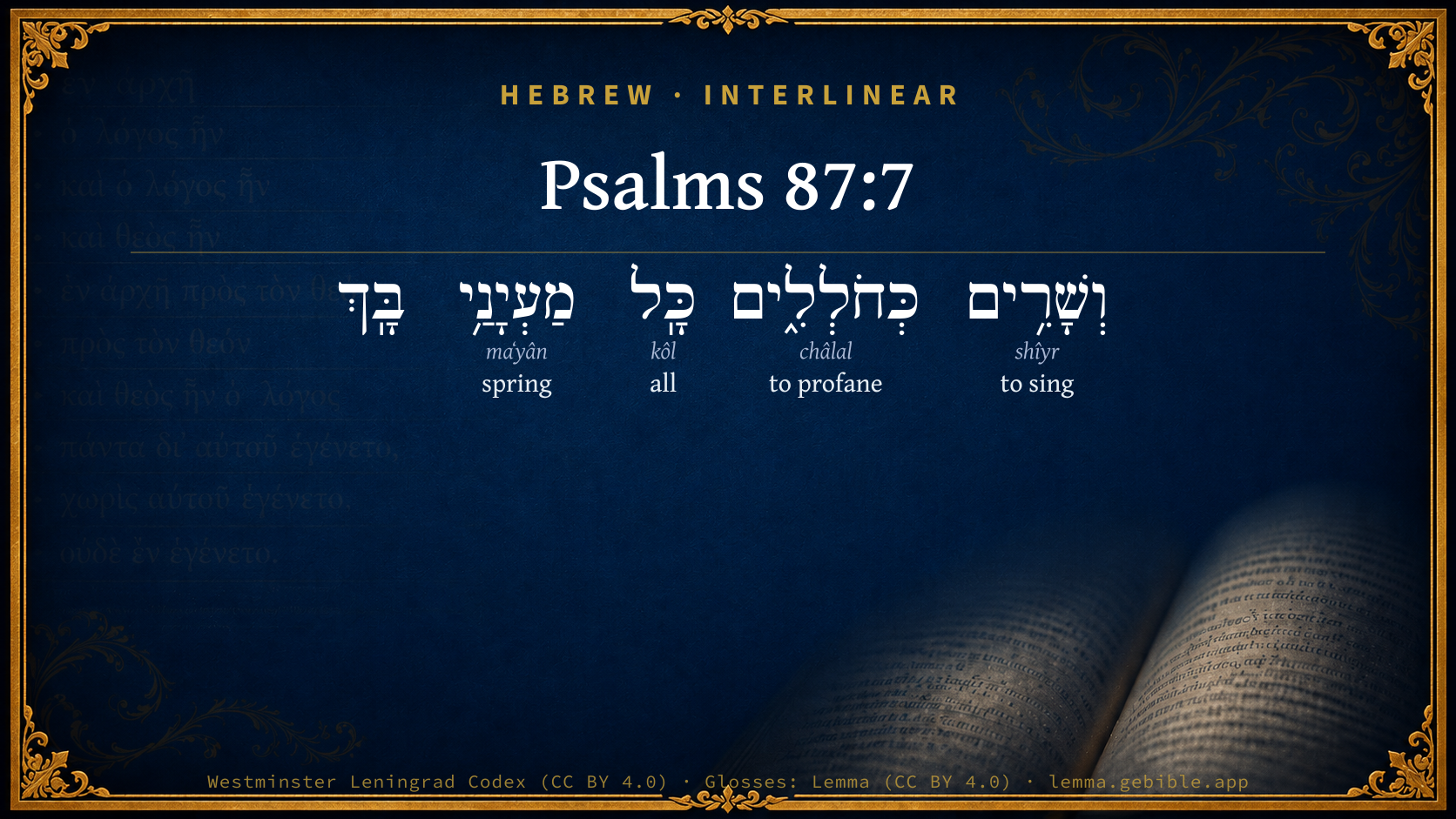
Psalms 87:7

Hebrew (Westminster Leningrad Codex) Psalms 87:7 appears in the Hebrew Old Testament. The text above is from the Westminster Leningrad Codex. Each word links to its Strong’s number, a concise gloss, and parsing drawn from the Open Scriptures Hebrew Bible morphology. Click any word for its full Brown-Driver-Briggs (BDB) entry.
Download image
Cite this verse

Psalms 87:7 (World English Bible). Public Domain. Lemma interlinear Bible study tool, https://lemma.gebible.app/v/psalms/87/7.

Show BibTeX & RIS
BibTeX
RIS
English Translation
Those who sing as well as those who dance say, "All my springs are in you."
World English Bible · Public Domain
Download a study sheet

One document with this verse’s original text, its word-by-word gloss line, the meaning frame, cross-references with their text, attributed commentary, and full source and license credits — printable, and it pastes into notes with its structure intact.

This verse Autodidact and up

Study sheet (.html) Plain text (.txt)

A passage Seminary Student

Up to 50 verses in one chapter. A passage sheet keeps up to 6 commentary sources and 12 cross-references per verse, in the order this page ranks them, and says so on the sheet whenever that leaves anything out. Ask for a single verse and you get the Autodidact verse sheet above.

Everything on this page stays free to read, with no account — the sheet is a download of what is already on screen, not access to it.

Want to remove ads? Support Godless Engineer
Compare translations 3

The same verse in 3 English versions, stacked beneath the original-language interlinear above. Click any original word for its lexicon entry.

Each is an independent rendering of the whole verse — the interlinear is not word-aligned to these translations.

Highlighted words mark where these versions differ — a whole-verse word diff, not a word-by-word alignment.

  • World English Bible Public Domain
    Those who sing as well as those who dance say, "All my springs are in you."
  • King James Version Public Domain
    As well the singers as the players on instruments shall be there: all my springs are in thee.
  • unfoldingWord Literal Text CC BY-SA 4.0
    And the singers, like the pipers, “All of my springs in you.”

unfoldingWord Literal Text — © unfoldingWord, licensed CC BY-SA 4.0. Word-aligned USFM3 via Door43 (git.door43.org/unfoldingWord/en_ult).

Versions to compare (up to 4)

3 of 4 selected

Show all 18 translations

Every available English version of this verse, each an independent rendering of the whole verse.

  • World English Bible Public Domain
    Those who sing as well as those who dance say, "All my springs are in you."
  • Berean Standard Bible Public Domain
    Singers and pipers will proclaim, “All my springs of joy are in You.”
  • Majority Standard Bible Public Domain
    Singers and pipers will proclaim, “All my springs of joy are in You.”
  • King James Version Public Domain
    As well the singers as the players on instruments shall be there: all my springs are in thee.
  • American Standard Version (1901) Public Domain
    They that sing as well as they that dance `shall say', All my fountains are in thee. Psalm 88 A Song, a Psalm of the sons of Korah; for the Chief Musician; set to Mahalath Leannoth. Maschil of Heman the Ezrahite.
  • Revised Version (1885) Public Domain
    They that sing as well as they that dance shall say, All my fountains are in thee.
  • Geneva Bible (1599) Public Domain
    Aswell the singers as the players on instruments shall prayse thee: all my springs are in thee.
  • Douay-Rheims (1899) Public Domain
    The dwelling in thee is as it were of all rejoicing.
  • Young's Literal Translation Public Domain
    Singers also as players on instruments, All my fountains `are' in Thee!
  • Literal Standard Version CC BY-SA 4.0
    Also singers as players on instruments, || All my fountains [are] in You!
  • Unlocked Literal Bible CC BY-SA 4.0
    So also the singers and the dancers say together, “All my fountains are in you.”
  • unfoldingWord Literal Text CC BY-SA 4.0
    And the singers, like the pipers, “All of my springs in you.”
  • Darby Bible Public Domain
    As well the singers as the dancers [shall say], All my springs are in thee.
  • World Messianic Bible Public Domain
    Those who sing as well as those who dance say, “All my springs are in you.”
  • Webster's Bible Public Domain
    As well the singers as the players on instruments shall be there: all my springs are in thee.
  • Free Bible Version CC BY-SA 4.0
    Singers and dancers alike say, “Living here I am at home.”
  • Bible in Basic English Public Domain
    The players on instruments will be there, and the dancers will say, All my springs are in you.
  • JPS Tanakh (1917) Public Domain
    And whether they sing or dance, all my thoughts are in Thee.

Literal Standard Version (2020), Covenant Press — licensed CC BY-SA 4.0. Text via the HelloAO Bible API (eBible.org). Unlocked Literal Bible (unfoldingWord) — licensed CC BY-SA 4.0. Text via the HelloAO Bible API (eBible.org). unfoldingWord Literal Text — © unfoldingWord, licensed CC BY-SA 4.0. Word-aligned USFM3 via Door43 (git.door43.org/unfoldingWord/en_ult). Free Bible Version, Dr. Jonathan Gallagher — licensed CC BY-SA 4.0. Text via the HelloAO Bible API (eBible.org).

Word by word

More ways to search: Search by grammar → Find every occurrence → Compare this word →

Practice this passage: Drill this verse → Learn its vocabulary →

About this verse

These counts appear in no published source. They are computed here, from the morphology-tagged text and Lemma’s own curated glosses. What Lemma adds →

5
words
4
distinct lemmas
Wisdom
section

Notable vocabulary

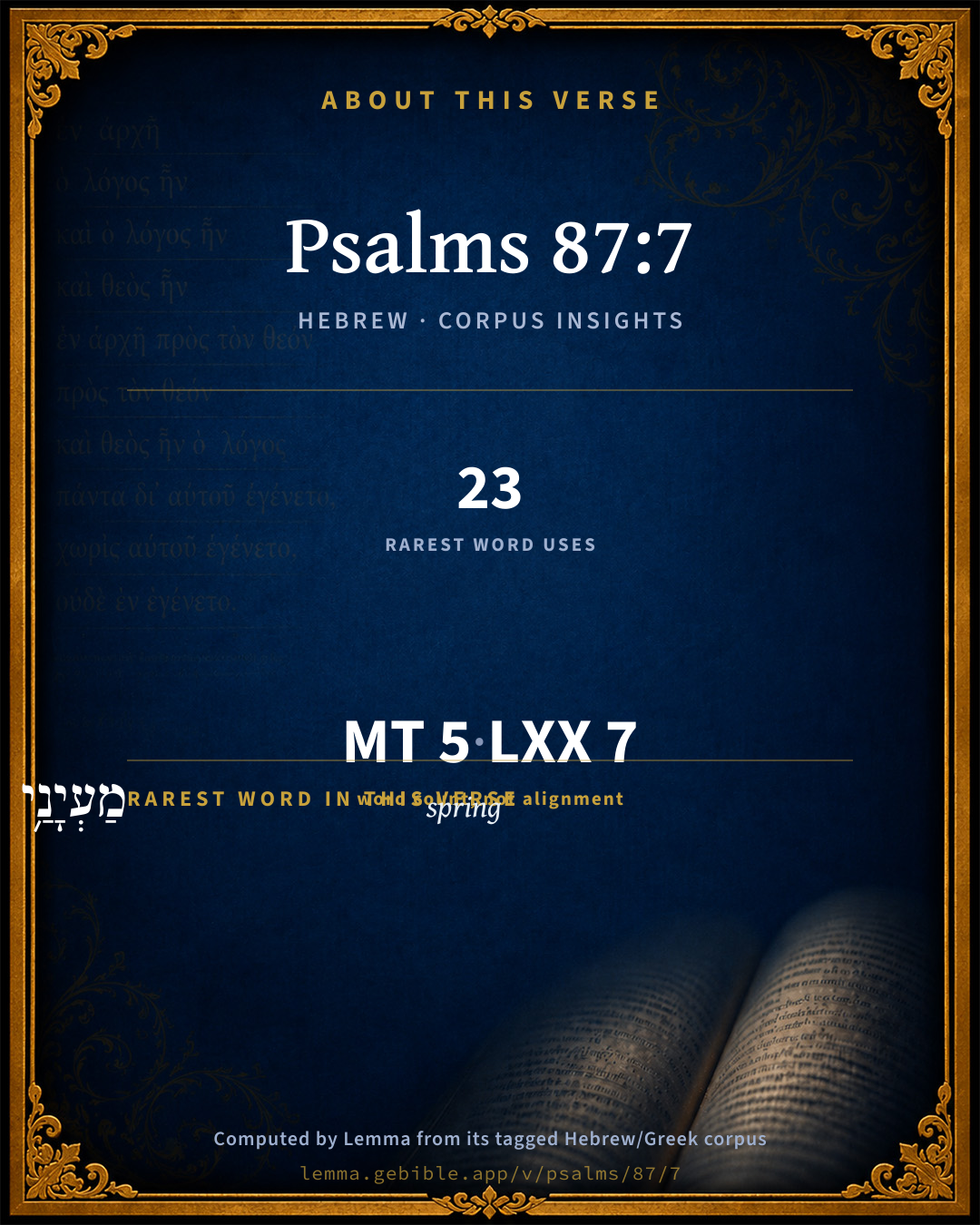
The rarest word here is מַעְיָנַ֥י spring H4599 — appearing just 23 times in the whole Hebrew Bible.

Shared distinctive vocabulary

מַעְיָנַ֥י spring H4599 occurs in 23 verses of the Hebrew Bible. Also found in:

Grammatical profile

  • 2 verbs
  • 2 nouns
  • 1 preposition

Verb forms

  • וְשָׁרִ֥ים Qal · Participle Active
  • כְּחֹלְלִ֑ים Qal · Participle Active

Hebrew & Septuagint length

In English translation the verse runs 16 words from the Hebrew and 14 from the Septuagint (LXX English) — closely comparable.

A rough comparison of the two English renderings, which tokenize alike — not a word-level alignment.

Word counts can differ between the Hebrew and the Greek without any difference in meaning — e.g. the Hebrew direct-object marker אֵת has no separate Greek word, and Greek often adds the article ὁ.

In the original languages it is 5 Hebrew tokens and 7 Greek tokens — but the two are counted differently (Hebrew bundles its prefixes and suffixes into one token; the Greek is in lemma form), so that isn’t a like-for-like length.

Cross-references

18

Topical passages linked to Psalms 87:7 in the Treasury of Scripture Knowledge — connected by theme and wording, ordered by reader-vote popularity; previews shown in the World English Bible.

  • Psalms 36:9 For with you is the spring of life. In your light shall we see light.
  • John 1:16 From his fullness we all received grace upon grace.
  • Isaiah 12:3 Therefore with joy you shall draw water out of the wells of salvation.
  • Revelation 22:17 The Spirit and the bride say, "Come!" He who hears, let him say, "Come!" He who is thirsty, let him come. He who desires, let him take the water of life freely.
  • John 4:14 but whoever drinks of the water that I will give him will never thirst again; but the water that I will give him will become in him a well of water springing up to eternal life."
  • Revelation 21:6 He said to me, "It is done! I am the Alpha and the Omega, the Beginning and the End. I will give freely to him who is thirsty from the spring of the water of life.
  • 2 Samuel 6:14 David danced before Yahweh with all his might; and David was girded with a linen ephod.
  • 1 Chronicles 23:5 and four thousand were doorkeepers; and four thousand praised Yahweh with the instruments which I made, [said David], for giving praise.
  • John 7:37–39 Now on the last and greatest day of the feast, Jesus stood and cried out, "If anyone is thirsty, let him come to me and drink!
  • Revelation 14:1–3 I saw, and behold, the Lamb standing on Mount Zion, and with him a number, one hundred forty-four thousand, having his name, and the name of his Father, written on their foreheads.
  • Revelation 22:1 He showed me a river of water of life, clear as crystal, proceeding out of the throne of God and of the Lamb,
  • John 4:10 Jesus answered her, "If you knew the gift of God, and who it is who says to you, 'Give me a drink,' you would have asked him, and he would have given you living water."
  • James 1:17 Every good gift and every perfect gift is from above, coming down from the Father of lights, with whom can be no variation, nor turning shadow.
  • Psalms 46:4 There is a river, the streams of which make the city of God glad, The holy place of the tents of the Most High.
  • Psalms 68:24–25 They have seen your processions, God, Even the processions of my God, my King, into the sanctuary.
  • 1 Chronicles 25:1–6 Moreover, David and the captains of the host set apart for the service certain of the sons of Asaph, and of Heman, and of Jeduthun, who should prophesy with harps, with psalteries, and with cymbals: and the number of those who did the work according to their service was:
  • 1 Chronicles 15:16–29 David spoke to the chief of the Levites to appoint their brothers the singers, with instruments of music, psalteries and harps and cymbals, sounding aloud and lifting up the voice with joy.
  • Psalms 149:3 Let them praise his name in the dance! Let them sing praises to him with tambourine and harp!

Cross-references courtesy of OpenBible.info (CC BY 4.0).

Hebrew and Greek witnesses Masoretic Hebrew ↔ Greek Septuagint

The same verse in the two great witnesses to the Old Testament, shown verse-for-verse.

You’re reading Greek Psalm 86 (Hebrew Psalm 87). The Septuagint counts the superscription, so verse numbers can differ from the Hebrew — chapter-level alignment, not verse-by-verse. Numbering follows Rahlfs.

These are two independent witnesses, not word-aligned to each other, and the Septuagint is shown in lemma (dictionary) form.

Hebrew Psalms 87:7 Masoretic · Westminster Leningrad Codex

וְשָׁרִ֥ים כְּחֹלְלִ֑ים כָּֽל מַעְיָנַ֥י בָּֽךְ

Those who sing as well as those who dance say, "All my springs are in you."

World English Bible · Public Domain

Greek LXX Greek Psalm 86:7 Septuagint · lemma form

ὡς εὐφραίνω πᾶς ὁ κατοικία ἐν σύ

The dwelling of all within you is as the dwelling of those that rejoice.

LXX2012 (modern English Septuagint) · Public Domain

Hebrew: Westminster Leningrad Codex (CC BY 4.0). Greek: Septuagint (public domain); English from LXX2012 (modern English Septuagint) (Public Domain). How the Septuagint differs from the Hebrew →

Commentary

Notes on Psalms 87:7 from classic Christian and Jewish commentators (each source and its license shown beneath its notes). The classic Christian expositions comment on the surrounding passage and are grouped to its opening verse, so a note may address several verses; the Jewish commentaries on the Tanakh (Rashi and others) are per-verse, so they appear only where the commentator wrote on this verse.

Lemma curates 59 commentaries, every one of them public domain or Creative Commons licensed, each selected and text-cleaned for this edition rather than reprinted as found. About our sources →

Adam Clarke's Commentary

Verse 7. As well the singers, c.] Perhaps, this may mean no more than, The burden of the songs of all the singers and choristers shall be, "All my fountains (ancestors and posterity) are in thee" and consequently, entitled to all thy privileges and immunities. Instead of שרים sharim, "singers," many MSS. and early printed editions have, sarim, "princes." Some for מעיני mayenai, "my fountains," would read with several of the Versions, מעוני meoney, "habitations;" but no MS. yet discovered supports this reading.

It would be a very natural cause of exultation, when considering the great privileges of this royal city, to know that all his friends, family, and children, were citizens of this city, were entered in God's register, and were entitled to his protection and favour. Applied to the Christian Church, the privileges are still higher: born of God, enrolled among the living in Jerusalem, having their hearts purified by faith, and being washed and made clean through the blood of the covenant, and sealed by the Holy Spirit of promise, such have a right to the inheritance among the saints in light. I need not add that springs, wells, fountains, and cisterns, and waters are used metaphorically in the sacred writings for children, posterity, fruitful women, people, c. see among others Pr 5:15-16; Ps 68:26; Isa 48:1; and Re 17:15. The old Psalter understands the whole as relating to Gospel times; and interprets it accordingly. Bishop Horne takes it in the same sense. The whole Psalm is obscure and difficult. I will venture a literal version of the whole, with a few explanatory interpolations, instead of notes, in order to cast a little more light upon it.

1. A Psalm to be sung by the posterity of Korah. A prophetic song.

2. "Jehovah loves his foundation, the city built by him on holy mountains. He loves the gates of Zion more than all the habitations of Jacob."

3. "Honourable things are declared of thee, O city of God. Selah."

4. "I will number Egypt and Babylon among my worshippers; behold Philistia and Tyre! They shall be born in the same place." They shall be considered as born in the city of God.

5. "But of Zion it shall be said, This one, and that one," persons of different nations, "was born in it, and the Most High shall establish it."

6. "Jehovah shall reckon in the registers of the people, This one was born there."

7. "The people shall sing, as in leading up a choir, All my fountains," the springs of my happiness, "are in thee."

I have nearly followed here the version of Mr. N. M. Berlin, who wonders that there should be any doubt concerning this translation of the last verse, when Symmachus and Aquila, who must have well known the sense of the Masoretic text, have translated: Και ᾳδοντης ῳς χοροι πασαι πηγαι εν σοι· "And they shall sing, as in leading up a dance, All my fountains are in thee." The translation cannot be far from the meaning.

ANALYSIS OF THE EIGHTY-SEVENTH PSALM

This Psalm contains marks of the beauty and perfection of the Church.

1. Its foundation. The author is GOD, it is his foundation; not laid in the sand, but upon the mountains, not common, but holy mountains, Ps 87:1.

2. The Lord loveth his Church-this assembly, beyond all others: "The Lord loveth," c., Ps 87:2.

3. All the prophets have spoken glorious things concerning it, and have considered it as the "city of God," Ps 87:3.

4. One of the glorious things spoken of it was the conversion of the Gentiles to it. So here Egyptians, Babylonians, Tyrians, Ethiopians, c., are to be gathered into it by regeneration. They shall all be brought to know the true God and shall be classed in the multitude of those who know him, i.e., who offer him a pure and holy worship, Ps 87:4.

5. By having the word of God in this true Church, they shall be converted to God so that it may be said, "This and that man were born to God in it," Ps 87:5.

6. All other cities shall decay and perish; but the Church of God, the city of the Great King, shall be established for ever, the gates of hell shall never prevail against it, Ps 87:5.

7. The converted Gentiles shall have equal privileges with the converted Jews; and in the Christian Church they shall all be enrolled without difference or precedence, Ps 87:6.

8. They shall enjoy a perpetual solemnity. They shall ever have cause to sing and rejoice, Ps 87:7.

9. The highest privilege is that in God's Church he opens the fountains of living water; in his ordinances God dispenses every blessing; every sincere and upright soul rejoices in opportunities to wait on God in his ordinances. Such a one can sing, "All my springs are in thee." All other fountains are muddy; this alone is as clear as crystal. Worldly springs yield no pure delight; all there are mixed and turbulent: all here are refreshing, satisfying, delightful.

Adam Clarke's Commentary on the Bible (1810–1826) — public domain. Text from a community e-Sword/MySword module.

Trapp's Complete Commentary

John Trapp

Psa 87:7 As well the singers as the players on instruments [shall be there]: all my springs [are] in thee.

Ver. 7. As well the singers as the players, &c.] There shall be an exuberancy of joy in the Holy Ghost, the only comfortable soul ravishing music, far beyond that of the material temple.

All my springs are in thee] i.e. All my thoughts run upon thee, with greatest delight. My eyes are wholly fixed upon thee, so some read it; others, My bowels are in thee, making these to be the words of the psalmist (Calvin; R. Solomon); but methinks they do better that make them to be the words of God, promising plenty of grace and comfort to his people, as from everflowing, overflowing fountains.

John Trapp, A Commentary or Exposition upon All the Books of the Old and New Testament (1647–1656) — public domain. Text from a community e-Sword module.

The Biblical Illustrator

Joseph S. Exell

Psa_87:7

As well the singers as the players on instruments shall be there.

Music an epitome of life

Music does a great many things for us. It pleases the senses, it affords aesthetic delight, it calms perplexed feelings, it nerves the soldiers heart to battle, it soothes the babe upon its mothers breast, it thrills the maidens heart with love, it consoles the mourners grief and hallows it, it spurs the rapture of the dance, and moderates and sanctifies the march to the tomb. What man would but cannot, music seems to do for him. When his deed lags, she strengthens him; when his spirit falters, she inspires; when his voice is dumb, she speaks for him. In a word, music is capable of supplementing mans finitude, and opening for him the realm of his ideals and his aspirations. And this is the explanation of its power to do so much for us, and be so much to us, because in its own terms it has a capacity of expressing life. This is at once an explanation of its power and a statement of its inscrutable mystery, that it is fitted to be the common language of the universal sentiment of humanity. As good old Father Haydn said of it, My language is understood all over the world. So, in recognition of this capacity to portray human experience and to reflect human sentiment, I have chosen to consider music as an epitome of life. One essential of music is based on time, and consists in the relation of notes to each other measured by duration. The savage beating his tom-tom is the rudimentary musician. The human ear is earliest susceptible to the impression of rhythm. Yet so radically and perpetually essential is this feature that the most elaborate symphony is dependent on it equally with the primitive drum-beat. Lacking it, either one would be incoherent, would cease to be music, and would become simply noise. This is manifest, but now where shall we find in life the equivalent of this essential term? What is the pulse of the moral life, the heart-beat of conduct as rhythm is the heart-beat of song? What imparts measure and meaning and impulse to the otherwise unrelated activities, and sets them in order in intelligible succession? What, if not the exercise of will, the putting forth of purpose? Yes, purpose is to life what rhythm is to song. Beside time, the other evident essential of music is tune, in which also we may discern some suggestive parallel to life. The possibility of tune depends on that mysterious feature of music we call the scale or the octave. These eight tones of relative pitch that compose the octave, with their semitones of the chromatic scale, furnish the material out of which all music is composed. Melody, which is a sort of harmony, and harmony, which is in turn a sort of condensed melody, both equally flow from this mysterious relation that sounds bear to each other, and depend on it. Not a single note in music stands alone in its significance. We are not far, then, from recognizing what is signified concerning human life, in the fact that music rests on the relation of note to note, of part to part. The parallel truth is that no man liveth to himself. Selfishness excludes one from the harmony of being. As the notes in the scale are fitted by their mutual relations to portray ideal beauty, so are we constituted for each other, attaining the roundness, the completeness, the satisfaction of life, never in ourselves alone, but only as we stand related to each other in the significance of that scale of character that imparts the meaning to life, and in this large relation we all inevitably stand for discord or for harmony. A closing parallel may be drawn from the motive of music. Its material it takes from time and tune, its method is obedience, and its motive is love. Each individual musical entity gives itself to the use and being of the whole. How the symphony exemplifies this truth! Each note is woven as a mesh in the network of tone; each part contrasts and amplifies every other part; each instrument sets in other colour the utterance of its neighbour--the violins in clear intensity of utterance give forth the theme, and then they part, some to maintain it, others to adorn it; the flutes and clarionets and oboes touch it with a sylvan tone; the lower strings grant it the fervour of their passionate thought; the horns breathe calm and clear; the trumpets sound the voice of resolute affirmation, while the basses solidly support them all: so many voices, yet with one harmonious theme, it is the picture of a community of inspired souls with a common purpose. Therein the finite escapes from its bondage and restriction, and goes out into the Infinite. Hear the words of the Christ, having identical import: He that loseth his life shall find it. Let a man deny himself, and he shall have a part in My eternal kingdom. Let the finite humble itself, and it shall be exalted to share in the Infinite. A definition has been given of music, at once most philosophical and most poetical--a single line by Sidney Lanier:--

Music is love in search of a word.

Yea, this is its one abiding theme; not the mere feeling of affection and selfish preference, not of mawkish sensibility, the expression of which is musics bane and curse and disgrace, but love that comes from a humble consciousness of the worth of personal being, and that in the spirit of consecration and of self-bestowment devotes itself to that fulness of being of which its character enables it to supply a part. Music is love in search of a word. True life is love striving for perfect utterance in word and deed. (C. F. Carter.)

All my springs are in Thee.

Christ Jesus the fountain of grace

I. In Jesus Christ are the springs of pardoning mercy. This is the root of every other mercy.

II. A Christian acknowledges all his springs of sanctifying grace to be in Jesus Christ. As the streams of a fountain are directed into various channels to water every part of the garden in which it springs, so doth the grace of God, in Jesus Christ, gush forth from its unfathomable depth of mercy, into every sentiment of the heart and mind of a sincere believer. It rectifies the erring judgment--it corrects the perverted will--it sanctifies the affections, weaning them from the vanities of earth and the defilement of sin, and turning them to dwell with complacency and with delight upon the supreme realities of eternal things. It quickens every languishing grace, and unites all the parts of Christian character in one supreme desire to glorify God.

III. The springs of that peace and joy with which a Christian is filled in believing, are also found in the Son of God, as He is present with His Church. O if the sight of Joseph at Pharaohs right hand, in favour and honour with the King of Egypt, could send the patriarchs home to Canaan with such joyful news to their aged father, what a message of delight must faith carry to the soul when it comes after a visitation of mercy in those services in which it hath contemplated the glory of Christ, and its own interest in that glory! With joy, even with joy unspeakable and full of glory, may such a soul draw water out of the wells of salvation.

IV. The springs of hope that cheer and bless the pilgrimage of a Christian, are derived from the great Head of the Church. To Him are given exceeding great and precious promises; and a view of the unchangeable fidelity of his Father, in the covenant of love by Jesus Christ, fills him with a hope that maketh not ashamed.

V. The springs of eternal glory proceed from the Son of God. The righteousness, the holiness, which constitutes the character of true Christians, and the blessedness with which it will be recompensed, are all given by Christ to the Church. They who possess them are the seed which should prolong their days, or be happy for ever. In them He sees of the travail of His soul, and is satisfied. Here the gracious purpose of Jehovah prospers in His hands, perfectly and for ever. (R. P. Buddicom, M. A.)

A song of triumph

I. The Christian requires divers kinds of blessings, and these are all furnished for him. Not one rill of supply merely, but many springs.

1. We will speak first of that spring which may be called sanctification, which washes us from daily accumulating evil, and checks our own depravity--which makes us more holy, and more fit to become partakers of the inheritance of the saints in light.

2. Sustaining grace.

3. Wisdom to direct.

4. Strength and assistance in every time of need.

5. Joy and comfort.

II. Where are these springs to be found? In Jesus our Lord and our God. It is of the Fathers grace that the Spirit gives us from Jesus fulness, so that we can never faint or fail. The wisdom of this arrangement will be evident if we consider--

1. Our own folly.

2. Our weakness.

3. Our great ingratitude and forgetfulness of God.

4. Our tendency to pride.

5. We admire this plan because it exalts God the Father, Son, and Holy Ghost. It makes us to come often into their presence to acknowledge our need and to extol God as alone able to supply it. (J. A. Spurgeon.)

.

Psa_88:1-18

The Biblical Illustrator, edited by Joseph S. Exell (c. 1880s–1900s) — public domain. Text from a community e-Sword module.

Joseph Benson's Commentary

Psa 87:7. As well the singers, &c., shall be there — That is, in the church, and among the people of God. Indeed God’s people have the greatest, nay, the only cause of rejoicing, being his children, and heirs, and joint heirs with Christ. As to all others, the divine injunction is, Be afflicted, and mourn and weep: let your laughter be turned into mourning, and your joy into heaviness. But the psalmist seems here to intimate, that when the prediction, contained in the preceding verses, should be fulfilled, and the Gentiles should be converted, and added to the church, there should be great rejoicing and praising of God, both with vocal and instrumental music, for that glorious event. He describes evangelical worship by legal phrases and customs, as the prophets frequently do. All my springs are in thee — In Zion, or the church. All graces, comforts, privileges, and blessings, are to be found in thee, O church of God, and are only to be expected in and through the word preached, and the ordinances administered there. These words are thought by many commentators to be here added as the burden of the song which the forementioned singers are supposed to sing, either in their own names, or in the name of the people of God. And so the sense is, all our desires and delights are in thee, O Zion. All the springs of mercy, grace, and glory, flow to us only in and through thee.

Joseph Benson's Commentary on the Old and New Testaments (1811–1818) — public domain. Text from a community e-Sword module.

J. A. Alexander on Psalms

Joseph Addison Alexander

7. (Psa 87:7) And singers as well as well as players (shall be heard saying), All my springs are in thee. The construction in the first clause is peculiar, singers as players. See above, on Psa 48:5. The image present to the Psalmist's mind seems to be that of a procession or triumphal march, composed of the nations on their way to Zion. At the head of this procession are the minstrels, who, as the spokesmen of the rest, acknowledge that the source of their happiness is henceforth to be sought in Zion, not as a mere locality, but as the place where God was pleased to manifest his gracious presence. It matters little, therefore, whether the closing words (in thee) be referred to God directly, or to Zion, as the channel through which he imparted spiritual blessings to the gentiles. Compare the figure of a spring or stream in Joe 3:18, Zec 13:1; Zec 14:8, Eze 47:1, and see above, on Psa 84:6. The word joined with singers admits of a twofold derivation, and may either mean players upon instruments, or still more definitely, pipers, as the players on stringed instruments are named in the same connection, Psa 68:25; or as some of the latest interpreters prefer, it may mean dancers, as this indication of joy was commonly practised, in connection with singing, not only by women but by men. See above, on Psa 30:11, and below, on Psa 150:4. and compare Exo 15:20, 2Sa 6:16. The Selah at the end of the preceding verse shews that the variations of the main theme are concluded, and separates the body of the psalm from this verse, which contains the words neither of the Psalmist nor the Church nor God himself, but of the converted Gentiles.

Joseph Addison Alexander, The Psalms Translated and Explained (1850) — public domain. Text from a community e-Sword module.

Geneva Bible (1599)

Geneva Bible translators

The Prophet setteth his whole affections and comfort in the Church.

Geneva Bible (1599) marginal notes — public domain. Text via Bolls.life.

John Calvin's Commentaries

The meaning of this verse is obscure, partly from its abrupt brevity, and partly from the ambiguity of one word. The word springs is, beyond all controversy, to be here taken metaphorically; but interpreters are not agreed as to the explanation of the metaphor. Some understand it as denoting hopes, some affections, and others thoughts. Did the idiom of the language admit, I would willingly subscribe to the opinion of those who translate it melodies or songs. But as this might be considered unsupported by the usage of the Hebrew term, I am rather inclined to adopt, as most suitable to the subject in hand, the opinion that lookings is the proper translation, the root of the word signifying an eye. It is as if the Psalmist had said, I will always be earnestly looking, as it were, with fixed eyes upon thee.

Let us now inquire what is meant by the other clause, The singers as the players upon instruments. This, it is true, is an abrupt form of expression; but the sense, about which there is a general agreement, is, that so great will be the ground for rejoicing, that the praises of God will resound in Zion continually, with the energy of the living voice, as well as with musical instruments. This, then, is a confirmation of what was spoken before concerning the glorious restoration of Zion; for by the greatness of the joy, and the manifold harmony and melody of praises, is portrayed the happiness which shall prevail in the midst of it. At the same time, we have here described the great design of all the gifts which God has conferred upon his Church with so liberal a hand; namely, that the faithful, by hymns and songs, should testify their remembrance of his benefits and gratefully acknowledge them. The Hebrew word חוללים, cholelim, which we have rendered the players upon instruments, is translated by some, those who dance to the sound of instruments. But this is a matter of no great importance, it being enough to consider the meaning, in short, as this, that there will be a continual concert of God’s praises in the Church, where he unfolds the treasures of his grace, and that the faithful will be heard singing successively and in response. Moreover, the prophet shows his singular love to the Church, and the singular care and zeal which he exercised about her, to encourage and stir up all the godly, by his example, to cultivate and manifest the same zeal, agreeably to what is stated in another psalm,

“If I forget thee, O Jerusalem! let my right hand forget her cunning. If I do not remember thee, let my tongue cleave to the roof of my mouth; if I prefer not Jerusalem above my chief joy.” (Psalm 137:5)

All our affections are then settled on the Church, when, gathered in from the vague and vain objects by which they are distracted, and regarding with indifference the honors, pleasures, riches, and pageantries of the world, they find enough to engage and satisfy them in the spiritual glory of Christ’s kingdom, and in that alone.

John Calvin's Commentaries (1540-1563) — public domain. Text from the Calvin Translation Society English edition (1840s-50s) via the Christian Classics Ethereal Library (ccel.org). Calvin's coverage is partial (roughly two-thirds of the Bible); uncommented books and verses are honest gaps, never fabricated. The 19th-century editor's footnotes and remarks are omitted so the notes are faithfully Calvin's own voice.

Ellicott's Commentary for English Readers

(7) The literal sense of this most obscure verse is—

“And singers as trumpeters

All my springs in Thee,

which we may paraphrase, keeping in the same line with the rest of the psalm, For such an one (celebrating his birthday, Gen_40:20, Mat_14:6) the singers and musicians will sing (to Zion), “All my offspring is in Thee.” Not only is it a boast to have been born in Zion, but in the genuine Hebrew spirit the boast is continued into the future generations, and the Hebrew of the Hebrews exults in addressing the sacred city as the cradle of his family.

For this figurative application of the word “springs” to posterity, comp. Psa_68:26; Isa_48:1; Pro_5:16.

A Bible Commentary for English Readers, edited by Charles John Ellicott (1878–1897) — public domain. Text from a community e-Sword module.

The Cambridge Bible for Schools and Colleges

gen. ed. J. J. S. Perowne

7. Conclusion. The Psalm ends as abruptly as it began, with a verse which is enigmatic in its brevity. It is best explained as an outline picture of the universal rejoicing with which the citizens of Zion greet their mother.

And singing as well as dancing (shall they chant,)

‘All my fountains are in thee.’

The rendering dancing is preferable to playing on the flute (cp. A.V., R.V. marg.). For dancing as an expression of religious rejoicing see Psa_30:11; Psa_149:3; Psa_150:4; Exo_15:20; 2Sa_6:16.

The second line is their anthem. It may even be a fragment of some well-known hymn. My fountains is to be understood metaphorically, as ‘fountains of salvation’ in Isa_12:3. Cp. Psa_36:9 f.; Psa_84:6; Eze_47:1; Joe_3:18; Zec_14:8. It is possible, but less satisfactory, to take the verse as the Psalmist’s apostrophe to Zion:

Both they that sing and they that dance,

All my fountains are in thee:

“meaning that every source of pleasure, music, singing, &c. was to be found in Zion” (Bp Perowne). So Milton in his paraphrase:

Both they who sing and they who dance

With sacred songs are there;

In thee fresh brooks and soft streams glance,

And all my fountains clear.

The obscurity of the verse must however be acknowledged. Cheyne thinks that it may be “a fragment of a description of a joyous procession.” Cp. Psa_68:25. Is it possible that it is not, strictly speaking, part of the Psalm, but a liturgical direction to sing the anthem “All my fountains are in thee” at the end of the Psalm, as an expression of the joy of Zion’s citizens?

The Cambridge Bible for Schools and Colleges (gen. ed. J. J. S. Perowne; Cambridge University Press, 1878–1918) — public domain. Text from a community e-Sword module.

John Gill's Exposition

As well the singers as the players on the instruments shall be there,.... In Zion, in the church; signifying that there should be great spiritual joy there when the above things should be accomplished; great joy in the churches, because of the conversion of Jews and Gentiles; and great joy in the persons themselves, born again, and brought to Zion; in allusion to the vocal and instrumental music used in the temple service; see Isa 35:10.

all my springs are in thee; which are either the words of the psalmist, or rather of the souls born in Zion; who, in their spiritual songs, will thus express themselves concerning the church, in which are the word and ordinances, compared to fountains of living water, and are springs of spiritual peace and refreshment to converted persons; see Joe 3:18, where also the Spirit and his graces are communicated by the ministry of the word and ordinances in the church, which are signified by wells and rivers of living water, Joh 4:14 and particularly here stands Christ, the fountain of gardens, and well of living waters, for the supply and comfort of saints, and his blood a fountain opened for cleansing and purification, Sol 4:15, yea, here flows the river of God's love, the streams whereof make glad the city of God; and which, like the waters in Ezekiel's vision, come from under the threshold of the sanctuary, Psa 46:4 or the words may be considered as an address of the psalmist, or of the church, or of regenerate persons, unto Christ:

all my springs or fountains are in thee; the fulness of grace dwells in him, the springs of all joy, and peace, and comfort, are with him; the wells of salvation are in him, and both grace and glory are from him; he is the spring of all grace now, and the fountain of all happiness hereafter. Gussetius (z) has a very peculiar version of the whole text, which he renders thus

"all my fountains will be singing in thee, or of thee, as those that dance at the sound of the pipe:''

taking the allusion to be to the playing of fountains in gardens, and to the delightful sound the waters make; but the accents will not admit of such a sense.

(z) Comment. Ebr. p. 845.

Next: Psalms Chapter 88

John Gill's Exposition of the Whole Bible (1746–1763) — public domain (CC PDM 1.0). Text via the HelloAO Bible API.

Albert Barnes' Notes on the Bible

As well the singers as the players on instruments shall be there - literally, “The singers as the players on instruments.” The image is that of a musical procession, where the singers go before, followed by those who play on various instruments of music. The idea seems to be that when the number of the true friends of God shall be made up, or shall all be enrolled, there will be a triumphal procession; or, they are seen by the psalmist, moving before God as in a triumphal procession. Compare the notes at Isa 35:10. Perhaps the reference is to heaven - the true Zion; to the assembling of all who shall have been born in Zion, and who shall have become citizens of the true Zion, the Jerusalem above.

All my springs are in thee - The word rendered springs means properly a place of fountains (see the notes at Psa 84:6), and also a fountain, Gen 7:11; Gen 8:2. It thus becomes an emblem of happiness; of delight; of pleasure; and the ideal here is that the highest happiness of the psalmist was found in what is here referred to by the word “thee.” That word may refer either to God or to Zion; but as the subject of the psalm is Zion, it is most natural to suppose that the reference is to that. Thus it accords with the sentiment so often found in the Psalms, where the writer expresses his love for Zion; his pleasure in its solemnities; his desire to abide there as his permanent home. Compare Psa 23:6; Psa 84:2-4, Psa 84:10. The idea has been beautifully expressed by Dr. Dwight, in his version of Psa 137:6 :

“I love thy church, O God;

Her walls before thee stand,

Dear as the apple of thine eye,

And graven on thy hand.

“If e’er my heart forget

Her welfare or her woe,

Let every joy this heart forsake,

And every grief o’erflow.

“Beyond my highest joy

I prize her heavenly ways.

Her sweet communion, solemn vows,

Her hymns of love and praise.”

Albert Barnes' Notes on the Bible (1834–1885) — public domain. Text from a community e-Sword/MySword module.

Matthew Poole's English Annotations

There shall be great rejoicing and praising God, both with vocal and instrumental music, for this glorious and stupendous work of the conversion of the Gentiles. He describes evangelical worship by legal phrases and customs, as the prophets frequently do.

In thee, i.e. in Zion, or the church. These words may be here added as the burden or matter of the song, which these singers are supposed to have sung; and that either,

1. In their own names, and in the name of all the Zionites or people of God. So the sense is, All our desires and delights are in thee, all the springs of mercy, grace, and glory flow to us only in and through thee; for springs or fountains are oft put for all precious or desirable things, as Psa 36:9; Isa 12:3; Hos 13:15. Or,

2. In God’s name, whose words were frequently sung by the singers in the Old Testament. And so the sense is, All the springs or fountains of good things, or of my blessings are in Zion, or in the church, out of which no true blessings are to be expected or found. And this sense seems best to suit with the phrase, my springs; partly because it seems more proper to call them God’s springs, who is the author and giver of them, than men’s springs, who are only the receivers of them; and partly because this is more agreeable to the phrase and usage of Scripture, which every where ascribes and appropriates them to God.

Matthew Poole's English Annotations on the Holy Bible (1683–1685) — public domain. Text from a community e-Sword/MySword module.

The Treasury of David

Charles H. Spurgeon

Ver. 7. In vision the Psalmist sees the citizens of Zion rejoicing at some sacred festival, and marching in triumphant procession with vocal and instrumental music:

As well the singers as the players on instruments shall be there. Where God is there must be joy, and where the church is increased by numerous conversions the joy becomes exuberant and finds out ways of displaying itself. Singers and dancers, Psalmists and pipers, united their efforts and made a joyful procession to the temple, inspired not by Bacchus, or by the Castalian fount, but by draughts from the sacred source of all good, of which they each one sing

All my springs are in thee. Did the poet mean that henceforth he would find all his joys in Zion, or that to the Lord he would look for all inspiration, comfort, strength, joy, life and everything. The last is the truest doctrine. Churches have not such all sufficiency within them that we can afford to look to them for all, but the Lord who founded the church is the eternal source of all our supplies, and looking to him we shall never flag or fail. How truly does all our experience lead us to look to the Lord by faith, and say "all my fresh springs are in thee." The springs of my faith and all my graces; the springs of my life and all my pleasures; the springs of my activity and all its right doings; the springs of my hope, and all its heavenly anticipations, all lie in thee, my Lord. Without thy Spirit I should be as a dry well, a mocking cistern, destitute of power to bless myself or others. O Lord, I am assured that I belong to the regenerate whose life is in thee, for I feel that I cannot live without thee; therefore, with all thy joyful people will I sing thy praises.

"With joy shall sing the choral train,

The minstrels breathe the answering strain:

`O Zion, Zion fair, I see

The fountains of my bliss in thee.'"

Ver. 7. The singers; the players on instruments. Song and music were prominent features of Divine worship in David's time. This is evident from the large number of two hundred and eighty-eight Levites who were expressly appointed for singing and the performance of music. Not less than two hundred and fifty-five singing men and singing women returned from the exile...The chief instruments used by the Levites were, according to the records of the Books of Chronicles, cymbals, harps, and lutes: according to Ps 5:1-12 (title), we should add the flute, which is frequently noticed on Egyptian monuments. Augustus F. Tholuck.

Ver. 7. (First clause). For all its inhabitants are expert musicians; lit. Sing like flute players. The Hebrews seem to have surpassed all nations in the skill of poetry and music; and every citizen could sing and dance. This preeminence the Psalmist seems to hint at. Alexander Geddes.

Ver. 7. All my springs are in thee. The original word ynyem, which we render "springs", is used in a figurative sense, to denote any one's posterity. Thus Pr 5:16, "Let thy fountains be dispersed abroad"; i.e., thy posterity be exceeding numerous. And thus in the place before us: the inhabitants of Jerusalem should triumph and sing, "All my springs", or fountains, all my friends, my family, my children, are in thee, are thy citizens, enjoy the glorious privileges thou art favoured with, are all inserted in God's register, and entitled to his protection and favour. Thus there is a harmony and connection between all the parts of this ode, which I think is very intelligible and poetical. Samuel Chandler.

Ver. 7. All my springs are in thee. Whatever conduit pipe be used, Christ is the fountain and foundation of every drop of comfort; Christ is the God of all true consolation. It is not in the power of all the angels of heaven to give any soul one drop of comfort, nor can all on earth give you one drop of comfort. They can speak the words of comfort, but they cannot cause the soul to receive comfort. God comforts by them, 2Co 7:6. Titus was but an instrument. Comforting is called frequently in Scripture the speaking to the heart, Ho 2:14. Who is able to speak to the heart but he who is the Lord and commander of the heart? God hath put all the oil of spiritual joy into the hands of Christ, Isa 61:3, and none but he can give it out. He that wants comfort must go to Christ, he that hath received any true comfort must ascribe it to Christ. "All my springs", saith the Church, "are in thee." Ralph Robinson.

Ver. 7. The silver springs of grace, and the golden springs of glory are in him. Thomas Watson.

Ver. 7. Springs. The meaning of this verse is obscure, partly from its abrupt brevity, and partly from the ambiguity of one word. The word "springs" is, beyond all controversy, to be here taken metaphorically; but interpreters are not agreed as to the explanation of the metaphor. Some understand it as denoting hopes, some affections, and others thoughts. Did the idiom of the language admit, I would willingly subscribe to the opinion of those who translate it melodies or songs. But as this might be considered unsupported by the usage of the Hebrew term, I am rather inclined to adopt, as most suitable to the subject in hand, the opinion that lookings is the proper translation, the root of the word signifying an eye. It is as if the Psalmist had said, I will always be earnestly looking, as it were, with fixed eyes upon thee. John Calvin.

Ver. 7. My springs.

Whether songs or melodies

In Thee are all my well springs.

This passage is given obscurely in most of the versions; it is here rendered strictly, and, as the author hopes, perspicuously. As the Greeks had their Pierian springs, their fountains of Aganippe dedicated to the Muses, Jerusalem had, in like manner, her sacred springs, her fountains of inspiration, in a much higher degree. It is to these the holy bard alludes in the passage before us, as Milton does in the following, who has perhaps copied from the present in his address to the "Heavenly Muse":

"Or if Zion's hill

Delight thee more, or Siloa's fount that flowed

Hard by the oracle of God, I thence

Invoke thine aid to my adventurous song." John Mason Good.

Ver. 7. All my springs. Fitly may we here quote the delightful hymn of Robert Robinson which has puzzled so many, but which has in it a fine classical allusion to Hippocrene and Mount Parnassus.

"Come, thou fount of every blessing,

Tune my heart to sing Thy grace,

Streams of mercy, never ceasing,

Call for songs of loudest praise.

Teach me some melodious sonnet,

Sung by flaming tongues above:

Praise the mountoh fix me on it,

Mount of God's unchanging love." C.H.S.

Ver. 7.

1. In God our joy.

2. From God our supplies.

3. To God our praise.

Ver. 7. (last clause). All the springs within me, all the springs which flow for me, are in my God. There are "upper and nether springs", springs "shut up", "valley" springs (Ps 104:10), rock springs, & c.; but all these flow from the Lord.

In "Sermons preached before the University of Oxford...by John Eveleigh, D.D., 1815, "is "Sermon, twelve, in which is proposed a New Interpretation of the Eighty-Seventh Psalm."

The Solace of Sion, and Joy of Jerusalem. Or consolation of God's Church in the latter age, redeemed by the preaching of the Gospel universally. Being a godly and learned exposition of the Eighty-Seventh Psalme of the Princelye Prophet David: Written in Letine by the reverend Doctor Urbanus Regius, Pastor of Christes Church at Zelle, in Saxonie 1536. Translated into English by R. Robinson, Citizen of London, 1587.

Charles H. Spurgeon's The Treasury of David (1869–1885) — public domain. Psalms only. Text from a community e-Sword/MySword module.

Whedon's Commentary on the Bible

Daniel D. Whedon

7. As well the singers as the players on instruments shall be there— The words “shall be there” are not in the text, and they destroy the sense. The Hebrew is exceedingly abrupt and elliptical, but the sense may be thus given: And the singers, as well as the fluters, [shall say, as the burden of their song,] All my springs are in thee, that is, in Zion. The image before the poet was that of multitudes of converts, from all nations, coming to Zion in joyful procession, with bands of singers and pipers, making Zion the theme of their song. “The Korahite author,” writes Bishop Alexander, “himself a chief singer in the sanctuary, does not grudge the admission of foreign nations into the sacred choir, but with generous and largehearted sympathy rejoices in the prospect.” Thus, also, Bishop Mant:—

“With joy shall sing the choral train,

The minstrels breathe the answering strain;

‘O Zion, Zion fair, I see The fountains of my bliss in thee.’”

“And if such be indeed the incomparable excellence of the Church, and such the benefit of her communion, as they have been set forth in the foregoing verses, what anthem better deserves to be performed by all her choirs?”—Horne. Isa_2:3; Isa_12:3; Joh_4:22.

Daniel D. Whedon (gen. ed.), Commentary on the Old and New Testaments (1874–1909) — public domain. Text from a community e-Sword module.

The Pulpit Commentary

As well the singers as the players on instruments; literally, and singers as well as dancers shall say. (On dancing as an element of religious service, see Exo_15:20 2Sa_6:16 Psa_68:25 Psa_149:3 Psa_150:4) The psalmist intends to represent the converted nations as coming in a grand procession, with songs and dances, to celebrate their admission to Zion, and there one and all exclaiming, All my fresh springsi.e. "all my sources of life, and joy, and happiness are in thee. The verse is possibly but "fragment," as Professor Cheyne supposes.

Various powers used in God"s service.

"As wall the singers as the players on instruments." This expresses admiration of the services and ceremonies in connection with Jehovah"s temple; and it suggests the thought that Divine worship ought to be made in every way delightful. But another thought is suggested by the marked distinction made between the "singers" and the "players." It is that the gifts and endowments of men are very various, but whatever may be their variety, they can all be taken up into the service of God and the service of God"s people. Some can sing; then encourage them to sing. Some can play; then use their skill in playing. Find what a man can do, and accept, for God, just the service he can render.

I THE REMARKABLE VARIETY OF HUMAN GIFTS. Examine them first as simply human gifts. Poetry, eloquence, art, science, government, do but, in the large, represent the thousandfold lesser forms of endowment which fit men for their varied places in life. Yet in common everyday life there is a place and a work for every one. Show that this includes kinds of gifts with which we may have no personal sympathy, such as mimicry, satire, humour, etc. Then examine those particular gifts which were granted to the early Churches tongues, prophecy, interpretation, etc.

Bring out that while each man has much in common with his fellows, each man also has something special to himself, something which constitutes his individuality. In the line of the use of that specialty will be found to lie his life mission.

II THE POSSIBLE USE FOR HUMANITY OF ALL HUMAN GIFTS. There is a danger of religious people unduly limiting the service of humanity. Sometimes, in an exclusive spirit, pious persons speak as if there were no real service to humanity save that which their religion sanctions. We may hold that all conceivable endowments may be sanctified, and ought to be sanctified, by being used for God consciously in God"s service. But we had better be more generous in our thinking, and say that everything that helps lift a human burden, cheer a human soul, brighten a human life, relieve a human strain, or perfect the human brotherhood, is the service of God. Some gifts bear a character, or are so small in measure, that men think of them as the one talented man thought of his talent. But he thought wrongly, and so do they. In God"s earth there is nothing that has not its use. In God"s world of men there is no gift without an answering sphere. Singers and players shall both be there, R.T.

Joy fountains in God.

Prayer book Version, "All my fresh springs shall be in thee." Jennings and Lowe render," All my well springs of delight are singing aloud like instrument players because of literally, "in thee." The springs are evidently our springs of gladness; and the sentence is best given thus: "Both they that sing and dance, all my fountains of delight are in thee;" with this as the meaning, "every source of pleasure, song, music, dancing, etc., was to be found ha Zion." The psalmist is praising Zion, not directly praising God: so his figures are naturally taken from the pleasures of the holy city, and especially of the sacred temple and its services. Remember that David had devoted genius and skill to the improvement of worship; had introduced music and poetry, until the old sombre ritual of Mosaism had become glorified. The joy of God"s everyday service ought to be illustrated by the brightness, attractiveness, and holy joy of our sanctuary services. Men ought to feel that it must be a joy to serve God always, because it is such an evident joy to serve God sometimes.

I JOY FOUNTAINS IN GOD"S WORSHIP.

II JOY FOUNTAINS IN DAILY LIFE.

III JOY FOUNTAINS IN WHAT GOD HAS DONE FOR US.

IV JOY FOUNTAINS IN WHAT GOD IS DOING FOR US.

V JOY FOUNTAINS IN GOD HIMSELF. "When all created streams are dried, his fulness is the same.

Impress that true religion cannot be gloomy and depressing. Its atmosphere of trust is an atmosphere of gladness. We are saddened if we look down upon the path of our feet; or in upon our frail selves; we need never be saddened if we look up off unto Jesus, the Author and Finisher of our faith." We may find ever fresh flowing springs of delight in God, and in this world of God"s which is his Zion for us. R.T.

The Pulpit Commentary (1880–1919), ed. H.D.M. Spence-Jones & Joseph S. Exell — public domain. Text from a community e-Sword module.

John Wesley's Explanatory Notes

Singers - There shall be great rejoicing and praising God, both with vocal and instrumental musick, for this glorious work of the conversion of the Gentiles. He describe's evangelical worship, by legal phrases and customs, as the prophets frequently do. In thee - In Zion or the church. These words may be here added as the burden of the song, which these singers are supposed to have sung, in the name of all the people of God. All our desires and delights are in thee, all the springs of mercy, grace, and glory, flow to us only in and thro' thee.

John Wesley, Explanatory Notes Upon the Whole Bible (1754–1765) — public domain. Text via the GEBible commentary corpus.

unfoldingWord translationNotes

Door43 World Missions Community

All my fountains are in you

Jerusalem being a place where people receive all their blessings is spoken of as if Jerusalem were a spring that provided water to the people. (See: Metaphor)

translationWords

fountain

unfoldingWord translationNotes — © Distant Shores Media and the Door43 World Missions Community, licensed CC BY-SA 4.0. Source: git.door43.org/Door43/en_tn.

Rashi

Rabbi Shlomo Yitzchaki (Rashi)

And singers as well as flute players concerning this.

with you With your salvation.

as well as flute players Heb. כחללים, an expression of (Jud. 21:21) בַּמְחֹלוֹת, musical instruments.

Rashi on the Tanakh — English translations: “The Judaica Press complete Tanach with Rashi, translated by A. J. Rosenberg” (CC BY 4.0); “Pentateuch with Rashi's commentary by M. Rosenbaum and A.M. Silbermann, 1929-1934” (public domain); “The Metsudah Tanach series, Lakewood, N.J” (CC BY 4.0); and “The Book of Joshua, Metsudah Publications, 1997” (CC BY 4.0). Text via Sefaria.

Lesson kit

Teaching starters — assembled from the data on this page, not authored interpretation. Every prompt links to the verse data it draws on. Edit before teaching.

Psalms, in the Wisdom, opens this verse with 5 words (4 distinct Hebrew lemmas). Its most distinctive word is maʻyân (“spring”). A historical commentator’s framing appears above. Read the whole chapter for the surrounding context.

Discussion questions

  1. What does “spring” (maʻyân) contribute to the verse as a whole?
  2. Genesis 7:11 shares the word «spring» with this verse. How do the two illuminate each other?
  3. The translations on this page render this verse differently — a whole-verse word diff, not a word-by-word alignment. What might account for the different wordings?
  4. The verb «וְשָׁרִ֥ים» is Qal Participle Active. How does its form color the action?
  5. Reading how Adam Clarke's Commentary and Trapp's Complete Commentary read this verse, where do the two commentators agree and where do they part?

Things to notice

Reading settings

Reading text

Shown beneath each verse's original-language words.

Old Testament
Old Testament edition

Read the OT as the Masoretic Hebrew (MT) or the Greek Septuagint (LXX).

English shown for the Greek Septuagint (in the Hebrew ↔ Greek comparison).

Comparing translations? Open the Compare panel on any verse page to stack up to four side by side.