Isaiah 56:2

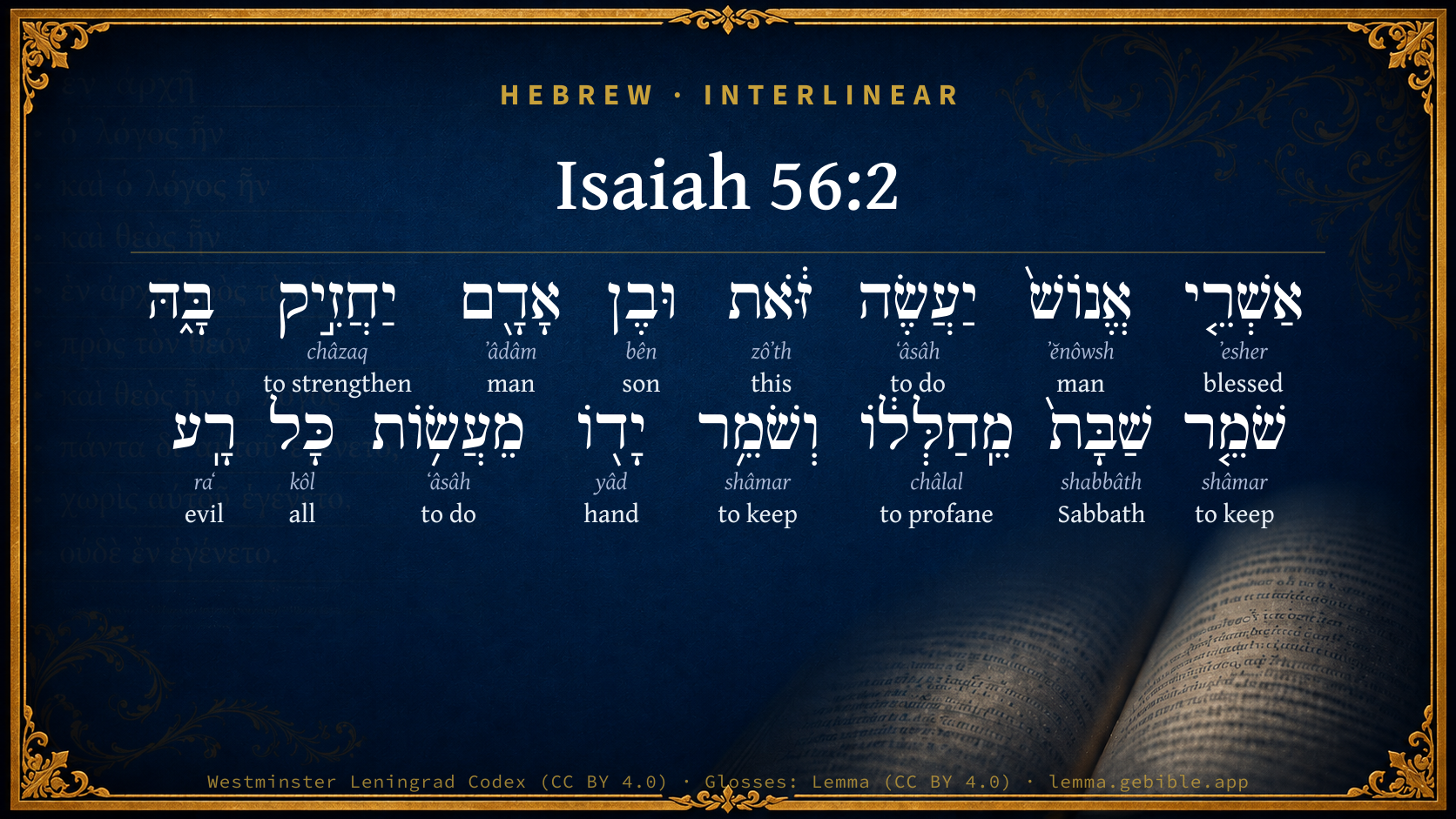
Hebrew (Westminster Leningrad Codex) Isaiah 56:2 appears in the Hebrew Old Testament. The text above is from the Westminster Leningrad Codex. Each word links to its Strong’s number, a concise gloss, and parsing drawn from the Open Scriptures Hebrew Bible morphology. Click any word for its full Brown-Driver-Briggs (BDB) entry.
Download image
Cite this verse

Isaiah 56:2 (World English Bible). Public Domain. Lemma interlinear Bible study tool, https://lemma.gebible.app/v/isaiah/56/2.

Show BibTeX & RIS
BibTeX
RIS
English Translation
Blessed is the man who does this, and the son of man who holds it fast; who keeps the Sabbath from profaning it, and keeps his hand from doing any evil.
World English Bible · Public Domain
Download a study sheet

One document with this verse’s original text, its word-by-word gloss line, the meaning frame, cross-references with their text, attributed commentary, and full source and license credits — printable, and it pastes into notes with its structure intact.

This verse Autodidact and up

Study sheet (.html) Plain text (.txt)

A passage Seminary Student

Up to 50 verses in one chapter. A passage sheet keeps up to 6 commentary sources and 12 cross-references per verse, in the order this page ranks them, and says so on the sheet whenever that leaves anything out. Ask for a single verse and you get the Autodidact verse sheet above.

Everything on this page stays free to read, with no account — the sheet is a download of what is already on screen, not access to it.

Want to remove ads? Support Godless Engineer
Compare translations 3

The same verse in 3 English versions, stacked beneath the original-language interlinear above. Click any original word for its lexicon entry.

Each is an independent rendering of the whole verse — the interlinear is not word-aligned to these translations.

Highlighted words mark where these versions differ — a whole-verse word diff, not a word-by-word alignment.

  • World English Bible Public Domain
    Blessed is the man who does this, and the son of man who holds it fast; who keeps the Sabbath from profaning it, and keeps his hand from doing any evil.
  • King James Version Public Domain
    Blessed is the man that doeth this, and the son of man that layeth hold on it; that keepeth the sabbath from polluting it, and keepeth his hand from doing any evil.
  • unfoldingWord Literal Text CC BY-SA 4.0
    The happiness of the man does this and the son of man holds onto it, keeping the Sabbath from profaning it and keeping his hand from doing any evil!” q1

unfoldingWord Literal Text — © unfoldingWord, licensed CC BY-SA 4.0. Word-aligned USFM3 via Door43 (git.door43.org/unfoldingWord/en_ult).

Versions to compare (up to 4)

3 of 4 selected

Show all 18 translations

Every available English version of this verse, each an independent rendering of the whole verse.

  • World English Bible Public Domain
    Blessed is the man who does this, and the son of man who holds it fast; who keeps the Sabbath from profaning it, and keeps his hand from doing any evil.
  • Berean Standard Bible Public Domain
    Blessed is the man who does this, and the son of man who holds it fast, who keeps the Sabbath without profaning it and keeps his hand from doing any evil.”
  • Majority Standard Bible Public Domain
    Blessed is the man who does this, and the son of man who holds it fast, who keeps the Sabbath without profaning it and keeps his hand from doing any evil.”
  • King James Version Public Domain
    Blessed is the man that doeth this, and the son of man that layeth hold on it; that keepeth the sabbath from polluting it, and keepeth his hand from doing any evil.
  • American Standard Version (1901) Public Domain
    Blessed is the man that doeth this, and the son of man that holdeth it fast; that keepeth the sabbath from profaning it, and keepeth his hand from doing any evil.
  • Revised Version (1885) Public Domain
    Blessed is the man that doeth this, and the son of man that holdeth fast by it; that keepeth the sabbath from profaning it, and keepeth his hand from doing any evil.
  • Geneva Bible (1599) Public Domain
    Blessed is the man that doeth this, and the sonne of man which layeth holde on it: hee that keepeth the Sabbath and polluteth it not, and keepeth his hand from doing any euill.
  • Douay-Rheims (1899) Public Domain
    Blessed is the man that doth this, and the son of man that shall lay hold on this: that keepeth the sabbath from profaning it, that keepeth his hands from doing any evil.
  • Young's Literal Translation Public Domain
    O the happiness of a man who doth this, And of a son of man who keepeth hold on it, Keeping the sabbath from polluting it, And keeping his hand from doing any evil.
  • Literal Standard Version CC BY-SA 4.0
    O the blessedness of a man who does this, || And of a son of man who keeps hold on it, || Keeping the Sabbath from defiling it, || And keeping his hand from doing any evil.
  • Unlocked Literal Bible CC BY-SA 4.0
    Blessed is the man that does this, and who holds it tightly. He observes the Sabbath, not defiling it, and keeps his hand from doing any evil.”
  • unfoldingWord Literal Text CC BY-SA 4.0
    The happiness of the man does this and the son of man holds onto it, keeping the Sabbath from profaning it and keeping his hand from doing any evil!” q1
  • Darby Bible Public Domain
    Blessed is the man that doeth this, and the son of man that holdeth fast to it; that keepeth the sabbath from profaning it, and keepeth his hand from doing any evil.
  • World Messianic Bible Public Domain
    Blessed is the man who does this, and the son of man who holds it fast; who keeps the Sabbath without profaning it and keeps his hand from doing any evil.”
  • Webster's Bible Public Domain
    Blessed is the man that doeth this, and the son of man that layeth hold on it; that keepeth the sabbath from profaning it, and keepeth his hand from doing any evil.
  • Free Bible Version CC BY-SA 4.0
    Blessed is everyone who does this—those who keep to it, who observe the Sabbath without violating it, and who don't do anything wrong.
  • Bible in Basic English Public Domain
    Happy is the man who does this, and the son of man whose behaviour is so ordered; who keeps the Sabbath holy, and his hand from doing any evil.
  • JPS Tanakh (1917) Public Domain
    Happy is the man that doeth this, and the son of man that holdeth fast by it: that keepeth the sabbath from profaning it, and keepeth his hand from doing any evil.

Literal Standard Version (2020), Covenant Press — licensed CC BY-SA 4.0. Text via the HelloAO Bible API (eBible.org). Unlocked Literal Bible (unfoldingWord) — licensed CC BY-SA 4.0. Text via the HelloAO Bible API (eBible.org). unfoldingWord Literal Text — © unfoldingWord, licensed CC BY-SA 4.0. Word-aligned USFM3 via Door43 (git.door43.org/unfoldingWord/en_ult). Free Bible Version, Dr. Jonathan Gallagher — licensed CC BY-SA 4.0. Text via the HelloAO Bible API (eBible.org).

Word by word

More ways to search: Search by grammar → Find every occurrence → Compare this word →

Practice this passage: Drill this verse → Learn its vocabulary →

אֱנוֹשׁ֙
ʼĕnôwsh
H582
“man”
Noun, Common, Masculine, Singular, Absolute
Part of Speech
Noun
Type
Common
Gender
Masculine
Number
Singular
State
Absolute
Full BDB Definition

Origin: from H605

TWOT: 136a

man, mortal man, person, mankind - of an individual - men (collective) - man, mankind
  1. אַשְׁרֵ֤י ʼesher H835 “blessed” Noun, Common, Masculine, Plural, Absolute
  2. יַעֲשֶׂה ʻâsâh H6213 “to do” Verb, Qal, Imperfect, 3rd Person, Masculine, Singular
  3. זֹּ֔את zôʼth H2063 “this” Pronoun, Demonstrative, Feminine, Singular
  4. וּבֶן bên H1121 “and · son of” Conjunction + Noun, Common, Masculine, Singular, Construct
  5. אָדָ֖ם ʼâdâm H120 “man” Noun, Common, Masculine, Singular, Absolute
  6. יַחֲזִ֣יק châzaq H2388 “to strengthen” Verb, Hiphil, Imperfect, 3rd Person, Masculine, Singular
  7. שֹׁמֵ֤ר shâmar H8104 “keeping” Verb, Qal, Participle Active, Masculine, Singular, Absolute
  8. שַׁבָּת֙ shabbâth H7676 “Sabbath” Noun, Common, Both, Singular, Absolute
  9. מֵֽחַלְּל֔וֹ châlal H2490 “from · to profane · him” Preposition + Verb, Piel, Infinitive Construct + Suffix, Personal, 3rd Person, Masculine, Singular
  10. וְשֹׁמֵ֥ר shâmar H8104 “and · keeping” Conjunction + Verb, Qal, Participle Active, Masculine, Singular, Absolute
  11. יָד֖וֹ yâd H3027 “hand · his” Noun, Common, Both, Singular, Construct + Suffix, Personal, 3rd Person, Masculine, Singular
  12. מֵעֲשׂ֥וֹת ʻâsâh H6213 “from · to do” Preposition + Verb, Qal, Infinitive Construct
  13. כָּל kôl H3605 “all of” Noun, Common, Masculine, Singular, Construct
  14. רָֽע raʻ H7451 “evil” Adjective, Adjective, Masculine, Singular, Absolute

About this verse

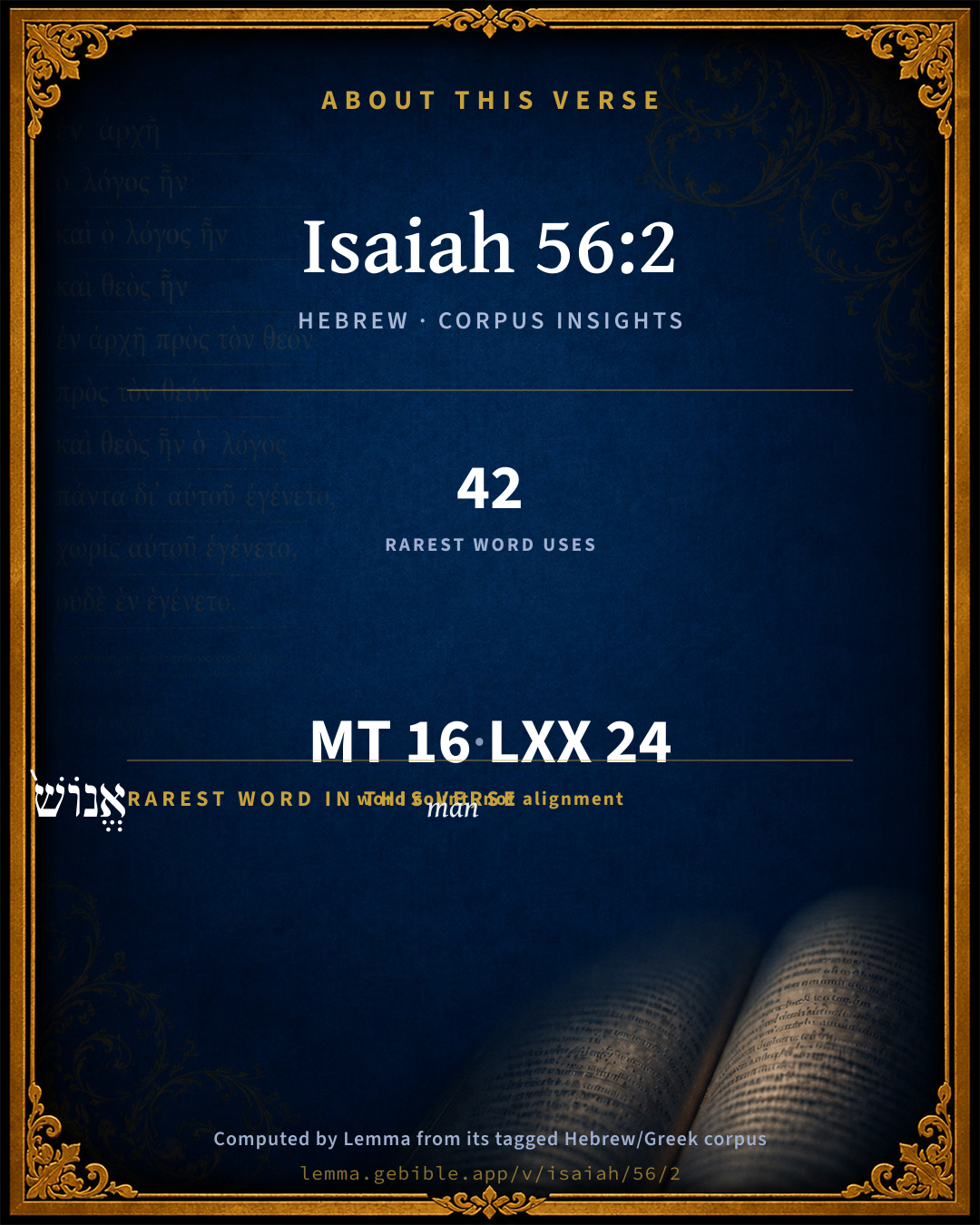
These counts appear in no published source. They are computed here, from the morphology-tagged text and Lemma’s own curated glosses. What Lemma adds →

16
words
13
distinct lemmas
Prophets
section

Shared distinctive vocabulary

אֱנוֹשׁ֙ man H582 occurs in 41 verses of the Hebrew Bible. Also found in:

Grammatical profile

  • 6 verbs
  • 7 nouns
  • 1 adjective
  • 1 pronoun
  • 1 preposition

Verb forms

  • יַעֲשֶׂה Qal · Imperfect
  • יַחֲזִ֣יק Hiphil · Imperfect
  • שֹׁמֵ֤ר Qal · Participle Active
  • מֵֽחַלְּל֔וֹ Piel · Infinitive Construct
  • וְשֹׁמֵ֥ר Qal · Participle Active
  • מֵעֲשׂ֥וֹת Qal · Infinitive Construct

Repetition

Words recur within this verse — often emphatic in Hebrew:

  • יַעֲשֶׂה to do H6213 ×2
  • שֹׁמֵ֤ר to keep H8104 ×2

Hebrew & Septuagint length

In English translation the verse runs 31 words from the Hebrew and 29 from the Septuagint (LXX English) — closely comparable.

A rough comparison of the two English renderings, which tokenize alike — not a word-level alignment.

Word counts can differ between the Hebrew and the Greek without any difference in meaning — e.g. the Hebrew direct-object marker אֵת has no separate Greek word, and Greek often adds the article ὁ.

In the original languages it is 16 Hebrew tokens and 24 Greek tokens — but the two are counted differently (Hebrew bundles its prefixes and suffixes into one token; the Greek is in lemma form), so that isn’t a like-for-like length.

Cross-references

31

Topical passages linked to Isaiah 56:2 in the Treasury of Scripture Knowledge — connected by theme and wording, ordered by reader-vote popularity; previews shown in the World English Bible.

  • Exodus 31:13–16 "Speak also to the children of Israel, saying, 'Most assuredly you shall keep my Sabbaths: for it is a sign between me and you throughout your generations; that you may know that I am Yahweh who sanctifies you.
  • Isaiah 58:13 If you turn away your foot from the Sabbath, from doing your pleasure on my holy day; and call the Sabbath a delight, [and] the holy of Yahweh honorable; and shall honor it, not doing your own ways, nor finding your own pleasure, nor speaking [your own] words:
  • Psalms 112:1 Praise Yah! Blessed is the man who fears Yahweh, Who delights greatly in his commandments.
  • Ezekiel 20:12 Moreover also I gave them my Sabbaths, to be a sign between me and them, that they might know that I am Yahweh who sanctifies them.
  • Exodus 20:10 but the seventh day is a Sabbath to Yahweh your God. You shall not do any work in it, you, nor your son, nor your daughter, your man-servant, nor your maid-servant, nor your cattle, nor your stranger who is within your gates;
  • Jeremiah 17:21–22 Thus says Yahweh, Take heed to yourselves, and bear no burden on the Sabbath day, nor bring it in by the gates of Jerusalem;
  • Ezekiel 20:20 and make my Sabbaths holy; and they shall be a sign between me and you, that you may know that I am Yahweh your God.
  • Luke 11:28 But he said, "On the contrary, blessed are those who hear the word of God, and keep it."
  • Psalms 106:3 Blessed are those who keep justice. Blessed is one who does what is right at all times.
  • John 13:17 If you know these things, blessed are you if you do them.
  • Exodus 20:8 "Remember the Sabbath day, to keep it holy.
  • Leviticus 19:30 "'You shall keep my Sabbaths, and reverence my sanctuary; I am Yahweh.
  • Psalms 119:1–5 Blessed are those whose ways are blameless, Who walk according to Yahweh's law.
  • Psalms 119:101 I have kept my feet from every evil way, That I might observe your word.
  • Proverbs 4:13 Take firm hold of instruction. Don't let her go. Keep her, for she is your life.
  • Proverbs 4:27 Don't turn to the right hand nor to the left. Remove your foot from evil.
  • Proverbs 14:16 A wise man fears, and shuns evil, But the fool is hotheaded and reckless.
  • Proverbs 16:6 By mercy and truth iniquity is atoned for. By the fear of Yahweh men depart from evil.
  • Proverbs 16:17 The highway of the upright is to depart from evil. He who keeps his way preserves his soul.
  • Nehemiah 13:17 Then I contended with the nobles of Judah, and said to them, What evil thing is this that you do, and profane the Sabbath day?
  • Psalms 34:14 Depart from evil, and do good. Seek peace, and pursue it.
  • Psalms 37:27 Depart from evil, and do good; Live securely forever.
  • Psalms 128:1 Blessed is everyone who fears Yahweh, Who walks in his ways.
  • Isaiah 56:6 Also the foreigners who join themselves to Yahweh, to minister to him, and to love the name of Yahweh, to be his servants, everyone who keeps the Sabbath from profaning it, and holds fast my covenant;
  • Luke 12:43 Blessed is that servant whom his lord will find doing so when he comes.
  • Revelation 22:14 Blessed are those who do his commandments, that they may have the right to the tree of life, and may enter in by the gates into the city.
  • Psalms 1:1–3 Blessed is the man who doesn't walk in the counsel of the wicked, Nor stand in the way of sinners, Nor sit in the seat of scoffers;
  • Psalms 15:1–5 Yahweh, who shall dwell in your sanctuary? Who shall live on your holy hill?
  • Ecclesiastes 7:18 It is good that you should take hold of this. Yes, also from that don't withdraw your hand; for he who fears God will come forth from them all.
  • Isaiah 56:4 For thus says Yahweh of the eunuchs who keep my Sabbaths, and choose the things that please me, and hold fast my covenant:
  • Romans 12:9 Let love be without hypocrisy. Abhor that which is evil. Cling to that which is good.

Cross-references courtesy of OpenBible.info (CC BY 4.0).

Hebrew and Greek witnesses Masoretic Hebrew ↔ Greek Septuagint

The same verse in the two great witnesses to the Old Testament, shown verse-for-verse.

These are two independent witnesses, not word-aligned to each other, and the Septuagint is shown in lemma (dictionary) form.

Hebrew Isaiah 56:2 Masoretic · Westminster Leningrad Codex

אַשְׁרֵ֤י אֱנוֹשׁ֙ יַעֲשֶׂה זֹּ֔את וּבֶן אָדָ֖ם יַחֲזִ֣יק בָּ֑הּ שֹׁמֵ֤ר שַׁבָּת֙ מֵֽחַלְּל֔וֹ וְשֹׁמֵ֥ר יָד֖וֹ מֵעֲשׂ֥וֹת כָּל רָֽע

Blessed is the man who does this, and the son of man who holds it fast; who keeps the Sabbath from profaning it, and keeps his hand from doing any evil.

World English Bible · Public Domain

Greek LXX Isaiah 56:2 Septuagint · lemma form

μακάριος ἀνήρ ὁ ποιέω οὗτος καί ἄνθρωπος ὁ ἀντιἔχω αὐτός καί φυλάσσω ὁ σάββατον μή βεβηλόω καί διατηρέω ὁ χείρ αὐτός μή ποιέω ἀδίκημα

Blessed is the man that does these things, and the man that holds by them, and keeps the sabbaths from profaning them, and keeps his hands from doing unrighteousness.

LXX2012 (modern English Septuagint) · Public Domain

Hebrew: Westminster Leningrad Codex (CC BY 4.0). Greek: Septuagint (public domain); English from LXX2012 (modern English Septuagint) (Public Domain). How the Septuagint differs from the Hebrew →

Targum (Aramaic paraphrase)

1

The Targum is the ancient Jewish Aramaic paraphrase of the Hebrew Scriptures — an interpretive translation, not the Hebrew text itself. Onkelos (literal) and Pseudo-Jonathan (expansive) render the Torah, and Jonathan the Prophets. Coverage is partial: where no permissively-licensed English translation exists for a verse, only the Aramaic is shown. This is verse-level text, not a word-by-word alignment to the Hebrew.

  1. Targum Jonathan Prophets (Joshua–Malachi)
    טוּבֵי אֱנָשׁ דְיַעְבַּד דָא וּבַר אֱנָשָׁא דְיִתְקֵף בָּהּ יִטַר שַׁבְּתָא מֵאַחֲלוּתֵהּ וְיִטֵר יְדוֹהִי מִלְמֶעְבַּד כָּל דְבִישׁ:

    Blessed is the man that doeth this, and the son of man that layeth hold on it; every one that shall keep the Sabbath from polluting it, and shall keep his hand from doing any evil.

    Targum Jonathan — Aramaic: “Mikraot Gedolot” (public domain). English: “Sefaria Community Translation” (CC0 1.0 (public-domain dedication)); “London "Chaldee Paraphrase," 1871” (public domain). Text via Sefaria.

Commentary

Notes on Isaiah 56:2 from classic Christian and Jewish commentators (each source and its license shown beneath its notes). The classic Christian expositions comment on the surrounding passage and are grouped to its opening verse, so a note may address several verses; the Jewish commentaries on the Tanakh (Rashi and others) are per-verse, so they appear only where the commentator wrote on this verse.

Lemma curates 59 commentaries, every one of them public domain or Creative Commons licensed, each selected and text-cleaned for this edition rather than reprinted as found. About our sources →

Trapp's Complete Commentary

John Trapp

Isa 56:2 Blessed [is] the man [that] doeth this, and the son of man [that] layeth hold on it; that keepeth the sabbath from polluting it, and keepeth his hand from doing any evil.

Ver. 2. Blessed is the man that doeth this.] And by it lays hold on that - i.e., that performeth the duties of both tables, of piety and of charity; that maketh conscience of keeping the Sabbath especially. The Fourth Commandment standeth fitly in the heart of the Decalogue, and between the two tables of the law, as having an influence into both.

From polluting it.] Either by corporal labour or spiritual idleness: spending the holy time holily.

And keepeth his hand from doing any evil.] That is, righteous as well as religious: not yielding his members as instruments of unrighteousness unto sin. {Rom 6:13}

John Trapp, A Commentary or Exposition upon All the Books of the Old and New Testament (1647–1656) — public domain. Text from a community e-Sword module.

The Biblical Illustrator

Joseph S. Exell

Isa_56:2

Blessed is the man that doeth this

The blessedness of right-doing

Blessed is the man that doeth this.

It must be so, for in doing judgment and justice he in some measure resembles the blessed God, who exerciseth judgment and righteousness in the earth, and delighteth in these things. (R. Macculloch.)

Comprehensive righteousness

The duties of the first table are typified by the observance of the Sabbath; those of the second table are signified in the comprehensive expression, That keepeth his hand that it do no evil. (Prof. S. R. Driver,D. D.)

Sabbath-keeping

A great variety of reasons have been given for the special mention of the Sabbath here. The true explanation is afforded by a reference to the primary and secondary ends of the Sabbatical institution, and the belief involved in its observance.

1. It implied a recognition of Jehovah as the omnipotent Creator of the universe (Exo_20:11; Exo_31:17).

2. As the Sanctifier of His people, not in the technical or theological sense, but as denoting Him by whom they had been set apart as a peculiar people Exo_31:13; Eze_20:12).

3. As the Saviour of this chosen people from the bondage of Egypt Deu_5:15). Of these great truths the Sabbath was a weekly remembrancer, and its observance by the people a perpetual recognition and profession, besides the practical advantages accruing to the maintenance of a religious spirit by a weekly recurrence of a day of rest. (J. A. Alexander.)

Sabbath-keeping

I. THE DUTY REQUIRED. To keep the Sabbath, to keep it as a talent we are to trade with, or a treasure we are entrusted with; keep it holy, keep it safe, keep it with care and caution, keep from polluting it; allow neither yourselves nor others either to violate the holy rest nor omit the holy work of that day.

II. THE ENCOURAGEMENT WE HAVE TO DO THIS DUTY. Blessed is he that doeth it. The way to have the blessing of God upon our employments all the week is to make conscience and business of Sabbath sanctification; and in doing so we shall be the better qualified to do judgment and justice. The more godliness the more honesty (1Ti_2:2). (M. Henry.)

Sabbath-keeping and justice

We are not just if we rob God of His time. (M. Henry.)

Resoluteness in Sabbath observance

Those that would keep the Sabbath from polluting it must put on resolution; must not only do this, but lay hold on it, for Sabbath time is precious; but it is very apt to slip away if we take not great care; therefore we must lay hold on it, and keep our hold; must do it, and persevere in it. (M. Henry.)

The utility of the Sabbath

As the Sabbath was instituted while man was yet within the precincts of Paradise, and unseduced by the wiles of the devil, we are warranted to conclude that a day of holy rest was useful and necessary to him, even in a state of innocence; and if it was of use and advantage to him then, how much more must it be now! Man is now become so sinful, so earthly, so forgetful of God, so careless of his highest interests, that were it not for the solemnities of the Sabbath, he would speedily lose all sense of religion, and utterly neglect the salvation of his soul. (D. Rees.)

An unpolluted Sabbath

The text gives us to understand that in order to keep the Sabbath from polluting it, we must keep our hands from doing any evil. Nor can we suppose that the day is to be sanctified merely by acts of negative holiness, but also by acts of positive goodness. (D. Rees.)

Sabbaths and week-days

That keepeth the Sabbath from polluting it, and keepeth his hand from doing any evil. The best evidence of our having kept the Sabbath well will be a care to keep a good conscience all the week. (M. Henry.)

The blessedness of keeping Gods holy day

What are we to understand by polluting the Lords day?

1. This holy time is certainly thus abused when it is spent in mere idleness.

2. When it is devoted to worldly amusement.

3. By all labour which may not fairly come under the description of work of necessity and mercy. (J. N. Norton.)

Sabbath observance

A little boy was on a visit to his uncle, and when the morning of the Lords Day came, the uncle said, Come, my man, you and I will go out and fish awhile! Uncle, answered the boy, very gravely and somewhat . . . puzzled, does God require us to fish here on Sunday at our house He doesnt allow us to do it. The fishing excursion was given up, and good came of the childs pointed sermon. (J. N. Norton.)

The Biblical Illustrator, edited by Joseph S. Exell (c. 1880s–1900s) — public domain. Text from a community e-Sword module.

Joseph Benson's Commentary

Isa 56:2. Blessed is the man — Any, or every man, not only Jews but Gentiles, or strangers, as it is explained in the following verses. That doeth this — That practiseth the judgment and justice, or the righteousness, mentioned Isa 56:1. That layeth hold on it — Or, that holdeth it fast, as יחזיק בה may be rendered; that is, resolute and constant in so doing; that not only begins well, but perseveres in well-doing: that keepeth the sabbath from polluting it — That doth not profane or defile the sabbath, either by forbidden practices, or by the neglect of commanded duties. The sabbath seems to be here put, as sacrifice is elsewhere, for the whole worship of God. And keepeth his hand from doing any evil — That conscientiously abstains from all evil and immoral works.

Joseph Benson's Commentary on the Old and New Testaments (1811–1818) — public domain. Text from a community e-Sword module.

Tyndale Open Study Notes

Tyndale Open Resources

56:2 Blessed: Cp. 30:18; 32:20; see also Pss 1:1; 119:1; Matt 5:3. • The Sabbath, as a sign of the covenant (Exod 31:13-17), is God’s gift to his people; it belongs to this age as well as to the age to come (Isa 56:4, 6; 58:13-14; see Heb 4:1-13).

Tyndale Open Study Notes — © Tyndale Open Resources, licensed CC BY-SA 4.0. Text via the HelloAO Bible API.

Geneva Bible (1599)

Geneva Bible translators

Under the Sabbath he comprehendeth the whole service of God and true religion.

Geneva Bible (1599) marginal notes — public domain. Text via Bolls.life.

Jamieson, Fausset & Brown

Robert Jamieson, A. R. Fausset & David Brown

(Luk 12:43).

the man--Hebrew, enosh, "a man in humble life," in contradistinction to Hebrew, ish, "one of high rank." Even the humblest, as "the stranger" and "the eunuch" (Isa 56:4, Isa 56:6), are admissible to these privileges.

this . . . it--what follows: "keeping the Sabbath," &c. (Isa 58:13-14; Eze 20:12). A proof that the Sabbath, in the spirit of its obligation, was to be binding under the Gospel (Isa 66:23). That gospel times are referred to is plain, from the blessing not being pronounced on the man who observed the sacrificial ritual of the Jewish law.

layeth hold--image from one grasping firmly some precious object which he is afraid of having forcibly snatched from him. The "Sabbath" here includes all the ordinances of divine worship under the new gospel law.

keepeth . . . hand . . . from . . . evil--The observance of the second table of the law; as the "Sabbath" referred to the first table. Together, they form the whole duty of man, the worship of God and a holy life.

Jamieson, Fausset & Brown — Commentary Critical and Explanatory on the Whole Bible (1871) — public domain (CC PDM 1.0). Text via the HelloAO Bible API.

Adam Clarke's Commentary

Verse 2. That keepeth the Sabbath from polluting it] Kimchi has an excellent note here. "The Sabbath is sanctified when it is distinguished in dignity; and separated from other days.

1. As to the body, in meat, drink, and clean clothing.

2. As to the soul, that it be empty of worldly occupations, and be busily employed in the words of the law and wisdom, and in meditation on the works of the Lord."

The rabbins say, "Jerusalem had never been destroyed, had not the Sabbaths been profaned in it."

Adam Clarke's Commentary on the Bible (1810–1826) — public domain. Text from a community e-Sword/MySword module.

Ellicott's Commentary for English Readers

(2) That keepeth the sabbath from polluting it . . .—It lies in the nature of the case that a devout king like Hezekiah would be an observer of the Sabbath. It is almost certain that the counsellors of the young Manasseh (probably the Shebna party), abandoning the religion of Israel in other things, would also disregard this. I take the prophet’s teaching accordingly as directed against that evil. He utters his beatitude for those who are faithful to the régime of Hezekiah’s reign, even though their alien birth or their condition as eunuchs seemed to exclude them from the polity of Israel (Deu_23:1-8).

A Bible Commentary for English Readers, edited by Charles John Ellicott (1878–1897) — public domain. Text from a community e-Sword module.

The Cambridge Bible for Schools and Colleges

gen. ed. J. J. S. Perowne

2. The blessing attached to Isa_56:1 extends to mankind in general (note the expressions man and son of man), i.e. to all who comply with the conditions of membership in the Jewish community.

that layeth hold on it] Better as R.V. that holdeth fast by it (and so Isa_56:4 and Isa_56:6).

that keepeth the sabbath from profaning it (R.V.)] (i.e. “so as not to profane it,” so Isa_56:6). The same emphasis on Sabbath observance appears in ch. Isa_58:13, and so in Eze_20:12 ff; Eze_22:8; Eze_22:26 (cf. Jer_17:19 ff.). Although one of the most ancient of Israel’s religious institutions (Exo_20:8; Deu_5:15; Amo_8:5) the Sabbath acquired peculiar significance during the Exile, when the ordinances of public worship were suspended and the Sabbath and circumcision became the chief external badges of fidelity to the covenant of which it was the sign (Exo_31:13-14; Eze_20:12).

from doing any evil] such offences as are specified in Isa_58:4 ff., Isa_59:3 f.

The Cambridge Bible for Schools and Colleges (gen. ed. J. J. S. Perowne; Cambridge University Press, 1878–1918) — public domain. Text from a community e-Sword module.

John Gill's Exposition

Blessed is the man that doth this,.... That does justice, and keeps judgment; he hereby exercises a good conscience both towards God and men; he enjoys communion with God in his ways, worship, and ordinances, he attends unto, and has an evidence of his right to eternal happiness:

and the son of man that layeth hold on it; on the salvation of Christ, and his righteousness; which supposes a sense of the insufficiency of a man's own righteousness, a view of the excellency and suitableness of Christ's righteousness; and is expressive of a strong act of faith upon it, embracing and retaining it as a man's own:

that keepeth the sabbath from polluting it; by doing any servile work on it, and attending to all religious duties, private or public. This is put for the whole of instituted worship under the Gospel dispensation, and for any day or time in which the church of Christ meet together for religious worship:

and keepeth his hand from doing any evil; committing any sin against God, or doing injury to the persons or properties of men, including the whole of moral duty.

John Gill's Exposition of the Whole Bible (1746–1763) — public domain (CC PDM 1.0). Text via the HelloAO Bible API.

Albert Barnes' Notes on the Bible

Blessed is the man - Hebrew, ‘The blessings of the man’ (see Psa 1:1). The sense is, ‘happy is the man.’ The word here rendered ‘man’ (אנושׁ 'ĕnôsh) usually denotes a man in humble life or in a subordinate rank, in contradistinction from אישׁ 'ı̂ysh, a man in elevated rank. As the object of the prophet here is particularly to say, that the ‘stranger’ and the ‘eunuch’ would be admitted to these privileges, it is possible that he designedly used a word denoting one in bumble life. The particular blessing to which he refers is specified in Isa 56:7-8.

That doeth this - That is, this which the prophet soon specifies - keeping the Sabbath, and abstaining from evil.

And the son of man - Another form of expression denoting man.

That layeth hold on it - Hebrew, ‘Binds himself fast to it;’ or seizes upon it with strength. That is, he adheres firmly to the purpose, as a man seizes upon a thing with an intention not to let it go.

That keepeth the Sabbath from polluting it - Who sacredly observes the day of holy rest which God has appointed. The Sabbath was one of the special rites of the Jewish religion, and one of the most important of their institutions. Its observance entered essentially into the idea of their worship, and was designed to be the standing memorial or sign between God and the Jewish nation Exo 31:13-17. At home, in their own nation, it kept up the constant sense of religion; abroad, when they traveled among strangers, it would serve to remind all of the special nature of their institutions, and be the public evidence that they were the worshippers of Yahweh. Hence, as this served to distinguish them from other people, it comes to be used here to signify the observance of the rites which pertained to the public worship of God; and evidently includes whatever was to be perpetual and unchanging in the public worship of the Creator. It is remarkable that the prophet does not pronounce a blessing on him who came to bloody altars with sacrifices, or him who burned incense, or him who conformed to the unique rites of the Jewish religion. These rites were to pass away, and the obligation to observe them was to cease; and in this indirect manner the sacred writer has given an intimation that there would be blessings on those who did not observe those rites, and that the period would arrive when the divine favor and mercy would descend on people in a different channel. In regard to the importance of the Sabbath, see the note at the close of Isa 58:1-14.

And keepeth his hand ... - That is, is an upright, holy, honest man. He not only worships God and keeps the Sabbath, but he is upright in the discharge of all the duties which he owes to his fellow-men. These two specifications are evidently designed to include all the influences of religion - the proper service and worship of God, and an upright and holy life. Never in fact are they separated, and the religion of the Bible was designed to secure the one as much as the other.

Albert Barnes' Notes on the Bible (1834–1885) — public domain. Text from a community e-Sword/MySword module.

Haydock's Catholic Bible Commentary

Sabbath. All the Jewish festivals, (Calmet) as well as those of the Christian Church, (Haydock) and the whole law. (Worthington)

George Leo Haydock (1774–1849), Haydock's Catholic Family Bible and Commentary, 1859 edition — public domain. Excludes Psalms (Douay-Rheims chapter numbering differs from Protestant) and Deuterocanonical books (Catholic canon only).

Matthew Poole's English Annotations

Blessed is the man; every man, not only Jews, but Gentiles, or strangers, as it is explained in the following verses. That were this; judgment and justice, mentioned Isa 56:1.

That layeth hold on it; or, that holdeth it fast; that is resolute and constant in so doing; that not only begins well, but perseveres in it.

That keepeth the sabbath, from polluting it; that guardeth the sabbath from profanation, and doth not defile it, either by forbidden practices, or by the neglect of commanded duties. And the sabbath seems to be put here, as sacrifice is elsewhere, synecdochically for the whole worship of God, whereof this is an eminent part, and the bond of all the rest.

Keepeth his hand; which being the great instrument of action, is put for all the kinds and means of action.

From doing any evil, to wit, to one’s neighbour, as it is more fully expressed, Psa 15:3.

Matthew Poole's English Annotations on the Holy Bible (1683–1685) — public domain. Text from a community e-Sword/MySword module.

Whedon's Commentary on the Bible

Daniel D. Whedon

2. Blessed is the man… the son of man — Terms meaning the same thing, used merely for the parallelism. The pronouncement of this blessing is for the consolation of those who “keep judgment and do justice.” Sabbath observance is claimed on grounds ethical and physical. It is a perpetual obligation. Priceless blessings attend sabbath keeping and conscientious right doing in all things.

Daniel D. Whedon (gen. ed.), Commentary on the Old and New Testaments (1874–1909) — public domain. Text from a community e-Sword module.

The Pulpit Commentary

That doeth this... that layeth hold on it; i.e. that doeth according to the exhortation in ver. 1. That keepeth the sabbath. The prominent place assigned to this duty by the evangelical prophet is remarkable. We may observe, however,

(1) that the spirit of obedience is better tested by a positive than by a moral ordinance; and

(2) that as, probably, there could be little outward keeping of the sabbath by the captives, it would have had to be kept inwardly by spiritual exercises, by silent prayer and praise, together with prolonged meditation upon holy things. In the absence of all the ordinary aids to devotion, the religious condition of the people must have depended very much on their keeping up the recollection of the sabbath, and hallowing it so far as was possible; e.g. doing no work for themselves, neither buying nor selling, making their devotions longer, and keeping God in their thoughts throughout the day.

The sabbath a test of obedience.

It is singular to find Isaiah now making so much of the sabbath when, in the earlier part of his prophecy, he had, in the name of God, spoken of it so scornfully. (see Isa_1:13, "The new moons and sabbaths, the calling of assemblies, I cannot away with Matthew Arnold refers to this contrast, and says, "That related to a time when the kingdom of Judah yet stood, when the service of the temple was in full course, the whole exterior part of the Jews" religion splendid and prominent. At such a time a prophet might naturally undervalue the whole of this exterior part in comparison with the inward part. But during the exile in Babylon all the services and sacrifices of the temple had ceased, and the one testimony of faithfulness to their religion which the Jews among an idolatrous people could give, was the observance of their sabbath; their sabbath was the one outward thing which brought their religion to their mind. Hence its observance acquired quite a special value." Inquire what signs of their allegiance to Jehovah, and their obedience to his commands, pious Jews in Babylon could give to those around them. None could be so important or so effective as to show themselves a nation of sabbath-keepers, because Jehovah, their God, had commanded sabbath-keeping.

I SABBATH-KEEPING A FORMAL ACT. As such it is of comparatively small importance. It bears good relation, indeed, to the physical health and the social order of a community, providing seasons of rest and change, and reminding of the claims of soul as well as body. But if sabbath-keeping be the mere formal act, with no deeper meaning in it, then it may be judged as a matter of expediency, and valued as a wise and excellent Mosaic arrangement, mere or less wisely imitated by other rulers.

II SABBATH-KEEPING A MORAL STATE. Souls must keep sabbath, or it is not really kept. Souls must keep sabbath

(1) as an act of obedience to God;

(2) as an expression of love for worship;

(3) as a sign of loyalty and affection for God.

There is never any difficulty about the proper ordering of the day when the soul is full of the sabbath-spirit.

III SABBATH-KEEPING THE FORMAL ACT WHICH EXHIBITS THE MORAL STATE. Man cannot test the soul-conditions of his fellowman save by observing the expressions of that condition in his conduct. God can read soul-states, but, for purposes of revelation and teaching, he treats us as we treat each other, and asks for signs in the life of what may be in the soul. Therefore he still looks for careful and faithful sabbath-keeping. R.T.

The Pulpit Commentary (1880–1919), ed. H.D.M. Spence-Jones & Joseph S. Exell — public domain. Text from a community e-Sword module.

John Wesley's Explanatory Notes

The man - Every man not only Jews but Gentiles, as it is explained in the following verses. The sabbath - The sabbath seems to be put here, as sacrifice is elsewhere, for the whole worship of God.

John Wesley, Explanatory Notes Upon the Whole Bible (1754–1765) — public domain. Text via the GEBible commentary corpus.

J. A. Alexander on Isaiah

Joseph Addison Alexander

“Happy the man (that) shall do this, and the son of man that shall hold it fast, keeping the sabbath from profaning it, and keeping his hand from doing all evil.” The pronoun this seems to refer to what follows, as in Psa 7:3 and Deu 32:29. ‘Son of man’ is simply an equivalent expression to the man of the other clause. The last clause is remarkable, and has occasioned much dispute among interpreters, on account of its combining a positive and negative description of the character required, the last of which is very general, and the first no less specific. A great variety of reasons have been given for the special mention of the Sabbath here. It has especially perplexed those writers who regard the Sabbath as a temporary ceremonial institution. The true explanation is afforded by a reference to the primary and secondary ends of the sabbatical institution, and the belief involved in its observance. In the first place, it implied a recognition of Jehovah as the omnipotent creator of the universe (Exo 20:11; Exo 31:17), in the next place, as the sanctifier of His people, not in the technical or theological sense, but as denoting Him by whom they had been set apart as a peculiar people (Exo 31:13; Eze 20:12), in the next place, as the Savior of this chosen people from the bondage of Egypt (Deu 5:15). Of these great truths the Sabbath was a weekly remembrance, and its observance by the people a perpetual recognition and profession, besides the practical advantages accruing to the maintenance of a religious spirit by the weekly recurrence of a day of rest. ‘Holding fast’ is a common idiomatic expression for consistent perseverance in a certain course. It occurs not infrequently in the New Testament (Heb 4:4; Heb 6:18; Rev 2:25; Rev 3:11).

Joseph Addison Alexander, The Prophecies of Isaiah (1846–1847; New York: Scribner, 1870–1878) — public domain. Text from a community e-Sword module.

Rashi

Rabbi Shlomo Yitzchaki (Rashi)

who will do this who observes the Sabbath, etc.

Rashi on the Tanakh — English translations: “The Judaica Press complete Tanach with Rashi, translated by A. J. Rosenberg” (CC BY 4.0); “Pentateuch with Rashi's commentary by M. Rosenbaum and A.M. Silbermann, 1929-1934” (public domain); “The Metsudah Tanach series, Lakewood, N.J” (CC BY 4.0); and “The Book of Joshua, Metsudah Publications, 1997” (CC BY 4.0). Text via Sefaria.

Ibn Ezra

Rabbi Abraham ibn Ezra

Blessed is the man that does this, that keeps the following precepts, to observe the Sabbath, etc. מחללו From polluting it. It is certain that the ת in שבת indicates the feminine gender; the masculine pronoun וֹ refers to the masculine noun יום day, which may be supplied before שבת, or to the verbal noun שִׁמּוּר implied in the verb שֹׁמֵר; for every verb implies a verbal noun, if that is not directly expressed; compare the remark of R. Moses Hakkohen on וַתִּצְפְּנוֹ (Jos. 2:7), that the suffix refers to the verbal noun the taking; compare also ברב יעצים עצה תקום ═ ברב יעצים תקום, in the multitude of counsellors it is established (Prov. 15:22), the word עצה being supplied.

Ibn Ezra on the Tanakh — English translations: “Sefaria Community Translation” (CC0 1.0 (public-domain dedication)); “Yalkut, Sifsei Chachomim Chumash, Metsudah Publications, 2009” (CC BY 4.0); and “Commentary of Ibn Ezra on Isaiah - trans. by M. Friedlander, 1873” (public domain). Text via Sefaria.

Lesson kit

Teaching starters — assembled from the data on this page, not authored interpretation. Every prompt links to the verse data it draws on. Edit before teaching.

Isaiah, in the Prophets, opens this verse with 16 words (13 distinct Hebrew lemmas). Its most distinctive word is ʼĕnôwsh (“man”). A historical commentator’s framing appears above. Read the whole chapter for the surrounding context.

Discussion questions

  1. How does “man” (ʼĕnôwsh) shape what this verse is saying?
  2. Deuteronomy 32:26 shares the word «man» with this verse. How do the two illuminate each other?
  3. “to do” occurs 2× in this one verse. What is the effect of the repetition?
  4. The translations on this page render this verse differently — a whole-verse word diff, not a word-by-word alignment. What might account for the different wordings?
  5. The verb «יַעֲשֶׂה» is Qal Imperfect. How does its form color the action?
  6. Reading how Trapp's Complete Commentary and The Biblical Illustrator read this verse, where do the two commentators agree and where do they part?

Things to notice

Reading settings

Reading text

Shown beneath each verse's original-language words.

Old Testament
Old Testament edition

Read the OT as the Masoretic Hebrew (MT) or the Greek Septuagint (LXX).

English shown for the Greek Septuagint (in the Hebrew ↔ Greek comparison).

Comparing translations? Open the Compare panel on any verse page to stack up to four side by side.