Leviticus 21:7

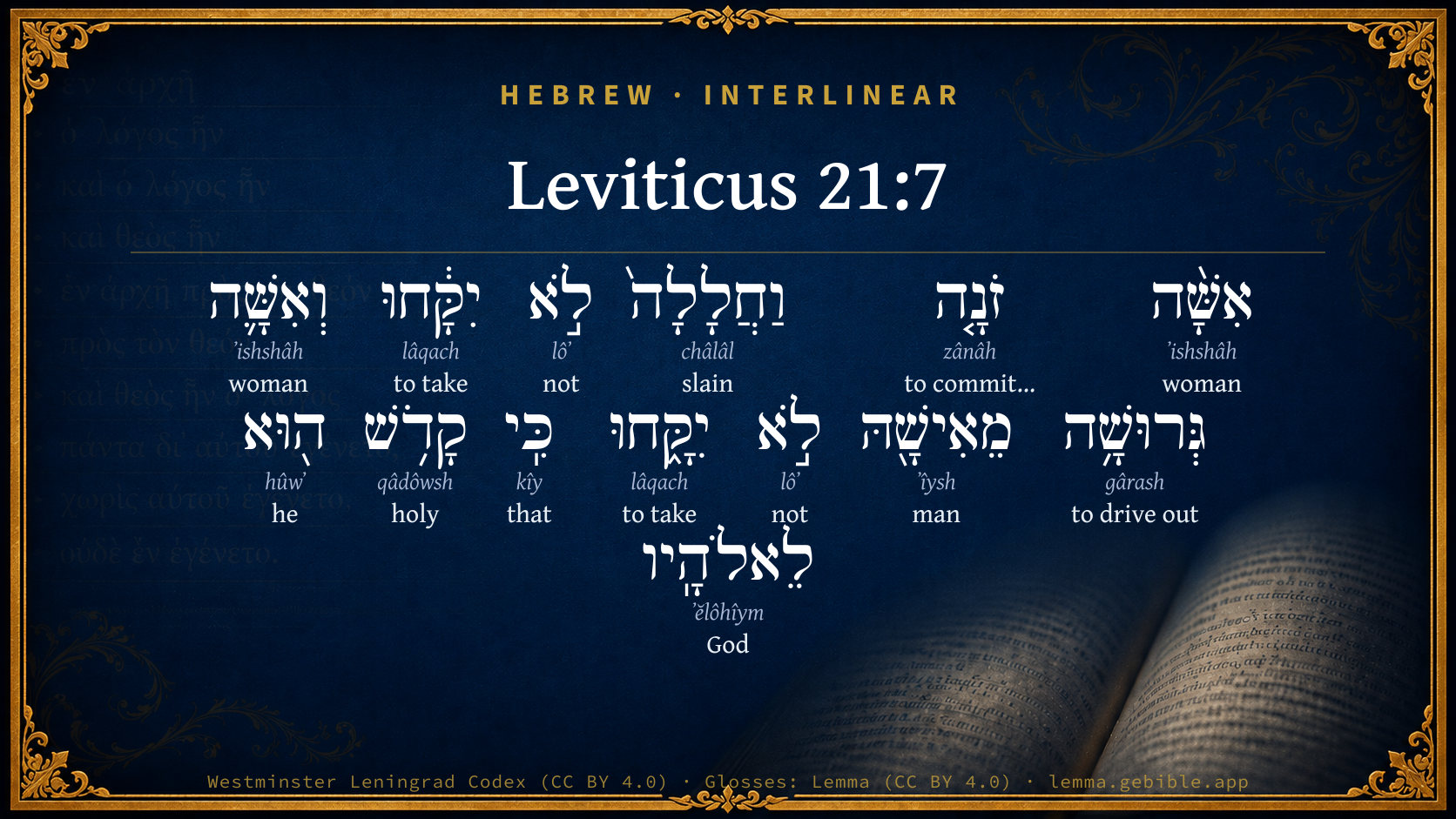
Hebrew (Westminster Leningrad Codex) Leviticus 21:7 appears in the Hebrew Old Testament. The text above is from the Westminster Leningrad Codex. Each word links to its Strong’s number, a concise gloss, and parsing drawn from the Open Scriptures Hebrew Bible morphology. Click any word for its full Brown-Driver-Briggs (BDB) entry.
Download image
Cite this verse

Leviticus 21:7 (World English Bible). Public Domain. Lemma interlinear Bible study tool, https://lemma.gebible.app/v/leviticus/21/7.

Show BibTeX & RIS
BibTeX
RIS
English Translation
"'They shall not marry a woman who is a prostitute, or profane; neither shall they marry a woman divorced from her husband: for he is holy to his God.
World English Bible · Public Domain
Download a study sheet

One document with this verse’s original text, its word-by-word gloss line, the meaning frame, cross-references with their text, attributed commentary, and full source and license credits — printable, and it pastes into notes with its structure intact.

This verse Autodidact and up

Study sheet (.html) Plain text (.txt)

A passage Seminary Student

Up to 50 verses in one chapter. A passage sheet keeps up to 6 commentary sources and 12 cross-references per verse, in the order this page ranks them, and says so on the sheet whenever that leaves anything out. Ask for a single verse and you get the Autodidact verse sheet above.

Everything on this page stays free to read, with no account — the sheet is a download of what is already on screen, not access to it.

Want to remove ads? Support Godless Engineer
Compare translations 3

The same verse in 3 English versions, stacked beneath the original-language interlinear above. Click any original word for its lexicon entry.

Each is an independent rendering of the whole verse — the interlinear is not word-aligned to these translations.

Highlighted words mark where these versions differ — a whole-verse word diff, not a word-by-word alignment.

  • World English Bible Public Domain
    "'They shall not marry a woman who is a prostitute, or profane; neither shall they marry a woman divorced from her husband: for he is holy to his God.
  • King James Version Public Domain
    They shall not take a wife that is a whore, or profane; neither shall they take a woman put away from her husband: for he is holy unto his God.
  • unfoldingWord Literal Text CC BY-SA 4.0
    He shall not take a prostituting or profaned woman, and he shall not take a woman divorced from her husband, for he holy to his God.

unfoldingWord Literal Text — © unfoldingWord, licensed CC BY-SA 4.0. Word-aligned USFM3 via Door43 (git.door43.org/unfoldingWord/en_ult).

Versions to compare (up to 4)

3 of 4 selected

Show all 18 translations

Every available English version of this verse, each an independent rendering of the whole verse.

  • World English Bible Public Domain
    "'They shall not marry a woman who is a prostitute, or profane; neither shall they marry a woman divorced from her husband: for he is holy to his God.
  • Berean Standard Bible Public Domain
    A priest must not marry a woman defiled by prostitution or divorced by her husband, for the priest is holy to his God.
  • Majority Standard Bible Public Domain
    A priest must not marry a woman defiled by prostitution or divorced by her husband, for the priest is holy to his God.
  • King James Version Public Domain
    They shall not take a wife that is a whore, or profane; neither shall they take a woman put away from her husband: for he is holy unto his God.
  • American Standard Version (1901) Public Domain
    They shall not take a woman that is a harlot, or profane; neither shall they take a woman put away from her husband: for he is holy unto his God.
  • Revised Version (1885) Public Domain
    They shall not take a woman that is a harlot, or profane; neither shall they take a woman put away from her husband: for he is holy unto his God.
  • Geneva Bible (1599) Public Domain
    They shall not take to wife an whore, or one polluted, neither shall they marrie a woman diuorced from her husband: for such one is holy vnto his God.
  • Douay-Rheims (1899) Public Domain
    They shall not take to wife a harlot or a vile prostitute, nor one that has been put away from her husband: because they are consecrated to their God,
  • Young's Literal Translation Public Domain
    `A woman, a harlot, or polluted, they do not take, and a woman cast out from her husband they do not take, for he `is' holy to his God;
  • Literal Standard Version CC BY-SA 4.0
    They do not take a woman of harlotry, or defiled, and they do not take a woman cast out from her husband, for he [is] holy to his God;
  • Unlocked Literal Bible CC BY-SA 4.0
    They must not marry any woman who is a prostitute and who is defiled, and they must not marry a woman divorced from her husband, for they are separate for their God.
  • unfoldingWord Literal Text CC BY-SA 4.0
    He shall not take a prostituting or profaned woman, and he shall not take a woman divorced from her husband, for he holy to his God.
  • Darby Bible Public Domain
    They shall not take as wife a whore, or a dishonoured woman; neither shall they take a woman put away from her husband; for he is holy unto his God.
  • World Messianic Bible Public Domain
    “‘They shall not marry a woman who is a prostitute, or profane. A priest shall not marry a woman divorced from her husband; for he is holy to his God.
  • Webster's Bible Public Domain
    They shall not take a wife that is a lewd woman, or profane; neither shall they take a woman put away from her husband: for he is holy to his God.
  • Free Bible Version CC BY-SA 4.0
    A priest is not to marry a woman made unclean through prostitution or who is divorced by her husband, for the priest must be holy to his God.
  • Bible in Basic English Public Domain
    They may not take as wife a loose or common woman, or one who has been put away by her husband: for the priest is holy to his God.
  • JPS Tanakh (1917) Public Domain
    They shall not take a woman that is a harlot, or profaned; neither shall they take a woman put away from her husband; for he is holy unto his God.

Literal Standard Version (2020), Covenant Press — licensed CC BY-SA 4.0. Text via the HelloAO Bible API (eBible.org). Unlocked Literal Bible (unfoldingWord) — licensed CC BY-SA 4.0. Text via the HelloAO Bible API (eBible.org). unfoldingWord Literal Text — © unfoldingWord, licensed CC BY-SA 4.0. Word-aligned USFM3 via Door43 (git.door43.org/unfoldingWord/en_ult). Free Bible Version, Dr. Jonathan Gallagher — licensed CC BY-SA 4.0. Text via the HelloAO Bible API (eBible.org).

Word by word

More ways to search: Search by grammar → Find every occurrence → Compare this word →

Practice this passage: Drill this verse → Learn its vocabulary →

גְּרוּשָׁ֥ה
gârash
H1644
“driven out”
Verb, Qal, Participle Passive, Feminine, Singular, Absolute
Part of Speech
Verb
Stem
Qal
Form
Participle Passive
Gender
Feminine
Number
Singular
State
Absolute
Full BDB Definition

Origin: a primitive root

TWOT: 388

to drive out, expel, cast out, drive away, divorce, put away, thrust away, trouble, cast up - (Qal) to thrust out, cast out - (Niphal) to be driven away, be tossed - (Piel) to drive out, drive away - (Pual) to be thrust out
  1. אִשָּׁ֨ה ʼishshâh H802 “woman” Noun, Common, Feminine, Singular, Absolute
  2. זֹנָ֤ה zânâh H2181 “prostitute” Noun, Common, Feminine, Singular, Absolute
  3. וַחֲלָלָה֙ châlâl H2491 “and · slain” Conjunction + Adjective, Adjective, Feminine, Singular, Absolute
  4. לֹ֣א lôʼ H3808 “not” Particle, Negative
  5. יִקָּ֔חוּ lâqach H3947 “to take” Verb, Qal, Imperfect, 3rd Person, Masculine, Plural
  6. וְאִשָּׁ֛ה ʼishshâh H802 “and · woman” Conjunction + Noun, Common, Feminine, Singular, Absolute
  7. מֵאִישָׁ֖הּ ʼîysh H376 “from · man · her” Preposition + Noun, Common, Masculine, Singular, Construct + Suffix, Personal, 3rd Person, Feminine, Singular
  8. לֹ֣א lôʼ H3808 “not” Particle, Negative
  9. יִקָּ֑חוּ lâqach H3947 “to take” Verb, Qal, Imperfect, 3rd Person, Masculine, Plural
  10. כִּֽי kîy H3588 “that” Conjunction
  11. קָדֹ֥שׁ qâdôwsh H6918 “holy” Adjective, Adjective, Masculine, Singular, Absolute
  12. ה֖וּא hûwʼ H1931 “he” Pronoun, Personal, 3rd Person, Masculine, Singular
  13. לֵאלֹהָֽיו ʼĕlôhîym H430 “to/for · God(s) · his” Preposition + Noun, Common, Masculine, Plural, Construct + Suffix, Personal, 3rd Person, Masculine, Singular

About this verse

These counts appear in no published source. They are computed here, from the morphology-tagged text and Lemma’s own curated glosses. What Lemma adds →

14
words
11
distinct lemmas
Pentateuch
section

Shared distinctive vocabulary

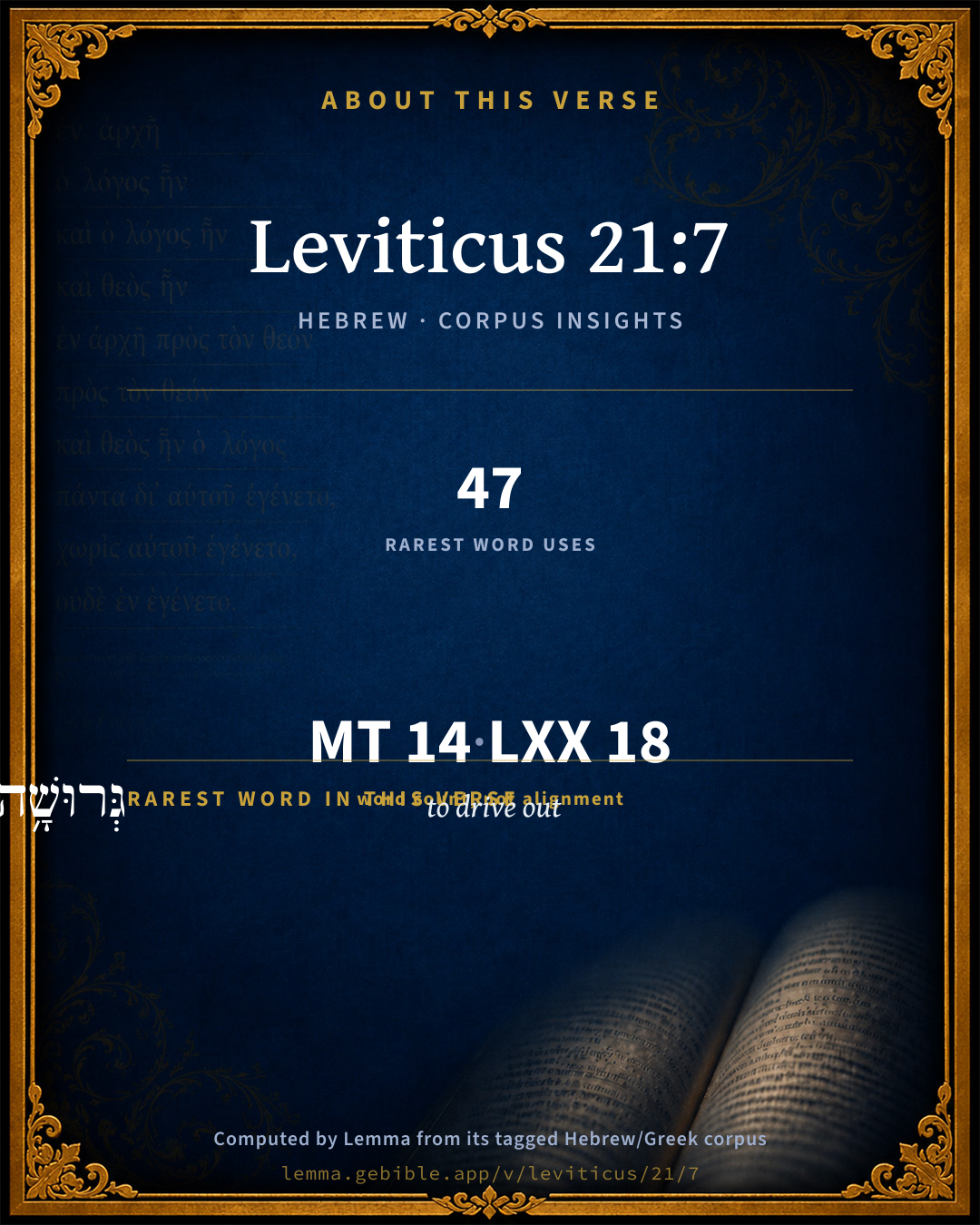
גְּרוּשָׁ֥ה to drive out H1644 occurs in 45 verses of the Hebrew Bible. Also found in:

Grammatical profile

  • 3 verbs
  • 5 nouns
  • 2 adjectives
  • 1 pronoun
  • 1 conjunction
  • 2 particles

Verb forms

  • יִקָּ֔חוּ Qal · Imperfect
  • גְּרוּשָׁ֥ה Qal · Participle Passive
  • יִקָּ֑חוּ Qal · Imperfect

Repetition

Words recur within this verse — often emphatic in Hebrew:

  • אִשָּׁ֨ה woman H802 ×2
  • יִקָּ֔חוּ to take H3947 ×2
  • לֹ֣א not H3808 ×2

Hebrew & Septuagint length

In English translation the verse runs 29 words from the Hebrew and 29 from the Septuagint (LXX English) — the same length.

A rough comparison of the two English renderings, which tokenize alike — not a word-level alignment.

Word counts can differ between the Hebrew and the Greek without any difference in meaning — e.g. the Hebrew direct-object marker אֵת has no separate Greek word, and Greek often adds the article ὁ.

In the original languages it is 14 Hebrew tokens and 18 Greek tokens — but the two are counted differently (Hebrew bundles its prefixes and suffixes into one token; the Greek is in lemma form), so that isn’t a like-for-like length.

Cross-references

6

Topical passages linked to Leviticus 21:7 in the Treasury of Scripture Knowledge — connected by theme and wording, ordered by reader-vote popularity; previews shown in the World English Bible.

  • Leviticus 21:13–14 "'He shall take a wife in her virginity.
  • Ezekiel 44:22 Neither shall they take for their wives a widow, nor her who is put away; but they shall take virgins of the seed of the house of Israel, or a widow who is the widow of a priest.
  • Leviticus 21:8 You shall sanctify him therefore; for he offers the bread of your God: he shall be holy to you: for I Yahweh, who sanctify you, am holy.
  • 1 Timothy 3:11 Their wives in the same way must be reverent, not slanderers, temperate, faithful in all things.
  • Deuteronomy 24:1–4 When a man takes a wife, and marries her, then it shall be, if she find no favor in his eyes, because he has found some unseemly thing in her, that he shall write her a bill of divorce, and give it in her hand, and send her out of his house.
  • Isaiah 50:1 Thus says Yahweh, Where is the bill of your mother's divorce, with which I have put her away? or which of my creditors is it to whom I have sold you? Behold, for your iniquities were you sold, and for your transgressions was your mother put away.

Cross-references courtesy of OpenBible.info (CC BY 4.0).

Hebrew and Greek witnesses Masoretic Hebrew ↔ Greek Septuagint

The same verse in the two great witnesses to the Old Testament, shown verse-for-verse.

These are two independent witnesses, not word-aligned to each other, and the Septuagint is shown in lemma (dictionary) form.

Hebrew Leviticus 21:7 Masoretic · Westminster Leningrad Codex

אִשָּׁ֨ה זֹנָ֤ה וַחֲלָלָה֙ לֹ֣א יִקָּ֔חוּ וְאִשָּׁ֛ה גְּרוּשָׁ֥ה מֵאִישָׁ֖הּ לֹ֣א יִקָּ֑חוּ כִּֽי קָדֹ֥שׁ ה֖וּא לֵאלֹהָֽיו

"'They shall not marry a woman who is a prostitute, or profane; neither shall they marry a woman divorced from her husband: for he is holy to his God.

World English Bible · Public Domain

Greek LXX Leviticus 21:7 Septuagint · lemma form

γυνή πόρνη καί βεβηλόω οὐ λαμβάνω καί γυνή ἐκβάλλω ἀπό ἀνήρ αὐτός ἅγιος εἰμί ὁ κύριος θεός αὐτός

They shall not take a woman who is a harlot and profaned, or a woman put away from her husband; for he is holy to the Lord his God.

LXX2012 (modern English Septuagint) · Public Domain

Hebrew: Westminster Leningrad Codex (CC BY 4.0). Greek: Septuagint (public domain); English from LXX2012 (modern English Septuagint) (Public Domain). How the Septuagint differs from the Hebrew →

Targum (Aramaic paraphrase)

2

The Targum is the ancient Jewish Aramaic paraphrase of the Hebrew Scriptures — an interpretive translation, not the Hebrew text itself. Onkelos (literal) and Pseudo-Jonathan (expansive) render the Torah, and Jonathan the Prophets. Coverage is partial: where no permissively-licensed English translation exists for a verse, only the Aramaic is shown. This is verse-level text, not a word-by-word alignment to the Hebrew.

  1. Targum Onkelos Torah (Genesis–Deuteronomy)
    אִתְּתָא מַטְעֲיָא וּמְחַלְלָא לָא יִסְבוּן וְאִתְּתָא דִמְתָרְכָא מִבַּעְלַהּ לָא יִסְבוּן אֲרֵי קַדִישׁ הוּא קֳדָם אֱלָהֵהּ

    (no public-domain English translation for this verse)

    Targum Onkelos — Aramaic: “Onkelos Genesis” (public domain); “Onkelos Exodus” (public domain); “Onkelos Leviticus” (public domain); “Onkelos Numbers” (public domain); “Onkelos Deuteronomy” (public domain). English: “Sefaria Community Translation” (CC0 1.0 (public-domain dedication)); “J.W. Etheridge. The Targums of Onkelos and Jonathan Ben Uzziel on the Pentateuch. London: Longmans, Green, 1862” (public domain). Text via Sefaria.

  2. Targum Pseudo-Jonathan Torah (Genesis–Deuteronomy)
    אִתְּתָא מַטְעַיָא בִּזְנוּ וּדְאִתְיְלִידָא מִן פְּסוּלַיָא לָא יִסְבּוּן וְאִתְּתָא דְמִפְטְרָא בֵּין מִגַבְרָא בֵּין מִן יְבָמָהּ לָא יִסְבּוּן אֲרוּם קַדִישׁ הוּא קֳדָם אֱלָהֵיהּ

    They shall not take to wife a woman who hath gone astray by fornication, or who was born illegitimate, nor a woman who hath been put away, whether from her husband or the husband's brother, may they take; for he is to be holy before his God.

    Targum Pseudo-Jonathan — Aramaic: “Targum Jonathan on Genesis” (public domain); “Targum Jonathan on Exodus” (public domain); “Targum Jonathan on Leviticus” (public domain); “Targum Jonathan on Numbers” (public domain); “Targum Jonathan on Deuteronomy” (public domain). English: “The Targum of Jonathan ben Uzziel, trans. J. W. Etheridge, London, 1862” (public domain). Text via Sefaria.

Commentary

Notes on Leviticus 21:7 from classic Christian and Jewish commentators (each source and its license shown beneath its notes). The classic Christian expositions comment on the surrounding passage and are grouped to its opening verse, so a note may address several verses; the Jewish commentaries on the Tanakh (Rashi and others) are per-verse, so they appear only where the commentator wrote on this verse.

Lemma curates 59 commentaries, every one of them public domain or Creative Commons licensed, each selected and text-cleaned for this edition rather than reprinted as found. About our sources →

Trapp's Complete Commentary

John Trapp

Lev 21:7 They shall not take a wife [that is] a whore, or profane; neither shall they take a woman put away from her husband: for he [is] holy unto his God.

Ver. 7. They shall not take a wife.] Lest their function be disgraced. That which Hosea was commanded to do against this prohibition {Hos 1:2} was but visional.

Or profane.] Deflowered, ravished.

Put away from her husband.] Because of evil report.

John Trapp, A Commentary or Exposition upon All the Books of the Old and New Testament (1647–1656) — public domain. Text from a community e-Sword module.

Joseph Benson's Commentary

Lev 21:7. Profane — Or defiled, or deflowered, though it were done secretly, or by force; because the priest must take care that all the members of his family be free not only from gross wickedness, but from all suspicions of evil.

Joseph Benson's Commentary on the Old and New Testaments (1811–1818) — public domain. Text from a community e-Sword module.

Whedon's Commentary on the Bible

Daniel D. Whedon

HOLINESS IN FAMILY RELATIONS, Lev_21:7-15.

7. Whore — A woman wilfully wanton.

Profane — Hebrew, profaned or dishonoured in any way, whether by violence or with consent.

Put away — A divorced woman may be perfectly virtuous, but the priest’s wife, like Caesar’s, must be above suspicion. He may marry a widow, unless he be a high priest. See Lev_21:14. We call attention to the absence of all limitations as to nationality. The priest might marry a non-Israelite if not an idolater; but not a Canaanite, because of their idolatry, nor an Ammonite nor a Moabite, on account of national antipathy. Exo_34:16; Deu_7:3; Deu_23:3. From Lev_21:14 we infer that he was permitted to marry a widow, as Josephus declares. Others infer from Eze_44:22 that he could marry only the widow of a priest.

Daniel D. Whedon (gen. ed.), Commentary on the Old and New Testaments (1874–1909) — public domain. Text from a community e-Sword module.

Tyndale Open Study Notes

Tyndale Open Resources

21:7 The priest, to lead Israel in worship, had to model the highest standard of conduct for the people both in his personal life and in leadership of his family. He could have no ties to pagan culture (prostitution, 21:9), nor could the legitimacy of his family be questioned (divorce). Similar standards applied to leaders of the early church (1 Tim 3:1-13).

Tyndale Open Study Notes — © Tyndale Open Resources, licensed CC BY-SA 4.0. Text via the HelloAO Bible API.

Geneva Bible (1599)

Geneva Bible translators

Which hath an evil name or is defamed.

Geneva Bible (1599) marginal notes — public domain. Text via Bolls.life.

Jamieson, Fausset & Brown

Robert Jamieson, A. R. Fausset & David Brown

They shall not take a wife that is a whore, or profane--Private individuals might form several connections, which were forbidden as inexpedient or improper in priests. The respectability of their office, and the honor of religion, required unblemished sanctity in their families as well as themselves, and departures from it in their case were visited with severer punishment than in that of others.

Jamieson, Fausset & Brown — Commentary Critical and Explanatory on the Whole Bible (1871) — public domain (CC PDM 1.0). Text via the HelloAO Bible API.

Adam Clarke's Commentary

Verse 7. That is a whore] A prostitute, though even reclaimed.

Profane] A heathen, or one who is not a cordial believer in the true God.

Put away from her husband] Because this very circumstance might lead to suspicion that the priest and the divorced woman might have been improperly connected before.

Adam Clarke's Commentary on the Bible (1810–1826) — public domain. Text from a community e-Sword/MySword module.

Ellicott's Commentary for English Readers

(7) Not take a wife.—From the defilement arising through contact with the dead, the lawgiver passes to’ regulation about the priest’s alliances with the living, which might be fraught with still more serious consequences to his sacred office. In selecting a wife he is to be careful both about her chastity and legitimate descent.

A Bible Commentary for English Readers, edited by Charles John Ellicott (1878–1897) — public domain. Text from a community e-Sword module.

The Cambridge Bible for Schools and Colleges

gen. ed. J. J. S. Perowne

7. profane] guilty of immorality.

The Cambridge Bible for Schools and Colleges (gen. ed. J. J. S. Perowne; Cambridge University Press, 1878–1918) — public domain. Text from a community e-Sword module.

John Gill's Exposition

They shall not take a wife that is a whore, or profane,.... By the former is meant a common whore, that prostitutes herself to any one through lust or for gain; and by the latter one whose chastity is violated, but either unwillingly, that has been forced and ravished, or else willingly, being enticed, persuaded, and prevailed upon, but did not make a practice of it; this seems to be the true sense of the words: but the Jewish writers understand them differently; by a "whore" they suppose is meant one that is not an Israelitish woman, that is not born of an Israelite, at least of an Israelitish woman, as proselytes or freed persons; for they say there are no whores but such, or one that lies with such persons, she may not marry with; as such as are guilty of cutting off, or any of the Nethinim, or spurious persons, so Jarchi; and by a "profane" person they think is meant such as are born of those that are rejected, as the Targum of Jonathan paraphrases it; that is, that are either born of incestuous marriages, such as are forbidden, Lev 18:1; or that are born of those that are rejected in the priesthood, or whom a priest might not marry, as the daughter of a widow, by the high priest, or the daughter of one divorced, by a common priest, which is the sense of Jarchi:

neither shall they take a woman put away by her husband: which was, in these and later times, common for any offence, when the crime of adultery was not pretended; but this always supposed something bad or amiss, and made such a woman suspected of having done an unseemly thing, therefore priests were forbidden marrying such persons: the Targum of Jonathan adds,"or by her husband's brother;''and so takes in one that has loosed the shoe, as the Jews call her, who being left without issue, her husband's brother refused to marry her, and therefore she plucked off his shoe, and spit in his face, see Deu 25:7; such an one a priest might not marry, according to this paraphrast, and other Jewish writers, and if he did was to be beaten (a):

for he is holy unto his God; separated from common persons, and devoted to the service of God, and therefore not to be defiled with such sort of women, or to lie under any scandal or reproach through such, marriages.

(a) Misn. Maccot, c. 3. sect. 1.

John Gill's Exposition of the Whole Bible (1746–1763) — public domain (CC PDM 1.0). Text via the HelloAO Bible API.

Albert Barnes' Notes on the Bible

Profane - A woman who has been seduced, or one of illegitimate birth. A somewhat stricter rule for the priests’ marriages was revealed to the prophet in later times, Eze 44:22.

Albert Barnes' Notes on the Bible (1834–1885) — public domain. Text from a community e-Sword/MySword module.

Haydock's Catholic Bible Commentary

Vile, (ver. 14,) defiled, (sordidam). Hebrew chalala, "a profane woman," (Pagnin) or one of ill-fame; as captives, inn-keepers, are generally esteemed. Zone, means a common prostitute. (Josephus, [Antiquities?] iii. 3.) None of these fit matches for the priests.

George Leo Haydock (1774–1849), Haydock's Catholic Family Bible and Commentary, 1859 edition — public domain. Excludes Psalms (Douay-Rheims chapter numbering differs from Protestant) and Deuterocanonical books (Catholic canon only).

Matthew Poole's English Annotations

Or profane, or defiled, or defloured, though it were done secretly, or by accident, or by force; because the priest must take care that all the members of his family be free not only from gross wickedness, but from all suspicion of evil, and occasions of reproach or contempt, because this would reflect upon himself, and upon his God and religion also. The word may denote one defloured by any person, though it were by her husband; or a widow, because not only the high priest was obliged to marry a virgin, Lev 21:13, but also the inferior priests, as appears from Eze 44:22, and that is either signified by this word, or by none other here. It is true, a widow, and a profane person, are distinguished, Lev 21:14; but the same word may be, and oft is, taken in differing senses, both more largely and more strictly, in the same chapter. And there was some reason why it should be more expressly and distinctly set down there, a widow, or one profane or defloured otherwise, because there was the more need of caution in the high priest, and therefore the widow is particularly mentioned, which in the former case might be sufficiently comprehended under a general title.

A woman put away from her husband, though not for adultery, but for light causes, and by the husband’s fault, because though the woman might he wholly innocent and free, yet it would leave some blemish upon her.

Matthew Poole's English Annotations on the Holy Bible (1683–1685) — public domain. Text from a community e-Sword/MySword module.

The Pulpit Commentary

Vers. 7-9. Moral uncleanness or defilement passes to the husband and father kern an immoral wife or daughter, and therefore the priest is to be specially careful in the selection of his wife; and his daughter, if she leads a licentious life, is to be stoned to death, and then burnt with fire, because she profaneth her father. (cf. 1Sa_2:17) In a similar spirit, St. Paul gives directions as to the families of those to whom the ministry of the Spirit is assigned. (1Ti_3:11Ti 1Ti_1:6) Keil would unite verse 4 in sense with verses 7-9, and argues that he shall not defile himself, being a chief man among his people, to profane himself, refers to the kind of marriage which the priest is to make, but the interposition of verses 5 and 6 forbid this explanation of verse 4.

Vers. 7-9. The marriage of the clergy,

according to the discipline of the reformed Churches, is one of the points on which the latter bear a marked superiority to the Latin Church, which forbids its bishops and priests to marry; and to the Greek Church, which expects its priests to be married before ordination, forbids them to marry a second time, and requires celibacy in its bishops.

I IT IS MORE SCRIPTURAL. in the Old Testament, the priests had the liberty of marriage; in the New Testament, the bishops or presbyters had the liberty of marriage, and Timothy and Titus are instructed by St. Paul to select married men for the clerical office. (1Ti_3:2, 4 Tit_1:6)

II IT Is MORE PRIMITIVE. The misinterpretation of St. Paul"s words, "the husband of one wife" (which, rightly interpreted, mean "a man faithful to one woman"), led in early time to the Greek discipline; but the Latin practice, condemned by the Greeks in the Council in Trullo, was not enforced upon the whole of the Western Church until the eleventh century, nor is it universal in it now.

III IT IS MORE HUMAN. The attempt to crush instead of regulate God-given instincts, whether by philosophical sects or religious bodies, has always led to unspeakable evils. In the present case it has led to

(1) immorality, as testified by the history of every country in which the practice has existed;

(2) inhumanity, as exhibited in the Inquisition and at the stake, such as a celibate priesthood could alone have been guilty of;

(3) disloyalty, which is naturally felt by those who, having their natural ties to their country severed, become the spiritual police of a foreign power.

IV DUTIES CONNECTED WITH IT.

1. For each individual clergyman to determine whether marriage will or will not "serve better to godliness" (Art. 32).

2. To select a wife who will be "a help meet for him". (Gen_2:20)

3. To be "a man of one woman", (1Ti 3:2Ti 1Ti_1:6) that is, faithful to his wife.

4. To "rule well his own house, having his children in subjection with all gravity"; (1Ti_3:4) "having faithful children not accused of riot or unruly". (Tit_1:6)

5. "To be diligent to form and fashion himself and his family according to the doctrine of Christ, and to make both himself and it, as much as in him lieth, wholesome examples and patterns to the flock of Christ" (Ordering of Priests).

6. For the wife and family to follow his godly monitions, and to abstain from amusements of doubtful character or tendency.

V MINOR ADVANTAGES ATTACHED TO IT. It gives occasion for the growth in the clergy of those graces of character which come from the cultivation and exercise of the affections love, cheerfulness, self-restraint for the sake of others, hopes and fears for others all of which are a prevention of selfishness. It gives a willing and unpaid body of assistants in ministerial work which, though not purely spiritual, has yet to be done by the clergy. It forms a natural link between the clergyman and his parishioners. It ensures the education of a considerable class throughout the country in the principles of religion. It spreads the practices of a religious household to households beyond the clergyman"s home, by the natural effects of intermarriage and friendly intercourse. It gives a safe home to many girls seeking domestic service. It dissipates the false idea that the state of celibacy is a purer and more chaste condition than that of matrimony. It gives an opportunity of learning by experience the working of young people"s minds and hearts, and women"s feelings, which is not, as a rule, to be otherwise safely attained by the clergy.

The Pulpit Commentary (1880–1919), ed. H.D.M. Spence-Jones & Joseph S. Exell — public domain. Text from a community e-Sword module.

John Wesley's Explanatory Notes

Profane - Or defiled, or deflowered, though it were done secretly, or by force: because the priest must take care that all the members of his family be free not only from gross wickedness, but from all suspicions of evil.

John Wesley, Explanatory Notes Upon the Whole Bible (1754–1765) — public domain. Text via the GEBible commentary corpus.

Keil & Delitzsch

C. F. Keil & F. Delitzsch

Their marriage and their domestic life were also to be in keeping with their holy calling. They were not to marry a whore (i.e., a public prostitute), or a fallen woman, or a woman put away (divorced) from her husband, that is to say, any person of notoriously immoral life, for this would be irreconcilable with the holiness of the priesthood, but (as may be seen from this in comparison with Lev 21:14) only a virgin or widow of irreproachable character. She need not be an Israelite, but might be the daughter of a stranger living among the Israelites; only she must not be an idolater or a Canaanite, for the Israelites were all forbidden to marry such a woman (Exo 34:16; Deu 7:3).

Lev 21:8

"Thou shalt sanctify him therefore," that is to say, not merely "respect his holy dignity" (Knobel), but take care that he did not desecrate his office by a marriage so polluted. The Israelites as a nation are addressed in the persons of their chiefs. The second clause of the verse, "he shall be holy unto thee," contains the same thought. The repetition strengthens the exhortation. The reason assigned for the first clause is the same as in Lev 21:6; and that for the second, the same as in Lev 20:8, Lev 20:26; Exo 31:13, etc.

Lev 21:9

The priests's family was also to lead a blameless life. If a priest's daughter began to play the whore, she profaned her father, and was to be burned, i.e., to be stoned and then burned (see Lev 20:14). כּהן אישׁ, a man who is a priest, a priest-man.

Keil & Delitzsch — Biblical Commentary on the Old Testament (1861–1891) — public domain (CC PDM 1.0). Text via the HelloAO Bible API. (Old Testament only.)

unfoldingWord translationNotes

Door43 World Missions Community

They must not

"The priests must not"

for they are separate

"for they are set apart"

You will set him apart

"You people must treat the priest as holy"

for he is the one who offers bread to your God

Here "bread" represents food in general. Yahweh does not actually eat these offerings. Translate this in a way that makes it clear that Yahweh does not actually eat the food. (See: Synecdoche)

He must be holy to you

This can be stated in active form. AT: "You must regard him as holy" (See: Active or Passive)

She must be burned

This can be stated in active form. AT: "You must burn her to death" (See: Active or Passive)

translationWords

prostitute

divorce

set apart

unfoldingWord translationNotes — © Distant Shores Media and the Door43 World Missions Community, licensed CC BY-SA 4.0. Source: git.door43.org/Door43/en_tn.

Rashi

Rabbi Shlomo Yitzchaki (Rashi)

זנה is a woman who had sexual intercourse with an Israelite who is forbidden to her as a husband, for instance, with those whom she may not marry under the penalty of excision, or a Gibeonite or a ממזר (that is, a man born from the union of a couple who are liable to excision for such a union) (cf. Sifra, Emor, Chapter 1 7; Yevamot 61b).

חללה — This is a woman born from a marriage which is forbidden to the priesthood alone (Kiddushin 77a), e. g., the daughter of a widow and a high priest, or the daughter of a divorced woman [or one released from levirate marriage by the appropriate ceremony (cf. Deuteronomy 25:9)] and an ordinary priest. So also it denotes a woman who became profaned in respect to the priesthood (who lost the right of marrying a priest) through her having previously entered into a union with one of those priests a marriage with whom comes under the term: "marriages forbidden to the priesthood alone”.

Rashi on the Tanakh — English translations: “The Judaica Press complete Tanach with Rashi, translated by A. J. Rosenberg” (CC BY 4.0); “Pentateuch with Rashi's commentary by M. Rosenbaum and A.M. Silbermann, 1929-1934” (public domain); “The Metsudah Tanach series, Lakewood, N.J” (CC BY 4.0); and “The Book of Joshua, Metsudah Publications, 1997” (CC BY 4.0). Text via Sefaria.

Lesson kit

Teaching starters — assembled from the data on this page, not authored interpretation. Every prompt links to the verse data it draws on. Edit before teaching.

Leviticus, in the Pentateuch, opens this verse with 14 words (11 distinct Hebrew lemmas). Its most distinctive word is gârash (“to drive out”). A historical commentator’s framing appears above. Read the whole chapter for the surrounding context.

Discussion questions

  1. How does “to drive out” (gârash) shape what this verse is saying?
  2. Genesis 3:24 shares the word «to drive out» with this verse. How do the two illuminate each other?
  3. “woman” occurs 2× in this one verse. What is the effect of the repetition?
  4. These translations render this verse differently; the difference is in the English rendering, not the original. What questions does that raise?
  5. The verb «יִקָּ֔חוּ» is Qal Imperfect. How does its form color the action?
  6. Reading how Trapp's Complete Commentary and Joseph Benson's Commentary read this verse, where do the two commentators agree and where do they part?

Things to notice

Reading settings

Reading text

Shown beneath each verse's original-language words.

Old Testament
Old Testament edition

Read the OT as the Masoretic Hebrew (MT) or the Greek Septuagint (LXX).

English shown for the Greek Septuagint (in the Hebrew ↔ Greek comparison).

Comparing translations? Open the Compare panel on any verse page to stack up to four side by side.