
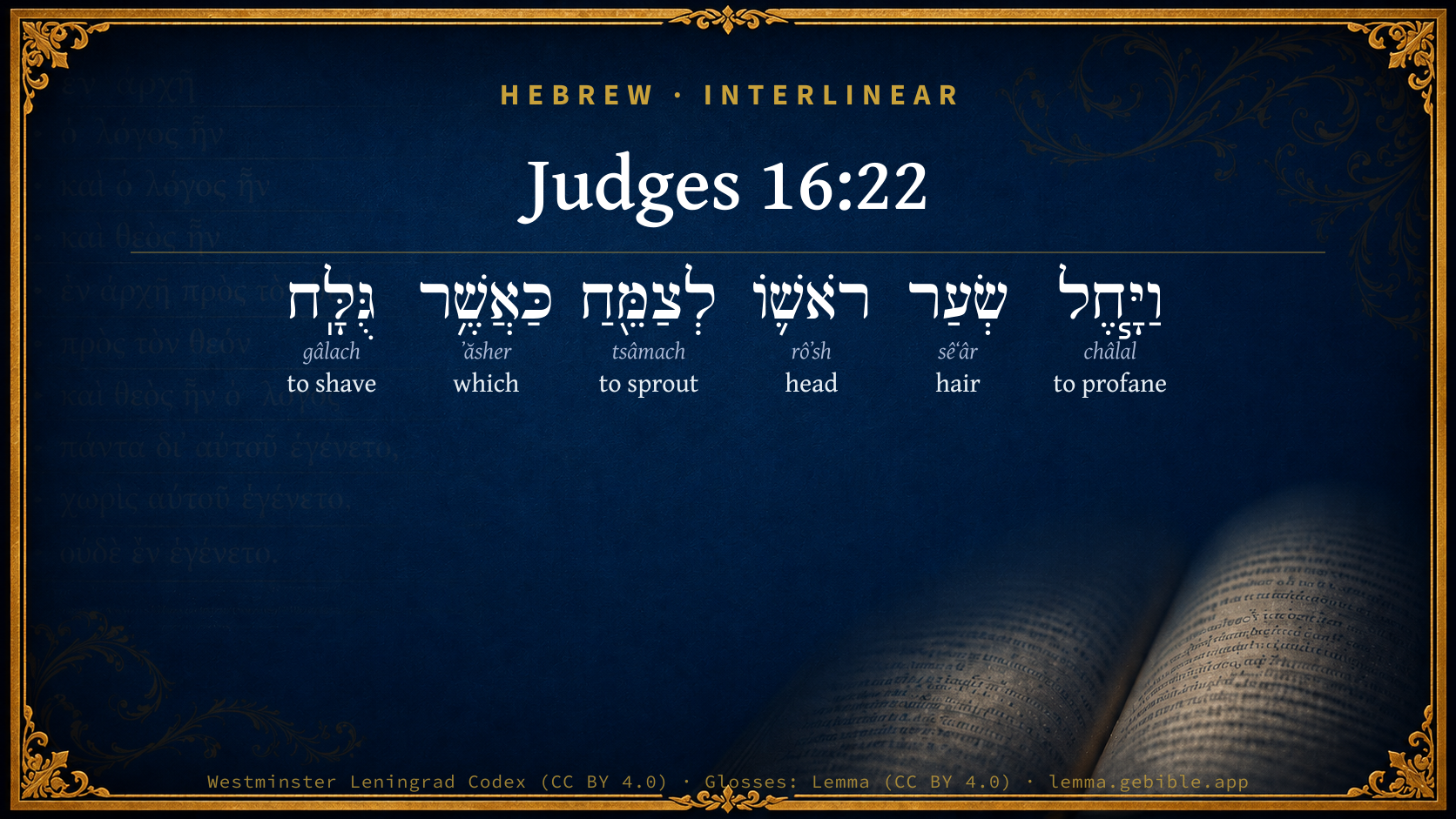
Judges 16:22

Hebrew (Westminster Leningrad Codex) Judges 16:22 appears in the Hebrew Old Testament. The text above is from the Westminster Leningrad Codex. Each word links to its Strong’s number, a concise gloss, and parsing drawn from the Open Scriptures Hebrew Bible morphology. Click any word for its full Brown-Driver-Briggs (BDB) entry.
Download image
Cite this verse

Judges 16:22 (World English Bible). Public Domain. Lemma interlinear Bible study tool, https://lemma.gebible.app/v/judges/16/22.

Show BibTeX & RIS
BibTeX
RIS
English Translation
However the hair of his head began to grow again after he was shaved.
World English Bible · Public Domain
Download a study sheet

One document with this verse’s original text, its word-by-word gloss line, the meaning frame, cross-references with their text, attributed commentary, and full source and license credits — printable, and it pastes into notes with its structure intact.

This verse Autodidact and up

Study sheet (.html) Plain text (.txt)

A passage Seminary Student

Up to 50 verses in one chapter. A passage sheet keeps up to 6 commentary sources and 12 cross-references per verse, in the order this page ranks them, and says so on the sheet whenever that leaves anything out. Ask for a single verse and you get the Autodidact verse sheet above.

Everything on this page stays free to read, with no account — the sheet is a download of what is already on screen, not access to it.

Want to remove ads? Support Godless Engineer
Compare translations 3

The same verse in 3 English versions, stacked beneath the original-language interlinear above. Click any original word for its lexicon entry.

Each is an independent rendering of the whole verse — the interlinear is not word-aligned to these translations.

Highlighted words mark where these versions differ — a whole-verse word diff, not a word-by-word alignment.

  • World English Bible Public Domain
    However the hair of his head began to grow again after he was shaved.
  • King James Version Public Domain
    Howbeit the hair of his head began to grow again after he was shaven.
  • unfoldingWord Literal Text CC BY-SA 4.0
    But the hair of his head began to grow after it had been shaved.

unfoldingWord Literal Text — © unfoldingWord, licensed CC BY-SA 4.0. Word-aligned USFM3 via Door43 (git.door43.org/unfoldingWord/en_ult).

Versions to compare (up to 4)

3 of 4 selected

Show all 18 translations

Every available English version of this verse, each an independent rendering of the whole verse.

  • World English Bible Public Domain
    However the hair of his head began to grow again after he was shaved.
  • Berean Standard Bible Public Domain
    However, the hair of his head began to grow back after it had been shaved.
  • Majority Standard Bible Public Domain
    However, the hair of his head began to grow back after it had been shaved.
  • King James Version Public Domain
    Howbeit the hair of his head began to grow again after he was shaven.
  • American Standard Version (1901) Public Domain
    Howbeit the hair of his head began to grow again after he was shaven.
  • Revised Version (1885) Public Domain
    Howbeit the hair of his head began to grow again after he was shaven.
  • Geneva Bible (1599) Public Domain
    And the heare of his head began to growe againe after that it was shauen.
  • Douay-Rheims (1899) Public Domain
    And now his hair began to grow again.
  • Young's Literal Translation Public Domain
    And the hair of his head beginneth to shoot up, when he hath been shaven,
  • Literal Standard Version CC BY-SA 4.0
    And the hair of his head begins to shoot up when he has been shaven,
  • Unlocked Literal Bible CC BY-SA 4.0
    But the hair on his head began to grow again after it had been shaved.
  • unfoldingWord Literal Text CC BY-SA 4.0
    But the hair of his head began to grow after it had been shaved.
  • Darby Bible Public Domain
    But the hair of his head began to grow again after it had been shaved.
  • World Messianic Bible Public Domain
    However, the hair of his head began to grow again after he was shaved.
  • Webster's Bible Public Domain
    However the hair of his head began to grow again after he was shaved.
  • Free Bible Version CC BY-SA 4.0
    But his hair began to grow back after it had been shaved off.
  • Bible in Basic English Public Domain
    But the growth of his hair was starting again after it had been cut off.
  • JPS Tanakh (1917) Public Domain
    Howbeit the hair of his head began to grow again after he was shaven.

Literal Standard Version (2020), Covenant Press — licensed CC BY-SA 4.0. Text via the HelloAO Bible API (eBible.org). Unlocked Literal Bible (unfoldingWord) — licensed CC BY-SA 4.0. Text via the HelloAO Bible API (eBible.org). unfoldingWord Literal Text — © unfoldingWord, licensed CC BY-SA 4.0. Word-aligned USFM3 via Door43 (git.door43.org/unfoldingWord/en_ult). Free Bible Version, Dr. Jonathan Gallagher — licensed CC BY-SA 4.0. Text via the HelloAO Bible API (eBible.org).

Word by word

More ways to search: Search by grammar → Find every occurrence → Compare this word →

Practice this passage: Drill this verse → Learn its vocabulary →

About this verse

These counts appear in no published source. They are computed here, from the morphology-tagged text and Lemma’s own curated glosses. What Lemma adds →

6
words
6
distinct lemmas
Historical
section

Notable vocabulary

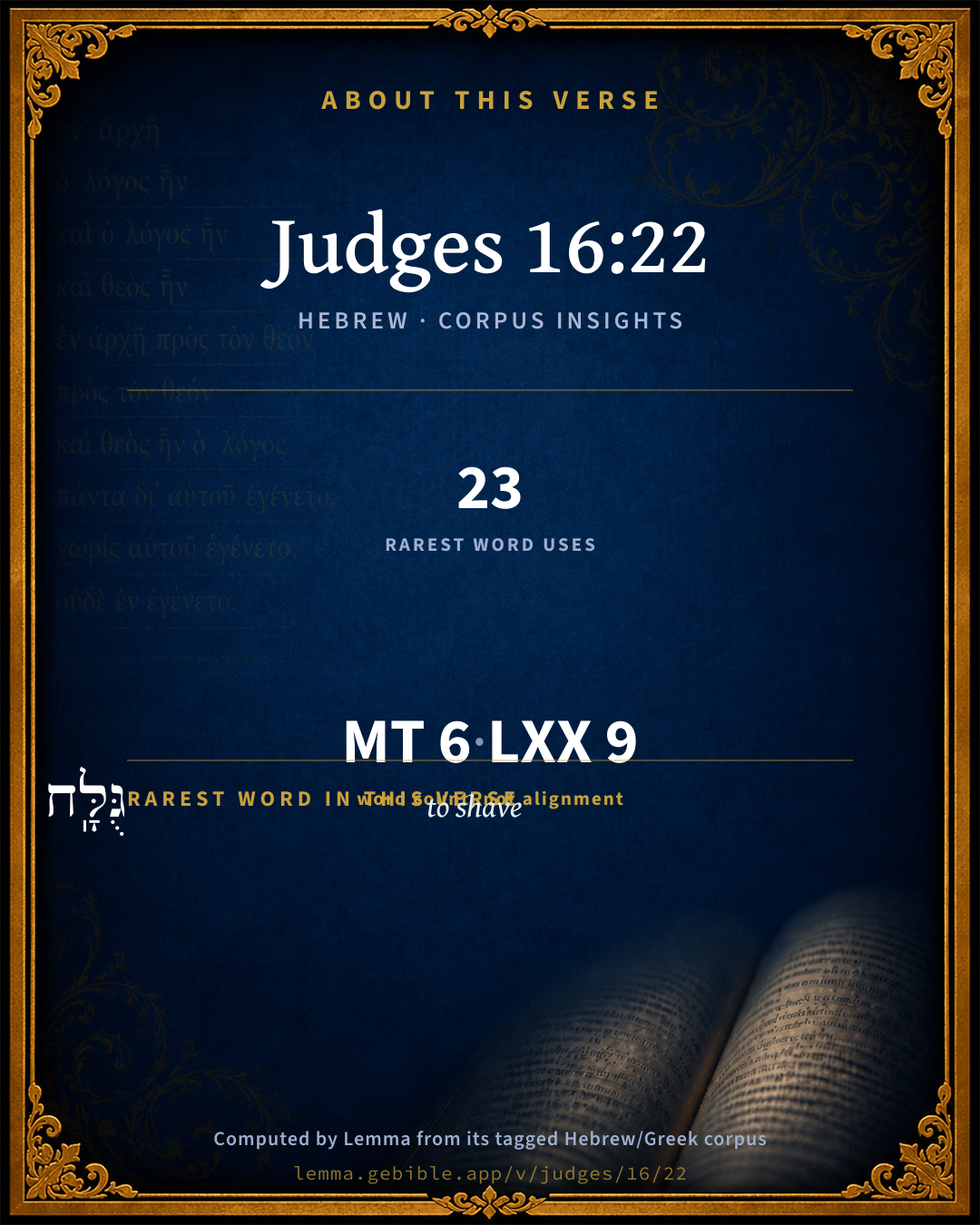
The rarest word here is גֻּלָּֽח to shave H1548 — appearing just 23 times in the whole Hebrew Bible.

Shared distinctive vocabulary

גֻּלָּֽח to shave H1548 occurs in 18 verses of the Hebrew Bible. Also found in:

Grammatical profile

  • 3 verbs
  • 2 nouns
  • 1 particle

Verb forms

  • וַיָּ֧חֶל Hiphil · Sequential Imperfect
  • לְצַמֵּ֖חַ Piel · Infinitive Construct
  • גֻּלָּֽח Pual · Perfect

Hebrew & Septuagint length

In English translation the verse runs 14 words from the Hebrew and 14 from the Septuagint (LXX English) — the same length.

A rough comparison of the two English renderings, which tokenize alike — not a word-level alignment.

Word counts can differ between the Hebrew and the Greek without any difference in meaning — e.g. the Hebrew direct-object marker אֵת has no separate Greek word, and Greek often adds the article ὁ.

In the original languages it is 6 Hebrew tokens and 9 Greek tokens — but the two are counted differently (Hebrew bundles its prefixes and suffixes into one token; the Greek is in lemma form), so that isn’t a like-for-like length.

Cross-references

4

Topical passages linked to Judges 16:22 in the Treasury of Scripture Knowledge — connected by theme and wording, ordered by reader-vote popularity; previews shown in the World English Bible.

  • Leviticus 26:44 Yet for all that, when they are in the land of their enemies, I will not reject them, neither will I abhor them, to destroy them utterly, and to break my covenant with them; for I am Yahweh their God;
  • Psalms 106:44–45 Nevertheless he regarded their distress, When he heard their cry.
  • Psalms 107:13–14 Then they cried to Yahweh in their trouble, And he saved them out of their distresses.
  • Deuteronomy 32:36 For Yahweh will judge his people, Repent himself for his servants; When he sees that [their] power is gone, There is none [remaining], shut up or left at large.

Cross-references courtesy of OpenBible.info (CC BY 4.0).

Hebrew and Greek witnesses Masoretic Hebrew ↔ Greek Septuagint

The same verse in the two great witnesses to the Old Testament, shown verse-for-verse.

These are two independent witnesses, not word-aligned to each other, and the Septuagint is shown in lemma (dictionary) form.

Hebrew Judges 16:22 Masoretic · Westminster Leningrad Codex

וַיָּ֧חֶל שְׂעַר רֹאשׁ֛וֹ לְצַמֵּ֖חַ כַּאֲשֶׁ֥ר גֻּלָּֽח

However the hair of his head began to grow again after he was shaved.

World English Bible · Public Domain

Greek LXX Judges 16:22 Septuagint · lemma form

καί ἄρχω θρίξ ὁ κεφαλή αὐτός βλαστάνω καθώς ξυράω

And the hair of his head began to grow as before it was shaven.

LXX2012 (modern English Septuagint) · Public Domain

Hebrew: Westminster Leningrad Codex (CC BY 4.0). Greek: Septuagint (public domain); English from LXX2012 (modern English Septuagint) (Public Domain). How the Septuagint differs from the Hebrew →

Targum (Aramaic paraphrase)

1

The Targum is the ancient Jewish Aramaic paraphrase of the Hebrew Scriptures — an interpretive translation, not the Hebrew text itself. Onkelos (literal) and Pseudo-Jonathan (expansive) render the Torah, and Jonathan the Prophets. Coverage is partial: where no permissively-licensed English translation exists for a verse, only the Aramaic is shown. This is verse-level text, not a word-by-word alignment to the Hebrew.

  1. Targum Jonathan Prophets (Joshua–Malachi)
    וּשְׁרֵי שְׂעַר רֵישֵׁיהּ לְצַמָחָא בָּתַר דְאִתְגַלָח:

    (no public-domain English translation for this verse)

    Targum Jonathan — Aramaic: “Mikraot Gedolot” (public domain). English: “Sefaria Community Translation” (CC0 1.0 (public-domain dedication)); “London "Chaldee Paraphrase," 1871” (public domain). Text via Sefaria.

Commentary

Notes on Judges 16:22 from classic Christian and Jewish commentators (each source and its license shown beneath its notes). The classic Christian expositions comment on the surrounding passage and are grouped to its opening verse, so a note may address several verses; the Jewish commentaries on the Tanakh (Rashi and others) are per-verse, so they appear only where the commentator wrote on this verse.

Lemma curates 59 commentaries, every one of them public domain or Creative Commons licensed, each selected and text-cleaned for this edition rather than reprinted as found. About our sources →

Matthew Henry's Commentary

Though the last stage of Samson's life was inglorious, and one could wish there were a veil drawn over it, yet this account here given of his death may be allowed to lessen, though it does not quite roll away, the reproach of it; for there was honour in his death. No doubt he greatly repented of his sin, the dishonour he had by it done to God and his forfeiture of the honour God had put upon him; for that God was reconciled to him appears, 1. By the return of the sign of his Nazariteship (Jdg 16:22): His hair began to grow again, as when he was shaven, that is, to be as thick and as long as when it was cut off. It is probable that their general thanksgiving to Dagon was not long deferred, before which Samson's hair had thus grown, by which, and the particular notice taken of it, it seems to have been extraordinary, and designed for a special indication of the return of God's favour to him upon his repentance. For the growth of his hair was neither the cause nor the sign of the return of his strength further than as it was the badge of his consecration, and a token that God accepted him as a Nazarite again, after the interruption, without those ceremonies which were appointed for the restoration of a lapsed Nazarite, which he had not now the opportunity of performing, Num 6:9. It is strange that the Philistines in whose hands he was were not jealous of the growth of his hair again, and did not cut it; but perhaps they were willing his great strength should return to him, that they might have so much the more work out of him, and now that he was blind they were in no fear of any hurt from him. 2. By the use God made of him for the destruction of the enemies of his people, and that at a time when it would be most for the vindication of the honour of God, and not immediately for the defence and deliverance of Israel. Observe,

I. How insolently the Philistines affronted the God of Israel, 1. By the sacrifices they offered to Dagon, his rival. This Dagon they call their god, a god of their own making, represented by an image, the upper part of which was in the shape of a man, the lower part of a fish, purely the creature of fancy; yet it served them to set up in opposition to the true and living God. To this pretended deity they ascribe their success (Jdg 16:23, Jdg 16:24): Our god has delivered Samson our enemy, and the destroyer of our country, into our hands. So they dreamed, though he could do neither good nor evil. They knew Delilah had betrayed him, and they had paid her for doing it, yet they attribute it to their god, and are confirmed by it in their belief of his power to protect them. All people will thus walk in the name of their gods: they will give them the praise of their achievements; and shall not we pay this tribute to our God whose kingdom ruleth over all? Yet, considering what wicked arts they used to get Samson into their hands, it must be confessed it was only such a dunghill-deity as Dagon that was fit to be made a patron of the villany. Sacrifices were offered, and songs of praise sung, on the general thanksgiving day, for this victory obtained over one man; there were great expressions of joy, and all to the honour of Dagon. Much more reason have we to give the praise of all our successes to our God. Thanks be to him who causeth us to triumph in Christ Jesus! 2. By the sport they made with Samson, God's champion, they reflected on God himself. When they were merry with wine, to make them more merry Samson must be fetched to make sport for them (Jdg 16:25, Jdg 16:27), that is, for them to make sport with. Having sacrificed to their god, and eaten and drunk upon the sacrifice, they rose up to play, according to the usage of idolaters (Co1 10:7), and Samson must be the fool in the play. They made themselves and one another laugh to see how, being blind, he stumbled and blundered. It is likely they smote this judge of Israel upon the cheek (Mic 5:1), and said, Prophesy who smote thee. It was an instance of their barbarity to trample thus upon a man in misery, at the sight of whom awhile ago they would have trembled. It put Samson into the depth of misery, and as a sword in his bones were their reproaches, when they said, Where is now they God? Nothing could be more grievous to so great a spirit; yet, being a penitent, his godly sorrow makes him patient, and he accepts the indignity as the punishment of his iniquity. How unrighteous soever the Philistines were, he could not but own that God was righteous. He had sported himself in his own deceivings and with his own deceivers, and justly are the Philistines let loose upon him to make sport with him. Uncleanness is a sin that makes men vile, and exposes them to contempt. A wound and dishonour shall he get whose heart is deceived by a woman, and his reproach shall not be wiped away. Everlasting shame and contempt will be the portion of those that are blinded and bound by their own lusts. The devil that deceived them will insult over them.

II. How justly the God of Israel brought sudden destruction upon them by the hands of Samson. Thousands of the Philistines had got together, to attend their lords in the sacrifices and joys of this day, and to be the spectators of this comedy; but it proved to them a fatal tragedy, for they were all slain, and buried in the ruins of the house: whether it was a temple or a theatre, or whether it was some slight building run up for the purpose, is uncertain. Observe,

1. Who were destroyed: All the lords of the Philistines (Jdg 16:27), who had by bribes corrupted Delilah to betray Samson to them. Evil pursued those sinners. Many of the people likewise, to the number of 3000, and among them a great many women, one of whom, it is likely, was that harlot of Gaza mentioned, Jdg 16:1. Samson had been drawn into sin by the Philistine women, and now a great slaughter is made among them, as was by Moses's order among the women of Midian, because it was they that caused the children of Israel to trespass against the Lord in the matter of Peor, Num 31:16.

2. When they were destroyed. (1.) When they were merry, secure, and jovial, and far from apprehending themselves in any danger. When they saw Samson lay hold of the pillars, we may suppose, his doing so served them for a jest, and they made sport with that too: What will this feeble Jew do? How are sinners brought to desolation in a moment! They are lifted up in pride and mirth, that their fall may be the more dreadful. Let us never envy the mirth of wicked people, but infer from this instance that their triumphing is short and their joy but for a moment. (2.) It was when they were praising Dagon their god, and giving that honour to him which is due to God only, which is no less than treason against the King of kings, his crown and dignity. Justly therefore is the blood of these traitors mingled with their sacrifices. Belshazzar was cut off when he was praising his man-made gods, Dan 5:4. (3.) It was when they were making sport with an Israelite, a Nazarite, and insulting over him, persecuting him whom God had smitten. Nothing fills the measure of the iniquity of any person or people faster than mocking and misusing the servants of God, yea, though it is by their own folly that they are brought low. Those know not what they do, nor whom they affront, that make sport with a good man.

3. How they were destroyed. Samson pulled the house down upon them, God no doubt putting it into his heart, as a public person, thus to avenge God's quarrel with them, Israel's, and his own. (1.) He gained strength to do it by prayer, Jdg 16:28. That strength which he had lost by sin he, like a true penitent, recovers by prayer; as David, who, when he had provoked the Spirit of grace to withdraw, prayed (Psa 51:12), Restore unto me the joy of thy salvation, and uphold me with thy free Spirit. We may suppose that this was only a mental prayer, and that his voice was not heard (for it was made in a noisy clamorous crowd of Philistines); but, though his voice was not heard of men, yet his prayer was heard of God and graciously answered, and though he lived not to give an account himself of this his prayer, as Nehemiah did of his, yet God not only accepted it in heaven, but, by revealing it to the inspired penmen, provided for the registering of it in his church. He prayed to God to remember him and strengthen him this once, thereby owning that his strength for what he had already done he had from God, and begged it might be afforded to him once more, to give them a parting blow. That it was not from a principle of passion or personal revenge, but from a holy zeal for the glory of God and Israel, that he desired to do this, appears from God's accepting and answering the prayer. Samson died praying, so did our blessed Saviour; but Samson prayed for vengeance, Christ for forgiveness. (2.) He gained opportunity to do it by leaning on the two pillars which were the chief supports of the building, and were, it seems, so near together that he could take hold of them both at one time, v. 26, 29. Having hold of them, he bore them down with all his might, crying aloud, Let me die with the Philistines, v. 30. Animamque in vulnere ponit - While inflicting the wound he dies. The vast concourse of people that were upon the roof looking down through it to see the sport, we may suppose, contributed to the fall of it. A weight so much greater than ever it was designed to carry might perhaps have sunk of itself, at least it made the fall more fatal to those within: and indeed few of either could escape being either stifled or crushed to death. This was done, not by any natural strength of Samson, but by the almighty power of God, and is not only marvellous, but miraculous, in our eyes. Now in this, [1.] The Philistines were greatly mortified. All their lords and great men were killed, and abundance of their people, and this in the midst of their triumph; the temple of Dagon (as many think the house was) was pulled down, and Dagon buried in it. This would give a great check to the insolence of the survivors, and, if Israel had but had so much sense and spirit left them as to improve the advantages of this juncture, they might now have thrown off the Philistines' yoke. [2.] Samson may very well be justified, and brought in not guilty of any sinful murder either of himself or the Philistines. He was a public person, a declared enemy to the Philistines, against whom he might therefore take all advantages. They were now in the most barbarous manner making war upon him; all present were aiding and abetting, and justly die with him. Nor was he felo de se, or a self-murderer, in it; for it was not his own life that he aimed at, though he had too much reason to be weary of it, but the lives of Israel's enemies, for the reaching of which he bravely resigned his own, not counting it dear to him, so that he might finish his course with honour. [3.] God was very much glorified in pardoning Samson's great transgressions, of which this was an evidence. It has been said that the prince's giving a commission to one convicted amounts to a pardon. Yet, though he was a God that forgave him, he took vengeance of his inventions (Psa 99:8), and, by suffering his champion to die in fetters, warned all to take heed of those lusts which war against the soul. However, we have good reason to hope that though Samson died with the Philistines he had not his everlasting portion with them. The Lord knows those that are his. [4.] Christ was plainly typified. He pulled down the devil's kingdom, as Samson did Dagon's temple; and, when he died, he obtained the most glorious victory over the powers of darkness. Then when his arms were stretched out upon the cross, as Samson's to the two pillars, he gave a fatal shake to the gates of hell, and, through death, destroyed him that had the power of death, that is, the devil (Heb 2:14, Heb 2:15), and herein exceeded Samson, that he not only died with the Philistines, but rose again to triumph over them.

Lastly, The story of Samson concludes, 1. With an account of his burial. His own relations, animated by the glories that attended his death, came and found out his body among the slain, brought it honourably to his own country, and buried it in the place of his fathers' sepulchres, the Philistines being in such a consternation that they durst not oppose it. 2. With the repetition of the account we had before of the continuance of his government: He judged Israel twenty years; and, if they had not been as mean and sneaking as he was brave and daring, he would have left them clear of the Philistines' yoke. They might have been easy, safe, and happy, if they would but have given God and their judges leave to make them so.

Matthew Henry's Commentary on the Whole Bible (1708–1710) — public domain (CC PDM 1.0). Text via the HelloAO Bible API.

Trapp's Complete Commentary

John Trapp

Jdg 16:22 Howbeit the hair of his head began to grow again after he was shaven.

Ver. 22. Howbeit the hair of his head began to grow again.] By this time Samson was thoroughly humbled, and "accepting the chastisement of his iniquity," found God favourable, whose property it is to comfort the abject, {2Co 7:6} and to do his people good when they are called outcasts; when men say, "This is Zion, whom no man seeketh after." {Jer 30:17} Samson repenting, reassumed his Nazariteship, and God was soon reconciled.

John Trapp, A Commentary or Exposition upon All the Books of the Old and New Testament (1647–1656) — public domain. Text from a community e-Sword module.

Joseph Benson's Commentary

Jdg 16:22. The hair of his head began to grow — This circumstance, though in itself inconsiderable, is noted as a sign of the recovery of God’s favour, and his former strength, in some degree, upon his repentance, and renewing his vow with God, which was allowed for Nazarites to do.

Joseph Benson's Commentary on the Old and New Testaments (1811–1818) — public domain. Text from a community e-Sword module.

Keil & Delitzsch

C. F. Keil & F. Delitzsch

Samson's Misery, and His Triumph in Death. - Jdg 16:22. The hair of his head began to grow, as he was shaven. In the word כּאשׁר, as (from the time when he was shaven), there is an indication that Samson only remained in his ignominious captivity till his hair began to grow again, i.e., visibly to grow. What follows agrees with this.

Jdg 16:23-24

The captivity of this dreaded hero was regarded by the Philistines as a great victory, which their princes resolved to celebrate with a great and joyous sacrificial festival in honour of their god Dagon, to whom they ascribed this victory. "A great sacrifice," consisting in the offering up of a large number of slain sacrifices. "And for joy," viz., to give expression to their joy, i.e., for a joyous festival. Dagon, one of the principal deities of the Philistines, was worshipped at Gaza and Ashdod (Sa2 5:2., and 1 Macc. 10:83), and, according to Jerome on Isa 46:1, in the rest of the Philistine towns as well. It was a fish-deity (דּגון, from דּג, a fish), and in shape resembled the body of a fish with the head and hands of a man (Sa1 5:4). It was a male deity, the corresponding female deity being Atargatis (2 Macc. 12:26) or Derceto, and was a symbol of water, and of all the vivifying forces of nature which produce their effects through the medium of water, like the Babylonian Ὠοδάκων, one of the four Oannes, and the Indian Vishnu (see Movers, Phniz. i. pp. 143ff., 590ff., and J. G. Mller in Herzog's Cycl.).

Jdg 16:24

All the people took part in this festival, and sang songs of praise to the god who had given the enemy, who had laid waste their fields and slain many of their countrymen, into their hands.

Jdg 16:25-27

When their hearts were merry (יטוב, inf. of יטב), they had Samson fetched out of the prison, that he might make sport before them, and "put him between the pillars" of the house or temple in which the triumphal feast was held. Then he said to the attendant who held his hand, "Let me loose, and let me touch the pillars upon which the house is built, that I may lean upon it." הימישׁני is the imperative Hiphil of the radical verb ימשׁ, which only occurs here; and the Keri substitutes the ordinary form המישׁ from מוּשׁ. "But the house," adds the historian by way of preparation for what follows, "was filled with men and women: all the princes of the Philistines also were there; and upon the roof were about three thousand men and women, who feasted their eyes with Samson's sports" (ראה with בּ, used to denote the gratification of looking).

Jdg 16:28

Then Samson prayed to Jehovah, "Lord Jehovah, remember me, and only this time make me strong. O God, that I may avenge myself (with) the revenge of one of my two eyes upon the Philistines," i.e., may take vengeance upon them for the loss of only one of my two eyes (משּׁתי, without Dagesh lene in the ת: see Ewald, 267, b.), - a sentence which shows how painfully he felt the loss of his two eyes, "a loss the severity of which even the terrible vengeance which he was meditating could never outweigh" (Bertheau).

Jdg 16:29-30

After he had prayed to the Lord for strength for this last great deed, he embraced the two middle pillars upon which the building was erected, leant upon them, one with his right hand, the other with the left (viz., embracing them with his hands, as these words also belong to ילפּת), and said, "let my soul die with the Philistines." He then bent (the two pillars) with force, and the house fell upon the princes and all the people who were within. So far as the fact itself is concerned, there is no ground nor questioning the possibility of Samson's bringing down the whole building with so many men inside by pulling down two middle columns, as we have no accurate acquaintance with the style of its architecture. In all probability we have to picture this temple of Dagon as resembling the modern Turkish kiosks, namely as consisting of a "spacious hall, the roof of which rested in front upon four columns, two of them standing at the ends, and two close together in the centre. Under this hall the leading men of the Philistines celebrated a sacrificial meal, whilst the people were assembled above upon the top of the roof, which was surrounded by a balustrade" (Faber, Archol. der. Hebr. p. 444, cf. pp. 436-7; and Shaw, Reisen, p. 190). The ancients enter very fully into the discussion of the question whether Samson committed suicide or not, though without arriving at any satisfactory conclusion. O. v. Gerlach, however, has given the true answer. "Samson's deed," he says, "was not suicide, but the act of a hero, who sees that it is necessary for him to plunge into the midst of his enemies with the inevitable certainty of death, in order to effect the deliverance of his people and decide the victory which he has still to achieve. Samson would be all the more certain that this was the will of the Lord, when he considered that even if he should deliver himself in any other way cut of the hands of the Philistines, he would always carry about with him the mark of his shame in the blindness of his eyes-a mark of his unfaithfulness as the servant of God quite as much as of the double triumph of his foes, who had gained a spiritual as well as a corporeal victory over him." Such a triumph as this the God of Israel could not permit His enemies and their idols to gain. The Lord must prove to them, even through Samson's death, that the shame of his sin was taken from him, and that the Philistines had no cause to triumph over him. Thus Samson gained the greatest victory over his foes in the moment of his own death. The terror of the Philistines when living, he became a destroyer of the temple of their idol when he died. Through this last act of his he vindicated the honour of Jehovah the God of Israel, against Dagon the idol of the Philistines. "The dead which he slew at his death were more than they which he slew in his life."

Jdg 16:31

This terrible blow necessarily made a powerful impression upon the Philistines, not only plunging them into deep mourning at the death of their princes and so many of their countrymen, and the destruction of the temple of Dagon, but filling them with fear and terror at the omnipotence of the God of the Israelites. Under these circumstances it is conceivable enough that the brethren and relatives of Samson were able to come to Gaza, and fetch away the body of the fallen hero, to bury it in his father's grave between Zorea and Eshtaol (see Jdg 13:25). - In conclusion, it is once more very appropriately observed that Samson had judged Israel twenty years (cf. Jdg 15:20).

Keil & Delitzsch — Biblical Commentary on the Old Testament (1861–1891) — public domain (CC PDM 1.0). Text via the HelloAO Bible API. (Old Testament only.)

Geneva Bible (1599)

Geneva Bible translators

Yet had he not his strength again, till he had called upon God, and reconciled himself.

Geneva Bible (1599) marginal notes — public domain. Text via Bolls.life.

Jamieson, Fausset & Brown

Robert Jamieson, A. R. Fausset & David Brown

Howbeit the hair of his head began to grow again--It is probable that he had now reflected on his folly; and becoming a sincere penitent, renewed his Nazarite vow. "His hair grew together with his repentance, and his strength with his hairs" [BISHOP HALL].

Jamieson, Fausset & Brown — Commentary Critical and Explanatory on the Whole Bible (1871) — public domain (CC PDM 1.0). Text via the HelloAO Bible API.

Adam Clarke's Commentary

Verse 22. The hair of his head began to grow again] And may we not suppose that, sensible of his sin and folly, he renewed his Nazir vow to the Lord, in consequence of which his supernatural strength was again restored?

Adam Clarke's Commentary on the Bible (1810–1826) — public domain. Text from a community e-Sword/MySword module.

The Cambridge Bible for Schools and Colleges

gen. ed. J. J. S. Perowne

22. began to grow again] and his strength simultaneously. The remark prepares the way for the supreme effort at the end. We must suppose a considerable interval to have passed between the capture and the closing scene.

The Cambridge Bible for Schools and Colleges (gen. ed. J. J. S. Perowne; Cambridge University Press, 1878–1918) — public domain. Text from a community e-Sword module.

John Gill's Exposition

Howbeit, the hair of his head began to grow again after he was shaven. It began to grow immediately no doubt, as it naturally would do; but it is highly probable it grew in an extraordinary manner, and in a short time became as when it was shaved (n), as it may be rendered, and upon which his strength was renewed; not that his strength naturally lay in his hair, and so naturally increased as that grew; but he being made sensible of his sin, and repenting of it, renewed his Nazariteship, of which letting his hair grow was a token; and it pleased God, who accepted of his repentance as genuine, of his own good will and pleasure to renew his strength; particularly upon his prayer to him, after related.

(n) "ut rasus fuerat", Tigurine version, Vatablus; "ut quum abraderetur", Junius & Tremellius.

John Gill's Exposition of the Whole Bible (1746–1763) — public domain (CC PDM 1.0). Text via the HelloAO Bible API.

Haydock's Catholic Bible Commentary

Again. Hebrew adds, "as when he was shaven." (Haydock) --- He was in prison three or four months. (Menochius) --- As his hair grew his strength returned, because he entered into himself and did penance, so that he was restored to the rank and privileges of a Nazarite. (Calmet; Menochius)

George Leo Haydock (1774–1849), Haydock's Catholic Family Bible and Commentary, 1859 edition — public domain. Excludes Psalms (Douay-Rheims chapter numbering differs from Protestant) and Deuterocanonical books (Catholic canon only).

Matthew Poole's English Annotations

This circumstance, though in itself inconsiderable, is noted as a sign of the recovery of God’s favour, and his former strength, in some good degree, upon his bitter repentance, and his renewing of his vow with God, which was allowed for Nazarites to do, Num 6:9, &c., and which it is here supposed he did, and by the effects proved.

Matthew Poole's English Annotations on the Holy Bible (1683–1685) — public domain. Text from a community e-Sword/MySword module.

John Wesley's Explanatory Notes

The hair - This circumstance, though in itself inconsiderable, is noted as a sign of the recovery of God's favour, and his former strength, in some degree, upon his repentance, and renewing his vow with God, which was allowed for Nazarites to do.

John Wesley, Explanatory Notes Upon the Whole Bible (1754–1765) — public domain. Text via the GEBible commentary corpus.

Kretzmann's Popular Commentary

Paul E. Kretzmann

The end of Samson

v. 22. Howbeit the hair of his head began to grow again after he was shaven, literally, as when he was shaven. for it came out again in a very short while, and the Philistines did not remember the significance of this.

v. 23. Then the lords of the Philistines gathered them together for to offer a great sacrifice unto Dagon, their god, and to rejoice, as over a great victory, to be celebrated with a general feast of thanksgiving; for they said, Our god hath delivered Samson, our enemy, into our hand. Dagon was the chief idol of the Philistines, being worshiped not only at Gaza, but also at Ashdod; he was usually represented with the body of a fish, but with human head and hands.

v. 24. And when the people saw him, as Samson was led forth, they praised their god, in a foolish burst of idolatry; for they said, Our god hath delivered into our hands our enemy and the destroyer of our country, for such he was by his having set their fields and orchards afire, which slew many of us.

v. 25. And it came to pass, when their hearts were merry, in the course of the feasting and carousing, that they said, Call for Samson that he may make us sport, be the object of ribald jesting and cutting mockery. And they called for Samson out of the prison-house; and he made them sport, he made a fine target for all the mean and mocking sayings which they could think of as their tongues were loosened by wine; and they set him between the pillars, those of the house or temple in which the feast was being celebrated.

v. 26. And Samson said unto the lad that held him by the hand, who led him from one place to another on account of his blindness, Suffer me that I may feel the pillars whereupon the house standeth, that I may lean upon them. The building was put up in such a manner as to have not only the lower part, but also the upper open galleries resting principally upon two mighty pillars, which supported the chief beams of the vast building.

v. 27. Now the house was full of men and women; and all the lords of the Philistines were there, the more distinguished visitors occupying the lower part of the house; and there were upon the roof, the open gallery above, surrounded by open trellis-work, about three thousand men and women, that beheld while Samson made sport.

v. 28. And Samson, who had repented of his deep fall, called unto the Lord and said, O Lord God, remember me, I pray thee, and strengthen me, I pray thee, only this once, O God, that I may be at once avenged of the Philistines for my two eyes. He no longer placed his trust in himself nor in his hair, but only and entirely in Jehovah, the true God. In revenging himself for the loss of his eyes, he would at the same time inflict a terrible punishment upon the enemies of Israel.

v. 29. And Samson took hold of the two middle pillars upon which the house stood, its entire weight being concentrated there, and on which it was borne up, he pressed steadily and firmly against them, of the one with his right hand and of the other with his left.

v. 30. And Samson said, Let me, literally, my soul, die with the Philistines. And he bowed himself with all his might, pulling the pillars down with him; and the house fell upon the lords and upon all the people that were therein, the entire building toppled over and crashed down upon itself, burying the merrymakers under its ruins. So the dead which he, Samson, slew at his death were more than they which he slew in his life.

v. 31. Then his brethren, the members of his own people, and all the house of his father came down, and took him, and brought him up, in a funeral procession which gave him more honor in death than he had gotten in life, and buried him between Zorah and Eshtaol in the burying place of Manoah, his father, who had not lived to see the shame of his great son. The Philistines, terrified by the evidence of God’s almighty power in the catastrophe which had befallen them, permitted the body of Samson to be removed without objection. Their princes were dead, their power, for the time being, broken. And he judged Israel twenty years. Thus Samson died with a prayer to the true God upon his lips. And so He raises up His children from their transgressions, leads them to repentance, and helps them to obtain the end of faith, their soul’s salvation.

Paul E. Kretzmann, Popular Commentary of the Bible (1921–1924) — public domain. Text from a community e-Sword module.

Lesson kit

Teaching starters — assembled from the data on this page, not authored interpretation. Every prompt links to the verse data it draws on. Edit before teaching.

Judges, in the Historical, opens this verse with 6 words (6 distinct Hebrew lemmas). Its most distinctive word is gâlach (“to shave”). A historical commentator’s framing appears above. Read the whole chapter for the surrounding context.

Discussion questions

  1. How does “to shave” (gâlach) shape what this verse is saying?
  2. How does Genesis 41:14, which shares the word «to shave», read alongside this verse?
  3. These translations render this verse differently; the difference is in the English rendering, not the original. What questions does that raise?
  4. «וַיָּ֧חֶל» is a Hiphil Sequential Imperfect verb. How does that grammatical form shape the action described?
  5. Compare how Matthew Henry's Commentary and Trapp's Complete Commentary read this verse. Where do they agree or differ?

Things to notice

Reading settings

Reading text

Shown beneath each verse's original-language words.

Old Testament
Old Testament edition

Read the OT as the Masoretic Hebrew (MT) or the Greek Septuagint (LXX).

English shown for the Greek Septuagint (in the Hebrew ↔ Greek comparison).

Comparing translations? Open the Compare panel on any verse page to stack up to four side by side.