
Jeremiah 34:16

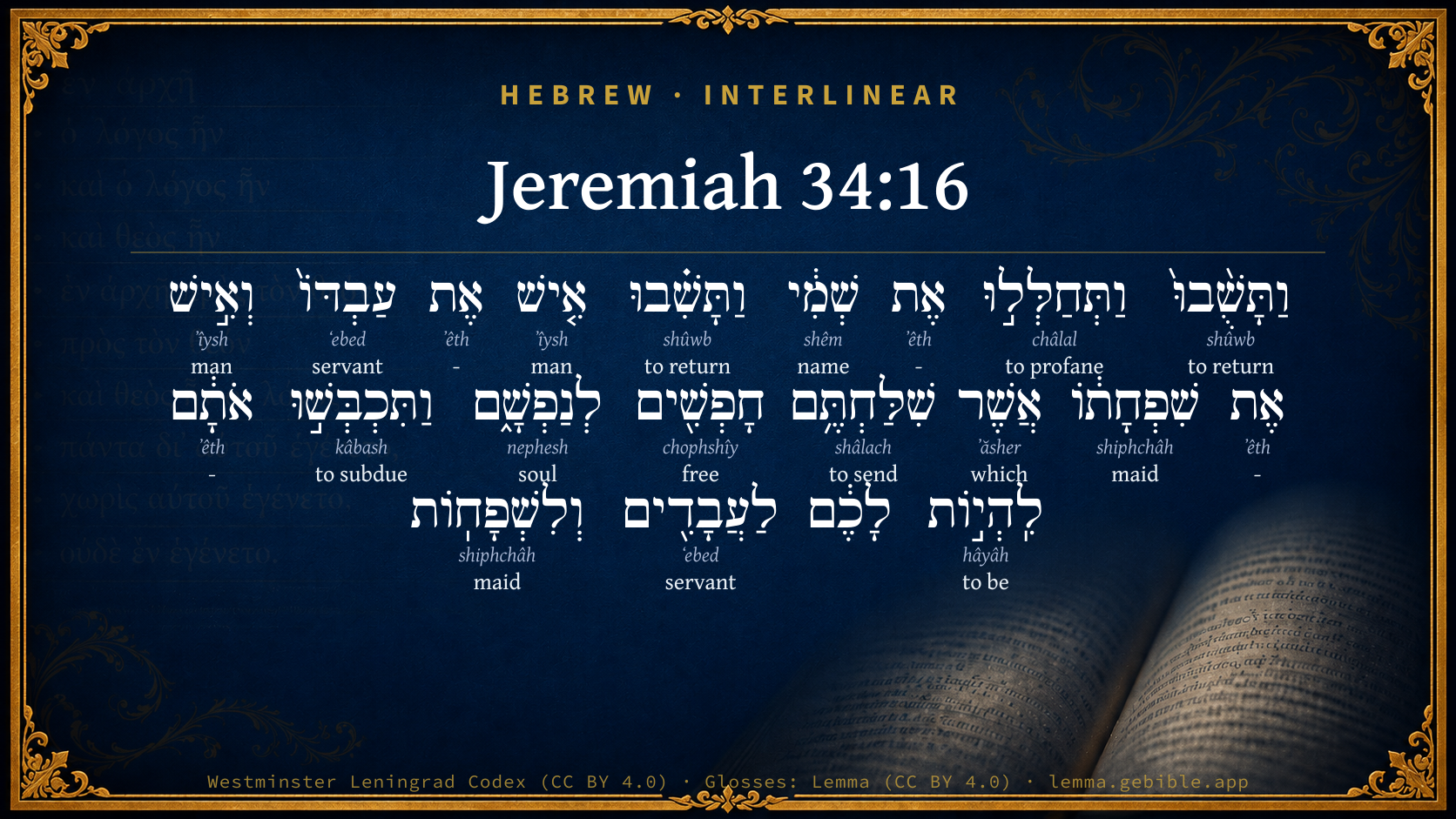
Hebrew (Westminster Leningrad Codex) Jeremiah 34:16 appears in the Hebrew Old Testament. The text above is from the Westminster Leningrad Codex. Each word links to its Strong’s number, a concise gloss, and parsing drawn from the Open Scriptures Hebrew Bible morphology. Click any word for its full Brown-Driver-Briggs (BDB) entry.
Download image
Cite this verse

Jeremiah 34:16 (World English Bible). Public Domain. Lemma interlinear Bible study tool, https://lemma.gebible.app/v/jeremiah/34/16.

Show BibTeX & RIS
BibTeX
RIS
English Translation
but you turned and profaned my name, and caused every man his servant, and every man his handmaid, whom you had let go free at their pleasure, to return; and you brought them into subjection, to be to you for servants and for handmaids.
World English Bible · Public Domain
Download a study sheet

One document with this verse’s original text, its word-by-word gloss line, the meaning frame, cross-references with their text, attributed commentary, and full source and license credits — printable, and it pastes into notes with its structure intact.

This verse Autodidact and up

Study sheet (.html) Plain text (.txt)

A passage Seminary Student

Up to 50 verses in one chapter. A passage sheet keeps up to 6 commentary sources and 12 cross-references per verse, in the order this page ranks them, and says so on the sheet whenever that leaves anything out. Ask for a single verse and you get the Autodidact verse sheet above.

Everything on this page stays free to read, with no account — the sheet is a download of what is already on screen, not access to it.

Want to remove ads? Support Godless Engineer
Compare translations 3

The same verse in 3 English versions, stacked beneath the original-language interlinear above. Click any original word for its lexicon entry.

Each is an independent rendering of the whole verse — the interlinear is not word-aligned to these translations.

Highlighted words mark where these versions differ — a whole-verse word diff, not a word-by-word alignment.

  • World English Bible Public Domain
    but you turned and profaned my name, and caused every man his servant, and every man his handmaid, whom you had let go free at their pleasure, to return; and you brought them into subjection, to be to you for servants and for handmaids.
  • King James Version Public Domain
    But ye turned and polluted my name, and caused every man his servant, and every man his handmaid, whom he had set at liberty at their pleasure, to return, and brought them into subjection, to be unto you for servants and for handmaids.
  • unfoldingWord Literal Text CC BY-SA 4.0
    But then you turned and polluted my name; you caused each man to bring back his male and female slaves, the ones whom you had sent out to go where they wished. You forced them to become your slaves again.’

unfoldingWord Literal Text — © unfoldingWord, licensed CC BY-SA 4.0. Word-aligned USFM3 via Door43 (git.door43.org/unfoldingWord/en_ult).

Versions to compare (up to 4)

3 of 4 selected

Show all 18 translations

Every available English version of this verse, each an independent rendering of the whole verse.

  • World English Bible Public Domain
    but you turned and profaned my name, and caused every man his servant, and every man his handmaid, whom you had let go free at their pleasure, to return; and you brought them into subjection, to be to you for servants and for handmaids.
  • Berean Standard Bible Public Domain
    But now you have changed your minds and profaned My name. Each of you has taken back the menservants and maidservants whom you had set at liberty to go wherever they wanted, and you have again forced them to be your slaves.
  • Majority Standard Bible Public Domain
    But now you have changed your minds and profaned My name. Each of you has taken back the menservants and maidservants whom you had set at liberty to go wherever they wanted, and you have again forced them to be your slaves.
  • King James Version Public Domain
    But ye turned and polluted my name, and caused every man his servant, and every man his handmaid, whom he had set at liberty at their pleasure, to return, and brought them into subjection, to be unto you for servants and for handmaids.
  • American Standard Version (1901) Public Domain
    but ye turned and profaned my name, and caused every man his servant, and every man his handmaid, whom ye had let go free at their pleasure, to return; and ye brought them into subjection, to be unto you for servants and for handmaids.
  • Revised Version (1885) Public Domain
    but ye turned and profaned my name, and caused every man his servant, and every man his handmaid, whom ye had let go free at their pleasure, to return; and ye brought them into subjection, to be unto you for servants and for handmaids.
  • Geneva Bible (1599) Public Domain
    But ye repented, and polluted my Name: for ye haue caused euery man his seruant, and euery man his handmayde, whom ye had set at libertie at their pleasure, to returne, and holde them in subiection to bee vnto you as seruantes and as handmaydes.
  • Douay-Rheims (1899) Public Domain
    And you are fallen back, and have defiled my name: and you have brought back again every man his manservant, and every man his maidservant, whom you had let go free, and set at liberty: and you have brought them into subjection to be your servants and handmaids.
  • Young's Literal Translation Public Domain
    And -- ye turn back, and pollute My name, and ye cause each his man-servant and each his maid-servant, whom he had sent forth free, (at their pleasure,) to return, and ye subdue them to be to you for men-servants and for maid-servants.
  • Literal Standard Version CC BY-SA 4.0
    And you turn back, and defile My Name, and you each cause his manservant and each his maidservant, whom he had sent forth free (at their pleasure), to return, and you subdue them to be for menservants and for maidservants to you.”
  • Unlocked Literal Bible CC BY-SA 4.0
    But then you turned and polluted my name; you caused each man to bring back his male and female slaves, the ones whom you had sent out to go where they wished. You forced them to become your slaves again.'
  • unfoldingWord Literal Text CC BY-SA 4.0
    But then you turned and polluted my name; you caused each man to bring back his male and female slaves, the ones whom you had sent out to go where they wished. You forced them to become your slaves again.’
  • Darby Bible Public Domain
    but ye have turned and profaned my name, and caused every man his bondman, and every man his bondmaid, whom ye had set at liberty at their pleasure, to return, and ye have brought them into subjection, to be unto you for bondmen and for bondmaids.
  • World Messianic Bible Public Domain
    but you turned and profaned my name, and every man caused his servant and every man his handmaid, whom you had let go free at their pleasure, to return. You brought them into subjection, to be to you for servants and for handmaids.’”
  • Webster's Bible Public Domain
    But ye turned and profaned my name, and caused every man his servant, and every man his handmaid, whom he had set at liberty at their pleasure, to return, and brought them into subjection, to be to you for servants and for handmaids.
  • Free Bible Version CC BY-SA 4.0
    But now you've changed your minds and dishonored me. Each of you took back the male and female slaves you'd set free to do whatever they wanted. You forced them to become your slaves again.
  • Bible in Basic English Public Domain
    But again you have put shame on my name, and you have taken back, every one his man-servant and his servant-girl, whom you had sent away free, and you have put them under the yoke again to be your servants and servant-girls.
  • JPS Tanakh (1917) Public Domain
    but ye turned and profaned My name, and caused every man his servant, and every man his handmaid, whom ye had let go free at their pleasure, to return; and ye brought them into subjection, to be unto you for servants and for handmaids.

Literal Standard Version (2020), Covenant Press — licensed CC BY-SA 4.0. Text via the HelloAO Bible API (eBible.org). Unlocked Literal Bible (unfoldingWord) — licensed CC BY-SA 4.0. Text via the HelloAO Bible API (eBible.org). unfoldingWord Literal Text — © unfoldingWord, licensed CC BY-SA 4.0. Word-aligned USFM3 via Door43 (git.door43.org/unfoldingWord/en_ult). Free Bible Version, Dr. Jonathan Gallagher — licensed CC BY-SA 4.0. Text via the HelloAO Bible API (eBible.org).

Word by word

More ways to search: Search by grammar → Find every occurrence → Compare this word →

Practice this passage: Drill this verse → Learn its vocabulary →

וַתִּכְבְּשׁ֣וּ
kâbash
H3533
“and · to subdue”
Conjunction + Verb, Qal, Sequential Imperfect, 2nd Person, Masculine, Plural
Part of Speech
Conjunction + Verb
Stem
Qal
Form
Sequential Imperfect
Person
2nd Person
Gender
Masculine
Number
Plural
Full BDB Definition

Origin: a primitive root

TWOT: 951

to subject, subdue, force, keep under, bring into bondage - (Qal) - to bring into bondage, make subservient - to subdue, force, violate - to subdue, dominate, tread down - (Niphal) to be subdued - (Piel) to subdue - (Hiphil) to bring into bondage
  1. וַתָּשֻׁ֨בוּ֙ shûwb H7725 “and · to return” Conjunction + Verb, Qal, Sequential Imperfect, 2nd Person, Masculine, Plural
  2. וַתְּחַלְּל֣וּ châlal H2490 “and · to profane” Conjunction + Verb, Piel, Sequential Imperfect, 2nd Person, Masculine, Plural
  3. אֶת ʼêth H853 “-” Particle, Direct Object
  4. שְׁמִ֔י shêm H8034 “name · my” Noun, Common, Masculine, Singular, Construct + Suffix, Personal, 1st Person, Common, Singular
  5. וַתָּשִׁ֗בוּ shûwb H7725 “and · to return” Conjunction + Verb, Hiphil, Sequential Imperfect, 2nd Person, Masculine, Plural
  6. אִ֤ישׁ ʼîysh H376 “man” Noun, Common, Masculine, Singular, Absolute
  7. אֶת ʼêth H853 “-” Particle, Direct Object
  8. עַבְדּוֹ֙ ʻebed H5650 “servant · his” Noun, Common, Masculine, Singular, Construct + Suffix, Personal, 3rd Person, Masculine, Singular
  9. וְאִ֣ישׁ ʼîysh H376 “and · man” Conjunction + Noun, Common, Masculine, Singular, Absolute
  10. אֶת ʼêth H853 “-” Particle, Direct Object
  11. שִׁפְחָת֔וֹ shiphchâh H8198 “maid · his” Noun, Common, Feminine, Singular, Construct + Suffix, Personal, 3rd Person, Masculine, Singular
  12. אֲשֶׁר ʼăsher H834 “which” Particle, Relative
  13. שִׁלַּחְתֶּ֥ם shâlach H7971 “to send” Verb, Piel, Perfect, 2nd Person, Masculine, Plural
  14. חָפְשִׁ֖ים chophshîy H2670 “free” Adjective, Adjective, Masculine, Plural, Absolute
  15. לְנַפְשָׁ֑ם nephesh H5315 “to/for · soul · their” Preposition + Noun, Common, Both, Singular, Construct + Suffix, Personal, 3rd Person, Masculine, Plural
  16. אֹתָ֔ם ʼêth H853 “- · them” Particle, Direct Object + Suffix, Personal, 3rd Person, Masculine, Plural
  17. לִֽהְי֣וֹת hâyâh H1961 “to be” Preposition + Verb, Qal, Infinitive Construct
  18. לַעֲבָדִ֖ים ʻebed H5650 “to/for · servants” Preposition + Noun, Common, Masculine, Plural, Absolute
  19. וְלִשְׁפָחֽוֹת shiphchâh H8198 “and · to/for · maids” Conjunction + Preposition + Noun, Common, Feminine, Plural, Absolute

About this verse

These counts appear in no published source. They are computed here, from the morphology-tagged text and Lemma’s own curated glosses. What Lemma adds →

21
words
13
distinct lemmas
Prophets
section

Notable vocabulary

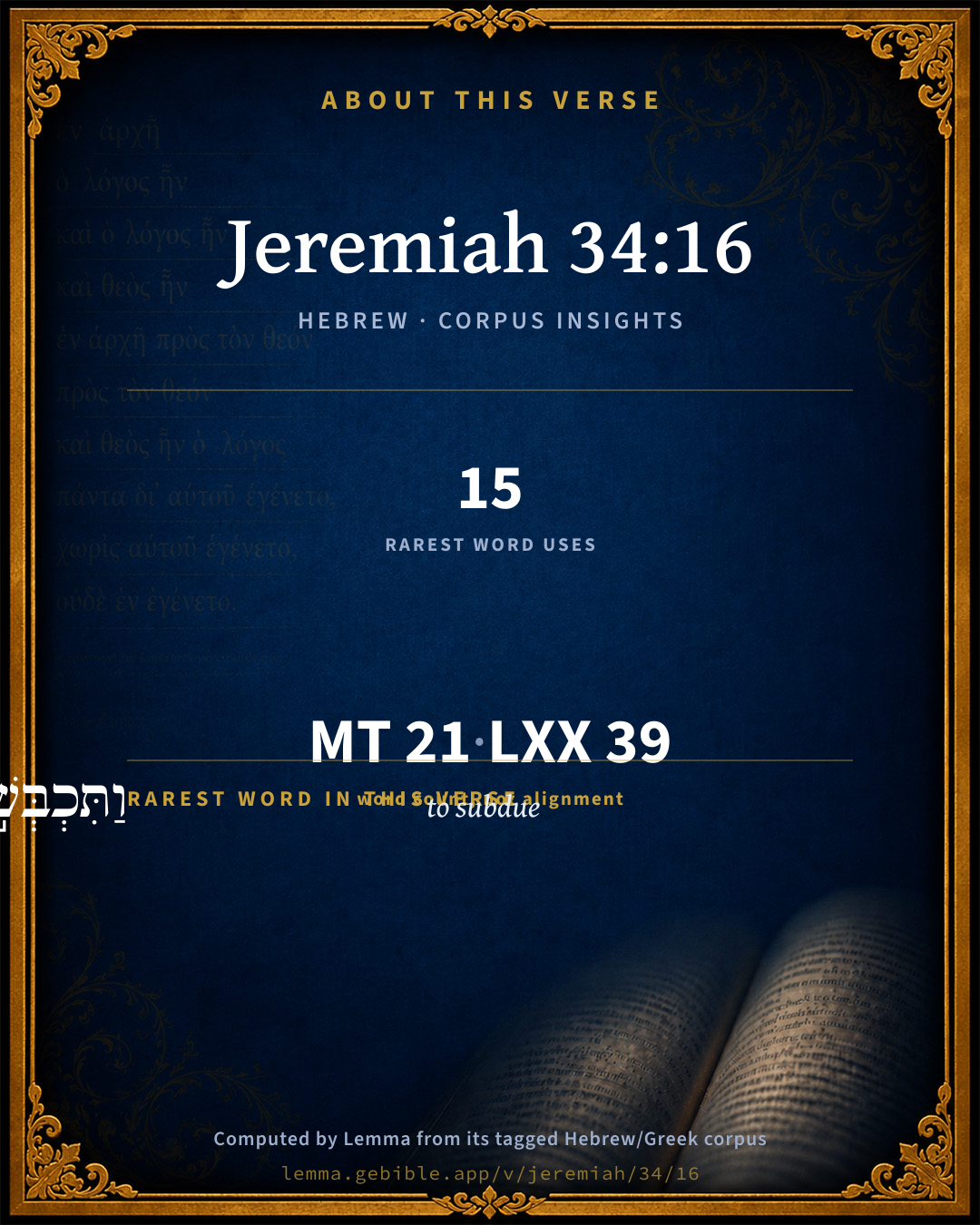
The rarest word here is וַתִּכְבְּשׁ֣וּ to subdue H3533 — appearing just 15 times in the whole Hebrew Bible.

Shared distinctive vocabulary

וַתִּכְבְּשׁ֣וּ to subdue H3533 occurs in 13 verses of the Hebrew Bible. Also found in:

Grammatical profile

  • 6 verbs
  • 8 nouns
  • 1 adjective
  • 1 preposition
  • 5 particles

Verb forms

  • וַתָּשֻׁ֨בוּ֙ Qal · Sequential Imperfect
  • וַתְּחַלְּל֣וּ Piel · Sequential Imperfect
  • וַתָּשִׁ֗בוּ Hiphil · Sequential Imperfect
  • שִׁלַּחְתֶּ֥ם Piel · Perfect
  • וַתִּכְבְּשׁ֣וּ Qal · Sequential Imperfect
  • לִֽהְי֣וֹת Qal · Infinitive Construct

Repetition

Words recur within this verse — often emphatic in Hebrew:

  • וַתָּשֻׁ֨בוּ֙ to return H7725 ×2
  • אִ֤ישׁ man H376 ×2
  • עַבְדּוֹ֙ servant H5650 ×2
  • שִׁפְחָת֔וֹ maid H8198 ×2

Hebrew & Septuagint length

In the original languages it is 21 Hebrew tokens and 39 Greek tokens — but the two are counted differently (Hebrew bundles its prefixes and suffixes into one token; the Greek is in lemma form), so that isn’t a like-for-like length.

Cross-references

14

Topical passages linked to Jeremiah 34:16 in the Treasury of Scripture Knowledge — connected by theme and wording, ordered by reader-vote popularity; previews shown in the World English Bible.

  • Leviticus 19:12 "'You shall not swear by my name falsely, and profane the name of your God. I am Yahweh.
  • Exodus 20:7 "You shall not take the name of Yahweh your God in vain, for Yahweh will not hold him guiltless who takes his name in vain.
  • Jeremiah 34:11 but afterwards they turned, and caused the servants and the handmaids, whom they had let go free, to return, and brought them into subjection for servants and for handmaids.
  • Ezekiel 3:20 Again, when a righteous man does turn from his righteousness, and commit iniquity, and I lay a stumbling block before him, he shall die: because you have not given him warning, he shall die in his sin, and his righteous deeds which he has done shall not be remembered; but his blood will I require at your hand.
  • Ezekiel 18:24 But when the righteous turns away from his righteousness, and commits iniquity, and does according to all the abominations that the wicked man does, shall he live? None of his righteous deeds that he has done shall be remembered: in his trespass that he has trespassed, and in his sin that he has sinned, in them shall he die.
  • 1 Samuel 15:11 It repents me that I have set up Saul to be king; for he is turned back from following me, and has not performed my commandments. Samuel was angry; and he cried to Yahweh all night.
  • Ezekiel 17:16–19 As I live, says the Lord Yahweh, surely in the place where the king dwells who made him king, whose oath he despised, and whose covenant he broke, even with him in the midst of Babylon he shall die.
  • Ezekiel 20:39 As for you, house of Israel, thus says the Lord Yahweh: Go you, serve everyone his idols, and hereafter also, if you will not listen to me; but my holy name shall you no more profane with your gifts, and with your idols.
  • Ezekiel 33:12–13 You, son of man, tell the children of your people, The righteousness of the righteous shall not deliver him in the day of his disobedience; and as for the wickedness of the wicked, he shall not fall thereby in the day that he turns from his wickedness; neither shall he who is righteous be able to live thereby in the day that he sins.
  • Ezekiel 39:7 My holy name will I make known in the midst of my people Israel; neither will I allow my holy name to be profaned any more: and the nations shall know that I am Yahweh, the Holy One in Israel.
  • Malachi 1:7 You offer polluted bread on my altar. You say, 'How have we polluted you?' In that you say, 'Yahweh's table contemptible.'
  • Malachi 1:12 "But you profane it, in that you say, 'Yahweh's table is polluted, and its fruit, even its food, is contemptible.'
  • Matthew 18:28–34 "But that servant went out, and found one of his fellow servants, who owed him one hundred denarii, and he grabbed him, and took him by the throat, saying, 'Pay me what you owe!'
  • Luke 8:13–15 Those on the rock are they who, when they hear, receive the word with joy; but these have no root, who believe for a while, then fall away in time of temptation.

Cross-references courtesy of OpenBible.info (CC BY 4.0).

Hebrew and Greek witnesses Masoretic Hebrew ↔ Greek Septuagint

The same verse in the two great witnesses to the Old Testament, shown verse-for-verse.

These are two independent witnesses, not word-aligned to each other, and the Septuagint is shown in lemma (dictionary) form.

Hebrew Jeremiah 34:16 Masoretic · Westminster Leningrad Codex

וַתָּשֻׁ֨בוּ֙ וַתְּחַלְּל֣וּ אֶת שְׁמִ֔י וַתָּשִׁ֗בוּ אִ֤ישׁ אֶת עַבְדּוֹ֙ וְאִ֣ישׁ אֶת שִׁפְחָת֔וֹ אֲשֶׁר שִׁלַּחְתֶּ֥ם חָפְשִׁ֖ים לְנַפְשָׁ֑ם וַתִּכְבְּשׁ֣וּ אֹתָ֔ם לִֽהְי֣וֹת לָכֶ֔ם לַעֲבָדִ֖ים וְלִשְׁפָחֽוֹת

but you turned and profaned my name, and caused every man his servant, and every man his handmaid, whom you had let go free at their pleasure, to return; and you brought them into subjection, to be to you for servants and for handmaids.

World English Bible · Public Domain

Greek LXX Structure differs

In the Septuagint, Jeremiah is about an eighth shorter than the Hebrew and arranges its material differently — the Oracles Against the Nations (Hebrew chapters 46–51) appear in the middle of the Greek book, after 25:13. Because the chapter and verse boundaries do not line up, a verse-for-verse comparison with the Hebrew is not shown.

A verse-for-verse comparison isn’t shown here because the chapters and verses don’t line up. Switch to the LXX edition with the MT / LXX toggle above to read the Greek directly.

Hebrew: Westminster Leningrad Codex (CC BY 4.0). Greek: Septuagint (public domain); English from a public-domain English Septuagint. How the Septuagint differs from the Hebrew →

Targum (Aramaic paraphrase)

1

The Targum is the ancient Jewish Aramaic paraphrase of the Hebrew Scriptures — an interpretive translation, not the Hebrew text itself. Onkelos (literal) and Pseudo-Jonathan (expansive) render the Torah, and Jonathan the Prophets. Coverage is partial: where no permissively-licensed English translation exists for a verse, only the Aramaic is shown. This is verse-level text, not a word-by-word alignment to the Hebrew.

  1. Targum Jonathan Prophets (Joshua–Malachi)
    וְתַבְתּוּן וְאָחַלְתּוּן יַת שְׁמִי וַאֲתֵיבְתּוּן גְבַר יַת עַבְדֵיהּ וּגְבַר יַת אַמְתֵיהּ דִי פְטַרְתּוּן בְּנֵי חוֹרִין לְנַפְשָׁתְהוֹן וּכְבֵישְׁתּוּן יַתְהוֹן לְמֶהֱוֵי לְכוֹן לְעַבְדִין וּלְאַמְהָן:

    (no public-domain English translation for this verse)

    Targum Jonathan — Aramaic: “Mikraot Gedolot” (public domain). English: “Sefaria Community Translation” (CC0 1.0 (public-domain dedication)); “London "Chaldee Paraphrase," 1871” (public domain). Text via Sefaria.

Commentary

Notes on Jeremiah 34:16 from classic Christian and Jewish commentators (each source and its license shown beneath its notes). The classic Christian expositions comment on the surrounding passage and are grouped to its opening verse, so a note may address several verses; the Jewish commentaries on the Tanakh (Rashi and others) are per-verse, so they appear only where the commentator wrote on this verse.

Lemma curates 59 commentaries, every one of them public domain or Creative Commons licensed, each selected and text-cleaned for this edition rather than reprinted as found. About our sources →

Trapp's Complete Commentary

John Trapp

Jer 34:16 But ye turned and polluted my name, and caused every man his servant, and every man his handmaid, whom ye had set at liberty at their pleasure, to return, and brought them into subjection, to be unto you for servants and for handmaids.

Ver. 16. But ye turned.] Exprobrat recidivum Iudaeorum scelus, qui scilicet primam virtutem turpiter deluserint et violarint. He upbraideth them, and deservedly, with their apostasy and perjury. Peter also thundereth against such. {2Pe 2:1-22}

And polluted my name,] scil., By the violation of your solemn vow; so doth every profligate professor and ungirt Christian.

Whom he had set at liberty at their pleasure.] Liberty is a desirable and delectable commodity. Those that live in Turkey, Persia, yea, or but in France, &c., esteem it so.

John Trapp, A Commentary or Exposition upon All the Books of the Old and New Testament (1647–1656) — public domain. Text from a community e-Sword module.

Jamieson, Fausset & Brown

Robert Jamieson, A. R. Fausset & David Brown

polluted my name--by violating your oath (Exo 20:7).

Jamieson, Fausset & Brown — Commentary Critical and Explanatory on the Whole Bible (1871) — public domain (CC PDM 1.0). Text via the HelloAO Bible API.

Adam Clarke's Commentary

Verse 16. Ye - polluted my name] Had made the covenant in my name, calling me to witness it; now ye have dishonoured my name, by breaking that covenant, and acting contrary to my law.

Adam Clarke's Commentary on the Bible (1810–1826) — public domain. Text from a community e-Sword/MySword module.

John Calvin's Commentaries

The Prophet expostulates here with the Jews, as we said in the last Lecture, with regard to their perjury; for they had made in a solemn manner a covenant in the Temple of God, to set free their servants according to what the law prescribed. There would have been no need of such a ceremony, had they observed what they learnt from the Law; but neither they nor their fathers observed the equity prescribed to them by God. Hence there was a necessity for a new promise, sanctioned by sacrifice. The Prophet commended them for obeying God’s command. But he now shews, that they were the more inexcusable, because they soon after returned to their old ways. But ye turned, he says, that is, they soon repented of the obedience they had promised to render to God. Their promptitude was worthy of praise, when they promised that they would willingly obey; but by doing this in bad faith, they treated God with mockery.

He adds that God’s name was polluted We hence learn that whenever we misuse God’s name, it is a kind of sacrilege; for nothing is deemed more precious by God than truth; yea, as he himself is truth, and is so called, (John 14:6) there is nothing more adverse to his nature than falsehood. It is then an intolerable profanation of God’s name whenever it is falsely appealed to; and thus perjury is allied with sacrilege. God’s name is indeed polluted in other ways than by perjury, that is, when God’s name is taken in vain rashly, thoughtlessly, and without reverence. But the most heinous pollution of it is, when the truth is changed into a lie. This passage then contains a useful doctrine, which teaches us to act faithfully, especially when God’s name is interposed.

He afterwards adds, Ye have remanded every one his servant and every one his maid, whom ye have set free, etc. The crime was doubled by this circumstance, — that they had emancipated their servants, and then remanded them. For had they not dissembled, their obstinacy could by no means have been tolerated; but their rebellion became still more base, when they had pretended to obey God, and it became shortly known that they had perfidiously promised liberty to their servants. He says that they were set free to their own soul, that is, to their own will; for we call men free when it is in their power to choose what they please, for when they are under the power of another, they have no will, no choice of their own. And indignity is increased, when servants who have been made free are afterwards deprived of so great a privilege; for nothing is more desirable than liberty, as even heathens have declared. He adds that this was done by force, Ye have made them subject The verb כבש cabesh, means to subject and to oppress. The Prophet then shews, that those who had been made free, were not willing to return to their miserable condition, and that they were not constrained to submit to the yoke in any other way than by tyranny. It hence appears that their masters not only employed deceit, but also cruel and tyrannical violence; so that to perjury they added inhumanity, which more increased their crime. It now follows, —

John Calvin's Commentaries (1540-1563) — public domain. Text from the Calvin Translation Society English edition (1840s-50s) via the Christian Classics Ethereal Library (ccel.org). Calvin's coverage is partial (roughly two-thirds of the Bible); uncommented books and verses are honest gaps, never fabricated. The 19th-century editor's footnotes and remarks are omitted so the notes are faithfully Calvin's own voice.

Ellicott's Commentary for English Readers

(16) But ye turned and polluted my name . . .—The second verb is the same as that translated “profane the name of the Lord” in Lev_19:12, in close connexion with the sin of swearing falsely. The sin of which the princes and rich men had been guilty was not merely an act of injustice. They had broken the third commandment as well as the eighth, and were accordingly guilty of sacrilege.

A Bible Commentary for English Readers, edited by Charles John Ellicott (1878–1897) — public domain. Text from a community e-Sword module.

The Cambridge Bible for Schools and Colleges

gen. ed. J. J. S. Perowne

16. at their pleasure] lit. according to their soul. See on Jer_22:27.

The Cambridge Bible for Schools and Colleges (gen. ed. J. J. S. Perowne; Cambridge University Press, 1878–1918) — public domain. Text from a community e-Sword module.

John Gill's Exposition

But ye turned and polluted my name,.... Changed their minds, and turned from their resolutions they had entered into, and the good ways they were walking in, and returned to their former evil practices; and so polluted the name of God by taking it in vain, and breaking the covenant they had agreed to:

and caused every man his servant, and every man his handmaid, whom he had set at liberty at pleasure: or, "according to their soul" (s); according to their souls' desire, what was very agreeable and acceptable to them, and gave them a real pleasure; which did not last long, since they caused them

to return to their former service and bondage under them:

and brought them into subjection: forced them to come back to their houses, and into their service, and be subject to them, and obey their commands as formerly:

to be unto you for servants and for handmaids; to do the business of such, as they had done before.

(s) "in animam suam", Pagninus, Montanus; "secundum animam eorum", Piscator; "ad desideriurn suum", Junius & Tremellius.

John Gill's Exposition of the Whole Bible (1746–1763) — public domain (CC PDM 1.0). Text via the HelloAO Bible API.

Haydock's Catholic Bible Commentary

And set. Hebrew, "to their own soul," to do as they pleased. (Haydock)

George Leo Haydock (1774–1849), Haydock's Catholic Family Bible and Commentary, 1859 edition — public domain. Excludes Psalms (Douay-Rheims chapter numbering differs from Protestant) and Deuterocanonical books (Catholic canon only).

Matthew Poole's English Annotations

You again licked up your vomit, and profaned my name, swearing by it to do that which you have not done, and forced your servants, though dismissed, to return again unto their former bondage and subjection to you.

Matthew Poole's English Annotations on the Holy Bible (1683–1685) — public domain. Text from a community e-Sword/MySword module.

Lesson kit

Teaching starters — assembled from the data on this page, not authored interpretation. Every prompt links to the verse data it draws on. Edit before teaching.

Jeremiah, in the Prophets, opens this verse with 21 words (13 distinct Hebrew lemmas). Its most distinctive word is kâbash (“to subdue”). A historical commentator’s framing appears above. Read the whole chapter for the surrounding context.

Discussion questions

  1. What does “to subdue” (kâbash) contribute to the verse as a whole?
  2. How does Genesis 1:28, which shares the word «to subdue», read alongside this verse?
  3. What does the repetition of “to return” (2× in this one verse) do in this verse?
  4. These translations render this verse differently; the difference is in the English rendering, not the original. What questions does that raise?
  5. «וַתָּשֻׁ֨בוּ֙» is a Qal Sequential Imperfect verb. How does that grammatical form shape the action described?
  6. Compare how Trapp's Complete Commentary and Jamieson, Fausset & Brown read this verse. Where do they agree or differ?

Things to notice

Reading settings

Reading text

Shown beneath each verse's original-language words.

Old Testament
Old Testament edition

Read the OT as the Masoretic Hebrew (MT) or the Greek Septuagint (LXX).

English shown for the Greek Septuagint (in the Hebrew ↔ Greek comparison).

Comparing translations? Open the Compare panel on any verse page to stack up to four side by side.