
Ezekiel 32:26

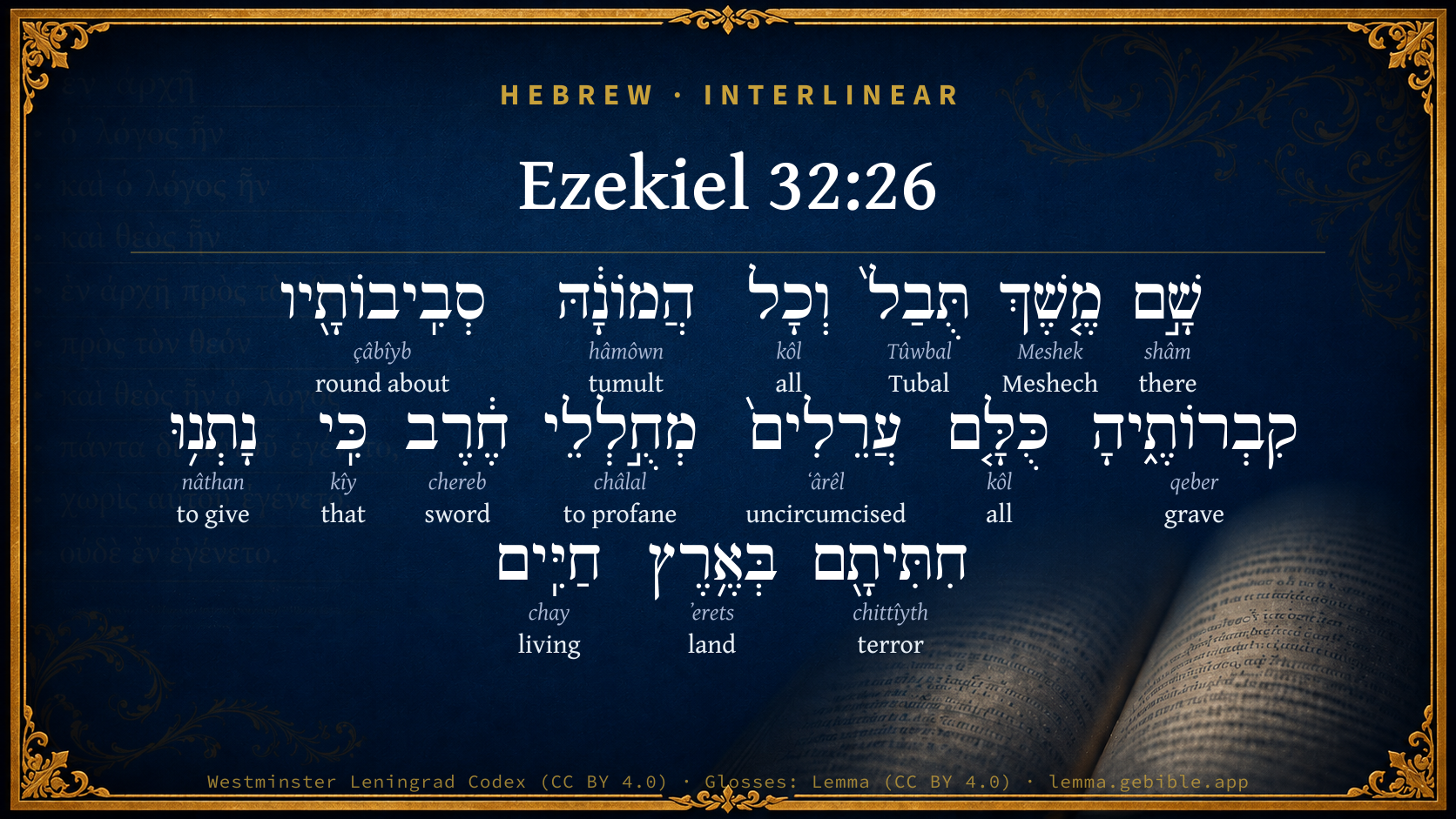
Hebrew (Westminster Leningrad Codex) Ezekiel 32:26 appears in the Hebrew Old Testament. The text above is from the Westminster Leningrad Codex. Each word links to its Strong’s number, a concise gloss, and parsing drawn from the Open Scriptures Hebrew Bible morphology. Click any word for its full Brown-Driver-Briggs (BDB) entry.
Download image
Cite this verse

Ezekiel 32:26 (World English Bible). Public Domain. Lemma interlinear Bible study tool, https://lemma.gebible.app/v/ezekiel/32/26.

Show BibTeX & RIS
BibTeX
RIS
English Translation
There is Meshech, Tubal, and all their multitude; their graves are round about them; all of them uncircumcised, slain by the sword; for they caused their terror in the land of the living.
World English Bible · Public Domain
Download a study sheet

One document with this verse’s original text, its word-by-word gloss line, the meaning frame, cross-references with their text, attributed commentary, and full source and license credits — printable, and it pastes into notes with its structure intact.

This verse Autodidact and up

Study sheet (.html) Plain text (.txt)

A passage Seminary Student

Up to 50 verses in one chapter. A passage sheet keeps up to 6 commentary sources and 12 cross-references per verse, in the order this page ranks them, and says so on the sheet whenever that leaves anything out. Ask for a single verse and you get the Autodidact verse sheet above.

Everything on this page stays free to read, with no account — the sheet is a download of what is already on screen, not access to it.

Want to remove ads? Support Godless Engineer
Compare translations 3

The same verse in 3 English versions, stacked beneath the original-language interlinear above. Click any original word for its lexicon entry.

Each is an independent rendering of the whole verse — the interlinear is not word-aligned to these translations.

Highlighted words mark where these versions differ — a whole-verse word diff, not a word-by-word alignment.

  • World English Bible Public Domain
    There is Meshech, Tubal, and all their multitude; their graves are round about them; all of them uncircumcised, slain by the sword; for they caused their terror in the land of the living.
  • King James Version Public Domain
    There is Meshech, Tubal, and all her multitude: her graves are round about him: all of them uncircumcised, slain by the sword, though they caused their terror in the land of the living.
  • unfoldingWord Literal Text CC BY-SA 4.0
    Meshech, Tubal, and all their multitudes are there! Their graves surround them. All of them are uncircumcised, killed by the sword, because they had brought their terrors on the land of the living.

unfoldingWord Literal Text — © unfoldingWord, licensed CC BY-SA 4.0. Word-aligned USFM3 via Door43 (git.door43.org/unfoldingWord/en_ult).

Versions to compare (up to 4)

3 of 4 selected

Show all 18 translations

Every available English version of this verse, each an independent rendering of the whole verse.

  • World English Bible Public Domain
    There is Meshech, Tubal, and all their multitude; their graves are round about them; all of them uncircumcised, slain by the sword; for they caused their terror in the land of the living.
  • Berean Standard Bible Public Domain
    Meshech and Tubal are there with all their multitudes, with their graves all around them. All of them are uncircumcised, slain by the sword, because they spread their terror in the land of the living.
  • Majority Standard Bible Public Domain
    Meshech and Tubal are there with all their multitudes, with their graves all around them. All of them are uncircumcised, slain by the sword, because they spread their terror in the land of the living.
  • King James Version Public Domain
    There is Meshech, Tubal, and all her multitude: her graves are round about him: all of them uncircumcised, slain by the sword, though they caused their terror in the land of the living.
  • American Standard Version (1901) Public Domain
    There is Meshech, Tubal, and all their multitude; their graves are round about them; all of them uncircumcised, slain by the sword; for they caused their terror in the land of the living.
  • Revised Version (1885) Public Domain
    There is Meshech, Tubal, and all her multitude; her graves are round about her: all of them uncircumcised, slain by the sword; for they caused their terror in the land of the living.
  • Geneva Bible (1599) Public Domain
    There is Meshech, Tubal, and all their multitude, their graues are round about them: al these vncircumcised were slaine by the sworde, though they caused their feare to be in ye land of the liuing.
  • Douay-Rheims (1899) Public Domain
    There is Mosoch, and Thubal, and all their multitude: their graves are round about him: all of them uncircumcised and slain, and fallen by the sword: though they spread their terror in the land of the living.
  • Young's Literal Translation Public Domain
    There `is' Meshech, Tubal, and all her multitude, Round about him `are' her graves, All of them uncircumcised, pierced of the sword, For they gave their terror in the land of the living,
  • Literal Standard Version CC BY-SA 4.0
    There [is] Meshech, Tubal, and all her multitude, || Her graves [are] around them, || All of them uncircumcised, pierced by the sword, || For they gave their terror in the land of the living,
  • Unlocked Literal Bible CC BY-SA 4.0
    Meshech, Tubal, and all their multitudes are there! Their graves surround them. All of them are uncircumcised, killed by the sword, because they had brought their terrors on the land of the living.
  • unfoldingWord Literal Text CC BY-SA 4.0
    Meshech, Tubal, and all their multitudes are there! Their graves surround them. All of them are uncircumcised, killed by the sword, because they had brought their terrors on the land of the living.
  • Darby Bible Public Domain
    There is Meshech, Tubal, and all their multitude, their graves round about them, all of them uncircumcised, slain by the sword, though they caused their terror in the land of the living.
  • World Messianic Bible Public Domain
    “There is Meshech, Tubal, and all their multitude. Their graves are around them, all of them uncircumcised, slain by the sword; for they caused their terror in the land of the living.
  • Webster's Bible Public Domain
    There is Meshech, Tubal, and all her multitude: her graves are around him: all of them uncircumcised, slain by the sword, though they caused their terror in the land of the living.
  • Free Bible Version CC BY-SA 4.0
    Meshech and Tubal are there with all their many people, surrounded by all their graves. They are all heathen and were killed by the sword, though they once terrorized others when they were alive.
  • Bible in Basic English Public Domain
    There is Meshech, Tubal, and all her people, round about her last resting-place: all of them without circumcision, put to death by the sword; for they were a cause of fear in the land of the living.
  • JPS Tanakh (1917) Public Domain
    There is Meshech, Tubal, and all her multitude; her graves are round about them; all of them uncircumcised, slain by the sword; because they caused their terror in the land of the living.

Literal Standard Version (2020), Covenant Press — licensed CC BY-SA 4.0. Text via the HelloAO Bible API (eBible.org). Unlocked Literal Bible (unfoldingWord) — licensed CC BY-SA 4.0. Text via the HelloAO Bible API (eBible.org). unfoldingWord Literal Text — © unfoldingWord, licensed CC BY-SA 4.0. Word-aligned USFM3 via Door43 (git.door43.org/unfoldingWord/en_ult). Free Bible Version, Dr. Jonathan Gallagher — licensed CC BY-SA 4.0. Text via the HelloAO Bible API (eBible.org).

Word by word

More ways to search: Search by grammar → Find every occurrence → Compare this word →

Practice this passage: Drill this verse → Learn its vocabulary →

תֻּבַל֙
Tûwbal
H8422
“Tubal”
Noun, Proper
Part of Speech
Noun
Type
Proper
Full BDB Definition

Origin: probably of foreign derivation

TWOT: None

Tubal = "thou shall be brought" - son of Japheth and grandson of Noah (noun proper masculine) - a region in east Asia Minor (noun proper territory) - perhaps nearly equal to Cappadocia
  1. שָׁ֣ם shâm H8033 “there” Adverb
  2. מֶ֤שֶׁךְ Meshek H4902 “Meshech” Noun, Proper
  3. וְכָל kôl H3605 “and · all of” Conjunction + Noun, Common, Masculine, Singular, Construct
  4. הֲמוֹנָ֔הּ hâmôwn H1995 “tumult · her” Noun, Common, Masculine, Singular, Construct + Suffix, Personal, 3rd Person, Feminine, Singular
  5. סְבִֽיבוֹתָ֖יו çâbîyb H5439 “surroundings · his” Noun, Common, Both, Plural, Construct + Suffix, Personal, 3rd Person, Masculine, Singular
  6. קִבְרוֹתֶ֑יהָ qeber H6913 “graves · her” Noun, Common, Masculine, Plural, Construct + Suffix, Personal, 3rd Person, Feminine, Singular
  7. כֻּלָּ֤ם kôl H3605 “all · their” Noun, Common, Masculine, Singular, Construct + Suffix, Personal, 3rd Person, Masculine, Plural
  8. עֲרֵלִים֙ ʻârêl H6189 “uncircumcised” Adjective, Adjective, Masculine, Plural, Absolute
  9. מְחֻ֣לְלֵי châlal H2490 “profaned” Verb, Pual, Participle Passive, Masculine, Plural, Construct
  10. חֶ֔רֶב chereb H2719 “sword” Noun, Common, Feminine, Singular, Absolute
  11. כִּֽי kîy H3588 “that” Conjunction
  12. נָתְנ֥וּ nâthan H5414 “to give” Verb, Qal, Perfect, 3rd Person, Common, Plural
  13. חִתִּיתָ֖ם chittîyth H2851 “terror · their” Noun, Common, Feminine, Singular, Construct + Suffix, Personal, 3rd Person, Masculine, Plural
  14. בְּאֶ֥רֶץ ʼerets H776 “in/at · land of” Preposition + Noun, Common, Both, Singular, Construct
  15. חַיִּֽים chay H2416 “living” Adjective, Adjective, Masculine, Plural, Absolute

About this verse

These counts appear in no published source. They are computed here, from the morphology-tagged text and Lemma’s own curated glosses. What Lemma adds →

16
words
15
distinct lemmas
Prophets
section

Notable vocabulary

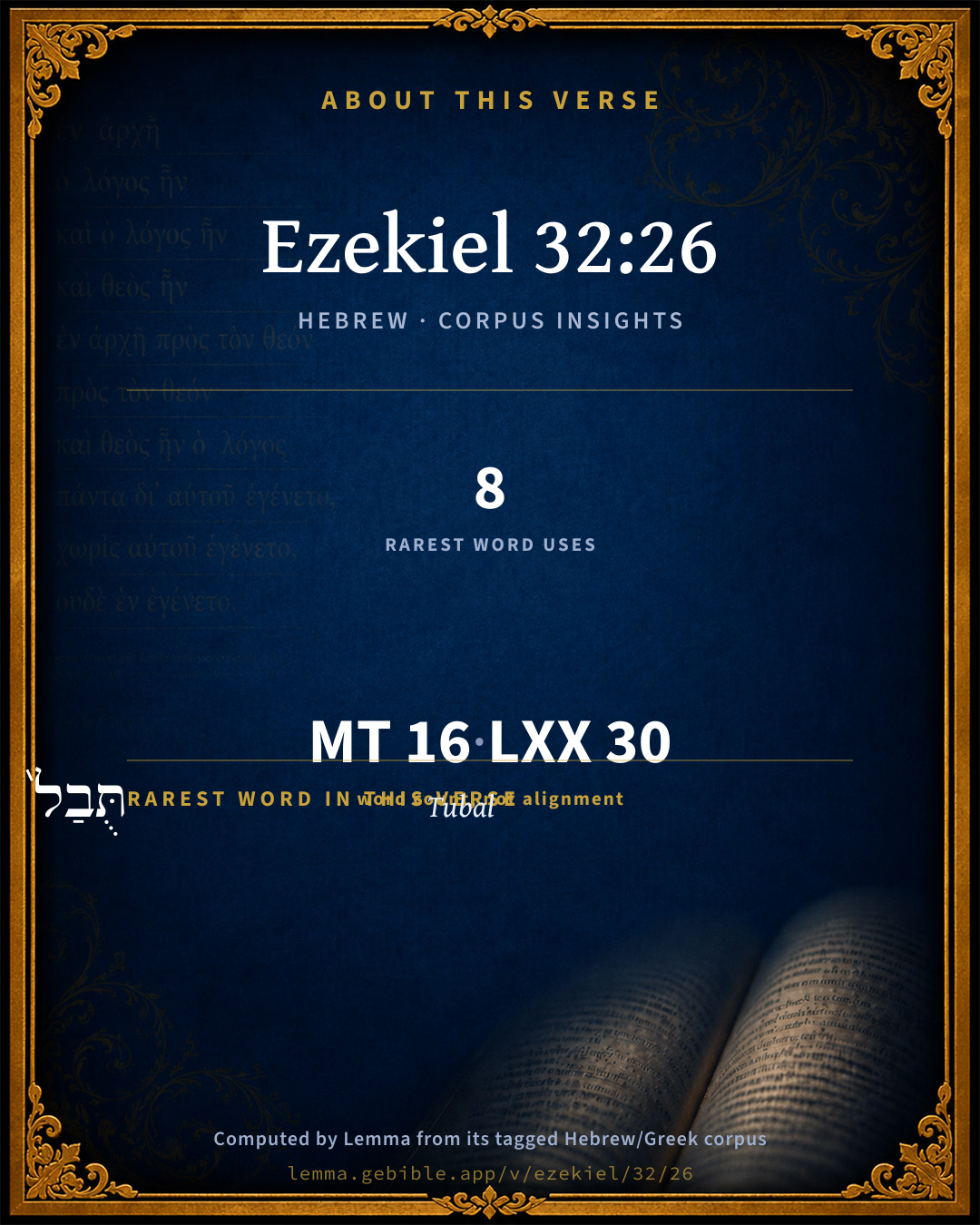
The rarest word here is תֻּבַל֙ Tubal H8422 — appearing just 8 times in the whole Hebrew Bible.

Shared distinctive vocabulary

תֻּבַל֙ Tubal H8422 occurs in 8 verses of the Hebrew Bible. Also found in:

Grammatical profile

  • 2 verbs
  • 10 nouns
  • 2 adjectives
  • 1 conjunction
  • 1 adverb

Verb forms

  • מְחֻ֣לְלֵי Pual · Participle Passive
  • נָתְנ֥וּ Qal · Perfect

Repetition

A word recurs within this verse — often emphatic in Hebrew:

  • וְכָל all H3605 ×2

Hebrew & Septuagint length

In English translation the verse runs 33 words from the Hebrew and 37 from the Septuagint (LXX English) — closely comparable.

A rough comparison of the two English renderings, which tokenize alike — not a word-level alignment.

Word counts can differ between the Hebrew and the Greek without any difference in meaning — e.g. the Hebrew direct-object marker אֵת has no separate Greek word, and Greek often adds the article ὁ.

In the original languages it is 16 Hebrew tokens and 30 Greek tokens — but the two are counted differently (Hebrew bundles its prefixes and suffixes into one token; the Greek is in lemma form), so that isn’t a like-for-like length.

Cross-references

10

Topical passages linked to Ezekiel 32:26 in the Treasury of Scripture Knowledge — connected by theme and wording, ordered by reader-vote popularity; previews shown in the World English Bible.

  • Ezekiel 27:13 Javan, Tubal, and Meshech, they were your traffickers; they traded the persons of men and vessels of brass for your merchandise.
  • Genesis 10:2 The sons of Japheth: Gomer, Magog, Madai, Javan, Tubal, Meshech, and Tiras.
  • Ezekiel 38:2–3 Son of man, set your face toward Gog, of the land of Magog, the prince of Rosh, Meshech, and Tubal, and prophesy against him,
  • Ezekiel 39:1 You, son of man, prophesy against Gog, and say, Thus says the Lord Yahweh: Behold, I am against you, Gog, prince of Rosh, Meshech, and Tubal:
  • Genesis 10:12 and Resen between Nineveh and Calah (the same is the great city).
  • 1 Chronicles 1:5 The sons of Japheth: Gomer, and Magog, and Madai, and Javan, and Tubal, and Meshech, and Tiras.
  • Ezekiel 32:19–20 Whom do you pass in beauty? Go down, and be laid with the uncircumcised.
  • Ezekiel 32:23–24 whose graves are set in the uttermost parts of the pit, and her company is round about her grave; all of them slain, fallen by the sword, who caused terror in the land of the living.
  • Ezekiel 32:27 They shall not lie with the mighty who are fallen of the uncircumcised, who are gone down to Sheol with their weapons of war, and have laid their swords under their heads, and their iniquities are on their bones; for [they were] the terror of the mighty in the land of the living.
  • Ezekiel 32:32 For I have put his terror in the land of the living; and he shall be laid in the midst of the uncircumcised, with those who are slain by the sword, even Pharaoh and all his multitude, says the Lord Yahweh.

Cross-references courtesy of OpenBible.info (CC BY 4.0).

Hebrew and Greek witnesses Masoretic Hebrew ↔ Greek Septuagint

The same verse in the two great witnesses to the Old Testament, shown verse-for-verse.

These are two independent witnesses, not word-aligned to each other, and the Septuagint is shown in lemma (dictionary) form.

Hebrew Ezekiel 32:26 Masoretic · Westminster Leningrad Codex

שָׁ֣ם מֶ֤שֶׁךְ תֻּבַל֙ וְכָל הֲמוֹנָ֔הּ סְבִֽיבוֹתָ֖יו קִבְרוֹתֶ֑יהָ כֻּלָּ֤ם עֲרֵלִים֙ מְחֻ֣לְלֵי חֶ֔רֶב כִּֽי נָתְנ֥וּ חִתִּיתָ֖ם בְּאֶ֥רֶץ חַיִּֽים

There is Meshech, Tubal, and all their multitude; their graves are round about them; all of them uncircumcised, slain by the sword; for they caused their terror in the land of the living.

World English Bible · Public Domain

Greek LXX Ezekiel 32:26 Septuagint · lemma form

ἐκεῖ δίδωμι μοσοχ καί θοβελ καί πᾶς ὁ ἰσχύς αὐτός περικύκλῳ ὁ μνῆμα αὐτός πᾶς τραυματίας αὐτός πᾶς ἀπερίτμητος τραυματίας ἀπό μάχαιρα ὁ δίδωμι ὁ φόβος αὐτός ἐπί γῆ ζωή

There were laid Mosoch, and Thobel, and all his strength round about his tomb: all his slain men, all the uncircumcised, slain with the sword, who caused their fear to be in the land of the living.

LXX2012 (modern English Septuagint) · Public Domain

Hebrew: Westminster Leningrad Codex (CC BY 4.0). Greek: Septuagint (public domain); English from LXX2012 (modern English Septuagint) (Public Domain). How the Septuagint differs from the Hebrew →

Targum (Aramaic paraphrase)

1

The Targum is the ancient Jewish Aramaic paraphrase of the Hebrew Scriptures — an interpretive translation, not the Hebrew text itself. Onkelos (literal) and Pseudo-Jonathan (expansive) render the Torah, and Jonathan the Prophets. Coverage is partial: where no permissively-licensed English translation exists for a verse, only the Aramaic is shown. This is verse-level text, not a word-by-word alignment to the Hebrew.

  1. Targum Jonathan Prophets (Joshua–Malachi)
    תַּמָן מֶשֶׁךְ תּוּבָל וְכָל מַשִׁרְיָתְהוֹן סָחֲרָנֵיהוֹן קְבוּרָתְהוֹן כּוּלְהוֹן חַיָבַיָא קְטִילֵי חַרְבָּא דְאִתְמְסָרוּ לִתְּבַר עַל דְשַׁלִיטוּ בְּאַרְעָא דְיִשְׂרָאֵל:

    (no public-domain English translation for this verse)

    Targum Jonathan — Aramaic: “Mikraot Gedolot” (public domain). English: “Sefaria Community Translation” (CC0 1.0 (public-domain dedication)); “London "Chaldee Paraphrase," 1871” (public domain). Text via Sefaria.

Commentary

Notes on Ezekiel 32:26 from classic Christian and Jewish commentators (each source and its license shown beneath its notes). The classic Christian expositions comment on the surrounding passage and are grouped to its opening verse, so a note may address several verses; the Jewish commentaries on the Tanakh (Rashi and others) are per-verse, so they appear only where the commentator wrote on this verse.

Lemma curates 59 commentaries, every one of them public domain or Creative Commons licensed, each selected and text-cleaned for this edition rather than reprinted as found. About our sources →

Trapp's Complete Commentary

John Trapp

Eze 32:26 There [is] Meshech, Tubal, and all her multitude: her graves [are] round about him: all of them uncircumcised, slain by the sword, though they caused their terror in the land of the living.

Ver. 26. There is Meshech and Tubal,] i.e., Say some, the Cappadocians and Spaniards; others, the Scythians and Sarmatians.

And all her multitude.] See Eze 32:25.

John Trapp, A Commentary or Exposition upon All the Books of the Old and New Testament (1647–1656) — public domain. Text from a community e-Sword module.

Joseph Benson's Commentary

Eze 32:26-28. There is Meshech, Tubal, &c. — These are some other of the Assyrian allies; some think the Cappadocians, and other nations neighbouring to them, are here meant. The Scythians also, who anciently governed Asia, may be comprehended, and their expulsion from Media by Cyaxares may here be referred to: see Obs. on Books, 1:192. And they shall not lie with the mighty, &c. — They shall not lie among those heathen heroes, men of courage and fortitude, who were laid in distinct graves, with pomp and magnificence, but shall all be tumbled together into one common pit, as their actions have not made them worthy of any distinction. Which are gone down to hell — Or, the state of the dead, as the word which we translate hell ought often to be rendered. With their weapons of war — Brave men, who had gained signal victories, used, by way of honour, to have their arms buried with them, or hung upon their sepulchres. Thus was the grave of Misenus honoured by Æneas.

“ — — — Ingenti mole sepulchrum Imponit, suaque arma viro.” ÆN. 6:232.

“It was usual,” says Kirchman, De Funer. Roman., 50. 3. c. 18, “in former times, in some places, to put swords, shields, and other armour in the graves of military men, as they did in the grave of Theseus, and on the bier of Alexander the Great.” But the meaning of the prophet here is, that those, of whom he speaks, should be without these usual martial solemnities, with which people formerly often honoured their dead. Instead of which he says their iniquities shall be upon their bones — Their death shall carry in it plain tokens of their sins, and of God’s vengeance pursuing them on account of them. Yea, thou shalt be broken in the midst of the uncircumcised — Thou, O king of Egypt, shalt have no honorary distinctions paid thee at thy death, or be laid in a magnificent tomb, as those great conquerors have been, but shalt lie in a common pit, or grave, promiscuously with those who are overcome and slain in battle.

Joseph Benson's Commentary on the Old and New Testaments (1811–1818) — public domain. Text from a community e-Sword module.

Geneva Bible (1599)

Geneva Bible translators

That is, the Cappadocians and Italians, or Spaniards, as Josephus writeth.

Geneva Bible (1599) marginal notes — public domain. Text via Bolls.life.

Jamieson, Fausset & Brown

Robert Jamieson, A. R. Fausset & David Brown

Meshech, Tubal--northern nations: the Moschi and Tibareni, between the Black and Caspian Seas. HERODOTUS [3.94], mentions them as a subjugated people, tributaries to Darius Hystaspes (see Eze 27:13).

Jamieson, Fausset & Brown — Commentary Critical and Explanatory on the Whole Bible (1871) — public domain (CC PDM 1.0). Text via the HelloAO Bible API.

Adam Clarke's Commentary

Verse 26. There is Meshech, Tubal] See on Eze 27:13.

Adam Clarke's Commentary on the Bible (1810–1826) — public domain. Text from a community e-Sword/MySword module.

Ellicott's Commentary for English Readers

(26) There is Meshech, Tubal.—See Note on Eze_27:13. It is difficult to obtain historical data for the exact time of the fall of these more obscure kingdoms; but at this period of the world these smaller states were being rapidly swallowed up and absorbed by the greater Powers who were contending for the world’s empire. Meshech and Tubal, like Persia, do not appear at this time to have yet attained their greatest development.

A Bible Commentary for English Readers, edited by Charles John Ellicott (1878–1897) — public domain. Text from a community e-Sword module.

The Cambridge Bible for Schools and Colleges

gen. ed. J. J. S. Perowne

26. Meshech and Tubal. See on Eze_27:13; cf. Eze_38:2.

her graves … him] On genders cf. Eze_32:22.

though they caused] for they caused.

The Cambridge Bible for Schools and Colleges (gen. ed. J. J. S. Perowne; Cambridge University Press, 1878–1918) — public domain. Text from a community e-Sword module.

John Gill's Exposition

There is Meshech, Tubal, and all her multitude,.... The Scythians, a powerful and warlike people; and all their armies, as the Targum; with their leaders, generals, and commanders, as lying in their graves next to the Assyrians and Elamites, or

her graves are round about him; not the king of Egypt, nor the king of Assyria, nor the king of Persia; but the chief commander of the Scythians, called the chief prince of Meshech and Tubal, Eze 38:2,

all of them slain by the sword; of Halyattes, king of Lydia, and Cyaxares, king of Media, who was assisted by the former in subduing the Scythians:

though they caused their terror in the land of the living; as they did in Media, and other countries, and especially in some parts of Asia.

John Gill's Exposition of the Whole Bible (1746–1763) — public domain (CC PDM 1.0). Text via the HelloAO Bible API.

Matthew Poole's English Annotations

Meshech: see Eze 27:13.

Tubal: see Eze 27:13; to which interpretation I still adhere, adding that in the full extent of these Moschi and Tibareni, these Cappadocians and Albanians, the Scythians may be included, many of which were next neighbours to them. Junius is of opinion that the Scythians are here meant, and so am I. But it will be said they never had such a settled kingdom worth noting. It is true of that barbarous people, there is no account that ever they were lords of the world; yet they caused their terror in the land of the living, and were slain by the sword under the command and in the expeditions of their kings into Asia, who were accompanied with her multitudes. Velleius reports they wasted Asia 350 years before Rome was thought of, and that is about 1082 years before Christ’s birth. Again, we find them in arms, (no doubt in numbers much like what they appeared in when Tomvris their queen destroyed Cyrus, or when they have moved against their neighbours in later days,) and with those arms wasted the Cimmerii, a people seated near them on the Euxine Sea and the Maeotis Palus; and about that time they did under their chieftains waste Asia, they forced Cyaxares from the siege of Nineveh, such considerable strength they had then; this was 634 before Christ’s’ birth, were lords of Asia for twenty-eight years, and it seems that their power was such, Cyaxares was glad to decline plain dealing, and to overthrow them by a wile, as Calvisius tells us, ad A.M. 3344, and the help of Halyattes, king of the Lydians. These things were fresh in memory when Ezekiel prophesied thus against Egypt, for they fell out about the eighth or ninth year of Pharaoh-necho, some fourteen years before Pharaoh-hophra came to the crown; now about the sixth year of his reign came this word of the Lord to Ezekiel; so that the prophet might well mention these as instances of God’s power abating the pride and destroying the kingdoms of the mighty, and these are with reason brought in among the Persians and Assyrians.

Matthew Poole's English Annotations on the Holy Bible (1683–1685) — public domain. Text from a community e-Sword/MySword module.

The Pulpit Commentary

There is Meshech, Tubal. (On the ethnological relations of the two tribes, see note on Eze_27:13, and later on in Eze 38, and Eze 39) Ezekiel obviously speaks of them as one of the powers that bad been conspicuous in his own time, and had been, in part at least, overthrown by the Chaldean monarchy. We may probably connect his words with the great irruption of the Scythians mentioned by Herodotus (1. 103; 4:11) as having swept over Asia even to Palestine and Egypt, inthe time of Josiah, and which, after compelling Cyaxares to raise the siege of Nineveh, left traces of itself in the name of the city of Scythe-polls. Many commentators find a reference to that invasion in the "evil from the north" of Jer_1:14 Jer_4:6; and in Zep_1:13-16. They also, once the terror of the nations, are now represented by the prophet as in the shadow-world of Sheol.

The Pulpit Commentary (1880–1919), ed. H.D.M. Spence-Jones & Joseph S. Exell — public domain. Text from a community e-Sword module.

John Wesley's Explanatory Notes

Her multitude - With the Cappadocians and Albanians, the Scythians may be included, many of whom were next neighbours to them.

John Wesley, Explanatory Notes Upon the Whole Bible (1754–1765) — public domain. Text via the GEBible commentary corpus.

unfoldingWord translationNotes

Door43 World Missions Community

Connecting Statement:

Yahweh continues speaking to Ezekiel about nations in Sheol.

Meshech ... Tubal

See how you translated these names in Ezekiel 27:13.

Their graves surround them

See how you translated "her graves surround her" in Ezekiel 32:22.

killed by the sword

Here "the sword" represents warfare. AT: "killed in battle" (See: Metonymy)

they had brought their terrors on the land of the living

Causing people to fear is spoken of as if it were the act of bringing an object to them. The abstract noun "terrors" can be translated with a verb. AT: "they terrified everyone in the land of the living" (See: Abstract Nouns)

All of them ... land of the living

See how you translated "All of them ... land of the living" in Ezekiel 32:25.

their iniquities over their bones

The warriors' iniquities cover their bodies, although one would expect that their shields would cover them in death. (See: Metaphor)

they were the terror of warriors in the land of the living

"while they were still alive, they made other warriors very afraid"

in the land of the living

The time during which these warriors were living is spoken of as if it were a place. AT: "while they were alive" (See: Metaphor)

translationWords

Meshech

Tubal

Hades

iniquity

unfoldingWord translationNotes — © Distant Shores Media and the Door43 World Missions Community, licensed CC BY-SA 4.0. Source: git.door43.org/Door43/en_tn.

Rashi

Rabbi Shlomo Yitzchaki (Rashi)

slain by the sword [Heb. מְחֻלְלֵי,] like הֲרוּגֵי.

Rashi on the Tanakh — English translations: “The Judaica Press complete Tanach with Rashi, translated by A. J. Rosenberg” (CC BY 4.0); “Pentateuch with Rashi's commentary by M. Rosenbaum and A.M. Silbermann, 1929-1934” (public domain); “The Metsudah Tanach series, Lakewood, N.J” (CC BY 4.0); and “The Book of Joshua, Metsudah Publications, 1997” (CC BY 4.0). Text via Sefaria.

Lesson kit

Teaching starters — assembled from the data on this page, not authored interpretation. Every prompt links to the verse data it draws on. Edit before teaching.

Ezekiel, in the Prophets, opens this verse with 16 words (15 distinct Hebrew lemmas). Its most distinctive word is Tûwbal (“Tubal”). A historical commentator’s framing appears above. Read the whole chapter for the surrounding context.

Discussion questions

  1. The word Tûwbal carries the sense “Tubal.” How does it shape the verse?
  2. Genesis 10:2 shares the word «Tubal» with this verse. How do the two illuminate each other?
  3. “all” occurs 2× in this one verse. What is the effect of the repetition?
  4. The translations on this page render this verse differently — a whole-verse word diff, not a word-by-word alignment. What might account for the different wordings?
  5. The verb «מְחֻ֣לְלֵי» is Pual Participle Passive. How does its form color the action?
  6. Reading how Trapp's Complete Commentary and Joseph Benson's Commentary read this verse, where do the two commentators agree and where do they part?

Things to notice

Reading settings

Reading text

Shown beneath each verse's original-language words.

Old Testament
Old Testament edition

Read the OT as the Masoretic Hebrew (MT) or the Greek Septuagint (LXX).

English shown for the Greek Septuagint (in the Hebrew ↔ Greek comparison).

Comparing translations? Open the Compare panel on any verse page to stack up to four side by side.