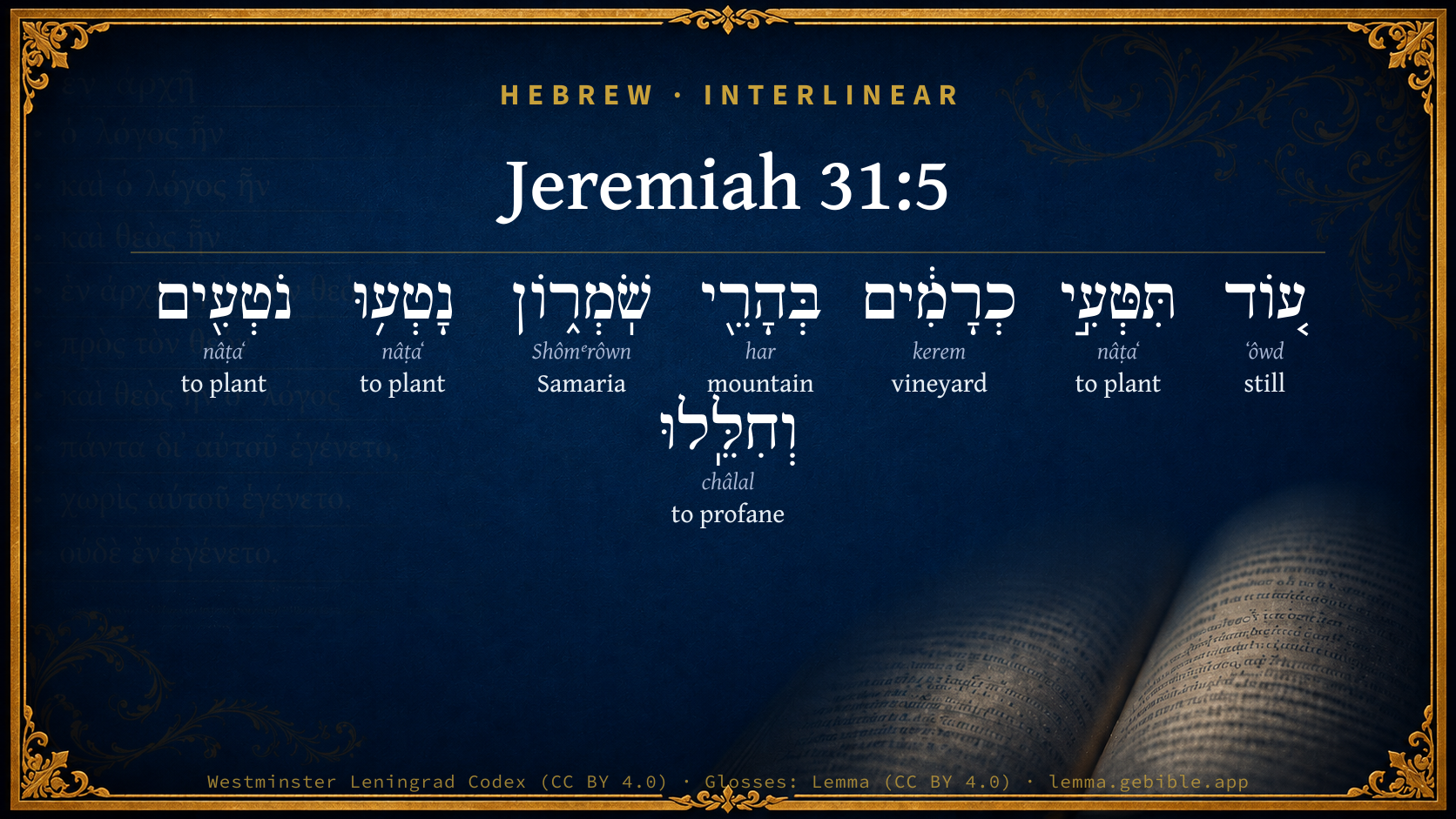
Jeremiah 31:5

Hebrew (Westminster Leningrad Codex) Jeremiah 31:5 appears in the Hebrew Old Testament. The text above is from the Westminster Leningrad Codex. Each word links to its Strong’s number, a concise gloss, and parsing drawn from the Open Scriptures Hebrew Bible morphology. Click any word for its full Brown-Driver-Briggs (BDB) entry.
Download image
Cite this verse

Jeremiah 31:5 (World English Bible). Public Domain. Lemma interlinear Bible study tool, https://lemma.gebible.app/v/jeremiah/31/5.

Show BibTeX & RIS
BibTeX
RIS
English Translation
Again shall you plant vineyards on the mountains of Samaria; the planters shall plant, and shall enjoy [the fruit of it].
World English Bible · Public Domain
Download a study sheet

One document with this verse’s original text, its word-by-word gloss line, the meaning frame, cross-references with their text, attributed commentary, and full source and license credits — printable, and it pastes into notes with its structure intact.

This verse Autodidact and up

Study sheet (.html) Plain text (.txt)

A passage Seminary Student

Up to 50 verses in one chapter. A passage sheet keeps up to 6 commentary sources and 12 cross-references per verse, in the order this page ranks them, and says so on the sheet whenever that leaves anything out. Ask for a single verse and you get the Autodidact verse sheet above.

Everything on this page stays free to read, with no account — the sheet is a download of what is already on screen, not access to it.

Want to remove ads? Support Godless Engineer
Compare translations 3

The same verse in 3 English versions, stacked beneath the original-language interlinear above. Click any original word for its lexicon entry.

Each is an independent rendering of the whole verse — the interlinear is not word-aligned to these translations.

Highlighted words mark where these versions differ — a whole-verse word diff, not a word-by-word alignment.

  • World English Bible Public Domain
    Again shall you plant vineyards on the mountains of Samaria; the planters shall plant, and shall enjoy [the fruit of it].
  • King James Version Public Domain
    Thou shalt yet plant vines upon the mountains of Samaria: the planters shall plant, and shall eat them as common things.
  • unfoldingWord Literal Text CC BY-SA 4.0
    You will plant vineyards again on the mountains of Samaria; the farmers will plant and put the fruit to good use.

unfoldingWord Literal Text — © unfoldingWord, licensed CC BY-SA 4.0. Word-aligned USFM3 via Door43 (git.door43.org/unfoldingWord/en_ult).

Versions to compare (up to 4)

3 of 4 selected

Show all 18 translations

Every available English version of this verse, each an independent rendering of the whole verse.

  • World English Bible Public Domain
    Again shall you plant vineyards on the mountains of Samaria; the planters shall plant, and shall enjoy [the fruit of it].
  • Berean Standard Bible Public Domain
    Again you will plant vineyards on the hills of Samaria; the farmers will plant and enjoy the fruit.
  • Majority Standard Bible Public Domain
    Again you will plant vineyards on the hills of Samaria; the farmers will plant and enjoy the fruit.
  • King James Version Public Domain
    Thou shalt yet plant vines upon the mountains of Samaria: the planters shall plant, and shall eat them as common things.
  • American Standard Version (1901) Public Domain
    Again shalt thou plant vineyards upon the mountains of Samaria; the planters shall plant, and shall enjoy `the fruit thereof'.
  • Revised Version (1885) Public Domain
    Again shalt thou plant vineyards upon the mountains of Samaria: the planters shall plant, and shall enjoy the fruit thereof.
  • Geneva Bible (1599) Public Domain
    Thou shalt yet plant vines vpon the mountaines of Samaria, and the planters that plant them, shall make them common.
  • Douay-Rheims (1899) Public Domain
    Thou shalt yet plant vineyards in the mountains of Samaria: the planters shall plant, and they shall not gather the vintage before the time.
  • Young's Literal Translation Public Domain
    Again thou dost plant vineyards In mountains of Samaria, Planters have planted, and made common.
  • Literal Standard Version CC BY-SA 4.0
    You plant vineyards in mountains of Samaria again, || Planters have planted, and made common.
  • Unlocked Literal Bible CC BY-SA 4.0
    You will plant vineyards again on the mountains of Samaria; the farmers will plant and put the fruit to good use.
  • unfoldingWord Literal Text CC BY-SA 4.0
    You will plant vineyards again on the mountains of Samaria; the farmers will plant and put the fruit to good use.
  • Darby Bible Public Domain
    Thou shalt again plant vineyards upon the mountains of Samaria; the planters shall plant, and shall eat the fruit.
  • World Messianic Bible Public Domain
    Again you will plant vineyards on the mountains of Samaria. The planters will plant, and will enjoy its fruit.
  • Webster's Bible Public Domain
    Thou shalt yet plant vines upon the mountains of Samaria: the planters shall plant, and shall eat them as common things.
  • Free Bible Version CC BY-SA 4.0
    You will replant vineyards on Samaria's hills; those who plant will enjoy the grapes.
  • Bible in Basic English Public Domain
    Again will your vine-gardens be planted on the hill of Samaria: the planters will be planting and using the fruit.
  • JPS Tanakh (1917) Public Domain
    Again shalt thou plant vineyards upon the mountains of Samaria; the planters shall plant, and shall have the use thereof.

Literal Standard Version (2020), Covenant Press — licensed CC BY-SA 4.0. Text via the HelloAO Bible API (eBible.org). Unlocked Literal Bible (unfoldingWord) — licensed CC BY-SA 4.0. Text via the HelloAO Bible API (eBible.org). unfoldingWord Literal Text — © unfoldingWord, licensed CC BY-SA 4.0. Word-aligned USFM3 via Door43 (git.door43.org/unfoldingWord/en_ult). Free Bible Version, Dr. Jonathan Gallagher — licensed CC BY-SA 4.0. Text via the HelloAO Bible API (eBible.org).

Word by word

More ways to search: Search by grammar → Find every occurrence → Compare this word →

Practice this passage: Drill this verse → Learn its vocabulary →

About this verse

These counts appear in no published source. They are computed here, from the morphology-tagged text and Lemma’s own curated glosses. What Lemma adds →

8
words
6
distinct lemmas
Prophets
section

Shared distinctive vocabulary

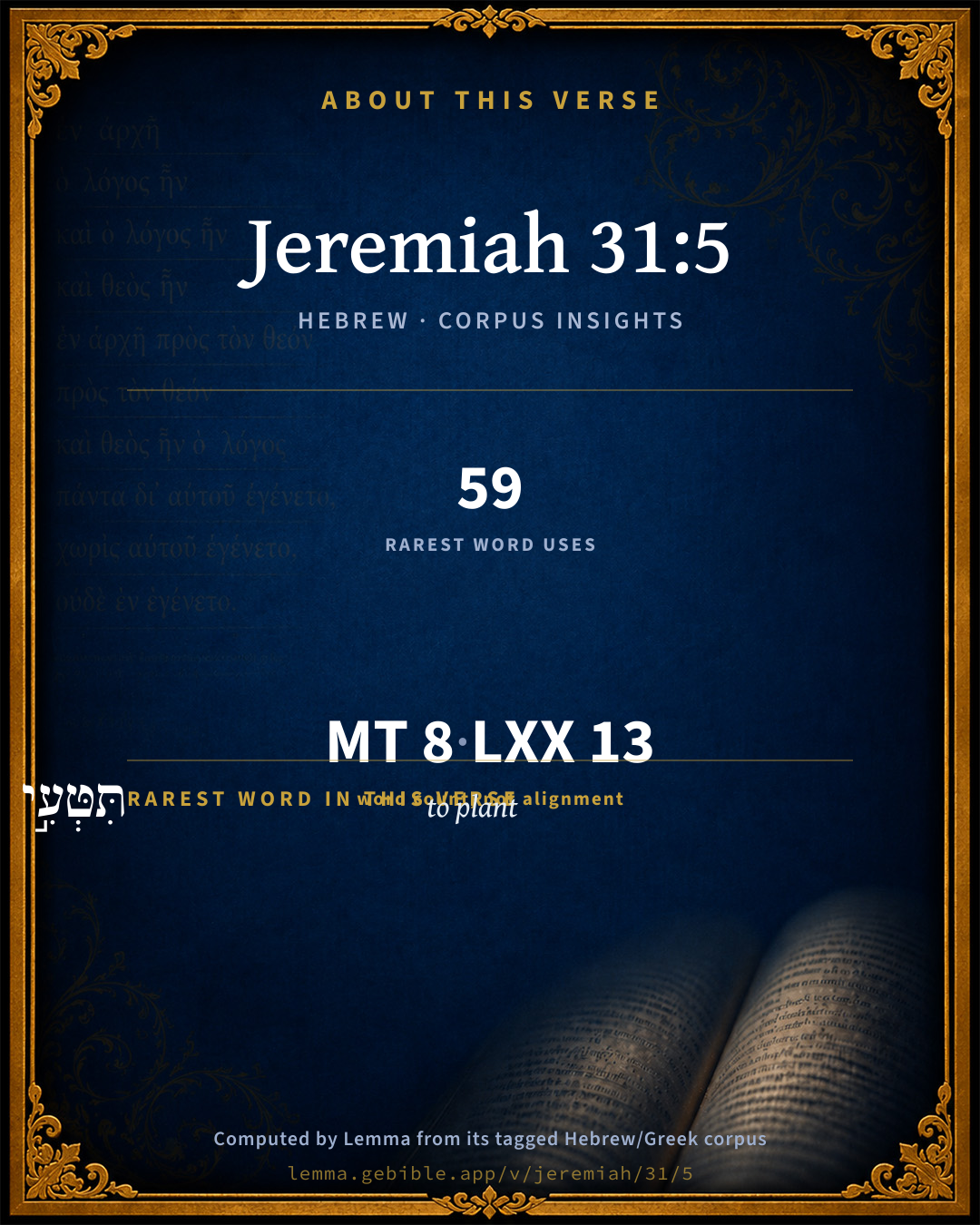
תִּטְּעִ֣י to plant H5193 occurs in 55 verses of the Hebrew Bible. Also found in:

Grammatical profile

  • 4 verbs
  • 3 nouns
  • 1 adverb

Verb forms

  • תִּטְּעִ֣י Qal · Imperfect
  • נָטְע֥וּ Qal · Perfect
  • נֹטְעִ֖ים Qal · Participle Active
  • וְחִלֵּֽלוּ Piel · Sequential Perfect

Repetition

A word recurs within this verse — often emphatic in Hebrew:

  • תִּטְּעִ֣י to plant H5193 ×3

Hebrew & Septuagint length

In the original languages it is 8 Hebrew tokens and 13 Greek tokens — but the two are counted differently (Hebrew bundles its prefixes and suffixes into one token; the Greek is in lemma form), so that isn’t a like-for-like length.

Cross-references

11

Topical passages linked to Jeremiah 31:5 in the Treasury of Scripture Knowledge — connected by theme and wording, ordered by reader-vote popularity; previews shown in the World English Bible.

  • Amos 9:14 I will bring back the captivity of my people Israel, And they will rebuild the ruined cities, and inhabit them; and they will plant vineyards, and drink wine from them. They shall also make gardens, And eat the fruit of them.
  • Leviticus 19:23–25 "'When you come into the land, and have planted all kinds of trees for food, then you shall count their fruit as forbidden. Three years shall they be forbidden to you. It shall not be eaten.
  • Deuteronomy 28:30 You shall betroth a wife, and another man shall lie with her: you shall build a house, and you shall not dwell therein: you shall plant a vineyard, and shall not use the fruit of it.
  • Isaiah 65:21–22 They shall build houses, and inhabit them; and they shall plant vineyards, and eat the fruit of them.
  • Micah 4:4 But they will sit every man under his vine and under his fig tree; And no one will make them afraid: For the mouth of Yahweh of Hosts has spoken.
  • Deuteronomy 20:6 What man is there who has planted a vineyard, and has not used the fruit of it? let him go and return to his house, lest he die in the battle, and another man use the fruit of it.
  • 1 Samuel 21:5 David answered the priest, and said to him, Of a truth women have been kept from us about these three days; when I came out, the vessels of the young men were holy, though it was but a common journey; how much more then today shall their vessels be holy?
  • Isaiah 62:8–9 Yahweh has sworn by his right hand, and by the arm of his strength, Surely I will no more give your grain to be food for your enemies; and foreigners shall not drink your new wine, for which you have labored:
  • Ezekiel 36:8 But you, mountains of Israel, you shall shoot forth your branches, and yield your fruit to my people Israel; for they are at hand to come.
  • Obadiah 1:19 Those of the South will possess the mountain of Esau, and those of the lowland, the Philistines. They will possess the field of Ephraim, and the field of Samaria. Benjamin will possess Gilead.
  • Zechariah 3:10 In that day,' says Yahweh of hosts, 'you will invite every man his neighbor under the vine and under the fig tree.'"

Cross-references courtesy of OpenBible.info (CC BY 4.0).

Hebrew and Greek witnesses Masoretic Hebrew ↔ Greek Septuagint

The same verse in the two great witnesses to the Old Testament, shown verse-for-verse.

These are two independent witnesses, not word-aligned to each other, and the Septuagint is shown in lemma (dictionary) form.

Hebrew Jeremiah 31:5 Masoretic · Westminster Leningrad Codex

ע֚וֹד תִּטְּעִ֣י כְרָמִ֔ים בְּהָרֵ֖י שֹֽׁמְר֑וֹן נָטְע֥וּ נֹטְעִ֖ים וְחִלֵּֽלוּ

Again shall you plant vineyards on the mountains of Samaria; the planters shall plant, and shall enjoy [the fruit of it].

World English Bible · Public Domain

Greek LXX Structure differs

In the Septuagint, Jeremiah is about an eighth shorter than the Hebrew and arranges its material differently — the Oracles Against the Nations (Hebrew chapters 46–51) appear in the middle of the Greek book, after 25:13. Because the chapter and verse boundaries do not line up, a verse-for-verse comparison with the Hebrew is not shown.

A verse-for-verse comparison isn’t shown here because the chapters and verses don’t line up. Switch to the LXX edition with the MT / LXX toggle above to read the Greek directly.

Hebrew: Westminster Leningrad Codex (CC BY 4.0). Greek: Septuagint (public domain); English from a public-domain English Septuagint. How the Septuagint differs from the Hebrew →

Targum (Aramaic paraphrase)

1

The Targum is the ancient Jewish Aramaic paraphrase of the Hebrew Scriptures — an interpretive translation, not the Hebrew text itself. Onkelos (literal) and Pseudo-Jonathan (expansive) render the Torah, and Jonathan the Prophets. Coverage is partial: where no permissively-licensed English translation exists for a verse, only the Aramaic is shown. This is verse-level text, not a word-by-word alignment to the Hebrew.

  1. Targum Jonathan Prophets (Joshua–Malachi)
    עוֹד תִּצְבִין כַּרְמִין בְּטוּרֵי שֹׁמְרוֹן צוּבוּ שְׁתִילִין וְאֲחִילוּ:

    "Again you shall plant vineyards on the hills of Samaria; the planters shall plant and enjoy the fruit."

    Targum Jonathan — Aramaic: “Mikraot Gedolot” (public domain). English: “Sefaria Community Translation” (CC0 1.0 (public-domain dedication)); “London "Chaldee Paraphrase," 1871” (public domain). Text via Sefaria.

Commentary

Notes on Jeremiah 31:5 from classic Christian and Jewish commentators (each source and its license shown beneath its notes). The classic Christian expositions comment on the surrounding passage and are grouped to its opening verse, so a note may address several verses; the Jewish commentaries on the Tanakh (Rashi and others) are per-verse, so they appear only where the commentator wrote on this verse.

Lemma curates 59 commentaries, every one of them public domain or Creative Commons licensed, each selected and text-cleaned for this edition rather than reprinted as found. About our sources →

Trapp's Complete Commentary

John Trapp

Jer 31:5 Thou shalt yet plant vines upon the mountains of Samaria: the planters shall plant, and shall eat [them] as common things.

Ver. 5. Thou shalt yet plant vines.] Profunda pax erit: nemo te perterrefaciet. Thou shalt have plenty, peace, and security.

The planters shall plant them, and shall eat them as common things,] i.e., Shall have God’s good leave and liking so to do. Heb., Shall profane them, i.e., not abuse them, but use them freely, even to an honest affluence. See Lev 19:23. {See Trapp on "Lev 19:23"}

John Trapp, A Commentary or Exposition upon All the Books of the Old and New Testament (1647–1656) — public domain. Text from a community e-Sword module.

Joseph Benson's Commentary

Jer 31:5. Thou shalt yet plant vines — Building and planting are commonly joined together; upon the mountains of Samaria — Samaria, being the metropolis of the ten tribes, seems to be put for the kingdom of Israel, as it is distinct from that of Judah. According to which interpretation the mountains of Samaria are equivalent to the mountains of Israel, and therefore the words imply, that the deliverance here spoken of should extend to Israel as well as Judah. The planters shall plant, and shall eat them as common things — After they have planted them they shall eat the fruits thereof, according to the promise contained in the parallel texts, (Isa 65:21; Amo 9:14,) whereas, God had threatened as a curse, that, in case of their disobedience, when they had planted their vines, another should eat the fruit, Deu 28:30. The verb חללו, translated, eat them as common things, alludes to the law that forbade the fruit of any young trees to be eaten till the fifth year of their bearing. For the first three years they were to be considered as in a state of uncircumcision or uncleanness. In the fourth year the fruit was holy to the Lord. But after that time it became free for the owner’s use, Lev 19:23-25. See also Deu 20:6; and Deu 28:30; where the same verb is used for eating of the fruit of a plantation without restraint. Here, therefore, a promise is given directly opposite to the above-mentioned threat, namely, That the persons who planted the vineyards on the hills of Samaria should not be compelled to give up the fruit of their labours to others, but should themselves remain in the land, and enjoy the produce of their plantations unmolested.

Joseph Benson's Commentary on the Old and New Testaments (1811–1818) — public domain. Text from a community e-Sword module.

Tyndale Open Study Notes

Tyndale Open Resources

31:5 Samaria was located in north-central Israel.

Tyndale Open Study Notes — © Tyndale Open Resources, licensed CC BY-SA 4.0. Text via the HelloAO Bible API.

Geneva Bible (1599)

Geneva Bible translators

Because the Israelites, which were the ten tribes never returned to Samaria, therefore this must be spiritually understood under the kingdom of Christ, which was the restoration of the true Israel.

That is, shall eat the fruit thereof, as Lev. 19:23-25; Deut. 20:6.

Geneva Bible (1599) marginal notes — public domain. Text via Bolls.life.

Jamieson, Fausset & Brown

Robert Jamieson, A. R. Fausset & David Brown

Samaria--the metropolis of the ten tribes; here equivalent to Israel. The mountainous nature of their country suited the growth of the vine.

eat . . . as common--literally, "shall profane," that is, shall put to common use. For the first three years after planting, the vine was "not to be eaten of"; on the fourth year the fruit was to be "holy to praise the Lord withal"; on the fifth year the fruit was to be eaten as common, no longer restricted to holy use (Lev 19:23-25; compare Deu 20:6; Deu 28:30, Margin). Thus the idea here is, "The same persons who plant shall reap the fruits"; it shall no longer be that one shall plant and another reap the fruit.

Jamieson, Fausset & Brown — Commentary Critical and Explanatory on the Whole Bible (1871) — public domain (CC PDM 1.0). Text via the HelloAO Bible API.

Adam Clarke's Commentary

Verse 5. Thou shalt yet plant vines upon the mountains of Samaria] This was the regal city of the Israelites, as Jerusalem was of the Jews.

Shall eat them as common things.] By the law of Moses no man was permitted to eat of the fruit of his vineyard till the fifth year after planting. For the first three years it was considered uncircumcised, unclean, not fit to be eaten; in the fourth year it was holy to the Lord, the fruit belonged to Him; in the fifth year he might use it for himself, Le 19:23-25. But in the time here mentioned the fruit should be considered common-lawful at all times to be eaten.

Adam Clarke's Commentary on the Bible (1810–1826) — public domain. Text from a community e-Sword/MySword module.

John Calvin's Commentaries

The verb חלל, chelal, means to profane, but it means also to apply to common use. The expression is taken from the Law; for it was not lawful to eat of the fruit of the vine until after the fourth year; for its uncircumcision as it were remained in the vine, so that its fruit was unclean. Then its first-fruits were offered to God; afterwards every one enjoyed his vintage. (Leviticus 19:23-25) But at the same time Jeremiah had respect to the curses which we read of elsewhere,

“Thou shalt plant a vineyard, and others shall eat its fruit.” (Deuteronomy 28:30)

What did he then mean by these words? even that the country would, for a time, be so deserted, that there would be no vines on the richest and the most fertile mountains. The mountains of Samaria were rich in vines; and when vines on these were cut down, there was a dreadful desolation. When, therefore, the Prophet says, they shall yet plant a vineyard, he intimates that the land would be desolate for a time; so also when he says, I will yet build thee, he reminds the Jews, that they were to bear with resignation the judgment of God, while they could see nothing but desolation through the whole land.

This, then, is what the word yet intimates: but when he promised that there would be vines again on the mountains of Samaria, he adds, that they who planted them would enjoy the fruit. Here, then, is an additional blessing: it would have availed them nothing to plant or set vines, except this blessing of God was added; for it is a very grievous thing to be deprived of a possession which we have cultivated, and on which we have spent much labor. He then who has diligently planted vines, and he who has cultivated his land, if driven into exile, feels deeply wounded in his mind, when he sees that his vines and his land are in the possession of strangers. Hence the Prophet here intimates that God’s favor would be certain, because he would not only give leisure to the Jews, when they returned, to plant vines, but would also cause them to enjoy the fruit in peace and quietness. They shall then profane, that is, apply to their own use, in the fifth year, the fruit produced by the vines, as though he had said, “They shall dwell, without disturbance, in their own inheritance, when once they shall have returned to it.”

John Calvin's Commentaries (1540-1563) — public domain. Text from the Calvin Translation Society English edition (1840s-50s) via the Christian Classics Ethereal Library (ccel.org). Calvin's coverage is partial (roughly two-thirds of the Bible); uncommented books and verses are honest gaps, never fabricated. The 19th-century editor's footnotes and remarks are omitted so the notes are faithfully Calvin's own voice.

Ellicott's Commentary for English Readers

(5) Thou shalt yet plant vines upon the mountains of Samaria . . .—The mention of Samaria shows that the prophet is thinking of the restoration of the northern kingdom, as well as of Judah, under the rule of the true King. In the Hebrew words “shall eat them as common things” we have a singular train of associations. The primary meaning of the verb is to “profane.” The rule of Lev_19:23-24, based partly, perhaps, on grounds of culture, partly with a symbolic meaning, required that a vineyard for three years after it was planted should be treated as “uncircumcised” (i.e., that no use should be made of the fruit), in the fourth year the fruit was to “be holy to praise the Lord with,” and in the fifth the planter might take the fruit for himself. So accordingly in Deu_20:6 we have, as one of the laws affecting war, that if a man had planted a vineyard and had not made it common—the same word as that used here—i.e., had not got beyond the fixed period of consecration, he might be exempted from military service, lest he should die and another eat of it. Compare also Deu_28:30, where the English “gather” answers, as the marginal reading shows, to the same verb. What is meant here, therefore, is, in contrast with the chances and changes of a time of war, that the planters of the vineyard should not be disturbed in their possession of it. They should not plant, and another eat thereof. (Comp. Isa_65:22; Deu_28:30.)

A Bible Commentary for English Readers, edited by Charles John Ellicott (1878–1897) — public domain. Text from a community e-Sword module.

The Cambridge Bible for Schools and Colleges

gen. ed. J. J. S. Perowne

5. shalt thou plant vineyards, etc.] As for several years these would yield no fruit of value, the words imply a return of settled prosperity.

Samaria] A post-exilic writer would not have mentioned Jerusalem’s rival in such a connexion.

shall enjoy] mg. Heb. profane, or, make common. The fruit borne by a tree for the first three years was not to be gathered, that of the fourth year was to be consecrated to God, while that of the fifth year the owner might eat. See Lev_19:23-25; Deu_20:6; Deu_28:30. The word which in Deut. (“used,” “use”) expresses the handing over of the fruit to the owner’s use is that here rendered “enjoy.”

The Cambridge Bible for Schools and Colleges (gen. ed. J. J. S. Perowne; Cambridge University Press, 1878–1918) — public domain. Text from a community e-Sword module.

John Gill's Exposition

Thou shalt yet plant vines upon the mountains of Samaria,.... Mountains are proper places for vines, and which generally produce the best wine; but vines are not to be understood merely literally, or as only expressive of the outward peace, plenty, and prosperity of Samaria, with other places given to the Jews, as Josephus (k) observes they were by the Demetrii; which they might improve by planting vines, &c. but figuratively of the planting of Gospel churches there, comparable to vines, Sol 2:13; which was done in the first times of the Gospel; see Joh 4:29; and which was a pledge of what will be done in those parts hereafter in the latter day:

the planters shall plant, and shall eat them as common things; the fruit of the vines planted by them. The allusion is to the law of eating the fruit of trees planted on the fifth year of their plantation, when, and not till then, it was lawful to eat of it; but here the planters might eat of it as soon as it was produced, even as the fruit of the fifth year, which was common and lawful, Lev 19:23. The "planters" are the ministers of the Gospel; such an one the Apostle Paul was; who are instruments in founding and raising churches, and of planting members in them, as well as of watering, and making them fruitful; and who receive themselves benefit from hence; not only in things temporal, but spiritual; it giving them a real pleasure and satisfaction to see the plants grow and thrive, which they have planted, Co1 3:6, Psa 92:14.

(k) Antiqu. Jud. l. 13. c. 2. sect. 3.

John Gill's Exposition of the Whole Bible (1746–1763) — public domain (CC PDM 1.0). Text via the HelloAO Bible API.

Albert Barnes' Notes on the Bible

Shall eat them as common things - Rather, shall eat the fruit. Literally, as in the margin. For three years the fruit of a newly-planted tree was not to be touched, that of the fourth year was consecrated to God, but on the fifth year it was profane, i. e., unconsecrated, and so might be applied to the owner’s use Lev 19:23-25.

Albert Barnes' Notes on the Bible (1834–1885) — public domain. Text from a community e-Sword/MySword module.

Haydock's Catholic Bible Commentary

Samaria. Its wine was famous, Judges ix. 27. (Josephus, Jewish Wars iii. 2.) --- Time, three years being elapsed, Leviticus xix. 35. (Calmet) --- Protestants, "plant, and shall eat (marginal note, profane) them as common things." They shall not be too greedy, (Haydock) but shall have leisure to enjoy the fruits of their labour. (Calmet)

George Leo Haydock (1774–1849), Haydock's Catholic Family Bible and Commentary, 1859 edition — public domain. Excludes Psalms (Douay-Rheims chapter numbering differs from Protestant) and Deuterocanonical books (Catholic canon only).

Matthew Poole's English Annotations

Samaria was the metropolis of the ten tribes, called so from Shemer, who owned the hill: Omri king of Israel bought it, and built Samaria upon it. Mountains in many places are judged the most convenient places for vineyards, being free from shades, and most exposed to the sun. God promiseth them a liberty to plant, and that they should enjoy their plantations, eating them as common things, which they could not do till the fifth year, as appears from Lev 19:23-25. The three first years it was to be accounted by them as uncircumcised, that is, unclean; in the fourth year it was to be holy to the Lord; in the fifth year they might eat the fruit of it, as any common thing that was not unclean, nor yet devoted and consecrated to the Lord.

Matthew Poole's English Annotations on the Holy Bible (1683–1685) — public domain. Text from a community e-Sword/MySword module.

Whedon's Commentary on the Bible

Daniel D. Whedon

5. Mountains of Samaria — Mentioned as the capital and sanctuary of the ten tribes. For many generations they had been exiled from this abode of their strength and pride; but now the promise is, that they shall eat their grapes there as common things; margin, shall profane them. For the first three years after planting the vines the Jews were forbidden to pluck the grapes, and the fruit of the fourth year was to be consecrated to the Lord, (see Lev_19:23-25; Deu_20:6,) so that not until the fifth year could the fruits be eaten as “common things.” This vividly suggests permanence of abode.

Daniel D. Whedon (gen. ed.), Commentary on the Old and New Testaments (1874–1909) — public domain. Text from a community e-Sword module.

The Pulpit Commentary

The mountains of Samaria. "Samaria" is used, equally with Ephraim, for the northern kingdom. Shall eat them as common things; rather, shall enjoy the fruit. The word, however, literally means shall profane them. The more common phrase, "shall eat the fruit," occurs in Isa_65:21, where the same promise is given. The law was that newly planted fruit trees should be left alone for three years; that in the fourth year their fruit should be consecrated to God; and that in the fifth year their fruit might be "profaned," i.e. devoted to ordinary uses. (comp. Deu_20:6 Deu_28:30)

Work yet to be found in the vineyard.

Here is to be an evidence of the everlasting love spoken of in ver. 3.

I THE RESTORATION OF WHAT HAD BEEN LOST. This is not the first prophecy in the book concerning vineyards. It had been declared that the nation from afar should eat up the vines and the fig trees of Israel. (Jer_5:17) "I will surely consume, saith the Lord. There shall be no grapes on the vine". (Jer_8:13) The bright prophecy here could not have been made but for the dark prophecies going before. The literal fulfillment of the prophecy is, of course, the least part of it. The deepest meaning is that, whatever we may lose through God"s chastisements, we shall get much more in a spiritual and truly abiding way.

II THE FUTURE IS DESCRIBED IN TERMS OF THE PAST. One of the occupations of the past had been to plant vineyards in Samaria. What associations there must have been with the sunny slopes! It is the way of God to speak of future comforts and glories in terms drawn from the present and from things around us. The future will give opportunities for profitable work. We shall always have some place to work in which shall be as the mountains of Samaria, and some work to do which shall be as the planting of vines. Fruitless toil and crushed hopes are but a disciplining episode in the career of those who are the heirs of eternal life.

III THE STABILITY IMPLIED IN THIS PROMISE. Five years, according to the Mosaic Law, had to pass from the planting to the time of fruitage. The prophecy was therefore a prophecy of peaceful settlement. The whole outlook gave a sense of security. Looked at in this light, one sees the reason of previous overthrowing and destruction. The aim is to get down to something solid and stable, to purify the heart from unworthy aims and love of the fleeting. The things that are shaken are removed, that the things which cannot be shaken may remain.

IV THE INCLUSIVENESS OF THIS PROMISE. Vineyards are to be planted, but vineyards are not the first necessity of life. To promise the planting of vineyards implied the promise of other things. The corn and the oil went along with the wine. The vineyard is doubtless here mentioned as a symbol of joy. He who is able to plant a vineyard is able to plant all good things. Note the evidence we have of the temporal fulfilment of this promise. From vineyards our Lord drew some of his most suggestive teaching. We may be sure they had often been seen by him, and their spiritual significance apprehended. Vine planting was a suitable industry, an industry to be expected in the land out of which the spies had brought the ponderous cluster of grapes. Y.

The Pulpit Commentary (1880–1919), ed. H.D.M. Spence-Jones & Joseph S. Exell — public domain. Text from a community e-Sword module.

John Wesley's Explanatory Notes

Samaria - Samaria was the metropolis of the ten tribes. Mountains are convenient for vineyards, being free from shades and exposed to the sun. Shall plant - God promises them a liberty to plant, and that they should enjoy their plantations, eating them as common things, which they could not do 'till the fifth year.

John Wesley, Explanatory Notes Upon the Whole Bible (1754–1765) — public domain. Text via the GEBible commentary corpus.

Rashi

Rabbi Shlomo Yitzchaki (Rashi)

and redeem [them] in the fourth year, they shall profane their produce by redeeming it with money.

Rashi on the Tanakh — English translations: “The Judaica Press complete Tanach with Rashi, translated by A. J. Rosenberg” (CC BY 4.0); “Pentateuch with Rashi's commentary by M. Rosenbaum and A.M. Silbermann, 1929-1934” (public domain); “The Metsudah Tanach series, Lakewood, N.J” (CC BY 4.0); and “The Book of Joshua, Metsudah Publications, 1997” (CC BY 4.0). Text via Sefaria.

Lesson kit

Teaching starters — assembled from the data on this page, not authored interpretation. Every prompt links to the verse data it draws on. Edit before teaching.

Jeremiah, in the Prophets, opens this verse with 8 words (6 distinct Hebrew lemmas). Its most distinctive word is nâṭaʻ (“to plant”). A historical commentator’s framing appears above. Read the whole chapter for the surrounding context.

Discussion questions

  1. How does “to plant” (nâṭaʻ) shape what this verse is saying?
  2. Genesis 2:8 shares the word «to plant» with this verse. How do the two illuminate each other?
  3. “to plant” occurs 3× in this one verse. What is the effect of the repetition?
  4. These translations render this verse differently; the difference is in the English rendering, not the original. What questions does that raise?
  5. The verb «תִּטְּעִ֣י» is Qal Imperfect. How does its form color the action?
  6. Reading how Trapp's Complete Commentary and Joseph Benson's Commentary read this verse, where do the two commentators agree and where do they part?

Things to notice

Reading settings

Reading text

Shown beneath each verse's original-language words.

Old Testament
Old Testament edition

Read the OT as the Masoretic Hebrew (MT) or the Greek Septuagint (LXX).

English shown for the Greek Septuagint (in the Hebrew ↔ Greek comparison).

Comparing translations? Open the Compare panel on any verse page to stack up to four side by side.