Isaiah 48:11

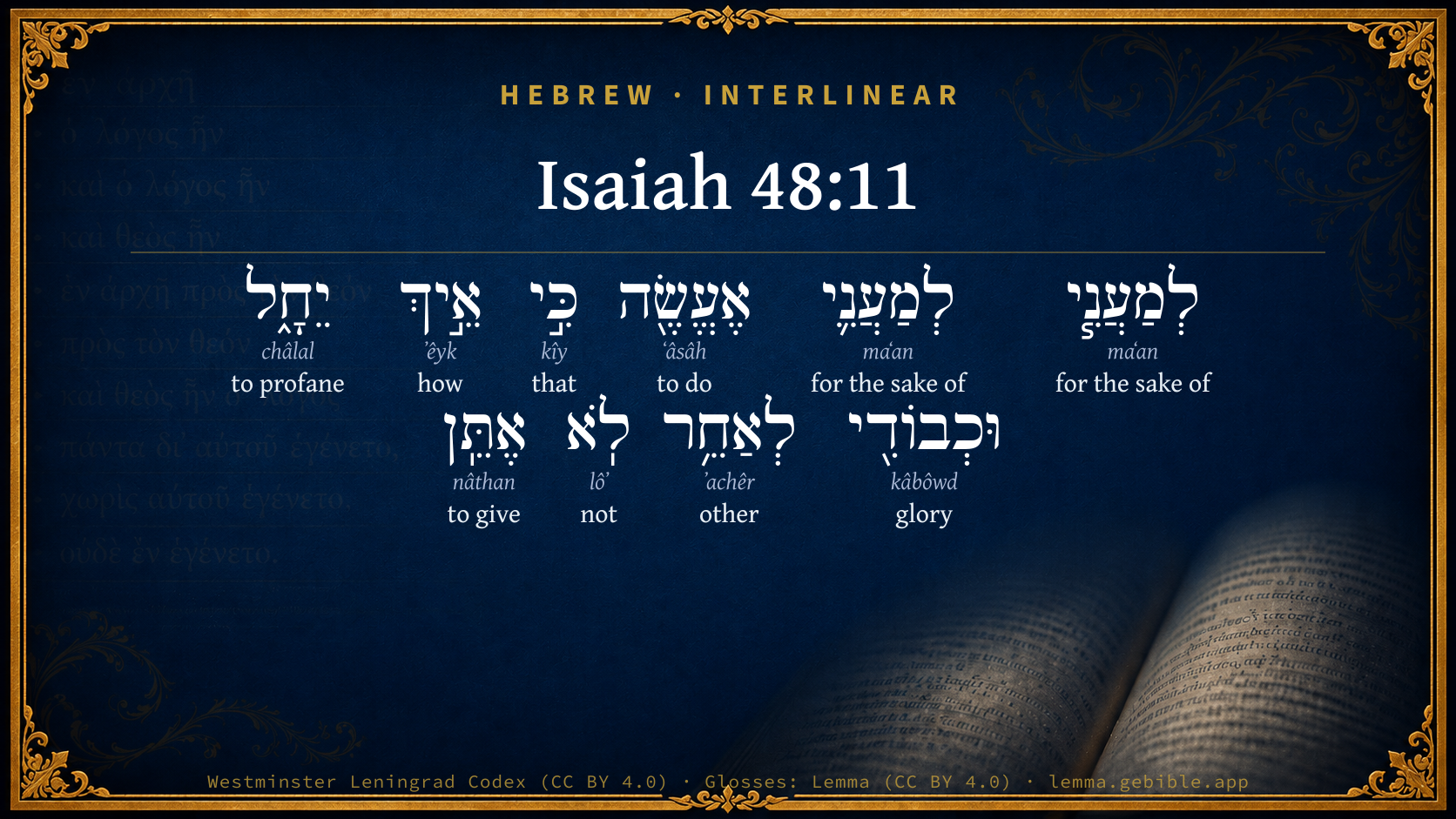
Hebrew (Westminster Leningrad Codex) Isaiah 48:11 appears in the Hebrew Old Testament. The text above is from the Westminster Leningrad Codex. Each word links to its Strong’s number, a concise gloss, and parsing drawn from the Open Scriptures Hebrew Bible morphology. Click any word for its full Brown-Driver-Briggs (BDB) entry.
Download image
Cite this verse

Isaiah 48:11 (World English Bible). Public Domain. Lemma interlinear Bible study tool, https://lemma.gebible.app/v/isaiah/48/11.

Show BibTeX & RIS
BibTeX
RIS
English Translation
For my own sake, for my own sake, will I do it; for how should [my name] be profaned? and my glory I will not give to another.
World English Bible · Public Domain
Download a study sheet

One document with this verse’s original text, its word-by-word gloss line, the meaning frame, cross-references with their text, attributed commentary, and full source and license credits — printable, and it pastes into notes with its structure intact.

This verse Autodidact and up

Study sheet (.html) Plain text (.txt)

A passage Seminary Student

Up to 50 verses in one chapter. A passage sheet keeps up to 6 commentary sources and 12 cross-references per verse, in the order this page ranks them, and says so on the sheet whenever that leaves anything out. Ask for a single verse and you get the Autodidact verse sheet above.

Everything on this page stays free to read, with no account — the sheet is a download of what is already on screen, not access to it.

Want to remove ads? Support Godless Engineer
Compare translations 3

The same verse in 3 English versions, stacked beneath the original-language interlinear above. Click any original word for its lexicon entry.

Each is an independent rendering of the whole verse — the interlinear is not word-aligned to these translations.

Highlighted words mark where these versions differ — a whole-verse word diff, not a word-by-word alignment.

  • World English Bible Public Domain
    For my own sake, for my own sake, will I do it; for how should [my name] be profaned? and my glory I will not give to another.
  • King James Version Public Domain
    For mine own sake, even for mine own sake, will I do it: for how should my name be polluted? and I will not give my glory unto another.
  • unfoldingWord Literal Text CC BY-SA 4.0
    For my sake, for my sake, I will do, for how should be profaned? And I will not give my glory to another. q1

unfoldingWord Literal Text — © unfoldingWord, licensed CC BY-SA 4.0. Word-aligned USFM3 via Door43 (git.door43.org/unfoldingWord/en_ult).

Versions to compare (up to 4)

3 of 4 selected

Show all 18 translations

Every available English version of this verse, each an independent rendering of the whole verse.

  • World English Bible Public Domain
    For my own sake, for my own sake, will I do it; for how should [my name] be profaned? and my glory I will not give to another.
  • Berean Standard Bible Public Domain
    For My own sake, My very own sake, I will act; for how can I let Myself be defamed? I will not yield My glory to another.
  • Majority Standard Bible Public Domain
    For My own sake, My very own sake, I will act; for how can I let Myself be defamed? I will not yield My glory to another.
  • King James Version Public Domain
    For mine own sake, even for mine own sake, will I do it: for how should my name be polluted? and I will not give my glory unto another.
  • American Standard Version (1901) Public Domain
    For mine own sake, for mine own sake, will I do it; for how should `my name' be profaned? and my glory will I not give to another.
  • Revised Version (1885) Public Domain
    For mine own sake, for mine own sake, will I do it; for how should my name be profaned? and my glory will I not give to another.
  • Geneva Bible (1599) Public Domain
    For mine owne sake, for mine owne sake wil I doe it: for how should my Name be polluted? surely I wil not giue my glory vnto another.
  • Douay-Rheims (1899) Public Domain
    For my own sake, for my own sake will I do it, that I may not be blasphemed: and I will not give my glory to another.
  • Young's Literal Translation Public Domain
    For My sake, for Mine own sake, I do `it', For how is it polluted? And Mine honour to another I give not.
  • Literal Standard Version CC BY-SA 4.0
    For My sake, for My own sake, I do [it], || For how is it defiled? And I do not give My glory to another.
  • Unlocked Literal Bible CC BY-SA 4.0
    For my own sake, for my own sake I will act; for how can I allow my name to be profaned? I will not give my glory to anyone else.
  • unfoldingWord Literal Text CC BY-SA 4.0
    For my sake, for my sake, I will do, for how should be profaned? And I will not give my glory to another. q1
  • Darby Bible Public Domain
    For mine own sake, for mine own sake, will I do [it]; for how should [my name] be profaned? and I will not give my glory unto another.
  • World Messianic Bible Public Domain
    For my own sake, for my own sake, I will do it; for how would my name be profaned? I will not give my glory to another.
  • Webster's Bible Public Domain
    For my own sake, even for my own sake, will I do it: for how should my name be profaned? and I will not give my glory to another.
  • Free Bible Version CC BY-SA 4.0
    The reason I'm doing this is because of who I am, yes, because of my very nature. I won't let my reputation be damaged—I won't let anyone else have it.
  • Bible in Basic English Public Domain
    For myself, even because of my name, I will do it; for I will not let my name be shamed; and my glory I will not give to another.
  • JPS Tanakh (1917) Public Domain
    For Mine own sake, for Mine own sake, will I do it; for how should it be profaned? And My glory will I not give to another.

Literal Standard Version (2020), Covenant Press — licensed CC BY-SA 4.0. Text via the HelloAO Bible API (eBible.org). Unlocked Literal Bible (unfoldingWord) — licensed CC BY-SA 4.0. Text via the HelloAO Bible API (eBible.org). unfoldingWord Literal Text — © unfoldingWord, licensed CC BY-SA 4.0. Word-aligned USFM3 via Door43 (git.door43.org/unfoldingWord/en_ult). Free Bible Version, Dr. Jonathan Gallagher — licensed CC BY-SA 4.0. Text via the HelloAO Bible API (eBible.org).

Word by word

More ways to search: Search by grammar → Find every occurrence → Compare this word →

Practice this passage: Drill this verse → Learn its vocabulary →

About this verse

These counts appear in no published source. They are computed here, from the morphology-tagged text and Lemma’s own curated glosses. What Lemma adds →

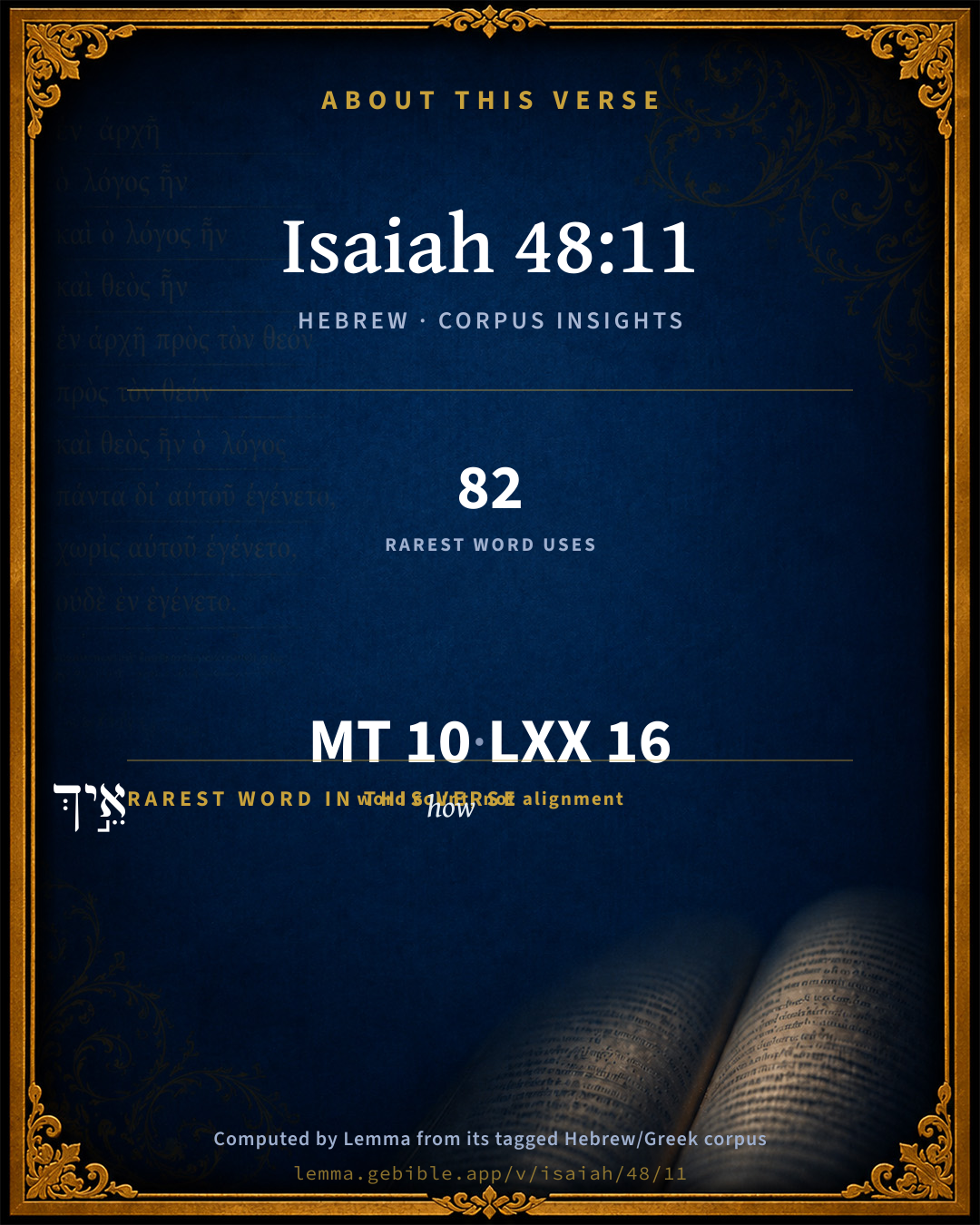
10
words
9
distinct lemmas
Prophets
section

Grammatical profile

  • 3 verbs
  • 1 noun
  • 1 adjective
  • 2 prepositions
  • 1 conjunction
  • 2 particles

Verb forms

  • אֶעֱשֶׂ֖ה Qal · Imperfect
  • יֵחָ֑ל Niphal · Imperfect
  • אֶתֵּֽן Qal · Imperfect

Repetition

A word recurs within this verse — often emphatic in Hebrew:

  • לְמַעֲנִ֧י for the sake of H4616 ×2

Hebrew & Septuagint length

In English translation the verse runs 28 words from the Hebrew and 24 from the Septuagint (LXX English) — closely comparable.

A rough comparison of the two English renderings, which tokenize alike — not a word-level alignment.

Word counts can differ between the Hebrew and the Greek without any difference in meaning — e.g. the Hebrew direct-object marker אֵת has no separate Greek word, and Greek often adds the article ὁ.

In the original languages it is 10 Hebrew tokens and 16 Greek tokens — but the two are counted differently (Hebrew bundles its prefixes and suffixes into one token; the Greek is in lemma form), so that isn’t a like-for-like length.

Cross-references

16

Topical passages linked to Isaiah 48:11 in the Treasury of Scripture Knowledge — connected by theme and wording, ordered by reader-vote popularity; previews shown in the World English Bible.

  • Isaiah 42:8 I am Yahweh, that is my name; and my glory will I not give to another, neither my praise to engraved images.
  • Ezekiel 20:9 But I worked for my name's sake, that it should not be profaned in the sight of the nations, among which they were, in whose sight I made myself known to them, in bringing them forth out of the land of Egypt.
  • Isaiah 37:35 For I will defend this city to save it, for my own sake, and for my servant David's sake.
  • Ezekiel 20:14 But I worked for my name's sake, that it should not be profaned in the sight of the nations, in whose sight I brought them out.
  • 1 Samuel 12:22 For Yahweh will not forsake his people for his great name's sake, because it has pleased Yahweh to make you a people to himself.
  • Isaiah 43:25 I, even I, am he who blots out your transgressions for my own sake; and I will not remember your sins.
  • Ezekiel 20:22 Nevertheless I withdrew my hand, and worked for my name's sake, that it should not be profaned in the sight of the nations, in whose sight I brought them forth.
  • Jeremiah 14:7 Though our iniquities testify against us, work you for your name's sake, Yahweh; for our backslidings are many; we have sinned against you.
  • Numbers 14:15–16 Now if you shall kill this people as one man, then the nations which have heard the fame of you will speak, saying,
  • Ezekiel 20:44 You shall know that I am Yahweh, when I have dealt with you for my name's sake, not according to your evil ways, nor according to your corrupt doings, you house of Israel, says the Lord Yahweh.
  • Deuteronomy 32:26–27 I said, I would scatter them afar, I would make the memory of them to cease from among men;
  • Ezekiel 20:39 As for you, house of Israel, thus says the Lord Yahweh: Go you, serve everyone his idols, and hereafter also, if you will not listen to me; but my holy name shall you no more profane with your gifts, and with your idols.
  • Isaiah 48:5 therefore I have declared it to you from of old; before it came to pass I shown it you; lest you should say, My idol has done them, and my engraved image, and my molten image, has commanded them.
  • Isaiah 52:5 Now therefore, what do I here, says Yahweh, seeing that my people is taken away for nothing? those who rule over them do howl, says Yahweh, and my name continually all the day is blasphemed.
  • John 5:23 that all may honor the Son, even as they honor the Father. He who doesn't honor the Son doesn't honor the Father who sent him.
  • Romans 2:24 For "the name of God is blasphemed among the Gentiles because of you," just as it is written.

Cross-references courtesy of OpenBible.info (CC BY 4.0).

Hebrew and Greek witnesses Masoretic Hebrew ↔ Greek Septuagint

The same verse in the two great witnesses to the Old Testament, shown verse-for-verse.

These are two independent witnesses, not word-aligned to each other, and the Septuagint is shown in lemma (dictionary) form.

Hebrew Isaiah 48:11 Masoretic · Westminster Leningrad Codex

לְמַעֲנִ֧י לְמַעֲנִ֛י אֶעֱשֶׂ֖ה כִּ֣י אֵ֣יךְ יֵחָ֑ל וּכְבוֹדִ֖י לְאַחֵ֥ר לֹֽא אֶתֵּֽן

For my own sake, for my own sake, will I do it; for how should [my name] be profaned? and my glory I will not give to another.

World English Bible · Public Domain

Greek LXX Isaiah 48:11 Septuagint · lemma form

ἕνεκεν ἐγώ ποιέω σύ ὅτι ὁ ἐμός ὄνομα βεβηλόω καί ὁ δόξα ἐγώ ἕτερος οὐ δίδωμι

For my own sake I will do this for you, because my name is profaned; and I will not give my glory to another.

LXX2012 (modern English Septuagint) · Public Domain

On this verse, Adam Clarke's Commentary discusses the Septuagint’s reading. Read the note in Commentary ↓

Hebrew: Westminster Leningrad Codex (CC BY 4.0). Greek: Septuagint (public domain); English from LXX2012 (modern English Septuagint) (Public Domain). How the Septuagint differs from the Hebrew →

Targum (Aramaic paraphrase)

1

The Targum is the ancient Jewish Aramaic paraphrase of the Hebrew Scriptures — an interpretive translation, not the Hebrew text itself. Onkelos (literal) and Pseudo-Jonathan (expansive) render the Torah, and Jonathan the Prophets. Coverage is partial: where no permissively-licensed English translation exists for a verse, only the Aramaic is shown. This is verse-level text, not a word-by-word alignment to the Hebrew.

  1. Targum Jonathan Prophets (Joshua–Malachi)
    בְּדִיל שְׁמִי בְּדִיל מֵימְרִי אַעְבֵּיד דְלָא יִתָּחָל וִיקָרִי דְאִתְגְלֵתִי עֲלֵיכוֹן לְעַם אוֹחֲרָן לָא אֶתֵּן:

    For my name's sake, for the sake of my WORD, that it may not be profaned, I will do it, and my glory in which I have revealed myself unto you, I will not give to another people.

    Targum Jonathan — Aramaic: “Mikraot Gedolot” (public domain). English: “Sefaria Community Translation” (CC0 1.0 (public-domain dedication)); “London "Chaldee Paraphrase," 1871” (public domain). Text via Sefaria.

Commentary

Notes on Isaiah 48:11 from classic Christian and Jewish commentators (each source and its license shown beneath its notes). The classic Christian expositions comment on the surrounding passage and are grouped to its opening verse, so a note may address several verses; the Jewish commentaries on the Tanakh (Rashi and others) are per-verse, so they appear only where the commentator wrote on this verse.

Lemma curates 59 commentaries, every one of them public domain or Creative Commons licensed, each selected and text-cleaned for this edition rather than reprinted as found. About our sources →

Trapp's Complete Commentary

John Trapp

Isa 48:11 For mine own sake, [even] for mine own sake, will I do [it]: for how should [my name] be polluted? and I will not give my glory unto another.

Ver. 11. For mine own sake, even for mine own sake.] This is oft repeated, that it may once be well observed. Bene cavet Spiritus Sanctus ubique in Scripturis ne nostris operibus salutem tribuamus; it is Oecolampadius’s note upon the first verse of this chapter, i.e., the Holy Ghost doth everywhere in Scripture take course that we ascribe not our safety to our own works. See on Isa 43:13.

For how should my name be polluted?] As it will be by the blasphemous heathens, who else will say that their gods are fortiores et faventiores, more powerful and more merciful than the God of the Hebrews. Thus the Turks at this day, when they have beaten the Christians, cry up their Mohammed as mightier than Christ.

And I will not give my glory to another.] Press this in prayer: it is an excellent argument. {Exo 32:12 Jos 7:9 Psa 79:9-10; Psa 115:1-2} The saints, after all other arguments used, hunc quasi arietem admovent, mind God of his glory engaged, and then doubt not to prevail with him.

John Trapp, A Commentary or Exposition upon All the Books of the Old and New Testament (1647–1656) — public domain. Text from a community e-Sword module.

Tyndale Open Study Notes

Tyndale Open Resources

48:11 I will not let my reputation be tarnished: Israel’s exile raised questions among the nations about the Lord’s character and reputation. The nations would not have perceived that Israel’s wicked character led to the Exile. Instead they would have viewed it as a failure of Israel’s God to protect his people and their land (see 36:19-20; 37:12; Ezek 36:19-26).

Tyndale Open Study Notes — © Tyndale Open Resources, licensed CC BY-SA 4.0. Text via the HelloAO Bible API.

Geneva Bible (1599)

Geneva Bible translators

God joineth the salvation of his with his own honor: so that they cannot perish, but his glory should be diminished, as Deut. 32:27.

Read Isa. 42:8.

Geneva Bible (1599) marginal notes — public domain. Text via Bolls.life.

Jamieson, Fausset & Brown

Robert Jamieson, A. R. Fausset & David Brown

how should my name--MAURER, instead of "My name" from Isa 48:9, supplies "My glory" from the next clause; and translates, "How (shamefully) My glory has been profaned!" In English Version the sense is, "I will refrain (Isa 48:9, that is, not utterly destroy thee), for why should I permit My name to be polluted, which it would be, if the Lord utterly destroyed His elect people" (Eze 20:9)?

not give my glory unto another--If God forsook His people for ever, the heathen would attribute their triumph over Israel to their idols; so God's glory would be given to another.

Jamieson, Fausset & Brown — Commentary Critical and Explanatory on the Whole Bible (1871) — public domain (CC PDM 1.0). Text via the HelloAO Bible API.

Adam Clarke's Commentary

Verse 11. For how should my name be polluted - "For how would my name be blasphemed"] The word שמי shemi, my name, is dropped out of the text; it is supplied by a MS. which has שמי shemi; and by the Septuagint, ὁτι το εμον ονομα βεβηλουται. The Syriac and Vulgate get over the difficulty, by making the verb in the first person; that I may not be blasphemed.

Adam Clarke's Commentary on the Bible (1810–1826) — public domain. Text from a community e-Sword/MySword module.

Ellicott's Commentary for English Readers

(11) Will I do it . . .—The neuter pronoun includes the whole work of redemption.

For how should my name be polluted?—The italics show that “my name” is not in the Hebrew, but the context requires its insertion as from Isa_48:9. or that of “my glory” from the clause that follows. The “pollution” or desecration of the name of Jehovah would follow, it is implied, on the non-completion of His redeeming work.

A Bible Commentary for English Readers, edited by Charles John Ellicott (1878–1897) — public domain. Text from a community e-Sword module.

The Cambridge Bible for Schools and Colleges

gen. ed. J. J. S. Perowne

11. for how should my name be polluted?] Better: for how is it profaned! a parenthetic ejaculation, and in all probability a marginal gloss.

I will not give my glory unto another] Cf. ch. Isa_42:8. The “glory” is that of bringing to pass the marvellous “new things,” the era of eternal salvation.

The Cambridge Bible for Schools and Colleges (gen. ed. J. J. S. Perowne; Cambridge University Press, 1878–1918) — public domain. Text from a community e-Sword module.

John Gill's Exposition

For mine own sake, even for mine own sake, will I do it,.... Defer his anger, not cut off his people and destroy them, but redeem and save them: this, in the literal sense, respects the redemption and deliverance of the Jews by Cyrus from the Babylonish captivity; which the Lord did, not for any deserts of theirs, but for the sake of his own honour and glory; or, as the Targum,

"for my name, and for my word;''

which is repeated here again and again for the confirmation of it, and that it might be more observed. In the mystical sense, it respects redemption and salvation by Christ, of which the former was typical:

for how should my name be polluted? blasphemed and evil spoken of among the nations of the world; who would be ready to say, that either the Lord did not love his people, and was not mercifully disposed towards them; or that he could not save them, and that their hands, or their gods, were mightier than he; see Deu 32:26.

and I will not give my glory to another; to another people, as the Targum, or to another god; See Gill on Isa 42:8.

John Gill's Exposition of the Whole Bible (1746–1763) — public domain (CC PDM 1.0). Text via the HelloAO Bible API.

Albert Barnes' Notes on the Bible

For mine own sake - (See Isa 48:9). The expression here is repeated to denote emphasis. He had thrown them into the furnace of affliction on his own account, that is, in order that his own name should not be profaned by their irreligion and idolatry, and that the glory which was due to him should not be given to idols.

For how should my name be polluted? - The sense is, that it would be inconsistent with his perfections to see his name profaned without endeavoring to correct and prevent it; and in order to this, that he brought these afflictions upon them. They had profaned his name by their irreligion and hypocrisy. In order to correct this evil, and to prevent it in future, he had brought these national judgments on them, and removed them to Babylon. The doctrine here taught is, that when the conduct of God’s professed people is such as to dishonor God, and to make his name a subject of reproach with the wicked, he will visit them with heavy judgments. He cannot indulge them in a course of life which will reflect dishonor on his own name.

And I will not give my glory unto another - (See the notes at Isa 42:8). The sense here is this. The Jews had, as a nation, been prone to ascribe to idols that which was due to God alone. To correct this, and to make an effectual reform, he had removed them to Babylon, and doomed them to a long and painful captivity there. It may be added that the punishment was effectual, and that their long trial in Babylon served entirely to correct all their idolatrous propensities as a nation.

Albert Barnes' Notes on the Bible (1834–1885) — public domain. Text from a community e-Sword/MySword module.

Matthew Poole's English Annotations

Will I do it; this great work of delivering my people out of Babylon. My name is here fitly supplied, both out of Isa 48:9, where it is expressed, and out of the following clause of this verse, where he saith,

my glory, which is equivalent to it. The sense is, If I should not spare and deliver my people, my name would be sadly profaned and blasphemed, as if I were either impotent or implacable to them.

I will not give my glory unto another; I will not give any colour or occasion to idolaters to ascribe the Divine nature and properties, which are my peculiar, unto idols, as they would do if I did not rescue my people out of their hands in spite of their idols.

Matthew Poole's English Annotations on the Holy Bible (1683–1685) — public domain. Text from a community e-Sword/MySword module.

The Pulpit Commentary

How should my Name be polluted? i.e. how should I allow of its pollution or desecration (see the comment on ver. 9)? I will not give my glory unto another. (comp. Isa_42:8) God would have ceded his glory to some god of the nations, had he under existing circumstances forsaken Israel.

The Pulpit Commentary (1880–1919), ed. H.D.M. Spence-Jones & Joseph S. Exell — public domain. Text from a community e-Sword module.

John Wesley's Explanatory Notes

It - This great work of delivering my people out of Babylon. Name - If I should not deliver my people, my name would be profaned and blasphemed. Glory - I will not give any colour to idolaters, to ascribe the divine nature and properties, to idols, as they would do if I did not rescue my people out of their hands in spite of their idols.

John Wesley, Explanatory Notes Upon the Whole Bible (1754–1765) — public domain. Text via the GEBible commentary corpus.

J. A. Alexander on Isaiah

Joseph Addison Alexander

“For my own sake, for my own sake, I will do (what is to be done).” This is commonly restricted to the restoration of the Jews from exile; but this specific application of the promise is not made till afterwards. The terms are comprehensive and contain a statement of the general doctrine, as the sum of the whole argument, that what Jehovah does for His own people, is in truth done not for any merit upon their part, but to protect His own divine honor. “For how will it be profaned?” This may either mean, ‘How greatly would it be profaned!’ or, ‘How can I suffer it to be profaned?’ “And my glory (or honor) to another will I not give,” as He must do if His enemies eventually triumph over His own people. The same words with the same sense occur above in Isa 42:8.

Joseph Addison Alexander, The Prophecies of Isaiah (1846–1847; New York: Scribner, 1870–1878) — public domain. Text from a community e-Sword module.

Rashi

Rabbi Shlomo Yitzchaki (Rashi)

For My sake For the sake of My holy name.

for how shall it be profaned How shall My name be profaned when I utterly destroy you?

And My honor I will not give to another That your enemies shall say that their God is powerful.

Rashi on the Tanakh — English translations: “The Judaica Press complete Tanach with Rashi, translated by A. J. Rosenberg” (CC BY 4.0); “Pentateuch with Rashi's commentary by M. Rosenbaum and A.M. Silbermann, 1929-1934” (public domain); “The Metsudah Tanach series, Lakewood, N.J” (CC BY 4.0); and “The Book of Joshua, Metsudah Publications, 1997” (CC BY 4.0). Text via Sefaria.

Ibn Ezra

Rabbi Abraham ibn Ezra

יחל Should be polluted. It is the Niphal of a verb (חלל) ע״ע; as to the use of the first person in למעני and third person in יחל, comp. ונשאר אני and I was left (Ez. 9:8); הנני יוסיף behold, I will add (38:5).

Ibn Ezra on the Tanakh — English translations: “Sefaria Community Translation” (CC0 1.0 (public-domain dedication)); “Yalkut, Sifsei Chachomim Chumash, Metsudah Publications, 2009” (CC BY 4.0); and “Commentary of Ibn Ezra on Isaiah - trans. by M. Friedlander, 1873” (public domain). Text via Sefaria.

Lesson kit

Teaching starters — assembled from the data on this page, not authored interpretation. Every prompt links to the verse data it draws on. Edit before teaching.

Isaiah, in the Prophets, opens this verse with 10 words (9 distinct Hebrew lemmas). Its most distinctive word is ʼêyk (“how”). A historical commentator’s framing appears above. Read the whole chapter for the surrounding context.

Discussion questions

  1. What does “how” (ʼêyk) contribute to the verse as a whole?
  2. How does Isaiah 42:8, which shares this passage’s theme, read alongside this verse?
  3. What does the repetition of “for the sake of” (2× in this one verse) do in this verse?
  4. These translations render this verse differently. What is at stake in choosing one wording over another?
  5. «אֶעֱשֶׂ֖ה» is a Qal Imperfect verb. How does that grammatical form shape the action described?
  6. Compare how Trapp's Complete Commentary and Tyndale Open Study Notes read this verse. Where do they agree or differ?

Things to notice

Reading settings

Reading text

Shown beneath each verse's original-language words.

Old Testament
Old Testament edition

Read the OT as the Masoretic Hebrew (MT) or the Greek Septuagint (LXX).

English shown for the Greek Septuagint (in the Hebrew ↔ Greek comparison).

Comparing translations? Open the Compare panel on any verse page to stack up to four side by side.