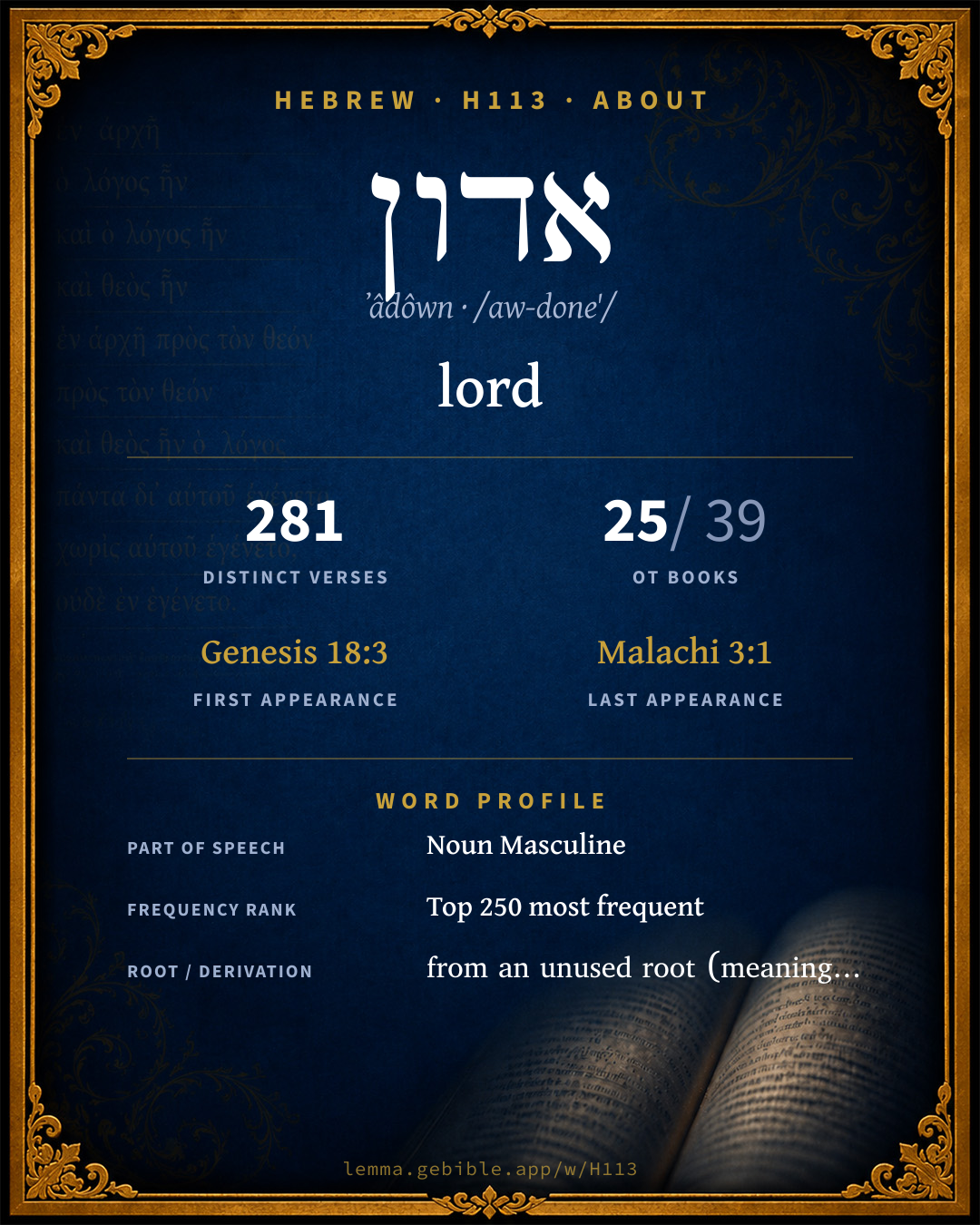
אָדוֹן
lord
also: firm, strong, master fuller range ↓
Full lexicon entry — Brown-Driver-Briggs (BDB)
From Brown-Driver-Briggs (BDB)
Where this word appears
See every Construct-state word in the Hebrew Bible →
Grammar key — what these labels mean
Part of speech
- Noun
- A naming word — a person, place, thing, or idea.
Noun type
- Common
- A common noun — a general class of person, place, or thing (“king,” “city,” “water”), not a specific name.
State
- Construct
- A noun bound to a following noun in a possessive / “of” relationship (the construct chain).
- Absolute
- The independent form of a noun, not bound to a following word.
Gender
- Masculine
- Grammatically masculine.
Number
- Singular
- One.
- Plural
- More than one (in Hebrew, generally three or more).
Every verse where H113 appears in the Book of Isaiah — 14 distinct verses. Click any verse to open its interlinear word-by-word view. Verse text shown in the World English Bible for context — . Each verse’s Hebrew form is shown with its reference; the English is not keyword-highlighted, since the data carries no word-level English alignment. Use “Compare translations” on any verse to read it across multiple English versions. This concordance covers the Hebrew Bible; Septuagint (Greek Old Testament) occurrences are not indexed here.
Isaiah
- Isaiah 1:24 הָֽ/אָדוֹן֙ ptcl def.art + n c ms Therefore the Lord, Yahweh of Hosts, The Mighty One of Israel, says: "Ah, I will get relief from my adversaries, And avenge myself of my enemies;
- Isaiah 3:1 הָ/אָד֜וֹן ptcl def.art + n c ms For, behold, the Lord, Yahweh of Hosts, takes away from Jerusalem and from Judah supply and support, The whole supply of bread, And the whole supply of water;
- Isaiah 10:16 הָ/אָד֜וֹן ptcl def.art + n c ms Therefore will the Lord, Yahweh of Hosts, send among his fat ones leanness; and under his glory there shall be kindled a burning like the burning of fire.
- Isaiah 10:33 הָ/אָדוֹן֙ ptcl def.art + n c ms Behold, the Lord, Yahweh of Hosts, will lop the boughs with terror: and the high of stature shall be hewn down, and the lofty shall be brought low.
- Isaiah 19:4 אֲדֹנִ֣ים הָ/אָד֖וֹן n c mp ptcl def.art + n c ms I will give over the Egyptians into the hand of a cruel lord; and a fierce king shall rule over them, says the Lord, Yahweh of Hosts.
- Isaiah 22:18 אֲדֹנֶֽי/ךָ n c mp cs + sfx pers 2ms He will surely wind you round and round, [and toss you] like a ball into a large country; there shall you die, and there shall be the chariots of your glory, you shame of your lord's house.
- Isaiah 24:2 כַּֽ/אדֹנָ֔י/ו prep + n c mp cs + sfx pers 3ms It shall be, as with the people, so with the priest; as with the servant, so with his master; as with the maid, so with her mistress; as with the buyer, so with the seller; as with the creditor, so with the debtor; as with the taker of interest, so with the giver of interest to him.
- Isaiah 26:13 אֲדֹנִ֖ים n c mp Yahweh our God, other lords besides you have had dominion over us; but by you only will we make mention of your name.
- Isaiah 36:8 אֲדֹנִ֖/י n c ms cs + sfx pers 1cs Now therefore, please give pledges to my master the king of Assyria, and I will give you two thousand horses, if you are able on your part to set riders on them.
- Isaiah 36:9 אֲדֹנִ֖/י n c ms cs + sfx pers 1cs How then can you turn away the face of one captain of the least of my master's servants, and put your trust on Egypt for chariots and for horsemen?
- Isaiah 36:12 אֲדֹנֶ֤י/ךָ אֲדֹנִ֔/י n c mp cs + sfx pers 2ms n c ms cs + sfx pers 1cs But Rabshakeh said, Has my master sent me to your master, and to you, to speak these words? [has he] not [sent me] to the men who sit on the wall, to eat their own dung, and to drink their own water with you?
- Isaiah 37:4 אֲדֹנָי/ו֙ n c mp cs + sfx pers 3ms It may be Yahweh your God will hear the words of Rabshakeh, whom the king of Assyria his master has sent to defy the living God, and will rebuke the words which Yahweh your God has heard. Therefore lift up your prayer for the remnant that is left.
- Isaiah 37:6 אֲדֹנֵי/כֶ֑ם n c mp cs + sfx pers 2mp Isaiah said to them, Thus shall you tell your master, Thus says Yahweh, Don't be afraid of the words that you have heard, with which the servants of the king of Assyria have blasphemed me.
- Isaiah 51:22 אֲדֹנַ֣יִ/ךְ n c mp cs + sfx pers 2fs Thus says your Lord Yahweh, and your God who pleads the cause of his people, Behold, I have taken out of your hand the cup of staggering, even the bowl of the cup of my wrath; you shall no more drink it again:
About this entry
At a glance — auto-summarized from this page’s data, not written by a person. Every figure links to its source below. This summary describes the numbers; it doesn’t interpret them.
“lord” is the headline sense of the Hebrew noun אדון (ʼâdôwn). Not a single-sense word: its full sense range also takes in “firm”, “strong”, and “master”. It turns up in 281 verses across 25 books, a common footprint. First canonically at Genesis 18:3, it enters the text early. From the same root come אדן, אדני and דין. The sections below give every sense, occurrence, and version rendering.
Gloss history
Strong's 1890 vs modern scholarship
About this word
Strong's H113 catalogs a Hebrew word from the Hebrew Old Testament.
These counts are not copied from any lexicon or concordance. They are computed here, from the morphology-tagged Hebrew Old Testament. What Lemma adds →
- 281
- distinct verses
- The word appears in 281 distinct verses.
- 25 / 39
- OT books
- The word appears in 25 of 39 Old Testament books.
- #150
- by frequency
- Top 250 most frequent Hebrew words (rank 150 of 8,640 Hebrew words by occurrence).
View all 281 occurrences in the concordance →
By section of the Old Testament
By traditional corpus
Conventional, traditional groupings — biblical authorship is debated, so this is a traditional corpus grouping, not an authorship claim. Each share is this word’s portion of its verses in that division of the Hebrew canon. Each figure is a share of the word’s 281 distinct verses.
- Prophets (Nevi'im) 176 verses · 63%
- Torah (Pentateuch) 75 verses · 27%
- Writings (Ketuvim) 30 verses · 11%
How translations render this word
Counts come from each version’s own published word-to-Strong’s tagging or interlinear alignment — an approximate guide to how each version renders this word, not a word-level alignment the data otherwise carries. Because each total is that version’s own tagged count, the per-version totals vary from one another and need not match the appearance or distinct-verse counts above. These counts may also differ from a printed concordance because Lemma counts each distinctly tagged rendering and does not collapse phrase taggings into a single head-word total. This is a fixed set of word-tagged versions (KJV, ASV, BSB, ULT) and does not change with the reading translation you choose elsewhere. Each version’s license is shown beside its name below (and on Sources).
- King James Version: Lord 159×, Master 63×, Master's 16×
- American Standard Version: Lord 137×, Master 68×, Let my lord 5×
- Berean Standard Bible: Lord 151×, Master 89×, Master’s 24×
- unfoldingWord Literal Text: Lord 154×, Master 142×, Lords 7×
King James Version Public Domain
Renders H113 across 335 tagged occurrences — most commonly:
Plus other, less common renderings. Plus 63 renderings that appear only once — usually multi-word phrases or single function words the recovered tagging swept in, not distinct renderings.
American Standard Version Public Domain
Renders H113 across 326 tagged occurrences — most commonly:
Plus other, less common renderings. Plus 73 renderings that appear only once — usually multi-word phrases or single function words the recovered tagging swept in, not distinct renderings.
Berean Standard Bible Public Domain
Renders H113 across 319 tagged occurrences — most commonly:
Plus other, less common renderings. Plus 19 renderings that appear only once — usually multi-word phrases or single function words the recovered tagging swept in, not distinct renderings. Not rendered by a distinct English word in 14 further occurrences.
unfoldingWord Literal Text CC BY-SA 4.0
Renders H113 across 328 tagged occurrences — most commonly:
Plus 15 renderings that appear only once — usually multi-word phrases or single function words the recovered tagging swept in, not distinct renderings.
8 senses and sub-senses in the full BDB
What do BDB’s symbols mean?
BDB uses these scholarly abbreviations:
| Symbol | Meaning |
|---|---|
| 𝔊 | the Septuagint (the ancient Greek translation, LXX) |
| 𝔙 | the Vulgate (the Latin translation) |
| 𝔖 | the Syriac version (the Peshitta) |
| 𝔗 | the Targum (the Aramaic translation) |
| ψ | the Psalms |
| √ | root (the underlying root or stem) |
| ‖ | parallel passage (a synonymous or contrasted parallel) |
| † | the dagger: every passage where the word occurs is cited |
The 8 senses and sub-senses the full Brown-Driver-Briggs lexicon distinguishes for this word, in lexicon order (not ranked by frequency), with BDB’s own verbatim wording and sub-sense lettering. Shown in Hebrew script with BDB’s own scholarly abbreviations. The condensed entry is in the Lexicon Entry tab. See also the Forms in the corpus table below.
- 1. sg. lord, master (1) ref. to men: (a) supt. of household, or of affairs Gn 45:8, 9 (E) = ψ 105:21; (b) master ψ 12:5; (c) king Je 22:18; 34:5; (2) ref. to God, הָאָדוֹן יהוה the Lord Yahweh (v. יהוה) Ex 23:17; 34:23 (Cov’t codes); אֲדוֹן כָּל־הָאָרֶץ Lord of the whole earth Jos 3:11, 13 (J) ψ 97:5 Zc 4:14; 6:5 Mi 4:13; צְבָאוֹת הָא׳ י׳, earlier Is 1:24; 3:1; 10:33; 19:4 (אֲדֹנָי Is 10:16 in common MT; not Massora, doubtless scrib. error); הָא׳ Mal 3:1; אָדוֹן ψ 114:7. e.g. Genesis 45:8
- 2. pl. lords, kings Dt 10:17 = ψ 136:3; Is 26:13 masters Am 4:1, elsewhere intens. pl. of rank, lord, master, (1) ref. to men: (a) proprietor of hill Samaria †1 K 16:24; (b) master Gn 40:7 (E) Ex 21:4(×2), 6, 8, 32 (Cov’t code) Gn 24:9 + (J, 11 times) Dt 23:16 Ju 19:11, 12 + 13 times S & K; Jb 3:19 ψ 123:2 Pr 25:13; 27:18; 30:10 Is 24:2 Zp 1:9 Mal 1:6(×2) (c) husband Ju 19:26, 27 ψ 45:12; (d) prophet 2 K 2:3, 5, 16; (e) governor Ne 3:5; (f) prince Gn 42:10, 30, 33 (E) 44:8 (J) 1 S 29:10; (g) king Gn 40:1 (E) Ju 3:25 + 40 times S & K; Ch only in sources 1 Ch 12:19 cf. 1 S 29:4; 2 Ch 13:6; 18:16 = 1 K 22:17; Is 19:4; 22:18; 36:12; 37:4, 6 Je 27:4; (2) ref. to God Mal 1:6; אֲדֹנֵי הָאֲדֹנִים Lord of lords Dt 10:17 = ψ 136:3; אֲדֹנֵינוּ ψ 135:5; 147:5 Ne 8:10; י׳אֲדֹנֵינוּ ψ 8:2, 10 Ne 10:30; אֲדֹנַיִךְ י׳ Is 51:22 (prob. = thy husband, Yahweh); אֲדֹנָיו Ho 12:15 (possibly error for אֲדֹנָי). e.g. Deuteronomy 10:17
- 3. sf. 1 s. אֲדֹנִי (אֲדֹנַי) (1) ref. to men: my lord, my master, (a) master Ex 21:5 (Cov’t code) Gn 24:12 +, 44:5 (J, 20 times) 1 S 30:13, 15 2 K 5:3, 20, 22; 6:15; (b) husband Gn 18:12 (J); (c) prophet 1 K 18:7, 13 2 K 2:19, 4:16, 28; 6:5; 8:5; (d) prince Gn 42:10 (E), 23:6, 11, 15 (P), 43:20; 44:18 +, 47:18, + (J, 12 times); Ju 4:18; (e) king 1 S 22:12 + (S & K 75 times); (f) father Gn 31:35 (E); (g) Moses Ex 32:22 Nu 11:28; 12:11; 32:25, 27 (J); 36:2(×2) (P); (h) priest 1 S 1:15, 26(×2); (i) theophanic angel Jos 5:14 Ju 6:13; (j) captain 2 S 11:11; (k) general recognition of superiority Gn 24:18; 32:5 +; 33:8 +; 44:7 + (J, 13 times), Ru 2:13 1 S 25:24 + (15 times); (2) ref. to God: אֲדֹנָי e.g. Exodus 21:5
- a. my Lord Gn 20:4 (?E) Ex 15:17 (Sam. יהוה) elsewhere in Hex, J; Gn 18:3(?), 27, 30, 31, 32; 19:2, 18(?) Ex 4:10, 13; 5:22; 34:9 Nu 14:17 Jos 7:8; also Ju 6:15; 13:8; not S; 1 K 22:6 2 K 19:23; noChron exc. memorials Ezr 10:3 (ref. to Ezra) Ne 1:11; 4:8; WisdLt only Jb 28:28 (doubtless scrib. error for יהוֹה of many MSS.); not Ho; Is 37:24; 38:16 (hist. part); exile Is 49:14 (cf. 51:22); Mi 1:2 ψ 16:2 + (47 times, chiefly this sense, exc. sub b.; cf. אֱלֹהַי וַאדֹנָי my Lord and my God ψ 35:23; (writers that use אֱלהִים seld. use אֲדֹנָי); e.g. Genesis 20:4
- b. Adonay n.pr. of God, parallel with Yahweh, substit. for it oft. by scrib. error, & eventually supplanting it. In earlier Is 3:17 + (19 times seeming to belong here), Am 7:7, 8; 9:1 Ez 18:25, 29; 33:17, 20; 21:12 (prob. אֲדֹנָי י׳ as in usual phrase); Zc 9:4 Mal 1:12, 14 La 1:14 + (14 times) ψ 2:4; 37:13; 78:65; 90:17 (? יהוה) 110:5 (Dalman puts most of these sub (a);—many cases are doubtful); 1 K 3:10, 15 (Mass. אדני for יהוה cf. Dalm. 2 K 7:6; Dalm. rightly questions; he reads יהוה). The phrases אֲדֹנָי אֱלֹהַי ψ 38:16; 86:12, Adonay my God; אֲדֹנָי הָאֱלֹהִים Dn 9:3, א׳ אֱלֹהֵינוּ 9:9, 15, א׳ הָאֵל Dn 9:4 favour taking א׳ Dn 1:2; 9:7, 8 (יהוה?) v 16, 17, 19(×3) as the divine name. e.g. Isaiah 3:17
- 4. אֲדֹנָי יהוה (a) my Lord Yahweh (v. יהוה) Gn 15:2, 8 (JE) Jos 7:7 (J, 𝔊 om. י׳) Dt 3:24; 9:26 Ju 6:22; 16:28 2 S 7 (6times) 1 K 2:26; 8:53; prob. Am 3:7, 8; 7:2, 4, 5; 9:8 Je 1:6; 4:10; 14:13; 32:17, 25 Ez 4:14; 8:1; 9:8; 11:13; 20:39; 37:3 (יָדַע כִּי אֲני א׳ י׳) 13:9; 23:49; 24:24; 28:24; 29:16 inappropriate in mouth of God; del. אֲדֹנָי (Co) or read י׳ אֱלֹהֵיכֶם (Dalm.); Mi 1:2 Zp 1:7 Ob 1 Zc 9:14 ψ 71:5, 16; 73:28; (b) appar. n.pr. Adonay Yahweh Is 25:8 Je 44:26; exil. Is 40:10 + (10 times, but 61:1, 11 read יהוה, 𝔊); (c) uncertain whether (a) or (b) in proph. formula אָמַר א׳ י׳ Is 7:7; 28:16; 30:15; 49:22; 52:4; 65:13 Je 7:20 Am 1:8; 3:11; 5:3; 7:6 Ob 1 Ez (131 times); נְאֻם א׳ י׳ Is 56:8 Je 2:22 Am 3:13; 4:5; 8:3, 9, 11 Ez (80 times); דְּבַר־א׳ י׳ Ez 6:3; 25:3; 36:4; נִשְׁבַּע א׳ י׳ Am 4:2; 6:8; כֹּה הִרְאַנִי א׳ י׳ Am 7:1, 4; 8:1. e.g. Genesis 15:2
- 5. יהוה אֲדֹנָי Yahweh my Lord ψ 68:21; 109:21; 140:8; 141:8 Hb 3:19. e.g. Psalms 68:21
- 6. אֲדֹנָי יהוה צְבָאוֹת (a) my Lord Yahweh Ṣ. (v. צבאות) ψ 69:7 Am 9:5 Is 10:23; 22:5, 12; 28:22 cf. י׳ אֱלֹהֵי הַצְבָאוֹת א׳, Yahweh, the God of Hosts my Lord Am 5:16; (b) a divine name, Adonay, Yahweh Ṣ. Je 46:10(×2); 50:25; (c) uncertain are כֹּה אָמַר א׳ י׳ צ׳ Is 10:24; 22:14, 15; נְאֻם א׳ י׳ צ׳ Is 3:15 Je 2:19; 49:5; 50:31. e.g. Psalms 69:7
Senses from the full Brown-Driver-Briggs lexicon (Brown, Driver, Briggs; Oxford 1906 — public domain), digitized via Sefaria, supplemented by the OpenScriptures HebrewLexicon (CC BY 4.0). Full attribution on Sources.
Word origin
n.m. Mal 3:1 lord (Ph. אדן)—א׳ ψ 12:5 + cstr. אֲדוֹן Jos 3:11 +; pl. אֲדֹנִים Is 26:13 +; cstr. אֲדֹנֵי Dt 10:17 +; sf. אֲדֹנֵינוּ 1 S 25:14 + etc.; (אֲדֹנִי, אֲדֹנַי, אֲדֹנָי are variations of Mass. pointing to distinguish divine reference fr. human. Pl., with few except an intens. pl. of rank; word takes sf. as pl. in all other pers.; so doubtless here. Orig. reading prob. in all cases אֲדֹנַי (v. DalmanDer Gottesname Adonaj; LagBN 188 makes אֲדֹנָי an Aramaic format.); אֲדֹנִי now found in J 51 textual; in E †Gn 31:35; 32:19; 42:10 Ex 21:5; in P †Gn 23:6, 11, 15 Nu 36:2(×2) often S & K in Chr only in sources, 1 Ch 21:3(×3), 23 (= 2 S 24:3, 22) 2 Ch 2:13, 14; Is & Je only in hist. parts Is 36:8, 9, 12 Je 37:20; 38:9; elsewhere †Dn 1:10; 10:16, 17, 19; 12:8 Zc 1:9; 4:4, 5, 13; 6:4 ψ 110:1 Ju 4:18; 6:13 Ru 2:13; בִּי אֲדנָי †Ex 4:10, 13; Jos 7:8 (J) Ju 6:15; 13:8 is referred to God, but בִּי אֲדנִי †Gn 43:20; 44:18 Nu 12:11 (J) 1 S 1:26; 25:24 (+ אני) 1 K 3:17, 26 to human superiors. There is doubt as to אֲדֹנָ֯י Gn 18:3; 19:18; אֲדֹ֯נַי 19:2)—
— Brown-Driver-Briggs (Oxford 1906, public domain), digitized via Sefaria, supplemented by the OpenScriptures HebrewLexicon (CC BY 4.0). See Sources.
Origin: from an unused root (meaning to rule)
Jastrow Dictionary
A second Hebrew/Aramaic lexicon for comparison, covering Aramaic and post-biblical (Talmudic, Targumic, Midrashic) usage that the biblical-Hebrew BDB does not. Matched by lemma rather than by Strong’s number, so a lemma may carry more than one Jastrow headword (shown separately below), and the entries cover usage well beyond the Bible.
אָדוֹן
- , const. אֲדוֹן (b. h.; lord, judge. Ḥag. 3ᵇ אֲ׳ כל המעשים Lord of all creatures. Y. Kidd. IV, beg. 65ᵇ (allud. to Adon, pr. n., Neh. VII, 61) אין דין אין א׳ there is no justice and not judge. Gen. R. s. 89 (play on Kar, Is. XXX, 23) קירי א׳ Kyri (κύριος) means Lord. e.g. Nehemiah 7:61
A Dictionary of the Targumim, the Talmud Babli and Yerushalmi, and the Midrashic Literature (Marcus Jastrow; London, Luzac, 1903) — Public Domain. Digitized via Sefaria. Digitized via Sefaria. Full attribution on Sources.
Forms in the corpus
The 124 distinct written forms H113 takes in the Hebrew Bible, most frequent first — each parse links to that state’s occurrences in the concordance. Hebrew forms include their vowel points and cantillation, so a single lemma takes many written forms.
The 60 most common forms are shown; 64 rarer forms follow in the full concordance.
Same root — word family
Other BDB entries built from the same root as H113, grouped by Strong’s listed origin. These share a root / origin per the lexicon — not necessarily a shared meaning. Each links to that word’s own entry.
Derived from this word
Proper names from this root
People and places named from this root — a name, not an additional meaning of the word.
- אדון ʼAddôwn H114 Addon
- אדניבזק ʼĂdônîy-Bezeq H137 Adoni-Bezek
- אדניה ʼĂdônîyâh H138 Adonijah
- אדניצדק ʼĂdônîy-Tsedeq H139 Adoni-zedek
- אדניקם ʼĂdônîyqâm H140 Adonikam
- אדנירם ʼĂdônîyrâm H141 Adoniram
Compare all same-root words → Showing 4 of 10 — not the complete family. 6 of the same-root words are proper names (people or places). They share a root, not necessarily a meaning.
Septuagint verse parallels
This word appears in 279 verses that also exist in the Greek Old Testament (Septuagint), out of the 281 Hebrew verses it occurs in. You can read those verses in Greek by switching the Old Testament edition to the Septuagint.
Read these verses in the Septuagint
- Genesis 18:3
- Exodus 21:4
- Numbers 11:28
- Deuteronomy 10:17
- Judges 3:25
- Ruth 2:13
- 1 Samuel 1:15
- 2 Samuel 1:10
- 1 Kings 1:2
- 2 Kings 2:3
- 1 Chronicles 12:19
- 2 Chronicles 2:14
This is a verse-level parallel only — the same verses exist in both the Hebrew and Greek Old Testaments. No word-level Hebrew↔Greek correspondence is claimed: the data carries no such alignment, so no Greek word is shown as this Hebrew word’s translation. Coverage is not total — the Septuagint omits the deuterocanon and renumbers the Psalms, so some Hebrew verses have no direct Greek parallel.