
Psalms 97:5

Hebrew (Westminster Leningrad Codex) Psalms 97:5 appears in the Hebrew Old Testament. The text above is from the Westminster Leningrad Codex. Each word links to its Strong’s number, a concise gloss, and parsing drawn from the Open Scriptures Hebrew Bible morphology. Click any word for its full Brown-Driver-Briggs (BDB) entry.
Download image
Cite this verse

Psalms 97:5 (World English Bible). Public Domain. Lemma interlinear Bible study tool, https://lemma.gebible.app/v/psalms/97/5.

Show BibTeX & RIS
BibTeX
RIS
English Translation
The mountains melt like wax at the presence of Yahweh, At the presence of the Lord of the whole earth.
World English Bible · Public Domain
Download a study sheet

One document with this verse’s original text, its word-by-word gloss line, the meaning frame, cross-references with their text, attributed commentary, and full source and license credits — printable, and it pastes into notes with its structure intact.

This verse Autodidact and up

Study sheet (.html) Plain text (.txt)

A passage Seminary Student

Up to 50 verses in one chapter. A passage sheet keeps up to 6 commentary sources and 12 cross-references per verse, in the order this page ranks them, and says so on the sheet whenever that leaves anything out. Ask for a single verse and you get the Autodidact verse sheet above.

Everything on this page stays free to read, with no account — the sheet is a download of what is already on screen, not access to it.

Want to remove ads? Support Godless Engineer
Compare translations 3

The same verse in 3 English versions, stacked beneath the original-language interlinear above. Click any original word for its lexicon entry.

Each is an independent rendering of the whole verse — the interlinear is not word-aligned to these translations.

Highlighted words mark where these versions differ — a whole-verse word diff, not a word-by-word alignment.

  • World English Bible Public Domain
    The mountains melt like wax at the presence of Yahweh, At the presence of the Lord of the whole earth.
  • King James Version Public Domain
    The hills melted like wax at the presence of the LORD, at the presence of the Lord of the whole earth.
  • unfoldingWord Literal Text CC BY-SA 4.0
    The mountains melt like wax from to the face of Yahweh, from to the face of the Lord of all the earth.

unfoldingWord Literal Text — © unfoldingWord, licensed CC BY-SA 4.0. Word-aligned USFM3 via Door43 (git.door43.org/unfoldingWord/en_ult).

Versions to compare (up to 4)

3 of 4 selected

Show all 18 translations

Every available English version of this verse, each an independent rendering of the whole verse.

  • World English Bible Public Domain
    The mountains melt like wax at the presence of Yahweh, At the presence of the Lord of the whole earth.
  • Berean Standard Bible Public Domain
    The mountains melt like wax at the presence of the LORD, before the Lord of all the earth.
  • Majority Standard Bible Public Domain
    The mountains melt like wax at the presence of the LORD, before the Lord of all the earth.
  • King James Version Public Domain
    The hills melted like wax at the presence of the LORD, at the presence of the Lord of the whole earth.
  • American Standard Version (1901) Public Domain
    The mountains melted like wax at the presence of Jehovah, At the presence of the Lord of the whole earth.
  • Revised Version (1885) Public Domain
    The hills melted like wax at the presence of the LORD, at the presence of the Lord of the whole earth;
  • Geneva Bible (1599) Public Domain
    The mountaines melted like waxe at the presence of the Lord, at the presence of the Lord of the whole earth.
  • Douay-Rheims (1899) Public Domain
    The mountains melted like wax, at the presence of the Lord: at the presence of the Lord of all the earth.
  • Young's Literal Translation Public Domain
    Hills, like wax, melted before Jehovah, Before the Lord of all the earth.
  • Literal Standard Version CC BY-SA 4.0
    Hills, like wax, melted before YHWH, || Before the Lord of all the earth.
  • Unlocked Literal Bible CC BY-SA 4.0
    The mountains melt like wax before Yahweh, the Lord of the whole earth.
  • unfoldingWord Literal Text CC BY-SA 4.0
    The mountains melt like wax from to the face of Yahweh, from to the face of the Lord of all the earth.
  • Darby Bible Public Domain
    The mountains melted like wax at the presence of Jehovah, at the presence of the Lord of the whole earth.
  • World Messianic Bible Public Domain
    The mountains melt like wax at the presence of the LORD, at the presence of the Lord of the whole earth.
  • Webster's Bible Public Domain
    The hills melted like wax at the presence of the LORD, at the presence of the Lord of the whole earth.
  • Free Bible Version CC BY-SA 4.0
    The mountains melt like wax in the presence of the Lord, before the Lord of all the earth.
  • Bible in Basic English Public Domain
    The mountains became like wax at the coming of the Lord, at the coming of the Lord of all the earth.
  • JPS Tanakh (1917) Public Domain
    The mountains melted like wax at the presence of the LORD, at the presence of the Lord of the whole earth.

Literal Standard Version (2020), Covenant Press — licensed CC BY-SA 4.0. Text via the HelloAO Bible API (eBible.org). Unlocked Literal Bible (unfoldingWord) — licensed CC BY-SA 4.0. Text via the HelloAO Bible API (eBible.org). unfoldingWord Literal Text — © unfoldingWord, licensed CC BY-SA 4.0. Word-aligned USFM3 via Door43 (git.door43.org/unfoldingWord/en_ult). Free Bible Version, Dr. Jonathan Gallagher — licensed CC BY-SA 4.0. Text via the HelloAO Bible API (eBible.org).

Word by word

More ways to search: Search by grammar → Find every occurrence → Compare this word →

Practice this passage: Drill this verse → Learn its vocabulary →

כַּדּוֹנַ֗ג
dôwnag
H1749
“like/as the · wax”
Preposition, Determined + Noun, Common, Masculine, Singular, Absolute
Part of Speech
Preposition + Noun
Type
Common
Gender
Masculine
Number
Singular
State
Absolute
Full BDB Definition

Origin: of uncertain derivation

TWOT: 444a

wax (always figurative 'of melting')
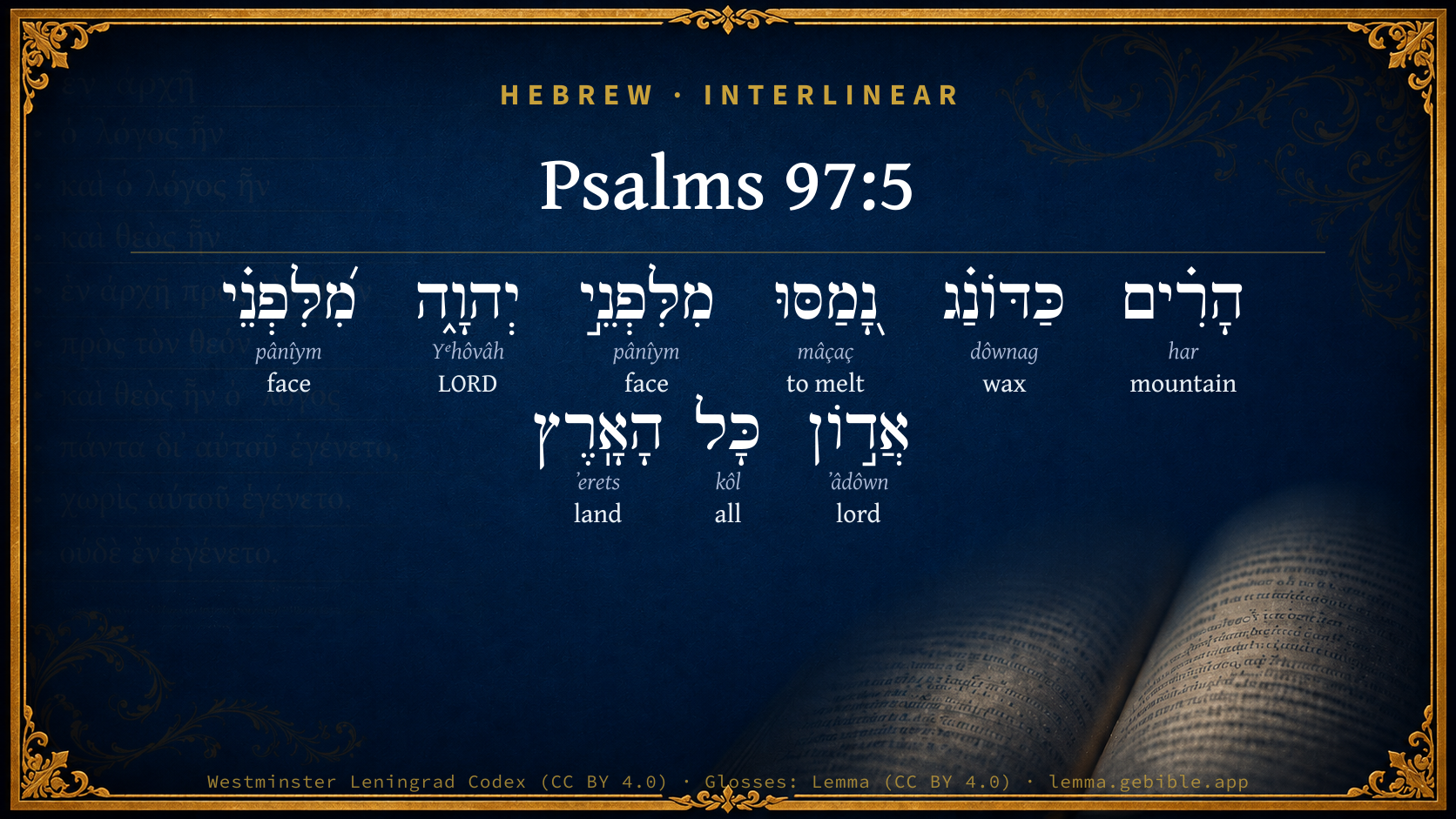
  1. הָרִ֗ים har H2022 “mountains” Noun, Common, Masculine, Plural, Absolute
  2. נָ֭מַסּוּ mâçaç H4549 “to melt” Verb, Niphal, Perfect, 3rd Person, Common, Plural
  3. מִלִּפְנֵ֣י pânîym H6440 “from · to/for · face(s) of” Preposition + Preposition + Noun, Common, Both, Plural, Construct
  4. יְהוָ֑ה Yᵉhôvâh H3068 “LORD” Noun, Proper
  5. מִ֝לִּפְנֵ֗י pânîym H6440 “from · to/for · face(s) of” Preposition + Preposition + Noun, Common, Both, Plural, Construct
  6. אֲד֣וֹן ʼâdôwn H113 “lord of” Noun, Common, Masculine, Singular, Construct
  7. כָּל kôl H3605 “all of” Noun, Common, Masculine, Singular, Construct
  8. הָאָֽרֶץ ʼerets H776 “the · land” Particle, Definite Article + Noun, Common, Both, Singular, Absolute

About this verse

These counts appear in no published source. They are computed here, from the morphology-tagged text and Lemma’s own curated glosses. What Lemma adds →

9
words
8
distinct lemmas
Wisdom
section

Notable vocabulary

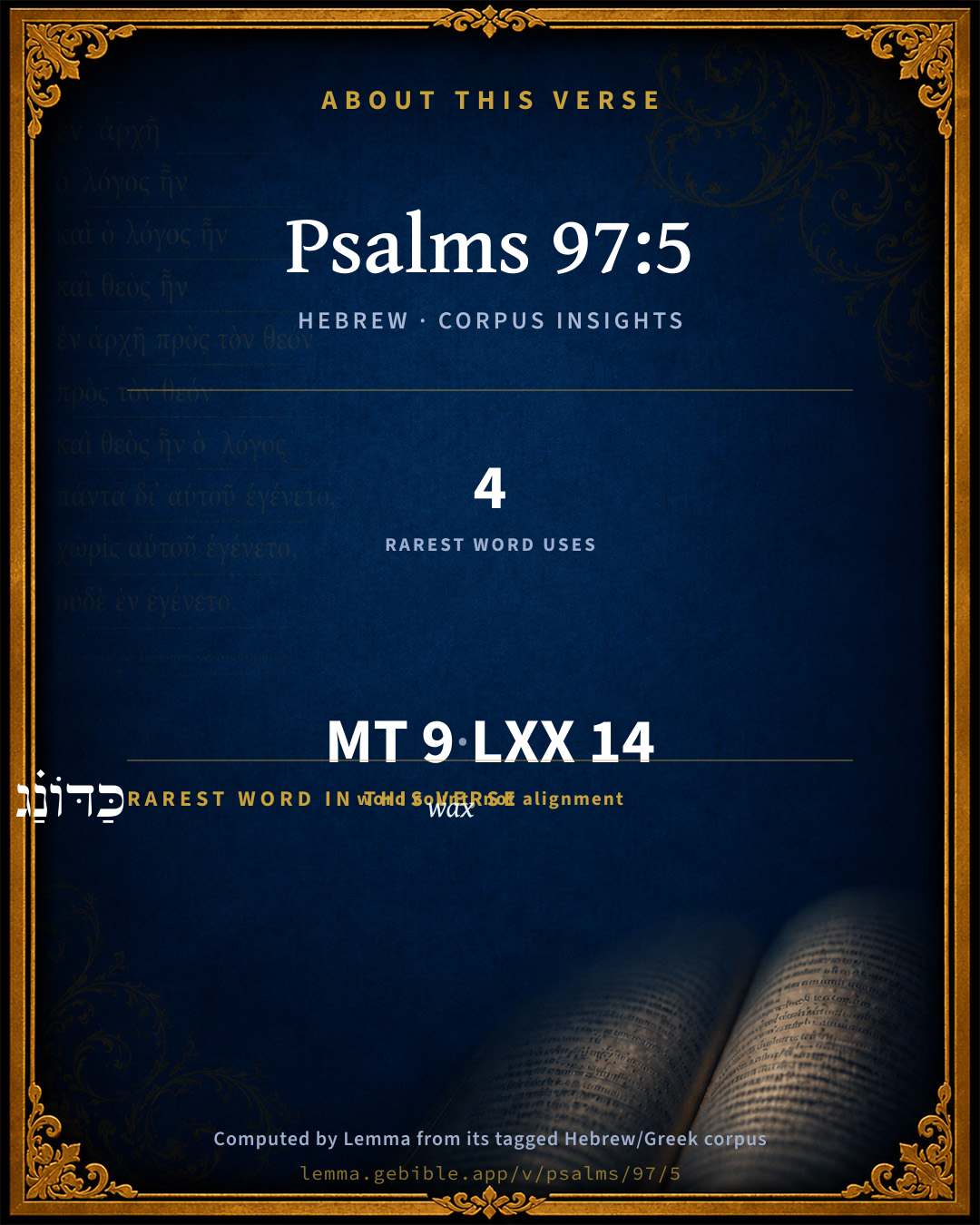
The rarest word here is כַּדּוֹנַ֗ג wax H1749 — appearing just 4 times in the whole Hebrew Bible.

Shared distinctive vocabulary

כַּדּוֹנַ֗ג wax H1749 occurs in 4 verses of the Hebrew Bible. Also found in:

Grammatical profile

  • 1 verb
  • 8 nouns

Verb forms

  • נָ֭מַסּוּ Niphal · Perfect

Repetition

A word recurs within this verse — often emphatic in Hebrew:

  • מִלִּפְנֵ֣י face H6440 ×2

Hebrew & Septuagint length

In English translation the verse runs 20 words from the Hebrew and 21 from the Septuagint (LXX English) — closely comparable.

A rough comparison of the two English renderings, which tokenize alike — not a word-level alignment.

Word counts can differ between the Hebrew and the Greek without any difference in meaning — e.g. the Hebrew direct-object marker אֵת has no separate Greek word, and Greek often adds the article ὁ.

In the original languages it is 9 Hebrew tokens and 14 Greek tokens — but the two are counted differently (Hebrew bundles its prefixes and suffixes into one token; the Greek is in lemma form), so that isn’t a like-for-like length.

Cross-references

14

Topical passages linked to Psalms 97:5 in the Treasury of Scripture Knowledge — connected by theme and wording, ordered by reader-vote popularity; previews shown in the World English Bible.

  • Nahum 1:5 The mountains quake before him, and the hills melt away. The earth trembles at his presence, yes, the world, and all who dwell in it.
  • Micah 1:3–4 For, behold, Yahweh comes forth out of his place, And will come down and tread on the high places of the earth.
  • Isaiah 24:19–20 The earth is utterly broken, the earth is torn apart, the earth is shaken violently.
  • Isaiah 64:1–2 Oh that you would tear the heavens, that you would come down, that the mountains might quake at your presence,
  • Habakkuk 3:6 He stood, and shook the earth. He looked, and made the nations tremble. The ancient mountains were crumbled. The age-old hills collapsed. His ways are eternal.
  • Psalms 47:2 For Yahweh Most High is awesome. He is a great King over all the earth.
  • Psalms 46:6 The nations raged. The kingdoms were moved. He lifted his voice, and the earth melted.
  • Joshua 3:11 Behold, the ark of the covenant of the Lord of all the earth passes over before you into the Jordan.
  • Judges 5:4–5 Yahweh, when you went forth out of Seir, When you marched out of the field of Edom, The earth trembled, the sky also dropped, Yes, the clouds dropped water.
  • Psalms 83:18 That they may know that you alone, whose name is Yahweh, Are the Most High over all the earth.
  • Micah 4:13 Arise and thresh, daughter of Zion; For I will make your horn iron, And I will make your hoofs brass; And you will beat in pieces many peoples: And I will devote their gain to Yahweh, And their substance to the Lord of the whole earth.
  • 1 Corinthians 1:2 to the assembly of God which is at Corinth; those who are sanctified in Christ Jesus, called to be saints, with all who call on the name of our Lord Jesus Christ in every place, both theirs and ours:
  • Isaiah 54:5 For your Maker is your husband; Yahweh of Hosts is his name: and the Holy One of Israel is your Redeemer; the God of the whole earth shall he be called.
  • Zechariah 4:14 Then he said, "These are the two anointed ones who stand by the Lord of the whole earth."

Cross-references courtesy of OpenBible.info (CC BY 4.0).

Hebrew and Greek witnesses Masoretic Hebrew ↔ Greek Septuagint

The same verse in the two great witnesses to the Old Testament, shown verse-for-verse.

You’re reading Greek Psalm 96 (Hebrew Psalm 97). The Septuagint counts the superscription, so verse numbers can differ from the Hebrew — chapter-level alignment, not verse-by-verse. Numbering follows Rahlfs.

These are two independent witnesses, not word-aligned to each other, and the Septuagint is shown in lemma (dictionary) form.

Hebrew Psalms 97:5 Masoretic · Westminster Leningrad Codex

הָרִ֗ים כַּדּוֹנַ֗ג נָ֭מַסּוּ מִלִּפְנֵ֣י יְהוָ֑ה מִ֝לִּפְנֵ֗י אֲד֣וֹן כָּל הָאָֽרֶץ

The mountains melt like wax at the presence of Yahweh, At the presence of the Lord of the whole earth.

World English Bible · Public Domain

Greek LXX Greek Psalm 96:5 Septuagint · lemma form

ὁ ὄρος τήκω ὡσεί κηρός ἀπό πρόσωπον κύριος ἀπό πρόσωπον κύριος πᾶς ὁ γῆ

The mountains melted like wax at the presence of the Lord, at the presence of the Lord of the whole earth.

LXX2012 (modern English Septuagint) · Public Domain

Hebrew: Westminster Leningrad Codex (CC BY 4.0). Greek: Septuagint (public domain); English from LXX2012 (modern English Septuagint) (Public Domain). How the Septuagint differs from the Hebrew →

Commentary

Notes on Psalms 97:5 from classic Christian and Jewish commentators (each source and its license shown beneath its notes). The classic Christian expositions comment on the surrounding passage and are grouped to its opening verse, so a note may address several verses; the Jewish commentaries on the Tanakh (Rashi and others) are per-verse, so they appear only where the commentator wrote on this verse.

Lemma curates 59 commentaries, every one of them public domain or Creative Commons licensed, each selected and text-cleaned for this edition rather than reprinted as found. About our sources →

Trapp's Complete Commentary

John Trapp

Psa 97:5 The hills melted like wax at the presence of the LORD, at the presence of the Lord of the whole earth.

Ver. 5. The hills melted like wax] Nothing shall be so stout and steady as to be able to stand before them.

Before the Lord] Adon, Dominator, the maker and master of all, the rightful proprietary. The Latin translation hath it, All the earth is before the face of the Lord.

John Trapp, A Commentary or Exposition upon All the Books of the Old and New Testament (1647–1656) — public domain. Text from a community e-Sword module.

J. A. Alexander on Psalms

Joseph Addison Alexander

5. (Psa 97:5) Mountains like wax are melted from before Jehovah, from before the Lord of all the earth. Compare Mic 1:4; Mic 4:13. As in all such cases, are while mountains are mentioned as the salient points of the earth, they suggest, at the same time, the idea of great states and kingdoms, of which they are a standing symbol. See above, on Psa 30:7; Psa 46:2.

Joseph Addison Alexander, The Psalms Translated and Explained (1850) — public domain. Text from a community e-Sword module.

Tyndale Open Study Notes

Tyndale Open Resources

97:5-7 The created order stirs at the coming of its King. He alone deserves worship.

Tyndale Open Study Notes — © Tyndale Open Resources, licensed CC BY-SA 4.0. Text via the HelloAO Bible API.

Adam Clarke's Commentary

Verse 5. The hills melted like wax] The fire of God seized on and liquefied them, so that they no longer opposed his march; and the mountains before him became a plain.

The Lord of the whole earth.] אדון כל הארץ adon col haarets, the Director, Stay, and Support of the whole earth. The universal Governor, whose jurisdiction is not confined to any one place; but who, having created all, governs all that he has made.

Adam Clarke's Commentary on the Bible (1810–1826) — public domain. Text from a community e-Sword/MySword module.

Ellicott's Commentary for English Readers

(5) The hills melted.—Comp. Psa_68:8, Note: Mic_1:4.

The Lord of the whole earth.—An expression first met with exactly in Jos_3:11-13, though Abraham speaks of God as judge of the whole earth (Gen_18:25). (Comp. Mic_4:13; Zec_4:10; Zec_6:5.) Though Jehovah was the tribal God, yet in marked distinction to surrounding tribes Israel regarded Him as having universal dominion.

A Bible Commentary for English Readers, edited by Charles John Ellicott (1878–1897) — public domain. Text from a community e-Sword module.

The Cambridge Bible for Schools and Colleges

gen. ed. J. J. S. Perowne

5. From Mic_1:4; Mic_4:13; cp. Zec_4:14; Zec_6:5. The dissolution of the most solid and ancient parts of the earth is the expression of its terror and the measure of His power. Cp. Hab_3:6.

The Cambridge Bible for Schools and Colleges (gen. ed. J. J. S. Perowne; Cambridge University Press, 1878–1918) — public domain. Text from a community e-Sword module.

John Gill's Exposition

The hills melted like wax at the presence of the Lord,.... Kimchi interprets the "hills" of the kings of the wicked; and it was verified in Herod and his nobles, and the citizens of Jerusalem, who, when they heard of the coming of the Messiah, of the birth of the King of the Jews, were exceedingly moved and troubled; their hearts melted like wax within them, Mat 2:1, so when he appeared, in the power of his Gospel, in the Gentile world, and went forth in the ministration of it, conquering, and to conquer, all fled before him; every mountain and island were moved out of their places; and the kings of the earth, and great men, ran to the rocks to hide them from his face, which they could not bear, Rev 6:14, and the like events, and more terrible, will they be, when he comes to destroy antichrist, and especially to judge the world, Rev 16:19.

at the presence of the Lord of the whole earth; as Christ is; he is Lord of all, the Prince of the kings of the earth, Act 10:36, Rev 1:5, and as he will show himself to be at the great day; and that is the reason why the proud and lofty, comparable to hills and mountains, shall melt at his presence.

John Gill's Exposition of the Whole Bible (1746–1763) — public domain (CC PDM 1.0). Text via the HelloAO Bible API.

Albert Barnes' Notes on the Bible

The hills melted like wax at the presence of the Lord - They seemed to flow down as if they were like melted wax: that is, they could not stand before him. The most firm, solid, lofty things were as nothing in his presence. Compare Rev 20:11; Jdg 5:5; Mic 1:4; Nah 1:5. The object here is to describe the sublimity, the greatness, the majesty of God, as if nothing could stand before him; as if everything fled away when he approached. There is perhaps a general allusion to his glory and power as manifested at Sinai.

At the presence of the Lord of the whole earth - The Creator and Ruler of the entire world. The God who thus manifested himself is not a local Deity, or the God of a particular nation or country, but the God of the whole world, before whom all created things are as nothing.

Albert Barnes' Notes on the Bible (1834–1885) — public domain. Text from a community e-Sword/MySword module.

Matthew Poole's English Annotations

The hills; the strongest and loftiest parts of the earth; whereby he may understand the great potentates of the world who set themselves against the Messias.

The Lord of the whole earth; whose dominion shall not then be confined in Canaan, as now in a manner it is, but shall be enlarged over the whole earth.

Matthew Poole's English Annotations on the Holy Bible (1683–1685) — public domain. Text from a community e-Sword/MySword module.

The Treasury of David

Charles H. Spurgeon

Ver. 5. The hills melted like wax at the presence of the LORD. Inanimate nature knows its Creator, and worships him in its own fashion. States and kingdoms which stand out upon the world like mountains are utterly dissolved when he decrees their end. Systems as ancient and firmly rooted as the hills pass away when he does but look upon them. In the Pentecostal era, and its subsequent age, this was seen on all hands, heathenism yielded at the glance of Jehovah Jesus, and the tyrannies based upon it dissolved like melted wax.

At the presence of the Lord of the whole earth. His dominion is universal, and his power is everywhere felt. Men cannot move the hills, with difficulty do they climb them, with incredible toil do they pierce their way through their fastnesses, but it is not so with the Lord, his presence makes a clear pathway, obstacles disappear, a highway is made, and that not by his hand as though it cost him pains, but by his mere presence, for power goes forth from him with a word or a glance. O for the presence of the Lord after this sort with his church at this hour! It is our one and only need. With it the mountains of difficulty would flee away, and all obstacles would disappear. O that thou wouldest rend the heavens and come down, that the mountains might flow down at thy presence, O Lord.

In the little world of our nature the presence of Jesus in reigning power is as a fire to consume our lusts and melt our souls to obedience. Sometimes we doubt the presence of the Lord within, for he is concealed with clouds, but we are again assured that he is within us when his light shines in and fills us with holy fear, while at the same time the warmth of grace softens us to penitence, resignation and obedience, even as wax becomes soft in the presence of fire.

Ver. 5. The hills melted like wax at the presence of the LORD. For a parallel passage see Mic 1:4. There the words are applied to the judgment of God about to fall on the people of the covenant: here they are applied to the judgment on the God opposing world. The fact that judgment has begun at the house of God is a token that judgments of a far more destructive kind will overtake the (openly) ungodly and sinners (1Pe 4:7). "The hills" symbolize the heights or man's self exalting pride of intellect, wealth, and power. A.R. Faussett.

Ver. 5. The Lord of the whole earth. In this title lies concealed the reason for the liquefaction of the hills, for the God who here manifests himself is he who created the earth, and is able therefore to reduce it to nothing. Martin Geier.

Ver. 5. The presence of God in the church her invincible power.

Psalms 97:6*

Charles H. Spurgeon's The Treasury of David (1869–1885) — public domain. Psalms only. Text from a community e-Sword/MySword module.

Whedon's Commentary on the Bible

Daniel D. Whedon

5. At the presence—Literally, from before the face. See, in a humbler sense, the terror of countenance, Mat_28:3-4

Daniel D. Whedon (gen. ed.), Commentary on the Old and New Testaments (1874–1909) — public domain. Text from a community e-Sword module.

The Pulpit Commentary

The hills melted like wax at the presence of the Lord. (comp. Jud_1:5:5 Isa_64:1 Mic_1:4) The earth itself is regarded as not only shaken (ver. 4), but as melting and crumbling away at the descent of God from heaven to earth. (comp. 2Pe_3:10) At the presence of the Lord of the whole earth. (comp. Jos_3:11, 13 Mic_4:13 Zec_4:14 Zec_6:5)

The Pulpit Commentary (1880–1919), ed. H.D.M. Spence-Jones & Joseph S. Exell — public domain. Text from a community e-Sword module.

Rashi

Rabbi Shlomo Yitzchaki (Rashi)

melted like wax Heb. כדונג, as it is written (Ezek. 38:20): “and the mountains will be thrown down, and the cliffs will fall.”

Rashi on the Tanakh — English translations: “The Judaica Press complete Tanach with Rashi, translated by A. J. Rosenberg” (CC BY 4.0); “Pentateuch with Rashi's commentary by M. Rosenbaum and A.M. Silbermann, 1929-1934” (public domain); “The Metsudah Tanach series, Lakewood, N.J” (CC BY 4.0); and “The Book of Joshua, Metsudah Publications, 1997” (CC BY 4.0). Text via Sefaria.

Lesson kit

Teaching starters — assembled from the data on this page, not authored interpretation. Every prompt links to the verse data it draws on. Edit before teaching.

Psalms, in the Wisdom, opens this verse with 9 words (8 distinct Hebrew lemmas). Its most distinctive word is dôwnag (“wax”). A historical commentator’s framing appears above. Read the whole chapter for the surrounding context.

Discussion questions

  1. The word dôwnag carries the sense “wax.” How does it shape the verse?
  2. How does Psalms 22:14, which shares the word «wax», read alongside this verse?
  3. What does the repetition of “face” (2× in this one verse) do in this verse?
  4. These translations render this verse differently; the difference is in the English rendering, not the original. What questions does that raise?
  5. «נָ֭מַסּוּ» is a Niphal Perfect verb. How does that grammatical form shape the action described?
  6. Compare how Trapp's Complete Commentary and J. A. Alexander on Psalms read this verse. Where do they agree or differ?

Things to notice

Reading settings

Reading text

Shown beneath each verse's original-language words.

Old Testament
Old Testament edition

Read the OT as the Masoretic Hebrew (MT) or the Greek Septuagint (LXX).

English shown for the Greek Septuagint (in the Hebrew ↔ Greek comparison).

Comparing translations? Open the Compare panel on any verse page to stack up to four side by side.