
Zechariah 4:14

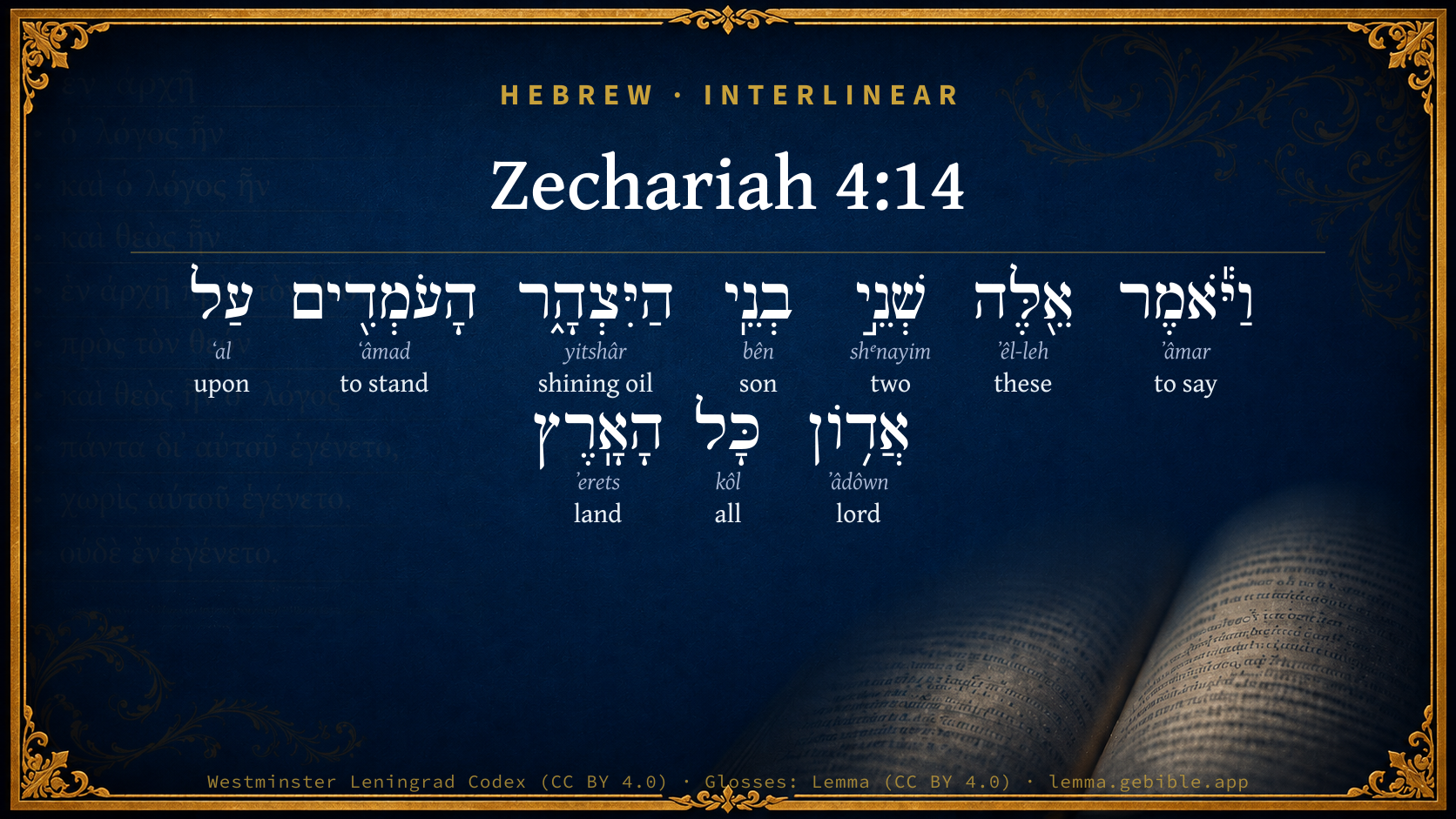
Hebrew (Westminster Leningrad Codex) Zechariah 4:14 appears in the Hebrew Old Testament. The text above is from the Westminster Leningrad Codex. Each word links to its Strong’s number, a concise gloss, and parsing drawn from the Open Scriptures Hebrew Bible morphology. Click any word for its full Brown-Driver-Briggs (BDB) entry.
Download image
Cite this verse

Zechariah 4:14 (World English Bible). Public Domain. Lemma interlinear Bible study tool, https://lemma.gebible.app/v/zechariah/4/14.

Show BibTeX & RIS
BibTeX
RIS
English Translation
Then he said, "These are the two anointed ones who stand by the Lord of the whole earth."
World English Bible · Public Domain
Download a study sheet

One document with this verse’s original text, its word-by-word gloss line, the meaning frame, cross-references with their text, attributed commentary, and full source and license credits — printable, and it pastes into notes with its structure intact.

This verse Autodidact and up

Study sheet (.html) Plain text (.txt)

A passage Seminary Student

Up to 50 verses in one chapter. A passage sheet keeps up to 6 commentary sources and 12 cross-references per verse, in the order this page ranks them, and says so on the sheet whenever that leaves anything out. Ask for a single verse and you get the Autodidact verse sheet above.

Everything on this page stays free to read, with no account — the sheet is a download of what is already on screen, not access to it.

Want to remove ads? Support Godless Engineer
Compare translations 3

The same verse in 3 English versions, stacked beneath the original-language interlinear above. Click any original word for its lexicon entry.

Each is an independent rendering of the whole verse — the interlinear is not word-aligned to these translations.

Highlighted words mark where these versions differ — a whole-verse word diff, not a word-by-word alignment.

  • World English Bible Public Domain
    Then he said, "These are the two anointed ones who stand by the Lord of the whole earth."
  • King James Version Public Domain
    Then said he, These are the two anointed ones, that stand by the LORD of the whole earth.
  • unfoldingWord Literal Text CC BY-SA 4.0
    And he said, “These are the two sons of the fresh oil, the ones standing before the Lord of all of the earth.”

unfoldingWord Literal Text — © unfoldingWord, licensed CC BY-SA 4.0. Word-aligned USFM3 via Door43 (git.door43.org/unfoldingWord/en_ult).

Versions to compare (up to 4)

3 of 4 selected

Show all 18 translations

Every available English version of this verse, each an independent rendering of the whole verse.

  • World English Bible Public Domain
    Then he said, "These are the two anointed ones who stand by the Lord of the whole earth."
  • Berean Standard Bible Public Domain
    So he said, “These are the two anointed ones who are standing beside the Lord of all the earth.”
  • Majority Standard Bible Public Domain
    So he said, “These are the two anointed ones who are standing beside the Lord of all the earth.”
  • King James Version Public Domain
    Then said he, These are the two anointed ones, that stand by the LORD of the whole earth.
  • American Standard Version (1901) Public Domain
    Then said he, These are the two anointed ones, that stand by the Lord of the whole earth.
  • Revised Version (1885) Public Domain
    Then said he, These are the two sons of oil, that stand by the Lord of the whole earth.
  • Geneva Bible (1599) Public Domain
    Then said he, These are the two oliue branches, that stand with the ruler of the whole earth.
  • Douay-Rheims (1899) Public Domain
    And he said: These are two sons of oil who stand before the Lord of the whole earth.
  • Young's Literal Translation Public Domain
    And he saith, `These `are' the two sons of the oil, who are standing by the Lord of the whole earth.'
  • Literal Standard Version CC BY-SA 4.0
    And he says, “These [are] the two sons of the oil, who are standing by the Lord of the whole earth.”
  • Unlocked Literal Bible CC BY-SA 4.0
    So he said, “These are the sons of fresh olive oil who stand before the Lord of all the earth.”
  • unfoldingWord Literal Text CC BY-SA 4.0
    And he said, “These are the two sons of the fresh oil, the ones standing before the Lord of all of the earth.”
  • Darby Bible Public Domain
    And he said, These are the two sons of oil, that stand before the Lord of the whole earth.
  • World Messianic Bible Public Domain
    Then he said, “These are the two anointed ones who stand by the Lord of the whole earth.”
  • Webster's Bible Public Domain
    Then said he, These are the two anointed ones, that stand by the Lord of the whole earth.
  • Free Bible Version CC BY-SA 4.0
    “These are the two who have been anointed who stand by the Lord of all the earth,” he replied.
  • Bible in Basic English Public Domain
    And he said, These are the two sons of oil, whose place is by the Lord of all the earth.
  • JPS Tanakh (1917) Public Domain
    Then said he: 'These are the two anointed ones, that stand by the Lord of the whole earth.'

Literal Standard Version (2020), Covenant Press — licensed CC BY-SA 4.0. Text via the HelloAO Bible API (eBible.org). Unlocked Literal Bible (unfoldingWord) — licensed CC BY-SA 4.0. Text via the HelloAO Bible API (eBible.org). unfoldingWord Literal Text — © unfoldingWord, licensed CC BY-SA 4.0. Word-aligned USFM3 via Door43 (git.door43.org/unfoldingWord/en_ult). Free Bible Version, Dr. Jonathan Gallagher — licensed CC BY-SA 4.0. Text via the HelloAO Bible API (eBible.org).

Word by word

More ways to search: Search by grammar → Find every occurrence → Compare this word →

Practice this passage: Drill this verse → Learn its vocabulary →

הַיִּצְהָ֑ר
yitshâr
H3323
“the · shining oil”
Particle, Definite Article + Noun, Common, Masculine, Singular, Absolute
Part of Speech
Particle + Noun
Type
Common
Gender
Masculine
Number
Singular
State
Absolute
Full BDB Definition

Origin: from H6671

TWOT: 1883c

fresh oil, shining (pure) oil
  1. וַיֹּ֕אמֶר ʼâmar H559 “and · to say” Conjunction + Verb, Qal, Sequential Imperfect, 3rd Person, Masculine, Singular
  2. אֵ֖לֶּה ʼêl-leh H428 “these” Pronoun, Demonstrative, Common, Plural
  3. שְׁנֵ֣י shᵉnayim H8147 “two” Adjective, Cardinal number, Masculine, Dual, Construct
  4. בְנֵֽי bên H1121 “sons of” Noun, Common, Masculine, Plural, Construct
  5. הָעֹמְדִ֖ים ʻâmad H5975 “the · standing” Particle, Definite Article + Verb, Qal, Participle Active, Masculine, Plural, Absolute
  6. עַל ʻal H5921 “upon” Preposition
  7. אֲד֥וֹן ʼâdôwn H113 “lord of” Noun, Common, Masculine, Singular, Construct
  8. כָּל kôl H3605 “all of” Noun, Common, Masculine, Singular, Construct
  9. הָאָֽרֶץ ʼerets H776 “the · land” Particle, Definite Article + Noun, Common, Both, Singular, Absolute

About this verse

These counts appear in no published source. They are computed here, from the morphology-tagged text and Lemma’s own curated glosses. What Lemma adds →

10
words
10
distinct lemmas
Prophets
section

Notable vocabulary

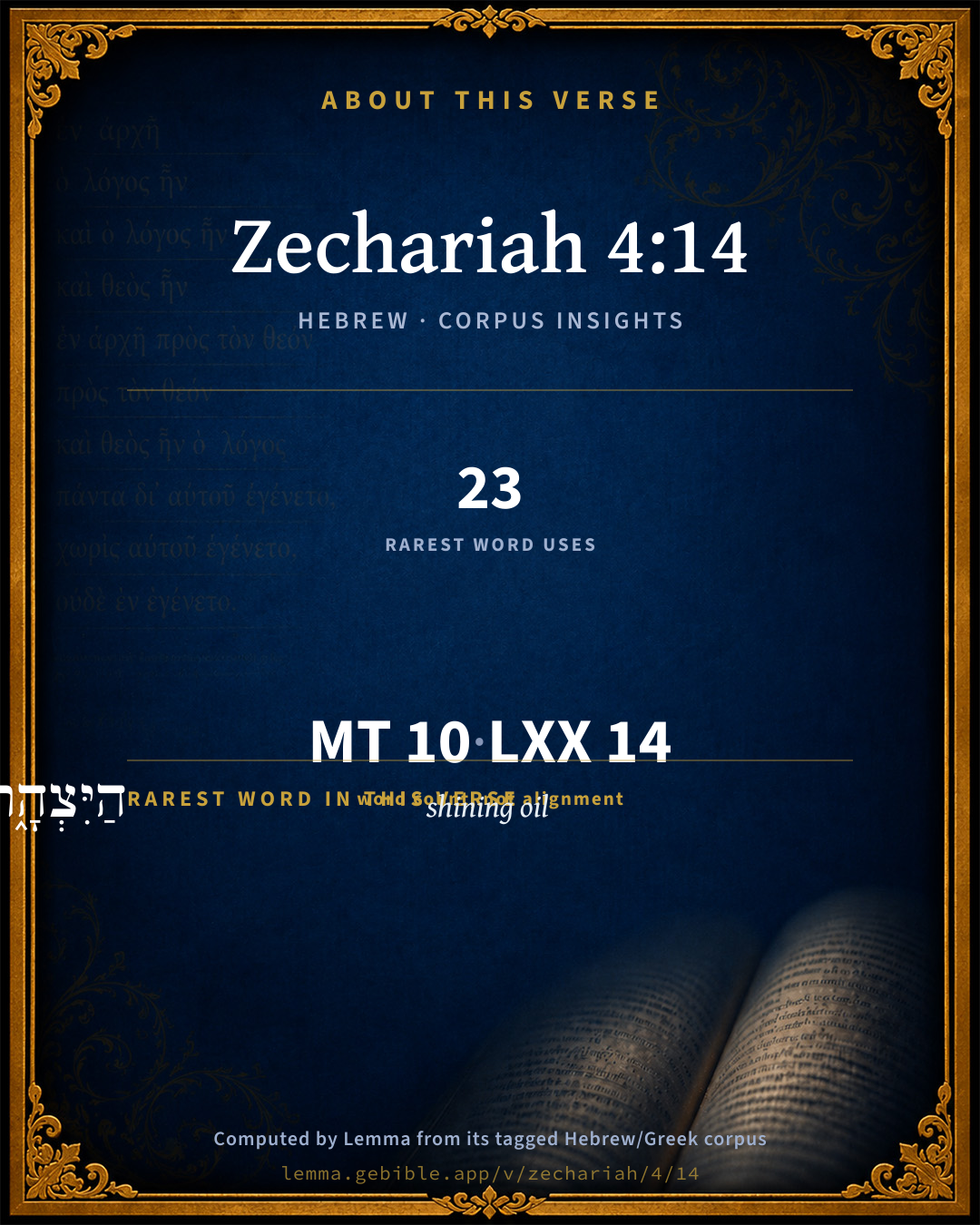
The rarest word here is הַיִּצְהָ֑ר shining oil H3323 — appearing just 23 times in the whole Hebrew Bible.

Shared distinctive vocabulary

הַיִּצְהָ֑ר shining oil H3323 occurs in 23 verses of the Hebrew Bible. Also found in:

Grammatical profile

  • 2 verbs
  • 5 nouns
  • 1 adjective
  • 1 pronoun
  • 1 preposition

Verb forms

  • וַיֹּ֕אמֶר Qal · Sequential Imperfect
  • הָעֹמְדִ֖ים Qal · Participle Active

Hebrew & Septuagint length

In English translation the verse runs 18 words from the Hebrew and 18 from the Septuagint (LXX English) — the same length.

A rough comparison of the two English renderings, which tokenize alike — not a word-level alignment.

Word counts can differ between the Hebrew and the Greek without any difference in meaning — e.g. the Hebrew direct-object marker אֵת has no separate Greek word, and Greek often adds the article ὁ.

In the original languages it is 10 Hebrew tokens and 14 Greek tokens — but the two are counted differently (Hebrew bundles its prefixes and suffixes into one token; the Greek is in lemma form), so that isn’t a like-for-like length.

Cross-references

27

Topical passages linked to Zechariah 4:14 in the Treasury of Scripture Knowledge — connected by theme and wording, ordered by reader-vote popularity; previews shown in the World English Bible.

  • Revelation 11:4 These are the two olive trees and the two lampstands, standing before the Lord of the earth.
  • Isaiah 61:1–3 The Spirit of the Lord Yahweh is on me; because Yahweh has anointed me to preach good news to the humble; he has sent me to bind up the broken-hearted, to proclaim liberty to the captives, and the opening [of the prison] to those who are bound;
  • Exodus 40:15 You shall anoint them, as you anointed their father, that they may minister to me in the priest's office. Their anointing shall be to them for an everlasting priesthood throughout their generations.
  • Daniel 9:24–26 Seventy weeks are decreed on your people and on your holy city, to finish disobedience, and to make an end of sins, and to make reconciliation for iniquity, and to bring in everlasting righteousness, and to seal up vision and prophecy, and to anoint the most holy.
  • Zechariah 3:1–7 He showed me Joshua the high priest standing before the angel of Yahweh, and Satan standing at his right hand to be his adversary.
  • Zechariah 6:13 even he shall build the temple of Yahweh; and he shall bear the glory, and shall sit and rule on his throne; and he shall be a priest on his throne; and the counsel of peace shall be between them both.
  • Exodus 29:7 Then you shall take the anointing oil, and pour it on his head, and anoint him.
  • Deuteronomy 10:8 At that time Yahweh set apart the tribe of Levi, to bear the ark of the covenant of Yahweh, to stand before Yahweh to minister to him, and to bless in his name, to this day.
  • Joshua 3:11 Behold, the ark of the covenant of the Lord of all the earth passes over before you into the Jordan.
  • 1 Samuel 10:1 Then Samuel took the vial of oil, and poured it on his head, and kissed him, and said, Isn't it that Yahweh has anointed you to be prince over his inheritance?
  • 1 Samuel 16:1 Yahweh said to Samuel, How long will you mourn for Saul, seeing I have rejected him from being king over Israel? fill your horn with oil, and go: I will send you to Jesse the Bethlehemite; for I have provided me a king among his sons.
  • 1 Samuel 16:12–13 He sent, and brought him in. Now he was ruddy, and withal of a beautiful face, and goodly to look on. Yahweh said, Arise, anoint him; for this is he.
  • Jeremiah 49:19 Behold, he shall come up like a lion from the pride of the Jordan against the strong habitation: for I will suddenly make them run away from it; and whoever is chosen, him will I appoint over it: for who is like me? and who will appoint me a time? and who is the shepherd who will stand before me?
  • Micah 4:13 Arise and thresh, daughter of Zion; For I will make your horn iron, And I will make your hoofs brass; And you will beat in pieces many peoples: And I will devote their gain to Yahweh, And their substance to the Lord of the whole earth.
  • Hebrews 1:8–9 but of the Son he says, "Your throne, O God, is forever and ever; The scepter of uprightness is the scepter of your Kingdom.
  • Leviticus 8:12 He poured some of the anointing oil on Aaron's head, and anointed him, to sanctify him.
  • Joshua 3:13 It shall come to pass, when the soles of the feet of the priests who bear the ark of Yahweh, the Lord of all the earth, shall rest in the waters of the Jordan, that the waters of the Jordan shall be cut off, even the waters that come down from above; and they shall stand in one heap.
  • 1 Kings 17:1 Elijah the Tishbite, who was of the foreigners of Gilead, said to Ahab, As Yahweh, the God of Israel, lives, before whom I stand, there shall not be dew nor rain these years, but according to my word.
  • Psalms 2:6 "Yet I have set my king on my holy hill of Zion."
  • Psalms 89:20 I have found David, my servant. I have anointed him with my holy oil,
  • Psalms 110:4 Yahweh has sworn, and will not change his mind: "You are a priest forever in the order of Melchizedek."
  • Isaiah 5:1 Let me sing for my well beloved a song of my beloved about his vineyard. My beloved had a vineyard on a very fruitful hill.
  • Isaiah 54:5 For your Maker is your husband; Yahweh of Hosts is his name: and the Holy One of Israel is your Redeemer; the God of the whole earth shall he be called.
  • Haggai 1:1–12 In the second year of Darius the king, in the sixth month, in the first day of the month, the Word of Yahweh came by Haggai, the prophet, to Zerubbabel, the son of Shealtiel, governor of Judah, and to Joshua, the son of Jehozadak, the high priest, saying,
  • Zechariah 6:5 The angel answered me, "These are the four winds of the sky, which go forth from standing before the Lord of all the earth.
  • Luke 1:19 The angel answered him, "I am Gabriel, who stands in the presence of God. I was sent to speak to you, and to bring you this good news.
  • Hebrews 7:1–2 For this Melchizedek, king of Salem, priest of God Most High, who met Abraham returning from the slaughter of the kings and blessed him,

Cross-references courtesy of OpenBible.info (CC BY 4.0).

Hebrew and Greek witnesses Masoretic Hebrew ↔ Greek Septuagint

The same verse in the two great witnesses to the Old Testament, shown verse-for-verse.

These are two independent witnesses, not word-aligned to each other, and the Septuagint is shown in lemma (dictionary) form.

Hebrew Zechariah 4:14 Masoretic · Westminster Leningrad Codex

וַיֹּ֕אמֶר אֵ֖לֶּה שְׁנֵ֣י בְנֵֽי הַיִּצְהָ֑ר הָעֹמְדִ֖ים עַל אֲד֥וֹן כָּל הָאָֽרֶץ

Then he said, "These are the two anointed ones who stand by the Lord of the whole earth."

World English Bible · Public Domain

Greek LXX Zechariah 4:14 Septuagint · lemma form

καί εἶπον οὗτος ὁ δύο υἱός ὁ πιότης παραἵστημι ὁ κύριος πᾶς ὁ γῆ

And he said, These are the two anointed ones that stand by the Lord of the whole earth.

LXX2012 (modern English Septuagint) · Public Domain

On this verse, Haydock's Catholic Bible Commentary discusses the Septuagint’s reading. Read the note in Commentary ↓

Hebrew: Westminster Leningrad Codex (CC BY 4.0). Greek: Septuagint (public domain); English from LXX2012 (modern English Septuagint) (Public Domain). How the Septuagint differs from the Hebrew →

Targum (Aramaic paraphrase)

1

The Targum is the ancient Jewish Aramaic paraphrase of the Hebrew Scriptures — an interpretive translation, not the Hebrew text itself. Onkelos (literal) and Pseudo-Jonathan (expansive) render the Torah, and Jonathan the Prophets. Coverage is partial: where no permissively-licensed English translation exists for a verse, only the Aramaic is shown. This is verse-level text, not a word-by-word alignment to the Hebrew.

  1. Targum Jonathan Prophets (Joshua–Malachi)
    וַאֲמַר אִלֵין תְּרֵין בְנֵי רַבְרְבַיָא דְקַיְמִין קֳדָם רִבּוֹן כָּל אַרְעָא:

    (no public-domain English translation for this verse)

    Targum Jonathan — Aramaic: “Mikraot Gedolot” (public domain). English: “Sefaria Community Translation” (CC0 1.0 (public-domain dedication)); “London "Chaldee Paraphrase," 1871” (public domain). Text via Sefaria.

Commentary

Notes on Zechariah 4:14 from classic Christian and Jewish commentators (each source and its license shown beneath its notes). The classic Christian expositions comment on the surrounding passage and are grouped to its opening verse, so a note may address several verses; the Jewish commentaries on the Tanakh (Rashi and others) are per-verse, so they appear only where the commentator wrote on this verse.

Lemma curates 59 commentaries, every one of them public domain or Creative Commons licensed, each selected and text-cleaned for this edition rather than reprinted as found. About our sources →

Trapp's Complete Commentary

John Trapp

Zec 4:14 Then said he, These [are] the two anointed ones, that stand by the Lord of the whole earth.

Ver. 14. These are the two anointed ones] Heb. sons of oil. {See Trapp on "Zec 4:7"}

That stand by the Lord of the whole earth] Because by the candlestick and utensils of the temple and type of the Church, which is at Christ’s right hand, Psa 45:4. as he at his Father’s right hand, Rom 8:34. He is with all his to the end of the world; and it is a part of his joy that we shall be one day where he is. This Lord of the whole earth, sovereign over all; but takes delight only in such as (Esther like) he purifies and perfumes for royal use; and these he loveth so affectionately as never any Lord did his subjects, Zec 3:1-7 "He loves the gates of Zion more than all the dwellings of Jacob," Psa 87:2.

John Trapp, A Commentary or Exposition upon All the Books of the Old and New Testament (1647–1656) — public domain. Text from a community e-Sword module.

Albert Barnes' Notes on the Bible

These are the two sons of oil - Probably not as themselves anointed, (for another word is used for this. Which stand by the Lord of the whole earth, as His servants and ministers. The candlestick is almost authoritatively interpreted for us, by the adoption of the symbol in the Revelation, where our Lord is exhibited “as walking in the midst of the seven golden candlesticks” Rev 1:13; Rev 2:1, and, it is said, “the seven candlesticks are the seven Churches” Rev 1:20; and our Lord says to the Apostles, on whom He founded the Church; “Ye are the light of the world: men light a candle, and put it on a candlestick, and it giveth light to them that are in the house” (Mat 5:14-15, compare Phi 2:15). Cyril: “The golden candlestick is the Church, as being honored in the world, most bright in virtues, raised on high exceedingly by the doctrines of the true knowledge of God. But there are seven lamps, having light, not of their own, but brought to them from without, and nourished by the supplies through the olive tree. These signify the holy apostles, evangelists, and those who, each in their season, were teachers of the churches, receiving, like lamps, into their mind and heart the illumination from Christ, which is nourished by the supplies of the Spirit, casting forth light to those who are in the house.”

Theodoret: “The pipes of the lamps, which pour in the oil, signify the unstinted prodigality of the loving-kindness of God to man.” The most difficult of explanation (as is plain from the variety of interpretations) is this last symbol of the spikes of the olive-tree, through whom flows the oil of the Holy Spirit to the candlesticks, and which yet represent created beings, ministers, and servants of God. Perhaps it represents that, in the church, grace is ministered through men, as Paul says, “Unto every one of us is given grace according to the measure of the gift of Christ. Wherefore he saith, when He ascended up on high, He led captivity captive and gave gifts unto men. And He gave some, apostles; and some, prophets; and some, evangelists; and some, pastor’s and teachers, for the perfecting of the saints, for the work of the ministry, for the edifying of the body of Christ - that we - may grow up into Him in all things which is the Head, even Christ, from whom the whole body, fitly joined together and compacted by that which every joint supplieth, according to the effectual working in the measure of every part, maketh increase of the body unto the edifying of itself in love” Eph 4:7-8, Eph 4:11-12, Eph 4:14-16.

What Paul expresses by “all the body, having nourishment ministered and being knit together by joints and bands, from the Head, and so increasing with the increase of God” Col 2:19, (as he elsewhere speaks of “the ministration of the Spirit” 2Co 3:8; “he that ministereth to you the Spirit” Gal 3:5) “that” Zechariah may express by the oil being poured, through the living tubes, the bowl, the sevenfold pipes, into the lamps, which shone with the God-given light. So Paul speaks again, of “having this treasure in earthen vessels” 2Co 4:7. Joshua and Zerubbabel, as representatives of the priestly and royal offices, shadowed forth what was united in Christ, and so, in their several offices, they might be included in the symbol of the olive-tree, they could not exhaust it; for people who, having served God in their generation, were to pass away, could not be alone intended in a vision, which describes the abiding being of the church.

Osorius: “Christ is both all-holy Priest and supreme eternal King. In both ways He supplies to us the light which He brought. For from Him piety and righteousness flow unceasingly to the Church, that it never lack the heavenly light. The oil is expressed into tubes; thence passed through pipes into the vessel which contains the lamps; to designate the various suppliers of light, which, the nearer they are to the effluence of the oil, the more they resemble Him by whom they are appointed to so divine an office. The seven lamps are the manifold Churches, distinct in place but most closely bound together by the consent of one faith and by the bond of charity. For although the Church is one, yet it is distinct according to the manifold variety of nations. They are said to be seven, both on account of the seven gifts of the Spirit, mentioned by Isaiah, and because in the numbers 3 and 4, is contained an emblem of piety and righteousness. There are 7 pipes to each lamp, to signify that each has need of many instruments, that the light may be maintained longer. For as there are diversities of gifts, so must there needs be the functions of many ministers, to complete one work. But the lamps are set in a circle, that the oil of one may flow more readily into others, and it, in turn, may receive from others their superabundance, to set forth the communion of love and the indissoluble community of faith.”

Albert Barnes' Notes on the Bible (1834–1885) — public domain. Text from a community e-Sword/MySword module.

Tyndale Open Study Notes

Tyndale Open Resources

4:14 two anointed ones: Jeshua and Zerubbabel, the religious and civic leaders of Jerusalem after the return from exile (3:1, 7; 4:6-7; Hag 1:14; 2:2-3), were anointed with oil as part of their commissioning. Under their leadership, the Temple of the Lord was rebuilt and worship was restored in Jerusalem.

Tyndale Open Study Notes — © Tyndale Open Resources, licensed CC BY-SA 4.0. Text via the HelloAO Bible API.

Geneva Bible (1599)

Geneva Bible translators

Which were ever green and full of oil, so that still they poured forth oil into the lamps: signifying, that God will continually maintain and preserve his Church, and endue it still with abundance and perfection of grace.

Geneva Bible (1599) marginal notes — public domain. Text via Bolls.life.

Jamieson, Fausset & Brown

Robert Jamieson, A. R. Fausset & David Brown

anointed ones--literally, "sons of oil" (Isa 5:1, Margin). Joshua the high priest, and Zerubbabel the civil ruler, must first be anointed with grace themselves, so as to be the instruments of furnishing it to others (compare Jo1 2:20, Jo1 2:27).

Next: Zechariah Chapter 5

Jamieson, Fausset & Brown — Commentary Critical and Explanatory on the Whole Bible (1871) — public domain (CC PDM 1.0). Text via the HelloAO Bible API.

Adam Clarke's Commentary

Verse 14. These are the two anointed ones] Joshua, the high priest; and Zerubbabel the governor. These are anointed-appointed by the Lord; and stand by him, the one to minister in the ecclesiastical, the other in the civil state.

Probably we may not be able to comprehend the whole of this hieroglyphical vision; for even the interpreting angel does not choose to answer the questions relative to this, which were put to him by the prophet. See Zec 4:4; Zec 4:11. But though the particulars are hard to be understood; yet the general meaning has, I hope, been given.

Adam Clarke's Commentary on the Bible (1810–1826) — public domain. Text from a community e-Sword/MySword module.

John Calvin's Commentaries

I come now to the answers of the angel, These are the two sons of oil. Some understand by the two sons of oil a king and a priest; but this is by no means suitable. There is no doubt but that he calls the perpetual flowing the two sons of oil; as though he had said, that it could not possibly be that the grace of God should ever fail to preserve the Church, as God possesses all abundance, and bids his grace so to flow, as that its abundance should never be diminished.

He therefore says, that they stand with the Lord of the whole earth: for על, ol, sometimes means with, and sometimes concerning; but I prefer taking its simple meaning; therefore, stand do the sons of oil with the Lord. Some render, “nigh the Lord,” but improperly; for they pervert the Prophet’s meaning, inasmuch as the angel means that these two sons of oil stood with God, as though he had said, that there is such fullness of grace in God, that it could never be exhausted. Though then the oil flowed, it would yet be sufficient to replenish the seven lamps, that is, fully; so that God would raise up his Church, preserve it safe, and lead it to the highest perfection. Hence God is not so poor but that he can continually supply as much grace as will be sufficient for the preservation of his Church. How so? because there are two sons of oil, that is, two continual flowing from him, so that the faithful shall really find, that when they are enriched by the gifts of God, they are in no danger of being in want. This is the meaning.

John Calvin's Commentaries (1540-1563) — public domain. Text from the Calvin Translation Society English edition (1840s-50s) via the Christian Classics Ethereal Library (ccel.org). Calvin's coverage is partial (roughly two-thirds of the Bible); uncommented books and verses are honest gaps, never fabricated. The 19th-century editor's footnotes and remarks are omitted so the notes are faithfully Calvin's own voice.

Ellicott's Commentary for English Readers

(14) Two anointed ones.—Literally, as margin, two sons of oil: viz., Joshua, the high priest, and Zerubbabel, the Prince of Judah, “who stand by the Lord of the whole earth” as His appointed instruments, and through whom He causes His Spirit to flow to His congregation. Thus, as by the preceding vision it was signified that the religious head of the nation was accepted by God and purified, so in this vision the civil head receives the assurance of God’s assistance in his work. The anointed priest and the anointed prince are mentioned together in the last verse to show that it is by their joint efforts that the prosperity of the nation is to be brought about. It shows too that “in religious development, outward or inward, the efficient cause always lies behind what is seen. God uses human instruments, and rarely, if ever, operates independently of them, but when they effect their aim, the power comes from above” (Chambers).

A Bible Commentary for English Readers, edited by Charles John Ellicott (1878–1897) — public domain. Text from a community e-Sword module.

The Cambridge Bible for Schools and Colleges

gen. ed. J. J. S. Perowne

14. the two anointed ones] Rather, sons of oil (as in R. V.). “Probably not as themselves anointed (for another word is used for this, and the whole vision has turned on the use of oil as an instrument of light, not of anointing) but as themselves abundantly ministering the stream which is the source of light.” Pusey, who compares the expression “son of oil,” i.e. fertile in producing oil, Isa_5:1. The reference here is generally supposed to be to Zerubbabel and Joshua, as representing the kingly and priestly offices, the channels through which God supplies His Church. It may be doubted, however, whether the angel does not purposely avoid giving a definite, and especially a human meaning to these symbols. The tenor of the whole vision is, “by My Spirit, saith the Lord of hosts.” These “sons of oil,” then, are agents or agencies, near to God and beyond our ken, “that stand by the Lord of the whole earth.” With this view would seem to accord the fact, that the two mysterious “Witnesses,” in the Book of Revelation (Zec_11:4), are spoken of as being “the two olive trees … standing before the God of the earth”; with an obvious reference to Zechariah’s vision.

The Cambridge Bible for Schools and Colleges (gen. ed. J. J. S. Perowne; Cambridge University Press, 1878–1918) — public domain. Text from a community e-Sword module.

Haydock's Catholic Bible Commentary

Two sons of oil. That is, the two anointed ones of the Lord; viz., Jesus, the high priest, and Zorobabel, the prince. (Challoner) --- The Hebrews have hot many adjectives. Thus they say, the son of perdition, for the lost son. Septuagint, "sons of fatness." Aquila and Theodotion, "of splendour;" two illustrious personages. (Haydock) --- One was head in religious, the other in civil matters. (Calmet) --- Both were appointed by God, and co-operated for the welfare of the people, as the church and state ought to act for the common good, and assist each other. (Haydock) --- Jesus and Zorobabel were to repair the damage done by the Chaldeans. They were assisted by the seven administering spirits, Hebrews i. 14. (Calmet)

George Leo Haydock (1774–1849), Haydock's Catholic Family Bible and Commentary, 1859 edition — public domain. Excludes Psalms (Douay-Rheims chapter numbering differs from Protestant) and Deuterocanonical books (Catholic canon only).

Matthew Poole's English Annotations

Not Enoch and Elias, nor the two witnesses, nor Peter and Paul, nor the two churches of Jew and Gentile; nor principally Zerubbabel and Joshua, though perhaps the exposition may glance upon them, and the two orders, magistracy and ministry, in them; as these are types of Christ in his two offices. King and Priest, or Christ and the Comforter: in this I determine nothing.

Matthew Poole's English Annotations on the Holy Bible (1683–1685) — public domain. Text from a community e-Sword/MySword module.

The Pulpit Commentary

The two anointed ones; literally, the two sons of oil; so the Revised Version; Vulgate, filii olei; Septuagint, uioi thv piothtov , "sons of fatness". (comp. Isa_5:1) By them are intended the two powers,the regal and the sacerdotal, through which God"s help and protection are dispensed to the theocracy. Oil was used in appointing to both these offices. (comp. Lev_21:10 1Sa_10:1) The expression, "son of," in many cases denotes a quality or property, like "son of Belial," "son of might;" so here Dr. Alexander considers that "sons of oil" means people possessed of oil, oil bearers, channels through which the oil flowed to others. Zerubbabel and Joshua are representatives of the civil and priestly authorities, but the text seems expressly to avoid naming any human agents, in order to show that the symbol must not be limited to individuals. Nor, indeed, must it be confined to the Jewish Church and state; it looks forward to the time when Jew and Gentile shall unite in upholding the Church of God. That stand by the Lord of the whole earth; i.e. ready as his ministers to do him service. There is a reference to this passage in Rev_11:4, where the "two witnesses" are called "the two olive trees..., standing Before the Lord of the earth" (Perowne). The vision, as we have seen, prefigures primarily the completion of the temple and the restoration of its worship, and secondly the establishment of the Christian Church by the advent of Messiah. The several parts of the vision may be thus explained. The candelabrum is a symbol of the Jewish Church and theocracy, in accordance with the imagery in the Apocalypse, where the seven candlesticks are seven Churches. (Rev_1:20) It is made of gold as precious in God"s sight, and to be kept pure and unalloyed; it is placed in the sanctuary, and has seven lamps, to indicate that it is bright with the grace of God, and is meant to shed its light around at all times, as Christian men are bidden to shine like lights in the world. (Mat_5:16 Php_2:15) The oil that supplies the lamps is the grace of God, the influence of the Holy Spirit, which alone enables the Church to shine and to accomplish its appointed work. The two olive trees are the two authorities, viz. the civil and sacerdotal, through which God communicates his grace to the Church; these stand by the Lord Because, instituted by him, they carry out his will in the ordering, guiding, extending, and purifying his kingdom among men. The two olive branches remit their oil into one receptacle, because the two authorities, the regal and priestly, are intimately connected and united, and their action tends to one end, the promotion of God"s glory in the salvation of men. In Messiah these offices are united; he is the channel of Divine grace, the source of light to the whole world.

The Pulpit Commentary (1880–1919), ed. H.D.M. Spence-Jones & Joseph S. Exell — public domain. Text from a community e-Sword module.

John Wesley's Explanatory Notes

The two anointed ones - Christ and the Holy Spirit. The Son was to be sent by the Father, and so was the Holy Ghost. And they stand by him, ready to go.

John Wesley, Explanatory Notes Upon the Whole Bible (1754–1765) — public domain. Text via the GEBible commentary corpus.

unfoldingWord translationNotes

Door43 World Missions Community

These are the sons of fresh olive oil

The branches symbolize these people, but they are not literally the people. AT: "These two branches represent the sons of fresh olive oil" (See: Symbolic Language)

the sons of fresh olive oil

This idiom means that these men have been anointed with fresh olive oil. A person who is anointed is one whom Yahweh has chosen or appointed for a special duty. AT: "the anointed men" or "the men whom Yahweh has appointed" (See: Idiom)

who stand before the Lord

The idiom "stand before" means to be in a person's presence and to serve him. AT: "who serve the Lord" (See: Idiom)

translationWords

lord

unfoldingWord translationNotes — © Distant Shores Media and the Door43 World Missions Community, licensed CC BY-SA 4.0. Source: git.door43.org/Door43/en_tn.

Rashi

Rabbi Shlomo Yitzchaki (Rashi)

two anointed ones The horns of the priesthood and the kingdom who are anointed with the anointing oil.

who stand before the Lord of all the earth to supplicate Him to return their greatness.

the two anointed ones The good inclination and the evil inclination, which is converted to good in the merit of the Torah.

Rashi on the Tanakh — English translations: “The Judaica Press complete Tanach with Rashi, translated by A. J. Rosenberg” (CC BY 4.0); “Pentateuch with Rashi's commentary by M. Rosenbaum and A.M. Silbermann, 1929-1934” (public domain); “The Metsudah Tanach series, Lakewood, N.J” (CC BY 4.0); and “The Book of Joshua, Metsudah Publications, 1997” (CC BY 4.0). Text via Sefaria.

Lesson kit

Teaching starters — assembled from the data on this page, not authored interpretation. Every prompt links to the verse data it draws on. Edit before teaching.

Zechariah, in the Prophets, opens this verse with 10 words (10 distinct Hebrew lemmas). Its most distinctive word is yitshâr (“shining oil”). A historical commentator’s framing appears above. Read the whole chapter for the surrounding context.

Discussion questions

  1. The word yitshâr carries the sense “shining oil.” How does it shape the verse?
  2. Numbers 18:12 shares the word «shining oil» with this verse. How do the two illuminate each other?
  3. These translations render this verse differently; the difference is in the English rendering, not the original. What questions does that raise?
  4. The verb «וַיֹּ֕אמֶר» is Qal Sequential Imperfect. How does its form color the action?
  5. Reading how Trapp's Complete Commentary and Albert Barnes' Notes on the Bible read this verse, where do the two commentators agree and where do they part?

Things to notice

Reading settings

Reading text

Shown beneath each verse's original-language words.

Old Testament
Old Testament edition

Read the OT as the Masoretic Hebrew (MT) or the Greek Septuagint (LXX).

English shown for the Greek Septuagint (in the Hebrew ↔ Greek comparison).

Comparing translations? Open the Compare panel on any verse page to stack up to four side by side.