
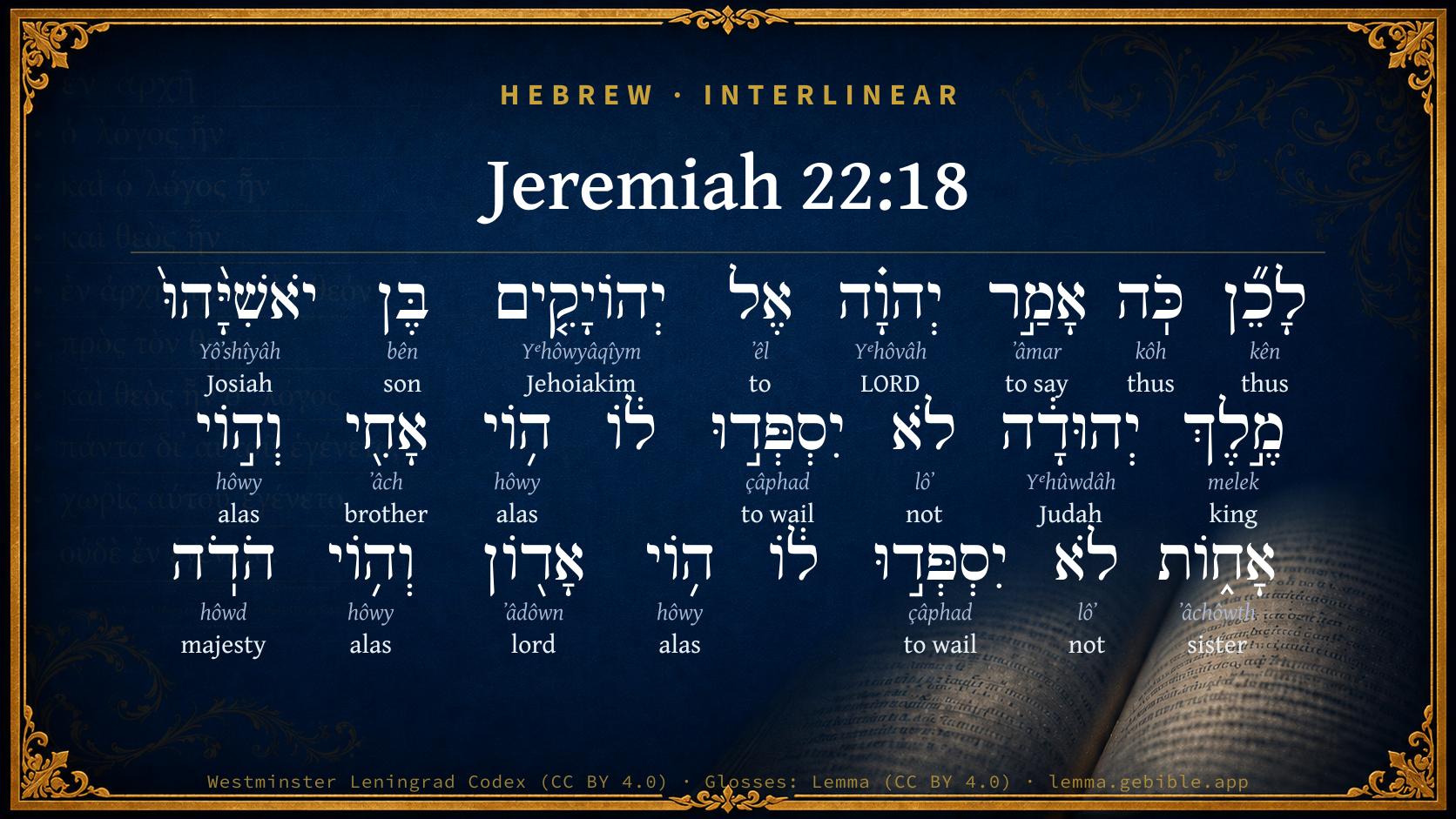
Jeremiah 22:18

Hebrew (Westminster Leningrad Codex) Jeremiah 22:18 appears in the Hebrew Old Testament. The text above is from the Westminster Leningrad Codex. Each word links to its Strong’s number, a concise gloss, and parsing drawn from the Open Scriptures Hebrew Bible morphology. Click any word for its full Brown-Driver-Briggs (BDB) entry.
Download image
Cite this verse

Jeremiah 22:18 (World English Bible). Public Domain. Lemma interlinear Bible study tool, https://lemma.gebible.app/v/jeremiah/22/18.

Show BibTeX & RIS
BibTeX
RIS
English Translation
Therefore thus says Yahweh concerning Jehoiakim the son of Josiah, king of Judah: they shall not lament for him, [saying], Ah my brother! or, Ah sister! They shall not lament for him, [saying] Ah lord! or, Ah his glory!
World English Bible · Public Domain
Download a study sheet

One document with this verse’s original text, its word-by-word gloss line, the meaning frame, cross-references with their text, attributed commentary, and full source and license credits — printable, and it pastes into notes with its structure intact.

This verse Autodidact and up

Study sheet (.html) Plain text (.txt)

A passage Seminary Student

Up to 50 verses in one chapter. A passage sheet keeps up to 6 commentary sources and 12 cross-references per verse, in the order this page ranks them, and says so on the sheet whenever that leaves anything out. Ask for a single verse and you get the Autodidact verse sheet above.

Everything on this page stays free to read, with no account — the sheet is a download of what is already on screen, not access to it.

Want to remove ads? Support Godless Engineer
Compare translations 3

The same verse in 3 English versions, stacked beneath the original-language interlinear above. Click any original word for its lexicon entry.

Each is an independent rendering of the whole verse — the interlinear is not word-aligned to these translations.

Highlighted words mark where these versions differ — a whole-verse word diff, not a word-by-word alignment.

  • World English Bible Public Domain
    Therefore thus says Yahweh concerning Jehoiakim the son of Josiah, king of Judah: they shall not lament for him, [saying], Ah my brother! or, Ah sister! They shall not lament for him, [saying] Ah lord! or, Ah his glory!
  • King James Version Public Domain
    Therefore thus saith the LORD concerning Jehoiakim the son of Josiah king of Judah; They shall not lament for him, saying, Ah my brother! or, Ah sister! they shall not lament for him, saying, Ah lord! or, Ah his glory!
  • unfoldingWord Literal Text CC BY-SA 4.0
    Therefore, thus says Yahweh concerning Jehoiakim the son of Josiah, king of Judah: “They will not mourn for him, ‘Woe, my brother!’ and ‘Woe, sister!’ They will not mourn for him, ‘Woe, master!’ and ‘Woe, his majesty!’

unfoldingWord Literal Text — © unfoldingWord, licensed CC BY-SA 4.0. Word-aligned USFM3 via Door43 (git.door43.org/unfoldingWord/en_ult).

Versions to compare (up to 4)

3 of 4 selected

Show all 18 translations

Every available English version of this verse, each an independent rendering of the whole verse.

  • World English Bible Public Domain
    Therefore thus says Yahweh concerning Jehoiakim the son of Josiah, king of Judah: they shall not lament for him, [saying], Ah my brother! or, Ah sister! They shall not lament for him, [saying] Ah lord! or, Ah his glory!
  • Berean Standard Bible Public Domain
    Therefore this is what the LORD says concerning Jehoiakim son of Josiah king of Judah: “They will not mourn for him: ‘Alas, my brother! Alas, my sister!’ They will not mourn for him: ‘Alas, my master! Alas, his splendor!’
  • Majority Standard Bible Public Domain
    Therefore this is what the LORD says concerning Jehoiakim son of Josiah king of Judah: “They will not mourn for him: ‘Alas, my brother! Alas, my sister!’ They will not mourn for him: ‘Alas, my master! Alas, his splendor!’
  • King James Version Public Domain
    Therefore thus saith the LORD concerning Jehoiakim the son of Josiah king of Judah; They shall not lament for him, saying, Ah my brother! or, Ah sister! they shall not lament for him, saying, Ah lord! or, Ah his glory!
  • American Standard Version (1901) Public Domain
    Therefore thus saith Jehovah concerning Jehoiakim the son of Josiah, king of Judah: they shall not lament for him, `saying', Ah my brother! or, Ah sister! They shall not lament for him, `saying' Ah lord! or, Ah his glory!
  • Revised Version (1885) Public Domain
    Therefore thus saith the LORD concerning Jehoiakim the son of Josiah, king of Judah: They shall not lament for him, saying, Ah my brother! or, Ah sister! they shall not lament for him, saying, Ah lord! or, Ah his glory!
  • Geneva Bible (1599) Public Domain
    Therefore thus saith the Lord against Iehoiakim, the sonne of Iosiah king of Iudah, They shall not lament him, saying, Ah, my brother, or ah, sister: neither shall they mourne for him, saying, Ah, lord, or ah, his glorie.
  • Douay-Rheims (1899) Public Domain
    Therefore thus saith the Lord concerning Joakim the son of Josias king of Juda: They shall not mourn for him, Alas, my brother, and Alas, sister: they shall not lament for him, Alas, my Lord, or, Alas, the noble one.
  • Young's Literal Translation Public Domain
    Therefore, thus said Jehovah concerning Jehoiakim son of Josiah king of Judah: They do not lament for him, Ah, my brother, and Ah, sister, They do not lament for him, Ah, lord, and Ah, his honour.
  • Literal Standard Version CC BY-SA 4.0
    Therefore, thus said YHWH concerning Jehoiakim son of Josiah king of Judah: “They do not lament for him, || Oh, my brother! And, Oh, my sister! They do not lament for him, || Oh, lord! And, Oh, his splendor!
  • Unlocked Literal Bible CC BY-SA 4.0
    Therefore this is what Yahweh says about Jehoiakim son of Josiah, king of Judah: They will not lament for him, saying, 'Woe, my brother!' or 'Woe, my sister!' They will not lament for him, saying, 'Woe, master!' or 'Woe, majesty!'
  • unfoldingWord Literal Text CC BY-SA 4.0
    Therefore, thus says Yahweh concerning Jehoiakim the son of Josiah, king of Judah: “They will not mourn for him, ‘Woe, my brother!’ and ‘Woe, sister!’ They will not mourn for him, ‘Woe, master!’ and ‘Woe, his majesty!’
  • Darby Bible Public Domain
    Therefore thus saith Jehovah concerning Jehoiakim the son of Josiah, the king of Judah: They shall not lament for him, Ah, my brother! or, Ah, sister! They shall not lament for him, Ah, lord! or Ah, his glory!
  • World Messianic Bible Public Domain
    Therefore the LORD says concerning Jehoiakim the son of Josiah, king of Judah: “They won’t lament for him, saying, ‘Ah my brother!’ or, ‘Ah sister!’ They won’t lament for him, saying ‘Ah lord!’ or, ‘Ah his glory!’
  • Webster's Bible Public Domain
    Therefore thus saith the LORD concerning Jehoiakim the son of Josiah king of Judah; They shall not lament for him, saying, Ah my brother! or, Ah sister! they shall not lament for him, saying, Ah lord! or, Ah his glory!
  • Free Bible Version CC BY-SA 4.0
    So this is what the Lord says about Jehoiakim, son of Josiah, king of Judah: They won't mourn for him, saying: “How sad, my brother! How sad my sister!” They won't mourn for him, saying: “How sad, my lord! How sad, his majesty!”
  • Bible in Basic English Public Domain
    So this is what the Lord has said about Jehoiakim, the son of Josiah, king of Judah: They will make no weeping for him, saying, Ah my brother! or, Ah sister! they will make no weeping for him, saying, Ah lord! or, Ah his glory!
  • JPS Tanakh (1917) Public Domain
    Therefore thus saith the LORD concerning Jehoiakim the son of Josiah, king of Judah: They shall not lament for him: 'Ah my brother!' or: 'Ah sister!' They shall not lament for him: 'Ah lord!' or: 'Ah his glory!'

Literal Standard Version (2020), Covenant Press — licensed CC BY-SA 4.0. Text via the HelloAO Bible API (eBible.org). Unlocked Literal Bible (unfoldingWord) — licensed CC BY-SA 4.0. Text via the HelloAO Bible API (eBible.org). unfoldingWord Literal Text — © unfoldingWord, licensed CC BY-SA 4.0. Word-aligned USFM3 via Door43 (git.door43.org/unfoldingWord/en_ult). Free Bible Version, Dr. Jonathan Gallagher — licensed CC BY-SA 4.0. Text via the HelloAO Bible API (eBible.org).

Word by word

More ways to search: Search by grammar → Find every occurrence → Compare this word →

Practice this passage: Drill this verse → Learn its vocabulary →

הֹדֹֽה
hôwd
H1935
“majesty · his”
Noun, Common, Masculine, Singular, Construct + Suffix, Personal, 3rd Person, Masculine, Singular
Part of Speech
Noun
Type
Common
Gender
Masculine
Number
Singular
State
Construct
Full BDB Definition

Origin: from an unused root

TWOT: 482a

splendour, majesty, vigour
  1. לָכֵ֞ן kên H3651 “to/for · thus” Preposition + Adverb
  2. כֹּֽה kôh H3541 “thus” Adverb
  3. אָמַ֣ר ʼâmar H559 “to say” Verb, Qal, Perfect, 3rd Person, Masculine, Singular
  4. יְהוָ֗ה Yᵉhôvâh H3068 “LORD” Noun, Proper
  5. אֶל ʼêl H413 “to” Preposition
  6. יְהוֹיָקִ֤ים Yᵉhôwyâqîym H3079 “Jehoiakim” Noun, Proper
  7. בֶּן bên H1121 “son of” Noun, Common, Masculine, Singular, Construct
  8. יֹאשִׁיָּ֨הוּ֙ Yôʼshîyâh H2977 “Josiah” Noun, Proper
  9. מֶ֣לֶךְ melek H4428 “king of” Noun, Common, Masculine, Singular, Construct
  10. יְהוּדָ֔ה Yᵉhûwdâh H3063 “Judah” Noun, Proper
  11. לֹא lôʼ H3808 “not” Particle, Negative
  12. יִסְפְּד֣וּ çâphad H5594 “to wail” Verb, Qal, Imperfect, 3rd Person, Masculine, Plural
  13. ה֥וֹי hôwy H1945 “alas” Particle, Interjection
  14. אָחִ֖י ʼâch H251 “brother · my” Noun, Common, Masculine, Singular, Construct + Suffix, Personal, 1st Person, Common, Singular
  15. וְה֣וֹי hôwy H1945 “and · alas” Conjunction + Particle, Interjection
  16. אָח֑וֹת ʼâchôwth H269 “sister” Noun, Common, Feminine, Singular, Absolute
  17. לֹא lôʼ H3808 “not” Particle, Negative
  18. יִסְפְּד֣וּ çâphad H5594 “to wail” Verb, Qal, Imperfect, 3rd Person, Masculine, Plural
  19. ה֥וֹי hôwy H1945 “alas” Particle, Interjection
  20. אָד֖וֹן ʼâdôwn H113 “lord” Noun, Common, Masculine, Singular, Absolute
  21. וְה֥וֹי hôwy H1945 “and · alas” Conjunction + Particle, Interjection

About this verse

These counts appear in no published source. They are computed here, from the morphology-tagged text and Lemma’s own curated glosses. What Lemma adds →

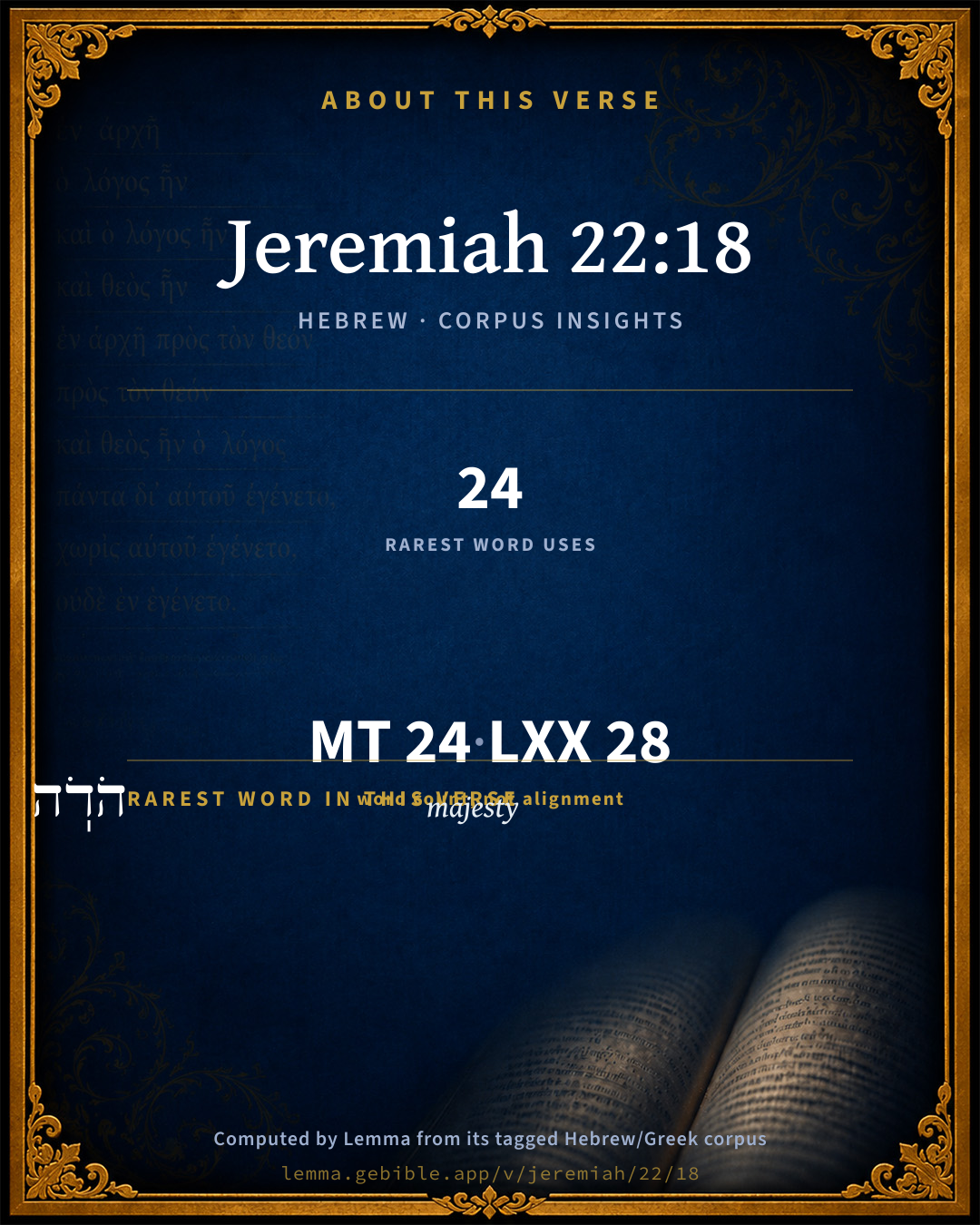
24
words
17
distinct lemmas
Prophets
section

Notable vocabulary

The rarest word here is הֹדֹֽה majesty H1935 — appearing just 24 times in the whole Hebrew Bible.

Shared distinctive vocabulary

הֹדֹֽה majesty H1935 occurs in 24 verses of the Hebrew Bible. Also found in:

Grammatical profile

  • 3 verbs
  • 10 nouns
  • 3 prepositions
  • 2 adverbs
  • 6 particles

Verb forms

  • אָמַ֣ר Qal · Perfect
  • יִסְפְּד֣וּ Qal · Imperfect
  • יִסְפְּד֣וּ Qal · Imperfect

Repetition

Words recur within this verse — often emphatic in Hebrew:

  • ה֥וֹי alas H1945 ×4
  • יִסְפְּד֣וּ to wail H5594 ×2
  • לֹא not H3808 ×2

Hebrew & Septuagint length

In the original languages it is 24 Hebrew tokens and 28 Greek tokens — but the two are counted differently (Hebrew bundles its prefixes and suffixes into one token; the Greek is in lemma form), so that isn’t a like-for-like length.

Cross-references

9

Topical passages linked to Jeremiah 22:18 in the Treasury of Scripture Knowledge — connected by theme and wording, ordered by reader-vote popularity; previews shown in the World English Bible.

  • 1 Kings 13:30 He laid his body in his own grave; and they mourned over him, [saying], Alas, my brother!
  • Jeremiah 16:6 Both great and small shall die in this land; they shall not be buried, neither shall men lament for them, nor cut themselves, nor make themselves bald for them;
  • Jeremiah 16:4 They shall die grievous deaths: they shall not be lamented, neither shall they be buried; they shall be as dung on the surface of the ground; and they shall be consumed by the sword, and by famine; and their dead bodies shall be food for the birds of the sky, and for the animals of the earth.
  • Jeremiah 22:10 Don't you weep for the dead, neither bemoan him; but weep sore for him who goes away; for he shall return no more, nor see his native country.
  • 2 Samuel 1:26 I am distressed for you, my brother Jonathan: Very pleasant have you been to me: Your love to me was wonderful, Passing the love of women.
  • 2 Samuel 3:33–38 The king lamented for Abner, and said, Should Abner die as a fool dies?
  • 2 Chronicles 21:19–20 It happened, in process of time, at the end of two years, that his bowels fell out by reason of his sickness, and he died of sore diseases. His people made no burning for him, like the burning of his fathers.
  • 2 Chronicles 35:25 Jeremiah lamented for Josiah: and all the singing men and singing women spoke of Josiah in their lamentations to this day; and they made them an ordinance in Israel: and, behold, they are written in the lamentations.
  • Jeremiah 34:5 you shall die in peace; and with the burnings of your fathers, the former kings who were before you, so shall they make a burning for you; and they shall lament you, [saying], Ah Lord! for I have spoken the word, says Yahweh.

Cross-references courtesy of OpenBible.info (CC BY 4.0).

Hebrew and Greek witnesses Masoretic Hebrew ↔ Greek Septuagint

The same verse in the two great witnesses to the Old Testament, shown verse-for-verse.

These are two independent witnesses, not word-aligned to each other, and the Septuagint is shown in lemma (dictionary) form.

Hebrew Jeremiah 22:18 Masoretic · Westminster Leningrad Codex

לָכֵ֞ן כֹּֽה אָמַ֣ר יְהוָ֗ה אֶל יְהוֹיָקִ֤ים בֶּן יֹאשִׁיָּ֨הוּ֙ מֶ֣לֶךְ יְהוּדָ֔ה לֹא יִסְפְּד֣וּ ל֔וֹ ה֥וֹי אָחִ֖י וְה֣וֹי אָח֑וֹת לֹא יִסְפְּד֣וּ ל֔וֹ ה֥וֹי אָד֖וֹן וְה֥וֹי הֹדֹֽה

Therefore thus says Yahweh concerning Jehoiakim the son of Josiah, king of Judah: they shall not lament for him, [saying], Ah my brother! or, Ah sister! They shall not lament for him, [saying] Ah lord! or, Ah his glory!

World English Bible · Public Domain

Greek LXX Structure differs

In the Septuagint, Jeremiah is about an eighth shorter than the Hebrew and arranges its material differently — the Oracles Against the Nations (Hebrew chapters 46–51) appear in the middle of the Greek book, after 25:13. Because the chapter and verse boundaries do not line up, a verse-for-verse comparison with the Hebrew is not shown.

A verse-for-verse comparison isn’t shown here because the chapters and verses don’t line up. Switch to the LXX edition with the MT / LXX toggle above to read the Greek directly.

On this verse, Keil & Delitzsch discusses the Septuagint’s reading. Read the note in Commentary ↓

Hebrew: Westminster Leningrad Codex (CC BY 4.0). Greek: Septuagint (public domain); English from a public-domain English Septuagint. How the Septuagint differs from the Hebrew →

Targum (Aramaic paraphrase)

1

The Targum is the ancient Jewish Aramaic paraphrase of the Hebrew Scriptures — an interpretive translation, not the Hebrew text itself. Onkelos (literal) and Pseudo-Jonathan (expansive) render the Torah, and Jonathan the Prophets. Coverage is partial: where no permissively-licensed English translation exists for a verse, only the Aramaic is shown. This is verse-level text, not a word-by-word alignment to the Hebrew.

  1. Targum Jonathan Prophets (Joshua–Malachi)
    בְּכֵן כִּדְנַן אֲמַר יְיָ עַל יְהוֹיָקִים בַּר יֹאשִׁיָה מְלַךְ שִׁבְטָא דְבֵית יְהוּדָה לָא יִסְפְּדוּן לֵיהּ וַי עַל אֲחִי וַי עַל אֲחָת לָא יִסְפְּדוּן לֵיהּ וַי עַל מַלְכָּא וַי עַל מַלְכוּתֵיהּ:

    (no public-domain English translation for this verse)

    Targum Jonathan — Aramaic: “Mikraot Gedolot” (public domain). English: “Sefaria Community Translation” (CC0 1.0 (public-domain dedication)); “London "Chaldee Paraphrase," 1871” (public domain). Text via Sefaria.

Commentary

Notes on Jeremiah 22:18 from classic Christian and Jewish commentators (each source and its license shown beneath its notes). The classic Christian expositions comment on the surrounding passage and are grouped to its opening verse, so a note may address several verses; the Jewish commentaries on the Tanakh (Rashi and others) are per-verse, so they appear only where the commentator wrote on this verse.

Lemma curates 59 commentaries, every one of them public domain or Creative Commons licensed, each selected and text-cleaned for this edition rather than reprinted as found. About our sources →

Jamieson, Fausset & Brown

Robert Jamieson, A. R. Fausset & David Brown

Ah my brother! . . . sister!--addressing him with such titles of affection as one would address to a deceased friend beloved as a brother or sister (compare Kg1 13:30). This expresses, They shall not lament him with the lamentation of private individuals [VATABLUS], or of blood relatives [GROTIUS]: as "Ah! lord," expresses public lamentation in the case of a king [VATABLUS], or that of subjects [GROTIUS]. HENDERSON thinks, "Ah! sister," refers to Jehoiakim's queen, who, though taken to Babylon and not left unburied on the way, as Jehoiakim, yet was not honored at her death with royal lamentations, such as would have been poured forth over her at Jerusalem. He notices the beauty of Jeremiah's manner in his prophecy against Jehoiakim. In Jer 22:13-14 he describes him in general terms; then, in Jer 22:15-17, he directly addresses him without naming him; at last, in Jer 22:18, he names him, but in the third person, to imply that God puts him to a distance from Him. The boldness of the Hebrew prophets proves their divine mission; were it not so, their reproofs to the Hebrew kings, who held the throne by divine authority, would have been treason.

Ah his glory!--"Alas! his majesty."

Jamieson, Fausset & Brown — Commentary Critical and Explanatory on the Whole Bible (1871) — public domain (CC PDM 1.0). Text via the HelloAO Bible API.

Trapp's Complete Commentary

John Trapp

Jer 22:18 Therefore thus saith the LORD concerning Jehoiakim the son of Josiah king of Judah; They shall not lament for him, [saying], Ah my brother! or, Ah sister! they shall not lament for him, [saying], Ah lord! or, Ah his glory!

Ver. 18. They shall not lament for him.] By his exactions he had so far lost his people’s affections, that none were found, either of his allies or others, that bewailed his death; but, Jehoram-like as he had lived undesired, so he died unlamented Edwin-like, as he lived wickedly, so he died wishedly; {a} Mohammed-like, he lived feared of all men, and died bewailed of none. {b} See the contrary promised to his brother Zedekiah, for his courtesy to Jeremiah, Jer 34:5.

{a} Daniel’s History.

{b} Turkish History.

John Trapp, A Commentary or Exposition upon All the Books of the Old and New Testament (1647–1656) — public domain. Text from a community e-Sword module.

The Biblical Illustrator

Joseph S. Exell

Jer_22:18-19

With the burial of an ass.

Dishonoured in death

Jehoiakim was king, and yet not one word of thanks do we find, nor one word of love, nor one word of regret expressed concerning his fate. We should learn from this how possible it is to pass through the world without leaving behind us one sacred or loving memory. He that seeketh his life shall lose it. A man that sacrifices daily to his own ambition, and never sets before himself a higher ideal than his own gratification, may appear to have much whilst he actually has nothing, may even appear to be winning great victories, when he is really undergoing disastrous defeats. What is a grand house if there be not in it a loving heart? What are walls but for the pictures that adorn them? What is life but for the trust which knits it into sympathetic unity? What is the night but for the stars that glitter in its darkness? There is an awful process of retrogression continually operating in life. Experienced men will tell us that the issue of life is one of two things: either advancement, or deterioration; continual improvement, or continual depreciation: we cannot remain just where we are, adding nothing, subtracting nothing, but realising a permanence of estate and faculty. The powers we do not use will fall into desuetude, and the abilities which might have made life easy may be so neglected as to become burdens too heavy to be carried. It lies within a mans power so to live that he may be buried with the burial of an ass: no mourners may surround his grave; no beneficiaries may recall his charities; no hidden hearts may conceal the tender story of his sympathy and helpfulness. A bitter sarcasm this, that a man should be buried like an ass! (J. Parker, D. D.)

The doom of the defrauder, libertine, and assassin

After a life of private or public iniquity, a mans death is not deplored. The obsequies may be pretentious--flags, wreaths, catafalques, military processions; but the world feels that a nuisance has been abated; he is cast forth by reason of the contempt of men; figuratively, if not literally, he is buried with the burial of an ass.

I. There is the romance of fraud. The heroes of this country are fast getting to be those who have most skill in swallowing trust funds, banks, stocks, and moneyed institutions. I thank God when fortunes thus gathered go to smash. They are plague struck, and blast a nation. I like to have them made loathsome and an insufferable stench, so that honest young men may take warning.

II. Next, I speak of the romance of libertinism. Society has severest retribution for the impurity that lurks about the cellars and alleys of the city. It cries out against it. It hurls the indignation of the law at it. But society becomes more lenient as impurity rises towards affluence and high social position, until, finally, it is silent, or disposed to palliate. Where is the judge, or the sheriff, or the police, who dare arraign for indecency the wealthy villain? Would God that the romance which flings its fascinations over the bestialities of high life might be gone! Whether it has canopied couch of eiderdown, or sleep amid the putridity of the low tenement house, four families in a room, Gods consuming vengeance is after it.

III. Next,. I speak of the romance of assassination. God gives life, and He only has a right to take it away; and that man who assumes this Divine prerogative has touched the last depth of crime. Society is alert for certain forms of murder. For garroting, or the beating out of life with a club, or axe, or slung shot, the law has a quick spring and a heavy stroke. But let a man come to wealth or social pretension, and then attempt to avenge his wrongs by aiming a pistol at the header heart of another, and immediately there are sympathies aroused. If capital punishment be right, then let the life of the polished murderer go with the life of the ignorant and vulgar assassin. Let there be no partiality of hemp, no aristocracy of the gallows. (T. De Witt Talmage.)

The ignominious burial of the wicked

Christ tells the story of a prosperous farmer who was clean intoxicated with success, and could not entertain a thought but of his gains,--how the very night that he had decided on the enlargement of his premises, a voice from heaven called his soul away; and whatever monument with flattering title his friends may have erected over his grave, God wrote his epitaph, in one word of four letters, Fool. Buried with the burial of an ass. No one will for a moment suppose that a splendid catafalque and imposing funeral obsequies betoken the close of a noble and honourable life. Ah! many a man is laid in one of yonder cemeteries with every form of ceremonial pomp, with gilt, and nodding plumes, and long rows of carriages and costly wreaths; and if the truth were told, a nuisance is being got rid of; the world will be better now that he is gone. Well might the artless child, who had been wandering among the tombstones, and reading the epitaphs, turn to its mother and say, Mother, where are all the bad people buried? (T. Thain Davidson, D. D.)

A kings humiliating burial

Our Richard II, for his exactions to maintain a great court and favourites, lost his kingdom, was starved to death at Pomfret Castle, and scarce afforded common burial. King Stephen was interred in Faversham monastery; but afterwards his body, for the gain of the lead wherein it was coffined, was cast into the river. (John Trapp.)

The Biblical Illustrator, edited by Joseph S. Exell (c. 1880s–1900s) — public domain. Text from a community e-Sword module.

Joseph Benson's Commentary

Jer 22:18-19. They shall not lament for him, saying, Ah my brother! &c. — “The prophet here repeats part of the funeral ditty or song which the public mourners used to sing at funerals, (see note on Jer 9:17; Jer 20:14, and compare 1Ki 13:30,) signifying, that neither Jehoiakim, nor his queen or family, should be buried with those solemn lamentations with which the memory of his predecessors, particularly that of his father, had been honoured: see 2Ch 35:25. Saying, Ah Lord! or, Ah his glory! — That is, how is his glory departed and vanished! another burden or chorus of the funeral song. He shall be buried with the burial of an ass — None attending him to his grave, none mourning over him. Or, the meaning is, he shall have no burial: for the carcasses of asses are not buried. Drawn and cast forth, &c. — The expression seems to be taken from the custom of dogs to draw about a carcass before they tear and devour it. Jehoiakim, having been advanced to the kingdom by Pharaoh-necho, king of Egypt, 2Ki 23:34, followed the fortune of that king, and upon the conquest of Egypt by the Chaldeans, Jer 46:2, after three years’ reign, was taken prisoner by Nebuchadnezzar, and put into irons, Dan 1:2; 2Ch 36:6. But afterward, it seems, the king of Babylon released him and made him a tributary king. After three years’ obedience, however, Jehoiakim rebelled, in confidence of assistance from Egypt. Soon after which Nebuchadnezzar’s army overran Judea, besieged Jerusalem, and probably took Jehoiakim prisoner in some sally that he made upon them, and killed him, and then cast out his dead body into the highway, denying him the common rites of burial: see 2Ki 24:1-6. Accordingly, he is said to have slept with his fathers, but not to have been buried with them: see also Joseph. Antiq., lib. 10. cap. 7, 8.

Joseph Benson's Commentary on the Old and New Testaments (1811–1818) — public domain. Text from a community e-Sword module.

Keil & Delitzsch

C. F. Keil & F. Delitzsch

As punishment for this, his end will be full of horrors; when he dies he will not be bemoaned and mourned for, and will lie unburied. To have an ass's burial means: to be left unburied in the open field, or cast into a flaying-ground, inasmuch as they drag out the dead body and cast it far from the gates of Jerusalem. The words: Alas, my brother! alas, etc.! are ipsissima verba of the regular mourners who were procured to bewail the deaths of men and women. The lxx took objection to the "alas, sister," and left it out, applying the words literally to Jehoiakim's death; whereas the words are but a rhetorical individualizing of the general idea: they will make no death-laments for him, and the omission destroys the parallelism. His glory, i.e., the king's. The idea is: neither his relatives nor his subjects will lament his death. The infinn. absoll. סחוב והשׁלך, dragging forth and casting (him), serve to explain: the burial of an ass, etc. In Jer 36:30, where Jeremiah repeats this prediction concerning Jehoiakim, it is said: His dead body shall be cast out (exposed) to the heat by day and to the cold by night, i.e., rot unburied under the open sky.

As to the fulfilment of this prophecy, we are told, indeed, in Kg2 24:6 that Jehoiakim slept with his fathers, and Jehoiachin, his son, was king in his stead. But the phrase "to sleep with his fathers" denotes merely departure from this life, without saying anything as to the manner of the death. It is not used only of kings who died a peaceful death on a sickbed, but of Ahab (Kg1 22:40), who, mortally wounded in the battle, died in the war-chariot. There is no record of Jehoiakim's funeral obsequies or burial in 2 Kings 24, and in Chr. there is not even mention made of his death. Three years after the first siege of Jerusalem by the Chaldeans, and after he had become tributary to the king of Babylon, Jehoiakim rose in insurrection, and Nebuchadnezzar sent against him the troops of the Chaldeans, Aramaeans, Moabites, and Ammonites. It was not till after the accession of Jehoiachin that Nebuchadnezzar himself appeared before Jerusalem and besieged it (Kg2 24:1-2, and Kg2 24:10). So it is in the highest degree probable that Jehoiakim fell in battle against the Chaldean-Syrian armies before Jerusalem was besieged, and while the enemies were advancing against the city; also that he was left to lie unburied outside of Jerusalem; see on Kg2 24:6, where other untenable attempts to harmonize are discussed. The absence of direct testimony to the fulfilment of the prophecy before us can be no ground for doubting that it was fulfilled, when we consider the great brevity of the notices of the last kings' reigns given by the authors of the books of Kings and Chronicles. Graf's remark hereon is excellent: "We have a warrant for the fulfilment of this prediction precisely in the fact that it is again expressly recounted in Jer 36, a historical passage written certainly at a later time (Jer 36:30 seems to contain but a slight reference to the prediction in Jer 22:18-19, Jer 22:30); or, while Jer 22:12, Jer 22:25. tallies so completely with the history, is Jer 22:18. to be held as contradicting it?"

Keil & Delitzsch — Biblical Commentary on the Old Testament (1861–1891) — public domain (CC PDM 1.0). Text via the HelloAO Bible API. (Old Testament only.)

Tyndale Open Study Notes

Tyndale Open Resources

22:18-23 God delivered his verdict against Jehoiakim’s terrible sins. Neither his family nor his subjects would mourn for him.

Tyndale Open Study Notes — © Tyndale Open Resources, licensed CC BY-SA 4.0. Text via the HelloAO Bible API.

Geneva Bible (1599)

Geneva Bible translators

For everyone shall have enough to lament for himself.

Geneva Bible (1599) marginal notes — public domain. Text via Bolls.life.

Adam Clarke's Commentary

Verse 18. They shall not lament for him, saying, Ah my brother!] These words were no doubt the burden of some funeral dirge. Alas! a brother, who was our lord or governor, is gone. Alas, our sister! his QUEEN, who has lost her glory in losing her husband. הדה hodah is feminine, and must refer to the glory of the queen.

The mournings in the east, and lamentations for the dead, are loud, vehement, and distressing. For a child or a parent grief is expressed in a variety of impassioned sentences, each ending with a burden like that in the text, "Ah my child!" "Ah my mother!" as the prophet in this place: הוי אחי hoi achi, "Ah my brother!" הוי אחות hoi achoth, "Ah sister!" הוי אדון hoi adon, "Ah lord!" הוי הדה hoi hodah, "Ah the glory."

Mr. Ward, in his Manners and Customs of the Hindoos, gives two examples of lamentation; one of a mother for the death of her son, one of a daughter for her departed mother. "When a woman," says he, "is overwhelmed with grief for the death of her child, she utters her grief in some such language as the following: -

Ah, my Hureedas, where is he gone? -

'Ah my child, my child!'

My golden image, Hureedas, who has taken? -

'Ah my child, my child!'

I nourished and reared him, where is he gone? -

'Ah my child, my child!'

Take me with thee. -

'Ah my child, my child!'

He played round me like a golden top. -

'Ah my child, my child!'

Like his face I never saw one. -

'Ah my child, my child!'

The infant continually cried, Ma Ma! -

'Ah my child, my child!'

Ah my child, crying, Ma! come into my lap. -

'Ah my child, my child!'

Who shall now drink milk? -

'Ah my child, my child!'

Who shall now stay in my lap? -

'Ah my child, my child!'

Our support is gone! -

'Ah my child, my child!'

"The lamentations for a mother are in some such strains as these: -

Mother! where is she gone? -

'Ah my mother, my mother!'

You are gone, but what have you left for me? -

'Ah my mother, my mother!'

Whom shall I now call mother, mother? -

'Ah my mother, my mother!'

Where shall I find such a mother? -

'Ah my mother, my mother!'"

From the above we may conclude that the funeral lamentations, to which the prophet refers, generally ended in this way, in each of the verses or interrogatories.

There is another intimation of this ancient and universal custom in 1Kg 13:30, where the old prophet, who had deceived the man of God, and who was afterwards slain by a lion, is represented as mourning over him, and saying, הוי אחי hoi achi, "Alas, my brother!" this being the burden of the lamentation which he had used on this occasion. Similar instances may be seen in other places, Jer 30:7; Eze 6:11; Joe 1:15; and particularly Am 5:16-17, and Re 18:10-19.

Adam Clarke's Commentary on the Bible (1810–1826) — public domain. Text from a community e-Sword/MySword module.

John Calvin's Commentaries

The Prophet having inveighed against Jehoiakim, now shews what kind of punishment from God awaited him; he would have otherwise despised the Prophet’s reproof; but when he heard that a reward was prepared for him, he must have been roused. Inasmuch then as he was seized with a foolish and even a sottish lust for glory, so that he cast aside every care for uprightness, the Prophet declares that disgrace was prepared for him; and hence he compares him after his death to an ass.

Therefore thus saith Jehovah to King Jehoiakim, or concerning King Jehoiakim, the son of Josiah the king, etc. He is not called the son of Josiah for honor’s sake, but for the purpose of touching him to the quick, because he had degenerated from the piety of his father. But as he hoped that the religion of Josiah would be to him a sort of covering, the Prophet derides and checks this vain confidence. “Thou gloriest in being the son of King Josiah, but thy holy father will avail thee nothing, for thou seemest avowedly to shew that thou art wholly different from him. Though then thou art, descended from Josiah, and though God has raised thee to the royal throne, yet there is no reason for thee to be confident as to thy safety; for these benefits of God will not preserve thee from that ignominious treatment which thou deservest.”

He says first, They shall not bewail him, Ah my brother! Ah sister! The Prophet mentions by way of imitation the words of the mourners. That people, we know, were very vehement in expressing their sorrow. And this ought to be borne in mind, because some being persuaded that nothing is related by the Prophets but what ought to be taken as an example, do therefore think that these modes of lamentation were approved by God. But we have before seen what the Prophet said in Jeremiah 22:4,

“Enter through these gates shall the kings of Judah and their princes in chariots,”

yet we know that kings had been forbidden to make such ostentations; but God did not scrupulously refer to what was lawful or right in speaking of royal splendor; so also when he spoke of funeral rites. We ought not then to make a law of what the Prophet says, as though it were right and proper to bewail the dead with howling. There is indeed no doubt, but these excesses which the Prophet mentions were not only foolish, but also wholly condemnable; for we often vie with one another in our lamentations; and when men intemperately express their grief in funerals, they excite themselves into a sort of madness in crying and bewailing, and then when they compose themselves and simulate grief, they act a part as in a theater. But the Prophet here speaks only according to the common practice of the age, when he says, “They shall not bewail him,” etc.; that is, he states what was usually done, when one embraced another, when a sister said, “Ah, my brother!” and when a brother said, “Ah, my sister!” or, when the people said, “Ah, lord, O king, where is thy glory! where is thy honor! where thy crown! where thy scepter! where thy throne!“ Very foolish then were the lamentations which the Prophet mentions here. But as I have already said, it is enough for us to know, that he refers to these rites, then commonly practiced, without expressing his approbation of them.

They shall not, he says, bewail King Jehoiakim; they shall not say at his funeral, Ah, my brother! Ah, sister! And, Ah, lord! Ah, his glory! There shall be no such thing; and why? because he shall be buried with the burial of an ass We have before said, that it was justly deemed one of God’s curses when a carcass was cast away unburied; for God would have burial a proof to distinguish us from brute animals even after death, as we in life excel them, and as our condition is much nobler than that of the brute creation. Burial is also a pledge as it were of immortality; for when man’s body is laid hid in the earth, it is, as it were, a mirror of a future life. Since then burial is an evidence of God’s grace and favor towards mankind, it is on the other hand a sign of a curse, when burial is denied.

But it has been elsewhere said, that temporal punishments ought not always to be viewed alike; for God has suffered sometimes his faithful servants to be unburied, according to what we read in Psalm 79:2, 3, that their bodies were cast forth in the fields, that they were exposed to be eaten by the beasts of the earth and by the birds of heaven. Those spoken of were the true and sincere worshippers of God. But we know that the good and the bad have temporal punishments in common; and this is true as to famine and nakedness, pestilence and war. The destruction of the city Jerusalem was a just punishment on the wicked; and yet Daniel and Jeremiah were driven into exile together with the wicked, and suffered great hardships; and, in short, they were so mixed with the ungodly, that their external condition was in nothing different. So, then, the state of things in the world is often in such disorder, that we cannot distinguish between the good and the bad by outward circumstances. But still it is right ever to hold this truth, that when burial is denied to a man, it is a sign of God’s curse.

John Calvin's Commentaries (1540-1563) — public domain. Text from the Calvin Translation Society English edition (1840s-50s) via the Christian Classics Ethereal Library (ccel.org). Calvin's coverage is partial (roughly two-thirds of the Bible); uncommented books and verses are honest gaps, never fabricated. The 19th-century editor's footnotes and remarks are omitted so the notes are faithfully Calvin's own voice.

Ellicott's Commentary for English Readers

(18) They shall not lament for him.—The words contrast the death as well as the life of Jehoiakim with that of Josiah. For him there should be no lamentation such as was made for the righteous king (2Ch_35:25), either from kindred mourning, as over a brother or a sister (perhaps, however, as “sister” would not be appropriate to the king, the words are those of a chorus of mourners, male and female, addressing each other), or from subjects wailing over the death of their “lord” and the departure of his “glory.” For the funeral ceremonies of Israel, see 1Ki_13:30; Mat_9:23; Mar_5:38.

A Bible Commentary for English Readers, edited by Charles John Ellicott (1878–1897) — public domain. Text from a community e-Sword module.

The Cambridge Bible for Schools and Colleges

gen. ed. J. J. S. Perowne

18. Ah my brother! or, Ah sister!] given as the usual formulae in lamenting a death (see 1Ki_13:30). The second is here inappropriate, but it satisfies the parallelism of the Ḳinah metre of the whole passage.

Ah lord! or, Ah his glory!] the lamentations of subjects and friends, those outside his family.

18, 19. The prediction of the circumstances attendant upon his death. Cp. Jer_36:30, the similarity of which makes it probable that these were among the “many like words” which were added to the original form of the Roll (Jer_36:32) as read to Jehoiakim, and would thus probably be later than the rest of the passage. The prediction was doubtless fulfilled, or it would not have been included in Jeremiah’s prophecies as edited. It is true that we read 2Ki_24:6 that Jehoiakim “slept with his fathers,” but mention of his burial is significantly omitted.

The Cambridge Bible for Schools and Colleges (gen. ed. J. J. S. Perowne; Cambridge University Press, 1878–1918) — public domain. Text from a community e-Sword module.

John Gill's Exposition

Therefore thus saith the Lord concerning Jehoiakim,.... This shows who is before spoken of and described; Jehoiakim, the then reigning king in Judah, whose name was Eliakim, but was changed by Pharaoh king of Egypt, when he deposed his brother Jehoahaz or Shallum, and set him on the throne, Kg2 23:34;

the son of Josiah king of Judah; and who seems to have been his eldest son, though his brother Jehoahaz reigned before him; for he was but twenty three years of age when he began his reign, and he reigned but three months; and Jehoiakim was twenty five years old when he succeeded him, Kg2 23:31; his relation to Josiah is mentioned, not so much for his honour, but rather to his disgrace, and as an aggravation of his wickedness, that having so religious a parent, and such a religious education, and the advantage of such an example, and yet did so sadly degenerate: and it also suggests that this would be no security to him from the divine vengeance; but rather provoke it, to deal more severely with him;

they shall not lament for him; that is, his people, his subjects, shall not lament for him when dead, as they did for his father Josiah; so far from having any real grief or inward sorrow on account of his death, that they should not so much as outwardly express any, or use the common form at meeting together:

saying, ah my brother! or, ah sister! a woman meeting her brother would not say to him, O my brother, what bad news is this! we have lost our king! nor he reply to her, O sister, it is so, the loss is great indeed! for this is not to be understood of the funeral "lessus" at the interment of a king or queen; lamenting them under these appellations of brother or sister, which is denied of this prince. Kimchi thinks it has reference to his relations, as that they should not mourn for him, and say, "ah my brother!" nor for his wife, who died at the same time, though not mentioned, ah sister! both should die unlamented, as by their subjects, so by their nearest friends and relations;

they shall not lament for him, saying, ah lord! or, ah his glory! O our liege lord and sovereign, he is gone! where are his glory and majesty now? where are his crown, his sceptre, his robes, and other ensigns of royalty? So the Targum,

"woe, or alas, for the king; alas, for his kingdom;''

a heavy stroke, a sorrowful melancholy providence this! but nothing of this kind should be said; as he lived not beloved, because of his oppression and violence, so he died without any lamentation for him.

John Gill's Exposition of the Whole Bible (1746–1763) — public domain (CC PDM 1.0). Text via the HelloAO Bible API.

Albert Barnes' Notes on the Bible

Boldly by name is the judgment at length pronounced upon Jehoiakim. Dreaded by all around him, he shall soon lie an unheeded corpse, with no one to lament. No loving relative shall make such wailing as when a brother or sister is carried to the grave; nor shall he have the respect of his subjects, Ah Lord! or, Ah his glory!

Albert Barnes' Notes on the Bible (1834–1885) — public domain. Text from a community e-Sword/MySword module.

Haydock's Catholic Bible Commentary

Sister. They shall not condole with his consort.

George Leo Haydock (1774–1849), Haydock's Catholic Family Bible and Commentary, 1859 edition — public domain. Excludes Psalms (Douay-Rheims chapter numbering differs from Protestant) and Deuterocanonical books (Catholic canon only).

Matthew Poole's English Annotations

Jehoiakim the son of Josiah king of Judah; a very bad son of a good father, whose name was Eliakim, by Pharaoh-nechoh turned to Jehoiakim, 2Ki 23:34, and by him set up. He reigned wickedly, and infinitely oppressed the people for money for Pharaoh-nechoh, that made him king, 23:35. He reigned but eleven years; but rebelling against Nebuchadnezzar king of Babylon, we read, 2Ki 24:1,2, he was carried by him into Babylon in fetters, 2Ch 36:6, where, for aught we read, he died. Jehoiachin, or Jeconiah, his son, succeeded him, Jer 22:9, reigning only three months and ten days.

They shall not lament for him; he died not lamented; for as it is not probable his enemies would lament him, so he had disobliged his own people by violence and oppression to that degree, that it is not likely that those of them that were in Babylon made any great lamentation for him.

Matthew Poole's English Annotations on the Holy Bible (1683–1685) — public domain. Text from a community e-Sword/MySword module.

Whedon's Commentary on the Bible

Daniel D. Whedon

18, 19. Not lament… Ah my brother — Neither relations nor subjects will lament his death. Like a dead ass his body will be dragged out, and left to decay unburied and unheeded. There is no minute account of the death of this king, and hence we have no historical illustration of the fulfilment of this prophecy.

Daniel D. Whedon (gen. ed.), Commentary on the Old and New Testaments (1874–1909) — public domain. Text from a community e-Sword module.

The Pulpit Commentary

Josiah had been bitterly missed and universally lamented; (2Ch_35:25) and so, only perhaps with less heartiness in most cases, Jehoiakim"s other predecessors. (Jer_34:5) The Babylonian kings, too, received the honors of public mourning, e.g. even the last of his race, who surrendered to Cyrus, according to the British Museum inscription translated by Mr. Pinches. Ah my brother! or, Ah sister! The Septuagint omits the latter part of this phrase, apparently because it seemed inappropriate to the death of Jehoiakim; but the parallelism requires a two-membered clause. According to Movers, the funeral procession is to be conceived of as formed of two parts, condoling with each other on having to share the same fate ("Die Phonizier," 2. 248). Or perhaps mythology may supply a reason; it is possible that the formulae of public mourning were derived from the ceremonies of the Adonia; Adonis was an androgynous deity (Lenormant, "Lettres assyriologiques," 2:209), and might be lamented by his devotees as at once "brother" and "sister." (For another view, see Sayco"s edition of G. Smith"s "Chaldean Genesis," p. 267). Ezekiel (Eze_8:13) testifies to the worship of Tammuz, or Adonis, and the highest compliment a king could receive might be to be lamented in the same terms as the sun-god. Jeremiah does not approve this; he merely describes the popular custom. The recognition of the deeply rooted heathenism of the Jews before the Exile involves no disparagement to Old Testament religion; rather it increases the cogency of the argument for its supernatural origin. For how great was the contrast between Jeremiah and his semi-heathen countrymen! And yet Jeremiah"s religion is the seed of the faith which overcame the world. Ah lord! or, Ah his glory! Lord is in the Hebrew adon (comp. Adonis and see above). His glory is against the parallelism; we should expect "lady" or "queen.

Exceptional facts in the law of transmission of character.

"Concerning Jehoiakim the son of Josiah King of Judah." The law is that like begets like. It is so physically and mentally to large extent, and morally and spiritually as well. Generally, blessed be God, the children of his servants become his servants too. And, on the other hand, the habit of sin in the parent is reproduced in the child, so that we have criminal classes, hereditary drunkards, profligates, and much else of a similar sad sort. But the law has frequent exceptions on both sides. The two names in this verse are both of them instances of such exception. Now, how are we to account for them? We have frequent instances in the Old Testament. The sons of "Aaron the saint of the Lord;" of Eli, the devout high priest; of Samuel, the upright judge. What a set David"s children were! And here we have Josiah the good, father of the infamous Jehoiakim. But we have nothing of this in the New Testament. It does not seem to be recognized there that the children of the godly can be otherwise than godly themselves. Even when one of the parents was an unbeliever, a heathen, the faith of the other was held to have such virtue that of their children St. Paul says, "Now are your children holy." We have very many instances of whole households being believers, but none of the children of believers being other than what their parents were. Would to God it were always so now! And, on the other hand, we have, as in the cases of the pious Hezekiah, son of the wicked Ahaz, and Josiah, son of Amen, who "sinned more and more," instances of ungodly parents having godly children. Now, how are these to be accounted for? Consider the sad case

I THAT GODLY PARENTS SHOULD HAVE UNGODLY CHILDREN. We are accustomed to assent to the possibility and frequency of this as an unquestionable truth. But is it so? We would ask two questions with a view to a better understanding of the matter.

1. Is it meant that godly parents who have been both able and anxious to train their children for God may yet have ungodly children?

(1) Some godly parents are not thus able. Probably Josiah was not. The might of evil, the fearful sweep and rush of its tide, was probably in those days, and in that court and city, too great for even the godly king to withstand, and it bore away his son before his eyes. For a prince in that age to be godly was almost a miracle. And that which we have suggested as perhaps and probably accounting for the ungodliness of Josiah"s son may explain some similar cases now.

(2) But more are not really anxious about it. If parents were as anxious about the godliness of their children as they are about their health, education, and start in life, and took as much pains to secure it, such cases as we are considering would be more rare than they are.

(3) The children of believers ought not to need conversion. They should grow up in the kingdom of God in which their baptism declared them to be already members. But there is a deadly doctrine all too influential in thousands of Christian homes, that children must go into the far country first, and there live more or less prodigal-like, and then afterwards come to themselves, be converted, and return. And of course what is expected of such children happens, as far as the going away is concerned: not always the return. But why should they ever go into that far country? The elder son though, like Jonah and many a devout Jew (cf. Paul"s "I bear them witness that they have a zeal for God," etc.), he was perplexed at the Father s gracious way of dealing with repentant sinners, was the elder Son still who had been ever obedient, and to whom the father said, "Son, thou art over with me, and all that I have is thine;" as much as to say, "Why do you complain of my treatment of your poor wretched brother? Yours is far the better lot; you are so much the happier that you assuredly ought not to complain." So did the lather "entreat him," and, no doubt, successfully. But from most mournful forgetfulness of the fact that there is no need that our children should go away, and that they ought not to go away, many parents let them go, or at least acquiesce in their going as something that is inevitable. Hence, as it is of no use to be anxious and guard against the inevitable, they take no such pains about their children"s godliness as they do about those other more temporal matters which concern their welfare, and which they know do very largely depend upon the endeavors they, their parents, put forth. They cannot avoid desiring their children"s highest good, and in family prayers and private ones it is remembered before God. But the energies of the will are never roused up to seek it as other and lesser things are sought. Would to God they were! Now, we say that if you have a case of real ungodliness in the children of the godly, it is to be accounted for by the fact that either the parents were not able or else not really anxious to train them for God. More often the latter is the sad truth.

2. But we ask, also What is meant by ungodly? Do you mean those who for a while go astray, but afterwards come back? Of course, if the sin be like Manasseh"s, very flagrant and long-continued, then, even though there may be the after coming back, as there was in his case, it must be allowed that such are ungodly. But that stern word should generally be reserved for a life wholly without God, and not be cast carelessly on those who, like so many of God"s saints have done, may fall yet rise again; still less on children because of their natural thoughtlessness and incapacity of thinking seriously for a long time about anything. God forbid they should I But if the word "ungodly" Be confined, as it should be, to those whose lives are wholly or for the most part without God, then we affirm that such children do not spring from parents both able and really anxious to train them for God. To affirm that they are would be to contradict:

(1) God"s word; e.g. "Train up a child... and when he is old he shall not depart from it;" Ask, and ye shall receive;" and the many promises to answer prayer. Now, we know that the godliness of our children must be in accordance with the Divine will, therefore all these promises must be set aside if, etc. And St. Paul bids parents train their children "in the nurture and admonition of the Lord;" and he never hints that such training may after all be thrown away. What was the constant baptism of households but an indication of the apostolic and primitive belief that, as a matter of course, in the faith of the father the children would share? The promise was to them and their children.

(2) Analogies. If there be real pains to train children in a given manner educationally, socially, morally as there is on the part of parents success is gained nearly always. And so it would be in things spiritual. There is no slight done to the truth of the Holy Spirit"s agency in this great matter, but all that is urged is that we obey the laws of the Spirit.

(3) Facts. No instance can be shown where there has been real solicitude and opportunity on the part of the parents that their children should be godly, of such children having been permanently ungodly. There has not been permanent failure, though there may have been temporary. It would be horrible to believe that God had drawn forth the earnest yearning of the parent"s heart for the salvation of their children a yearning attested by all loving and consistent endeavor in the way of example, education, influence, direct and indirect and yet, after all, such desire to be miserably and forever disappointed. We will not believe it. And, on the other hand, there are innumerable instances which show that it is the rule that godly parents should have godly children. Nearly all the godly today are the children of the godly. Instead of the fathers have risen up the children. Such is God"s blessed order, and we should be slow to believe that he ever sets it aside. It is well for every father and mother to take it to heart that if their children turn out ungodly the fault is, in all probability, theirs. But now note the opposite case

II THAT UNGODLY PARENTS SHOULD HAVE GODLY CHILDREN. We have referred above to such cases. And they frequently occur. The chaff nourishes the wheat in its bosom. The ungodly home nurtures godly children. How is this?

1. Sometimes it is because ungodly parents are more careful than even others about the companionships of their children. They try to gain a good for their children which they know they have not for themselves. Many a bad parent wishes his child to be good.

2. Sometimes the children, seeing how wretched sin makes their home, are led to seek "a more excellent way" for themselves. The ways of godliness seem like paradise to the victim of the ungodliness of many a home. How Sunday school children many of them from terrible homes love their school!

3. God willing to show them that there is nothing too hard for the Lord. Can a man bring forth a clean thing out of an unclean? Certainly not. But God can, and in these instances does. And the reasons for such gracious action may be:

a. Pity for the children.

b. Instruction to his Church. They are to despair of none.

c. The glory of his Name.

Hence he snatches these, trophies as it were, from the very gates of hell; plucks them as brands from the burning.

4. Conclusion. Let us give God thanks that he does this. That Amens have Josiahs for children; Ahaz, Hezekiah; Henry VIII, Edward VI That from such a court as that of the previous reigns our own beloved queen should have come. God be praised for this and every such instance! C.

The Pulpit Commentary (1880–1919), ed. H.D.M. Spence-Jones & Joseph S. Exell — public domain. Text from a community e-Sword module.

Rashi

Rabbi Shlomo Yitzchaki (Rashi)

Hoe, his glory! Woe for his glory.

Rashi on the Tanakh — English translations: “The Judaica Press complete Tanach with Rashi, translated by A. J. Rosenberg” (CC BY 4.0); “Pentateuch with Rashi's commentary by M. Rosenbaum and A.M. Silbermann, 1929-1934” (public domain); “The Metsudah Tanach series, Lakewood, N.J” (CC BY 4.0); and “The Book of Joshua, Metsudah Publications, 1997” (CC BY 4.0). Text via Sefaria.

Lesson kit

Teaching starters — assembled from the data on this page, not authored interpretation. Every prompt links to the verse data it draws on. Edit before teaching.

Jeremiah, in the Prophets, opens this verse with 24 words (17 distinct Hebrew lemmas). Its most distinctive word is hôwd (“majesty”). A historical commentator’s framing appears above. Read the whole chapter for the surrounding context.

Discussion questions

  1. What does “majesty” (hôwd) contribute to the verse as a whole?
  2. Numbers 27:20 shares the word «majesty» with this verse. How do the two illuminate each other?
  3. “alas” occurs 4× in this one verse. What is the effect of the repetition?
  4. These translations render this verse differently; the difference is in the English rendering, not the original. What questions does that raise?
  5. The verb «אָמַ֣ר» is Qal Perfect. How does its form color the action?
  6. Reading how Jamieson, Fausset & Brown and Trapp's Complete Commentary read this verse, where do the two commentators agree and where do they part?

Things to notice

Reading settings

Reading text

Shown beneath each verse's original-language words.

Old Testament
Old Testament edition

Read the OT as the Masoretic Hebrew (MT) or the Greek Septuagint (LXX).

English shown for the Greek Septuagint (in the Hebrew ↔ Greek comparison).

Comparing translations? Open the Compare panel on any verse page to stack up to four side by side.