
Isaiah 37:4

Hebrew (Westminster Leningrad Codex) Isaiah 37:4 appears in the Hebrew Old Testament. The text above is from the Westminster Leningrad Codex. Each word links to its Strong’s number, a concise gloss, and parsing drawn from the Open Scriptures Hebrew Bible morphology. Click any word for its full Brown-Driver-Briggs (BDB) entry.
Download image
Cite this verse

Isaiah 37:4 (World English Bible). Public Domain. Lemma interlinear Bible study tool, https://lemma.gebible.app/v/isaiah/37/4.

Show BibTeX & RIS
BibTeX
RIS
English Translation
It may be Yahweh your God will hear the words of Rabshakeh, whom the king of Assyria his master has sent to defy the living God, and will rebuke the words which Yahweh your God has heard. Therefore lift up your prayer for the remnant that is left.
World English Bible · Public Domain
Download a study sheet

One document with this verse’s original text, its word-by-word gloss line, the meaning frame, cross-references with their text, attributed commentary, and full source and license credits — printable, and it pastes into notes with its structure intact.

This verse Autodidact and up

Study sheet (.html) Plain text (.txt)

A passage Seminary Student

Up to 50 verses in one chapter. A passage sheet keeps up to 6 commentary sources and 12 cross-references per verse, in the order this page ranks them, and says so on the sheet whenever that leaves anything out. Ask for a single verse and you get the Autodidact verse sheet above.

Everything on this page stays free to read, with no account — the sheet is a download of what is already on screen, not access to it.

Want to remove ads? Support Godless Engineer
Compare translations 3

The same verse in 3 English versions, stacked beneath the original-language interlinear above. Click any original word for its lexicon entry.

Each is an independent rendering of the whole verse — the interlinear is not word-aligned to these translations.

Highlighted words mark where these versions differ — a whole-verse word diff, not a word-by-word alignment.

  • World English Bible Public Domain
    It may be Yahweh your God will hear the words of Rabshakeh, whom the king of Assyria his master has sent to defy the living God, and will rebuke the words which Yahweh your God has heard. Therefore lift up your prayer for the remnant that is left.
  • King James Version Public Domain
    It may be the LORD thy God will hear the words of Rabshakeh, whom the king of Assyria his master hath sent to reproach the living God, and will reprove the words which the LORD thy God hath heard: wherefore lift up thy prayer for the remnant that is left.
  • unfoldingWord Literal Text CC BY-SA 4.0
    Perhaps Yahweh your God will have heard the words of the Rabshakeh, whom the king of Assyria, his master, sent to taunt the living God, and he will chastise the words that Yahweh your God has heard. And may you lift up a prayer on behalf of the remnant found.’”

unfoldingWord Literal Text — © unfoldingWord, licensed CC BY-SA 4.0. Word-aligned USFM3 via Door43 (git.door43.org/unfoldingWord/en_ult).

Versions to compare (up to 4)

3 of 4 selected

Show all 18 translations

Every available English version of this verse, each an independent rendering of the whole verse.

  • World English Bible Public Domain
    It may be Yahweh your God will hear the words of Rabshakeh, whom the king of Assyria his master has sent to defy the living God, and will rebuke the words which Yahweh your God has heard. Therefore lift up your prayer for the remnant that is left.
  • Berean Standard Bible Public Domain
    Perhaps the LORD your God will hear the words of the Rabshakeh, whom his master the king of Assyria has sent to defy the living God, and He will rebuke him for the words that the LORD your God has heard. Therefore lift up a prayer for the remnant that still survives.”
  • Majority Standard Bible Public Domain
    Perhaps the LORD your God will hear the words of the Rabshakeh, whom his master the king of Assyria has sent to defy the living God, and He will rebuke him for the words that the LORD your God has heard. Therefore lift up a prayer for the remnant that still survives.”
  • King James Version Public Domain
    It may be the LORD thy God will hear the words of Rabshakeh, whom the king of Assyria his master hath sent to reproach the living God, and will reprove the words which the LORD thy God hath heard: wherefore lift up thy prayer for the remnant that is left.
  • American Standard Version (1901) Public Domain
    It may be Jehovah thy God will hear the words of Rabshakeh, whom the king of Assyria his master hath sent to defy the living God, and will rebuke the words which Jehovah thy God hath heard: wherefore lift up thy prayer for the remnant that is left.
  • Revised Version (1885) Public Domain
    It may be the LORD thy God will hear the words of Rabshakeh, whom the king of Assyria his master hath sent to reproach the living God, and will rebuke the words which the LORD thy God hath heard: wherefore lift up thy prayer for the remnant that is left.
  • Geneva Bible (1599) Public Domain
    If so be the Lord thy God hath heard the wordes of Rabshakeh, whom the King of Asshur his master hath sent to raile on the liuing God, and to reproch him with wordes which the Lord thy God hath heard, then lift thou vp thy prayer for the remnant that are left.
  • Douay-Rheims (1899) Public Domain
    It may be the Lord thy God will hear the words of Rabsaces, whom the king of the Assyrians his master hath sent to blaspheme the living God, and to reproach with words which the Lord thy God hath heard: wherefore lift up thy prayer for the remnant that is left.
  • Young's Literal Translation Public Domain
    `It may be Jehovah thy God doth hear the words of Rabshakeh with which the king of Asshur his lord hath sent him to reproach the living God, and hath decided concerning the words that Jehovah thy God hath heard, and thou hast lifted up prayer for the remnant that is found.'
  • Literal Standard Version CC BY-SA 4.0
    It may be your God YHWH hears the words of Rabshakeh with which the king of Asshur his lord has sent him to reproach the living God, and has decided concerning the words that your God YHWH has heard, and you have lifted up prayer for the remnant that is found.”
  • Unlocked Literal Bible CC BY-SA 4.0
    It may be Yahweh your God will hear the words of the chief commander, whom the king of Assyria his master has sent to defy the living God, and will rebuke the words which Yahweh your God has heard. Now lift up your prayer for the remnant that is still here.'”
  • unfoldingWord Literal Text CC BY-SA 4.0
    Perhaps Yahweh your God will have heard the words of the Rabshakeh, whom the king of Assyria, his master, sent to taunt the living God, and he will chastise the words that Yahweh your God has heard. And may you lift up a prayer on behalf of the remnant found.’”
  • Darby Bible Public Domain
    It may be Jehovah thy God will hear the words of Rab-shakeh, whom the king of Assyria his master has sent to reproach the living God, and will rebuke the words which Jehovah thy God hath heard. Therefore lift up a prayer for the remnant that is left.
  • World Messianic Bible Public Domain
    It may be the LORD your God will hear the words of Rabshakeh, whom the king of Assyria his master has sent to defy the living God, and will rebuke the words which the LORD your God has heard. Therefore lift up your prayer for the remnant that is left.’”
  • Webster's Bible Public Domain
    It may be the LORD thy God will hear the words of Rabshakeh, whom the king of Assyria his master hath sent to reproach the living God, and will reprove the words which the LORD thy God hath heard: wherefore lift up thy prayer for the remnant that is left.
  • Free Bible Version CC BY-SA 4.0
    Maybe the Lord your God, hearing the message the army commander delivered on behalf of his master, the king of Assyria—a message sent to insult the living God—will punish him for his words. Please say a prayer for the remnant of us who still survive.”
  • Bible in Basic English Public Domain
    It may be that the Lord your God will give ear to the words of the Rab-shakeh, whom the king of Assyria, his master, has sent to say evil things against the living God, and will make his words come to nothing: so make your prayer for the rest of the people.
  • JPS Tanakh (1917) Public Domain
    It may be the LORD thy God will hear the words of Rab-shakeh, whom the king of Assyria his master hath sent to taunt the living God, and will rebuke the words which the LORD thy God hath heard; wherefore make prayer for the remnant that is left.'

Literal Standard Version (2020), Covenant Press — licensed CC BY-SA 4.0. Text via the HelloAO Bible API (eBible.org). Unlocked Literal Bible (unfoldingWord) — licensed CC BY-SA 4.0. Text via the HelloAO Bible API (eBible.org). unfoldingWord Literal Text — © unfoldingWord, licensed CC BY-SA 4.0. Word-aligned USFM3 via Door43 (git.door43.org/unfoldingWord/en_ult). Free Bible Version, Dr. Jonathan Gallagher — licensed CC BY-SA 4.0. Text via the HelloAO Bible API (eBible.org).

Word by word

More ways to search: Search by grammar → Find every occurrence → Compare this word →

Practice this passage: Drill this verse → Learn its vocabulary →

רַב
Rabshâqêh
H7262
“chief cupbearer”
Noun, Proper
Part of Speech
Noun
Type
Proper
Full BDB Definition

Origin: from H7227 and H8248

TWOT: None

chief cupbearer, chief of the officers? - Rabshakeh
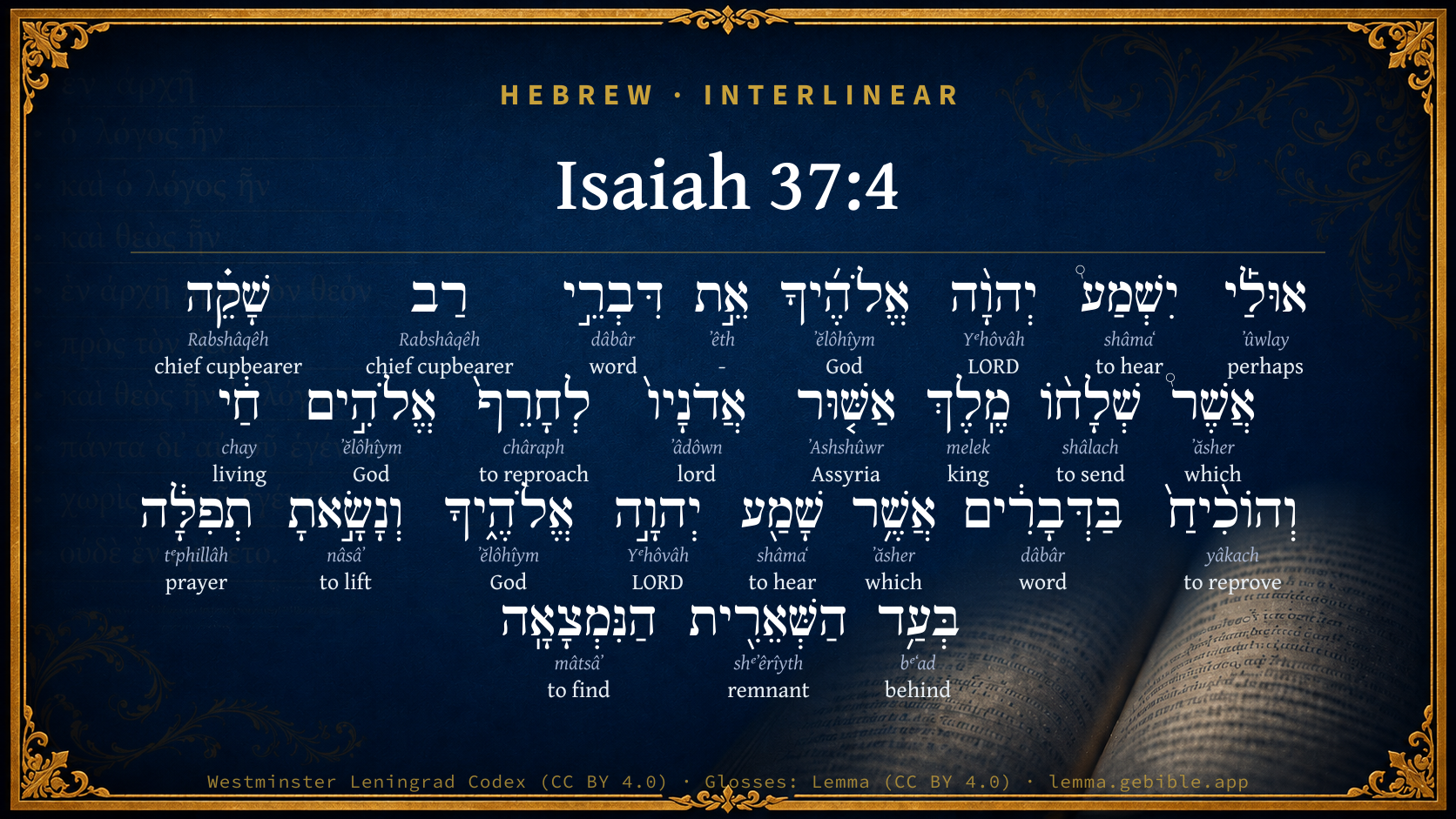
  1. אוּלַ֡י ʼûwlay H194 “perhaps” Adverb
  2. יִשְׁמַע֩ shâmaʻ H8085 “to hear” Verb, Qal, Imperfect, 3rd Person, Masculine, Singular
  3. יְהוָ֨ה Yᵉhôvâh H3068 “LORD” Noun, Proper
  4. אֱלֹהֶ֜יךָ ʼĕlôhîym H430 “God(s) · your” Noun, Common, Masculine, Plural, Construct + Suffix, Personal, 2nd Person, Masculine, Singular
  5. אֵ֣ת ʼêth H853 “-” Particle, Direct Object
  6. דִּבְרֵ֣י dâbâr H1697 “words of” Noun, Common, Masculine, Plural, Construct
  7. שָׁקֵ֗ה Rabshâqêh H7262 “chief cupbearer” Noun, Proper
  8. אֲשֶׁר֩ ʼăsher H834 “which” Particle, Relative
  9. שְׁלָח֨וֹ shâlach H7971 “to send · him” Verb, Qal, Perfect, 3rd Person, Masculine, Singular + Suffix, Personal, 3rd Person, Masculine, Singular
  10. מֶֽלֶךְ melek H4428 “king of” Noun, Common, Masculine, Singular, Construct
  11. אַשּׁ֤וּר ʼAshshûwr H804 “Assyria” Noun, Proper
  12. אֲדֹנָיו֙ ʼâdôwn H113 “lords · his” Noun, Common, Masculine, Plural, Construct + Suffix, Personal, 3rd Person, Masculine, Singular
  13. לְחָרֵף֙ châraph H2778 “to reproach” Preposition + Verb, Piel, Infinitive Construct
  14. אֱלֹהִ֣ים ʼĕlôhîym H430 “God(s)” Noun, Common, Masculine, Plural, Absolute
  15. חַ֔י chay H2416 “living” Adjective, Adjective, Masculine, Singular, Absolute
  16. וְהוֹכִ֨יחַ֙ yâkach H3198 “and · to reprove” Conjunction + Verb, Hiphil, Sequential Perfect, 3rd Person, Masculine, Singular
  17. בַּדְּבָרִ֔ים dâbâr H1697 “in/at the · words” Preposition, Determined + Noun, Common, Masculine, Plural, Absolute
  18. אֲשֶׁ֥ר ʼăsher H834 “which” Particle, Relative
  19. שָׁמַ֖ע shâmaʻ H8085 “to hear” Verb, Qal, Perfect, 3rd Person, Masculine, Singular
  20. יְהוָ֣ה Yᵉhôvâh H3068 “LORD” Noun, Proper
  21. אֱלֹהֶ֑יךָ ʼĕlôhîym H430 “God(s) · your” Noun, Common, Masculine, Plural, Construct + Suffix, Personal, 2nd Person, Masculine, Singular
  22. וְנָשָׂ֣אתָ nâsâʼ H5375 “and · to lift” Conjunction + Verb, Qal, Sequential Perfect, 2nd Person, Masculine, Singular
  23. תְפִלָּ֔ה tᵉphillâh H8605 “prayer” Noun, Common, Feminine, Singular, Absolute
  24. בְּעַ֥ד bᵉʻad H1157 “behind” Preposition
  25. הַשְּׁאֵרִ֖ית shᵉʼêrîyth H7611 “the · remnant” Particle, Definite Article + Noun, Common, Feminine, Singular, Absolute
  26. הַנִּמְצָאָֽה mâtsâʼ H4672 “the · finding” Particle, Definite Article + Verb, Niphal, Participle Active, Feminine, Singular, Absolute

About this verse

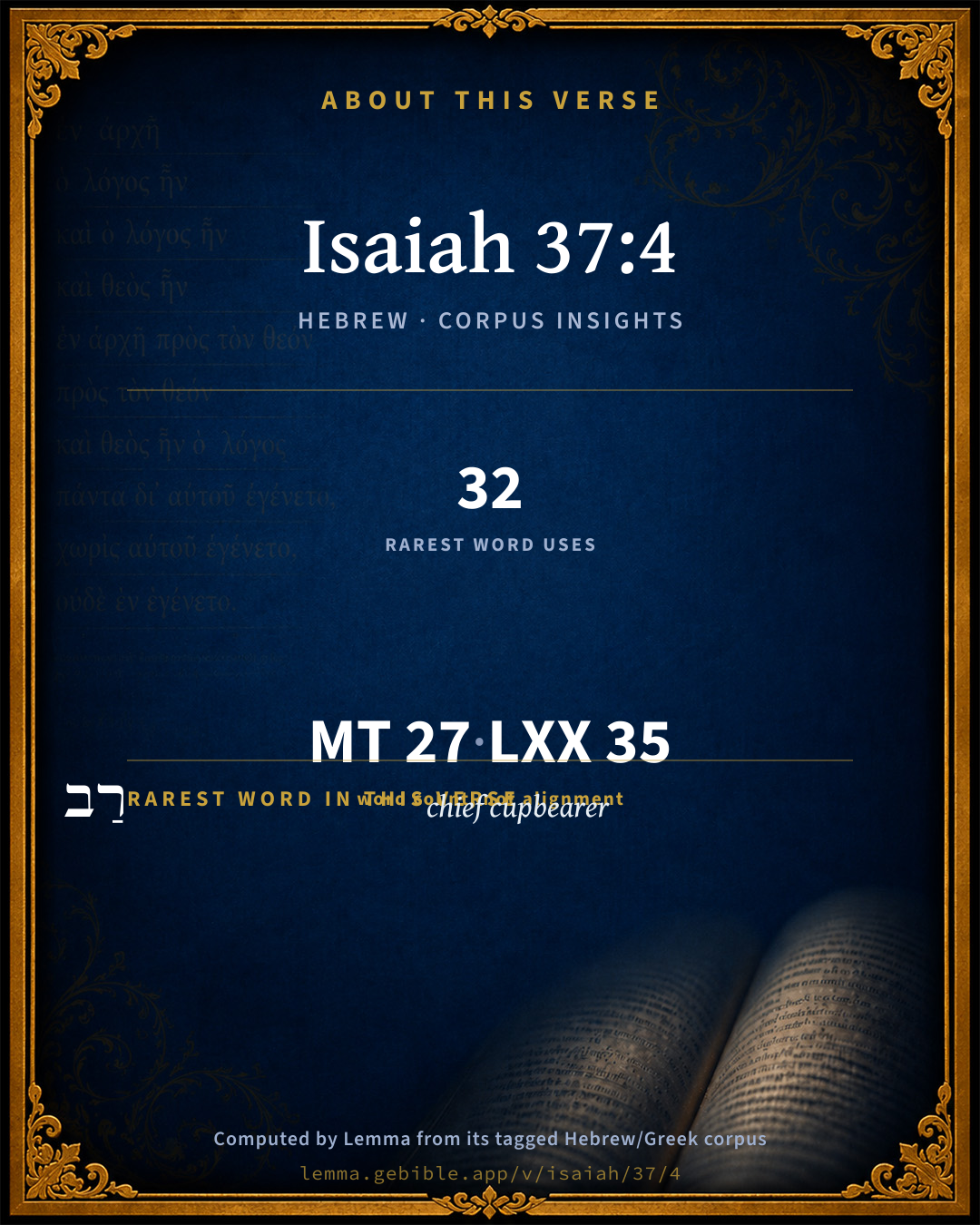
These counts appear in no published source. They are computed here, from the morphology-tagged text and Lemma’s own curated glosses. What Lemma adds →

27
words
20
distinct lemmas
Prophets
section

Shared distinctive vocabulary

רַב chief cupbearer H7262 occurs in 16 verses of the Hebrew Bible. Also found in:

Grammatical profile

  • 7 verbs
  • 14 nouns
  • 1 adjective
  • 1 preposition
  • 1 adverb
  • 3 particles

Verb forms

  • יִשְׁמַע֩ Qal · Imperfect
  • שְׁלָח֨וֹ Qal · Perfect
  • לְחָרֵף֙ Piel · Infinitive Construct
  • וְהוֹכִ֨יחַ֙ Hiphil · Sequential Perfect
  • שָׁמַ֖ע Qal · Perfect
  • וְנָשָׂ֣אתָ Qal · Sequential Perfect
  • הַנִּמְצָאָֽה Niphal · Participle Active

Repetition

Words recur within this verse — often emphatic in Hebrew:

  • אֱלֹהֶ֜יךָ God H430 ×3
  • יִשְׁמַע֩ to hear H8085 ×2
  • יְהוָ֨ה LORD H3068 ×2
  • דִּבְרֵ֣י word H1697 ×2
  • רַב chief cupbearer H7262 ×2
  • אֲשֶׁר֩ which H834 ×2

Hebrew & Septuagint length

In English translation the verse runs 48 words from the Hebrew and 48 from the Septuagint (LXX English) — the same length.

A rough comparison of the two English renderings, which tokenize alike — not a word-level alignment.

Word counts can differ between the Hebrew and the Greek without any difference in meaning — e.g. the Hebrew direct-object marker אֵת has no separate Greek word, and Greek often adds the article ὁ.

In the original languages it is 27 Hebrew tokens and 35 Greek tokens — but the two are counted differently (Hebrew bundles its prefixes and suffixes into one token; the Greek is in lemma form), so that isn’t a like-for-like length.

Cross-references

29

Topical passages linked to Isaiah 37:4 in the Treasury of Scripture Knowledge — connected by theme and wording, ordered by reader-vote popularity; previews shown in the World English Bible.

  • Isaiah 1:9 Unless Yahweh of hosts had left to us a very small remnant, We would have been as Sodom; We would have been like Gomorrah.
  • Isaiah 36:20 Who are they among all the gods of these countries, that have delivered their country out of my hand, that Yahweh should deliver Jerusalem out of my hand?
  • Psalms 106:23 Therefore he said that he would destroy them, Had Moses, his chosen, not stood before him in the breach, To turn away his wrath, so that he wouldn't destroy them.
  • Isaiah 10:22 For though your people, Israel, be as the sand of the sea, [only] a remnant of them shall return: a destruction [is] determined, overflowing with righteousness.
  • Joshua 14:12 Now therefore give me this hill-country, of which Yahweh spoke in that day; for you heard in that day how the Anakim were there, and cities great and fortified: it may be that Yahweh will be with me, and I shall drive them out, as Yahweh spoke.
  • 1 Samuel 7:8 The children of Israel said to Samuel, "Don't cease to cry to Yahweh our God for us, that he will save us out of the hand of the Philistines."
  • 1 Samuel 12:19 All the people said to Samuel, Pray for your servants to Yahweh your God, that we not die; for we have added to all our sins [this] evil, to ask us a king.
  • 1 Samuel 12:23 Moreover as for me, far be it from me that I should sin against Yahweh in ceasing to pray for you: but I will instruct you in the good and the right way.
  • 1 Samuel 14:6 Jonathan said to the young man who bore his armor, Come, and let us go over to the garrison of these uncircumcised: it may be that Yahweh will work for us; for there is no restraint to Yahweh to save by many or by few.
  • 1 Samuel 17:26 David spoke to the men who stood by him, saying, What shall be done to the man who kills this Philistine, and takes away the reproach from Israel? for who is this uncircumcised Philistine, that he should defy the armies of the living God?
  • 1 Samuel 17:36 Your servant struck both the lion and the bear: and this uncircumcised Philistine shall be as one of them, seeing he has defied the armies of the living God.
  • 2 Samuel 16:12 It may be that Yahweh will look on the wrong done to me, and that Yahweh will requite me good for [his] cursing of me this day.
  • 2 Kings 17:18 Therefore Yahweh was very angry with Israel, and removed them out of his sight: there was none left but the tribe of Judah only.
  • 2 Kings 18:9–16 It happened in the fourth year of king Hezekiah, which was the seventh year of Hoshea son of Elah king of Israel, that Shalmaneser king of Assyria came up against Samaria, and besieged it.
  • 2 Kings 19:4 It may be Yahweh your God will hear all the words of Rabshakeh, whom the king of Assyria his master has sent to defy the living God, and will rebuke the words which Yahweh your God has heard. Therefore lift up your prayer for the remnant that is left.
  • 2 Kings 19:22–23 Whom have you defied and blasphemed? and against whom have you exalted your voice and lifted up your eyes on high? [even] against the Holy One of Israel.
  • 2 Chronicles 28:19 For Yahweh brought Judah low because of Ahaz king of Israel; for he had dealt wantonly in Judah, and trespassed severely against Yahweh.
  • 2 Chronicles 32:15–20 Now therefore don't let Hezekiah deceive you, nor persuade you after this manner, neither believe you him; for no god of any nation or kingdom was able to deliver his people out of my hand, and out of the hand of my fathers: how much less shall your God deliver you out of my hand?
  • Psalms 50:21 You have done these things, and I kept silent. You thought that the "I AM" was just like you. I will rebuke you, and accuse you in front of your eyes.
  • Isaiah 8:7–8 now therefore, behold, the Lord brings up on them the waters of the River, strong and many, [even] the king of Assyria and all his glory: and it shall come up over all its channels, and go over all its banks;
  • Isaiah 10:5–6 Ho Assyrian, the rod of my anger, the staff in whose hand is my indignation!
  • Isaiah 36:13 Then Rabshakeh stood, and cried with a loud voice in the Jews' language, and said, Hear you the words of the great king, the king of Assyria.
  • Isaiah 36:18 Beware lest Hezekiah persuade you, saying, Yahweh will deliver us. Has any of the gods of the nations delivered his land out of the hand of the king of Assyria?
  • Isaiah 37:23–24 Whom have you defied and blasphemed? and against whom have you exalted your voice and lifted up your eyes on high? [even] against the Holy One of Israel.
  • Isaiah 51:7–8 Listen to me, you who know righteousness, the people in whose heart is my law; don't you fear the reproach of men, neither be you dismayed at their insults.
  • Joel 2:17 Let the priests, the ministers of Yahweh, weep between the porch and the altar, And let them say, "Spare your people, Yahweh, And don't give your heritage to reproach, That the nations should rule over them. Why should they say among the peoples, 'Where is their God?'"
  • Amos 5:15 Hate evil, love good, And establish justice in the courts. It may be that Yahweh, the God of hosts, will be gracious to the remnant of Joseph."
  • Romans 9:27 Isaiah cries concerning Israel, "If the number of the children of Israel are as the sand of the sea, It is the remnant who will be saved;
  • James 5:16 Confess your offenses to one another, and pray one for another, that you may be healed. The effective, earnest prayer of a righteous man is powerfully effective.

Cross-references courtesy of OpenBible.info (CC BY 4.0).

Hebrew and Greek witnesses Masoretic Hebrew ↔ Greek Septuagint

The same verse in the two great witnesses to the Old Testament, shown verse-for-verse.

These are two independent witnesses, not word-aligned to each other, and the Septuagint is shown in lemma (dictionary) form.

Hebrew Isaiah 37:4 Masoretic · Westminster Leningrad Codex

אוּלַ֡י יִשְׁמַע֩ יְהוָ֨ה אֱלֹהֶ֜יךָ אֵ֣ת דִּבְרֵ֣י רַב שָׁקֵ֗ה אֲשֶׁר֩ שְׁלָח֨וֹ מֶֽלֶךְ אַשּׁ֤וּר אֲדֹנָיו֙ לְחָרֵף֙ אֱלֹהִ֣ים חַ֔י וְהוֹכִ֨יחַ֙ בַּדְּבָרִ֔ים אֲשֶׁ֥ר שָׁמַ֖ע יְהוָ֣ה אֱלֹהֶ֑יךָ וְנָשָׂ֣אתָ תְפִלָּ֔ה בְּעַ֥ד הַשְּׁאֵרִ֖ית הַנִּמְצָאָֽה

It may be Yahweh your God will hear the words of Rabshakeh, whom the king of Assyria his master has sent to defy the living God, and will rebuke the words which Yahweh your God has heard. Therefore lift up your prayer for the remnant that is left.

World English Bible · Public Domain

Greek LXX Isaiah 37:4 Septuagint · lemma form

εἰςἀκούω κύριος ὁ θεός σύ ὁ λόγος ραψακης ὅς ἀποστέλλω βασιλεύς ἀσσύριος ὀνειδίζω θεός ζάω καί ὀνειδίζω λόγος ὅς ἀκούω κύριος ὁ θεός σύ καί δέω πρός κύριος ὁ θεός σύ περί ὁ καταλείπω οὗτος

May the Lord your God hear the words of Rabsaces, which the king of the Assyrians has sent, to reproach the living God, even to reproach with the words which the Lord your God has heard: therefore you shall pray to your Lord for these that are left.

LXX2012 (modern English Septuagint) · Public Domain

Hebrew: Westminster Leningrad Codex (CC BY 4.0). Greek: Septuagint (public domain); English from LXX2012 (modern English Septuagint) (Public Domain). How the Septuagint differs from the Hebrew →

Targum (Aramaic paraphrase)

1

The Targum is the ancient Jewish Aramaic paraphrase of the Hebrew Scriptures — an interpretive translation, not the Hebrew text itself. Onkelos (literal) and Pseudo-Jonathan (expansive) render the Torah, and Jonathan the Prophets. Coverage is partial: where no permissively-licensed English translation exists for a verse, only the Aramaic is shown. This is verse-level text, not a word-by-word alignment to the Hebrew.

  1. Targum Jonathan Prophets (Joshua–Malachi)
    מָאִים שְׁמִיעַ קֳדָם יְיָ אֱלָהָךְ יַת פִּתְגָמֵי רַבְשָׁקֵה דְשַׁלְחֵהּ מַלְכָּא דְאַתּוּר רִבּוֹנֵהּ לְחַסָדָא עַמָא דַייָ קְיָמָא וְיַעְבֵּיד פּוּרְעֲנוּתָא עַל כָּל פִּתְגָמַיָא דְשָׁמְעִין קֳדָם אֱלָהָךְ וְתִתְחַנֵן בִּצְלוֹ עַל שְׁאָרָא דְאִשְׁתְּאַר:

    Perhaps the words of Rabshakeh may be heard by the Lord thy God, whom the king of Assyria, his master, hath sent to reproach the people of the living God, and he may take vengeance for the words which were heard before thy God, wherefore thou shalt supplicate in prayer for the remnant that is left.

    Targum Jonathan — Aramaic: “Mikraot Gedolot” (public domain). English: “Sefaria Community Translation” (CC0 1.0 (public-domain dedication)); “London "Chaldee Paraphrase," 1871” (public domain). Text via Sefaria.

Commentary

Notes on Isaiah 37:4 from classic Christian and Jewish commentators (each source and its license shown beneath its notes). The classic Christian expositions comment on the surrounding passage and are grouped to its opening verse, so a note may address several verses; the Jewish commentaries on the Tanakh (Rashi and others) are per-verse, so they appear only where the commentator wrote on this verse.

Lemma curates 59 commentaries, every one of them public domain or Creative Commons licensed, each selected and text-cleaned for this edition rather than reprinted as found. About our sources →

The Biblical Illustrator

Joseph S. Exell

Isa_37:4

Lift up thy prayer for the remnant that is left

Efficacious prayer

I.

THE PERSON WHO WAS TO ENGAGE IN THE WORK OF INTERCESSION Was one of great eminence in the Church and commonwealth, a great and good man, a prophet of the Lord, and one who was indulged with peculiar nearness to Him. Persons of eminent piety will not be contented with ordinary applications to the throne of grace; they will seek till they find, and wrestle till they prevail. This was a day of trouble, as Hezekiah calls it; and therefore, it ought to be a day of prayer. Intercession is the duty of all saints. But herein ministers should take the lead. They are the Churchs watchmen, and Gods remembrancers. Zedekiah, who at one time cast Jeremiah the prophet into a dungeon, at another time desired an interest in his supplications, and sent messengers to him, saying, Pray now unto the Lord our God for us. And God often spares the wicked for the sake of the righteous, and in answer to their requests, even as the intercession of Abraham was accepted for the inhabitants of Sodom.

II. THOSE FOR WHOM THE PROPHET WAS REQUESTED TO PRAY were the remnant that was left; a certain number known unto God, and who remained after the rest were scattered or destroyed. This should teach us, that though in our prayers we should be forgetful of none, yet we are to be particularly mindful of our fellow-Christians, especially when in a state of adversity. It becomes us also to be attentive to public and national calamities, as well as to those which are personal and private, and to spread them before the Lord in prayer and supplication.

III. There is something observable as to THE MANNER IN WHICH THE PROPHETS INTERCESSION IS REQUESTED. Lift up thy prayer. This expressive form of speech may teach us to remember--

1. That the glorious object of prayer is infinitely exalted.

2. The low and mean condition of the worshipper.

3. The secrecy of prayer, according to our Lords direction, When thou prayest, enter into thy closet, &c. Lifting up a prayer may denote the same thing as David expresses by the lifting up of the soul to God, in mental and silent ejaculation.

4. The importunity and ardour of prayer. In lifting up our prayer to God, our affections should rise high, though our voice may be low and feeble.

5. The spirituality and heavenly-mindedness of the person engaged.

6. Boldness and confidence, accompanied with the hope of being heard and answered.

7. The proper end of prayer, which is not to draw the Divine Being near to us, but ourselves to Him. (B. Beddome, M. A.)

The Biblical Illustrator, edited by Joseph S. Exell (c. 1880s–1900s) — public domain. Text from a community e-Sword module.

Tyndale Open Study Notes

Tyndale Open Resources

37:4 perhaps . . . God has heard the Assyrian chief of staff . . . defy the living God: Hezekiah’s hope was not based on Judah’s or his own goodness, or the presence of the Temple in Jerusalem; instead, it was based on God responding to Assyria’s blasphemy.

Tyndale Open Study Notes — © Tyndale Open Resources, licensed CC BY-SA 4.0. Text via the HelloAO Bible API.

Geneva Bible (1599)

Geneva Bible translators

That is, will declare by effect that he hath heard it: for when God deferreth to punish, it seemeth to the flesh, that he knoweth not the sin, or heareth not the cause.

Declaring that the minister’s office doth not only stand in comforting by the word, but also in praying for the people.

Geneva Bible (1599) marginal notes — public domain. Text via Bolls.life.

Jamieson, Fausset & Brown

Robert Jamieson, A. R. Fausset & David Brown

hear--take cognizance of (Sa2 16:12).

reprove--will punish him for the words, &c. (Psa 50:21).

remnant--the two tribes of the kingdom of Judah, Israel being already captive. Isaiah is entreated to act as intercessor with God.

Jamieson, Fausset & Brown — Commentary Critical and Explanatory on the Whole Bible (1871) — public domain (CC PDM 1.0). Text via the HelloAO Bible API.

Ellicott's Commentary for English Readers

(4) Lift up thy prayer for the remnant . . .—Isaiah’s characteristic words (Isa_1:9; Isa_10:21) had impressed itself on the king’s mind. Now that town after town of Judah had fallen into Sennacherib’s hands (forty-six, according to his inscriptions—Records of the Past, i. 38), those who were gathered within the walls of Jerusalem were as a mere remnant of the people.

A Bible Commentary for English Readers, edited by Charles John Ellicott (1878–1897) — public domain. Text from a community e-Sword module.

The Cambridge Bible for Schools and Colleges

gen. ed. J. J. S. Perowne

4. It may be] Or “Peradventure.” The one hope is that Jehovah will take notice of the dishonour done to His name by the threats and blasphemies of the Assyrian king. the Lord thy God] See ch. Isa_7:13. The prophet stands nearer to God than other men. Jehovah is the living God, as opposed to the dead idols to whose level the boast of the Assyrian had degraded Him. (Cf. 1Sa_17:26; 1Sa_17:36.)

wherefore lift up] Or perhaps “and that thou wilt lift up,”—still dependent on “It may be.” The efficacy of intercessory prayer is taught and assumed throughout the Old Testament: see Gen_18:23 ff.; Exo_32:31 ff.; 1Sa_12:19; Amo_7:2; Amo_7:5; Jer_14:11; Jer_15:1, &c.

the remnant that is left] Cf. Isa_37:32. The idea is Isaiah’s; but the word is not that used elsewhere by the prophet himself.

The Cambridge Bible for Schools and Colleges (gen. ed. J. J. S. Perowne; Cambridge University Press, 1878–1918) — public domain. Text from a community e-Sword module.

John Gill's Exposition

It may be the Lord thy God will hear the words of Rabshakeh,.... He had heard them; but the sense is, that it might be that he would take notice of them, and resent them in a public manner, and punish for them; and this is said, not as doubting and questioning whether he would or not, but as hoping and encouraging himself that he would: and it may be observed, that Hezekiah does not call the Lord "my God", or "our God", because he and his people were under the chastening hand of God for their sins, and were undeserving of such a relation; but "thy God", whose prophet he was, whom he served, and to whom he was dear, and with whom he had an interest; and therefore it might be hoped his prayer to him would be heard and accepted, and that through his interposition God would be prevailed upon to take notice of the railing speech of Rabshakeh:

whom the king of Assyria his master hath sent to reproach the living God; who has life in and of himself, and is the fountain, author, and giver of life to all others; him he reproached by setting him on a level with the lifeless idols of the Gentiles:

and will reprove the words which the Lord thy God hath heard; reprove him for his words, take vengeance upon him, or punish him for the blasphemous words spoken by him against the Lord and in his hearing: to this sense is the Targum; and so the Syriac and Arabic versions:

wherefore lift up thy prayer for the remnant that is left; lift up thy voice, thy hands, and thine heart, in prayer to God in heaven; pray earnestly and fervently for those that are left; the two tribes of Judah and Benjamin, the other ten having been carried captive some time ago; or the inhabitants of Jerusalem particularly, the defenced cities of Judah having been already taken by the Assyrian king. The fewness of the number that remained seems to be made use of as an argument for prayer in their favour. In times of distress, men should not only pray for themselves, but get others to pray for them, and especially men of eminence in religion, who have nearness of access to God, and interest in him.

John Gill's Exposition of the Whole Bible (1746–1763) — public domain (CC PDM 1.0). Text via the HelloAO Bible API.

Albert Barnes' Notes on the Bible

It may be the Lord thy God - The God whom thou dost serve, and in whose name and by whose authority thou dost exercise the prophetic office.

Will hear the words - Will come forth and vindicate himself in regard to the language of reproach and blasphemy which has been used. See a similar use of the word ‘hear’ in Exo 2:24; Exo 3:7.

To reproach the living God - The revilings of Rabsbakeh were really directed against the true God. The reproach of the ‘living God’ consisted in comparing him to idols, and saying that be was no more able to deleted Jerusalem than the idol-gods had been able to defend their lands (see the note at Isa 36:18). The phrase ‘the living God’ is often applied to Yahweh in contradistinction from idols, which were mere blocks of wood or stone.

For the remnant that is left - For those who survive; or probably for those parts of the land, including Jerusalem, that have not fallen into the hands of the Assyrian. Sennacherib had taken many towns, but there were many also that had not yet been subdued by him.

Albert Barnes' Notes on the Bible (1834–1885) — public domain. Text from a community e-Sword/MySword module.

Whedon's Commentary on the Bible

Daniel D. Whedon

4. It may be — Peradventure, possibly, perhaps.

The Lord thy God will hear — Jehovah will not fail to inflict vengeance on the blasphemy poured on his name this day by Rabshakeh, in behalf of his master, Sennacherib. The king puts this timidly, as though he hardly dared to hope; yet he does, and opens the apodosis of the sentence with a wherefore, or therefore, lift up thy prayer, namely, to Heaven. The idea here is, not merely a mental prayer, but one of deep struggle, of importunity and strong utterance.

For the remnant that is left — Namely, Jerusalem and its people. This city only had been prepared to resist invasion. All the villages round about were open to sack and overthrow.

Daniel D. Whedon (gen. ed.), Commentary on the Old and New Testaments (1874–1909) — public domain. Text from a community e-Sword module.

The Pulpit Commentary

It may be the Lord... will hear; i.e. "will notice," or "will punish." If Isaiah laid the matter before God, and prayed earnestly, it was possible that God would intervene to save Judah, and punish the blapshemous words uttered. The living God. In opposition to the dead idols of the heathen, which had neither life, nor breath, nor perception. (see Psa_115:4-8 Psa_135:15-18) The remnant that is left. It is usual to explain this of Judah generally, which still survived, although Israel had been carried away captive. But perhaps the contrast is rather between the numerous Judaean captives who had been taken and conveyed to Assyria by Sennacherib when he took the "fenced cities", (Isa_36:1) and the portion of the nation which still remained in the land. Sennacherib says, in his annals, that he took "forty-six" cities, and carried captive to Assyria above two hundred thousand persons ("Records of the Past," vol. 1. p. 38).

Responsibility of prayer-leaders.

The message sent to Isaiah, the prophet of God, was this: "Pray for us; be our leader, our intercessor." "Wherefore lift up thy prayer for the remnant that is left." Scripture singles out Samuel and Moses as great prayer-leaders, or intercessors, but we can add Joshua, David, our Lord Jesus Christ, and the Apostle Paul, drawing further illustrations from each of these. The Prophet Jeremiah has a very striking sentence, which indicates the power that prayer-leaders have with God: "Then said the Lord unto me, Though Moses and Samuel stood before me, yet my mind could not be toward this people". (Jer_15:1) Isaiah, in our text, was sought by Hezekiah in his trouble, because he was a prayer-leader, an intercessor. We note that the things about men which are really most important are not the things which most readily attract attention. We need to get the view of men which God takes, if we would get the true view. Some of the best gifts bestowed on the Christian Church are undervalued; the endowments which give men public prominence are thought much more of than those spiritual powers which are men"s best possessions. To some men God gives, in unusual measure, the power of prayer. There is a remarkable difference between good men in this gift and power of prayer. We see the difference in our children. Some of them are able to move and persuade us so that we find it most difficult to refuse them anything. And men and women seem to have a like power in their relations with God a most responsible power., Some of us can never rise above the orderly habit of prayer, and treat it as a matter of duty; but others have such praying frames of mind that, at any moment, they seem able to go in to God. There are men among us who are true prayer-leaders whose utterance is full of petition, who are able to seize the souls of their fellow-worshippers, be their mouthpiece, and carry their desires within the veil; while other good men can only pray before us, and fail to awaken responsive prayer-feelings in our hearts.

I THE GREATNESS OF PRAYER THAT RISES TO BE INTERCESSION. Man"s power of prayer is a faculty full of high possibilities. It may rise even to this it may go beyond all self-spheres, and become intercessory. While prayer keeps in the self-sphere there is a certain narrowness and even meanness about it. It is all concerned with what we want, and what we feel, and we are greatly comforted if we have any fervour of emotion in such prayer. But we feel that a course of daily prayer from which the interceding element is removed would be most injurious to the spiritual life. It lacks the generous, sympathetic, unselfish element, and it will very soon lack fervour and faith. No one can long keep up a prayerful life, and persist in praying altogether about himself. Power comes, love grows, when prayer includes intercession. Limitations of earnestness and importunity pass away; the soul is free to urge its pleas with persevering instancy; we can ask for another what we dare not fashion into a prayer for ourselves. The prayers of Scripture are, for the most part, intercessory. Illustrate Abraham"s for Sodom; Moses", Joshua"s, Samuel"s, for the people of Israel in their distresses. Daniel prays with his window open towards desolate Jerusalem, that he may be reminded of the captive people. Our last sight of Job finds him in the attitude of the mediator, praying for God"s mercy on his mistaken and cruel friends. And the Apostle Paul writes again and again of the constancy of his intercessions. We may learn the secret of the poverty and formality of much Christian praying. It has so little intercession in it. When some beloved friend is smitten down with imperilling sickness, our prayer suddenly gains strength, and becomes a thing full of fervour and pathos. All our souls then go out in strong crying and tears. But this power might be in our praying always. We might be not only prayerful men, but also prayer-leaders, carrying the burdens of others to the throne of grace, and ourselves sanctified through the carrying.

II THE POWER OF INTERCESSION THAT MAY BE IN A SINGLE INDIVIDUAL. Any one of us may have the gift of intercession. One man, one woman, even one child, may bring down the Divine benedictions as refreshing rains upon us. We may kneel for others before God. We may win the blessing, prevailing with God, for men. Illustrate from the life of Moses. Note three great interceding-times:

(1) at Rephidim;

(2) matter of golden calf;

(3) return of spies.

Or from the life of Samuel, who may be regarded as the most consistently beautiful character in the Bible. Note two cases:

(1) battle with Philistines;

(2) matter of asking for a king.

But what responsibilities rest on such men! On such men living amongst us now! Who can tell what the Church of God would become, if interceders would but intercede? Plead that, in these times, we need to be often recalled to the power of prayer. "We have not, because we ask not." The Prophet Isaiah has a wonderful conception. He represents God as looking out upon men in their sin and sorrow and shame, and saying, "I saw that there was no man, and I wondered that there was no intercessor." It may be so still God may look into our family lives, and wonder that there is no intercessor. He may look at our Churches, and wonder that there is no intercessor. Oh for a multiplying of men and women who say, "I can pray. I can intercede. I can plead for Jerusalem"! R.T.

The Pulpit Commentary (1880–1919), ed. H.D.M. Spence-Jones & Joseph S. Exell — public domain. Text from a community e-Sword module.

J. A. Alexander on Isaiah

Joseph Addison Alexander

“If peradventure Jehovah thy God will hear the words of Rabshakeh, whom the king of Assyria his master hath sent to reproach the living God, and will rebuke the words which Jehovah thy God hath heard, then shalt thou lift up a prayer for the remnant (that is still) found (here).” It was because Hezekiah thought Jehovah might hear, that he asked Isaiah’s prayers in his behalf. The reproach and blasphemy of the Assyrian consisted mainly in his confounding Jehovah with the gods of the surrounding nations (2Ch 32:19) in antithesis to whom, as being impotent and lifeless, He is here and elsewhere called the living God. To lift up a prayer is not simply to utter one, but has allusion to two common idiomatic phrases, that of lifting up the voice, in the sense of speaking loud or beginning to speak, and that of lifting up the heart or soul, in the sense of earnestly desiring. The passive participle found is often used in Hebrew to denote what is present in a certain place, or more generally what is extant, in existence, or forthcoming. The meaning ‘lift’, which is expressed in the English version, is suggested wholly by the noun with which the participle here agrees. As to the application of the whole phrase, it may either be a general description of the straits or low condition to which the chosen people were reduced (as the church at Sardis is exhorted to strengthen the things which remain - Rev 3:2), or be more specifically understood in reference to Judah as surviving the destruction of the ten tribes (compare Isa 28:5), or to Jerusalem as spared amidst the general desolation of Judah (compare Isa 1:8). In either case, the king requests the prophet to pray for their deliverance from entire destruction. This application was made to Isaiah, not as a private person, however eminent in piety, but as one who was recognized as standing in an intimate relation to Jehovah, and as a constituted medium of communication with Him. In like manner God Himself said to Abimelech of Abraham: ‘he is a prophet, and shall pray for thee, and thou shalt live’ (Gen 20:7).

In recognition of this same relation, Hezekiah twice says ‘thy God’, (i.e., ‘thine in a peculiar and distinctive sense’). This phrase is, therefore, not to be regarded as an expression of despondency, nor even of humility, on Hezekiah’s part, but as a kind of indirect explanation of his reason for resorting to the Prophet at this juncture.

Joseph Addison Alexander, The Prophecies of Isaiah (1846–1847; New York: Scribner, 1870–1878) — public domain. Text from a community e-Sword module.

Rashi

Rabbi Shlomo Yitzchaki (Rashi)

and he brought proof with the words (וְהוֹכִיחַ) He told his strength and showed his success. The word והוֹכִיחַ is eprober in O.F., to prove.

Rashi on the Tanakh — English translations: “The Judaica Press complete Tanach with Rashi, translated by A. J. Rosenberg” (CC BY 4.0); “Pentateuch with Rashi's commentary by M. Rosenbaum and A.M. Silbermann, 1929-1934” (public domain); “The Metsudah Tanach series, Lakewood, N.J” (CC BY 4.0); and “The Book of Joshua, Metsudah Publications, 1997” (CC BY 4.0). Text via Sefaria.

Lesson kit

Teaching starters — assembled from the data on this page, not authored interpretation. Every prompt links to the verse data it draws on. Edit before teaching.

Isaiah, in the Prophets, opens this verse with 27 words (20 distinct Hebrew lemmas). Its most distinctive word is Rabshâqêh (“chief cupbearer”). A historical commentator’s framing appears above. Read the whole chapter for the surrounding context.

Discussion questions

  1. The word Rabshâqêh carries the sense “chief cupbearer.” How does it shape the verse?
  2. How does 2 Kings 18:17, which shares the word «chief cupbearer», read alongside this verse?
  3. What does the repetition of “God” (3× in this one verse) do in this verse?
  4. The translations on this page render this verse differently — a whole-verse word diff, not a word-by-word alignment. What might account for the different wordings?
  5. «יִשְׁמַע֩» is a Qal Imperfect verb. How does that grammatical form shape the action described?
  6. Compare how The Biblical Illustrator and Tyndale Open Study Notes read this verse. Where do they agree or differ?

Things to notice

Reading settings

Reading text

Shown beneath each verse's original-language words.

Old Testament
Old Testament edition

Read the OT as the Masoretic Hebrew (MT) or the Greek Septuagint (LXX).

English shown for the Greek Septuagint (in the Hebrew ↔ Greek comparison).

Comparing translations? Open the Compare panel on any verse page to stack up to four side by side.