
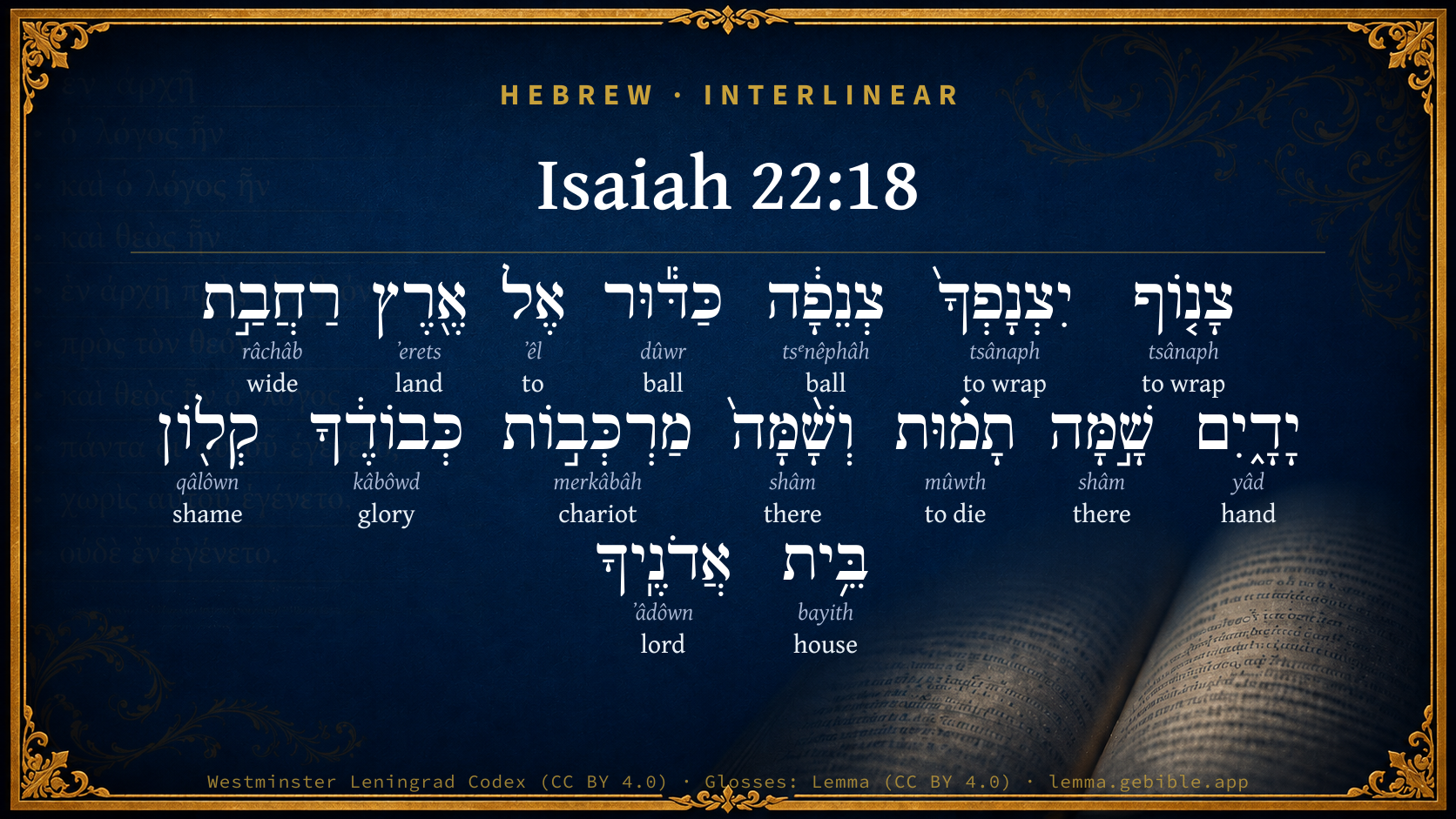
Isaiah 22:18

Hebrew (Westminster Leningrad Codex) Isaiah 22:18 appears in the Hebrew Old Testament. The text above is from the Westminster Leningrad Codex. Each word links to its Strong’s number, a concise gloss, and parsing drawn from the Open Scriptures Hebrew Bible morphology. Click any word for its full Brown-Driver-Briggs (BDB) entry.
Download image
Cite this verse

Isaiah 22:18 (World English Bible). Public Domain. Lemma interlinear Bible study tool, https://lemma.gebible.app/v/isaiah/22/18.

Show BibTeX & RIS
BibTeX
RIS
English Translation
He will surely wind you round and round, [and toss you] like a ball into a large country; there shall you die, and there shall be the chariots of your glory, you shame of your lord's house.
World English Bible · Public Domain
Highlights
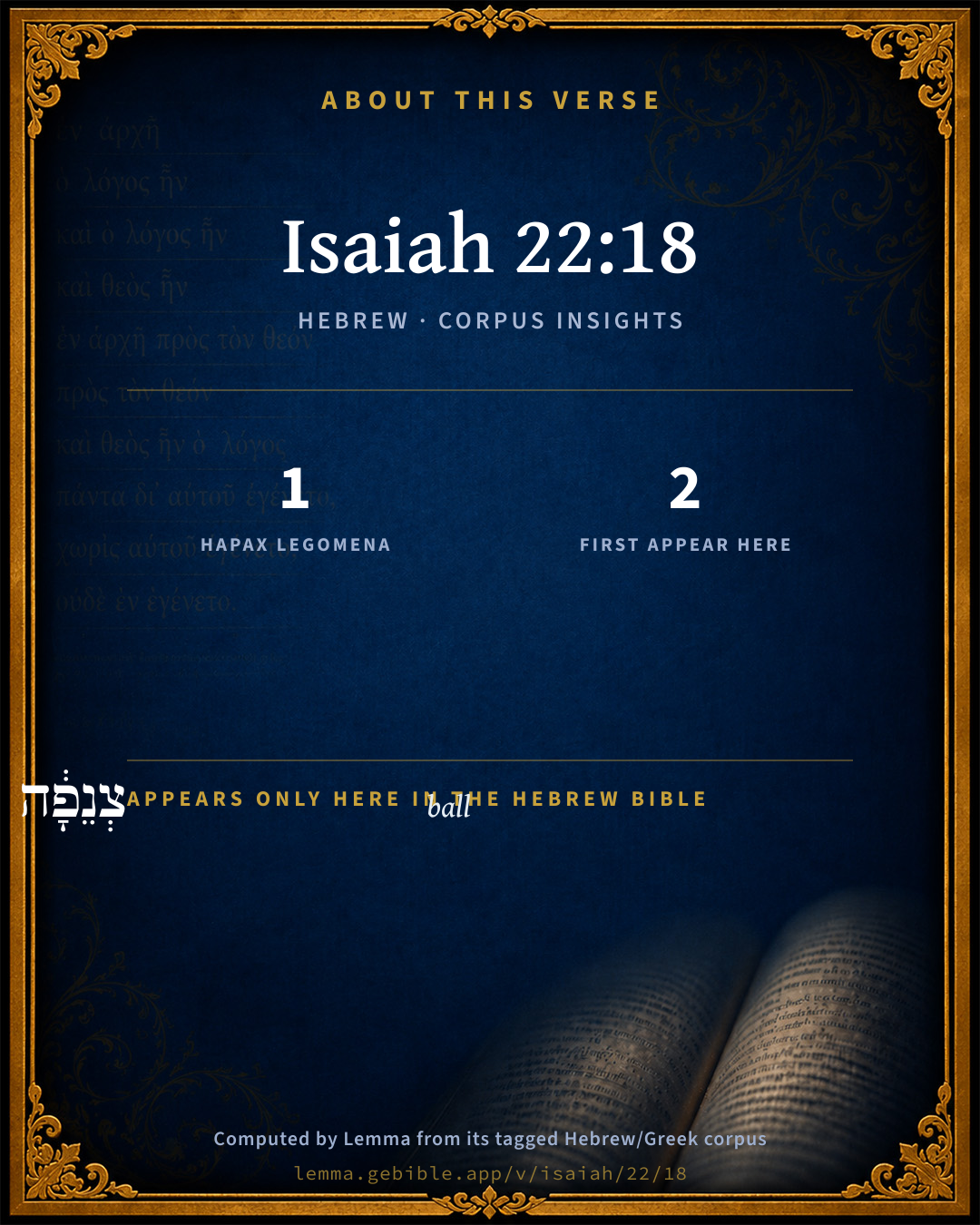
  • 1 hapax legomenon — only here in the Hebrew Bible
  • 2 first appearances in the Hebrew Bible
Full analysis ↓
Download a study sheet

One document with this verse’s original text, its word-by-word gloss line, the meaning frame, cross-references with their text, attributed commentary, and full source and license credits — printable, and it pastes into notes with its structure intact.

This verse Autodidact and up

Study sheet (.html) Plain text (.txt)

A passage Seminary Student

Up to 50 verses in one chapter. A passage sheet keeps up to 6 commentary sources and 12 cross-references per verse, in the order this page ranks them, and says so on the sheet whenever that leaves anything out. Ask for a single verse and you get the Autodidact verse sheet above.

Everything on this page stays free to read, with no account — the sheet is a download of what is already on screen, not access to it.

Want to remove ads? Support Godless Engineer
Compare translations 3

The same verse in 3 English versions, stacked beneath the original-language interlinear above. Click any original word for its lexicon entry.

Each is an independent rendering of the whole verse — the interlinear is not word-aligned to these translations.

Highlighted words mark where these versions differ — a whole-verse word diff, not a word-by-word alignment.

  • World English Bible Public Domain
    He will surely wind you round and round, [and toss you] like a ball into a large country; there shall you die, and there shall be the chariots of your glory, you shame of your lord's house.
  • King James Version Public Domain
    He will surely violently turn and toss thee like a ball into a large country: there shalt thou die, and there the chariots of thy glory shall be the shame of thy lord's house.
  • unfoldingWord Literal Text CC BY-SA 4.0
    Winding, he will wind you, a toss like a ball to a land broad of hands. There you will die, and there, the chariots of your glory, disgrace of the house of your lord!

unfoldingWord Literal Text — © unfoldingWord, licensed CC BY-SA 4.0. Word-aligned USFM3 via Door43 (git.door43.org/unfoldingWord/en_ult).

Versions to compare (up to 4)

3 of 4 selected

Show all 18 translations

Every available English version of this verse, each an independent rendering of the whole verse.

  • World English Bible Public Domain
    He will surely wind you round and round, [and toss you] like a ball into a large country; there shall you die, and there shall be the chariots of your glory, you shame of your lord's house.
  • Berean Standard Bible Public Domain
    roll you into a ball, and sling you into a wide land. There you will die, and there your glorious chariots will remain—a disgrace to the house of your master.
  • Majority Standard Bible Public Domain
    roll you into a ball, and sling you into a wide land. There you will die, and there your glorious chariots will remain—a disgrace to the house of your master.
  • King James Version Public Domain
    He will surely violently turn and toss thee like a ball into a large country: there shalt thou die, and there the chariots of thy glory shall be the shame of thy lord's house.
  • American Standard Version (1901) Public Domain
    He will surely wind thee round and round, `and toss thee' like a ball into a large country; there shalt thou die, and there shall be the chariots of thy glory, thou shame of thy lord's house.
  • Revised Version (1885) Public Domain
    He will surely turn and toss thee like a ball into a large country; there shalt thou die, and there shall be the chariots of thy glory, thou shame of thy lord’s house.
  • Geneva Bible (1599) Public Domain
    He wil surely rolle and turne thee like a bal in a large countrey: there shalt thou die, and there the charets of thy glory shalbe the shame of thy lordes house.
  • Douay-Rheims (1899) Public Domain
    He will crown thee with a crown of tribulation, he will toss thee like a ball into a large and spacious country: there shalt thou die, and there shall the chariot of thy glory be, the shame of the house of thy Lord.
  • Young's Literal Translation Public Domain
    And thy coverer covering, wrapping round, Wrappeth thee round, O babbler, On a land broad of sides -- there thou diest, And there the chariots of thine honour `Are' the shame of the house of thy lord.
  • Literal Standard Version CC BY-SA 4.0
    And your coverer covering, wrapping around, || Wraps you around, O babbler, || On a land of broad sides—there you die, || And there the chariots of your glory [are] the shame of the house of your lord.
  • Unlocked Literal Bible CC BY-SA 4.0
    He will surely wind you round and round, and toss you like a ball into a vast country. There you will die, and there your glorious chariots will be; you will be the shame of your master's house!
  • unfoldingWord Literal Text CC BY-SA 4.0
    Winding, he will wind you, a toss like a ball to a land broad of hands. There you will die, and there, the chariots of your glory, disgrace of the house of your lord!
  • Darby Bible Public Domain
    Rolling thee up completely, he will roll thee as a ball into a wide country: there shalt thou die, and there shall be the chariots of thy glory, O shame of thy lord's house!
  • World Messianic Bible Public Domain
    He will surely wind you around and around, and throw you like a ball into a large country. There you will die, and there the chariots of your glory will be, you disgrace of your lord’s house.
  • Webster's Bible Public Domain
    With violence he will surely turn and toss thee like a ball into a wide country: there shalt thou die, and there the chariots of thy glory shall be the shame of thy lord's house.
  • Free Bible Version CC BY-SA 4.0
    He's going to roll you up into a ball, and throw you far away into a vast country. You will die there, and that's where the chariots you were so proud of will remain. You're a disgrace to your lord's royal family.
  • Bible in Basic English Public Domain
    Twisting you round and round like a ball he will send you out into a wide country: there you will come to your end, and there will be the carriages of your pride, O shame of your lord's house!
  • JPS Tanakh (1917) Public Domain
    He will violently roll and toss thee like a ball into a large country; there shalt thou die, and there shall be the chariots of thy glory, thou shame of the lord's house.

Literal Standard Version (2020), Covenant Press — licensed CC BY-SA 4.0. Text via the HelloAO Bible API (eBible.org). Unlocked Literal Bible (unfoldingWord) — licensed CC BY-SA 4.0. Text via the HelloAO Bible API (eBible.org). unfoldingWord Literal Text — © unfoldingWord, licensed CC BY-SA 4.0. Word-aligned USFM3 via Door43 (git.door43.org/unfoldingWord/en_ult). Free Bible Version, Dr. Jonathan Gallagher — licensed CC BY-SA 4.0. Text via the HelloAO Bible API (eBible.org).

Word by word

More ways to search: Search by grammar → Find every occurrence → Compare this word →

Practice this passage: Drill this verse → Learn its vocabulary →

צְנֵפָ֔ה
tsᵉnêphâh
H6802
“ball”
Noun, Common, Feminine, Singular, Absolute
Part of Speech
Noun
Type
Common
Gender
Feminine
Number
Singular
State
Absolute
Full BDB Definition

Origin: from H6801

TWOT: 1940b

winding, thing wrapped, ball
  1. צָנ֤וֹף tsânaph H6801 “to wrap” Verb, Qal, Infinitive Absolute
  2. יִצְנָפְךָ֙ tsânaph H6801 “to wrap · you” Verb, Qal, Imperfect, 3rd Person, Masculine, Singular + Suffix, Personal, 2nd Person, Masculine, Singular
  3. כַּדּ֕וּר dûwr H1754 “ball” Noun, Common, Masculine, Singular, Absolute
  4. אֶל ʼêl H413 “to” Preposition
  5. אֶ֖רֶץ ʼerets H776 “land” Noun, Common, Both, Singular, Absolute
  6. רַחֲבַ֣ת râchâb H7342 “wide of” Adjective, Adjective, Feminine, Singular, Construct
  7. יָדָ֑יִם yâd H3027 “hands” Noun, Common, Both, Dual, Absolute
  8. שָׁ֣מָּה shâm H8033 “there · toward” Adverb + Suffix, Demonstrative
  9. תָמ֗וּת mûwth H4191 “to die” Verb, Qal, Imperfect, 2nd Person, Masculine, Singular
  10. וְשָׁ֨מָּה֙ shâm H8033 “and · there · toward” Conjunction + Adverb + Suffix, Demonstrative
  11. מַרְכְּב֣וֹת merkâbâh H4818 “chariots of” Noun, Common, Feminine, Plural, Construct
  12. כְּבוֹדֶ֔ךָ kâbôwd H3519 “glory · your” Noun, Common, Both, Singular, Construct + Suffix, Personal, 2nd Person, Masculine, Singular
  13. קְל֖וֹן qâlôwn H7036 “shame of” Noun, Common, Masculine, Singular, Construct
  14. בֵּ֥ית bayith H1004 “house of” Noun, Common, Masculine, Singular, Construct
  15. אֲדֹנֶֽיךָ ʼâdôwn H113 “lords · your” Noun, Common, Masculine, Plural, Construct + Suffix, Personal, 2nd Person, Masculine, Singular

About this verse

These counts appear in no published source. They are computed here, from the morphology-tagged text and Lemma’s own curated glosses. What Lemma adds →

16
words
14
distinct lemmas
Prophets
section

Notable vocabulary

1 hapax legomenon — a word that appears only here in the entire Hebrew Bible:

  • צְנֵפָ֔ה ball H6802

First appearance in Scripture

These words make their first canonical appearance in the Hebrew Bible here:

  • צְנֵפָ֔ה ball H6802
  • כַּדּ֕וּר ball H1754

Shared distinctive vocabulary

צָנ֤וֹף to wrap H6801 occurs in 2 verses of the Hebrew Bible. Also found in:

Grammatical profile

  • 3 verbs
  • 9 nouns
  • 1 adjective
  • 1 preposition
  • 2 adverbs

Verb forms

  • צָנ֤וֹף Qal · Infinitive Absolute
  • יִצְנָפְךָ֙ Qal · Imperfect
  • תָמ֗וּת Qal · Imperfect

Repetition

Words recur within this verse — often emphatic in Hebrew:

  • צָנ֤וֹף to wrap H6801 ×2
  • שָׁ֣מָּה there H8033 ×2

Hebrew & Septuagint length

In English translation the verse runs 37 words from the Hebrew and 34 from the Septuagint (LXX English) — closely comparable.

A rough comparison of the two English renderings, which tokenize alike — not a word-level alignment.

Word counts can differ between the Hebrew and the Greek without any difference in meaning — e.g. the Hebrew direct-object marker אֵת has no separate Greek word, and Greek often adds the article ὁ.

Cross-references

2

Topical passages linked to Isaiah 22:18 in the Treasury of Scripture Knowledge — connected by theme and wording, ordered by reader-vote popularity; previews shown in the World English Bible.

  • Isaiah 17:13 The nations shall rush like the rushing of many waters: but he shall rebuke them, and they shall flee far off, and shall be chased as the chaff of the mountains before the wind, and like the whirling dust before the storm.
  • Amos 7:17 Therefore thus says Yahweh: 'Your wife shall be a prostitute in the city, and your sons and your daughters shall fall by the sword, and your land shall be divided by line; and you yourself shall die in a land that is unclean, and Israel shall surely be led away captive out of his land.'"

Cross-references courtesy of OpenBible.info (CC BY 4.0).

Hebrew and Greek witnesses Masoretic Hebrew ↔ Greek Septuagint

The same verse in the two great witnesses to the Old Testament, shown verse-for-verse.

These are two independent witnesses, not word-aligned to each other, and the Septuagint is shown in lemma (dictionary) form.

Hebrew Isaiah 22:18 Masoretic · Westminster Leningrad Codex

צָנ֤וֹף יִצְנָפְךָ֙ צְנֵפָ֔ה כַּדּ֕וּר אֶל אֶ֖רֶץ רַחֲבַ֣ת יָדָ֑יִם שָׁ֣מָּה תָמ֗וּת וְשָׁ֨מָּה֙ מַרְכְּב֣וֹת כְּבוֹדֶ֔ךָ קְל֖וֹן בֵּ֥ית אֲדֹנֶֽיךָ

He will surely wind you round and round, [and toss you] like a ball into a large country; there shall you die, and there shall be the chariots of your glory, you shame of your lord's house.

World English Bible · Public Domain

Greek LXX Isaiah 22:18 Septuagint · lemma form

καί ὁ στέφανος σύ ὁ ἔνδοξος καί ῥίπτω σύ εἰς χώρα μέγας καί ἀμέτρητος καί ἐκεῖ ἀποθνήσκω καί τίθημι ὁ ἅρμα σύ ὁ καλός εἰς ἀτιμία καί ὁ οἶκος ὁ ἄρχων σύ εἰς καταπάτημα

and will cast you into a great and unmeasured land, and there you shall die: and he will bring your fair chariot to shame, and the house of your prince to be trodden down.

LXX2012 (modern English Septuagint) · Public Domain

Hebrew: Westminster Leningrad Codex (CC BY 4.0). Greek: Septuagint (public domain); English from LXX2012 (modern English Septuagint) (Public Domain). How the Septuagint differs from the Hebrew →

Targum (Aramaic paraphrase)

1

The Targum is the ancient Jewish Aramaic paraphrase of the Hebrew Scriptures — an interpretive translation, not the Hebrew text itself. Onkelos (literal) and Pseudo-Jonathan (expansive) render the Torah, and Jonathan the Prophets. Coverage is partial: where no permissively-licensed English translation exists for a verse, only the Aramaic is shown. This is verse-level text, not a word-by-word alignment to the Hebrew.

  1. Targum Jonathan Prophets (Joshua–Malachi)
    יַעְדֵי מִנָךְ יַת מִצְנֶפְתָּא וְיַקִיפוּנָךְ בַּעֲלֵי דְבַב כְּשׁוּר מַקַף וְיַגְלוּנָךְ לְאַרְעָא פְתַיוּת יְדַיִין תַּמָן תְּמוּת וּלְתַמָן רְתִיכֵי יְקָרָךְ יְתוּבוּן בְּקָלָן עַל דְלָא נְטַרְתָּא יְקָר בֵּית רִבּוֹנָךְ:

    He shall take away from thee thy tiara, and the enemies shall enclose thee, like a surrounding wall, and they shall lead thee into captivity into a spacious country, there thou shalt die, and thither the chariots of thy glory shall return in disgrace, because thou hast not preserved the honours of thy master's house.

    Targum Jonathan — Aramaic: “Mikraot Gedolot” (public domain). English: “Sefaria Community Translation” (CC0 1.0 (public-domain dedication)); “London "Chaldee Paraphrase," 1871” (public domain). Text via Sefaria.

Commentary

Notes on Isaiah 22:18 from classic Christian and Jewish commentators (each source and its license shown beneath its notes). The classic Christian expositions comment on the surrounding passage and are grouped to its opening verse, so a note may address several verses; the Jewish commentaries on the Tanakh (Rashi and others) are per-verse, so they appear only where the commentator wrote on this verse.

Lemma curates 59 commentaries, every one of them public domain or Creative Commons licensed, each selected and text-cleaned for this edition rather than reprinted as found. About our sources →

Trapp's Complete Commentary

John Trapp

Isa 22:18 He will surely violently turn and toss thee [like] a ball into a large country: there shalt thou die, and there the chariots of thy glory [shall be] the shame of thy lord’s house.

Ver. 18. He will surely turn and toss thee.] Turn thee like a bowl, and toss thee like a ball. How and when this was fulfilled the Scripture relateth not. But the Talmudists tell us that Shebna, revolting to Sennacherib, was by him - after the execution done by God’s angel upon his forces - carried to Nineveh, there tied to a horse tail, and drawn through briers and brambles till he died.

There shalt thou die.] Ingloria vita recedet. Spotswood, Archbishop of St Andrews, who had discouraged, and by degrees extirpated, many faithful ministers of Scotland, thought it seasonable, A.D. 1639, to repair into England, where he died; and so was fulfilled upon him the prediction of Mr Walsh, a famous Scottish minister, who, in a letter to the bishop, written long before, told him he should die an outcast. {a}

And there the chariots of thy glory.] Thy stately chariots, wherein thou delightest to be hurried up and down, these shall also die or cease; O domus regiae dedecus! O optimi regis opprobrium! - for so some read the words by an apostrophe to Shebna - O thou that art such a blur to thy good master, and such a disgrace to his house. {b} Shebna affected to bear as great a deportment almost as the king himself did, sed passus est manes suos, but he came to an ill end. So did the Duke of Guise in France; and so did here Cardinal Wolsey, Sir Thomas Moore, Sir Francis Bacon, &c.

{a} Myst. of Iniq., p. 15.

{b} O dedecus domus domini!

John Trapp, A Commentary or Exposition upon All the Books of the Old and New Testament (1647–1656) — public domain. Text from a community e-Sword module.

The Biblical Illustrator

Joseph S. Exell

Isa_22:18

He will surely violently turn and toss the like a ball

Shebnas doom

To this unfamilied intruder, who had sought to establish himself in Jerusalem, after the manner of those days, by hewing himself a great sepulchre, Isaiah brought sentence of violent banishment: Behold, Jehovah will be hurling, hurling thee away, thou big man, and crumpling, crumpling thee together.

He will roll, roll thee on, thou rolling stone, like a ball thrown out On broad, level ground; there shalt thou die, and there shall be the chariots of thy glory, thou shame of the house of thy lord. And I thrust thee from thy post, and from thy station do they pull thee down. This vagabond was not to die in his bed, nor to be gathered in his big tomb to the people on whom he had foisted himself. (Prof. G. A. Smith, D. D.)

Shebnas doom

For him, like Cain, there was a land of Nod; and upon it he was to find a vagabonds death. (Prof. G. A. Smith, D. D.)

Shebnas ejection

The ideas suggested are those of violence, rapidity, and distance. (J. A. Alexander.)

Retribution

Those that, when they are in power, turn and toss others, will be justly turned and tossed themselves when their day shall come to fall. Many that have thought themselves fastened like a nail may come to be tossed like a ball, for here have we no continuing city. Shebna thought his place too strait for him, he had no room to thrive; God will, therefore, send him into a large country, where he shall have room to wander, but never find the way back again. (M. Henry.)

The irresistibleness of Gods judgments

Learn--

I. THE EASE WITH WHICH GOD EFFECTS HIS JUDGMENTS.

II. THE UTTER USELESSNESS OF ANY RESISTANCE TO THE DIVINE JUDGMENTS. As surely as a ball must follow the line of projection, so surely must we go whither the judgments of God carry us.

III. THE AWFULNESS OF FALLING INTO THE HANDS OF THE LIVING GOD. (W. Manning.)

The Biblical Illustrator, edited by Joseph S. Exell (c. 1880s–1900s) — public domain. Text from a community e-Sword module.

The Preacher's Complete Homiletical Commentary

Joseph S. Exell (gen. ed.)

THE IRRESISTIBLENESS OF GOD’S JUDGMENTS

Isa_22:18. He will surely violently turn and toss thee like a ball into a large country.

Such was the prophet’s message to a haughty statesman who prided himself on his power. Learn from it—

1. The ease with which God effects His judgments. There are many things we wish to do which require great preparations and extensive machinery; but to toss a ball from the hand is an easy matter, mere child’s play. He who takes up the isles as a very little thing, performs all His works with an ease which cannot be baffled or disturbed.

2. The utter uselessness of any resistance to the Divine judgments. As surely as a ball must follow the line of projection, so surely must we go whither the judgments of God carry us when His set time to visit us is come (H. E. I., 2269, 4960).

3. The awfulness of falling into the hands of the living God.—William Manning.

The Preacher's Complete Homiletical Commentary (gen. ed. Joseph S. Exell; Funk & Wagnalls, c. 1892) — public domain (pre-1929). A full-Bible homiletical/sermon-outline anthology covering 65 of 66 books (2 John is absent from the source module). Text from a community e-Sword module.

Tyndale Open Study Notes

Tyndale Open Resources

22:18 toss you away into a distant, barren land: Shebna would not find a resting place or have a memorial (cp. 14:11-20). • your glorious chariots: In his high position, Shebna had lived in luxury.

Tyndale Open Study Notes — © Tyndale Open Resources, licensed CC BY-SA 4.0. Text via the HelloAO Bible API.

Geneva Bible (1599)

Geneva Bible translators

Signifying that whatsoever dignity the wicked attain unto, at length it will turn to the shame of those princes, by whom they are preferred.

Geneva Bible (1599) marginal notes — public domain. Text via Bolls.life.

Jamieson, Fausset & Brown

Robert Jamieson, A. R. Fausset & David Brown

violently turn and toss--literally, "whirling He will whirl thee," that is, He will, without intermission, whirl thee [MAURER]. "He will whirl thee round and round, and (then) cast thee away," as a stone in a sling is first whirled round repeatedly, before the string is let go [LOWTH].

large country--perhaps Assyria.

chariots . . . shall be the shame of thy lord's house--rather, "thy splendid chariots shall be there, O thou disgrace of thy lord's house" [NOYES]; "chariots of thy glory" mean "thy magnificent chariots." It is not meant that he would have these in a distant land, as he had in Jerusalem, but that he would be borne thither in ignominy instead of in his magnificent chariots. The Jews say that he was tied to the tails of horses by the enemy, to whom he had designed to betray Jerusalem, as they thought he was mocking them; and so he died.

Jamieson, Fausset & Brown — Commentary Critical and Explanatory on the Whole Bible (1871) — public domain (CC PDM 1.0). Text via the HelloAO Bible API.

Ellicott's Commentary for English Readers

(18) Like a ball into a large country.—The picture is that of a ball flung violently on a smooth, even plain where it bounds on and on with nothing to stay its progress. The “large country” is, probably, the plain of Mesopotamia, where Shebna is to end his days in exile.

There the chariots of thy glory shall be the shame of thy lord’s house.—Better, Thither shall go the chariots of thy glory, the shame of thy lord’s house. The words point to another form of Shebna’s ostentatious pride. Not content with riding on an ass or mule, as even judges and counsellors rode (Jdg_5:10; Jdg_10:4; Jdg_12:14; 2Sa_17:23), he had appeared in public in stately chariots, such as were used by kings (Song Son_1:9; Son_3:9). These were to accompany him in his exile, but it would be as the spoil of the conqueror. There are no records of the fulfilment of the prediction, and the judgment may have been averted by repentance; but when we next meet with Shebna (Isa_36:22) he is in the inferior position of a scribe, and Eliakim occupies his place as being “over the household.”

A Bible Commentary for English Readers, edited by Charles John Ellicott (1878–1897) — public domain. Text from a community e-Sword module.

The Cambridge Bible for Schools and Colleges

gen. ed. J. J. S. Perowne

18. The first half of the verse reads: He will roll thee up in a bundle (and toss thee) like a ball into a spacious land (lit. “a land broad on both sides,” as Gen_34:21; Jdg_18:10). The words “and toss thee” have to be supplied from the context; the construction is pregnant. The figure expresses banishment from Jehovah’s territory, the “spacious land” referring probably to the Assyrian Empire.

there shall thou die (cf. Amo_7:17) and there shall be thy splendid chariots, thou shame of thy lord’s house] To ride forth with “chariots and horses” was once regarded as a sign of aspiring to the highest dignity (2Sa_15:1; 1Ki_1:5); later it seems to have been the privilege of the princely caste (Jer_17:25), peculiarly offensive, therefore, in a foreign adventurer. The concentrated bitterness of the last words points to something worse than political differences as the cause of Isaiah’s antipathy to Shebna.

The Cambridge Bible for Schools and Colleges (gen. ed. J. J. S. Perowne; Cambridge University Press, 1878–1918) — public domain. Text from a community e-Sword module.

John Gill's Exposition

He will surely violently turn and toss thee,.... Or, "wrapping he will wrap thee with a wrapping"; as anything is wrapped up close and round, either to be more commodiously carried, or more easily tossed: or, "rolling he will roll thee with a rolling" (d); that is, roll thee over and over again, till brought to a place appointed:

like a ball into a large country; where there is nothing to stop it; and being cast with a strong hand, runs a great way, and with prodigious swiftness; and signifies, that Shebna's captivity was inevitable, which he could not escape; that he was no more in the hands of the Lord than a ball in the hands of a strong man; and could as easily, and would be, hurled out of his place, into a distant country, as a ball, well wrapped, could be thrown at a great distance by a strong arm; and that this his captivity would be swift and sudden; and that he should be carried into a large country, and at a distance. Jarchi says Casiphia (e), a place mentioned in Ezr 8:17. Aben Ezra interprets it of Babylon, which seems likely.

There shalt thou die: in that large and distant country; and not at Jerusalem, where he had built a magnificent sepulchre for himself and family:

and there the chariots of thy glory; shall cease and be no more; he should not have them along with him to ride in pomp and state, and to show his glory and grandeur, as he had done in Jerusalem. We connect this with the following clause, and supply it thus,

shall be the shame of thy lord's house; as if the chariots and coaches of state he had rode in were to the reproach of the king his master; who had made such an ill choice of a steward of his house, or prime minister of state, and had advanced such a worthless creature to such a dignity; but it may be better supplied thus, without being so strictly connected with the other clause, and which is more agreeable to the accents, "O thou, the shame of thy lord's house" (f); a disgrace and dishonour to Ahaz, who perhaps put him in his office; and to Hezekiah, that continued him in it. The Jews say he was brought to a very shameful end; they say (g), that when he went out of the city of Jerusalem, in order to deliver Hezekiah's forces into the hands of the enemy, Gabriel shut the gate before his army; to whom the enemy said, where's thy army? he replied, they are turned back; say they, thou hast mocked us: upon which they bored his heels, and fastened him to the tails of horses, and drew him upon thorns and briers. So says Kimchi, instead of chariots of glory, he thought they would give him, they put him to shame, binding him to the tails of horses.

(d) "cidarizando cidarizabit te cidari", Forerius; as the priest's linen mitre, Lev. xvi. 4. which was wrapped about his head, so Ben Melech; or any turban, such as were used in the eastern countries; signifying, that he should be rolled up like this, or any such like round thing, and carried away. (e) So in Vajikra, sect. 5. fol. 150. 3. (f) "tu, O dedecus domus domini tui", Tigurine version; "O ignominia", &c. Junius & Tremellius, Piscator. (g) T. Bab. Sanhedrin, fol 26. 1, 2.

John Gill's Exposition of the Whole Bible (1746–1763) — public domain (CC PDM 1.0). Text via the HelloAO Bible API.

Albert Barnes' Notes on the Bible

He will surely violently turn - Lowth has well expressed the sense of this:

He will whirl thee round and round, and cast thee away.

Thus it refers to the action of throwing a stone with a “sling,” when the sling is whirled round and round several times before the string is let go, in order to increase the velocity of the stone. The idea is here, that God designed to cast him into a distant land, and that he would give such an “impulse” to him that he would be sent afar, so far that he would not be able to return again.

Like a ball - A stone, ball, or other projectile that is cast from a sling.

Into a large country - Probably Assyria. When this was done we have no means of determining.

And there the chariots of glory shall be the shame of thy lord’s house - Lowth renders this,

- And there shall thy glorious chariots

Become the shame of the house of thy lord.

Noyes renders it,

There shall thy splendid chariots perish,

Thou disgrace of the house of thy lord.

The Chaldee renders it, ‘And there the chariots of thy glory shall be converted into ignominy, because thou didst not preserve the glory of the house of thy lord.’ Probably the correct interpretation is that which regards the latter part of the verse, ‘the shame of thy lord’s house,’ as an address to him as the shame or disgrace of Ahaz, who had appointed him to that office, and of Hezekiah, who had continued him in it. The phrase ‘the chariots of thy glory,’ means splendid or magnificent chariots; and refers doubtless to the fact that in Jerusalem he had affected great pride and display, and had, like many weak minds, sought distinction by the splendor of his equipage. The idea here is, that the ‘chariot of his glory,’ that is, the vehicle in which he would ride, would be in a distant land, not meaning that in that land he would ride in chariots as magnificent as those which he had in Jerusalem, but that he would be conveyed there, and probably be borne in an ignominous manner, instead of the splendid mode in which he was carried in Jerusalem. The Jews say that when he left Jerusalem to deliver it into the hands of the enemy, they asked him where his army was; and when he said that they had turned back, they said, ‘thou hast mocked us;’ and that there-upon they bored his heels, and tied him to the tails of horses, and that thus he died.

Albert Barnes' Notes on the Bible (1834–1885) — public domain. Text from a community e-Sword/MySword module.

Haydock's Catholic Bible Commentary

Lord; Manasses, who hath exalted thee. (Calmet)

George Leo Haydock (1774–1849), Haydock's Catholic Family Bible and Commentary, 1859 edition — public domain. Excludes Psalms (Douay-Rheims chapter numbering differs from Protestant) and Deuterocanonical books (Catholic canon only).

Matthew Poole's English Annotations

He will surely violently turn and toss thee like a ball, Heb. wrapping he will wrap thee up like a ball, which consists of materials wrapped and bound together, that it may be tossed far away. Or, Rolling he will roll thee with the rolling of a ball. Into a large country; like a ball which is cast into a large and plain spot of ground, where being thrown by a strong man, it runs far and wide. Or, to a far country, which seems to be here called large of spaces, not so much in itself, for that was inconsiderable to him, whether the land of his captivity was large or little, as in respect of its distance from the place of his birth and abode.

The chariots of thy glory shall be the shame of thy lord’s house. The sense of the words thus rendered seems to be this, Thy glorious chariots, wherein thou didst ride in great state at Jerusalem, shall then and there be turned into shame to thyself, and to thy master, to whom it is just matter of reproach, that he was so foolish as to advance and trust such a faithless and unworthy person. But the words are by divers others fitly rendered,

there the chariots of thy glory shall be, (or, shall die or vanish, i.e. that shall be the end of all thy pompous chariots, and other monuments of thy pride,) O thou who art

the shame of thy Lord’s house; who by thy unjust and wicked practices hast exposed thy king and master, and the royal family, to reproach and contempt.

Matthew Poole's English Annotations on the Holy Bible (1683–1685) — public domain. Text from a community e-Sword/MySword module.

The Pulpit Commentary

He will surely violently turn and toss thee, etc.; literally, rolling he will roll thee with rolling like a ball, etc. Into a large country. Assyria, or perhaps Egypt. If Shebna was disgraced on account of his recommending the Egyptian alliance, he may not improbably have taken refuge with Tirhakah. There the chariots of thy glory shall be the shame of thy lord"s house; rather, there shall be the chariots of thy glory, O thou shame of thy lords house. His chariots, in which he gloried, should accompany him, either as spoil taken by the enemy, or as the instruments of his flight.

God"s violent providences.

Margin Revised Version, "He will surely wind thee round and round like a ball and toss thee." Generally the figure is assumed to be that of a ball flung violently on a smooth, even plain, where it bounds on and on with nothing to stay its progress. But a gentleman was in the island of Mitylene during a great storm of wind in winter, and observed a peculiar plant, not unlike wormwood, which grows into a compact, globular form, with very stiff stalks and branches. In the winter the plant dies down to the ground, and in its dry and light condition is torn from its roots by the wind, and set bounding over the wide and unenclosed country. He reports having seen five or six of these balls coursing along at once. If such plants were found in the countries familiar to the prophet, they would furnish a vivid emblem of the man who is at the mercy of a higher power, and helpless either to choose his own course or to find rest. The point which is proposed for illustration is that there must be a variety of arrows in the Lord"s quiver, and a needs-be sometimes for the severest and most searching dealings. God must sometimes display his sovereign power over men in a crushing and overwhelming way, in order to silence the tongue of pride, to prove that man can never get beyond God"s reach, never raise Babel-towers that he cannot overwhelm. The mightiest forces of nature are God"s instruments. And man"s pride he will utterly abase. Compare the death of the lord who scorned the prophet"s assurance of immediate deliverance; (2Ki_7:19, 2Ki_7:20) Nebuchadnezzar"s humiliation in the hour of his boasting; (Dan_4:29-33) and Herod"s awful death, (Act_12:20-23) when he permitted men to offer him the honors due alone to God. Man"s folly in trying God"s power to smite and wound is finely satirized by Eliphaz the Temanite: (Job_15:25, Job_15:26) "For he stretcheth out his hand against God, and strengtheneth himself against the Almighty. He runneth upon him, even on his neck, upon the thick bosses of his bucklers. R.T.

The Pulpit Commentary (1880–1919), ed. H.D.M. Spence-Jones & Joseph S. Exell — public domain. Text from a community e-Sword module.

John Wesley's Explanatory Notes

Thy chariots - Thy glorious chariots where thou didst ride in great state at Jerusalem, shall be turned into shame to thyself, and to thy master.

John Wesley, Explanatory Notes Upon the Whole Bible (1754–1765) — public domain. Text via the GEBible commentary corpus.

J. A. Alexander on Isaiah

Joseph Addison Alexander

“Rolling He will roll thee in a roll, like a ball (thrown) into a spacious ground, there shalt thou die, and there the chariots of thy glory, shame of thy master’s house.” The ejection of Shebna from the country is compared to the rolling of a ball into an open space where there is nothing to obstruct its progress. The ideas suggested are those of violence, rapidity, and distance. All the interpreters appear to apply this directly to Shebna, and are thence led to raise the question, what land is meant? It seems to me that the phrase in question has relation not to Shebna as a man but to the ball with which he is compared, and that land should be taken in the sense of ground. There are several different constructions of the last clause, of which this is one: thither shalt thou die (i.e., thither shalt thou go to die) and thither shall thy splendid chariots (convey thee). The allusion will then be simply to Shebna’s return to his own country (whether Syria, Phoenicia, Mesopotamia, or Assyria), and not to captivity in war or to suffering in exile, of which there is no intimation in the text. All that the Prophet clearly threatens Shebna with, is the loss of rank and influence in Judah and a return to his own country. An analogous incident in modern history (so far as these circumstances are concerned) is Necker’s retreat from France to Switzerland at the beginning of the French Revolution.

Joseph Addison Alexander, The Prophecies of Isaiah (1846–1847; New York: Scribner, 1870–1878) — public domain. Text from a community e-Sword module.

Rashi

Rabbi Shlomo Yitzchaki (Rashi)

He shall wind you around like a turban that surrounds the head, the enemies and oppressors shall surround you.

like a surrounding wall. (כַּדּוּר). Our Rabbis, however, explained it as an expression of a ball, which they call ‘pelote’ in French, which is tossed and caught from hand to hand.

to a land of ample space in Casiphia, the name of a place.

there you shall die And you shall not be buried in the sepulchre of the House of David, and there the chariots of your glory shall be converted into the shame of the house of your master which you sought.

Rashi on the Tanakh — English translations: “The Judaica Press complete Tanach with Rashi, translated by A. J. Rosenberg” (CC BY 4.0); “Pentateuch with Rashi's commentary by M. Rosenbaum and A.M. Silbermann, 1929-1934” (public domain); “The Metsudah Tanach series, Lakewood, N.J” (CC BY 4.0); and “The Book of Joshua, Metsudah Publications, 1997” (CC BY 4.0). Text via Sefaria.

Ibn Ezra

Rabbi Abraham ibn Ezra

צנוף יצנפך צנפה He will surely bind thee together. Comp. מצנפת mitre (Ex. 28:4). He will take him, together with all his money and wealth.

כדור Like a ball. The כ is the prefix of comparison; the word is familiar from its use in the Rabbinical literature; its meaning may also be gathered from the context.

A large country. Babylon.

There shalt thou die, etc. There he shall die, with all his horsemen. The shame of thy lord’s house. For thou art a disgrace to the house of thy master; or thou wilt then be, etc. This prediction was probably verified in the exile of King Jehoiakim or Jehoiachim; comp. And I will call my servant Eliakim, the son of Hilkiah (ver. 20)

Ibn Ezra on the Tanakh — English translations: “Sefaria Community Translation” (CC0 1.0 (public-domain dedication)); “Yalkut, Sifsei Chachomim Chumash, Metsudah Publications, 2009” (CC BY 4.0); and “Commentary of Ibn Ezra on Isaiah - trans. by M. Friedlander, 1873” (public domain). Text via Sefaria.

Lesson kit

Teaching starters — assembled from the data on this page, not authored interpretation. Every prompt links to the verse data it draws on. Edit before teaching.

Isaiah, in the Prophets, opens this verse with 16 words (14 distinct Hebrew lemmas). Its most distinctive word is tsᵉnêphâh (“ball”). A historical commentator’s framing appears above. Read the whole chapter for the surrounding context.

Discussion questions

  1. What does “ball” (tsᵉnêphâh) contribute to the verse as a whole?
  2. This verse holds 1 word here found nowhere else in the Hebrew Bible. What might the rare word draw attention to?
  3. 2 words here appear for the first time in Scripture. What is being introduced at this debut?
  4. Leviticus 16:4 shares the word «to wrap» with this verse. How do the two illuminate each other?
  5. “to wrap” occurs 2× in this one verse. What is the effect of the repetition?
  6. These translations render this verse differently. What is at stake in choosing one wording over another?
  7. The verb «צָנ֤וֹף» is Qal Infinitive Absolute. How does its form color the action?
  8. Reading how Trapp's Complete Commentary and The Biblical Illustrator read this verse, where do the two commentators agree and where do they part?

Things to notice

  • 1 word in this verse appears nowhere else in the Hebrew Bible.
  • 2 words make their first canonical appearance in Scripture here.
  • These translations choose different wording for 18 words in this verse.
  • “to wrap” occurs 2× in this single verse.
  • 14 distinct Hebrew lemmas span 16 words in this verse.

Reading settings

Reading text

Shown beneath each verse's original-language words.

Old Testament
Old Testament edition

Read the OT as the Masoretic Hebrew (MT) or the Greek Septuagint (LXX).

English shown for the Greek Septuagint (in the Hebrew ↔ Greek comparison).

Comparing translations? Open the Compare panel on any verse page to stack up to four side by side.