
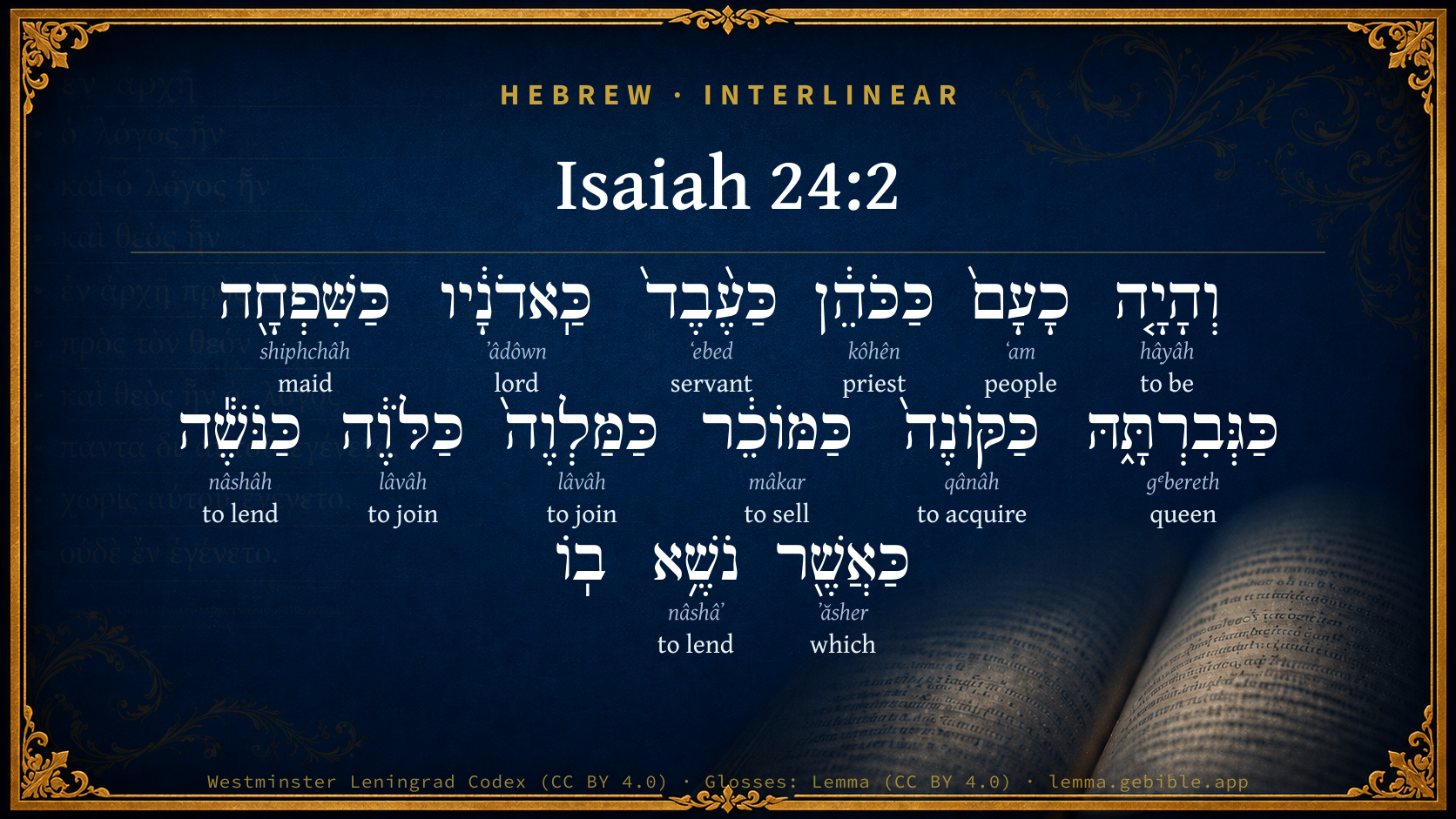
Isaiah 24:2

Hebrew (Westminster Leningrad Codex) Isaiah 24:2 appears in the Hebrew Old Testament. The text above is from the Westminster Leningrad Codex. Each word links to its Strong’s number, a concise gloss, and parsing drawn from the Open Scriptures Hebrew Bible morphology. Click any word for its full Brown-Driver-Briggs (BDB) entry.
Download image
Cite this verse

Isaiah 24:2 (World English Bible). Public Domain. Lemma interlinear Bible study tool, https://lemma.gebible.app/v/isaiah/24/2.

Show BibTeX & RIS
BibTeX
RIS
English Translation
It shall be, as with the people, so with the priest; as with the servant, so with his master; as with the maid, so with her mistress; as with the buyer, so with the seller; as with the creditor, so with the debtor; as with the taker of interest, so with the giver of interest to him.
World English Bible · Public Domain
Download a study sheet

One document with this verse’s original text, its word-by-word gloss line, the meaning frame, cross-references with their text, attributed commentary, and full source and license credits — printable, and it pastes into notes with its structure intact.

This verse Autodidact and up

Study sheet (.html) Plain text (.txt)

A passage Seminary Student

Up to 50 verses in one chapter. A passage sheet keeps up to 6 commentary sources and 12 cross-references per verse, in the order this page ranks them, and says so on the sheet whenever that leaves anything out. Ask for a single verse and you get the Autodidact verse sheet above.

Everything on this page stays free to read, with no account — the sheet is a download of what is already on screen, not access to it.

Want to remove ads? Support Godless Engineer
Compare translations 3

The same verse in 3 English versions, stacked beneath the original-language interlinear above. Click any original word for its lexicon entry.

Each is an independent rendering of the whole verse — the interlinear is not word-aligned to these translations.

Highlighted words mark where these versions differ — a whole-verse word diff, not a word-by-word alignment.

  • World English Bible Public Domain
    It shall be, as with the people, so with the priest; as with the servant, so with his master; as with the maid, so with her mistress; as with the buyer, so with the seller; as with the creditor, so with the debtor; as with the taker of interest, so with the giver of interest to him.
  • King James Version Public Domain
    And it shall be, as with the people, so with the priest; as with the servant, so with his master; as with the maid, so with her mistress; as with the buyer, so with the seller; as with the lender, so with the borrower; as with the taker of usury, so with the giver of usury to him.
  • unfoldingWord Literal Text CC BY-SA 4.0
    And it will be, like the people, like the priest; like the male servant, like his master; like the female servant, like her mistress; like the buyer, like the seller; like the lender, like the borrower; like the creditor, like who is carrying on himself.

unfoldingWord Literal Text — © unfoldingWord, licensed CC BY-SA 4.0. Word-aligned USFM3 via Door43 (git.door43.org/unfoldingWord/en_ult).

Versions to compare (up to 4)

3 of 4 selected

Show all 18 translations

Every available English version of this verse, each an independent rendering of the whole verse.

  • World English Bible Public Domain
    It shall be, as with the people, so with the priest; as with the servant, so with his master; as with the maid, so with her mistress; as with the buyer, so with the seller; as with the creditor, so with the debtor; as with the taker of interest, so with the giver of interest to him.
  • Berean Standard Bible Public Domain
    people and priest alike, servant and master, maid and mistress, buyer and seller, lender and borrower, creditor and debtor.
  • Majority Standard Bible Public Domain
    people and priest alike, servant and master, maid and mistress, buyer and seller, lender and borrower, creditor and debtor.
  • King James Version Public Domain
    And it shall be, as with the people, so with the priest; as with the servant, so with his master; as with the maid, so with her mistress; as with the buyer, so with the seller; as with the lender, so with the borrower; as with the taker of usury, so with the giver of usury to him.
  • American Standard Version (1901) Public Domain
    And it shall be, as with the people, so with the priest; as with the servant, so with his master; as with the maid, so with her mistress; as with the buyer, so with the seller; as with the creditor, so with the debtor; as with the taker of interest, so with the giver of interest to him.
  • Revised Version (1885) Public Domain
    And it shall be, as with the people, so with the priest; as with the servant, so with his master; as with the maid, so with her mistress; as with the buyer, so with the seller; as with the lender, so with the borrower; as with the taker of usury, so with the giver of usury to him.
  • Geneva Bible (1599) Public Domain
    And there shalbe like people, like Priest, and like seruaunt, like master, like maide, like mistresse, like bier, like seller, like lender, like borower, like giuer, like taker to vsurie.
  • Douay-Rheims (1899) Public Domain
    And it shall be as with the people, so with the priest: and as with the servant, so with his master: as with the handmaid, so with her mistress: as with the buyer, so with the seller: as with the lender, so with the borrower: as with him that calleth for his money, so with him that oweth.
  • Young's Literal Translation Public Domain
    And it hath been -- as a people so a priest, As the servant so his master, As the maid-servant so her mistress, As the buyer so the seller, As the lender so the borrower, As the usurer so he who is lifting `it' on himself.
  • Literal Standard Version CC BY-SA 4.0
    And it has been—as a people so a priest, || As the servant so his master, || As the maidservant so her mistress, || As the buyer so the seller, || As the lender so the borrower, || As the usurer so he who is lifting [it] on himself.
  • Unlocked Literal Bible CC BY-SA 4.0
    It will come about that, as with the people, so with the priest; as with the servant, so with his master; as with the maid, so with her mistress; as with the buyer, so with the seller; as with the creditor, so with the debtor; as with the receiver of interest, so with the giver of interest.
  • unfoldingWord Literal Text CC BY-SA 4.0
    And it will be, like the people, like the priest; like the male servant, like his master; like the female servant, like her mistress; like the buyer, like the seller; like the lender, like the borrower; like the creditor, like who is carrying on himself.
  • Darby Bible Public Domain
    And it shall be, as with the people, so with the priest; as with the servant, so with his master; as with the maid, so with her mistress; as with the buyer, so with the seller; as with the lender, so with the borrower; as with the taker of usury, so with him from whom usury is taken.
  • World Messianic Bible Public Domain
    It will be as with the people, so with the priest; as with the servant, so with his master; as with the maid, so with her mistress; as with the buyer, so with the seller; as with the creditor, so with the debtor; as with the taker of interest, so with the giver of interest.
  • Webster's Bible Public Domain
    And it shall be, as with the people, so with the priest; as with the servant, so with his master; as with the maid, so with her mistress; as with the buyer, so with the seller; as with the lender, so with the borrower; as with the taker of interest, so with the giver of interest to him.
  • Free Bible Version CC BY-SA 4.0
    It will happen the same for everybody—whether people or priests, servants or their masters, maids or their mistresses, buyers or sellers, lenders or borrowers, creditors or debtors.
  • Bible in Basic English Public Domain
    And it will be the same for the people as for the priest; for the servant as for his master; and for the woman-servant as for her owner; the same for the one offering goods for a price as for him who takes them; the same for him who gives money at interest and for him who takes it; the same for him who lets others have the use of his property as for those who make use of it.
  • JPS Tanakh (1917) Public Domain
    And it shall be, as with the people, so with the priest; as with the servant, so with his master; as with the maid, so with her mistress; as with the buyer, so with the seller; as with the lender, so with the borrower; as with the creditor, so with the debtor.

Literal Standard Version (2020), Covenant Press — licensed CC BY-SA 4.0. Text via the HelloAO Bible API (eBible.org). Unlocked Literal Bible (unfoldingWord) — licensed CC BY-SA 4.0. Text via the HelloAO Bible API (eBible.org). unfoldingWord Literal Text — © unfoldingWord, licensed CC BY-SA 4.0. Word-aligned USFM3 via Door43 (git.door43.org/unfoldingWord/en_ult). Free Bible Version, Dr. Jonathan Gallagher — licensed CC BY-SA 4.0. Text via the HelloAO Bible API (eBible.org).

Word by word

More ways to search: Search by grammar → Find every occurrence → Compare this word →

Practice this passage: Drill this verse → Learn its vocabulary →

נֹשֶׁ֥א
nâshâʼ
H5378
“lending”
Verb, Qal, Participle Active, Masculine, Singular, Absolute
Part of Speech
Verb
Stem
Qal
Form
Participle Active
Gender
Masculine
Number
Singular
State
Absolute
Full BDB Definition

Origin: a primitive root [perhaps identical with H5377 , through the idea of imposition]

TWOT: 1424

to lend on interest or usury, be a creditor - (Qal) creditor (participle) - (Hiphil) to act as a creditor
  1. וְהָיָ֤ה hâyâh H1961 “and · to be” Conjunction + Verb, Qal, Sequential Perfect, 3rd Person, Masculine, Singular
  2. כָעָם֙ ʻam H5971 “like/as the · people” Preposition, Determined + Noun, Common, Masculine, Singular, Absolute
  3. כַּכֹּהֵ֔ן kôhên H3548 “like/as the · priest” Preposition, Determined + Noun, Common, Masculine, Singular, Absolute
  4. כַּעֶ֨בֶד֙ ʻebed H5650 “like/as the · servant” Preposition, Determined + Noun, Common, Masculine, Singular, Absolute
  5. כַּֽאדֹנָ֔יו ʼâdôwn H113 “like/as · lords · his” Preposition + Noun, Common, Masculine, Plural, Construct + Suffix, Personal, 3rd Person, Masculine, Singular
  6. כַּשִּׁפְחָ֖ה shiphchâh H8198 “like/as the · maid” Preposition, Determined + Noun, Common, Feminine, Singular, Absolute
  7. כַּגְּבִרְתָּ֑הּ gᵉbereth H1404 “like/as the · queen · her” Preposition, Determined + Noun, Common, Feminine, Singular, Construct + Suffix, Personal, 3rd Person, Feminine, Singular
  8. כַּקּוֹנֶה֙ qânâh H7069 “like/as the · acquiring” Preposition, Determined + Verb, Qal, Participle Active, Masculine, Singular, Absolute
  9. כַּמּוֹכֵ֔ר mâkar H4376 “like/as the · selling” Preposition, Determined + Verb, Qal, Participle Active, Masculine, Singular, Absolute
  10. כַּמַּלְוֶה֙ lâvâh H3867 “like/as the · joining” Preposition, Determined + Verb, Hiphil, Participle Active, Masculine, Singular, Absolute
  11. כַּלֹּוֶ֔ה lâvâh H3867 “like/as the · joining” Preposition, Determined + Verb, Qal, Participle Active, Masculine, Singular, Absolute
  12. כַּנֹּשֶׁ֕ה nâshâh H5383 “like/as the · lending” Preposition, Determined + Verb, Qal, Participle Active, Masculine, Singular, Absolute
  13. כַּאֲשֶׁ֖ר ʼăsher H834 “like/as · which” Preposition + Particle, Relative

About this verse

These counts appear in no published source. They are computed here, from the morphology-tagged text and Lemma’s own curated glosses. What Lemma adds →

15
words
13
distinct lemmas
Prophets
section

Notable vocabulary

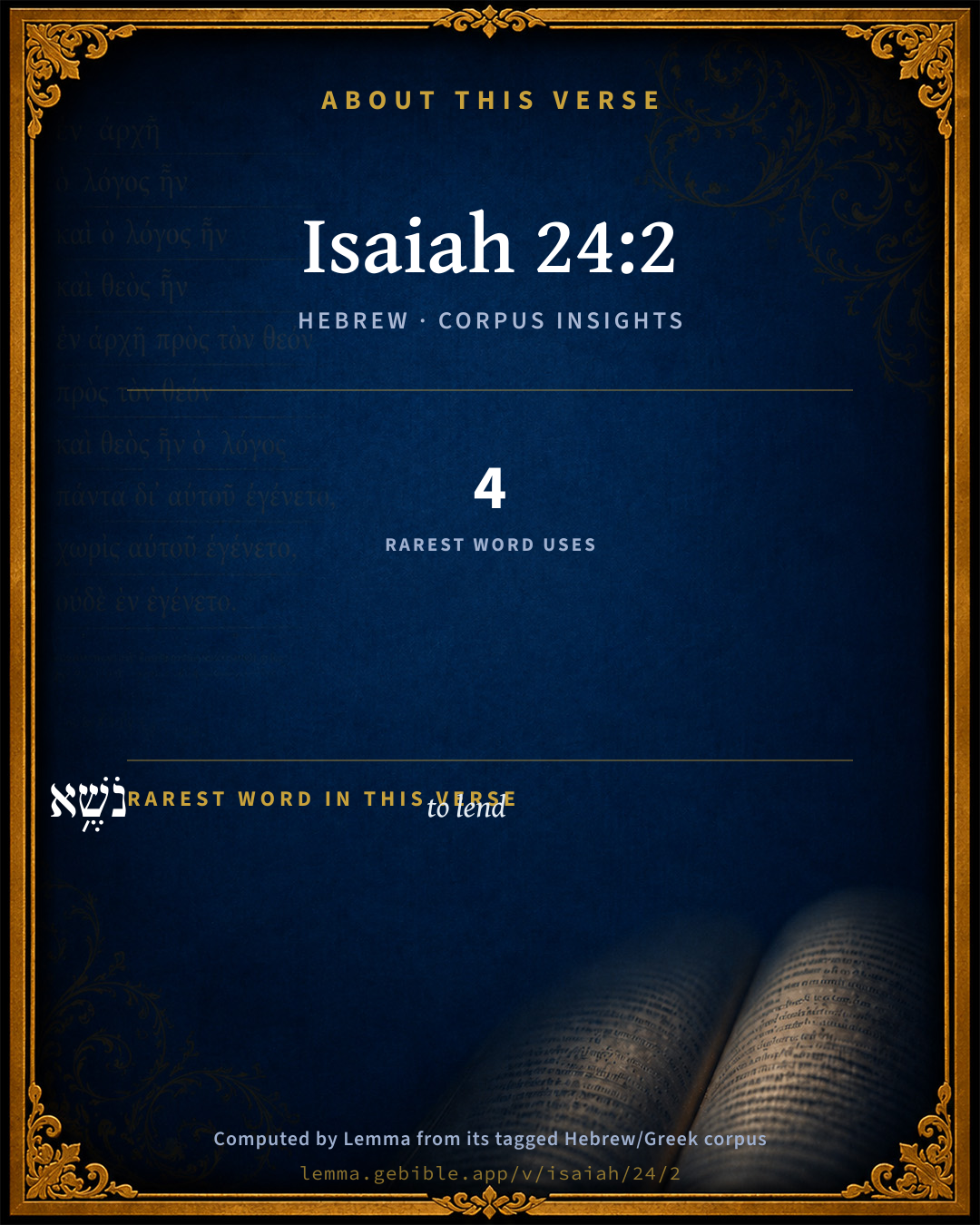
The rarest word here is נֹשֶׁ֥א to lend H5378 — appearing just 4 times in the whole Hebrew Bible.

Shared distinctive vocabulary

נֹשֶׁ֥א to lend H5378 occurs in 4 verses of the Hebrew Bible. Also found in:

Grammatical profile

  • 7 verbs
  • 6 nouns
  • 1 preposition
  • 1 particle

Verb forms

  • וְהָיָ֤ה Qal · Sequential Perfect
  • כַּקּוֹנֶה֙ Qal · Participle Active
  • כַּמּוֹכֵ֔ר Qal · Participle Active
  • כַּמַּלְוֶה֙ Hiphil · Participle Active
  • כַּלֹּוֶ֔ה Qal · Participle Active
  • כַּנֹּשֶׁ֕ה Qal · Participle Active
  • נֹשֶׁ֥א Qal · Participle Active

Repetition

A word recurs within this verse — often emphatic in Hebrew:

  • כַּמַּלְוֶה֙ to join H3867 ×2

Hebrew & Septuagint length

In English translation the verse runs 57 words from the Hebrew and 38 from the Septuagint (LXX English) — the Septuagint runs noticeably shorter here. See the side-by-side →

A rough comparison of the two English renderings, which tokenize alike — not a word-level alignment.

Word counts can differ between the Hebrew and the Greek without any difference in meaning — e.g. the Hebrew direct-object marker אֵת has no separate Greek word, and Greek often adds the article ὁ.

Cross-references

22

Topical passages linked to Isaiah 24:2 in the Treasury of Scripture Knowledge — connected by theme and wording, ordered by reader-vote popularity; previews shown in the World English Bible.

  • Hosea 4:9 It will be, like people, like priest; And I will punish them for their ways, And will repay them for their deeds.
  • Lamentations 5:12–14 Princes were hanged up by their hand: The faces of elders were not honored.
  • Ezekiel 7:12–13 The time is come, the day draws near: don't let the buyer rejoice, nor the seller mourn; for wrath is on all the multitude of it.
  • Genesis 41:50 To Joseph were born two sons before the year of famine came, whom Asenath, the daughter of Potiphera priest of On, bore to him.
  • Leviticus 25:36–37 Take no interest from him or profit, but fear your God; that your brother may live among you.
  • Deuteronomy 23:19–20 You shall not lend on interest to your brother; interest of money, interest of food, interest of anything that is lent on interest:
  • 2 Chronicles 36:14–17 Moreover all the chiefs of the priests, and the people, trespassed very greatly after all the abominations of the nations; and they polluted the house of Yahweh which he had made holy in Jerusalem.
  • 2 Chronicles 36:20 Those who had escaped from the sword carried he away to Babylon; and they were servants to him and his sons until the reign of the kingdom of Persia:
  • Isaiah 2:9 Man is brought low, And mankind is humbled; Therefore don't forgive them.
  • Isaiah 3:2–8 The mighty man, The man of war, The judge, The prophet, The diviner, The elder,
  • Isaiah 5:15 So man is brought low, Mankind is humbled, And the eyes of the arrogant ones are humbled;
  • Isaiah 9:14–17 Therefore Yahweh will cut off from Israel head and tail, palm-branch and rush, in one day.
  • Jeremiah 5:3–6 O Yahweh, don't your eyes look on truth? you have stricken them, but they were not grieved; you have consumed them, but they have refused to receive correction: they have made their faces harder than a rock; they have refused to return.
  • Jeremiah 23:11–13 for both prophet and priest are profane; yes, in my house have I found their wickedness, says Yahweh.
  • Jeremiah 41:2 Then arose Ishmael the son of Nethaniah, and the ten men who were with him, and struck Gedaliah the son of Ahikam the son of Shaphan with the sword, and killed him, whom the king of Babylon had made governor over the land.
  • Jeremiah 42:18 For thus says Yahweh of Hosts, the God of Israel: As my anger and my wrath has been poured forth on the inhabitants of Jerusalem, so shall my wrath be poured forth on you, when you shall enter into Egypt; and you shall be an object of horror, and an astonishment, and a curse, and a reproach; and you shall see this place no more.
  • Jeremiah 44:11–13 Therefore thus says Yahweh of Hosts, the God of Israel: Behold, I will set my face against you for evil, even to cut off all Judah.
  • Jeremiah 52:24–30 The captain of the guard took Seraiah the chief priest, and Zephaniah the second priest, and the three keepers of the threshold:
  • Lamentations 4:13 [It is] because of the sins of her prophets, [and] the iniquities of her priests, That have shed the blood of the just in the midst of her.
  • Ezekiel 14:8–10 and I will set my face against that man, and will make him an astonishment, for a sign and a proverb, and I will cut him off from the midst of my people; and you shall know that I am Yahweh.
  • Daniel 9:5–8 we have sinned, and have dealt perversely, and have done wickedly, and have rebelled, even turning aside from your precepts and from your ordinances;
  • Ephesians 6:8–9 knowing that whatever good thing each one does, he will receive the same again from the Lord, whether he is bound or free.

Cross-references courtesy of OpenBible.info (CC BY 4.0).

Hebrew and Greek witnesses Masoretic Hebrew ↔ Greek Septuagint

The same verse in the two great witnesses to the Old Testament, shown verse-for-verse.

Here the Septuagint runs noticeably shorter than the Hebrew — LXX2012 (modern English Septuagint) 38 words vs World English Bible 57. A rough length comparison of the two English translations, not a word-level alignment — read both below.

These are two independent witnesses, not word-aligned to each other, and the Septuagint is shown in lemma (dictionary) form.

Hebrew Isaiah 24:2 Masoretic · Westminster Leningrad Codex

וְהָיָ֤ה כָעָם֙ כַּכֹּהֵ֔ן כַּעֶ֨בֶד֙ כַּֽאדֹנָ֔יו כַּשִּׁפְחָ֖ה כַּגְּבִרְתָּ֑הּ כַּקּוֹנֶה֙ כַּמּוֹכֵ֔ר כַּמַּלְוֶה֙ כַּלֹּוֶ֔ה כַּנֹּשֶׁ֕ה כַּאֲשֶׁ֖ר נֹשֶׁ֥א בֽוֹ

It shall be, as with the people, so with the priest; as with the servant, so with his master; as with the maid, so with her mistress; as with the buyer, so with the seller; as with the creditor, so with the debtor; as with the taker of interest, so with the giver of interest to him.

World English Bible · Public Domain

Greek LXX Isaiah 24:2 Septuagint · lemma form

καί εἰμί ὁ λαός ὡς ὁ ἱερεύς καί ὁ παῖς ὡς ὁ κύριος καί ὁ θεραπαίνης ὡς ὁ κυρία εἰμί ὁ ἀγοράζω ὡς ὁ πωλέω καί ὁ δανείζω ὡς ὁ δανείζω καί ὁ ὀφείλω ὡς ὅς ὀφείλω

And the people shall be as the priest, and the servant as the lord, and the maid as the mistress; the buyer shall be as the seller, the lender as the borrower, and the debtor as his creditor.

LXX2012 (modern English Septuagint) · Public Domain

Hebrew: Westminster Leningrad Codex (CC BY 4.0). Greek: Septuagint (public domain); English from LXX2012 (modern English Septuagint) (Public Domain). How the Septuagint differs from the Hebrew →

Targum (Aramaic paraphrase)

1

The Targum is the ancient Jewish Aramaic paraphrase of the Hebrew Scriptures — an interpretive translation, not the Hebrew text itself. Onkelos (literal) and Pseudo-Jonathan (expansive) render the Torah, and Jonathan the Prophets. Coverage is partial: where no permissively-licensed English translation exists for a verse, only the Aramaic is shown. This is verse-level text, not a word-by-word alignment to the Hebrew.

  1. Targum Jonathan Prophets (Joshua–Malachi)
    וִיהֵי חִילוֹנָאָה כְּכַהֲנָא עַבְדָא כְּרִיבּוֹנֵהּ אַמְתָא כְּמֶרָתָהּ זָבְנָא כִּמְזַבְּנָא יָזְפָא כְּמוֹזְפָא רָשָׁא כְּמַן דְרָשֵׁי בֵיהּ:

    And it shall be, as with the laity, so with the priest; as with the servant, so with his master; as with the handmaid, so with her mistress; as with the buyer, so with the seller; as with the borrower, so with the lender: as with the giver of usury, so with the usurer.

    Targum Jonathan — Aramaic: “Mikraot Gedolot” (public domain). English: “Sefaria Community Translation” (CC0 1.0 (public-domain dedication)); “London "Chaldee Paraphrase," 1871” (public domain). Text via Sefaria.

Commentary

Notes on Isaiah 24:2 from classic Christian and Jewish commentators (each source and its license shown beneath its notes). The classic Christian expositions comment on the surrounding passage and are grouped to its opening verse, so a note may address several verses; the Jewish commentaries on the Tanakh (Rashi and others) are per-verse, so they appear only where the commentator wrote on this verse.

Lemma curates 59 commentaries, every one of them public domain or Creative Commons licensed, each selected and text-cleaned for this edition rather than reprinted as found. About our sources →

Trapp's Complete Commentary

John Trapp

Isa 24:2 And it shall be, as with the people, so with the priest; as with the servant, so with his master; as with the maid, so with her mistress; as with the buyer, so with the seller; as with the lender, so with the borrower; as with the taker of usury, so with the giver of usury to him.

Ver. 2. And it shall be, as with the people, so with the priest.] Or, Prince. Dignity and wealth hindereth him not; doth he esteem nobility or riches, or anything that fortifieth strength? Poverty or meanness findeth no favour with him. In a common calamity, all commonly share and fare alike.

John Trapp, A Commentary or Exposition upon All the Books of the Old and New Testament (1647–1656) — public domain. Text from a community e-Sword module.

The Biblical Illustrator

Joseph S. Exell

Isa_24:2

And it shall be, as with the people, go with the priest

The mutual assimilation of minister and people

The minister makes the people and the people make the minister.

I. THE MINISTERS INFLUENCE.

1. As a preacher and teacher--upon the conceptions of truth and duty, the understanding of the Word of God, and the practical conduct of the people.

2. As a man, in his own example and life.

3. As a pastor, in his pastoral intercourse with his flock.

4. As a public leader of reforms, etc.

II. THE PEOPLES INFLUENCE.

1. In getting him audience. Giving him their own ears and attention and gathering in others.

2. In making him eloquent. Gladstone says, Eloquence is pouring back on an audience in a shower what is first received from the audience in vapour.

3. In making him spiritual. They can encourage him to spiritual growth and culture; to earnest and edifying preaching. They can pray for him and help him to feel that they want and wish only spiritual food.

4. In making him a power for good. Aristotle says, Truth is what a thing is in itself, in its relations and in the medium through which it is viewed. Goethe says, Before we complain of the writing as obscure we must first examine if all be clear within. In the twilight a very plain manuscript is illegible. So the attitude of a hearer largely limits the power of a preacher; the cooperation of a Church member may indefinitely increase the effectiveness of a pastors work. (Homiletic Review.)

Preachers affected by their congregations

A few years ago, after a minister had been preaching in a Wesleyan chapel not far from my house, one of the older officials of the circuit began to talk to him of the glories of a past generation, and said with some fervour, Ah, sir, there were great preachers in those days. Yes, was the reply of the minister, and there were great hearers in those days. The answer was a wise and just one. If preachers form and discipline their congregations, it is equally true that congregations form and discipline their preachers. (R. W. Dale, LL. D.)

As with the buyer, so with the seller

Buying and selling

Buying and selling are of very ancient date. The earliest instance we read of occurs in the history of Abraham. The purchase made was a burying place; and is connected with the death of Sarah, Abrahams wife. Various nations and states have distinguished themselves at different times by their trade and commerce. In ancient times we may enumerate Arabia, Egypt, and especially Tyre--the crowning city where merchants were princes--where traffickers were the honourable of the earth. In more moderntimes we may mention Greece, Rome, Venice, the Hanse, Spain, Portugal, and above all Great Britain. Well might Napoleon Buonaparte call us a nation of shopkeepers. (R. W. Overbury.)

The relative duties of buyers and sellers

I. POINT OUT SOME OF THE EVILS BY WHICH THE RELATION BETWEEN BUYER AND SELLER IS VIOLATED. This relation is violated by every violation of those two important principles that lie at the foundation of all society--justice and truth. Justice consists in giving everyone his due; and truth or veracity in keeping our engagements, and avoiding lying and dissimulation. These principles and the relative duties arising out of them are violated--

1. By the practice of any and every kind of fraud in the transaction of business.

2. By the contracting of debts without any reasonable prospect of being able to pay them.

(1) But what is an individual to do who in the course of regular business finds himself, through the fluctuation to which every branch of trade is liable, insolvent at the end of the year? If he be a man of an honourable character and standing in trade, he will not want friends who are willing to lend him a sufficient sum to extricate him from his present difficulties, and to enable him to make a fresh trial under the blessing of God to succeed in that line of business which he has hitherto followed. But if, after having renewed the attempt, Divine providence does not see fit to succeed his endeavours, then from a false shame of appearing what he is in worldly circumstances before his fellow men, to keep on in business till he involve many others in ruin is most unjustifiable.

(2) Further, if an individual who has failed in anothers debt, should at any future time possess the means of paying his debts, we hold it that justice requires that he should so pay them.

3. Another way in which the relation between buyers and sellers is violated is, by making ourselves responsible for the debts of others, when we are not in possession of sufficient capital to warrant it.

4. By the very prevalent practice of underselling. Where does the injury fall? First, upon the poor operatives, who labour day and night by the sweat of their brow, to furnish conveniences and luxuries for the higher ranks of society, whilst their labour is remunerated at a price that hardly keeps them and their families from starving. The other party upon whom the injury falls is other tradesmen in the same line, who, shrinking from the use of such unscrupulous and oppressive means of realising large profits, lose either a part or the whole of their custom.

II. SHOW THE IMPORTANCE OF THE SUBJECT.

1. In a secular view. The permanent prosperity of our trade, and consequently the temporal welfare of society depend upon the principles which pervade our business transactions. Every deviation from right principles inflicts injury somewhere, and in proportion to the extent of that deviation contributes to augment the sum of national distress. Nations, as such, are punished in this life--individuals hereafter. An invisible Being, too little recognised in the marts of trade, presides over our national affairs, and distributes or withholds national blessings in proportion as the principles of eternal truth and justice are practically acknowledged.

2. In a religious view. It has been well said, that a Christian is the highest style of man.

(1) A man who cares not by what means he obtains money, provided he succeeds in making a fortune, cannot be a Christian. The character and doom of such are too plainly written in Scripture to be mistaken for a single moment.

(2) We do not, perhaps, sufficiently reflect that the predominance of the love of gain is equally incompatible with true piety; although a feeling of justice and benevolence, joined with self-respect, may lead us to abhor and reject all that is dishonourable in business.

(3) Nor must we omit to observe, that whilst the habitual predominance of a worldly spirit is incompatible with personal piety, the too great prevalence of it is highly injurious. It either lifts a man up with vanity and pride, or it depresses him with anxiety and care; both of which unfit him for the service of God. In proportion as the spirit of the world prevails over the people of God, it stints their piety and usefulness, and counteracts the end for which they are constituted a chosen generation, a royal priesthood, a holy nation, a peculiar people,--that ye should show forth the praises of Him, who hath called you out of darkness into His marvellous light. (R. W. Overbury.)

The Biblical Illustrator, edited by Joseph S. Exell (c. 1880s–1900s) — public domain. Text from a community e-Sword module.

Joseph Benson's Commentary

Isa 24:2-3. And it shall be, as with the people, so with the priest, &c. — The calamity shall be universal, without any respect or distinction of persons or ranks of men; the priests themselves, having been partakers of the people’s sins, shall also partake with them of their plagues. As with the buyer, so with the seller — The purchaser of lands shall have no more left than he that hath sold his patrimony; but all persons shall be made equal in beggary and slavery. The land shall be utterly emptied and utterly spoiled — Shall be deprived both of its riches and inhabitants. “As the public calamities coming upon the land were to be repeated, at various times and in various manners,” the sacred writer is thought by some interpreters to have “accommodated his discourse to these calamities, and divided it into various articles and gradations.” See Vitringa.

Joseph Benson's Commentary on the Old and New Testaments (1811–1818) — public domain. Text from a community e-Sword module.

Geneva Bible (1599)

Geneva Bible translators

Because this was a name of dignity, it was also applied to them, which were not of Aaron’s family, and so signifieth also a man of dignity, as 2 Sam. 8:18 and 20:25; 1 Chron. 18:17, and by these words the Prophet signifieth an horrible confusion, where there shall be neither religion, order, nor policy, Hos. 4:9.

Geneva Bible (1599) marginal notes — public domain. Text via Bolls.life.

Jamieson, Fausset & Brown

Robert Jamieson, A. R. Fausset & David Brown

as with the people, so with the priest--All alike shall share the same calamity: no favored class shall escape (compare Eze 7:12-13; Hos 4:9; Rev 6:15).

Jamieson, Fausset & Brown — Commentary Critical and Explanatory on the Whole Bible (1871) — public domain (CC PDM 1.0). Text via the HelloAO Bible API.

Ellicott's Commentary for English Readers

(2) It shall be, as with the people . . .—In the apparently general classification there is, perhaps, in the last two clauses a trace of the prophet’s indignation at the growing tendency of the people to the luxury which led to debt, and to the avarice which traded on the debtor’s necessities. Israel, it would seem, was already on the way to become a nation of money lenders.

A Bible Commentary for English Readers, edited by Charles John Ellicott (1878–1897) — public domain. Text from a community e-Sword module.

The Cambridge Bible for Schools and Colleges

gen. ed. J. J. S. Perowne

2. The judgment affects all classes alike, without distinction of rank or fortune.

as with the people … priest] Cf. Hos_4:9. It would hardly be safe to infer from this proverbial expression that at the time of the author the priests formed the aristocracy of the Jewish people. the buyer … the seller] Eze_7:12. the taker … the giver of usury] Jer_15:10.

The Cambridge Bible for Schools and Colleges (gen. ed. J. J. S. Perowne; Cambridge University Press, 1878–1918) — public domain. Text from a community e-Sword module.

John Gill's Exposition

And it shall be, as with the people, so with the priest,.... Or, "prince" (p); no order or rank of men will fare better than another; their dignity, in things civil or ecclesiastical, will not secure them from ruin; it will be no better with princes and priests than the common people; they shall all alike share in the common destruction. Not Jeroboam's priests, but rather the Romish priests, are here meant, who have led the people into superstition and idolatry; blind leaders of the blind, and so both fall into the ditch together:

as with the servant, so with his master; as with the maid, so with her mistress; there shall be no distinction of superiors and inferiors; as not of prince and subjects, so not of master and servant, mistress and maid; no respect will be had to persons, but the one shall be treated even as the other:

as with the buyer, so with the seller; the one that bought an estate, and thought to enjoy it, will be no better off than he that sold it, and perhaps spent the money; the one will be possessed of no more than the other, seeing what the one had bought, and the other sold, will now be in the possession of a third:

as with the lender, so with the borrower; their condition will be equal; he that was so poor that he was obliged to borrow to carry on his business, or for the necessaries of life, and so he that was so rich that he was capable of lending, now the one will be no richer than the other, but both on a level; the substance of the lender being taken from him:

as with the taker of usury, so with the giver of usury to him; this was forbidden the Jews by a law, Deu 23:19 wherefore not the land of Judea is here meant, but the antichristian states, among whom this practice has greatly prevailed.

(p) "ac praesidi", Junius & Tremellius; "sic gubernator", Piscator.

John Gill's Exposition of the Whole Bible (1746–1763) — public domain (CC PDM 1.0). Text via the HelloAO Bible API.

Albert Barnes' Notes on the Bible

As with the people, so with the priest - This does not mean in moral character, but in destiny. It does not mean that the character of the priest would have any influence on that of the people, or that because the one was corrupt the other would be; but it means that all would be involved in the same calamity, and there would be no favored class that would escape. The prophet, therefore, enumerate the various ranks of the people, and shows that all classes would be involved in the impending calamity.

As with the taker of usury - He who lends his money at interest. It was contrary to the Mosaic law for one Israelite to take interest of another Lev 25:36; Deu 23:19; Neh 5:7, Neh 5:10; but it is not probable that this law was very carefully observed, and especially in the corrupt times that preceded the Babylonian captivity.

Albert Barnes' Notes on the Bible (1834–1885) — public domain. Text from a community e-Sword/MySword module.

Haydock's Catholic Bible Commentary

Priest. All distinctions shall be disregarded. (Worthington) --- When Jerusalem was taken, all became captives.

George Leo Haydock (1774–1849), Haydock's Catholic Family Bible and Commentary, 1859 edition — public domain. Excludes Psalms (Douay-Rheims chapter numbering differs from Protestant) and Deuterocanonical books (Catholic canon only).

Matthew Poole's English Annotations

It shall be, as with the people, so with the priest; the approaching calamity shall be universal, without any respect or distinction of persons or ranks of men; the priests themselves, having been partakers of the people’s sins, shall also partake with them in their plagues.

As with the buyer, so with the seller; the purchaser of lands shall have no more left than he that hath sold all his patrimony; and all persons shall be made equal in beggary and slavery.

Matthew Poole's English Annotations on the Holy Bible (1683–1685) — public domain. Text from a community e-Sword/MySword module.

Whedon's Commentary on the Bible

Daniel D. Whedon

2. As with the people, so with the priest; as… so, etc. — Judgment is entered upon all alike. There is no favoured class. All fall under the one doom, which is utter and final.

Daniel D. Whedon (gen. ed.), Commentary on the Old and New Testaments (1874–1909) — public domain. Text from a community e-Sword module.

The Pulpit Commentary

It shall be, as with the people, so with the priest, etc. There shall be "no respect of persons no favor shown to men of any particular rank or station. All shall suffer equally. The author is obliged to take as examples distinctions of rank known to him; but he carefully selects such as are of almost universal occurrence. There was scarcely any nation of antiquity in which there were not "priests and people," "masters and slaves," "buyers and sellers," "lenders and borrowers," "takers and givers of usury." By "usury" is meant, not exorbitant interest, but interest simply, of whatever amount.

HOMILIES BY R. TUCK Ver. 2. Common burden-bearing.

The figure of calamity given in ver. 1 is that of emptying a vessel by turning it upside down. In national calamities all classes share alike. There is indiscriminate ruin. No distinction is made between the different ranks and conditions of life, though the idle poor are always the first to suffer. Illustrations may be taken from the great Lancashire cotton famine; or from times of trade depression which., as year after year passes on, reaches every class and section of society. "It is in a special manner true of the destroying judgments which God sometimes brings upon sinful nations; when he pleases he can make them universal, so that none shall escape them or be exempt from them; whether men have little or much, they shall lose it all. Those of the meaner sort smart first by famine; but those of the higher rank go first into captivity, while the poor of the land are left. Let not those that are advanced in the world set their inferiors at too great a distance, because they know not how soon they may be put upon a level with them" (Matthew Henry). The Apostle Paul advises that we accept the fact of burdens being common, and strive to turn the bearing of them into Christian virtue. "Bear ye one another"s burdens." "Every man shall bear his own burden." It is as if he had said, "Bear ye one another"s burdens, by kindly sympathy and ready help, as far as ever you can, partly because you have a very heavy burden of your own to bear, so you know what burden-bearing means, and partly because, come near to help one another how you may, you know from yourselves how true it is that every man must bear his own burden; the really heavy weight of it can rest on no shoulders but his own

I THE BURDENS THAT PRESS ON EACH ONE. The text suggests such as are special to times of calamity and distress, but we may treat our topic in a comprehensive way, so as to get direct practical applications. Each one of us has burdens as directly related to his sins and sinfulness as the woes of Jerusalem were to the national transgressions. The histories of cities and nations do but picture in the large the story of individuals. The cursory reader of the Pilgrims Progress will tell you that the pilgrim lost his burden from his shoulders when he gazed so trustfully upon the cross. But the more careful reader, who notes Christian"s infirmities, and frailties, and stumblings, and falls, will tell you that the pilgrim bore his burdens right through to the end, and that they weighed him down even when crossing the stream. We have our burdens in our frail bodies frail in the nerves, the head, the bones, the lungs, or yet more secret organs. Each one has a real "thorn in the flesh," which has influences far wider and more serious than he thinks. We have our burdens in our dispositions and characters burdens of despondency, or of impulsiveness, or of carnality, or of masterfulness, or of vanity, giving a bad appearance to all our work and relationship. And the problem of our life is just this: "How true, how beautiful can we become, with that burden, under the pressures and hindrances of that burden?" There is divinely arranged a great variety and wide distribution of burdens and disabilities, both in the sense of infirmities and calamities, so that we might come very near to one another, and really help one another. As we meet and feel "I am a man with a burden," we look into the face of our fellows, and he is a poor face-reader who does not say, "And my brother, too, is evidently a man with a burden." Perhaps a suspicion even crosses our mind that our brother"s burden is heavier than our own. Burdens, when rightly borne, never separate men from each other. The sanctified bearing of our own makes us so simple, so gentle, so tender-hearted, that we can bear the burdens of others, in the spirit of our meekness and sympathy, and so fulfill the law of Christ.

II THE BURDENS THAT WE MAY BEAR WITH OTHERS. There are common burdens in the home life; common burdens in the business life; common burdens in the social life; and common burdens in the national life; and we properly think ill things of the individuals or the classes that isolate themselves, and refuse to share the common burden. But it will be well to ask how practically we can take up the common burden so as to really help our brethren who are in the common trouble? Our great power is our power of sympathy. We can come so near to our brother in his weakness, his disability, even in his sin, that he shall feel as if another shoulder were put under his burden, and it felt to him a little lighter. We all yearn for sympathy; we all want some other human heart to feel in our trouble-times; "Oh what a joy on earth to find A mirror in an answering mind!

But we can often enter, as a relieving power, into the circumstances that make the burden. The doctor takes the sufferer into his interest and care, and deals helpfully with the circumstances that make the burden. And every one of us can be a doctor for the moral difficulties and distresses of life. We have all more power ever the circumstances that make trouble than we think; we can "lift up hands that hang down, and strengthen feeble knees." Beautiful in time of national calamity is the help which the poor give to the poor. Beautiful ought to be the help which each gives to each, and all to all, in the ordinary burden-bearing of family and social life. R.T.

The Pulpit Commentary (1880–1919), ed. H.D.M. Spence-Jones & Joseph S. Exell — public domain. Text from a community e-Sword module.

John Wesley's Explanatory Notes

It shall be - The approaching calamity shall be universal, without any distinction of persons or ranks; the priests themselves having been partakers of the peoples sins, shall also partake with them in their plagues. The seller - The purchaser of lands shall have no more left than he that hath sold all his patrimony; and all persons shall be made equal in beggary and slavery.

John Wesley, Explanatory Notes Upon the Whole Bible (1754–1765) — public domain. Text via the GEBible commentary corpus.

J. A. Alexander on Isaiah

Joseph Addison Alexander

“And it shall be, as the people so the priest, as the servant so his master, as the buyer so the seller, as the borrower so the lender, as the debtor so the creditor.” That is, all ranks and classes shall fare alike.

Joseph Addison Alexander, The Prophecies of Isaiah (1846–1847; New York: Scribner, 1870–1878) — public domain. Text from a community e-Sword module.

Rashi

Rabbi Shlomo Yitzchaki (Rashi)

(Addendum) And it shall be, as with the people, so with the priest Not like other travelers, that the master is led by his slave, and the mistress is led by her maidservant; the master is esteemed and the slave is held in low esteem, the mistress is esteemed and the maidservant is held in low esteem, but when the captor leads the captives, all are equal before him. [Addendum to Rashi]

as with the buyer, so with the seller When the people lives in its land securely, the buyer is happy and the seller is unhappy, since he will not return to the land he sold, but when the captor leads them, the buyer will not rejoice and the seller will not mourn, and so, as with the lender, so with the borrower, both are equal, for the borrower has nothing to pay, and the lender, had he not lent to this one, the captor would have taken it. Likewise, as with the creditor, so with the one who owes him. The word לֹֹוֶה applies to money and נֹשֶה applies to other commodities, such as wine, oil, grain, and honey, as it is written (Deut. 24:10): “When you lend your brother anything as a loan.” [Addendum to Rashi]

Rashi on the Tanakh — English translations: “The Judaica Press complete Tanach with Rashi, translated by A. J. Rosenberg” (CC BY 4.0); “Pentateuch with Rashi's commentary by M. Rosenbaum and A.M. Silbermann, 1929-1934” (public domain); “The Metsudah Tanach series, Lakewood, N.J” (CC BY 4.0); and “The Book of Joshua, Metsudah Publications, 1997” (CC BY 4.0). Text via Sefaria.

Ibn Ezra

Rabbi Abraham ibn Ezra

And it shall be, etc. All men shall be alike in this catastrophe. כעם ככהן וגו׳. As with the people, so with the priest. etc. When two nouns with the prefix כ follow each other, the phrase is elliptical; the complete sentence would be: as with the people so with the priest, and as with the priest so with the people, as with the servant so with the master, and as with the master so with the servant, etc.

כמלוה As with the lender, as with him who gives away money without security.

נושה The capitalist.

אשר נושה בו He who borrows money on security.

Ibn Ezra on the Tanakh — English translations: “Sefaria Community Translation” (CC0 1.0 (public-domain dedication)); “Yalkut, Sifsei Chachomim Chumash, Metsudah Publications, 2009” (CC BY 4.0); and “Commentary of Ibn Ezra on Isaiah - trans. by M. Friedlander, 1873” (public domain). Text via Sefaria.

Lesson kit

Teaching starters — assembled from the data on this page, not authored interpretation. Every prompt links to the verse data it draws on. Edit before teaching.

Isaiah, in the Prophets, opens this verse with 15 words (13 distinct Hebrew lemmas). Its most distinctive word is nâshâʼ (“to lend”). The Greek Septuagint runs shorter here. A historical commentator’s framing appears above. Read the whole chapter for the surrounding context.

Discussion questions

  1. How does “to lend” (nâshâʼ) shape what this verse is saying?
  2. How does 1 Samuel 22:2, which shares the word «to lend», read alongside this verse?
  3. What does the repetition of “to join” (2× in this one verse) do in this verse?
  4. The Septuagint runs shorter here than the Hebrew. What might account for the difference?
  5. These translations render this verse differently; the difference is in the English rendering, not the original. What questions does that raise?
  6. «וְהָיָ֤ה» is a Qal Sequential Perfect verb. How does that grammatical form shape the action described?
  7. Compare how Trapp's Complete Commentary and The Biblical Illustrator read this verse. Where do they agree or differ?

Things to notice

Reading settings

Reading text

Shown beneath each verse's original-language words.

Old Testament
Old Testament edition

Read the OT as the Masoretic Hebrew (MT) or the Greek Septuagint (LXX).

English shown for the Greek Septuagint (in the Hebrew ↔ Greek comparison).

Comparing translations? Open the Compare panel on any verse page to stack up to four side by side.