Jeremiah 27:4

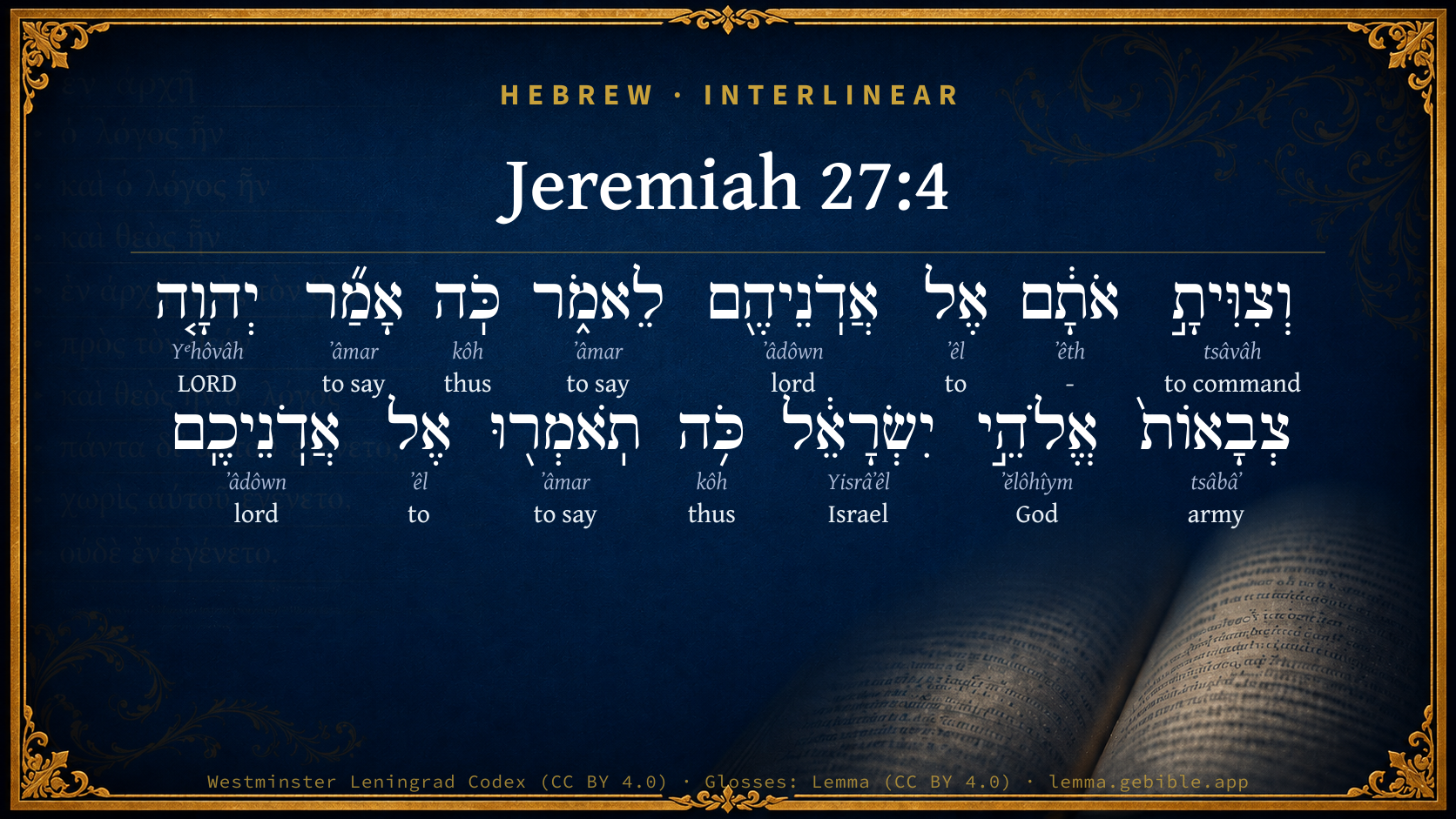
Hebrew (Westminster Leningrad Codex) Jeremiah 27:4 appears in the Hebrew Old Testament. The text above is from the Westminster Leningrad Codex. Each word links to its Strong’s number, a concise gloss, and parsing drawn from the Open Scriptures Hebrew Bible morphology. Click any word for its full Brown-Driver-Briggs (BDB) entry.
Download image
Cite this verse

Jeremiah 27:4 (World English Bible). Public Domain. Lemma interlinear Bible study tool, https://lemma.gebible.app/v/jeremiah/27/4.

Show BibTeX & RIS
BibTeX
RIS
English Translation
and give them a charge to their masters, saying, Thus says Yahweh of Hosts, the God of Israel, Thus shall you tell your masters:
World English Bible · Public Domain
Download a study sheet

One document with this verse’s original text, its word-by-word gloss line, the meaning frame, cross-references with their text, attributed commentary, and full source and license credits — printable, and it pastes into notes with its structure intact.

This verse Autodidact and up

Study sheet (.html) Plain text (.txt)

A passage Seminary Student

Up to 50 verses in one chapter. A passage sheet keeps up to 6 commentary sources and 12 cross-references per verse, in the order this page ranks them, and says so on the sheet whenever that leaves anything out. Ask for a single verse and you get the Autodidact verse sheet above.

Everything on this page stays free to read, with no account — the sheet is a download of what is already on screen, not access to it.

Want to remove ads? Support Godless Engineer
Compare translations 3

The same verse in 3 English versions, stacked beneath the original-language interlinear above. Click any original word for its lexicon entry.

Each is an independent rendering of the whole verse — the interlinear is not word-aligned to these translations.

Highlighted words mark where these versions differ — a whole-verse word diff, not a word-by-word alignment.

  • World English Bible Public Domain
    and give them a charge to their masters, saying, Thus says Yahweh of Hosts, the God of Israel, Thus shall you tell your masters:
  • King James Version Public Domain
    And command them to say unto their masters, Thus saith the LORD of hosts, the God of Israel; Thus shall ye say unto your masters;
  • unfoldingWord Literal Text CC BY-SA 4.0
    And command them to their masters, saying, “Thus says Yahweh of Armies, the God of Israel: Thus you shall say to your masters,

unfoldingWord Literal Text — © unfoldingWord, licensed CC BY-SA 4.0. Word-aligned USFM3 via Door43 (git.door43.org/unfoldingWord/en_ult).

Versions to compare (up to 4)

3 of 4 selected

Show all 18 translations

Every available English version of this verse, each an independent rendering of the whole verse.

  • World English Bible Public Domain
    and give them a charge to their masters, saying, Thus says Yahweh of Hosts, the God of Israel, Thus shall you tell your masters:
  • Berean Standard Bible Public Domain
    Give them a message from the LORD of Hosts, the God of Israel, to relay to their masters:
  • Majority Standard Bible Public Domain
    Give them a message from the LORD of Hosts, the God of Israel, to relay to their masters:
  • King James Version Public Domain
    And command them to say unto their masters, Thus saith the LORD of hosts, the God of Israel; Thus shall ye say unto your masters;
  • American Standard Version (1901) Public Domain
    and give them a charge unto their masters, saying, Thus saith Jehovah of hosts, the God of Israel, Thus shall ye say unto your masters:
  • Revised Version (1885) Public Domain
    and give them a charge unto their masters; saying, Thus saith the LORD of hosts, the God of Israel: Thus shall ye say unto your masters;
  • Geneva Bible (1599) Public Domain
    And commande them to saye vnto their masters, Thus saith the Lord of hostes the God of Israel, Thus shall ye say vnto your masters,
  • Douay-Rheims (1899) Public Domain
    And thou shalt command them to speak to their masters: Thus saith the Lord of hosts the God of Israel: Thus shall you say to your masters:
  • Young's Literal Translation Public Domain
    And thou hast commanded them for their lords, saying, Thus said Jehovah of Hosts, God of Israel,
  • Literal Standard Version CC BY-SA 4.0
    and you have commanded them for their lords, saying, Thus said YHWH of Hosts, God of Israel:
  • Unlocked Literal Bible CC BY-SA 4.0
    Give commands to them for their masters and say, 'Yahweh of hosts, God of Israel, says this: This is what you must say to your masters,
  • unfoldingWord Literal Text CC BY-SA 4.0
    And command them to their masters, saying, “Thus says Yahweh of Armies, the God of Israel: Thus you shall say to your masters,
  • Darby Bible Public Domain
    And give them a charge unto their masters, saying, Thus saith Jehovah of hosts, the God of Israel: Thus shall ye say unto your masters:
  • World Messianic Bible Public Domain
    Give them a command to their masters, saying, ‘The LORD of Hosts, the God of Israel says, “You shall tell your masters:
  • Webster's Bible Public Domain
    And command them to say to their masters, Thus saith the LORD of hosts, the God of Israel; Thus shall ye say to your masters;
  • Free Bible Version CC BY-SA 4.0
    Give them this order from the Lord Almighty, the God of Israel, to convey to their masters:
  • Bible in Basic English Public Domain
    And give them orders to say to their masters, This is what the Lord of armies, the God of Israel, has said: Say to your masters,
  • JPS Tanakh (1917) Public Domain
    and give them a charge unto their masters, saying: Thus saith the LORD of hosts, the God of Israel: Thus shall ye say unto your masters:

Literal Standard Version (2020), Covenant Press — licensed CC BY-SA 4.0. Text via the HelloAO Bible API (eBible.org). Unlocked Literal Bible (unfoldingWord) — licensed CC BY-SA 4.0. Text via the HelloAO Bible API (eBible.org). unfoldingWord Literal Text — © unfoldingWord, licensed CC BY-SA 4.0. Word-aligned USFM3 via Door43 (git.door43.org/unfoldingWord/en_ult). Free Bible Version, Dr. Jonathan Gallagher — licensed CC BY-SA 4.0. Text via the HelloAO Bible API (eBible.org).

Word by word

More ways to search: Search by grammar → Find every occurrence → Compare this word →

Practice this passage: Drill this verse → Learn its vocabulary →

אֲדֹֽנֵיהֶ֖ם
ʼâdôwn
H113
“lords · their”
Noun, Common, Masculine, Plural, Construct + Suffix, Personal, 3rd Person, Masculine, Plural
Part of Speech
Noun
Type
Common
Gender
Masculine
Number
Plural
State
Construct
Full BDB Definition

Origin: from an unused root (meaning to rule)

TWOT: 27b

firm, strong, lord, master - lord, master - reference to men - superintendent of household, of affairs - master - king - reference to God - the Lord God - Lord of the whole earth - lords, kings - reference to men - proprietor of hill of Samaria - master - husband - prophet - governor - prince - king - reference to God - Lord of lords (probably = "thy husband, Yahweh" ) - my lord, my master - reference to men - master - husband - prophet - prince - king - father - Moses - priest - theophanic angel - captain - general recognition of superiority - reference to God - my Lord, my Lord and my God - Adonai (parallel with Yahweh)
  1. וְצִוִּיתָ֣ tsâvâh H6680 “and · to command” Conjunction + Verb, Piel, Sequential Perfect, 2nd Person, Masculine, Singular
  2. אֹתָ֔ם ʼêth H853 “- · them” Particle, Direct Object + Suffix, Personal, 3rd Person, Masculine, Plural
  3. אֶל ʼêl H413 “to” Preposition
  4. לֵאמֹ֑ר ʼâmar H559 “to say” Preposition + Verb, Qal, Infinitive Construct
  5. כֹּֽה kôh H3541 “thus” Adverb
  6. אָמַ֞ר ʼâmar H559 “to say” Verb, Qal, Perfect, 3rd Person, Masculine, Singular
  7. יְהוָ֤ה Yᵉhôvâh H3068 “LORD” Noun, Proper
  8. צְבָאוֹת֙ tsâbâʼ H6635 “armies” Noun, Common, Both, Plural, Absolute
  9. אֱלֹהֵ֣י ʼĕlôhîym H430 “God(s) of” Noun, Common, Masculine, Plural, Construct
  10. יִשְׂרָאֵ֔ל Yisrâʼêl H3478 “Israel” Noun, Proper
  11. כֹּ֥ה kôh H3541 “thus” Adverb
  12. תֹֽאמְר֖וּ ʼâmar H559 “to say” Verb, Qal, Imperfect, 2nd Person, Masculine, Plural
  13. אֶל ʼêl H413 “to” Preposition
  14. אֲדֹֽנֵיכֶֽם ʼâdôwn H113 “lords · your” Noun, Common, Masculine, Plural, Construct + Suffix, Personal, 2nd Person, Masculine, Plural

About this verse

These counts appear in no published source. They are computed here, from the morphology-tagged text and Lemma’s own curated glosses. What Lemma adds →

15
words
10
distinct lemmas
Prophets
section

Grammatical profile

  • 4 verbs
  • 6 nouns
  • 2 prepositions
  • 2 adverbs
  • 1 particle

Verb forms

  • וְצִוִּיתָ֣ Piel · Sequential Perfect
  • לֵאמֹ֑ר Qal · Infinitive Construct
  • אָמַ֞ר Qal · Perfect
  • תֹֽאמְר֖וּ Qal · Imperfect

Repetition

Words recur within this verse — often emphatic in Hebrew:

  • לֵאמֹ֑ר to say H559 ×3
  • אֲדֹֽנֵיהֶ֖ם lord H113 ×2
  • כֹּֽה thus H3541 ×2
  • אֶל to H413 ×2

Cross-references

5

Topical passages linked to Jeremiah 27:4 in the Treasury of Scripture Knowledge — connected by theme and wording, ordered by reader-vote popularity; previews shown in the World English Bible.

  • Exodus 5:1 Afterward Moses and Aaron came, and said to Pharaoh, "This is what Yahweh, the God of Israel, says, 'Let my people go, that they may hold a feast to me in the wilderness.'"
  • Jeremiah 10:10 But Yahweh is the true God; he is the living God, and an everlasting King: at his wrath the earth trembles, and the nations are not able to abide his indignation.
  • Jeremiah 10:16 The portion of Jacob is not like these; for he is the former of all things; and Israel is the tribe of his inheritance: Yahweh of Hosts is his name.
  • Jeremiah 25:27 You shall tell them, Thus says Yahweh of Hosts, the God of Israel: Drink you, and be drunken, and spew, and fall, and rise no more, because of the sword which I will send among you.
  • Jeremiah 51:19 The portion of Jacob is not like these; for he is the former of all things; and [Israel] is the tribe of his inheritance: Yahweh of Hosts is his name.

Cross-references courtesy of OpenBible.info (CC BY 4.0).

Hebrew and Greek witnesses Masoretic Hebrew ↔ Greek Septuagint

The same verse in the two great witnesses to the Old Testament, shown verse-for-verse.

These are two independent witnesses, not word-aligned to each other, and the Septuagint is shown in lemma (dictionary) form.

Hebrew Jeremiah 27:4 Masoretic · Westminster Leningrad Codex

וְצִוִּיתָ֣ אֹתָ֔ם אֶל אֲדֹֽנֵיהֶ֖ם לֵאמֹ֑ר כֹּֽה אָמַ֞ר יְהוָ֤ה צְבָאוֹת֙ אֱלֹהֵ֣י יִשְׂרָאֵ֔ל כֹּ֥ה תֹֽאמְר֖וּ אֶל אֲדֹֽנֵיכֶֽם

and give them a charge to their masters, saying, Thus says Yahweh of Hosts, the God of Israel, Thus shall you tell your masters:

World English Bible · Public Domain

Greek LXX Structure differs

In the Septuagint, Jeremiah is about an eighth shorter than the Hebrew and arranges its material differently — the Oracles Against the Nations (Hebrew chapters 46–51) appear in the middle of the Greek book, after 25:13. Because the chapter and verse boundaries do not line up, a verse-for-verse comparison with the Hebrew is not shown.

A verse-for-verse comparison isn’t shown here because the chapters and verses don’t line up. Switch to the LXX edition with the MT / LXX toggle above to read the Greek directly.

Hebrew: Westminster Leningrad Codex (CC BY 4.0). Greek: Septuagint (public domain); English from a public-domain English Septuagint. How the Septuagint differs from the Hebrew →

Targum (Aramaic paraphrase)

1

The Targum is the ancient Jewish Aramaic paraphrase of the Hebrew Scriptures — an interpretive translation, not the Hebrew text itself. Onkelos (literal) and Pseudo-Jonathan (expansive) render the Torah, and Jonathan the Prophets. Coverage is partial: where no permissively-licensed English translation exists for a verse, only the Aramaic is shown. This is verse-level text, not a word-by-word alignment to the Hebrew.

  1. Targum Jonathan Prophets (Joshua–Malachi)
    וּתְפַקֵיד יַתְהוֹן לְוַת רִבּוֹנְהוֹן לְמֵימָר כִּדְנַן אֲמַר יְיָ צְבָאוֹת אֱלָהָא דְיִשְׂרָאֵל כִּדְנַן תֵּימְרוּן לְרִבּוֹנְכוֹן:

    (no public-domain English translation for this verse)

    Targum Jonathan — Aramaic: “Mikraot Gedolot” (public domain). English: “Sefaria Community Translation” (CC0 1.0 (public-domain dedication)); “London "Chaldee Paraphrase," 1871” (public domain). Text via Sefaria.

Commentary

Notes on Jeremiah 27:4 from classic Christian and Jewish commentators (each source and its license shown beneath its notes). The classic Christian expositions comment on the surrounding passage and are grouped to its opening verse, so a note may address several verses; the Jewish commentaries on the Tanakh (Rashi and others) are per-verse, so they appear only where the commentator wrote on this verse.

Lemma curates 59 commentaries, every one of them public domain or Creative Commons licensed, each selected and text-cleaned for this edition rather than reprinted as found. About our sources →

Trapp's Complete Commentary

John Trapp

Jer 27:4 And command them to say unto their masters, Thus saith the LORD of hosts, the God of Israel; Thus shall ye say unto your masters;

Ver. 4. Go, tell your masters.] But they would not be warned, and were therefore ruined. So true is that of an ancient, Divinum consilium, dam devitatur, impletur: humana sapicuria, dum reluctatur, comprehendirut.

John Trapp, A Commentary or Exposition upon All the Books of the Old and New Testament (1647–1656) — public domain. Text from a community e-Sword module.

The Biblical Illustrator

Joseph S. Exell

Jer_27:4-5

I have made the earth.

God and the earth

I. God is the creator of all earthly things: The man and the beast that are upon the ground. The earth is not eternal, net the production of chance, not the work of many Gods. It has one Maker. This agrees with all true science.

II. God is the sovereign disposes of all earthly things. Have given it unto whom it seemed meet unto Me. He might have built it and left it uninhabited, or He might have populated it with other creatures than those who tenant it now. He has given what He thinks fit of it to individuals, tribes, and nations. (Homilist.)

The earth made by God

I have in my house a little sheet of paper on which there is a faint, pale, and not particularly skilful representation of a hyacinth It is not half as beautiful as many other pictures I have, but I regard it as the most exquisite of them all My mother painted it; and I never see it that I do not think that her hand rested on it, and that her thought was concerned in its execution. Now, suppose you had such a conception of God that you never saw a flower, a tree, a cloud, or any natural object, that you did not instantly think, My Father made it, what a natural world would this become to you! How beautiful would the earth seem to you! And how would you find that nature was a revelation of God, speaking as plainly as His written Word! And if you are alone, in solitude, without company, desolate in your circumstances, it is because you have not that inner sense of the Divine love and care which it is your privilege to have, and which you ought to have. (H. W. Beecher.)

Have given it unto whom it seemed meet unto Me.

Meetness before God

I. God is the proprietor of all.

1. Mans forgetfulness of this in daily life.

2. The harmony of mans being requires a sense of dependence.

3. Depression results from stopping short of God.

II. Wisdom and sovereignity go together.

1. No comfort to know we live under an absolute sovereign.

2. God gives not according to seeming fitness. He sees deeper than what seems.

III. The unerring mind of God.

1. Cultivate an adoring spirit.

2. Rest on Him in simple belief.

3. Repose in Gods law of meetness. (P. B. Power, M. A.)

The Divine distribution of the earth amongst men

I. In it He exercises absolute right. The earth, with all its minerals, fruits, productions, and countless tenants, is His. If He gives a thousand acres to one man and denies a yard to another, it is not for us to complain.

II. In it He acts according to His own free choice alone. He gives it not on the ground of merit to any man, for now He gave it to Nebuchadnezzar, one of the worst of men. The only principle in the distribution is His own sovereignty. What seemeth meet to a Being of Infinite wisdom and goodness must be the wisest and the most benevolent. Here let us hush all our murmurings, here let us repose the utmost confidence. Conclusion--The subject teaches us how we should hold that portion of the earth we possess, however small or great it may be.

1. With profound humility. What we possess is a gift, not a right. We are temporary trustees, not proprietors. He who holds the most should be the most humble, for he has the most to account for.

2. With practical thanksgiving. This indeed is all the rent that the Supreme Landlord requires from us, thanksgiving and praise.

3. With a solemn sense of our responsibility. It is given to us not for our own gratification and self-aggrandisement, but for the good of the race and the glory of God.

4. With a conscious dependence on His will. We are all tenants at will. We know not the moment when He shall see fit to eject us from His land. (Homilist.)

.

The Biblical Illustrator, edited by Joseph S. Exell (c. 1880s–1900s) — public domain. Text from a community e-Sword module.

Tyndale Open Study Notes

Tyndale Open Resources

27:4-5 The entire weight of the divine name was behind this message (see study note on 2:2). The Lord’s authority over everything was a direct challenge to the false nature deities worshiped by each of the nations addressed.

Tyndale Open Study Notes — © Tyndale Open Resources, licensed CC BY-SA 4.0. Text via the HelloAO Bible API.

John Calvin's Commentaries

Though the Prophet was bidden to command the ambassadors to say to the kings by whom they had been sent, Thus saith Jehovah, of hosts, they yet might have refused to do so, and that with indignation: “What! Are we come here to be ambassadors to thee? and who indeed art thou who commandest us? besides, dost thou think that we are so mad as to threaten for thy sake, our kings and masters, and to declare to them what thou biddest, that they are shortly to become the servants of the Chaldean king?” The ambassadors then might have thus treated the holy Prophet with derision and laughter: but, as we have said, the whole was done for the sake of Zedekiah and the people, in order that the Prophet might dissipate that vain splendor and pomp, by which he saw that Zedekiah and all the Jews were deceived; for they thought that they had as it were high and large mountains to be set in opposition to the Chaldean king and his army: “On what part can they assail us, since the king of Tyrus is on our side, and also the king of Sidon, the king of Moab, and the king of Ammon? these rule widely, and their cities are impregnable.” Thus, then, the Jews were convinced that they would be exempt from every trouble and molestation; but in order that they might not deceive themselves with that vain display, Jeremiah said,

“Declare, ye ambassadors, to your masters what God has spoken, even that ye must submit to the yoke of the king of Babylon.”

And a visible symbol was added in order to confirm the prediction: the Prophet was bidden to put a yoke on his neck, or yokes, for he speaks in the plural number. מוט muth, means a pole, a yoke, a transverse piece of wood: and no doubt he applied some pieces of wood to his neck, like the yoke laid on oxen; and then he tied this yoke or crossbar; for יסר, isar, means to bind or tie, and so מוסרות, musarut, are bands; מוסר, musar, also means sometimes a girdle; but here it is to be taken for bands or ligaments. It was a sad spectacle to see on the neck of Jeremiah, when he went forth, the symbol of the bondage of all kings and nations: he was as it were in the place of all a captive before the time: but when God laid a yoke on the Jews and on all other nations, Jeremiah was then a free man; for though he bore this mark of bondage, he yet expected God’s judgment with a resigned mind, while others disregarded it. But this confirmation rendered them more inexcusable, as the case is, when God, to strengthen faith, adds sacraments or other helps to his word, by which means he impresses us the more, for he thus teaches not only our ears, but also our eyes and all our senses: when God thus omits nothing that may tend to strengthen our faith in his word, a heavier condemnation awaits us, if such signs avail not.

We then perceive the reason why the Prophet applied to his neck the symbol of future bondage: were there any teachable among the people, to see such a sign with their eyes must have been useful to them. But as the greater part had hardened themselves in their obstinacy, what ought to have done them good, by humbling them in time before God, so as to anticipate his judgment, had no other effect but to render their punishment more grievous.

John Calvin's Commentaries (1540-1563) — public domain. Text from the Calvin Translation Society English edition (1840s-50s) via the Christian Classics Ethereal Library (ccel.org). Calvin's coverage is partial (roughly two-thirds of the Bible); uncommented books and verses are honest gaps, never fabricated. The 19th-century editor's footnotes and remarks are omitted so the notes are faithfully Calvin's own voice.

Ellicott's Commentary for English Readers

(4) Thus saith the Lord of hosts, the God of Israel.—As addressed to the outlying heathen nations, who were not His worshippers, the proclamation of the message, as coming from Jehovah Sabaoth, the God of Israel, had a special force, which we hardly appreciate as we read the English. They, with their hosts of earth, were setting themselves against the Lord of the hosts alike of heaven and of earth.

A Bible Commentary for English Readers, edited by Charles John Ellicott (1878–1897) — public domain. Text from a community e-Sword module.

John Gill's Exposition

And command them to say unto their masters,.... The prophet is sent with authority, and ordered to speak in a very high strain, having his orders from the King of kings and Lord of lords; a greater master than those messengers had; and to enjoin them to tell their several masters in his master's name; as follows:

thus saith the Lord of hosts, the God of Israel; who, though in a peculiar manner the God of Israel, yet was Lord of the whole world, and had all the armies of heaven and earth at his command, to enforce his power and authority; wherefore what he says ought to be attended to:

thus shall ye say to your masters; deliver to them the following words of the great Jehovah.

John Gill's Exposition of the Whole Bible (1746–1763) — public domain (CC PDM 1.0). Text via the HelloAO Bible API.

Matthew Poole's English Annotations

The Lord of hosts, who hath therefore a power over all the creatures; who though he be in a special sense

the God of Israel, yet his dominion is extended to your masters’ countries, as well as unto Israel.

Matthew Poole's English Annotations on the Holy Bible (1683–1685) — public domain. Text from a community e-Sword/MySword module.

Whedon's Commentary on the Bible

Daniel D. Whedon

4. Command them to say unto their masters, etc. — Here is a specimen of a missionary message of the olden time. God causes his prophet to deliver a message in which his universal creatorship, his unity, and his supremacy are most plainly asserted. He brings to view his universal providence, extending not only to his own chosen people but to all the nations. He intimates that even Nebuchadnezzar, the eminent representative heathen king, rules by the appointment of God, and that his own divine resources would be brought to bear to perpetuate his authority. And yet he does not close without the intimation that Babylon, in its turn, shall become subject.

Daniel D. Whedon (gen. ed.), Commentary on the Old and New Testaments (1874–1909) — public domain. Text from a community e-Sword module.

Lesson kit

Teaching starters — assembled from the data on this page, not authored interpretation. Every prompt links to the verse data it draws on. Edit before teaching.

Jeremiah, in the Prophets, opens this verse with 15 words (10 distinct Hebrew lemmas). Its most distinctive word is ʼâdôwn (“lord”). A historical commentator’s framing appears above. Read the whole chapter for the surrounding context.

Discussion questions

  1. What does “lord” (ʼâdôwn) contribute to the verse as a whole?
  2. Exodus 5:1 shares this passage’s theme. How do the two illuminate each other?
  3. “to say” occurs 3× in this one verse. What is the effect of the repetition?
  4. These translations render this verse differently. What is at stake in choosing one wording over another?
  5. The verb «וְצִוִּיתָ֣» is Piel Sequential Perfect. How does its form color the action?
  6. Reading how Trapp's Complete Commentary and The Biblical Illustrator read this verse, where do the two commentators agree and where do they part?

Things to notice

Reading settings

Reading text

Shown beneath each verse's original-language words.

Old Testament
Old Testament edition

Read the OT as the Masoretic Hebrew (MT) or the Greek Septuagint (LXX).

English shown for the Greek Septuagint (in the Hebrew ↔ Greek comparison).

Comparing translations? Open the Compare panel on any verse page to stack up to four side by side.