
Isaiah 37:6

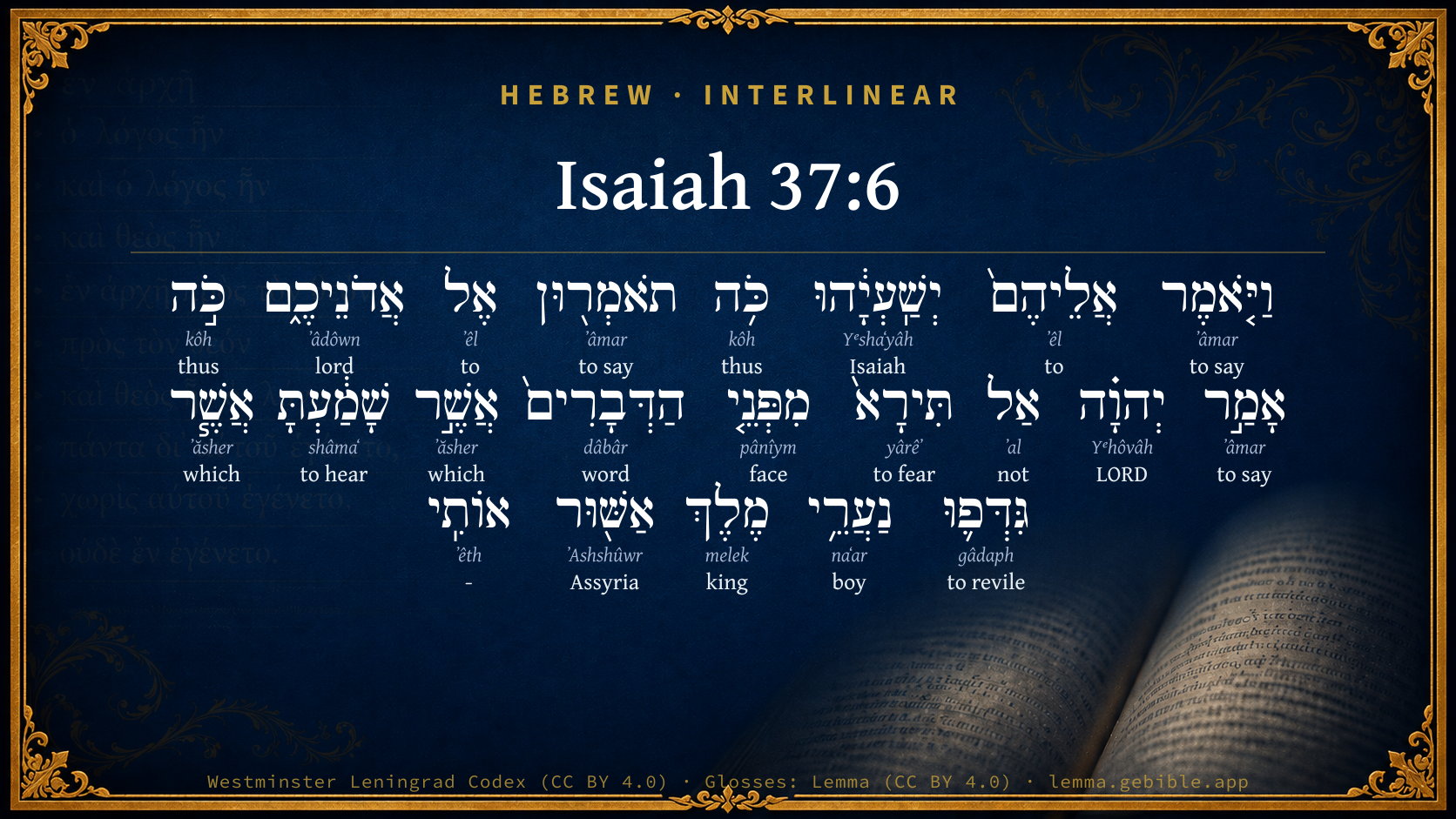
Hebrew (Westminster Leningrad Codex) Isaiah 37:6 appears in the Hebrew Old Testament. The text above is from the Westminster Leningrad Codex. Each word links to its Strong’s number, a concise gloss, and parsing drawn from the Open Scriptures Hebrew Bible morphology. Click any word for its full Brown-Driver-Briggs (BDB) entry.
Download image
Cite this verse

Isaiah 37:6 (World English Bible). Public Domain. Lemma interlinear Bible study tool, https://lemma.gebible.app/v/isaiah/37/6.

Show BibTeX & RIS
BibTeX
RIS
English Translation
Isaiah said to them, Thus shall you tell your master, Thus says Yahweh, Don't be afraid of the words that you have heard, with which the servants of the king of Assyria have blasphemed me.
World English Bible · Public Domain
Download a study sheet

One document with this verse’s original text, its word-by-word gloss line, the meaning frame, cross-references with their text, attributed commentary, and full source and license credits — printable, and it pastes into notes with its structure intact.

This verse Autodidact and up

Study sheet (.html) Plain text (.txt)

A passage Seminary Student

Up to 50 verses in one chapter. A passage sheet keeps up to 6 commentary sources and 12 cross-references per verse, in the order this page ranks them, and says so on the sheet whenever that leaves anything out. Ask for a single verse and you get the Autodidact verse sheet above.

Everything on this page stays free to read, with no account — the sheet is a download of what is already on screen, not access to it.

Want to remove ads? Support Godless Engineer
Compare translations 3

The same verse in 3 English versions, stacked beneath the original-language interlinear above. Click any original word for its lexicon entry.

Each is an independent rendering of the whole verse — the interlinear is not word-aligned to these translations.

Highlighted words mark where these versions differ — a whole-verse word diff, not a word-by-word alignment.

  • World English Bible Public Domain
    Isaiah said to them, Thus shall you tell your master, Thus says Yahweh, Don't be afraid of the words that you have heard, with which the servants of the king of Assyria have blasphemed me.
  • King James Version Public Domain
    And Isaiah said unto them, Thus shall ye say unto your master, Thus saith the LORD, Be not afraid of the words that thou hast heard, wherewith the servants of the king of Assyria have blasphemed me.
  • unfoldingWord Literal Text CC BY-SA 4.0
    and Isaiah said to them, “Thus you shall say to your master, ‘Thus says Yahweh, “May you not be afraid from the face of the words that you have heard, which the servants of the king of Assyria have blasphemed me.

unfoldingWord Literal Text — © unfoldingWord, licensed CC BY-SA 4.0. Word-aligned USFM3 via Door43 (git.door43.org/unfoldingWord/en_ult).

Versions to compare (up to 4)

3 of 4 selected

Show all 18 translations

Every available English version of this verse, each an independent rendering of the whole verse.

  • World English Bible Public Domain
    Isaiah said to them, Thus shall you tell your master, Thus says Yahweh, Don't be afraid of the words that you have heard, with which the servants of the king of Assyria have blasphemed me.
  • Berean Standard Bible Public Domain
    who replied, “Tell your master that this is what the LORD says: ‘Do not be afraid of the words you have heard, with which the servants of the king of Assyria have blasphemed Me.
  • Majority Standard Bible Public Domain
    who replied, “Tell your master that this is what the LORD says: ‘Do not be afraid of the words you have heard, with which the servants of the king of Assyria have blasphemed Me.
  • King James Version Public Domain
    And Isaiah said unto them, Thus shall ye say unto your master, Thus saith the LORD, Be not afraid of the words that thou hast heard, wherewith the servants of the king of Assyria have blasphemed me.
  • American Standard Version (1901) Public Domain
    And Isaiah said unto them, Thus shall ye say to your master, Thus saith Jehovah, Be not afraid of the words that thou hast heard, wherewith the servants of the king of Assyria have blasphemed me.
  • Revised Version (1885) Public Domain
    And Isaiah said unto them, Thus shall ye say to your master, Thus saith the LORD, Be not afraid of the words that thou hast heard, wherewith the servants of the king Assyria have blasphemed me.
  • Geneva Bible (1599) Public Domain
    And Isaiah sayde vnto them, Thus say vnto your master, Thus saith the Lord, Be not afrayd of the wordes that thou hast heard, wherewith the seruants of the king of Asshur haue blasphemed me.
  • Douay-Rheims (1899) Public Domain
    And Isaias said to them: Thus shall you say to your master: Thus saith the Lord: Be not afraid of the words that thou hast heard, with which the servants of the king of the Assyrians have blasphemed me.
  • Young's Literal Translation Public Domain
    and Isaiah saith unto them, `Thus do ye say unto your lord, Thus said Jehovah, Be not afraid because of the words that thou hast heard, with which the servants of the king of Asshur have reviled Me.
  • Literal Standard Version CC BY-SA 4.0
    and Isaiah says to them, “Thus you say to your lord, Thus said YHWH: Do not be afraid because of the words that you have heard, with which the servants of the king of Asshur have reviled Me.
  • Unlocked Literal Bible CC BY-SA 4.0
    and Isaiah said to them, “Say to your master: 'Yahweh says, “Do not be afraid of the words that you have heard, with which the servants of the king of Assyria have insulted me.
  • unfoldingWord Literal Text CC BY-SA 4.0
    and Isaiah said to them, “Thus you shall say to your master, ‘Thus says Yahweh, “May you not be afraid from the face of the words that you have heard, which the servants of the king of Assyria have blasphemed me.
  • Darby Bible Public Domain
    And Isaiah said to them, Thus shall ye say to your master, Thus saith Jehovah: Be not afraid of the words that thou hast heard, wherewith the servants of the king of Assyria have blasphemed me.
  • World Messianic Bible Public Domain
    Isaiah said to them, “Tell your master, ‘The LORD says, “Don’t be afraid of the words that you have heard, with which the servants of the king of Assyria have blasphemed me.
  • Webster's Bible Public Domain
    And Isaiah said to them, Thus shall ye say to your master, Thus saith the LORD, Be not afraid of the words that thou hast heard, with which the servants of the king of Assyria have blasphemed me.
  • Free Bible Version CC BY-SA 4.0
    Isaiah replied to them, “Tell your master, This is what the Lord says: Don't be frightened by the words that you have heard, the words used by the servants of the king of Assyria to blaspheme me.
  • Bible in Basic English Public Domain
    And Isaiah said to them, This is what you are to say to your master: The Lord says, Be not troubled by the words which the servants of the king of Assyria have said against me in your hearing.
  • JPS Tanakh (1917) Public Domain
    And Isaiah said unto them: 'Thus shall ye say to your master: Thus saith the LORD: Be not afraid of the words that thou hast heard, wherewith the servants of the king of Assyria have blasphemed Me.

Literal Standard Version (2020), Covenant Press — licensed CC BY-SA 4.0. Text via the HelloAO Bible API (eBible.org). Unlocked Literal Bible (unfoldingWord) — licensed CC BY-SA 4.0. Text via the HelloAO Bible API (eBible.org). unfoldingWord Literal Text — © unfoldingWord, licensed CC BY-SA 4.0. Word-aligned USFM3 via Door43 (git.door43.org/unfoldingWord/en_ult). Free Bible Version, Dr. Jonathan Gallagher — licensed CC BY-SA 4.0. Text via the HelloAO Bible API (eBible.org).

Word by word

More ways to search: Search by grammar → Find every occurrence → Compare this word →

Practice this passage: Drill this verse → Learn its vocabulary →

גִּדְּפ֛וּ
gâdaph
H1442
“to revile”
Verb, Piel, Perfect, 3rd Person, Common, Plural
Part of Speech
Verb
Stem
Piel
Form
Perfect
Person
3rd Person
Gender
Common
Number
Plural
Full BDB Definition

Origin: a primitive root

TWOT: 317

to revile men, blaspheme God - (Piel) - to revile (between men) - to blaspheme (God)
  1. וַיֹּ֤אמֶר ʼâmar H559 “and · to say” Conjunction + Verb, Qal, Sequential Imperfect, 3rd Person, Masculine, Singular
  2. אֲלֵיהֶם֙ ʼêl H413 “to · them” Preposition + Suffix, Personal, 3rd Person, Masculine, Plural
  3. יְשַֽׁעְיָ֔הוּ Yᵉshaʻyâh H3470 “Isaiah” Noun, Proper
  4. כֹּ֥ה kôh H3541 “thus” Adverb
  5. תֹאמְר֖וּן ʼâmar H559 “to say” Verb, Qal, Imperfect, 2nd Person, Masculine, Plural + Suffix, n
  6. אֶל ʼêl H413 “to” Preposition
  7. אֲדֹנֵיכֶ֑ם ʼâdôwn H113 “lords · your” Noun, Common, Masculine, Plural, Construct + Suffix, Personal, 2nd Person, Masculine, Plural
  8. כֹּ֣ה kôh H3541 “thus” Adverb
  9. אָמַ֣ר ʼâmar H559 “to say” Verb, Qal, Perfect, 3rd Person, Masculine, Singular
  10. יְהוָ֗ה Yᵉhôvâh H3068 “LORD” Noun, Proper
  11. אַל ʼal H408 “not” Particle, Negative
  12. תִּירָא֙ yârêʼ H3372 “to fear” Verb, Qal, Jussive, 2nd Person, Masculine, Singular
  13. מִפְּנֵ֤י pânîym H6440 “from · face(s) of” Preposition + Noun, Common, Both, Plural, Construct
  14. הַדְּבָרִים֙ dâbâr H1697 “the · words” Particle, Definite Article + Noun, Common, Masculine, Plural, Absolute
  15. אֲשֶׁ֣ר ʼăsher H834 “which” Particle, Relative
  16. שָׁמַ֔עְתָּ shâmaʻ H8085 “to hear” Verb, Qal, Perfect, 2nd Person, Masculine, Singular
  17. אֲשֶׁ֧ר ʼăsher H834 “which” Particle, Relative
  18. נַעֲרֵ֥י naʻar H5288 “boys of” Noun, Common, Masculine, Plural, Construct
  19. מֶלֶךְ melek H4428 “king of” Noun, Common, Masculine, Singular, Construct
  20. אַשּׁ֖וּר ʼAshshûwr H804 “Assyria” Noun, Proper
  21. אוֹתִֽי ʼêth H853 “- · me” Particle, Direct Object + Suffix, Personal, 1st Person, Common, Singular

About this verse

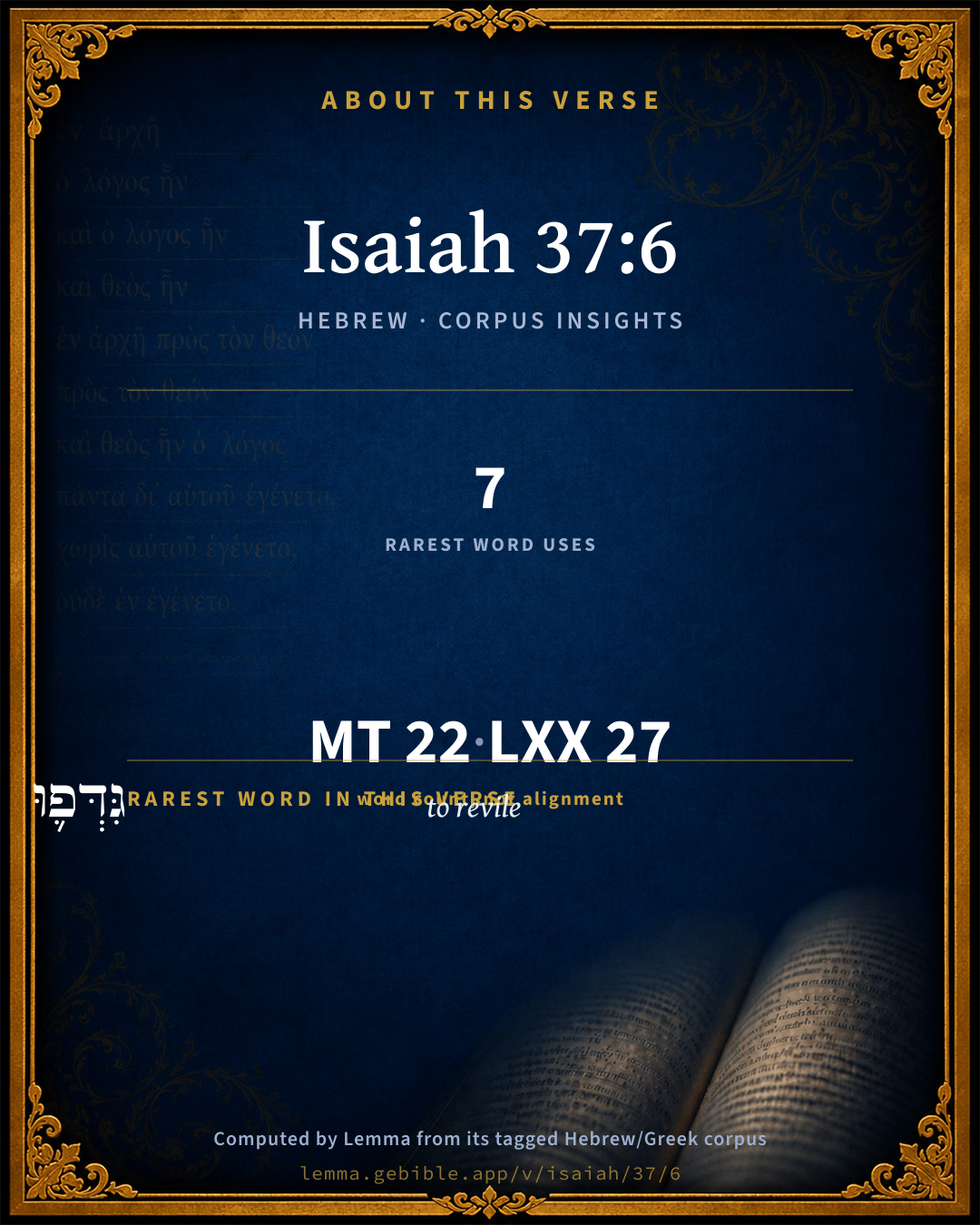
These counts appear in no published source. They are computed here, from the morphology-tagged text and Lemma’s own curated glosses. What Lemma adds →

22
words
17
distinct lemmas
Prophets
section

Notable vocabulary

The rarest word here is גִּדְּפ֛וּ to revile H1442 — appearing just 7 times in the whole Hebrew Bible.

Shared distinctive vocabulary

גִּדְּפ֛וּ to revile H1442 occurs in 7 verses of the Hebrew Bible. Also found in:

Grammatical profile

  • 6 verbs
  • 8 nouns
  • 2 prepositions
  • 2 adverbs
  • 4 particles

Verb forms

  • וַיֹּ֤אמֶר Qal · Sequential Imperfect
  • תֹאמְר֖וּן Qal · Imperfect
  • אָמַ֣ר Qal · Perfect
  • תִּירָא֙ Qal · Jussive
  • שָׁמַ֔עְתָּ Qal · Perfect
  • גִּדְּפ֛וּ Piel · Perfect

Repetition

Words recur within this verse — often emphatic in Hebrew:

  • וַיֹּ֤אמֶר to say H559 ×3
  • כֹּ֥ה thus H3541 ×2
  • אֲלֵיהֶם֙ to H413 ×2
  • אֲשֶׁ֣ר which H834 ×2

Hebrew & Septuagint length

In English translation the verse runs 35 words from the Hebrew and 39 from the Septuagint (LXX English) — closely comparable.

A rough comparison of the two English renderings, which tokenize alike — not a word-level alignment.

Word counts can differ between the Hebrew and the Greek without any difference in meaning — e.g. the Hebrew direct-object marker אֵת has no separate Greek word, and Greek often adds the article ὁ.

In the original languages it is 22 Hebrew tokens and 27 Greek tokens — but the two are counted differently (Hebrew bundles its prefixes and suffixes into one token; the Greek is in lemma form), so that isn’t a like-for-like length.

Cross-references

14

Topical passages linked to Isaiah 37:6 in the Treasury of Scripture Knowledge — connected by theme and wording, ordered by reader-vote popularity; previews shown in the World English Bible.

  • Isaiah 7:4 Tell him, 'Be careful, and keep calm. Don't be afraid, neither let your heart be faint because of these two tails of smoking firebrands, for the fierce anger of Rezin and Syria, and of the son of Remaliah.
  • Isaiah 35:4 Tell those who are of a fearful heart, Be strong, don't be afraid: behold, your God will come [with] vengeance, [with] the recompense of God; he will come and save you.
  • Mark 5:36 But Jesus, when he heard the message spoken, immediately said to the ruler of the synagogue, "Don't be afraid, only believe."
  • Exodus 14:13 Moses said to the people, "Don't be afraid. Stand still, and see the salvation of Yahweh, which he will work for you today: for the Egyptians whom you have seen today, you shall never see them again.
  • Leviticus 26:8 Five of you shall chase a hundred, and a hundred of you shall chase ten thousand; and your enemies shall fall before you by the sword.
  • Joshua 11:6 Yahweh said to Joshua, Don't be afraid because of them; for tomorrow at this time will I deliver them up all slain before Israel: you shall hamstring their horses, and burn their chariots with fire.
  • 2 Kings 19:5–7 So the servants of king Hezekiah came to Isaiah.
  • 2 Kings 22:15–20 She said to them, Thus says Yahweh, the God of Israel: Tell you the man who sent you to me,
  • 2 Chronicles 20:15–20 and he said, Listen you, all Judah, and you inhabitants of Jerusalem, and you king Jehoshaphat: Thus says Yahweh to you, Don't be afraid you, neither be dismayed by reason of this great multitude; for the battle is not yours, but God's.
  • Isaiah 10:24–25 Therefore thus says the Lord, Yahweh of Hosts, my people who dwell in Zion, don't be afraid of the Assyrian, though he strike you with the rod, and lift up his staff against you, after the manner of Egypt.
  • Isaiah 41:10–14 Don't you be afraid, for I am with you; don't be dismayed, for I am your God; I will strengthen you; yes, I will help you; yes, I will uphold you with the right hand of my righteousness.
  • Isaiah 43:1–2 But now thus says Yahweh who created you, Jacob, and he who formed you, Israel: Don't be afraid, for I have redeemed you; I have called you by your name, you are mine.
  • Isaiah 51:12–13 I, even I, am he who comforts you: who are you, that you are afraid of man who shall die, and of the son of man who shall be made as grass;
  • Mark 4:40 He said to them, "Why are you so afraid? How is it that you have no faith?"

Cross-references courtesy of OpenBible.info (CC BY 4.0).

Hebrew and Greek witnesses Masoretic Hebrew ↔ Greek Septuagint

The same verse in the two great witnesses to the Old Testament, shown verse-for-verse.

These are two independent witnesses, not word-aligned to each other, and the Septuagint is shown in lemma (dictionary) form.

Hebrew Isaiah 37:6 Masoretic · Westminster Leningrad Codex

וַיֹּ֤אמֶר אֲלֵיהֶם֙ יְשַֽׁעְיָ֔הוּ כֹּ֥ה תֹאמְר֖וּן אֶל אֲדֹנֵיכֶ֑ם כֹּ֣ה אָמַ֣ר יְהוָ֗ה אַל תִּירָא֙ מִפְּנֵ֤י הַדְּבָרִים֙ אֲשֶׁ֣ר שָׁמַ֔עְתָּ אֲשֶׁ֧ר גִּדְּפ֛וּ נַעֲרֵ֥י מֶלֶךְ אַשּׁ֖וּר אוֹתִֽי

Isaiah said to them, Thus shall you tell your master, Thus says Yahweh, Don't be afraid of the words that you have heard, with which the servants of the king of Assyria have blasphemed me.

World English Bible · Public Domain

Greek LXX Isaiah 37:6 Septuagint · lemma form

καί εἶπον αὐτός ησαιας οὕτως εἶπον πρός ὁ κύριος σύ ὅδε λέγω κύριος μή φοβέω ἀπό ὁ λόγος ὅς ἀκούω ὅς ὀνειδίζω ἐγώ ὁ πρέσβυς βασιλεύς ἀσσύριος

And Esaias said to them, Thus shall you⌃ say to your master, Thus says the Lord, Be not you afraid at the words which you have heard, wherewith the ambassadors of the king of the Assyrians have reproached me,

LXX2012 (modern English Septuagint) · Public Domain

Hebrew: Westminster Leningrad Codex (CC BY 4.0). Greek: Septuagint (public domain); English from LXX2012 (modern English Septuagint) (Public Domain). How the Septuagint differs from the Hebrew →

Targum (Aramaic paraphrase)

1

The Targum is the ancient Jewish Aramaic paraphrase of the Hebrew Scriptures — an interpretive translation, not the Hebrew text itself. Onkelos (literal) and Pseudo-Jonathan (expansive) render the Torah, and Jonathan the Prophets. Coverage is partial: where no permissively-licensed English translation exists for a verse, only the Aramaic is shown. This is verse-level text, not a word-by-word alignment to the Hebrew.

  1. Targum Jonathan Prophets (Joshua–Malachi)
    וַאֲמַר לְהוֹן יְשַׁעְיָה כְּדֵין תֵּימְרוּן לְרִיבּוֹנְכוֹן כִּדְנַן אֲמַר יְיָ לָא תִדְחַל מִן קֳדָם פִּתְגָמַיָא דִי שְׁמַעְתָּא דְחַסְדוּ עוּלֵימֵי מַלְכָּא דְאַתּוּר קֳדָמָי:

    And Isaiah said unto them, Thus shall ye say unto your master, Thus saith the Lord, Be not afraid on account of the words that thou hast heard, wherewith the servants of the king of Assyria have blasphemed before me.

    Targum Jonathan — Aramaic: “Mikraot Gedolot” (public domain). English: “Sefaria Community Translation” (CC0 1.0 (public-domain dedication)); “London "Chaldee Paraphrase," 1871” (public domain). Text via Sefaria.

Commentary

Notes on Isaiah 37:6 from classic Christian and Jewish commentators (each source and its license shown beneath its notes). The classic Christian expositions comment on the surrounding passage and are grouped to its opening verse, so a note may address several verses; the Jewish commentaries on the Tanakh (Rashi and others) are per-verse, so they appear only where the commentator wrote on this verse.

Lemma curates 59 commentaries, every one of them public domain or Creative Commons licensed, each selected and text-cleaned for this edition rather than reprinted as found. About our sources →

Jamieson, Fausset & Brown

Robert Jamieson, A. R. Fausset & David Brown

servants--literally, "youths," mere lads, implying disparagement, not an embassy of venerable elders. The Hebrew is different from that for "servants" in Isa 37:5.

blasphemed me-- (Isa 36:20).

Jamieson, Fausset & Brown — Commentary Critical and Explanatory on the Whole Bible (1871) — public domain (CC PDM 1.0). Text via the HelloAO Bible API.

Adam Clarke's Commentary

Verse 6. Thus shall ye say] כה תאמרון ko tomerun, "thus shall ye (explicitly, earnestly, and positively) say." The paragogic נ nun deepens and increases the sense.

Adam Clarke's Commentary on the Bible (1810–1826) — public domain. Text from a community e-Sword/MySword module.

Ellicott's Commentary for English Readers

(6) The servants of the king of Assyria.—Not the usual word for “servants,” which might include high officers of state, but a less honourable one (na‘arâ), like puer in Latin, or garçon in French. He speaks of Rabshakeh (probably the king’s cup-bearer) as though he were only, after all, a valet.

A Bible Commentary for English Readers, edited by Charles John Ellicott (1878–1897) — public domain. Text from a community e-Sword module.

The Cambridge Bible for Schools and Colleges

gen. ed. J. J. S. Perowne

6. the servants] Lit “the youths.” Cf. 1Ki_20:14.

6, 7. Isaiah’s answer far exceeds the king’s request. He does not need now to pray, for he is already in possession of the Divine message for this crisis.

The Cambridge Bible for Schools and Colleges (gen. ed. J. J. S. Perowne; Cambridge University Press, 1878–1918) — public domain. Text from a community e-Sword module.

John Gill's Exposition

Behold, I will send a blast upon him,.... The king of Assyria; a pestilential one, as he afterwards did, which destroyed his army: or,

I will put a spirit into him (s); a spirit of fear and dread, which will oblige him to desist from his purposes, and flee; though some interpret it only of an inclination, a will (t) in him, to return: it may be understood of an angel, a ministering spirit, and be rendered "I will send a spirit against him"; an angelic spirit, as he did, which cut off his army in one night:

and he shall hear a rumour; of the sudden and total destruction of his army; though some refer this to the rumour of the king of Ethiopia coming out to make war against him, Isa 37:9, but upon this he did not return to his own land, nor was he slain with the sword, as follows:

and return to his own land; as he did, immediately upon the slaughter of his army by the angel:

and I will cause him to fall by the sword in his own land: as he did, being slain by his own sons, Isa 37:37.

(s) "indam ei Spiritum", Junius & Tremellius, Piscator. (t) So Ben Melech explains it by "will", "desire", "purpose".

John Gill's Exposition of the Whole Bible (1746–1763) — public domain (CC PDM 1.0). Text via the HelloAO Bible API.

Albert Barnes' Notes on the Bible

Wherewith the servants ... - Hebrew, נערי na‛ărēy - The ‘youth,’ or the young men. The word properly denotes boys, youths, young men; and is used here probably by way of disparagement, in contradistinction from an embassy that would be truly respectable, made up of aged men.

Have blasphemed me - God regarded these words as spoken against himself and he would vindicate his own honor and name.

Albert Barnes' Notes on the Bible (1834–1885) — public domain. Text from a community e-Sword/MySword module.

Whedon's Commentary on the Bible

Daniel D. Whedon

6, 7. Isaiah replies — He lives closer to God than his king assumes to; this is implied by the king himself in his appeal to him.

Thus saith the Lord — Direct communion with Jehovah brings to the prophet a revelation favourable to the king’s hesitating hope in the case. All the braggadocio of Rabshakeh occasions no fear.

Send a blast — Bring a spirit upon him; — some supernatural force that shall influence his thought and plans.

He shall hear a rumour — Something that shall produce terror, and shall disgracefully scare him homeward, where his career shall end in his being murdered.

Daniel D. Whedon (gen. ed.), Commentary on the Old and New Testaments (1874–1909) — public domain. Text from a community e-Sword module.

The Pulpit Commentary

The servants of the King of Assyria. Mr. Cheyne translates, "the minions of the King of Assyria," remarking truly that the word used is not the ordinary one for "servants," but "a disparaging expression." Perhaps the best translation would be lackeys.

HOMILIES BY W.M. STATHAM Ver. 6. Caution against fear.

"Be not afraid of the words that thou hast heard." We are often afraid of whispers; we often suffer severely through words. It is not surprising. Words are winged, and fly across oceans. Words are penetrating, and enter into the secret places of the heart. Words are indestructible, and, once uttered, who but God can restrain their power?

I THESE WERE WORDS AGAINST GOD. Alas! there have been many such in every age. This is part of the perils of moral government, which leaves the creature "free." But God has set in order a universe of men, and not of machines, and he is too wise not to have ordered all things wisely and well. Man is evidently a being born to the perils which beset all freedom. Thus he can speak against the Most High. "I am equal to the sad occasion," says in effect Jehovah to Isaiah. "The servants of the King of Assyria have blasphemed me, but I will send a blast upon them." No more solemn thought can occupy our minds than the consideration how every day blasphemous, false, and base words are spoken against our Father in heaven.

II THESE WORDS ARE OFTEN DESIGNED TO HURT HIS CHILDREN. "Fear them not," says God; "they cannot hurt you." We are thankful for this revelation of the impotence of evil. If your character is falsely traduced, God can "bring forth thy righteousness as the light, and thy judgment as the noonday." If your influence is injured for a time, God has so ordered the world that evil men reveal their true character. They are not good, and they know it; "and they that be otherwise cannot be hid." Let not the friends of God tremble in the presence of infidel insinuation or sceptical scorn. God"s nature has been revealed. His wonderful works attest his power and goodness. Christ and the cross are the revelation of his love.

III THESE WORDS ARE SURE TO BE HEARD. We cannot at times help the entrance of evil, but we can help the entertainment of it. We must treat all the evil surmises of wicked men with the disdain that they deserve. We can, as Solomon suggests, "turn from it and pass away." Besides, just as there is in love what Dr. Chalmers calls "the expulsive power of a new affection," so there is in love to God a power to banish all that old love of the world which makes men mingle with the irreverent and undevout. The siren voice of evil whisperings will have no charm for us when we hide God"s Word in our heart. The great lesson is not to be afraid of the wickedness of the wicked, or to make their words of account by taking too great note of them. Many malignant words would have perished at their birth if they had not been made much of by argument and reply. The best answer is to trust in God and do the right. W.M.S.

Vers. 6, 7. God"s message to the troubled.

"Thus saith Jehovah, Be not afraid." We have here the Divine response, through Isaiah, as the national intercessor. The circumstances, the boastings, the threatenings, were eminently calculated to produce fear, both in Isaiah and in the people. There was such a show of material strength as Elisha"s servant saw at Dothan, which sent him to his master full of fears. The answer is such as Elisha gave when he made the servant see what it was to have God on their side. God in the city was abundant security against Assyria outside the city, and Hezekiah need not be afraid. God"s message to those who seek him in their troubles is always this: "Be not afraid;" "I am with you." Our fears only stay with us when our eyes are so dim that we cannot see God. Fear goes when he "lifts the light of his countenance upon us." Matthew Henry says, "Those who have made God their enemy we have no reason to be afraid of, for they are marked for ruin; and though they may hiss, they cannot hurt." Dr. A. Raleigh remarks that every creature is liable to fear; there can only be one Being in the universe absolutely and for ever free from that liability he who knows everything and controls everything.

1. The great mysteries of existence have a tendency to produce fear. There are few thoughtful persons who do not feel the shadow of them on their path. They are such things as the existence of evil, sin, misery in the universe, under the government of an infinitely powerful and infinitely benevolent Being. There is great mystery about the plan of Divine providence in the world. Job, David, Jeremiah, were all perplexed and appalled by the sight of the afflictions of the righteous and the prosperity of the wicked.

2. There are certain possibilities, the thought of which has a tendency to darken the spirit with fear. The most sanguine and cheerful can hardly ever imagine, far less expect, a wholly uncheckered future. The worst of all earthly calamities is the possibility of spiritual failure, ending in a final exclusion from the presence of God and the joys of the blessed. Whatsoever form our fear may take, whatsoever may be the trouble or the alarm out of which it grows, if the fear drives us to God, we shall always be sure of getting this response, "Be not afraid." The one answer to all mysteries is this: "God is, God lives; and I can trust him." The one strength with which to meet all the possibilities, and bear all the calamities, of life is this, "He maketh all things work together for good." Fully unfolded, the response of God is given in Isa_41:10. "Fear thou not; for I am withthee: be not dismayed; for I am thy God. R.T.

The Pulpit Commentary (1880–1919), ed. H.D.M. Spence-Jones & Joseph S. Exell — public domain. Text from a community e-Sword module.

J. A. Alexander on Isaiah

Joseph Addison Alexander

“And Isaiah said to them, Thus shall ye say to your master, Thus saith Jehovah, Be not afraid of (literally from before or from the face of) the words which thou hast heard, (with) which the servants of the king of Assyria have blasphemed me.” The last verb means to rail at or revile, and when applied to God must be translated by a still stronger term. The word translated servants is not the same with that in the preceding verse, but strictly means young men or boys. Many regard it as a contemptuous description.

Joseph Addison Alexander, The Prophecies of Isaiah (1846–1847; New York: Scribner, 1870–1878) — public domain. Text from a community e-Sword module.

Lesson kit

Teaching starters — assembled from the data on this page, not authored interpretation. Every prompt links to the verse data it draws on. Edit before teaching.

Isaiah, in the Prophets, opens this verse with 22 words (17 distinct Hebrew lemmas). Its most distinctive word is gâdaph (“to revile”). A historical commentator’s framing appears above. Read the whole chapter for the surrounding context.

Discussion questions

  1. The word gâdaph carries the sense “to revile.” How does it shape the verse?
  2. How does Numbers 15:30, which shares the word «to revile», read alongside this verse?
  3. What does the repetition of “to say” (3× in this one verse) do in this verse?
  4. These translations render this verse differently; the difference is in the English rendering, not the original. What questions does that raise?
  5. «וַיֹּ֤אמֶר» is a Qal Sequential Imperfect verb. How does that grammatical form shape the action described?
  6. Compare how Jamieson, Fausset & Brown and Adam Clarke's Commentary read this verse. Where do they agree or differ?

Things to notice

Reading settings

Reading text

Shown beneath each verse's original-language words.

Old Testament
Old Testament edition

Read the OT as the Masoretic Hebrew (MT) or the Greek Septuagint (LXX).

English shown for the Greek Septuagint (in the Hebrew ↔ Greek comparison).

Comparing translations? Open the Compare panel on any verse page to stack up to four side by side.