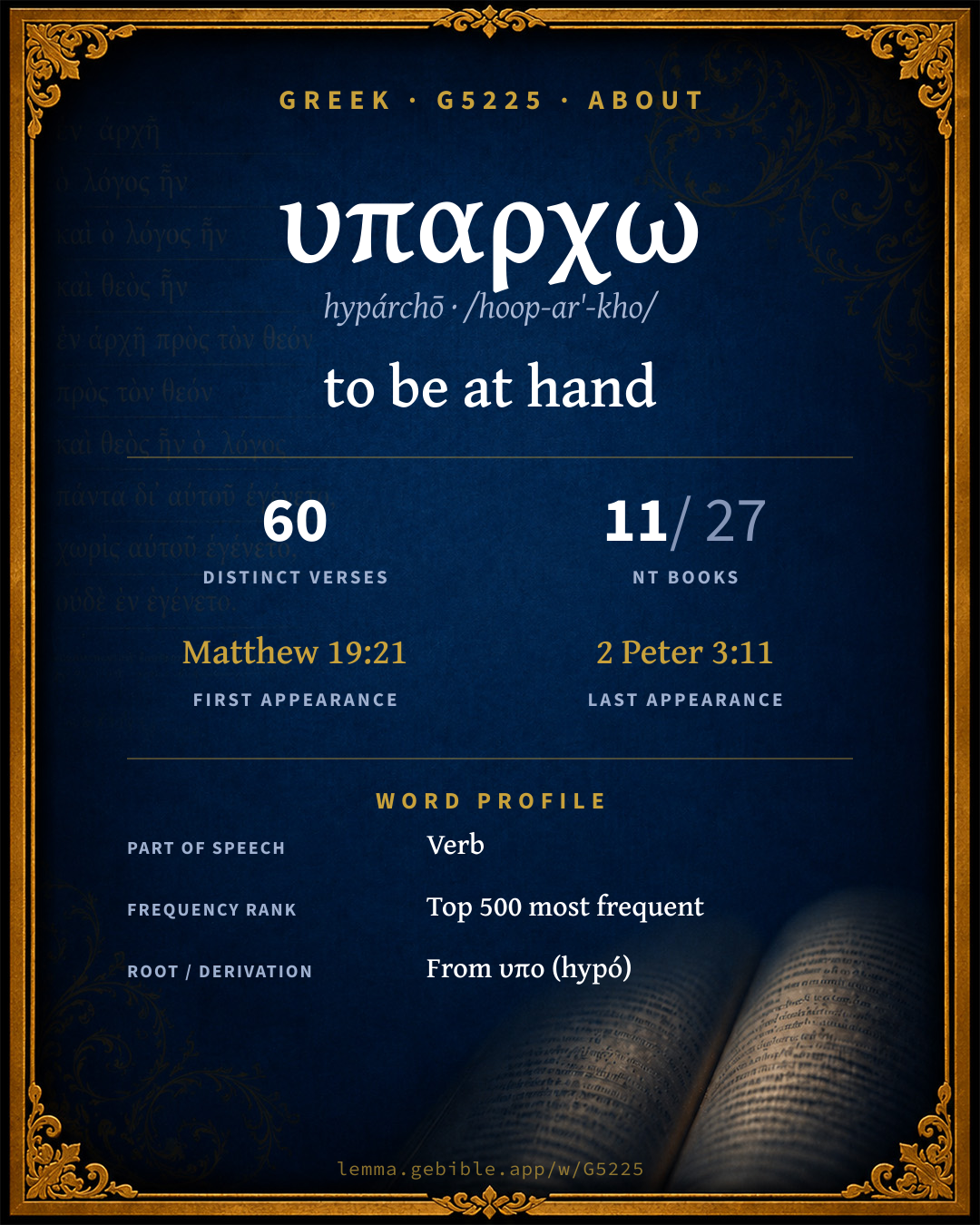
ὑπάρχω
to be at hand
‘to be at hand’ is one of 3 main senses fuller range ↓
Full lexicon entry — Thayer's Greek Lexicon
From Thayer's Greek Lexicon
Where this word appears
See every Present-tense verb in the Greek New Testament →
Grammar key — what these labels mean
Part of speech
- Verb
- An action or state-of-being word.
Tense
- Present
- Ongoing or general action in present time (imperfective aspect).
- Imperfect
- Continuous or repeated action in past time (“was writing”).
Voice
- Active
- The subject performs the action.
Mood
- Participle
- A verbal adjective (“writing,” “having written”).
- Infinitive
- A verbal noun (“to write”), unmarked for person or number.
- Indicative
- States a fact or asks a factual question (the mood of reality).
- Subjunctive
- Expresses probability, purpose, or possibility (the mood of contingency).
Case
- Nominative
- The case of the subject (and the predicate nominative).
- Accusative
- The case of the direct object and of extent.
- Genitive
- The case of source, possession, or “of” — answers “whose / from what.”
- Dative
- The case of the indirect object, means, or location — “to / for / with / in.”
Person
- 3rd person
- The one spoken about (“he / she / it / they”).
Gender
- Masculine
- Grammatically masculine.
- Neuter
- Grammatically neuter.
- Feminine
- Grammatically feminine.
Number
- Singular
- One.
- Plural
- More than one.
Grammatical forms 17 distinct
- Verb, Present, Active, Participle, Nominative, Singular, Masculine 15 times (25%)
- Verb, Present, Active, Infinitive 6 times (10%)
- Verb, Present, Active, Participle, Nominative, Plural, Masculine 6 times (10%)
- Verb, Imperfect, Active, Indicative, 3rd person, Singular 5 times (8%)
- Verb, Present, Active, Participle, Accusative, Plural, Neuter 5 times (8%)
- Verb, Present, Active, Participle, Genitive, Plural, Neuter 5 times (8%)
- Verb, Present, Active, Indicative, 3rd person, Singular 3 times (5%)
- Verb, Present, Active, Participle, Dative, Plural, Neuter 3 times (5%)
+9 more forms (12 occurrences)
Parsed forms decoded from the imported morphology (Robinson–Tischendorf, public domain), counted across 60 parsed occurrences — not distinct verses.
Every verse where G5225 appears — 60 distinct verses across 11 books. Click any verse to open its interlinear word-by-word view. Verse text shown in the World English Bible for context — . Each verse’s Greek form is shown with its reference; the English is not keyword-highlighted, since the data carries no word-level English alignment. Use “Compare translations” on any verse to read it across multiple English versions. This concordance covers the Greek New Testament; Septuagint (Greek Old Testament) occurrences of this word are not indexed here.
Matthew 3 verses
- Matthew 19:21 ὑπάρχοντα pres act ptcp acc pl neut Jesus said to him, "If you want to be perfect, go, sell what you have, and give to the poor, and you will have treasure in heaven; and come, follow me."
- Matthew 24:47 ὑπάρχουσιν pres act ptcp dat pl neut Most assuredly I tell you that he will set him over all that he has.
- Matthew 25:14 ὑπάρχοντα pres act ptcp acc pl neut "For it is like a man, going into another country, who called his own servants, and entrusted his goods to them.
Luke 15 verses
- Luke 7:25 ὑπάρχοντες pres act ptcp nom pl masc But what did you go out to see? A man clothed in soft clothing? Behold, those who are gorgeously dressed, and live delicately, are in kings' courts.
- Luke 8:3 ὑπαρχόντων pres act ptcp gen pl neut and Joanna, the wife of Chuzas, Herod's steward; Susanna; and many others; who ministered to them from their possessions.
- Luke 8:41 ὑπῆρχεν impf act ind 3sg Behold, there came a man named Jairus, and he was a ruler of the synagogue. He fell down at Jesus' feet, and begged him to come into his house,
- Luke 9:48 ὑπάρχων pres act ptcp nom sg masc and said to them, "Whoever receives this little child in my name receives me. Whoever receives me receives him who sent me. For whoever is least among you all, this one will be great."
- Luke 11:13 ὑπάρχοντες pres act ptcp nom pl masc If you then, being evil, know how to give good gifts to your children, how much more will your heavenly Father give the Holy Spirit to those who ask him?"
- Luke 11:21 ὑπάρχοντα pres act ptcp nom pl neut "When the strong man, fully armed, guards his own dwelling, his goods are safe.
- Luke 12:15 ὑπαρχόντων pres act ptcp gen pl neut He said to them, "Beware! Keep yourselves from covetousness, for a man's life doesn't consist of the abundance of the things which he possesses."
- Luke 12:33 ὑπάρχοντα pres act ptcp acc pl neut Sell that which you have, and give gifts to the needy. Make for yourselves purses which don't grow old, a treasure in the heavens that doesn't fail, where no thief approaches, neither moth destroys.
- Luke 12:44 ὑπάρχουσιν pres act ptcp dat pl neut Truly I tell you, that he will set him over all that he has.
- Luke 14:33 ὑπάρχουσιν pres act ptcp dat pl neut So therefore whoever of you who doesn't renounce all that he has, he can't be my disciple.
- Luke 16:1 ὑπάρχοντα pres act ptcp acc pl neut He also said to his disciples, "There was a certain rich man who had a manager. An accusation was made to him that this man was wasting his possessions.
- Luke 16:14 ὑπάρχοντες pres act ptcp nom pl masc The Pharisees, who were lovers of money, also heard all these things, and they scoffed at him.
- Luke 16:23 ὑπάρχων pres act ptcp nom sg masc In Hades, he lifted up his eyes, being in torment, and saw Abraham far off, and Lazarus at his bosom.
- Luke 19:8 ὑπαρχόντων pres act ptcp gen pl neut Zacchaeus stood and said to the Lord, "Behold, Lord, half of my goods I give to the poor. If I have wrongfully exacted anything of anyone, I restore four times as much."
- Luke 23:50 ὑπάρχων pres act ptcp nom sg masc Behold, a man named Joseph, who was a member of the council, a good and righteous man
Acts 25 verses
- Acts 2:30 ὑπάρχων pres act ptcp nom sg masc Therefore, being a prophet, and knowing that God had sworn with an oath to him that of the fruit of his body, according to the flesh, he would raise up the Christ to sit on his throne,
- Acts 3:2 ὑπάρχων pres act ptcp nom sg masc A certain man who was lame from his mother's womb was being carried, whom they laid daily at the door of the temple which is called Beautiful, to ask gifts for the needy of those who entered into the temple.
- Acts 3:6 ὑπάρχει pres act ind 3sg But Peter said, "Silver and gold have I none, but what I have, that I give you. In the name of Jesus Christ of Nazareth, get up and walk!"
- Acts 4:32 ὑπαρχόντων pres act ptcp gen pl neut The multitude of those who believed were of one heart and soul. Not one of them claimed that anything of the things which he possessed was his own, but they had all things in common.
- Acts 4:34 ὑπῆρχον impf act ind 3pl For neither was there among them any who lacked, for as many as were owners of lands or houses sold them, and brought the proceeds of the things that were sold,
- Acts 4:37 ὑπάρχοντος pres act ptcp gen sg masc having a field, sold it, and brought the money and laid it at the apostles' feet.
- Acts 5:4 ὑπῆρχεν impf act ind 3sg While you kept it, didn't it remain your own? After it was sold, wasn't it in your power? How is it that you have conceived this thing in your heart? You haven't lied to men, but to God."
- Acts 7:55 ὑπάρχων pres act ptcp nom sg masc But he, being full of the Holy Spirit, looked up steadfastly into heaven, and saw the glory of God, and Jesus standing on the right hand of God,
- Acts 8:16 ὑπῆρχον impf act ind 3pl for as yet he had fallen on none of them. They had only been baptized in the name of Christ Jesus.
- Acts 10:12 ὑπῆρχεν impf act ind 3sg in which were all kinds of four-footed animals of the earth, wild animals, reptiles, and birds of the sky.
- Acts 16:3 ὑπῆρχεν impf act ind 3sg Paul wanted to have him go out with him, and he took and circumcised him because of the Jews who were in those parts; for they all knew that his father was a Greek.
- Acts 16:20 ὑπάρχοντες pres act ptcp nom pl masc When they had brought them to the magistrates, they said, "These men, being Jews, are agitating our city,
- Acts 16:37 ὑπάρχοντας pres act ptcp acc pl masc But Paul said to them, "They have beaten us publicly, without a trial, men who are Romans, and have cast us into prison! Do they now release us secretly? No, most assuredly, but let them come themselves and bring us out!"
- Acts 17:24 ὑπάρχων pres act ptcp nom sg masc The God who made the world and all things in it, he, being Lord of heaven and earth, doesn't dwell in temples made with hands,
- Acts 17:27 ὑπάρχοντα pres act ptcp acc sg masc that they should seek the Lord, if perhaps they might reach out for him and find him, though he is not far from each one of us.
- Acts 17:29 ὑπάρχοντες pres act ptcp nom pl masc Being then the offspring of God, we ought not to think that the Divine Nature is like gold, or silver, or stone, engraved by art and design of man.
- Acts 19:36 ὑπάρχειν pres act inf Seeing then that these things can't be denied, you ought to be quiet, and to do nothing rash.
- Acts 19:40 ὑπάρχοντος pres act ptcp gen sg neut For indeed we are in danger of being accused concerning this day's riot, there being no cause. Concerning it, we wouldn't be able to give an account of this commotion."
- Acts 21:20 ὑπάρχουσιν pres act ind 3pl They, when they heard it, glorified God. They said to him, "You see, brother, how many thousands there are among the Jews of those who have believed, and they are all zealous for the law.
- Acts 22:3 ὑπάρχων pres act ptcp nom sg masc "I am indeed a Jew, born in Tarsus of Cilicia, but brought up in this city at the feet of Gamaliel, instructed according to the strict manner of the law of our fathers, being zealous for God, even as you all are this day.
- Acts 27:12 ὑπάρχοντος pres act ptcp gen sg masc Because the haven was not suitable to winter in, the majority advised going to sea from there, if by any means they could reach Phoenix, and winter there, which is a port of Crete, looking northeast and southeast.
- Acts 27:21 ὑπαρχούσης pres act ptcp gen sg fem When they had been long without food, Paul stood up in the middle of them, and said, "Sirs, you should have listened to me, and not have set sail from Crete, and have gotten this injury and loss.
- Acts 27:34 ὑπάρχει pres act ind 3sg Therefore I beg you to take some food, for this is for your safety; for not a hair will perish from any of your heads."
- Acts 28:7 ὑπῆρχεν impf act ind 3sg Now in the neighborhood of that place were lands belonging to the chief man of the island, named Publius, who received us, and courteously entertained us for three days.
- Acts 28:18 ὑπάρχειν pres act inf who, when they had examined me, desired to set me free, because there was no cause of death in me.
Romans 1 verse
1 Corinthians 5 verses
- 1 Corinthians 7:26 ὑπάρχειν pres act inf I think that it is good therefore, because of the distress that is on us, that it is good for a man to be as he is.
- 1 Corinthians 11:7 ὑπάρχων pres act ptcp nom sg masc For a man indeed ought not to have his head covered, because he is the image and glory of God, but the woman is the glory of the man.
- 1 Corinthians 11:18 ὑπάρχειν pres act inf For first of all, when you come together in the assembly, I hear that divisions exist among you, and I partly believe it.
- 1 Corinthians 12:22 ὑπάρχειν pres act inf No, much rather, those members of the body which seem to be weaker are necessary.
- 1 Corinthians 13:3 ὑπάρχοντά pres act ptcp acc pl neut If I dole out all my goods to feed the poor, and if I give my body to be burned, but don't have love, it profits me nothing.
2 Corinthians 2 verses
- 2 Corinthians 8:17 ὑπάρχων pres act ptcp nom sg masc For he indeed accepted our exhortation, but being himself very earnest, he went out to you of his own accord.
- 2 Corinthians 12:16 ὑπάρχων pres act ptcp nom sg masc But be it so, I did not myself burden you. But, being crafty, I caught you with deception.
Galatians 2 verses
- Galatians 1:14 ὑπάρχων pres act ptcp nom sg masc I advanced in the Jews' religion beyond many of my own age among my countrymen, being more exceedingly zealous for the traditions of my fathers.
- Galatians 2:14 ὑπάρχων pres act ptcp nom sg masc But when I saw that they didn't walk uprightly according to the truth of the Gospel, I said to Peter before them all, "If you, being a Jew, live as the Gentiles do, and not as the Jews do, why do you compel the Gentiles to live as the Jews do?
Philippians 2 verses
Hebrews 1 verse
James 1 verse
2 Peter 3 verses
- 2 Peter 1:8 ὑπάρχοντα pres act ptcp nom pl neut For if these things are yours and abound, they make you to be not idle nor unfruitful to the knowledge of our Lord Jesus Christ.
- 2 Peter 2:19 ὑπάρχοντες pres act ptcp nom pl masc promising them liberty, while they themselves are bondservants of corruption; for by whom a man is overcome, by the same is he also brought into bondage.
- 2 Peter 3:11 ὑπάρχειν pres act inf Therefore since all these things are thus to be destroyed, what manner of persons ought you to be in holy living and godliness,
About this entry
At a glance — auto-summarized from this page’s data, not written by a person. Every figure links to its source below. This summary describes the numbers; it doesn’t interpret them.
υπαρχω — transliterated hypárchō — is a Greek verb carrying the sense “to be at hand.” Translators differ — “being” in the King James Version, then “possessions” (Berean Standard Bible), as the renderings breakdown shows. With 60 verses in 11 books, it is a moderately common word in the Greek New Testament. Its uses concentrate in Acts (42% of all occurrences). Its lexical range runs to 3 senses. See the sense tree, 60-verse concordance, and the renderings breakdown below.
Gloss history
Strong's 1890 vs modern scholarship

About this word
Strong's G5225 catalogs a Greek word from the Greek New Testament.
These counts are not copied from any lexicon or concordance. They are computed here, from the morphology-tagged Greek New Testament. What Lemma adds →
- 60
- distinct verses
- The word appears in 60 distinct verses.
- 11 / 27
- NT books
- The word appears in 11 of 27 New Testament books.
- #272
- by frequency
- Top 500 most frequent Greek words (rank 272 of 5,347 Greek words by occurrence).
View all 60 occurrences in the concordance →
Most concentrated in
- Acts 25 verses 42%
- Luke 15 verses 25%
- 1 Corinthians 5 verses 8%
By section of the New Testament
By traditional corpus
Conventional, traditional groupings — biblical authorship is debated, so this is a traditional corpus grouping, not an authorship claim. Some books belong to more than one corpus (Luke is in both the Gospels and the Lukan corpus, and so on), so these shares overlap and need not total 100%. Each figure is a share of the word’s 60 distinct verses.
- Lukan (Luke–Acts) 40 verses · 67%
- Gospels 18 verses · 30%
- Pauline corpus 12 verses · 20%
- General (Catholic) Epistles 4 verses · 7%
- Hebrews 1 verse · 2%
How translations render this word
Counts come from each version’s own published word-to-Strong’s tagging or interlinear alignment — an approximate guide to how each version renders this word, not a word-level alignment the data otherwise carries. Because each total is that version’s own tagged count, the per-version totals vary from one another and need not match the appearance or distinct-verse counts above. These counts may also differ from a printed concordance because Lemma counts each distinctly tagged rendering and does not collapse phrase taggings into a single head-word total. This is a fixed set of word-tagged versions (KJV, ASV, BSB, ULT) and does not change with the reading translation you choose elsewhere. Each version’s license is shown beside its name below (and on Sources).
- King James Version: Being 12×, Be 6×, Was 6×
- American Standard Version: Being 12×, Be 4×, Is 4×
- Berean Standard Bible: Possessions 10×, Are 6×, Is 5×
- unfoldingWord Literal Text: Being 23×, Possessions 12×, Were 5×
King James Version Public Domain
Renders G5225 across 49 tagged occurrences — most commonly:
Plus 17 renderings that appear only once — usually multi-word phrases or single function words the recovered tagging swept in, not distinct renderings.
American Standard Version Public Domain
Renders G5225 across 51 tagged occurrences — most commonly:
Plus 22 renderings that appear only once — usually multi-word phrases or single function words the recovered tagging swept in, not distinct renderings.
Berean Standard Bible Public Domain
Renders G5225 across 52 tagged occurrences — most commonly:
Plus 19 renderings that appear only once — usually multi-word phrases or single function words the recovered tagging swept in, not distinct renderings. Not rendered by a distinct English word in 5 further occurrences.
unfoldingWord Literal Text CC BY-SA 4.0
Renders G5225 across 66 tagged occurrences — most commonly:
Plus 13 renderings that appear only once — usually multi-word phrases or single function words the recovered tagging swept in, not distinct renderings.
Senses in Thayer's
The 3 senses Thayer's distinguishes for this word, in lexicon order (not ranked by frequency or importance). The full entry — with sub-senses — is in the Lexicon Entry tab.
- to begin below, to make a beginning
- to come forth, hence to be there, be ready, be at hand
- to be
Word origin
Derived from υπο (hypó) (G5259) — under.
From G5259 and G756 ; to begin under ( quietly ) that is come into existence ( be present or at hand ); expletively to exist (as copula or subordinate to an adjective participle adverb or preposition or as auxilliary to principal verb): - after behave live.
— Strong’s Exhaustive Concordance (1890), public domain.
Forms in the corpus
The 14 distinct written forms G5225 takes in the Greek New Testament, most frequent first — each parse links to that tense’s occurrences in the concordance.
Same root — word family
Other Thayer's entries built from the same root as G5225, grouped by Strong’s listed origin. These share a root / origin per the lexicon — not necessarily a shared meaning. Each links to that word’s own entry.
Derives from
Shares the same root
- υπαγω hypágō G5217 to depart
- υπακουω hypakoúō G5219 to listen
- υπανδρος hýpandros G5220 under (married)
- υπανταω hypantáō G5221 to meet
- υπεικω hypeíkō G5226 to yield
- υπεναντιος hypenantíos G5227 adversary
- υπεχω hypéchō G5254 to sustain
- υπηρετης hypērétēs G5257 servant
- υπνος hýpnos G5258 sleep
- υποβαλλω hypobállō G5260 to instigate
- υπογραμμος hypogrammós G5261 example
- υποδεικνυμι hypodeíknymi G5263 to demonstrate
- υποδεχομαι hypodéchomai G5264 to welcome
- υποδεω hypodéō G5265 to bind on
- υποδικος hypódikos G5267 debtor
- υποζυγιον hypozýgion G5268 beast of burden
- υποζωννυμι hypozṓnnymi G5269 to undergird
- υποκατω hypokátō G5270 underneath
- υποκρινομαι hypokrínomai G5271 to pretend
- υπολαμβανω hypolambánō G5274 to welcome
- υποληνιον hypolḗnion G5276 wine pit
- υπομενω hypoménō G5278 to endure
- υπομιμνησκω hypomimnḗskō G5279 to remind
- υπονοεω hyponoéō G5282 to suppose
+15 more words share this root (not shown).
Derived from this word
Compare all same-root words → Showing 4 of 43 — not the complete family. They share a root, not necessarily a meaning.
Septuagint usage
The same Greek word υπαρχω appears 105 times in the Greek Old Testament (Septuagint), across 102 verses in 29 books.
- 105
- LXX occurrences
- Tagged occurrences of this Greek word in the Septuagint.
- 102
- verses
- Distinct Septuagint verses containing this word.
- 29 / 39
- OT books
- The word appears in 29 of the 39 Old Testament books.
Sample Septuagint occurrences
- Genesis 12:5 ὑποἄρχω
- Exodus 14:11 ὑποἄρχω
- Numbers 32:4 ὑποἄρχω
- Deuteronomy 20:14 ὑποἄρχω
- Joshua 4:6 ὑποἄρχω
- Ruth 2:21 ὑποἄρχω
- 1 Samuel 9:7 ὑποἄρχω
- 1 Chronicles 27:31 ὑποἄρχω
- 2 Chronicles 15:17 ὑποἄρχω
- Ezra 6:8 ὑποἄρχω
- Esther 3:8 ὑποἄρχω
- Job 2:3 ὑποἄρχω
Septuagint occurrences (same lexeme)
Every verse where the same Strong’s number (G5225) appears in the Greek Septuagint — showing the first 50 of 102. Verse text shown in the World English Bible for context; the Greek form is the matched word — the English is not keyword-highlighted.
- Genesis 12:5 ὑποἄρχω Abram took Sarai his wife, Lot his brother's son, all their substance that they had gathered, and the souls who they had gotten in Haran; and they went forth to go into the land of Canaan. Into the land of Canaan they came.
- Genesis 13:6 ὑποἄρχω The land was not able to bear them, that they might live together: for their substance was great, so that they could not live together.
- Genesis 14:16 ὑποἄρχω He brought back all the goods, and also brought back his relative, Lot, and his goods, and the women also, and the people.
- Genesis 24:59 ὑποἄρχω They sent away Rebekah, their sister, with her nurse, Abraham's servant, and his men.
- Genesis 25:5 ὑποἄρχω Abraham gave all that he had to Isaac,
- Genesis 31:18 ὑποἄρχω and he carried away all his cattle, and all his substance which he had gathered, the cattle of his getting, which he had gathered in Paddan Aram, to go to Isaac his father to the land of Canaan.
- Genesis 34:23 ὑποἄρχω Won't their cattle and their substance and all their animals be ours? Only let us give our consent to them, and they will dwell with us."
- Genesis 36:6 ὑποἄρχω Esau took his wives, his sons, his daughters, and all the members of his household, with his cattle, all his animals, and all his possessions, which he had gathered in the land of Canaan, and went into a land away from his brother Jacob.
- Genesis 36:7 ὑποἄρχω For their substance was too great for them to dwell together, and the land of their travels couldn't bear them because of their cattle.
- Genesis 39:5 ὑποἄρχω It happened from the time that he made him overseer in his house, and over all that he had, that Yahweh blessed the Egyptian's house for Joseph's sake; and the blessing of Yahweh was on all that he had, in the house and in the field.
- Genesis 42:13 ὑποἄρχω They said, "We, your servants, are twelve brothers, the sons of one man in the land of Canaan; and, behold, the youngest is this day with our father, and one is no more."
- Genesis 42:32 ὑποἄρχω We are twelve brothers, sons of our father; one is no more, and the youngest is this day with our father in the land of Canaan.'
- Genesis 45:11 ὑποἄρχω There I will nourish you; for there are yet five years of famine; lest you come to poverty, you, and your household, and all that you have."'
- Genesis 45:18 ὑποἄρχω Take your father and your households, and come to me, and I will give you the good of the land of Egypt, and you will eat the fat of the land.'
- Genesis 46:6 ὑποἄρχω They took their cattle, and their goods, which they had gotten in the land of Canaan, and came into Egypt-- Jacob, and all his seed with him,
- Genesis 47:18 ὑποἄρχω When that year was ended, they came to him the second year, and said to him, "We will not hide from my lord how our money is all spent, and the herds of cattle are my lord's. There is nothing left in the sight of my lord, but our bodies, and our lands.
- Exodus 14:11 ὑποἄρχω They said to Moses, "Because there were no graves in Egypt, have you taken us away to die in the wilderness? Why have you treated us this way, to bring us forth out of Egypt?
- Exodus 22:2 ὑποἄρχω If the thief is found breaking in, and is struck so that he dies, there shall be no guilt of bloodshed for him.
- Exodus 32:24 ὑποἄρχω I said to them, 'Whoever has any gold, let them take it off:' so they gave it me; and I threw it into the fire, and out came this calf."
- Numbers 32:4 ὑποἄρχω the land which Yahweh struck before the congregation of Israel, is a land for cattle; and your servants have cattle.
- Deuteronomy 20:14 ὑποἄρχω but the women, and the little ones, and the cattle, and all that is in the city, even all the spoil of it, shall you take for a prey to yourself; and you shall eat the spoil of your enemies, which Yahweh your God has given you.
- Deuteronomy 21:16 ὑποἄρχω then it shall be, in the day that he causes his sons to inherit that which he has, that he may not make the son of the beloved the firstborn before the son of the hated, who is the firstborn:
- Joshua 4:6 ὑποἄρχω that this may be a sign among you, that when your children ask in time to come, saying, What do you mean by these stones?
- Joshua 5:12 ὑποἄρχω The manna ceased on the next day, after they had eaten of the produce of the land; neither had the children of Israel manna any more; but they ate of the fruit of the land of Canaan that year.
- Joshua 7:24 ὑποἄρχω Joshua, and all Israel with him, took Achan the son of Zerah, and the silver, and the mantle, and the wedge of gold, and his sons, and his daughters, and his oxen, and his donkeys, and his sheep, and his tent, and all that he had: and they brought them up to the valley of Achor.
- Ruth 2:21 ὑποἄρχω Ruth the Moabitess said, Yes, he said to me, You shall keep fast by my young men, until they have ended all my harvest.
- Ruth 4:9 ὑποἄρχω Boaz said to the elders, and to all the people, You are witnesses this day, that I have bought all that was Elimelech's, and all that was Chilion's and Mahlon's, of the hand of Naomi.
- 1 Samuel 9:7 ὑποἄρχω Then said Saul to his servant, But, behold, if we go, what shall we bring the man? for the bread is spent in our vessels, and there is not a present to bring to the man of God: what have we?
- 1 Chronicles 27:31 ὑποἄρχω All these were the rulers of the substance which was king David's.
- 1 Chronicles 28:1 ὑποἄρχω David assembled all the princes of Israel, the princes of the tribes, and the captains of the companies who served the king by division, and the captains of thousands, and the captains of hundreds, and the rulers over all the substance and possessions of the king and of his sons, with the officers, and the mighty men, even all the mighty men of valor, to Jerusalem.
- 2 Chronicles 15:17 ὑποἄρχω But the high places were not taken away out of Israel: nevertheless the heart of Asa was perfect all his days.
- 2 Chronicles 20:33 ὑποἄρχω However the high places were not taken away; neither as yet had the people set their hearts to the God of their fathers.
- 2 Chronicles 26:10 ὑποἄρχω He built towers in the wilderness, and hewed out many cisterns, for he had much cattle; in the lowland also, and in the plain: [and he had] farmers and vineyard keepers in the mountains and in the fruitful fields; for he loved farming.
- 2 Chronicles 31:3 ὑποἄρχω [He appointed] also the king's portion of his substance for the burnt-offerings, [to wit], for the morning and evening burnt offerings, and the burnt offerings for the Sabbaths, and for the new moons, and for the set feasts, as it is written in the law of Yahweh.
- Ezra 6:8 ὑποἄρχω Moreover I make a decree what you shall do to these elders of the Jews for the building of this house of God: that of the king's goods, even of the tribute beyond the River, expenses be given with all diligence to these men, that they be not hindered.
- Esther 3:8 ὑποἄρχω Haman said to king Ahasuerus, There is a certain people scattered abroad and dispersed among the peoples in all the provinces of your kingdom; and their laws are diverse from [those of] every people; neither keep they the king's laws: therefore it is not for the king's profit to allow them.
- Esther 3:13 ὑποἄρχω Letters were sent by posts into all the king's provinces, to destroy, to kill, and to cause to perish, all Jews, both young and old, little children and women, in one day, even on the thirteenth [day] of the twelfth month, which is the month Adar, and to take the spoil of them for a prey.
- Esther 8:1 ὑποἄρχω On that day did the king Ahasuerus give the house of Haman the Jews' enemy to Esther the queen. Mordecai came before the king; for Esther had told what he was to her.
- Esther 8:7 ὑποἄρχω Then the king Ahasuerus said to Esther the queen and to Mordecai the Jew, See, I have given Esther the house of Haman, and him they have hanged on the gallows, because he laid his hand on the Jews.
- Job 2:3 ὑποἄρχω Yahweh said to Satan, "Have you considered my servant Job? For there is none like him in the earth, a blameless and an upright man, one who fears God, and turns away from evil. He still maintains his integrity, although you incited me against him, to ruin him without cause."
- Job 2:4 ὑποἄρχω Satan answered Yahweh, and said, "Skin for skin. Yes, all that a man has will he give for his life.
- Job 15:29 ὑποἄρχω He shall not be rich, neither shall his substance continue, Neither shall their possessions be extended on the earth.
- Job 17:3 ὑποἄρχω "Now give a pledge, be collateral for me with yourself. Who is there who will strike hands with me?
- Job 18:7 ὑποἄρχω The steps of his strength shall be shortened, His own counsel shall cast him down.
- Job 18:17 ὑποἄρχω His memory shall perish from the earth. He shall have no name in the street.
- Job 20:20 ὑποἄρχω "Because he knew no quietness within him, He shall not save anything of that in which he delights.
- Job 20:29 ὑποἄρχω This is the portion of a wicked man from God, The heritage appointed to him by God."
- Job 21:19 ὑποἄρχω You say, 'God lays up his iniquity for his children.' Let him recompense it to himself, that he may know it.
- Job 38:26 ὑποἄρχω To cause it to rain on a land where no man is; On the wilderness, in which there is no man;
- Job 42:17 ὑποἄρχω So Job died, being old and full of days.
These are occurrences of the same Greek lexeme (G5225) in the Septuagint — not a translation of any one Hebrew word. The store carries no word-level Hebrew↔Greek alignment, so no Hebrew original is asserted here. Counts come from the recovered LXX Strong's tagging — high-frequency vocabulary is well covered, while rare or late forms may be untagged — so they reflect tagged occurrences and may slightly undercount.