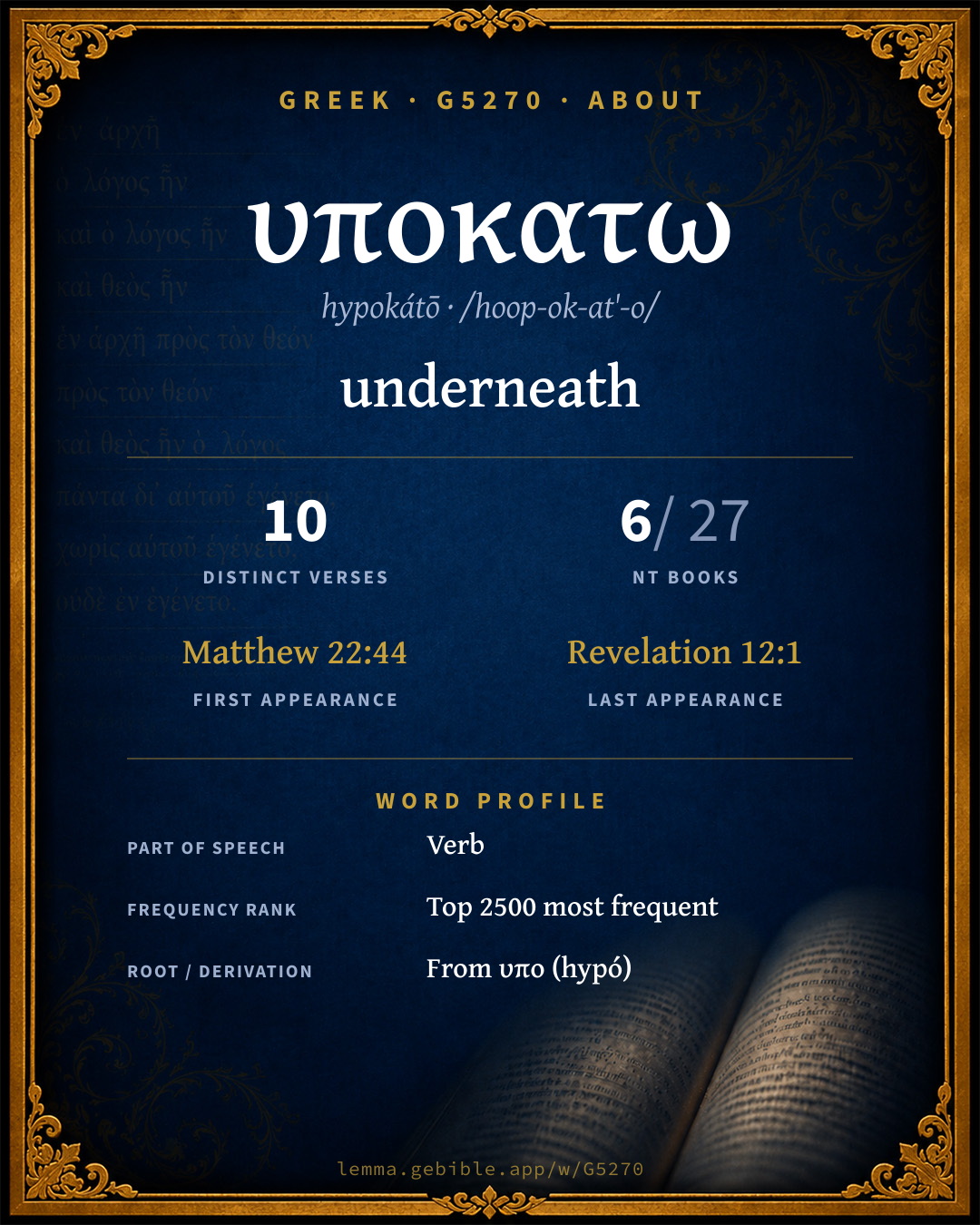
ὑποκάτω
underneath
Full lexicon entry — Thayer's Greek Lexicon
From Thayer's Greek Lexicon
Where this word appears
Grammar key — what these labels mean
Part of speech
- Adverb
- A word that modifies a verb, adjective, or other adverb.
Every verse where G5270 appears — 10 distinct verses across 6 books. Click any verse to open its interlinear word-by-word view. Verse text shown in the World English Bible for context — . Each verse’s Greek form is shown with its reference; the English is not keyword-highlighted, since the data carries no word-level English alignment. Use “Compare translations” on any verse to read it across multiple English versions. This concordance covers the Greek New Testament; Septuagint (Greek Old Testament) occurrences of this word are not indexed here.
Matthew 1 verse
Mark 2 verses
- Mark 6:11 ὑποκάτω adv Whoever will not receive you nor hear you, as you depart from there, shake off the dust that is under your feet for a testimony against them. Assuredly, I tell you, it will be more tolerable for Sodom and Gomorrah in the day of judgment than for that city!"
- Mark 7:28 ὑποκάτω adv But she answered him, "Yes, Lord. Yet even the dogs under the table eat the children's crumbs."
Luke 1 verse
John 1 verse
Hebrews 1 verse
Revelation 4 verses
- Revelation 5:3 ὑποκάτω adv No one in heaven above, or on the earth, or under the earth, was able to open the book, or to look in it.
- Revelation 5:13 ὑποκάτω adv I heard every created thing which is in heaven, on the earth, under the earth, on the sea, and everything in them, saying, "To him who sits on the throne, and to the Lamb be the blessing, the honor, the glory, and the dominion, forever and ever! Amen!"
- Revelation 6:9 ὑποκάτω adv When he opened the fifth seal, I saw underneath the altar the souls of those who had been killed for the Word of God, and for the testimony of the Lamb which they had.
- Revelation 12:1 ὑποκάτω adv A great sign was seen in heaven: a woman clothed with the sun, and the moon under her feet, and on her head a crown of twelve stars.
About this entry
At a glance — auto-summarized from this page’s data, not written by a person. Every figure links to its source below. This summary describes the numbers; it doesn’t interpret them.
The Greek verb υποκατω centers on the idea of “underneath.” Its earliest occurrence is Matthew 22:44. It appears 10 verses across 6 books of the Greek New Testament, among its uncommon vocabulary. The word gravitates to Revelation (40%), then Mark and Matthew. It clusters with υπο, υπαγω and υπακουω under a shared root. For the data behind this summary, explore the sense tree and the renderings breakdown below.
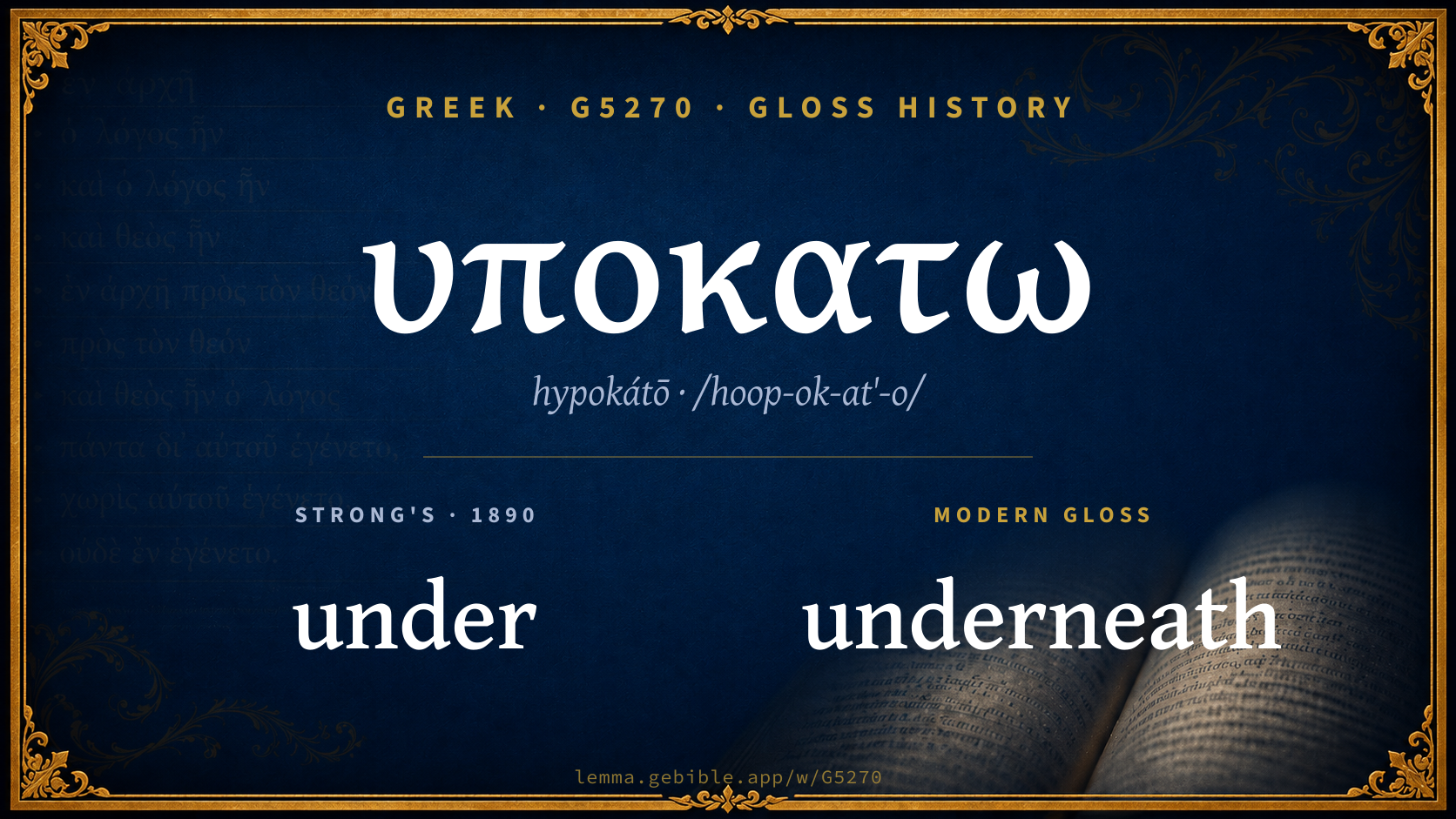
Gloss history
Strong's 1890 vs modern scholarship
About this word
Strong's G5270 catalogs a Greek word from the Greek New Testament.
These counts are not copied from any lexicon or concordance. They are computed here, from the morphology-tagged Greek New Testament. What Lemma adds →
- 10
- distinct verses
- The word appears in 10 distinct verses.
- 6 / 27
- NT books
- The word appears in 6 of 27 New Testament books.
- #1,056
- by frequency
- Top 2500 most frequent Greek words (rank 1,056 of 5,347 Greek words by occurrence).
View all 10 occurrences in the concordance →
Most concentrated in
- Revelation 4 verses 40%
- Mark 2 verses 20%
- Matthew 1 verse 10%
By section of the New Testament
By traditional corpus
Conventional, traditional groupings — biblical authorship is debated, so this is a traditional corpus grouping, not an authorship claim. Some books belong to more than one corpus (Luke is in both the Gospels and the Lukan corpus, and so on), so these shares overlap and need not total 100%. Each figure is a share of the word’s 10 distinct verses.
- Gospels 5 verses · 50%
- Johannine 5 verses · 50%
- Revelation 4 verses · 40%
- Lukan (Luke–Acts) 1 verse · 10%
- Hebrews 1 verse · 10%
How translations render this word
Counts come from each version’s own published word-to-Strong’s tagging or interlinear alignment — an approximate guide to how each version renders this word, not a word-level alignment the data otherwise carries. Because each total is that version’s own tagged count, the per-version totals vary from one another and need not match the appearance or distinct-verse counts above. These counts may also differ from a printed concordance because Lemma counts each distinctly tagged rendering and does not collapse phrase taggings into a single head-word total. This is a fixed set of word-tagged versions (KJV, ASV, BSB, ULT) and does not change with the reading translation you choose elsewhere. Each version’s license is shown beside its name below (and on Sources).
- King James Version: Under 9×
- American Standard Version: Under 6×, Underneath 2×
- Berean Standard Bible: Under 10×
- unfoldingWord Literal Text: Under 10×
King James Version Public Domain
Renders G5270 across 9 tagged occurrences — most commonly:
American Standard Version Public Domain
Renders G5270 across 9 tagged occurrences — most commonly:
Plus 1 rendering that appears only once — usually multi-word phrases or single function words the recovered tagging swept in, not distinct renderings.
Berean Standard Bible Public Domain
Renders G5270 across 11 tagged occurrences — most commonly:
Plus 1 rendering that appears only once — usually multi-word phrases or single function words the recovered tagging swept in, not distinct renderings.
unfoldingWord Literal Text CC BY-SA 4.0
Renders G5270 across 11 tagged occurrences — most commonly:
Plus 1 rendering that appears only once — usually multi-word phrases or single function words the recovered tagging swept in, not distinct renderings.
Senses in Thayer's
The 1 sense Thayer's distinguishes for this word, in lexicon order (not ranked by frequency or importance). The full entry — with sub-senses — is in the Lexicon Entry tab.
- under, underneath
Word origin
Derived from υπο (hypó) (G5259) — under.
Same root — word family
Other Thayer's entries built from the same root as G5270, grouped by Strong’s listed origin. These share a root / origin per the lexicon — not necessarily a shared meaning. Each links to that word’s own entry.
Derives from
Shares the same root
- υπαγω hypágō G5217 to depart
- υπακουω hypakoúō G5219 to listen
- υπανδρος hýpandros G5220 under (married)
- υπανταω hypantáō G5221 to meet
- υπαρχω hypárchō G5225 to be at hand
- υπεικω hypeíkō G5226 to yield
- υπεναντιος hypenantíos G5227 adversary
- υπεχω hypéchō G5254 to sustain
- υπηρετης hypērétēs G5257 servant
- υπνος hýpnos G5258 sleep
- υποβαλλω hypobállō G5260 to instigate
- υπογραμμος hypogrammós G5261 example
- υποδεικνυμι hypodeíknymi G5263 to demonstrate
- υποδεχομαι hypodéchomai G5264 to welcome
- υποδεω hypodéō G5265 to bind on
- υποδικος hypódikos G5267 debtor
- υποζυγιον hypozýgion G5268 beast of burden
- υποζωννυμι hypozṓnnymi G5269 to undergird
- υποκρινομαι hypokrínomai G5271 to pretend
- υπολαμβανω hypolambánō G5274 to welcome
- υποληνιον hypolḗnion G5276 wine pit
- υπομενω hypoménō G5278 to endure
- υπομιμνησκω hypomimnḗskō G5279 to remind
- υπονοεω hyponoéō G5282 to suppose
+15 more words share this root (not shown).
Compare all same-root words → Showing 4 of 41 — not the complete family. They share a root, not necessarily a meaning.
Septuagint usage
The same Greek word υποκατω appears 79 times in the Greek Old Testament (Septuagint), across 76 verses in 28 books.
- 79
- LXX occurrences
- Tagged occurrences of this Greek word in the Septuagint.
- 76
- verses
- Distinct Septuagint verses containing this word.
- 28 / 39
- OT books
- The word appears in 28 of the 39 Old Testament books.
Sample Septuagint occurrences
- Genesis 1:7 ὑποκάτω
- Exodus 20:4 ὑποκάτω
- Leviticus 15:10 ὑποκάτω
- Numbers 16:31 ὑποκάτω
- Deuteronomy 2:25 ὑποκάτω
- Joshua 7:21 ὑποκάτω
- Judges 1:7 ὑποκάτω
- 1 Samuel 7:11 ὑποκάτω
- 2 Samuel 2:23 ὑποκάτω
- 1 Kings 4:12 ὑποκάτω
- 2 Kings 9:13 ὑποκάτω
- 1 Chronicles 17:1 ὑποκάτω
Septuagint occurrences (same lexeme)
Every verse where the same Strong’s number (G5270) appears in the Greek Septuagint — showing the first 50 of 76. Verse text shown in the World English Bible for context; the Greek form is the matched word — the English is not keyword-highlighted.
- Genesis 1:7 ὑποκάτω God made the expanse, and divided the waters which were under the expanse from the waters which were above the expanse, and it was so.
- Genesis 1:9 ὑποκάτω God said, "Let the waters under the sky be gathered together to one place, and let the dry land appear," and it was so.
- Genesis 6:17 ὑποκάτω I, even, I do bring the flood of waters on this earth, to destroy all flesh having the breath of life from under the sky. Everything that is in the earth will die.
- Genesis 7:19 ὑποκάτω The waters prevailed exceedingly on the earth. All the high mountains that were under the whole sky were covered.
- Genesis 21:15 ὑποκάτω The water in the bottle was spent, and she cast the child under one of the shrubs.
- Exodus 20:4 ὑποκάτω "You shall not make for yourselves an idol, nor any image of anything that is in the heavens above, or that is in the earth beneath, or that is in the water under the earth:
- Leviticus 15:10 ὑποκάτω Whoever touches anything that was under him shall be unclean until the evening. He who carries those things shall wash his clothes, and bathe himself in water, and be unclean until the evening.
- Numbers 16:31 ὑποκάτω It happened, as he made an end of speaking all these words, that the ground split apart that was under them;
- Numbers 22:27 ὑποκάτω The donkey saw the angel of Yahweh, and she lay down under Balaam: and Balaam's anger was kindled, and he struck the donkey with his staff.
- Deuteronomy 2:25 ὑποκάτω This day will I begin to put the dread of you and the fear of you on the peoples who are under the whole sky, who shall hear the report of you, and shall tremble, and be in anguish because of you.
- Deuteronomy 4:18 ὑποκάτω the likeness of anything that creeps on the ground, the likeness of any fish that is in the water under the earth;
- Deuteronomy 4:19 ὑποκάτω and lest you lift up your eyes to the sky, and when you see the sun and the moon and the stars, even all the host of the sky, you are drawn away and worship them, and serve them, which Yahweh your God has allotted to all the peoples under the whole sky.
- Deuteronomy 5:8 ὑποκάτω "You shall not make an engraved image for yourself, [nor] any likeness [of anything] that is in heaven above, or that is in the earth beneath, or that is in the water under the earth:
- Deuteronomy 12:2 ὑποκάτω You shall surely destroy all the places in which the nations that you shall dispossess served their gods, on the high mountains, and on the hills, and under every green tree:
- Deuteronomy 28:13 ὑποκάτω Yahweh will make you the head, and not the tail; and you shall be above only, and you shall not be beneath; if you shall listen to the commandments of Yahweh your God, which I command you this day, to observe and to do [them],
- Deuteronomy 28:23 ὑποκάτω Your sky that is over your head shall be brass, and the earth that is under you shall be iron.
- Joshua 7:21 ὑποκάτω when I saw among the spoil a goodly Babylonian mantle, and two hundred shekels of silver, and a wedge of gold of fifty shekels weight, then I coveted them, and took them; and, behold, they are hid in the earth in the midst of my tent, and the silver under it.
- Joshua 7:22 ὑποκάτω So Joshua sent messengers, and they ran to the tent; and, behold, it was hid in his tent, and the silver under it.
- Judges 1:7 ὑποκάτω Adoni-bezek said, "Seventy kings, having their thumbs and their great toes cut off, gathered [their food] under my table: as I have done, so God has requited me." They brought him to Jerusalem, and he died there.
- Judges 7:8 ὑποκάτω So the people took food in their hand, and their trumpets; and he sent all the men of Israel every man to his tent, but retained the three hundred men: and the camp of Midian was beneath him in the valley.
- 1 Samuel 7:11 ὑποκάτω The men of Israel went out of Mizpah, and pursued the Philistines, and struck them, until they came under Beth Kar.
- 2 Samuel 2:23 ὑποκάτω However he refused to turn aside: therefore Abner with the hinder end of the spear struck him in the body, so that the spear came out behind him; and he fell down there, and died in the same place: and it happened, that as many as came to the place where Asahel fell down and died stood still.
- 2 Samuel 22:10 ὑποκάτω He bowed the heavens also, and came down; Thick darkness was under his feet.
- 2 Samuel 22:37 ὑποκάτω You have enlarged my steps under me; My feet have not slipped.
- 2 Samuel 22:40 ὑποκάτω For you have girded me with strength to the battle; You have subdued under me those who rose up against me.
- 2 Samuel 22:48 ὑποκάτω Even the God who executes vengeance for me, Who brings down peoples under me,
- 1 Kings 4:12 ὑποκάτω Baana the son of Ahilud, in Taanach and Megiddo, and all Beth-shean which is beside Zarethan, beneath Jezreel, from Beth-shean to Abel Meholah, as far as beyond Jokmeam;
- 1 Kings 6:6 ὑποκάτω The nethermost story was five cubits broad, and the middle was six cubits broad, and the third was seven cubits broad; for on the outside he made offsets [in the wall] of the house round about, that [the beams] should not have hold in the walls of the house.
- 1 Kings 7:13 ὑποκάτω King Solomon sent and fetched Hiram out of Tyre.
- 1 Kings 7:17 ὑποκάτω There were nets of checker-work, and wreaths of chain-work, for the capitals which were on the top of the pillars; seven for the one capital, and seven for the other capital.
- 1 Kings 7:30 ὑποκάτω Every base had four brazen wheels, and axles of brass; and the four feet of it had supports: beneath the basin were the supports molten, with wreaths at the side of each.
- 1 Kings 14:3 ὑποκάτω Take with you ten loaves, and cakes, and a jar of honey, and go to him: he will tell you what shall become of the child.
- 2 Kings 9:13 ὑποκάτω Then they hurried, and took every man his garment, and put it under him on the top of the stairs, and blew the trumpet, saying, Jehu is king.
- 2 Kings 16:4 ὑποκάτω He sacrificed and burnt incense in the high places, and on the hills, and under every green tree.
- 2 Kings 16:17 ὑποκάτω King Ahaz cut off the panels of the bases, and removed the basin from off them, and took down the sea from off the brazen oxen that were under it, and put it on a pavement of stone.
- 2 Kings 17:10 ὑποκάτω and they set them up pillars and Asherim on every high hill, and under every green tree;
- 1 Chronicles 17:1 ὑποκάτω It happened, when David lived in his house, that David said to Nathan the prophet, Behold, I dwell in a house of cedar, but the ark of the covenant of Yahweh [dwells] under curtains.
- 2 Chronicles 4:15 ὑποκάτω one sea, and the twelve oxen under it.
- 2 Chronicles 5:7 ὑποκάτω The priests brought in the ark of the covenant of Yahweh to its place, into the oracle of the house, to the most holy place, even under the wings of the cherubim.
- 2 Chronicles 28:4 ὑποκάτω He sacrificed and burnt incense in the high places, and on the hills, and under every green tree.
- Ezra 12:14 ὑποκάτω
- Job 26:8 ὑποκάτω He binds up the waters in his thick clouds, And the cloud is not burst under them.
- Job 28:5 ὑποκάτω As for the earth, out of it comes bread; Underneath it is turned up as it were by fire.
- Job 36:16 ὑποκάτω Yes, he would have allured you out of distress, Into a broad place, where there is no restriction. That which is set on your table would be full of fatness.
- Job 37:3 ὑποκάτω He sends it forth under the whole sky, And his lightning to the ends of the earth.
- Psalms 8:7 ὑποκάτω All sheep and oxen, Yes, and the animals of the field,
- Psalms 17:37 ὑποκάτω
- Psalms 17:40 ὑποκάτω
- Psalms 44:6 ὑποκάτω For I will not trust in my bow, Neither shall my sword save me.
- Isaiah 14:11 ὑποκάτω Your pomp is brought down to Sheol, [and] the noise of your viols: the worm is spread under you, and worms cover you.
These are occurrences of the same Greek lexeme (G5270) in the Septuagint — not a translation of any one Hebrew word. The store carries no word-level Hebrew↔Greek alignment, so no Hebrew original is asserted here. Counts come from the recovered LXX Strong's tagging — high-frequency vocabulary is well covered, while rare or late forms may be untagged — so they reflect tagged occurrences and may slightly undercount.