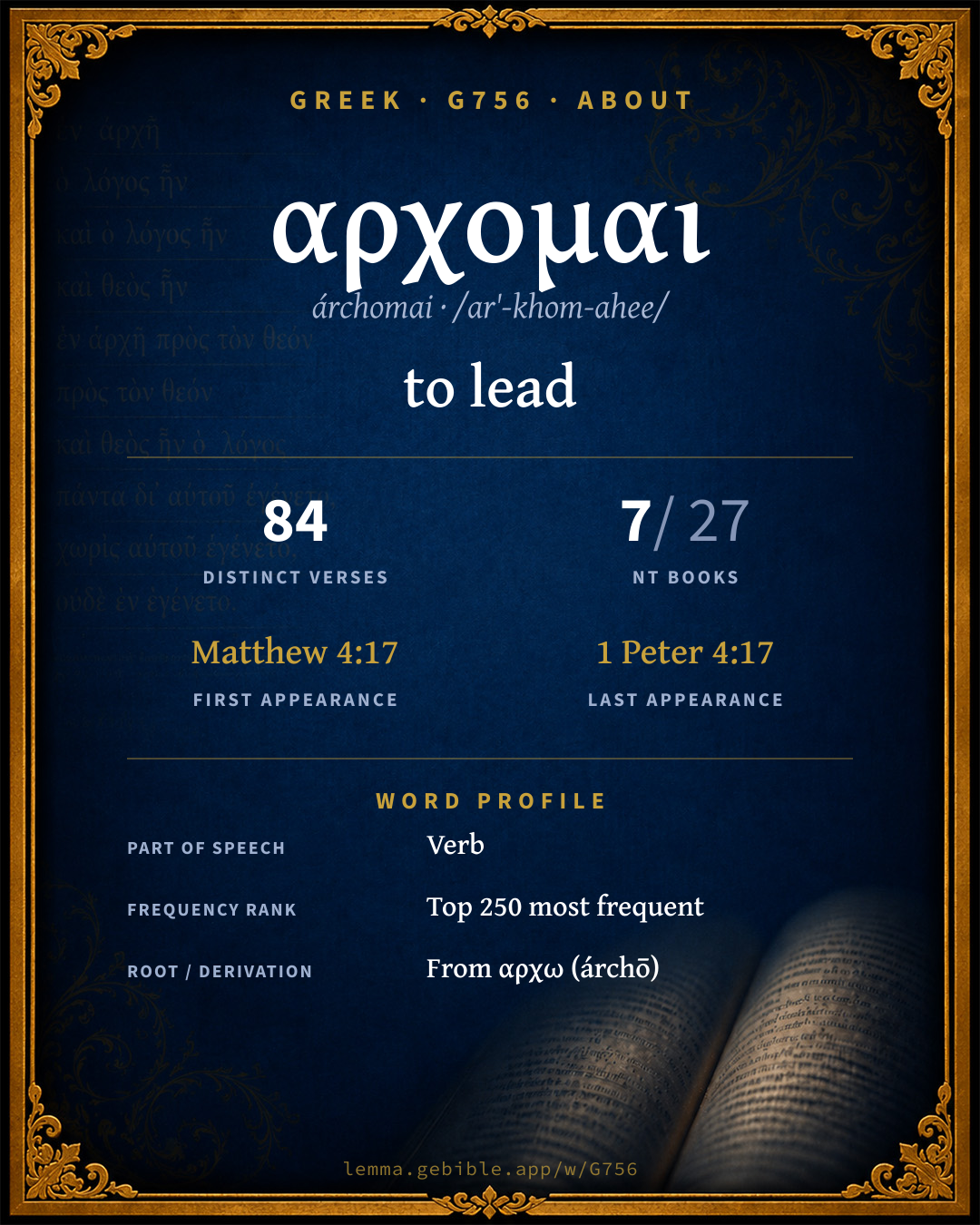
ἄρχομαι
to lead
‘to lead’ is one of 3 main senses fuller range ↓
Full lexicon entry — Thayer's Greek Lexicon
From Thayer's Greek Lexicon
Where this word appears
See every Aorist-tense verb in the Greek New Testament →
Grammar key — what these labels mean
Part of speech
- Verb
- An action or state-of-being word.
Tense
- Aorist
- Action viewed as a simple whole, without regard to duration — often past (perfective aspect).
- Future
- Action expected in future time.
- Present
- Ongoing or general action in present time (imperfective aspect).
Voice
- Middle deponent
- Middle in form but active in meaning.
- Middle
- The subject acts on or for itself, or with special interest in the action.
Mood
- Indicative
- States a fact or asks a factual question (the mood of reality).
- Participle
- A verbal adjective (“writing,” “having written”).
- Infinitive
- A verbal noun (“to write”), unmarked for person or number.
- Subjunctive
- Expresses probability, purpose, or possibility (the mood of contingency).
Case
- Nominative
- The case of the subject (and the predicate nominative).
- Genitive
- The case of source, possession, or “of” — answers “whose / from what.”
Person
- 3rd person
- The one spoken about (“he / she / it / they”).
- 2nd person
- The one addressed (“you”).
- 1st person
- The speaker (“I / we”).
Gender
- Masculine
- Grammatically masculine.
Number
- Singular
- One.
- Plural
- More than one.
Grammatical forms 15 distinct
- Verb, Aorist, Middle deponent, Indicative, 3rd person, Singular 41 times (49%)
- Verb, Aorist, Middle deponent, Indicative, 3rd person, Plural 19 times (23%)
- Verb, Aorist, Middle, Participle, Nominative, Singular, Masculine 8 times (10%)
- Verb, Aorist, Middle, Infinitive 2 times (2%)
- Verb, Aorist, Middle, Participle, Nominative, Plural, Masculine 2 times (2%)
- Verb, Aorist, Middle, Subjunctive, 2nd person, Plural 2 times (2%)
- Verb, Aorist, Middle, Subjunctive, 3rd person, Singular 2 times (2%)
- Verb, Aorist, Middle, Participle, Genitive, Singular, Masculine 1 time (1%)
+7 more forms (7 occurrences)
Parsed forms decoded from the imported morphology (Robinson–Tischendorf, public domain), counted across 84 parsed occurrences — not distinct verses.
Every verse where G756 appears — 84 distinct verses across 7 books. Click any verse to open its interlinear word-by-word view. Verse text shown in the World English Bible for context — . Each verse’s Greek form is shown with its reference; the English is not keyword-highlighted, since the data carries no word-level English alignment. Use “Compare translations” on any verse to read it across multiple English versions. This concordance covers the Greek New Testament; Septuagint (Greek Old Testament) occurrences of this word are not indexed here.
Matthew 13 verses
- Matthew 4:17 ἤρξατο aor mid.dep ind 3sg From that time, Jesus began to preach, and to say, "Repent! For the Kingdom of Heaven is at hand."
- Matthew 11:7 ἤρξατο aor mid.dep ind 3sg As these went their way, Jesus began to say to the multitudes concerning John, "What did you go out into the wilderness to see? A reed shaken by the wind?
- Matthew 11:20 ἤρξατο aor mid.dep ind 3sg Then he began to denounce the cities in which most of his mighty works had been done, because they didn't repent.
- Matthew 12:1 ἤρξαντο aor mid.dep ind 3pl At that time, Jesus went on the Sabbath day through the grain fields. His disciples were hungry and began to pluck heads of grain and to eat.
- Matthew 14:30 ἀρξάμενος aor mid ptcp nom sg masc But when he saw that the wind was strong, he was afraid, and beginning to sink, he cried out, saying, "Lord, save me!"
- Matthew 16:21 ἤρξατο aor mid.dep ind 3sg From that time, Jesus began to show his disciples that he must go to Jerusalem and suffer many things from the elders, chief priests, and scribes, and be killed, and the third day be raised up.
- Matthew 16:22 ἤρξατο aor mid.dep ind 3sg Peter took him aside, and began to rebuke him, saying, "Far be it from you, Lord! This will never be done to you."
- Matthew 18:24 ἀρξαμένου aor mid ptcp gen sg masc When he had begun to reconcile, one was brought to him who owed him ten thousand talents.
- Matthew 20:8 ἀρξάμενος aor mid ptcp nom sg masc When evening had come, the lord of the vineyard said to his steward, 'Call the laborers and pay them their wages, beginning from the last to the first.'
- Matthew 24:49 ἄρξηται aor mid subj 3sg and begins to beat his fellow-servants, and eat and drink with the drunken,
- Matthew 26:22 ἤρξαντο aor mid.dep ind 3pl They were exceedingly sorrowful, and each began to ask him, "It isn't me, is it, Lord?"
- Matthew 26:37 ἤρξατο aor mid.dep ind 3sg He took with him Peter and the two sons of Zebedee, and began to be sorrowful and severely troubled.
- Matthew 26:74 ἤρξατο aor mid.dep ind 3sg Then he began to curse and to swear, "I don't know the man!" Immediately the rooster crowed.
Mark 26 verses
- Mark 1:45 ἤρξατο aor mid.dep ind 3sg But he went out, and began to proclaim it much, and to spread about the matter, so that Jesus could no more openly enter into a city, but was outside in desert places: and they came to him from everywhere.
- Mark 2:23 ἤρξαντο aor mid.dep ind 3pl It happened that he was going on the Sabbath day through the grain fields, and his disciples began, as they went, to pluck the ears of grain.
- Mark 4:1 ἤρξατο aor mid.dep ind 3sg Again he began to teach by the seaside. A great multitude was gathered to him, so that he entered into a boat in the sea, and sat down. All the multitude were on the land by the sea.
- Mark 5:17 ἤρξαντο aor mid.dep ind 3pl They began to beg him to depart from their region.
- Mark 5:20 ἤρξατο aor mid.dep ind 3sg He went his way, and began to proclaim in Decapolis how Jesus had done great things for him, and everyone marveled.
- Mark 6:2 ἤρξατο aor mid.dep ind 3sg When the Sabbath had come, he began to teach in the synagogue, and many hearing him were astonished, saying, "Where did this man get these things?" and, "What is the wisdom that is given to this man, that such mighty works come about by his hands?
- Mark 6:7 ἤρξατο aor mid.dep ind 3sg He called to himself the twelve, and began to send them out two by two; and he gave them authority over the unclean spirits.
- Mark 6:34 ἤρξατο aor mid.dep ind 3sg Jesus came out, saw a great multitude, and he had compassion on them, because they were like sheep without a shepherd, and he began to teach them many things.
- Mark 6:55 ἤρξαντο aor mid.dep ind 3pl and ran around that whole region, and began to bring those who were sick, on their mats, to where they heard he was.
- Mark 8:11 ἤρξαντο aor mid.dep ind 3pl The Pharisees came out and began to question him, seeking from him a sign from heaven, and testing him.
- Mark 8:31 ἤρξατο aor mid.dep ind 3sg He began to teach them that the Son of Man must suffer many things, and be rejected by the elders, the chief priests, and the scribes, and be killed, and after three days rise again.
- Mark 8:32 ἤρξατο aor mid.dep ind 3sg He spoke to them openly. Peter took him, and began to rebuke him.
- Mark 10:28 Ἤρξατο aor mid.dep ind 3sg Peter began to tell him, "Behold, we have left all, and have followed you."
- Mark 10:32 ἤρξατο aor mid.dep ind 3sg They were on the way, going up to Jerusalem; and Jesus was going in front of them, and they were amazed; and those who followed were afraid. He again took the twelve, and began to tell them the things that were going to happen to him.
- Mark 10:41 ἤρξαντο aor mid.dep ind 3pl When the ten heard it, they began to be indignant towards James and John.
- Mark 10:47 ἤρξατο aor mid.dep ind 3sg When he heard that it was Jesus the Nazarene, he began to cry out, and say, "Jesus, you son of David, have mercy on me!"
- Mark 11:15 ἤρξατο aor mid.dep ind 3sg They came to Jerusalem, and Jesus entered into the temple, and began to throw out those who sold and those who bought in the temple, and overthrew the tables of the money-changers, and the seats of those who sold the doves.
- Mark 12:1 ἤρξατο aor mid.dep ind 3sg He began to speak to them in parables. "A man planted a vineyard, put a hedge around it, dug a pit for the winepress, built a tower, rented it out to a farmer, and went into another country.
- Mark 13:5 ἤρξατο aor mid.dep ind 3sg Jesus, answering, began to tell them, "Be careful that no one leads you astray.
- Mark 14:19 ἤρξαντο aor mid.dep ind 3pl They began to be sorrowful, and to ask him one by one, "Surely not I?" And another said, "Surely not I?"
- Mark 14:33 ἤρξατο aor mid.dep ind 3sg He took with him Peter, James, and John, and began to be greatly troubled and distressed.
- Mark 14:65 ἤρξαντό aor mid.dep ind 3pl Some began to spit on him, and to cover his face, and to beat him with fists, and to tell him, "Prophesy!" The officers struck him with the palms of their hands.
- Mark 14:69 ἤρξατο aor mid.dep ind 3sg The maid saw him, and began again to tell those who stood by, "This is one of them."
- Mark 14:71 ἤρξατο aor mid.dep ind 3sg But he began to curse, and to swear, "I don't know this man of whom you speak!"
- Mark 15:8 ἤρξατο aor mid.dep ind 3sg The multitude, crying aloud, began to ask him to do as he always did for them.
- Mark 15:18 ἤρξαντο aor mid.dep ind 3pl They began to salute him, "Hail, King of the Jews!"
Luke 31 verses
- Luke 3:8 ἄρξησθε aor mid subj 2pl Bring forth therefore fruits worthy of repentance, and don't begin to say among yourselves, 'We have Abraham for our father;' for I tell you that God is able to raise up children to Abraham from these stones!
- Luke 3:23 ἀρχόμενος pres mid ptcp nom sg masc Jesus himself, when he began to teach, was about thirty years old, being the son (as was supposed) of Joseph, the son of Heli,
- Luke 4:21 ἤρξατο aor mid.dep ind 3sg He began to tell them, "Today, this Scripture has been fulfilled in your hearing."
- Luke 5:21 ἤρξαντο aor mid.dep ind 3pl The scribes and the Pharisees began to reason, saying, "Who is this that speaks blasphemies? Who can forgive sins, but God alone?"
- Luke 7:15 ἤρξατο aor mid.dep ind 3sg He who was dead sat up, and began to speak. And he gave him to his mother.
- Luke 7:24 ἤρξατο aor mid.dep ind 3sg When John's messengers had departed, he began to tell the multitudes about John, "What did you go out into the wilderness to see? A reed shaken by the wind?
- Luke 7:38 ἤρξατο aor mid.dep ind 3sg Standing behind at his feet weeping, she began to wet his feet with her tears, and she wiped them with the hair of her head, kissed his feet, and anointed them with the ointment.
- Luke 7:49 ἤρξαντο aor mid.dep ind 3pl Those who sat at the table with him began to say to themselves, "Who is this who even forgives sins?"
- Luke 9:12 ἤρξατο aor mid.dep ind 3sg The day began to wear away; and the twelve came, and said to him, "Send the multitude away, that they may go into the surrounding villages and farms, and lodge, and get food, for we are here in a deserted place."
- Luke 11:29 ἤρξατο aor mid.dep ind 3sg When the multitudes were gathering together to him, he began to say, "This is an evil generation. It seeks after a sign. No sign will be given to it but the sign of Jonah, the prophet.
- Luke 11:53 ἤρξαντο aor mid.dep ind 3pl As he said these things to them, the scribes and the Pharisees began to be terribly angry, and to draw many things out of him;
- Luke 12:1 ἤρξατο aor mid.dep ind 3sg Meanwhile, when a multitude of many thousands had gathered together, so much so that they trampled on each other, he began to tell his disciples first of all, "Beware of the yeast of the Pharisees, which is hypocrisy.
- Luke 12:45 ἄρξηται aor mid subj 3sg But if that servant says in his heart, 'My lord delays his coming,' and begins to beat the menservants and the maidservants, and to eat and drink, and to be drunken,
- Luke 13:25 ἄρξησθε aor mid subj 2pl When once the master of the house has risen up, and has shut the door, and you begin to stand outside, and to knock at the door, saying, 'Lord, Lord, open to us!' then he will answer and tell you, 'I don't know you or where you come from.'
- Luke 13:26 ἄρξεσθε fut mid ind 2pl Then you will begin to say, 'We ate and drink in your presence, and you taught in our streets.'
- Luke 14:9 ἄρξῃ aor mid subj 2sg and he who invited both of you would come and tell you, 'Make room for this person.' Then you would begin, with shame, to take the lowest place.
- Luke 14:18 ἤρξαντο aor mid.dep ind 3pl They all as one began to make excuses. "The first said to him, 'I have bought a field, and I must go and see it. Please have me excused.'
- Luke 14:29 ἄρξωνται aor mid subj 3pl Or perhaps, when he has laid a foundation, and is not able to finish, everyone who sees begins to mock him,
- Luke 14:30 ἤρξατο aor mid.dep ind 3sg saying, 'This man began to build, and wasn't able to finish.'
- Luke 15:14 ἤρξατο aor mid.dep ind 3sg When he had spent all of it, there arose a severe famine in that country, and he began to be in need.
- Luke 15:24 ἤρξαντο aor mid.dep ind 3pl for this, my son, was dead, and is alive again. He was lost, and is found.' They began to celebrate.
- Luke 19:37 ἤρξαντο aor mid.dep ind 3pl As he was now getting near, at the descent of the Mount of Olives, the whole multitude of the disciples began to rejoice and praise God with a loud voice for all the mighty works which they had seen,
- Luke 19:45 ἤρξατο aor mid.dep ind 3sg He entered into the temple, and began to drive out those who bought and sold in it,
- Luke 20:9 Ἤρξατο aor mid.dep ind 3sg He began to tell the people this parable. "A man planted a vineyard, and rented it out to some farmers, and went into another country for a long time.
- Luke 21:28 ἀρχομένων pres mid ptcp gen pl masc But when these things begin to happen, look up, and lift up your heads, because your redemption is near."
- Luke 22:23 ἤρξαντο aor mid.dep ind 3pl They began to question among themselves, which of them it was who would do this thing.
- Luke 23:2 ἤρξαντο aor mid.dep ind 3pl They began to accuse him, saying, "We found this man perverting the nation, forbidding paying taxes to Caesar, and saying that he himself is Christ, a king."
- Luke 23:5 ἀρξάμενος aor mid ptcp nom sg masc But they insisted, saying, "He stirs up the people, teaching throughout all Judea, beginning from Galilee even to this place."
- Luke 23:30 ἄρξονται fut mid ind 3pl Then they will begin to tell the mountains, 'Fall on us!' and tell the hills, 'Cover us.'
- Luke 24:27 ἀρξάμενος aor mid ptcp nom sg masc Beginning from Moses and from all the prophets, he explained to them in all the Scriptures the things concerning himself.
- Luke 24:47 ἀρξάμενοι aor mid ptcp nom pl masc and that repentance and remission of sins should be preached in his name to all the nations, beginning at Jerusalem.
John 2 verses
- John 8:9 ἀρξάμενοι aor mid ptcp nom pl masc They, when they heard it, being convicted by their conscience, went out one by one, beginning from the oldest, even to the last. Jesus was left alone with the woman where she was, in the middle.
- John 13:5 ἤρξατο aor mid.dep ind 3sg Then he poured water into the basin, and began to wash the disciples' feet, and to wipe them with the towel that was wrapped around him.
Acts 10 verses
- Acts 1:1 ἤρξατο aor mid.dep ind 3sg The first book I wrote, Theophilus, concerned all that Jesus began both to do and to teach,
- Acts 1:22 ἀρξάμενος aor mid ptcp nom sg masc beginning from the baptism of John, to the day that he was received up from us, of these one must become a witness with us of his resurrection."
- Acts 2:4 ἤρξαντο aor mid.dep ind 3pl They were all filled with the Holy Spirit, and began to speak with other languages, as the Spirit gave them the ability to speak.
- Acts 8:35 ἀρξάμενος aor mid ptcp nom sg masc Philip opened his mouth, and beginning from this Scripture, preached to him Jesus.
- Acts 10:37 ἀρξάμενος aor mid ptcp nom sg masc that spoken word you yourselves know, which was proclaimed throughout all Judea, beginning from Galilee, after the baptism which John preached;
- Acts 11:4 ἀρξάμενος aor mid ptcp nom sg masc But Peter began, and explained to them in order, saying,
- Acts 11:15 ἄρξασθαί aor mid inf As I began to speak, the Holy Spirit fell on them, even as on us at the beginning.
- Acts 18:26 ἤρξατο aor mid.dep ind 3sg He began to speak boldly in the synagogue. But when Priscilla and Aquila heard him, they took him aside, and explained to him the way of God more accurately.
- Acts 24:2 ἤρξατο aor mid.dep ind 3sg When he was called, Tertullus began to accuse him, saying, "Seeing that by you we enjoy much peace, and that excellent measures are coming to this nation,
- Acts 27:35 ἤρξατο aor mid.dep ind 3sg When he had said this, and had taken bread, he gave thanks to God in the presence of all, and he broke it, and began to eat.
2 Corinthians 1 verse
1 Peter 1 verse
About this entry
At a glance — auto-summarized from this page’s data, not written by a person. Every figure links to its source below. This summary describes the numbers; it doesn’t interpret them.
αρχομαι — transliterated árchomai — is a Greek verb carrying the sense “to lead.” It first appears in Matthew 4:17. With 84 verses in 7 books, it is a moderately common word in the Greek New Testament. Its uses concentrate in Luke (37% of all occurrences). Its lexical range runs to 3 senses. Each statement above links to its evidence; the full detail follows below.
Gloss history
Strong's 1890 vs modern scholarship

About this word
Strong's G756 catalogs a Greek word from the Greek New Testament.
These counts are not copied from any lexicon or concordance. They are computed here, from the morphology-tagged Greek New Testament. What Lemma adds →
- 84
- distinct verses
- The word appears in 84 distinct verses.
- 7 / 27
- NT books
- The word appears in 7 of 27 New Testament books.
- #204
- by frequency
- Top 250 most frequent Greek words (rank 204 of 5,347 Greek words by occurrence).
View all 84 occurrences in the concordance →
By section of the New Testament
By traditional corpus
Conventional, traditional groupings — biblical authorship is debated, so this is a traditional corpus grouping, not an authorship claim. Some books belong to more than one corpus (Luke is in both the Gospels and the Lukan corpus, and so on), so these shares overlap and need not total 100%. Each figure is a share of the word’s 84 distinct verses.
- Gospels 72 verses · 86%
- Lukan (Luke–Acts) 41 verses · 49%
- Johannine 2 verses · 2%
- Pauline corpus 1 verse · 1%
- General (Catholic) Epistles 1 verse · 1%
How translations render this word
Counts come from each version’s own published word-to-Strong’s tagging or interlinear alignment — an approximate guide to how each version renders this word, not a word-level alignment the data otherwise carries. Because each total is that version’s own tagged count, the per-version totals vary from one another and need not match the appearance or distinct-verse counts above. These counts may also differ from a printed concordance because Lemma counts each distinctly tagged rendering and does not collapse phrase taggings into a single head-word total. This is a fixed set of word-tagged versions (KJV, ASV, BSB, ULT) and does not change with the reading translation you choose elsewhere. Each version’s license is shown beside its name below (and on Sources).
- King James Version: Began 43×, He began 12×, Beginning 7×
- American Standard Version: Began 38×, He began 11×, Beginning 9×
- Berean Standard Bible: Began 44×, He began 9×, Beginning 6×
King James Version Public Domain
Renders G756 across 84 tagged occurrences — most commonly:
Plus 9 renderings that appear only once — usually multi-word phrases or single function words the recovered tagging swept in, not distinct renderings.
American Standard Version Public Domain
Renders G756 across 88 tagged occurrences — most commonly:
Plus 17 renderings that appear only once — usually multi-word phrases or single function words the recovered tagging swept in, not distinct renderings.
Berean Standard Bible Public Domain
Renders G756 across 78 tagged occurrences — most commonly:
Plus 8 renderings that appear only once — usually multi-word phrases or single function words the recovered tagging swept in, not distinct renderings. Not rendered by a distinct English word in 1 further occurrence.
Senses in Thayer's
The 3 senses Thayer's distinguishes for this word, in lexicon order (not ranked by frequency or importance). The full entry — with sub-senses — is in the Lexicon Entry tab.
- to be the first to do (anything), to begin
- to be chief, leader, ruler
- to begin, make a beginning
Word origin
Derived from αρχω (árchō) (G757) — to rule.
Middle voice of G757 (through the implication of precedence ); to commence (in order of time): - rehearse from the) begin (-ning).
— Strong’s Exhaustive Concordance (1890), public domain.
Forms in the corpus
The 18 distinct written forms G756 takes in the Greek New Testament, most frequent first — each parse links to that tense’s occurrences in the concordance.
Same root — word family
Other Thayer's entries built from the same root as G756, grouped by Strong’s listed origin. These share a root / origin per the lexicon — not necessarily a shared meaning. Each links to that word’s own entry.
Derives from
Shares the same root
Derived from this word
Proper names from this root
People and places named from this root — a name, not an additional meaning of the word.
Compare all same-root words → Showing 4 of 6 — not the complete family. 1 of the same-root words is a proper name (a person or place). They share a root, not necessarily a meaning.