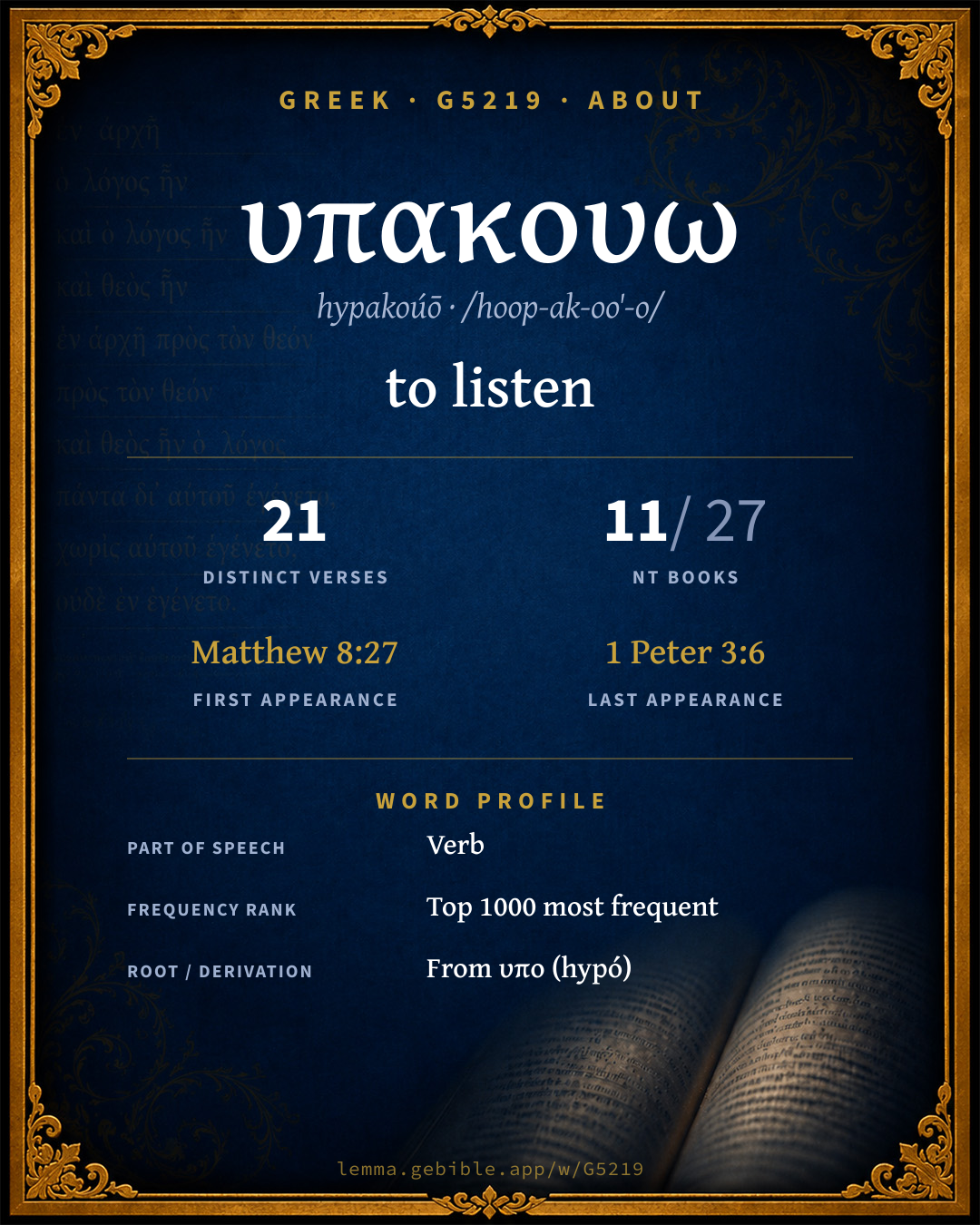
ὑπακούω
to listen
‘to listen’ is one of 2 main senses fuller range ↓
Full lexicon entry — Thayer's Greek Lexicon
From Thayer's Greek Lexicon
Where this word appears
See every Present-tense verb in the Greek New Testament →
Grammar key — what these labels mean
Part of speech
- Verb
- An action or state-of-being word.
Tense
- Present
- Ongoing or general action in present time (imperfective aspect).
- Aorist
- Action viewed as a simple whole, without regard to duration — often past (perfective aspect).
- Imperfect
- Continuous or repeated action in past time (“was writing”).
Voice
- Active
- The subject performs the action.
Mood
- Imperative
- Expresses a command or request.
- Indicative
- States a fact or asks a factual question (the mood of reality).
- Participle
- A verbal adjective (“writing,” “having written”).
- Infinitive
- A verbal noun (“to write”), unmarked for person or number.
Case
- Dative
- The case of the indirect object, means, or location — “to / for / with / in.”
Person
- 2nd person
- The one addressed (“you”).
- 3rd person
- The one spoken about (“he / she / it / they”).
Gender
- Masculine
- Grammatically masculine.
Number
- Plural
- More than one.
- Singular
- One.
Grammatical forms 11 distinct
- Verb, Present, Active, Imperative, 2nd person, Plural 4 times (19%)
- Verb, Aorist, Active, Indicative, 3rd person, Singular 3 times (14%)
- Verb, Present, Active, Indicative, 3rd person, Plural 3 times (14%)
- Verb, Aorist, Active, Indicative, 2nd person, Plural 2 times (10%)
- Verb, Present, Active, Indicative, 3rd person, Singular 2 times (10%)
- Verb, Present, Active, Participle, Dative, Plural, Masculine 2 times (10%)
- Verb, Aorist, Active, Indicative, 3rd person, Plural 1 time (5%)
- Verb, Aorist, Active, Infinitive 1 time (5%)
+3 more forms (3 occurrences)
Parsed forms decoded from the imported morphology (Robinson–Tischendorf, public domain), counted across 21 parsed occurrences — not distinct verses.
Every verse where G5219 appears — 21 distinct verses across 11 books. Click any verse to open its interlinear word-by-word view. Verse text shown in the World English Bible for context — . Each verse’s Greek form is shown with its reference; the English is not keyword-highlighted, since the data carries no word-level English alignment. Use “Compare translations” on any verse to read it across multiple English versions. This concordance covers the Greek New Testament; Septuagint (Greek Old Testament) occurrences of this word are not indexed here.
Matthew 1 verse
Mark 2 verses
- Mark 1:27 ὑπακούουσιν pres act ind 3pl They were all amazed, so that they questioned among themselves, saying, "What is this? A new teaching? For with authority he commands even the unclean spirits, and they obey him!"
- Mark 4:41 ὑπακούει pres act ind 3sg They were greatly afraid, and said to one another, "Who then is this, that even the wind and the sea obey him?"
Luke 2 verses
- Luke 8:25 ὑπακούουσιν pres act ind 3pl He said to them, "Where is your faith?" Being afraid they marveled, saying one to another, "Who is this, then, that he commands even the winds and the water, and they obey him?"
- Luke 17:6 ὑπήκουσεν aor act ind 3sg The Lord said, "If you had faith like a grain of mustard seed, you would tell this sycamore tree, 'Be uprooted, and be planted in the sea,' and it would obey you.
Acts 2 verses
- Acts 6:7 ὑπήκουον impf act ind 3pl The word of God increased and the number of the disciples multiplied in Jerusalem exceedingly. A great company of the priests were obedient to the faith.
- Acts 12:13 ὑπακοῦσαι aor act inf When Peter knocked at the door of the gate, a maid named Rhoda came to answer.
Romans 4 verses
- Romans 6:12 ὑπακούειν pres act inf Therefore don't let sin reign in your mortal body, that you should obey it in its lusts.
- Romans 6:16 ὑπακούετε pres act ind 2pl Don't you know that to whom you present yourselves as servants to obedience, his servants you are whom you obey; whether of sin to death, or of obedience to righteousness?
- Romans 6:17 ὑπηκούσατε aor act ind 2pl But thanks be to God, that, whereas you were bondservants of sin, you became obedient from the heart to that form of teaching whereunto you were delivered.
- Romans 10:16 ὑπήκουσαν aor act ind 3pl But they didn't all listen to the glad news. For Isaiah says, "Lord, who has believed our report?"
Ephesians 2 verses
Philippians 1 verse
Colossians 2 verses
- Colossians 3:20 ὑπακούετε pres act impv 2pl Children, obey your parents in all things, for this pleases the Lord.
- Colossians 3:22 ὑπακούετε pres act impv 2pl Servants, obey in all things those who are your masters according to the flesh, not just when they are looking, as men-pleasers, but in singleness of heart, fearing God.
2 Thessalonians 2 verses
- 2 Thessalonians 1:8 ὑπακούουσιν pres act ptcp dat pl masc giving vengeance to those who don't know God, and to those who don't obey the Gospel of our Lord Jesus,
- 2 Thessalonians 3:14 ὑπακούει pres act ind 3sg If any man doesn't obey our word in this letter, note that man, that you have no company with him, to the end that he may be ashamed.
Hebrews 2 verses
- Hebrews 5:9 ὑπακούουσιν pres act ptcp dat pl masc Having been made perfect, he became to all of those who obey him the author of eternal salvation,
- Hebrews 11:8 ὑπήκουσεν aor act ind 3sg By faith, Abraham, when he was called, obeyed to go out to the place which he was to receive for an inheritance. He went out, not knowing where he went.
1 Peter 1 verse
About this entry
At a glance — auto-summarized from this page’s data, not written by a person. Every figure links to its source below. This summary describes the numbers; it doesn’t interpret them.
υπακουω (hypakoúō) is a Greek verb most often rendered “to listen.” It first appears in Matthew 8:27. With 21 verses in 11 books, it is an uncommon word in the Greek New Testament. Ranging over 2 senses, it is not a single-sense word. It clusters with υπο, υπαγω and υπανδρος under a shared root. The sections below give every sense, occurrence, and version rendering.
Gloss history
Strong's 1890 vs modern scholarship

About this word
Strong's G5219 catalogs a Greek word from the Greek New Testament.
These counts are not copied from any lexicon or concordance. They are computed here, from the morphology-tagged Greek New Testament. What Lemma adds →
- 21
- distinct verses
- The word appears in 21 distinct verses.
- 11 / 27
- NT books
- The word appears in 11 of 27 New Testament books.
- #607
- by frequency
- Top 1000 most frequent Greek words (rank 607 of 5,347 Greek words by occurrence).
View all 21 occurrences in the concordance →
By section of the New Testament
By traditional corpus
Conventional, traditional groupings — biblical authorship is debated, so this is a traditional corpus grouping, not an authorship claim. Some books belong to more than one corpus (Luke is in both the Gospels and the Lukan corpus, and so on), so these shares overlap and need not total 100%. Each figure is a share of the word’s 21 distinct verses.
- Pauline corpus 11 verses · 52%
- Gospels 5 verses · 24%
- Lukan (Luke–Acts) 4 verses · 19%
- Hebrews 2 verses · 10%
- General (Catholic) Epistles 1 verse · 5%
How translations render this word
Counts come from each version’s own published word-to-Strong’s tagging or interlinear alignment — an approximate guide to how each version renders this word, not a word-level alignment the data otherwise carries. Because each total is that version’s own tagged count, the per-version totals vary from one another and need not match the appearance or distinct-verse counts above. These counts may also differ from a printed concordance because Lemma counts each distinctly tagged rendering and does not collapse phrase taggings into a single head-word total. This is a fixed set of word-tagged versions (KJV, ASV, BSB, ULT) and does not change with the reading translation you choose elsewhere. Each version’s license is shown beside its name below (and on Sources).
- King James Version: Obey 9×, Obeyed 4×
- American Standard Version: Obey 8×, Obeyed 3×, They obey 2×
- Berean Standard Bible: Obey 8×, Obeyed 2×, They obey 2×
- unfoldingWord Literal Text: Obey 8×, Obeyed 4×, Obeying 2×
King James Version Public Domain
Renders G5219 across 23 tagged occurrences — most commonly:
Plus 10 renderings that appear only once — usually multi-word phrases or single function words the recovered tagging swept in, not distinct renderings.
American Standard Version Public Domain
Renders G5219 across 23 tagged occurrences — most commonly:
Plus 10 renderings that appear only once — usually multi-word phrases or single function words the recovered tagging swept in, not distinct renderings.
Berean Standard Bible Public Domain
Renders G5219 across 21 tagged occurrences — most commonly:
Plus 7 renderings that appear only once — usually multi-word phrases or single function words the recovered tagging swept in, not distinct renderings.
unfoldingWord Literal Text CC BY-SA 4.0
Renders G5219 across 23 tagged occurrences — most commonly:
Plus 7 renderings that appear only once — usually multi-word phrases or single function words the recovered tagging swept in, not distinct renderings.
Senses in Thayer's
The 2 senses Thayer's distinguishes for this word, in lexicon order (not ranked by frequency or importance). The full entry — with sub-senses — is in the Lexicon Entry tab.
- of one who on the knock at the door comes to listen who it is, (the duty of a porter)
- to obey, be obedient to, submit to
Word origin
Derived from υπο (hypó) (G5259) — under.
Forms in the corpus
The 9 distinct written forms G5219 takes in the Greek New Testament, most frequent first — each parse links to that tense’s occurrences in the concordance.
| Form | Parsing | Example | Uses |
|---|---|---|---|
| ὑπακούετε hypakoúete | Verb, Present, Active, Imperative, 2nd person, Plural | Ephesians 6:1 | 5 |
| ὑπακούουσιν hypakoúousin | Verb, Present, Active, Indicative, 3rd person, Plural | Matthew 8:27 | 5 |
| ὑπήκουσεν hypḗkousen | Verb, Aorist, Active, Indicative, 3rd person, Singular | Luke 17:6 | 3 |
| ὑπακούει hypakoúei | Verb, Present, Active, Indicative, 3rd person, Singular | Mark 4:41 | 2 |
| ὑπηκούσατε hypēkoúsate | Verb, Aorist, Active, Indicative, 2nd person, Plural | Romans 6:17 | 2 |
| ὑπήκουον hypḗkouon | Verb, Imperfect, Active, Indicative, 3rd person, Plural | Acts 6:7 | 1 |
| ὑπήκουσαν hypḗkousan | Verb, Aorist, Active, Indicative, 3rd person, Plural | Romans 10:16 | 1 |
| ὑπακούειν hypakoúein | Verb, Present, Active, Infinitive | Romans 6:12 | 1 |
| ὑπακοῦσαι hypakoûsai | Verb, Aorist, Active, Infinitive | Acts 12:13 | 1 |
Same root — word family
Other Thayer's entries built from the same root as G5219, grouped by Strong’s listed origin. These share a root / origin per the lexicon — not necessarily a shared meaning. Each links to that word’s own entry.
Derives from
Shares the same root
- υπαγω hypágō G5217 to depart
- υπανδρος hýpandros G5220 under (married)
- υπανταω hypantáō G5221 to meet
- υπαρχω hypárchō G5225 to be at hand
- υπεικω hypeíkō G5226 to yield
- υπεναντιος hypenantíos G5227 adversary
- υπεχω hypéchō G5254 to sustain
- υπηρετης hypērétēs G5257 servant
- υπνος hýpnos G5258 sleep
- υποβαλλω hypobállō G5260 to instigate
- υπογραμμος hypogrammós G5261 example
- υποδεικνυμι hypodeíknymi G5263 to demonstrate
- υποδεχομαι hypodéchomai G5264 to welcome
- υποδεω hypodéō G5265 to bind on
- υποδικος hypódikos G5267 debtor
- υποζυγιον hypozýgion G5268 beast of burden
- υποζωννυμι hypozṓnnymi G5269 to undergird
- υποκατω hypokátō G5270 underneath
- υποκρινομαι hypokrínomai G5271 to pretend
- υπολαμβανω hypolambánō G5274 to welcome
- υποληνιον hypolḗnion G5276 wine pit
- υπομενω hypoménō G5278 to endure
- υπομιμνησκω hypomimnḗskō G5279 to remind
- υπονοεω hyponoéō G5282 to suppose
+15 more words share this root (not shown).
Derived from this word
Compare all same-root words → Showing 4 of 43 — not the complete family. They share a root, not necessarily a meaning.
Septuagint usage
The same Greek word υπακουω appears 51 times in the Greek Old Testament (Septuagint), across 51 verses in 14 books.
- 51
- LXX occurrences
- Tagged occurrences of this Greek word in the Septuagint.
- 51
- verses
- Distinct Septuagint verses containing this word.
- 14 / 39
- OT books
- The word appears in 14 of the 39 Old Testament books.
Sample Septuagint occurrences
- Genesis 16:2 ὑποἀκούω
- Leviticus 26:14 ὑποἀκούω
- Deuteronomy 17:12 ὑποἀκούω
- Judges 2:17 ὑποἀκούω
- 1 Samuel 30:24 ὑποἀκούω
- 2 Samuel 22:42 ὑποἀκούω
- Esther 3:4 ὑποἀκούω
- Job 5:1 ὑποἀκούω
- Psalms 17:45 ὑποἀκούω
- Proverbs 1:24 ὑποἀκούω
- Song of Solomon 3:1 ὑποἀκούω
- Isaiah 11:14 ὑποἀκούω
Septuagint occurrences (same lexeme)
Every verse where the same Strong’s number (G5219) appears in the Greek Septuagint — showing the first 50 of 51. Verse text shown in the World English Bible for context; the Greek form is the matched word — the English is not keyword-highlighted.
- Genesis 16:2 ὑποἀκούω Sarai said to Abram," See now, Yahweh has restrained me from bearing. Please go in to my handmaid. It may be that I will obtain children by her." Abram listened to the voice of Sarai.
- Genesis 22:18 ὑποἀκούω In your seed will all the nations of the earth be blessed, because you have obeyed my voice."
- Genesis 26:5 ὑποἀκούω because Abraham obeyed my voice, and kept my charge, my commandments, my statutes, and my laws."
- Genesis 27:13 ὑποἀκούω His mother said to him, "Let your curse be on me, my son. Only obey my voice, and go get them for me."
- Genesis 39:10 ὑποἀκούω It happened that as she spoke to Joseph day by day, that he didn't listen to her, to lie by her, or to be with her.
- Genesis 41:40 ὑποἀκούω You shall be over my house, and according to your word will all my people be ruled. Only in the throne I will be greater than you."
- Leviticus 26:14 ὑποἀκούω "'But if you will not listen to me, and will not do all these commandments;
- Leviticus 26:18 ὑποἀκούω "'If you in spite of these things will not listen to me, then I will chastise you seven times more for your sins.
- Leviticus 26:21 ὑποἀκούω "'If you walk contrary to me, and won't listen to me, then I will bring seven times more plagues on you according to your sins.
- Leviticus 26:27 ὑποἀκούω "'If you in spite of this won't listen to me, but walk contrary to me;
- Deuteronomy 17:12 ὑποἀκούω The man who does presumptuously, in not listening to the priest who stands to minister there before Yahweh your God, or to the judge, even that man shall die: and you shall put away the evil from Israel.
- Deuteronomy 20:12 ὑποἀκούω If it will make no peace with you, but will make war against you, then you shall besiege it:
- Deuteronomy 21:18 ὑποἀκούω If a man have a stubborn and rebellious son, who will not obey the voice of his father, or the voice of his mother, and, though they chasten him, will not listen to them;
- Deuteronomy 21:20 ὑποἀκούω and they shall tell the elders of his city, This our son is stubborn and rebellious, he will not obey our voice; he is a glutton, and a drunkard.
- Deuteronomy 26:14 ὑποἀκούω I have not eaten of it in my mourning, neither have I put away of it, being unclean, nor given of it for the dead: I have listened to the voice of Yahweh my God; I have done according to all that you have commanded me.
- Deuteronomy 26:17 ὑποἀκούω You have declared Yahweh this day to be your God, and that you would walk in his ways, and keep his statutes, and his commandments, and his ordinances, and listen to his voice:
- Deuteronomy 30:2 ὑποἀκούω and shall return to Yahweh your God, and shall obey his voice according to all that I command you this day, you and your children, with all your heart, and with all your soul;
- Judges 2:17 ὑποἀκούω Yet they didn't listen to their judges; for they played the prostitute after other gods, and bowed themselves down to them: they turned aside quickly out of the way in which their fathers walked, obeying the commandments of Yahweh; [but] they didn't do so.
- 1 Samuel 30:24 ὑποἀκούω Who will listen to you in this matter? for as his share is who goes down to the battle, so shall his share be who tarries by the baggage: they shall share alike.
- 2 Samuel 22:42 ὑποἀκούω They looked, but there was none to save; Even to Yahweh, but he didn't answer them.
- Esther 3:4 ὑποἀκούω Now it came to pass, when they spoke daily to him, and he didn't listen to them, that they told Haman, to see whether Mordecai's matters would stand: for he had told those who he was a Jew.
- Job 5:1 ὑποἀκούω "Call now; is there any who will answer you? To which of the holy ones will you turn?
- Job 9:3 ὑποἀκούω If he is pleased to contend with him, He can't answer him one time in a thousand.
- Job 9:14 ὑποἀκούω How much less shall I answer him, Choose my words to argue with him?
- Job 9:16 ὑποἀκούω If I had called, and he had answered me, Yet would I not believe that he listened to my voice.
- Job 13:22 ὑποἀκούω Then call, and I will answer; Or let me speak, and you answer me.
- Job 14:15 ὑποἀκούω You would call, and I would answer you. You would have a desire to the work of your hands.
- Job 19:16 ὑποἀκούω I call to my servant, and he gives me no answer; I beg him with my mouth.
- Job 38:34 ὑποἀκούω "Can you lift up your voice to the clouds, That abundance of waters may cover you?
- Psalms 17:45 ὑποἀκούω
- Proverbs 1:24 ὑποἀκούω Because I have called, and you have refused; I have stretched out my hand, and no one has paid attention;
- Proverbs 2:2 ὑποἀκούω So as to turn your ear to wisdom, And apply your heart to understanding;
- Proverbs 8:1 ὑποἀκούω Doesn't wisdom cry out? Doesn't understanding raise her voice?
- Proverbs 15:23 ὑποἀκούω Joy comes to a man with the reply of his mouth. How good is a word at the right time!
- Proverbs 17:4 ὑποἀκούω An evil-doer heeds wicked lips. A liar gives ear to a mischievous tongue.
- Proverbs 22:21 ὑποἀκούω To teach you truth, reliable words, To give sound answers to the ones who sent you?
- Proverbs 28:17 ὑποἀκούω A man who is tormented by life blood will be a fugitive until death; No one will support him.
- Proverbs 29:12 ὑποἀκούω If a ruler listens to lies, All of his officials are wicked.
- Proverbs 29:19 ὑποἀκούω A servant can't be corrected by words. Though he understands, yet he will not respond.
- Song of Solomon 3:1 ὑποἀκούω By night on my bed, I sought him whom my soul loves. I sought him, but I didn't find him.
- Song of Solomon 5:6 ὑποἀκούω I opened to my beloved; But my beloved left; gone away. My heart went out when he spoke. I looked for him, but I didn't find him. I called him, but he didn't answer.
- Isaiah 11:14 ὑποἀκούω They shall fly down on the shoulder of the Philistines on the west; together shall they despoil the children of the east: they shall put forth their hand on Edom and Moab; and the children of Ammon shall obey them.
- Isaiah 29:24 ὑποἀκούω They also who err in spirit shall come to understanding, and those who murmur shall receive instruction.
- Isaiah 50:2 ὑποἀκούω Why, when I came, was there no man? when I called, was there none to answer? Is my hand shortened at all, that it can't redeem? or have I no power to deliver? Behold, at my rebuke I dry up the sea, I make the rivers a wilderness: their fish stink, because there is no water, and die for thirst.
- Isaiah 65:12 ὑποἀκούω I will destine you to the sword, and you shall all bow down to the slaughter; because when I called, you did not answer; when I spoke, you did not hear; but you did that which was evil in my eyes, and chose that in which I didn't delight.
- Isaiah 66:4 ὑποἀκούω I also will choose their delusions, and will bring their fears on them; because when I called, none did answer; when I spoke, they did not hear: but they did that which was evil in my eyes, and chose that in which I didn't delight.
- Jeremiah 3:13 ὑποἀκούω Only acknowledge your iniquity, that you have transgressed against Yahweh your God, and have scattered your ways to the strangers under every green tree, and you have not obeyed my voice, says Yahweh.
- Jeremiah 3:25 ὑποἀκούω Let us lie down in our shame, and let our confusion cover us; for we have sinned against Yahweh our God, we and our fathers, from our youth even to this day; and we have not obeyed the voice of Yahweh our God.
- Jeremiah 13:10 ὑποἀκούω This evil people, who refuse to hear my words, who walk in the stubbornness of their heart, and are gone after other gods to serve them, and to worship them, shall even be as this belt, which is profitable for nothing.
- Jeremiah 16:12 ὑποἀκούω and you have done evil more than your fathers; for, behold, you walk every one after the stubbornness of his evil heart, so that you don't listen to me:
These are occurrences of the same Greek lexeme (G5219) in the Septuagint — not a translation of any one Hebrew word. The store carries no word-level Hebrew↔Greek alignment, so no Hebrew original is asserted here. Counts come from the recovered LXX Strong's tagging — high-frequency vocabulary is well covered, while rare or late forms may be untagged — so they reflect tagged occurrences and may slightly undercount.