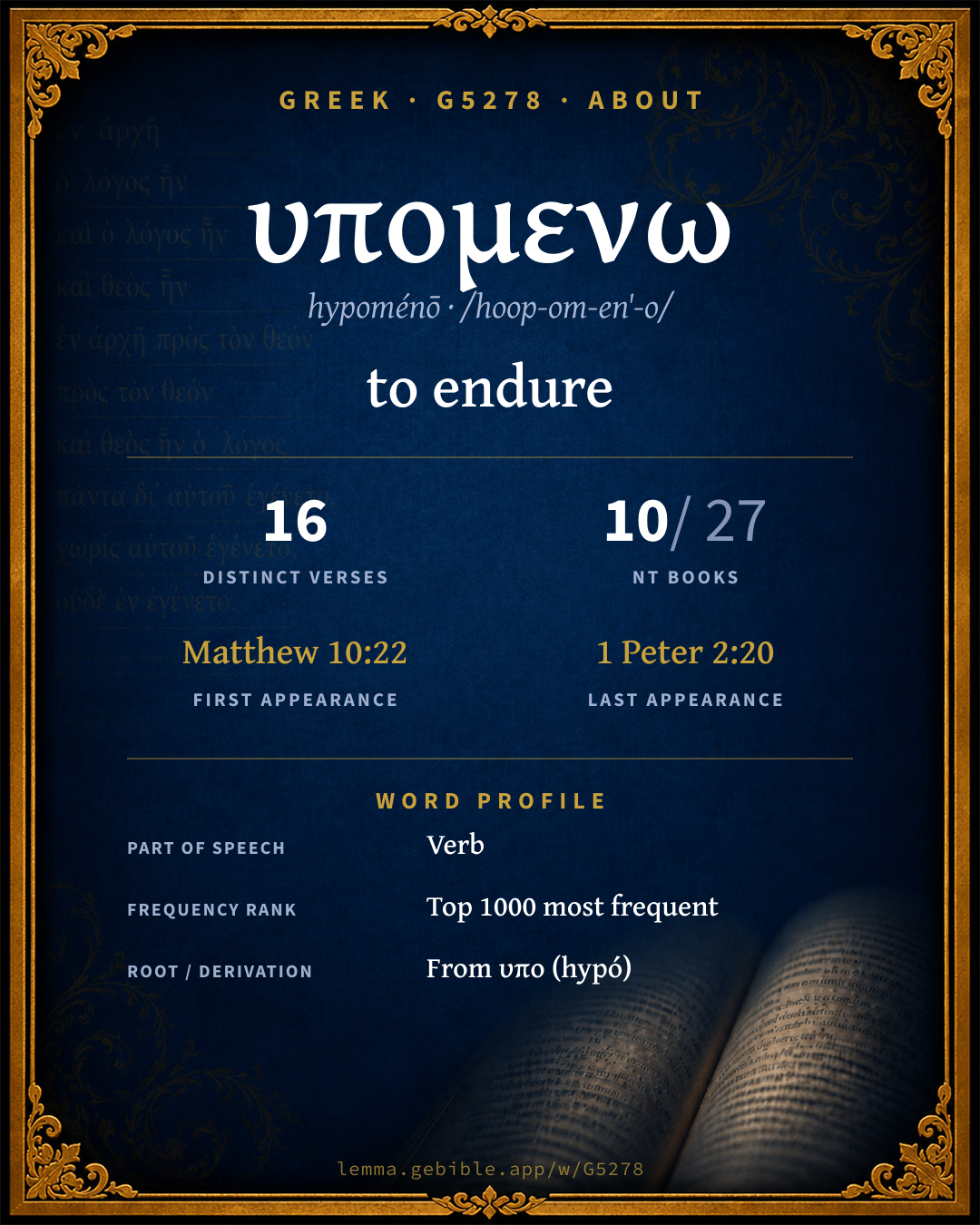
ὑπομένω
to endure
‘to endure’ is one of 2 main senses fuller range ↓
Full lexicon entry — Thayer's Greek Lexicon
From Thayer's Greek Lexicon
Where this word appears
See every Aorist-tense verb in the Greek New Testament →
Grammar key — what these labels mean
Part of speech
- Verb
- An action or state-of-being word.
Tense
- Aorist
- Action viewed as a simple whole, without regard to duration — often past (perfective aspect).
- Future
- Action expected in future time.
- Present
- Ongoing or general action in present time (imperfective aspect).
- Perfect
- A completed past action with continuing present results.
Voice
- Active
- The subject performs the action.
Mood
- Participle
- A verbal adjective (“writing,” “having written”).
- Indicative
- States a fact or asks a factual question (the mood of reality).
Case
- Nominative
- The case of the subject (and the predicate nominative).
- Accusative
- The case of the direct object and of extent.
Person
- 3rd person
- The one spoken about (“he / she / it / they”).
- 2nd person
- The one addressed (“you”).
- 1st person
- The speaker (“I / we”).
Gender
- Masculine
- Grammatically masculine.
Number
- Singular
- One.
- Plural
- More than one.
Grammatical forms 12 distinct
- Verb, Aorist, Active, Participle, Nominative, Singular, Masculine 3 times (18%)
- Verb, Aorist, Active, Indicative, 3rd person, Singular 2 times (12%)
- Verb, Future, Active, Indicative, 2nd person, Plural 2 times (12%)
- Verb, Present, Active, Indicative, 3rd person, Singular 2 times (12%)
- Verb, Aorist, Active, Indicative, 2nd person, Plural 1 time (6%)
- Verb, Aorist, Active, Indicative, 3rd person, Plural 1 time (6%)
- Verb, Aorist, Active, Participle, Accusative, Plural, Masculine 1 time (6%)
- Verb, Present, Active, Indicative, 1st person, Plural 1 time (6%)
+4 more forms (4 occurrences)
Parsed forms decoded from the imported morphology (Robinson–Tischendorf, public domain), counted across 17 parsed occurrences — not distinct verses.
Every verse where G5278 appears — 16 distinct verses across 10 books. Click any verse to open its interlinear word-by-word view. Verse text shown in the World English Bible for context — . Each verse’s Greek form is shown with its reference; the English is not keyword-highlighted, since the data carries no word-level English alignment. Use “Compare translations” on any verse to read it across multiple English versions. This concordance covers the Greek New Testament; Septuagint (Greek Old Testament) occurrences of this word are not indexed here.
Matthew 2 verses
Mark 1 verse
Luke 1 verse
Acts 1 verse
Romans 1 verse
1 Corinthians 1 verse
2 Timothy 2 verses
- 2 Timothy 2:10 ὑπομένω pres act ind 1sg Therefore I endure all things for the chosen ones' sake, that they also may obtain the salvation which is in Christ Jesus with eternal glory.
- 2 Timothy 2:12 ὑπομένομεν pres act ind 1pl If we endure, We will also reign with him. If we deny him, He also will deny us.
Hebrews 4 verses
- Hebrews 10:32 ὑπεμείνατε aor act ind 2pl But remember the former days, in which, after you were enlightened, you endured a great struggle with sufferings;
- Hebrews 12:2 ὑπέμεινεν aor act ind 3sg looking to Jesus, the author and perfecter of faith, who for the joy that was set before him endured the cross, despising shame, and has sat down at the right hand of the throne of God.
- Hebrews 12:3 ὑπομεμενηκότα perf act ptcp acc sg masc For consider him who has endured such contradiction of sinners against himself, that you don't grow weary, fainting in your souls.
- Hebrews 12:7 ὑπομένετε pres act ind 2pl It is for discipline that you endure. God deals with you as with children, for what son is there whom his father doesn't discipline?
James 2 verses
- James 1:12 ὑπομένει pres act ind 3sg Blessed is the man who endures temptation, for when he has been approved, he will receive the crown of life, which the Lord promised to those who love him.
- James 5:11 ὑπομείναντας aor act ptcp acc pl masc Behold, we call them blessed who endured. You have heard of the patience of Job, and have seen the Lord in the outcome, and how the Lord is full of compassion and mercy.
1 Peter 1 verse
About this entry
At a glance — auto-summarized from this page’s data, not written by a person. Every figure links to its source below. This summary describes the numbers; it doesn’t interpret them.
“to endure” is the headline sense of the Greek verb υπομενω (hypoménō). First canonically at Matthew 10:22, it enters the text early. It turns up in 16 verses across 10 books, an uncommon footprint. It concentrates in Hebrews, which alone accounts for 25% of its uses. Catalogued under 2 senses, its meaning is not single-sense. The sections below give every sense, occurrence, and version rendering.
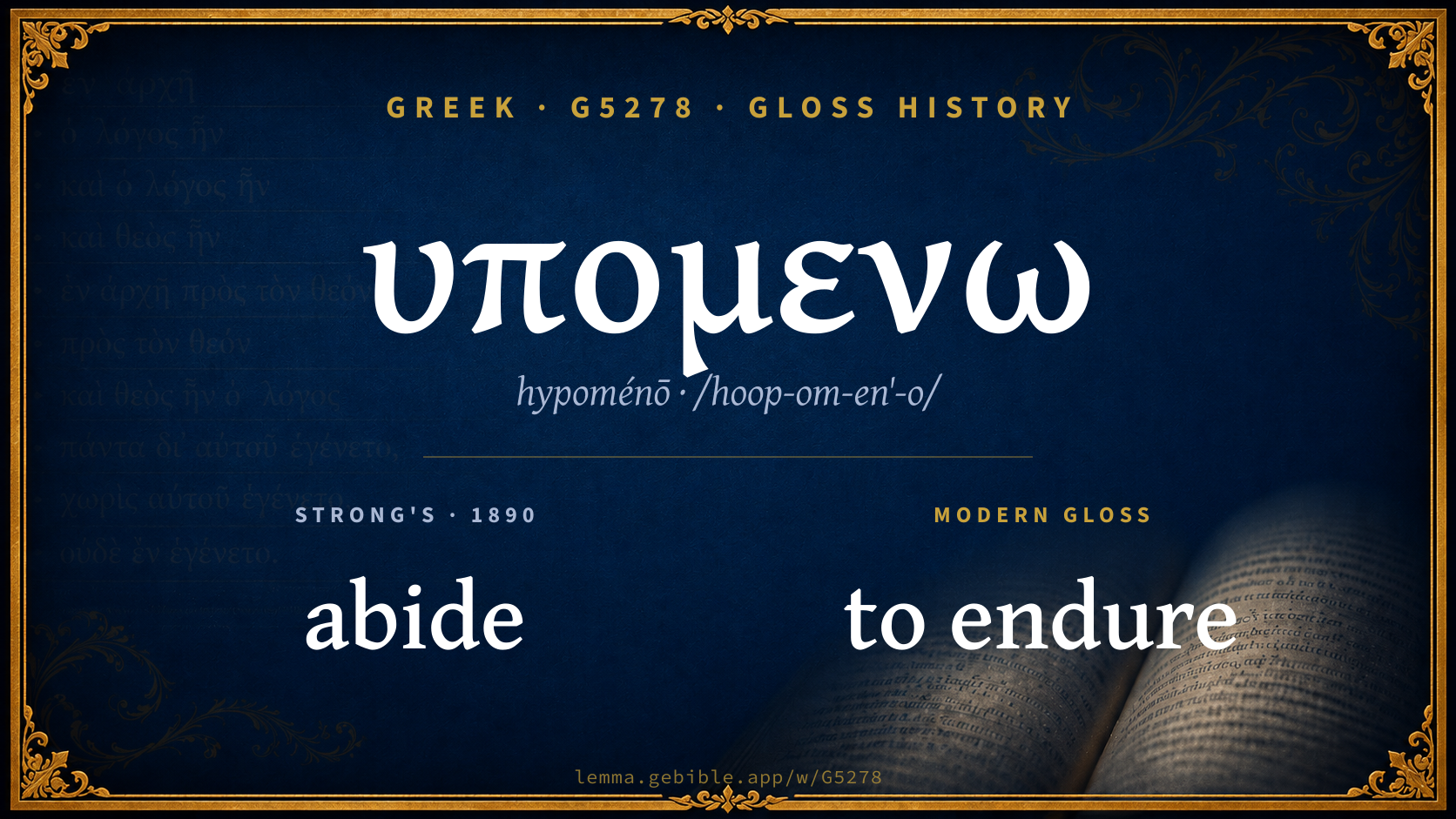
Gloss history
Strong's 1890 vs modern scholarship
About this word
Strong's G5278 catalogs a Greek word from the Greek New Testament.
These counts are not copied from any lexicon or concordance. They are computed here, from the morphology-tagged Greek New Testament. What Lemma adds →
- 16
- distinct verses
- The word appears in 16 distinct verses.
- 10 / 27
- NT books
- The word appears in 10 of 27 New Testament books.
- #697
- by frequency
- Top 1000 most frequent Greek words (rank 697 of 5,347 Greek words by occurrence).
View all 16 occurrences in the concordance →
By section of the New Testament
By traditional corpus
Conventional, traditional groupings — biblical authorship is debated, so this is a traditional corpus grouping, not an authorship claim. Some books belong to more than one corpus (Luke is in both the Gospels and the Lukan corpus, and so on), so these shares overlap and need not total 100%. Each figure is a share of the word’s 16 distinct verses.
- Gospels 4 verses · 25%
- Pauline corpus 4 verses · 25%
- Hebrews 4 verses · 25%
- General (Catholic) Epistles 3 verses · 19%
- Lukan (Luke–Acts) 2 verses · 13%
How translations render this word
Counts come from each version’s own published word-to-Strong’s tagging or interlinear alignment — an approximate guide to how each version renders this word, not a word-level alignment the data otherwise carries. Because each total is that version’s own tagged count, the per-version totals vary from one another and need not match the appearance or distinct-verse counts above. These counts may also differ from a printed concordance because Lemma counts each distinctly tagged rendering and does not collapse phrase taggings into a single head-word total. This is a fixed set of word-tagged versions (KJV, ASV, BSB, ULT) and does not change with the reading translation you choose elsewhere. Each version’s license is shown beside its name below (and on Sources).
- King James Version: Endureth 3×, Endured 2×, He that shall endure 2×
- American Standard Version: Endureth 4×, Endured 2×, It 2×
- Berean Standard Bible: Perseveres 4×, Endured 2×, You endure 2×
- unfoldingWord Literal Text: Having endured 4×, Endures 2×, You will endure 2×
King James Version Public Domain
Renders G5278 across 18 tagged occurrences — most commonly:
Plus 11 renderings that appear only once — usually multi-word phrases or single function words the recovered tagging swept in, not distinct renderings.
American Standard Version Public Domain
Renders G5278 across 18 tagged occurrences — most commonly:
Plus 10 renderings that appear only once — usually multi-word phrases or single function words the recovered tagging swept in, not distinct renderings.
Berean Standard Bible Public Domain
Renders G5278 across 17 tagged occurrences — most commonly:
Plus 9 renderings that appear only once — usually multi-word phrases or single function words the recovered tagging swept in, not distinct renderings.
unfoldingWord Literal Text CC BY-SA 4.0
Renders G5278 across 17 tagged occurrences — most commonly:
Plus 9 renderings that appear only once — usually multi-word phrases or single function words the recovered tagging swept in, not distinct renderings.
Senses in Thayer's
The 2 senses Thayer's distinguishes for this word, in lexicon order (not ranked by frequency or importance). The full entry — with sub-senses — is in the Lexicon Entry tab.
- to tarry behind
- to remain i.e. abide, not recede or flee
Word origin
Derived from υπο (hypó) (G5259) — under.
Forms in the corpus
The 12 distinct written forms G5278 takes in the Greek New Testament, most frequent first — each parse links to that tense’s occurrences in the concordance.
Same root — word family
Other Thayer's entries built from the same root as G5278, grouped by Strong’s listed origin. These share a root / origin per the lexicon — not necessarily a shared meaning. Each links to that word’s own entry.
Derives from
Shares the same root
- υπαγω hypágō G5217 to depart
- υπακουω hypakoúō G5219 to listen
- υπανδρος hýpandros G5220 under (married)
- υπανταω hypantáō G5221 to meet
- υπαρχω hypárchō G5225 to be at hand
- υπεικω hypeíkō G5226 to yield
- υπεναντιος hypenantíos G5227 adversary
- υπεχω hypéchō G5254 to sustain
- υπηρετης hypērétēs G5257 servant
- υπνος hýpnos G5258 sleep
- υποβαλλω hypobállō G5260 to instigate
- υπογραμμος hypogrammós G5261 example
- υποδεικνυμι hypodeíknymi G5263 to demonstrate
- υποδεχομαι hypodéchomai G5264 to welcome
- υποδεω hypodéō G5265 to bind on
- υποδικος hypódikos G5267 debtor
- υποζυγιον hypozýgion G5268 beast of burden
- υποζωννυμι hypozṓnnymi G5269 to undergird
- υποκατω hypokátō G5270 underneath
- υποκρινομαι hypokrínomai G5271 to pretend
- υπολαμβανω hypolambánō G5274 to welcome
- υποληνιον hypolḗnion G5276 wine pit
- υπομιμνησκω hypomimnḗskō G5279 to remind
- υπονοεω hyponoéō G5282 to suppose
+15 more words share this root (not shown).
Derived from this word
Compare all same-root words → Showing 4 of 42 — not the complete family. They share a root, not necessarily a meaning.
Septuagint usage
The same Greek word υπομενω appears 54 times in the Greek Old Testament (Septuagint), across 51 verses in 16 books.
- 54
- LXX occurrences
- Tagged occurrences of this Greek word in the Septuagint.
- 51
- verses
- Distinct Septuagint verses containing this word.
- 16 / 39
- OT books
- The word appears in 16 of the 39 Old Testament books.
Sample Septuagint occurrences
- Numbers 22:19 ὑπομένω
- Joshua 19:48 ὑπομένω
- Judges 3:25 ὑπομένω
- 2 Kings 6:33 ὑπομένω
- Job 3:9 ὑπομένω
- Psalms 24:3 ὑπομένω
- Proverbs 20:9 ὑπομένω
- Isaiah 40:31 ὑπομένω
- Jeremiah 14:19 ὑπομένω
- Lamentations 3:21 ὑπομένω
- Micah 7:7 ὑπομένω
- Nahum 1:7 ὑπομένω
Septuagint occurrences (same lexeme)
Every verse where the same Strong’s number (G5278) appears in the Greek Septuagint — showing the first 50 of 51. Verse text shown in the World English Bible for context; the Greek form is the matched word — the English is not keyword-highlighted.
- Numbers 22:19 ὑπομένω Now therefore, please wait also here this night, that I may know what Yahweh will speak to me more.
- Joshua 19:48 ὑπομένω This is the inheritance of the tribe of the children of Dan according to their families, these cities with their villages.
- Judges 3:25 ὑπομένω They waited until they were ashamed; and, behold, he didn't open the doors of the upper room: therefore they took the key, and opened [them], and, behold, their lord was fallen down dead on the earth.
- 2 Kings 6:33 ὑπομένω While he was yet talking with them, behold, the messenger came down to him: and he said, Behold, this evil is of Yahweh; why should I wait for Yahweh any longer?
- Job 3:9 ὑπομένω Let the stars of the twilight of it be dark. Let it look for light, but have none, Neither let it see the eyelids of the morning,
- Job 6:11 ὑπομένω What is my strength, that I should wait? What is my end, that I should be patient?
- Job 7:3 ὑπομένω So am I made to possess months of misery, Wearisome nights are appointed to me.
- Job 8:15 ὑπομένω He shall lean on his house, but it shall not stand. He shall cling to it, but it shall not endure.
- Job 9:4 ὑπομένω God who is wise in heart, and mighty in strength: Who has hardened himself against him, and prospered?
- Job 14:14 ὑπομένω If a man dies, shall he live again? All the days of my warfare would I wait, Until my release should come.
- Job 15:31 ὑπομένω Let him not trust in emptiness, deceiving himself; For emptiness shall be his reward.
- Job 17:13 ὑπομένω If I look for Sheol as my house, If I have spread my couch in the darkness,
- Job 20:26 ὑπομένω All darkness is laid up for his treasures. An unfanned fire shall devour him. It shall consume that which is left in his tent.
- Job 22:21 ὑπομένω "Acquaint yourself with him, now, and be at peace. Thereby good shall come to you.
- Job 32:4 ὑπομένω Now Elihu had waited to speak to Job, because they were elder than he.
- Job 32:16 ὑπομένω Shall I wait, because they don't speak, Because they stand still, and answer no more?
- Job 33:5 ὑπομένω If you can, answer me; Set your words in order before me, and stand forth.
- Job 41:3 ὑπομένω Will he make many petitions to you? Or will he speak soft words to you?
- Psalms 24:3 ὑπομένω Who may ascend to Yahweh's hill? Who may stand in his holy place?
- Psalms 24:5 ὑπομένω He shall receive a blessing from Yahweh, Righteousness from the God of his salvation.
- Psalms 24:21 ὑπομένω
- Psalms 26:14 ὑπομένω
- Psalms 32:20 ὑπομένω
- Psalms 36:9 ὑπομένω For with you is the spring of life. In your light shall we see light.
- Psalms 36:34 ὑπομένω
- Psalms 39:2 ὑπομένω I was mute with silence. I held my peace, even from good. My sorrow was stirred.
- Psalms 51:11 ὑπομένω Don't throw me from your presence, And don't take your holy Spirit from me.
- Psalms 55:7 ὑπομένω Behold, then I would wander far off. I would lodge in the wilderness." Selah.
- Psalms 68:7 ὑπομένω God, when you went forth before your people, When you marched through the wilderness... Selah.
- Psalms 68:21 ὑπομένω But God will strike through the head of his enemies, The hairy scalp of such a one as still continues in his guiltiness.
- Psalms 105:13 ὑπομένω They went about from nation to nation, From one kingdom to another people.
- Psalms 118:95 ὑπομένω
- Psalms 129:5 ὑπομένω Let them be disappointed and turned backward, All those who hate Zion.
- Psalms 141:8 ὑπομένω For my eyes are on you, Yahweh, the Lord. In you, I take refuge. Don't leave my soul destitute.
- Proverbs 20:9 ὑπομένω Who can say, "I have made my heart pure. I am clean and without sin?"
- Isaiah 40:31 ὑπομένω but those who wait for Yahweh shall renew their strength; they shall mount up with wings as eagles; they shall run, and not be weary; they shall walk, and not faint.
- Isaiah 51:5 ὑπομένω My righteousness is near, my salvation is gone forth, and my arms shall judge the peoples; the isles shall wait for me, and on my arm shall they trust.
- Isaiah 59:9 ὑπομένω Therefore is justice far from us, neither does righteousness overtake us: we look for light, but, behold, darkness; for brightness, but we walk in obscurity.
- Isaiah 60:9 ὑπομένω Surely the isles shall wait for me, and the ships of Tarshish first, to bring your sons from far, their silver and their gold with them, for the name of Yahweh your God, and for the Holy One of Israel, because he has glorified you.
- Isaiah 64:3 ὑπομένω When you did terrible things which we didn't look for, you came down, the mountains quaked at your presence.
- Jeremiah 14:19 ὑπομένω Have you utterly rejected Judah? has your soul loathed Zion? why have you struck us, and there is no healing for us? We looked for peace, but no good came; and for a time of healing, and, behold, dismay!
- Jeremiah 14:22 ὑπομένω Are there any among the vanities of the nations that can cause rain? or can the sky give showers? Aren't you he, Yahweh our God? therefore we will wait for you; for you have made all these things.
- Lamentations 3:21 ὑπομένω This I recall to my mind; therefore have I hope.
- Lamentations 3:25 ὑπομένω Yahweh is good to those who wait for him, to the soul that seeks him.
- Lamentations 3:26 ὑπομένω It is good that a man should hope and quietly wait for the salvation of Yahweh.
- Micah 7:7 ὑπομένω But as for me, I will look to Yahweh. I will wait for the God of my salvation. My God will hear me.
- Nahum 1:7 ὑπομένω Yahweh is good, a stronghold in the day of trouble; and he knows those who take refuge in him.
- Habakkuk 2:3 ὑπομένω For the vision is yet for the appointed time, and it hurries toward the end, and won't prove false. Though it takes time, wait for it; because it will surely come. It won't delay.
- Zephaniah 3:8 ὑπομένω "Therefore wait for me," says Yahweh, "until the day that I rise up to the prey, for my determination is to gather the nations, that I may assemble the kingdoms, to pour on them my indignation, even all my fierce anger, for all the earth will be devoured with the fire of my jealousy.
- Zechariah 6:14 ὑπομένω The crowns shall be to Helem, and to Tobijah, and to Jedaiah, and to Hen the son of Zephaniah, for a memorial in the temple of Yahweh.
These are occurrences of the same Greek lexeme (G5278) in the Septuagint — not a translation of any one Hebrew word. The store carries no word-level Hebrew↔Greek alignment, so no Hebrew original is asserted here. Counts come from the recovered LXX Strong's tagging — high-frequency vocabulary is well covered, while rare or late forms may be untagged — so they reflect tagged occurrences and may slightly undercount.