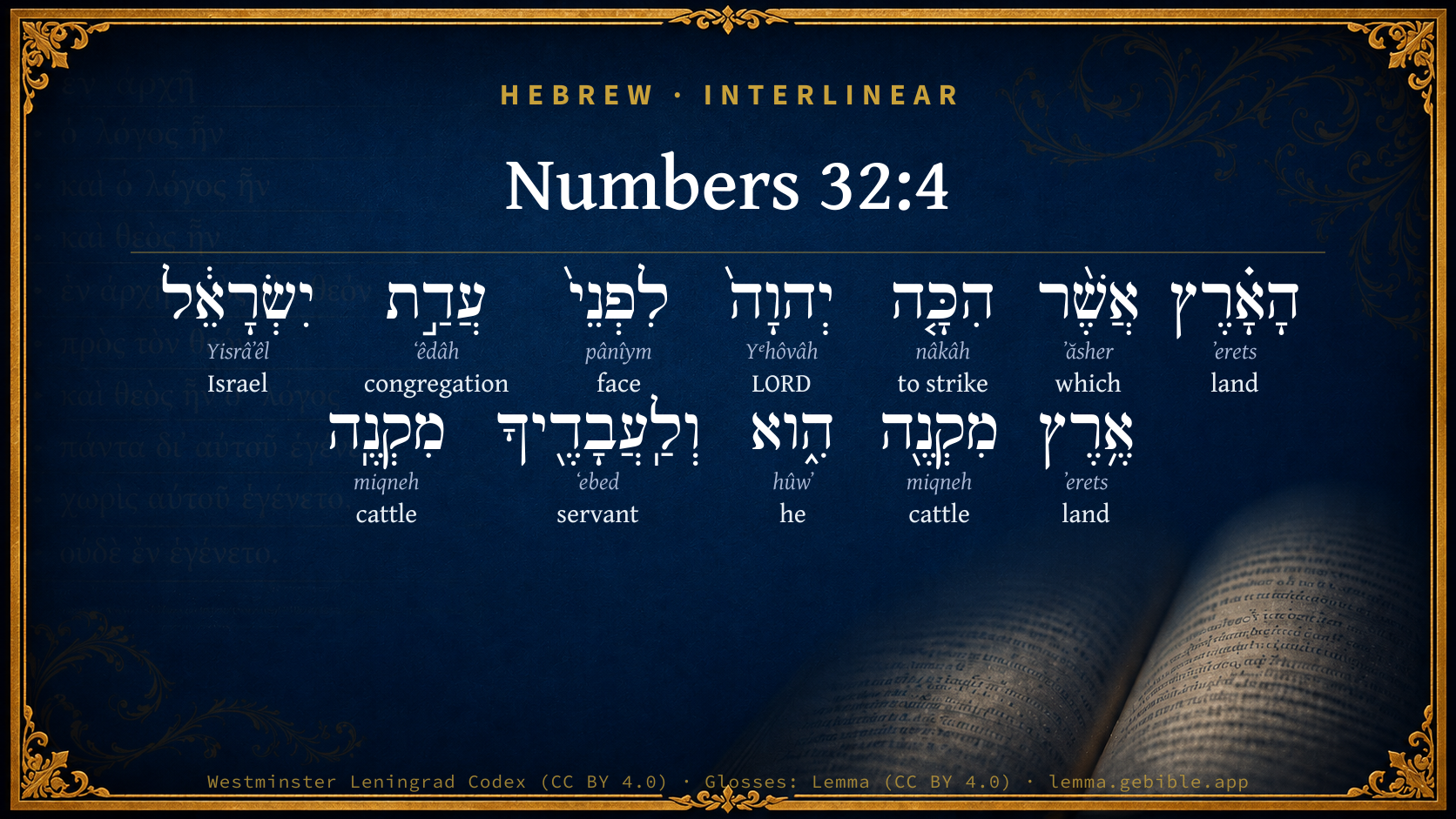
Numbers 32:4

Hebrew (Westminster Leningrad Codex) Numbers 32:4 appears in the Hebrew Old Testament. The text above is from the Westminster Leningrad Codex. Each word links to its Strong’s number, a concise gloss, and parsing drawn from the Open Scriptures Hebrew Bible morphology. Click any word for its full Brown-Driver-Briggs (BDB) entry.
Download image
Cite this verse

Numbers 32:4 (World English Bible). Public Domain. Lemma interlinear Bible study tool, https://lemma.gebible.app/v/numbers/32/4.

Show BibTeX & RIS
BibTeX
RIS
English Translation
the land which Yahweh struck before the congregation of Israel, is a land for cattle; and your servants have cattle.
World English Bible · Public Domain
Download a study sheet

One document with this verse’s original text, its word-by-word gloss line, the meaning frame, cross-references with their text, attributed commentary, and full source and license credits — printable, and it pastes into notes with its structure intact.

This verse Autodidact and up

Study sheet (.html) Plain text (.txt)

A passage Seminary Student

Up to 50 verses in one chapter. A passage sheet keeps up to 6 commentary sources and 12 cross-references per verse, in the order this page ranks them, and says so on the sheet whenever that leaves anything out. Ask for a single verse and you get the Autodidact verse sheet above.

Everything on this page stays free to read, with no account — the sheet is a download of what is already on screen, not access to it.

Want to remove ads? Support Godless Engineer
Compare translations 3

The same verse in 3 English versions, stacked beneath the original-language interlinear above. Click any original word for its lexicon entry.

Each is an independent rendering of the whole verse — the interlinear is not word-aligned to these translations.

Highlighted words mark where these versions differ — a whole-verse word diff, not a word-by-word alignment.

  • World English Bible Public Domain
    the land which Yahweh struck before the congregation of Israel, is a land for cattle; and your servants have cattle.
  • King James Version Public Domain
    Even the country which the LORD smote before the congregation of Israel, is a land for cattle, and thy servants have cattle:
  • unfoldingWord Literal Text CC BY-SA 4.0
    are the land that Yahweh struck before the face of the congregation of Israel. It is a land of livestock, and livestock belongs to your servants.”

unfoldingWord Literal Text — © unfoldingWord, licensed CC BY-SA 4.0. Word-aligned USFM3 via Door43 (git.door43.org/unfoldingWord/en_ult).

Versions to compare (up to 4)

3 of 4 selected

Show all 18 translations

Every available English version of this verse, each an independent rendering of the whole verse.

  • World English Bible Public Domain
    the land which Yahweh struck before the congregation of Israel, is a land for cattle; and your servants have cattle.
  • Berean Standard Bible Public Domain
    which the LORD conquered before the congregation of Israel, are suitable for livestock—and your servants have livestock.”
  • Majority Standard Bible Public Domain
    which the LORD conquered before the congregation of Israel, are suitable for livestock—and your servants have livestock.”
  • King James Version Public Domain
    Even the country which the LORD smote before the congregation of Israel, is a land for cattle, and thy servants have cattle:
  • American Standard Version (1901) Public Domain
    the land which Jehovah smote before the congregation of Israel, is a land for cattle; and thy servants have cattle.
  • Revised Version (1885) Public Domain
    the land which the LORD smote before the congregation of Israel, is a land for cattle, and thy servants have cattle.
  • Geneva Bible (1599) Public Domain
    Which countrey the Lord smote before the Congregation of Israel, is a lande meete for cattell, and thy seruants haue cattell:
  • Douay-Rheims (1899) Public Domain
    The land, which the Lord hath conquered in the sight of the children of Israel, is a very fertile soil for the feeding of beasts: and we thy servants have very much cattle:
  • Young's Literal Translation Public Domain
    the land which Jehovah hath smitten before the company of Israel, is a land for cattle, and thy servants have cattle.'
  • Literal Standard Version CC BY-SA 4.0
    the land which YHWH has struck before the congregation of Israel, is a land for livestock, and your servants have livestock.”
  • Unlocked Literal Bible CC BY-SA 4.0
    These are the lands that Yahweh attacked before the community of Israel, and they are good places for livestock. We, your servants, have a lot of livestock.”
  • unfoldingWord Literal Text CC BY-SA 4.0
    are the land that Yahweh struck before the face of the congregation of Israel. It is a land of livestock, and livestock belongs to your servants.”
  • Darby Bible Public Domain
    the country that Jehovah smote before the assembly of Israel, is a land for cattle, and thy servants have cattle;
  • World Messianic Bible Public Domain
    the land which the LORD struck before the congregation of Israel, is a land for livestock; and your servants have livestock.”
  • Webster's Bible Public Domain
    Even the country which the LORD smote before the congregation of Israel, is a land for cattle, and thy servants have cattle:
  • Free Bible Version CC BY-SA 4.0
    which the Lord conquered in full view of the Israelites, are well-suited for the livestock that we your servants own.”
  • Bible in Basic English Public Domain
    The land which the Lord gave into the hands of the children of Israel, is a land for cattle, and your servants have cattle.
  • JPS Tanakh (1917) Public Domain
    the land which the LORD smote before the congregation of Israel, is a land for cattle, and thy servants have cattle.'

Literal Standard Version (2020), Covenant Press — licensed CC BY-SA 4.0. Text via the HelloAO Bible API (eBible.org). Unlocked Literal Bible (unfoldingWord) — licensed CC BY-SA 4.0. Text via the HelloAO Bible API (eBible.org). unfoldingWord Literal Text — © unfoldingWord, licensed CC BY-SA 4.0. Word-aligned USFM3 via Door43 (git.door43.org/unfoldingWord/en_ult). Free Bible Version, Dr. Jonathan Gallagher — licensed CC BY-SA 4.0. Text via the HelloAO Bible API (eBible.org).

Word by word

More ways to search: Search by grammar → Find every occurrence → Compare this word →

Practice this passage: Drill this verse → Learn its vocabulary →

מִקְנֶ֖ה
miqneh
H4735
“cattle”
Noun, Common, Masculine, Singular, Absolute
Part of Speech
Noun
Type
Common
Gender
Masculine
Number
Singular
State
Absolute
Full BDB Definition

Origin: from H7069

TWOT: 2039b

cattle, livestock - cattle, livestock - in general of a purchasable domestic animal - cows, sheep, goats (in herds and flocks)
  1. הָאָ֗רֶץ ʼerets H776 “the · land” Particle, Definite Article + Noun, Common, Both, Singular, Absolute
  2. אֲשֶׁ֨ר ʼăsher H834 “which” Particle, Relative
  3. הִכָּ֤ה nâkâh H5221 “to strike” Verb, Hiphil, Perfect, 3rd Person, Masculine, Singular
  4. יְהוָה֙ Yᵉhôvâh H3068 “LORD” Noun, Proper
  5. לִפְנֵי֙ pânîym H6440 “to/for · face(s) of” Preposition + Noun, Common, Both, Plural, Construct
  6. עֲדַ֣ת ʻêdâh H5712 “congregation of” Noun, Common, Feminine, Singular, Construct
  7. יִשְׂרָאֵ֔ל Yisrâʼêl H3478 “Israel” Noun, Proper
  8. אֶ֥רֶץ ʼerets H776 “land of” Noun, Common, Both, Singular, Construct
  9. הִ֑וא hûwʼ H1931 “he” Pronoun, Personal, 3rd Person, Feminine, Singular
  10. וְלַֽעֲבָדֶ֖יךָ ʻebed H5650 “and · to/for · servants · your” Conjunction + Preposition + Noun, Common, Masculine, Plural, Construct + Suffix, Personal, 2nd Person, Masculine, Singular
  11. מִקְנֶֽה miqneh H4735 “cattle” Noun, Common, Masculine, Singular, Absolute

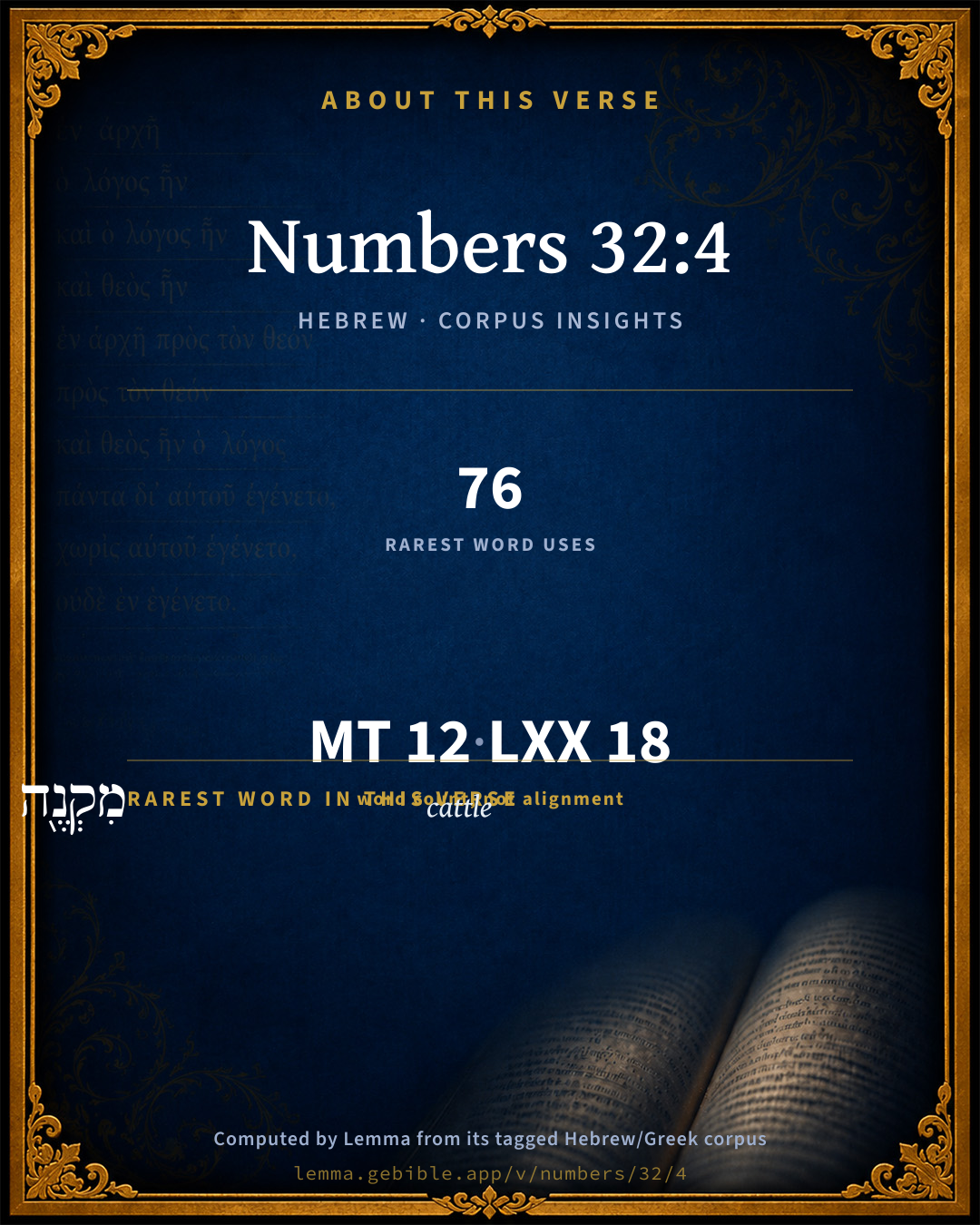
About this verse

These counts appear in no published source. They are computed here, from the morphology-tagged text and Lemma’s own curated glosses. What Lemma adds →

12
words
10
distinct lemmas
Pentateuch
section

Grammatical profile

  • 1 verb
  • 9 nouns
  • 1 pronoun
  • 1 particle

Verb forms

  • הִכָּ֤ה Hiphil · Perfect

Repetition

Words recur within this verse — often emphatic in Hebrew:

  • הָאָ֗רֶץ land H776 ×2
  • מִקְנֶ֖ה cattle H4735 ×2

Hebrew & Septuagint length

In English translation the verse runs 20 words from the Hebrew and 21 from the Septuagint (LXX English) — closely comparable.

A rough comparison of the two English renderings, which tokenize alike — not a word-level alignment.

Word counts can differ between the Hebrew and the Greek without any difference in meaning — e.g. the Hebrew direct-object marker אֵת has no separate Greek word, and Greek often adds the article ὁ.

In the original languages it is 12 Hebrew tokens and 18 Greek tokens — but the two are counted differently (Hebrew bundles its prefixes and suffixes into one token; the Greek is in lemma form), so that isn’t a like-for-like length.

Cross-references

3

Topical passages linked to Numbers 32:4 in the Treasury of Scripture Knowledge — connected by theme and wording, ordered by reader-vote popularity; previews shown in the World English Bible.

  • Numbers 21:34 Yahweh said to Moses, Don't fear him: for I have delivered him into your hand, and all his people, and his land; and you shall do to him as you did to Sihon king of the Amorites, who lived at Heshbon.
  • Numbers 21:24 Israel struck him with the edge of the sword, and possessed his land from the Arnon to the Jabbok, even to the children of Ammon; for the border of the children of Ammon was strong.
  • Deuteronomy 2:24–35 Rise up, take your journey, and pass over the valley of the Arnon: behold, I have given into your hand Sihon the Amorite, king of Heshbon, and his land; begin to possess it, and contend with him in battle.

Cross-references courtesy of OpenBible.info (CC BY 4.0).

Hebrew and Greek witnesses Masoretic Hebrew ↔ Greek Septuagint

The same verse in the two great witnesses to the Old Testament, shown verse-for-verse.

These are two independent witnesses, not word-aligned to each other, and the Septuagint is shown in lemma (dictionary) form.

Hebrew Numbers 32:4 Masoretic · Westminster Leningrad Codex

הָאָ֗רֶץ אֲשֶׁ֨ר הִכָּ֤ה יְהוָה֙ לִפְנֵי֙ עֲדַ֣ת יִשְׂרָאֵ֔ל אֶ֥רֶץ מִקְנֶ֖ה הִ֑וא וְלַֽעֲבָדֶ֖יךָ מִקְנֶֽה

the land which Yahweh struck before the congregation of Israel, is a land for cattle; and your servants have cattle.

World English Bible · Public Domain

Greek LXX Numbers 32:4 Septuagint · lemma form

ὁ γῆ ὅς παραδίδωμι κύριος ἐνώπιον ὁ υἱός ἰσραήλ γῆ κτηνοτρόφος εἰμί καί ὁ παῖς σύ κτῆνος ὑποἄρχω

the land which the Lord has delivered up before the children of Israel, is pasture land, and your servants have cattle.

LXX2012 (modern English Septuagint) · Public Domain

Hebrew: Westminster Leningrad Codex (CC BY 4.0). Greek: Septuagint (public domain); English from LXX2012 (modern English Septuagint) (Public Domain). How the Septuagint differs from the Hebrew →

Targum (Aramaic paraphrase)

2

The Targum is the ancient Jewish Aramaic paraphrase of the Hebrew Scriptures — an interpretive translation, not the Hebrew text itself. Onkelos (literal) and Pseudo-Jonathan (expansive) render the Torah, and Jonathan the Prophets. Coverage is partial: where no permissively-licensed English translation exists for a verse, only the Aramaic is shown. This is verse-level text, not a word-by-word alignment to the Hebrew.

  1. Targum Onkelos Torah (Genesis–Deuteronomy)
    אַרְעָא דִי מְחָא יְיָ יַת יָתְבָהָא קֳדָם כְּנִשְׁתָּא דְיִשְׂרָאֵל אֲרַע כָּשְׁרָא לְבֵית בְּעִיר הִיא וּלְעַבְדָיךְ אִית בְּעִיר

    (no public-domain English translation for this verse)

    Targum Onkelos — Aramaic: “Onkelos Genesis” (public domain); “Onkelos Exodus” (public domain); “Onkelos Leviticus” (public domain); “Onkelos Numbers” (public domain); “Onkelos Deuteronomy” (public domain). English: “Sefaria Community Translation” (CC0 1.0 (public-domain dedication)); “J.W. Etheridge. The Targums of Onkelos and Jonathan Ben Uzziel on the Pentateuch. London: Longmans, Green, 1862” (public domain). Text via Sefaria.

  2. Targum Pseudo-Jonathan Torah (Genesis–Deuteronomy)
    אַרְעָא דְכָבַשׁ יְיָ וּמְחָא יַתְבָהָא קֳדָם כְּנִישְׁתָּא דְיִשְרָאֵל אֲרַע כָּשַׁר לְבֵית בְּעִיר הִיא וּלְעַבְדָךְ אִית בְּעִיר

    the land which the Lord hath subdued, and whose inhabitants he hath smitten before the congregation of Israel, is a land suitable for cattle, and thy servants have cattle.

    Targum Pseudo-Jonathan — Aramaic: “Targum Jonathan on Genesis” (public domain); “Targum Jonathan on Exodus” (public domain); “Targum Jonathan on Leviticus” (public domain); “Targum Jonathan on Numbers” (public domain); “Targum Jonathan on Deuteronomy” (public domain). English: “The Targum of Jonathan ben Uzziel, trans. J. W. Etheridge, London, 1862” (public domain). Text via Sefaria.

Commentary

Notes on Numbers 32:4 from classic Christian and Jewish commentators (each source and its license shown beneath its notes). The classic Christian expositions comment on the surrounding passage and are grouped to its opening verse, so a note may address several verses; the Jewish commentaries on the Tanakh (Rashi and others) are per-verse, so they appear only where the commentator wrote on this verse.

Lemma curates 59 commentaries, every one of them public domain or Creative Commons licensed, each selected and text-cleaned for this edition rather than reprinted as found. About our sources →

Joseph Benson's Commentary

Num 32:4. Which the Lord smote — That is, whose inhabitants we, by God’s peculiar aid, routed and destroyed: Deu 2:33, compared with the history of this victory, Numbers 21.

Joseph Benson's Commentary on the Old and New Testaments (1811–1818) — public domain. Text from a community e-Sword module.

John Gill's Exposition

Wherefore, said they, if we have found grace in thy sight,.... Directing their speech to Moses, the ruler of the congregation, in a very modest, decent, and respectable manner:

let this land be given unto thy servants for a possession; as their own portion and inheritance, to be enjoyed by them, and their children after them:

and bring us not over Jordan; into the land of Canaan, where as they after explain themselves, they did not desire to have any part with their brethren, but should be content with their possession here, should it be granted them.

John Gill's Exposition of the Whole Bible (1746–1763) — public domain (CC PDM 1.0). Text via the HelloAO Bible API.

Matthew Poole's English Annotations

Which the Lord smote before the congregation, and gave to them for a possession, in the same manner as he will give the land of Canaan.

Matthew Poole's English Annotations on the Holy Bible (1683–1685) — public domain. Text from a community e-Sword/MySword module.

unfoldingWord translationNotes

Door43 World Missions Community

General Information:

The people from Reuben and Gad continue speaking to Moses, Eleazar, and the other leaders.

the lands that Yahweh attacked before the community of Israel

Yahweh enabling the Israelites to conquer the people who lived in the land is spoken of as if Yahweh went before the Israelites and attacked the people. AT: "the lands where Yahweh enabled us to defeat the people living there" (See: Metaphor)

We, your servants

The people of the tribes of Reuben and Gad refer to themselves in this way to show respect to a person of higher authority.

If we have found favor in your eyes

Here "found favor" is an idiom that means be approved of or that the leaders are pleased with them. Here "eyes" are a metonym for sight, and sight is a metaphor representing his evaluation. AT: "If we have found favor with you" or "If you are pleased with us" (See: Idiom and Metonymy and Metaphor)

let this land be given to us

This can be stated in active form. AT: "give this land to us" (See: Active or Passive)

Do not make us cross over the Jordan

They wanted the land on the east side of the Jordan River instead of crossing over to the west side and claiming land there. AT: "Do not make us cross over the Jordan to take possession of land on that side" (See: Assumed Knowledge and Implicit Information)

translationWords

Yahweh

Israel

servant

favor

possess

Jordan River

unfoldingWord translationNotes — © Distant Shores Media and the Door43 World Missions Community, licensed CC BY-SA 4.0. Source: git.door43.org/Door43/en_tn.

Lesson kit

Teaching starters — assembled from the data on this page, not authored interpretation. Every prompt links to the verse data it draws on. Edit before teaching.

Numbers, in the Pentateuch, opens this verse with 12 words (10 distinct Hebrew lemmas). Its most distinctive word is miqneh (“cattle”). A historical commentator’s framing appears above. Read the whole chapter for the surrounding context.

Discussion questions

  1. What does “cattle” (miqneh) contribute to the verse as a whole?
  2. How does Numbers 21:34, which shares this passage’s theme, read alongside this verse?
  3. What does the repetition of “land” (2× in this one verse) do in this verse?
  4. These translations render this verse differently; the difference is in the English rendering, not the original. What questions does that raise?
  5. «הִכָּ֤ה» is a Hiphil Perfect verb. How does that grammatical form shape the action described?
  6. Compare how Joseph Benson's Commentary and John Gill's Exposition read this verse. Where do they agree or differ?

Things to notice

Reading settings

Reading text

Shown beneath each verse's original-language words.

Old Testament
Old Testament edition

Read the OT as the Masoretic Hebrew (MT) or the Greek Septuagint (LXX).

English shown for the Greek Septuagint (in the Hebrew ↔ Greek comparison).

Comparing translations? Open the Compare panel on any verse page to stack up to four side by side.