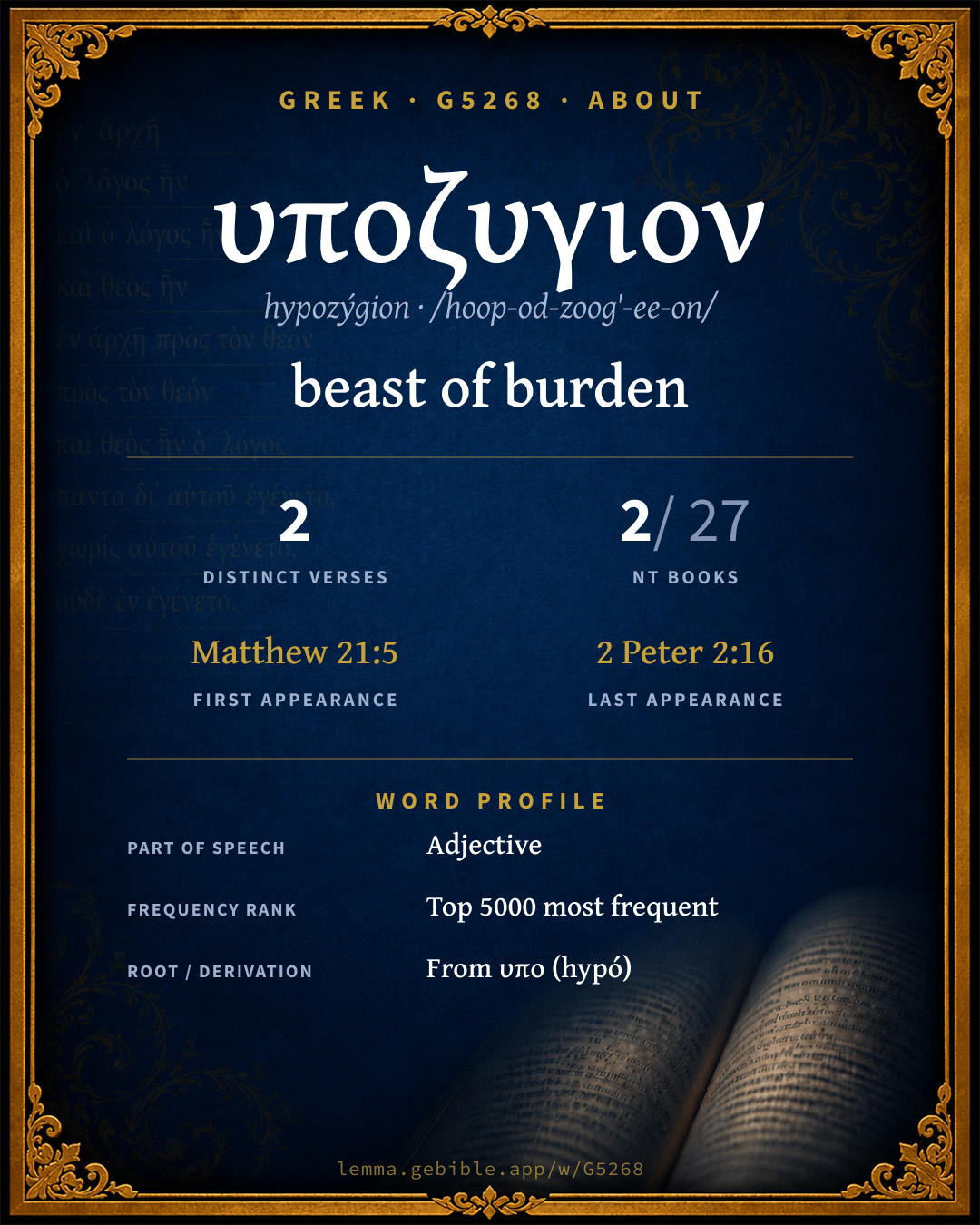
ὑποζύγιον
beast of burden
‘beast of burden’ is one of 2 main senses fuller range ↓
Full lexicon entry — Thayer's Greek Lexicon
From Thayer's Greek Lexicon
Where this word appears
See every Genitive-case word in the Greek New Testament →
Grammar key — what these labels mean
Part of speech
- Noun
- A naming word — a person, place, thing, or idea.
Case
- Genitive
- The case of source, possession, or “of” — answers “whose / from what.”
- Nominative
- The case of the subject (and the predicate nominative).
Gender
- Neuter
- Grammatically neuter.
Number
- Singular
- One.
Grammatical forms
- Noun, Genitive, Singular, Neuter 1 time (50%)
- Noun, Nominative, Singular, Neuter 1 time (50%)
Parsed forms decoded from the imported morphology (Robinson–Tischendorf, public domain), counted across 2 parsed occurrences — not distinct verses.
Every verse where G5268 appears — 2 distinct verses across 2 books. Click any verse to open its interlinear word-by-word view. Verse text shown in the World English Bible for context — . Each verse’s Greek form is shown with its reference; the English is not keyword-highlighted, since the data carries no word-level English alignment. Use “Compare translations” on any verse to read it across multiple English versions. This concordance covers the Greek New Testament; Septuagint (Greek Old Testament) occurrences of this word are not indexed here.
Matthew 1 verse
2 Peter 1 verse
About this entry
At a glance — auto-summarized from this page’s data, not written by a person. Every figure links to its source below. This summary describes the numbers; it doesn’t interpret them.
The Greek adjective υποζυγιον centers on the idea of “beast of burden.” It is rare — just 2 verses in the entire Greek New Testament. Matthew dominates its distribution — 1 of 2 verses. First canonically at Matthew 21:5, it enters the text early. Lexicons map it across 2 senses. For the data behind this summary, explore the sense tree and the renderings breakdown below.
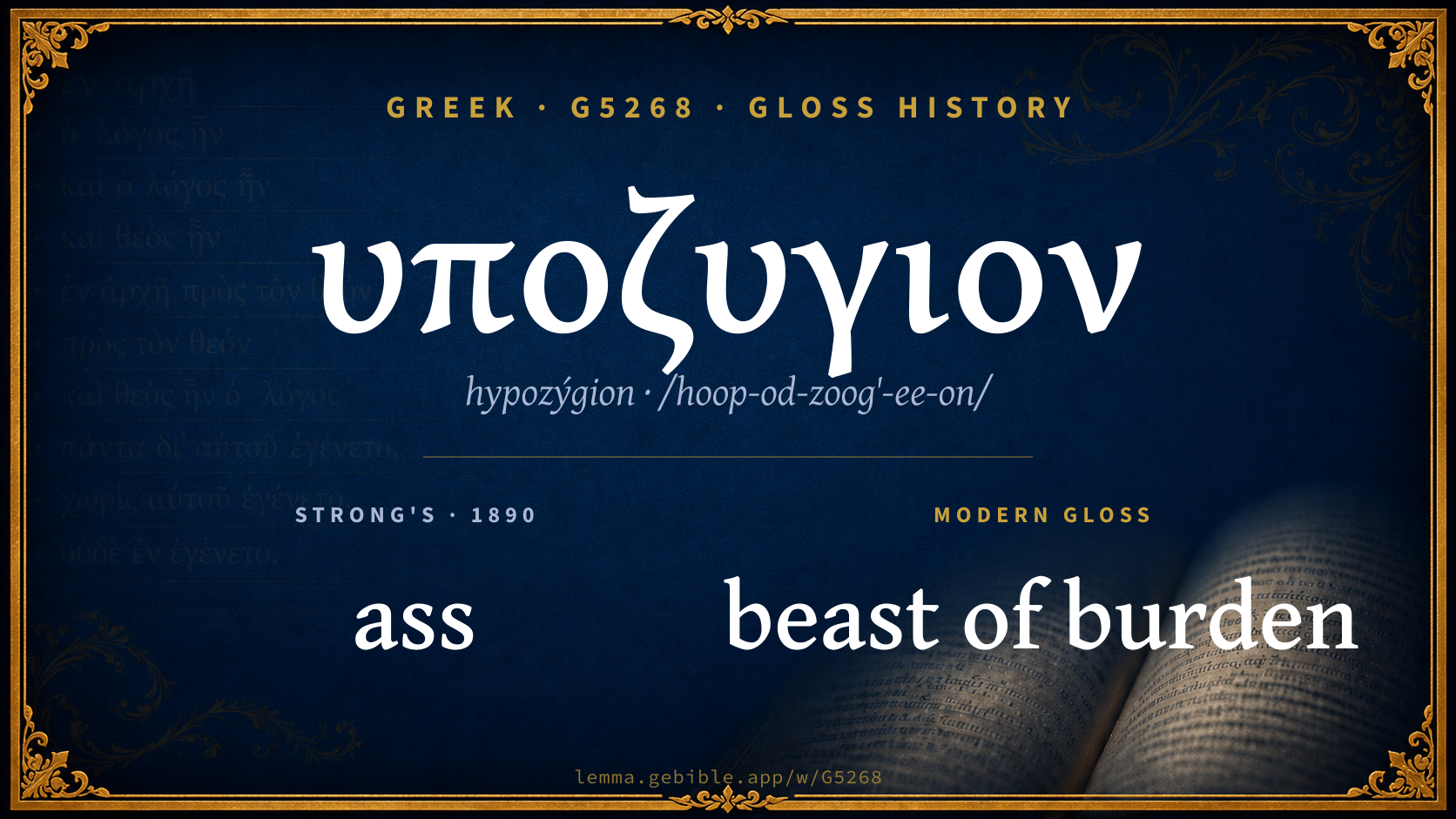
Gloss history
Strong's 1890 vs modern scholarship
About this word
Strong's G5268 catalogs a Greek word from the Greek New Testament.
These counts are not copied from any lexicon or concordance. They are computed here, from the morphology-tagged Greek New Testament. What Lemma adds →
- 2
- distinct verses
- The word appears in 2 distinct verses.
- 2 / 27
- NT books
- The word appears in 2 of 27 New Testament books.
- #2,678
- by frequency
- Top 5000 most frequent Greek words (rank 2,678 of 5,347 Greek words by occurrence).
View all 2 occurrences in the concordance →
By traditional corpus
Conventional, traditional groupings — biblical authorship is debated, so this is a traditional corpus grouping, not an authorship claim. Some books belong to more than one corpus (Luke is in both the Gospels and the Lukan corpus, and so on), so these shares overlap and need not total 100%. Each figure is a share of the word’s 2 distinct verses.
- Gospels 1 verse · 50%
- General (Catholic) Epistles 1 verse · 50%
How translations render this word
Counts come from each version’s own published word-to-Strong’s tagging or interlinear alignment — an approximate guide to how each version renders this word, not a word-level alignment the data otherwise carries. Because each total is that version’s own tagged count, the per-version totals vary from one another and need not match the appearance or distinct-verse counts above. These counts may also differ from a printed concordance because Lemma counts each distinctly tagged rendering and does not collapse phrase taggings into a single head-word total. This is a fixed set of word-tagged versions (KJV, ASV, BSB, ULT) and does not change with the reading translation you choose elsewhere. Each version’s license is shown beside its name below (and on Sources).
- King James Version: Ass 2×
- American Standard Version: Ass 2×
- Berean Standard Bible: Donkey 2×
- unfoldingWord Literal Text: A 1×, Beast of burden 1×, Donkey 1×
King James Version Public Domain
Renders G5268 across 2 tagged occurrences — most commonly:
American Standard Version Public Domain
Renders G5268 across 2 tagged occurrences — most commonly:
Berean Standard Bible Public Domain
Renders G5268 across 2 tagged occurrences — most commonly:
unfoldingWord Literal Text CC BY-SA 4.0
Renders G5268 across 3 tagged occurrences — most commonly:
Senses in Thayer's
The 2 senses Thayer's distinguishes for this word, in lexicon order (not ranked by frequency or importance). The full entry — with sub-senses — is in the Lexicon Entry tab.
- under the yoke
- a beast of burden, an ass
Word origin
Derived from υπο (hypó) (G5259) — under.
Forms in the corpus
The 2 distinct written forms G5268 takes in the Greek New Testament, most frequent first — each parse links to that case’s occurrences in the concordance.
| Form | Parsing | Example | Uses |
|---|---|---|---|
| ὑποζυγίου hypozygíou | Noun, Genitive, Singular, Neuter | Matthew 21:5 | 1 |
| ὑποζύγιον hypozýgion | Noun, Nominative, Singular, Neuter | 2 Peter 2:16 | 1 |
Same root — word family
Other Thayer's entries built from the same root as G5268, grouped by Strong’s listed origin. These share a root / origin per the lexicon — not necessarily a shared meaning. Each links to that word’s own entry.
Derives from
Shares the same root
- υπαγω hypágō G5217 to depart
- υπακουω hypakoúō G5219 to listen
- υπανδρος hýpandros G5220 under (married)
- υπανταω hypantáō G5221 to meet
- υπαρχω hypárchō G5225 to be at hand
- υπεικω hypeíkō G5226 to yield
- υπεναντιος hypenantíos G5227 adversary
- υπεχω hypéchō G5254 to sustain
- υπηρετης hypērétēs G5257 servant
- υπνος hýpnos G5258 sleep
- υποβαλλω hypobállō G5260 to instigate
- υπογραμμος hypogrammós G5261 example
- υποδεικνυμι hypodeíknymi G5263 to demonstrate
- υποδεχομαι hypodéchomai G5264 to welcome
- υποδεω hypodéō G5265 to bind on
- υποδικος hypódikos G5267 debtor
- υποζωννυμι hypozṓnnymi G5269 to undergird
- υποκατω hypokátō G5270 underneath
- υποκρινομαι hypokrínomai G5271 to pretend
- υπολαμβανω hypolambánō G5274 to welcome
- υποληνιον hypolḗnion G5276 wine pit
- υπομενω hypoménō G5278 to endure
- υπομιμνησκω hypomimnḗskō G5279 to remind
- υπονοεω hyponoéō G5282 to suppose
+15 more words share this root (not shown).
Compare all same-root words → Showing 4 of 41 — not the complete family. They share a root, not necessarily a meaning.
Septuagint usage
The same Greek word υποζυγιον appears 21 times in the Greek Old Testament (Septuagint), across 21 verses in 9 books.
- 21
- LXX occurrences
- Tagged occurrences of this Greek word in the Septuagint.
- 21
- verses
- Distinct Septuagint verses containing this word.
- 9 / 39
- OT books
- The word appears in 9 of the 39 Old Testament books.
Sample Septuagint occurrences
- Genesis 36:24 ὑποζύγιον
- Exodus 4:20 ὑποζύγιον
- Deuteronomy 5:14 ὑποζύγιον
- Joshua 6:21 ὑποζύγιον
- Judges 1:14 ὑποζύγιον
- 2 Samuel 16:2 ὑποζύγιον
- 2 Chronicles 28:15 ὑποζύγιον
- Job 24:3 ὑποζύγιον
- Zechariah 9:9 ὑποζύγιον
Septuagint occurrences (same lexeme)
Every verse where the same Strong’s number (G5268) appears in the Greek Septuagint. Verse text shown in the World English Bible for context; the Greek form is the matched word — the English is not keyword-highlighted.
- Genesis 36:24 ὑποζύγιον These are the children of Zibeon: Aiah and Anah. This is Anah who found the hot springs in the wilderness, as he fed the donkeys of Zibeon his father.
- Exodus 4:20 ὑποζύγιον Moses took his wife and his sons, and set them on a donkey, and he returned to the land of Egypt. Moses took God's rod in his hand.
- Exodus 9:3 ὑποζύγιον behold, the hand of Yahweh is on your cattle which are in the field, on the horses, on the donkeys, on the camels, on the herds, and on the flocks with a very grievous pestilence.
- Exodus 20:10 ὑποζύγιον but the seventh day is a Sabbath to Yahweh your God. You shall not do any work in it, you, nor your son, nor your daughter, your man-servant, nor your maid-servant, nor your cattle, nor your stranger who is within your gates;
- Exodus 20:17 ὑποζύγιον "You shall not covet your neighbor's house. You shall not covet your neighbor's wife, nor his man-servant, nor his maid-servant, nor his ox, nor his donkey, nor anything that is your neighbor's."
- Exodus 22:8 ὑποζύγιον If the thief isn't found, then the master of the house shall come near to God, to find out if he hasn't put his hand to his neighbor's goods.
- Exodus 22:9 ὑποζύγιον For every matter of trespass, whether it be for ox, for donkey, for sheep, for clothing, or for any kind of lost thing, about which one says, 'This is mine,' the cause of both parties shall come before God. He whom God condemns shall pay double to his neighbor.
- Exodus 22:29 ὑποζύγιον "You shall not delay to offer from your harvest and from the outflow of your presses. "You shall give the firstborn of your sons to me.
- Exodus 23:4 ὑποζύγιον "If you meet your enemy's ox or his donkey going astray, you shall surely bring it back to him again.
- Exodus 23:5 ὑποζύγιον If you see the donkey of him who hates you fallen down under his burden, don't leave him, you shall surely help him with it.
- Exodus 23:12 ὑποζύγιον "Six days you shall do your work, and on the seventh day you shall rest, that your ox and your donkey may have rest, and the son of your handmaid, and the alien may be refreshed.
- Exodus 34:20 ὑποζύγιον The firstborn of a donkey you shall redeem with a lamb: and if you will not redeem it, then you shall break its neck. All the firstborn of your sons you shall redeem. No one shall appear before me empty.
- Deuteronomy 5:14 ὑποζύγιον but the seventh day is a Sabbath to Yahweh your God: [in it] you shall not do any work, you, nor your son, nor your daughter, nor your man-servant, nor your maid-servant, nor your ox, nor your donkey, nor any of your cattle, nor your stranger who is within your gates; that your man-servant and your maid-servant may rest as well as you.
- Deuteronomy 5:21 ὑποζύγιον "Neither shall you covet your neighbor's wife; neither shall you desire your neighbor's house, his field, or his man-servant, or his maid-servant, his ox, or his donkey, or anything that is your neighbor's."
- Joshua 6:21 ὑποζύγιον They utterly destroyed all that was in the city, both man and woman, both young and old, and ox, and sheep, and donkey, with the edge of the sword.
- Joshua 7:24 ὑποζύγιον Joshua, and all Israel with him, took Achan the son of Zerah, and the silver, and the mantle, and the wedge of gold, and his sons, and his daughters, and his oxen, and his donkeys, and his sheep, and his tent, and all that he had: and they brought them up to the valley of Achor.
- Judges 1:14 ὑποζύγιον It happened, when she came [to him], that she moved him to ask of her father a field: and she alighted from off her donkey; and Caleb said to her, What would you?
- 2 Samuel 16:2 ὑποζύγιον The king said to Ziba, What do you mean by these? Ziba said, The donkeys are for the king's household to ride on; and the bread and summer fruit for the young men to eat; and the wine, that such as are faint in the wilderness may drink.
- 2 Chronicles 28:15 ὑποζύγιον The men who have been mentioned by name rose up, and took the captives, and with the spoil clothed all who were naked among them, and arrayed them, and shod them, and gave them to eat and to drink, and anointed them, and carried all the feeble of them on donkeys, and brought them to Jericho, the city of palm trees, to their brothers: then they returned to Samaria.
- Job 24:3 ὑποζύγιον They drive away the donkey of the fatherless, And they take the widow's ox for a pledge.
- Zechariah 9:9 ὑποζύγιον Rejoice greatly, daughter of Zion! Shout, daughter of Jerusalem! Behold, your king comes to you! He is righteous, and having salvation; Lowly, and riding on a donkey, Even on a colt, the foal of a donkey.
These are occurrences of the same Greek lexeme (G5268) in the Septuagint — not a translation of any one Hebrew word. The store carries no word-level Hebrew↔Greek alignment, so no Hebrew original is asserted here. Counts come from the recovered LXX Strong's tagging — high-frequency vocabulary is well covered, while rare or late forms may be untagged — so they reflect tagged occurrences and may slightly undercount.