
Joshua 5:12

Hebrew (Westminster Leningrad Codex) Joshua 5:12 appears in the Hebrew Old Testament. The text above is from the Westminster Leningrad Codex. Each word links to its Strong’s number, a concise gloss, and parsing drawn from the Open Scriptures Hebrew Bible morphology. Click any word for its full Brown-Driver-Briggs (BDB) entry.
Download image
Cite this verse

Joshua 5:12 (World English Bible). Public Domain. Lemma interlinear Bible study tool, https://lemma.gebible.app/v/joshua/5/12.

Show BibTeX & RIS
BibTeX
RIS
English Translation
The manna ceased on the next day, after they had eaten of the produce of the land; neither had the children of Israel manna any more; but they ate of the fruit of the land of Canaan that year.
World English Bible · Public Domain
Download a study sheet

One document with this verse’s original text, its word-by-word gloss line, the meaning frame, cross-references with their text, attributed commentary, and full source and license credits — printable, and it pastes into notes with its structure intact.

This verse Autodidact and up

Study sheet (.html) Plain text (.txt)

A passage Seminary Student

Up to 50 verses in one chapter. A passage sheet keeps up to 6 commentary sources and 12 cross-references per verse, in the order this page ranks them, and says so on the sheet whenever that leaves anything out. Ask for a single verse and you get the Autodidact verse sheet above.

Everything on this page stays free to read, with no account — the sheet is a download of what is already on screen, not access to it.

Want to remove ads? Support Godless Engineer
Compare translations 3

The same verse in 3 English versions, stacked beneath the original-language interlinear above. Click any original word for its lexicon entry.

Each is an independent rendering of the whole verse — the interlinear is not word-aligned to these translations.

Highlighted words mark where these versions differ — a whole-verse word diff, not a word-by-word alignment.

  • World English Bible Public Domain
    The manna ceased on the next day, after they had eaten of the produce of the land; neither had the children of Israel manna any more; but they ate of the fruit of the land of Canaan that year.
  • King James Version Public Domain
    And the manna ceased on the morrow after they had eaten of the old corn of the land; neither had the children of Israel manna any more; but they did eat of the fruit of the land of Canaan that year.
  • unfoldingWord Literal Text CC BY-SA 4.0
    And the manna stopped from the morrow of their eating from the yield of the land, and manna was no longer for the sons of Israel. And they ate from the produce of the land of Canaan in that year.

unfoldingWord Literal Text — © unfoldingWord, licensed CC BY-SA 4.0. Word-aligned USFM3 via Door43 (git.door43.org/unfoldingWord/en_ult).

Versions to compare (up to 4)

3 of 4 selected

Show all 18 translations

Every available English version of this verse, each an independent rendering of the whole verse.

  • World English Bible Public Domain
    The manna ceased on the next day, after they had eaten of the produce of the land; neither had the children of Israel manna any more; but they ate of the fruit of the land of Canaan that year.
  • Berean Standard Bible Public Domain
    And the day after they had eaten from the produce of the land, the manna ceased. There was no more manna for the Israelites, so that year they began to eat the crops of the land of Canaan.
  • Majority Standard Bible Public Domain
    And the day after they had eaten from the produce of the land, the manna ceased. There was no more manna for the Israelites, so that year they began to eat the crops of the land of Canaan.
  • King James Version Public Domain
    And the manna ceased on the morrow after they had eaten of the old corn of the land; neither had the children of Israel manna any more; but they did eat of the fruit of the land of Canaan that year.
  • American Standard Version (1901) Public Domain
    And the manna ceased on the morrow, after they had eaten of the produce of the land; neither had the children of Israel manna any more; but they did eat of the fruit of the land of Canaan that year.
  • Revised Version (1885) Public Domain
    And the manna ceased on the morrow, after they had eaten of the old corn of the land; neither had the children of Israel manna any more; but they did eat of the fruit of the land of Canaan that year.
  • Geneva Bible (1599) Public Domain
    And the MAN ceased on the morowe after they had eaten of the corne of the land, neither had the children of Israel MAN any more, but did eate of the fruite of the land of Canaan that yeere.
  • Douay-Rheims (1899) Public Domain
    And the manna ceased after they ate of the corn of the land, neither did the children of Israel use that food any more, but they ate of the corn of the present year of the land of Chanaan.
  • Young's Literal Translation Public Domain
    and the manna doth cease on the morrow in their eating of the old corn of the land, and there hath been no more manna to the sons of Israel, and they eat of the increase of the land of Canaan in that year.
  • Literal Standard Version CC BY-SA 4.0
    and the manna ceases on the next day in their eating of the old grain of the land, and there has been no more manna for [the] sons of Israel, and they eat of the increase of the land of Canaan in that year.
  • Unlocked Literal Bible CC BY-SA 4.0
    The manna stopped on the day after they ate the produce of the land. There was no longer manna for the people of Israel, but they ate the produce of the land of Canaan that year.
  • unfoldingWord Literal Text CC BY-SA 4.0
    And the manna stopped from the morrow of their eating from the yield of the land, and manna was no longer for the sons of Israel. And they ate from the produce of the land of Canaan in that year.
  • Darby Bible Public Domain
    And the manna ceased on the morrow, when they had eaten of the old corn of the land; and there was no more manna for the children of Israel; and they ate of the produce of the land of Canaan that year.
  • World Messianic Bible Public Domain
    The manna ceased on the next day, after they had eaten of the produce of the land. The children of Israel didn’t have manna any more, but they ate of the fruit of the land of Canaan that year.
  • Webster's Bible Public Domain
    And the manna ceased on the morrow after they had eaten of the old corn of the land; neither had the children of Israel manna any more; but they ate of the fruit of the land of Canaan that year.
  • Free Bible Version CC BY-SA 4.0
    On the same day when they began eating produce from the land there was no more manna. No longer did the Israelites have manna; after that they ate the produce of the land of Canaan.
  • Bible in Basic English Public Domain
    And there was no more manna from the day after they had for their food the produce of the land; the children of Israel had manna no longer, but that year the produce of the land of Canaan was their food.
  • JPS Tanakh (1917) Public Domain
    And the manna ceased on the morrow, after they had eaten of the produce of the land; neither had the children of Israel manna any more; but they did eat of the fruit of the land of Canaan that year.

Literal Standard Version (2020), Covenant Press — licensed CC BY-SA 4.0. Text via the HelloAO Bible API (eBible.org). Unlocked Literal Bible (unfoldingWord) — licensed CC BY-SA 4.0. Text via the HelloAO Bible API (eBible.org). unfoldingWord Literal Text — © unfoldingWord, licensed CC BY-SA 4.0. Word-aligned USFM3 via Door43 (git.door43.org/unfoldingWord/en_ult). Free Bible Version, Dr. Jonathan Gallagher — licensed CC BY-SA 4.0. Text via the HelloAO Bible API (eBible.org).

Word by word

More ways to search: Search by grammar → Find every occurrence → Compare this word →

Practice this passage: Drill this verse → Learn its vocabulary →

מֵעֲב֣וּר
ʻâbûwr
H5669
“from · produce of”
Preposition + Noun, Common, Masculine, Singular, Construct
Part of Speech
Preposition + Noun
Type
Common
Gender
Masculine
Number
Singular
State
Construct
Full BDB Definition

Origin: the same as H5668

TWOT: 1556f

produce, yield
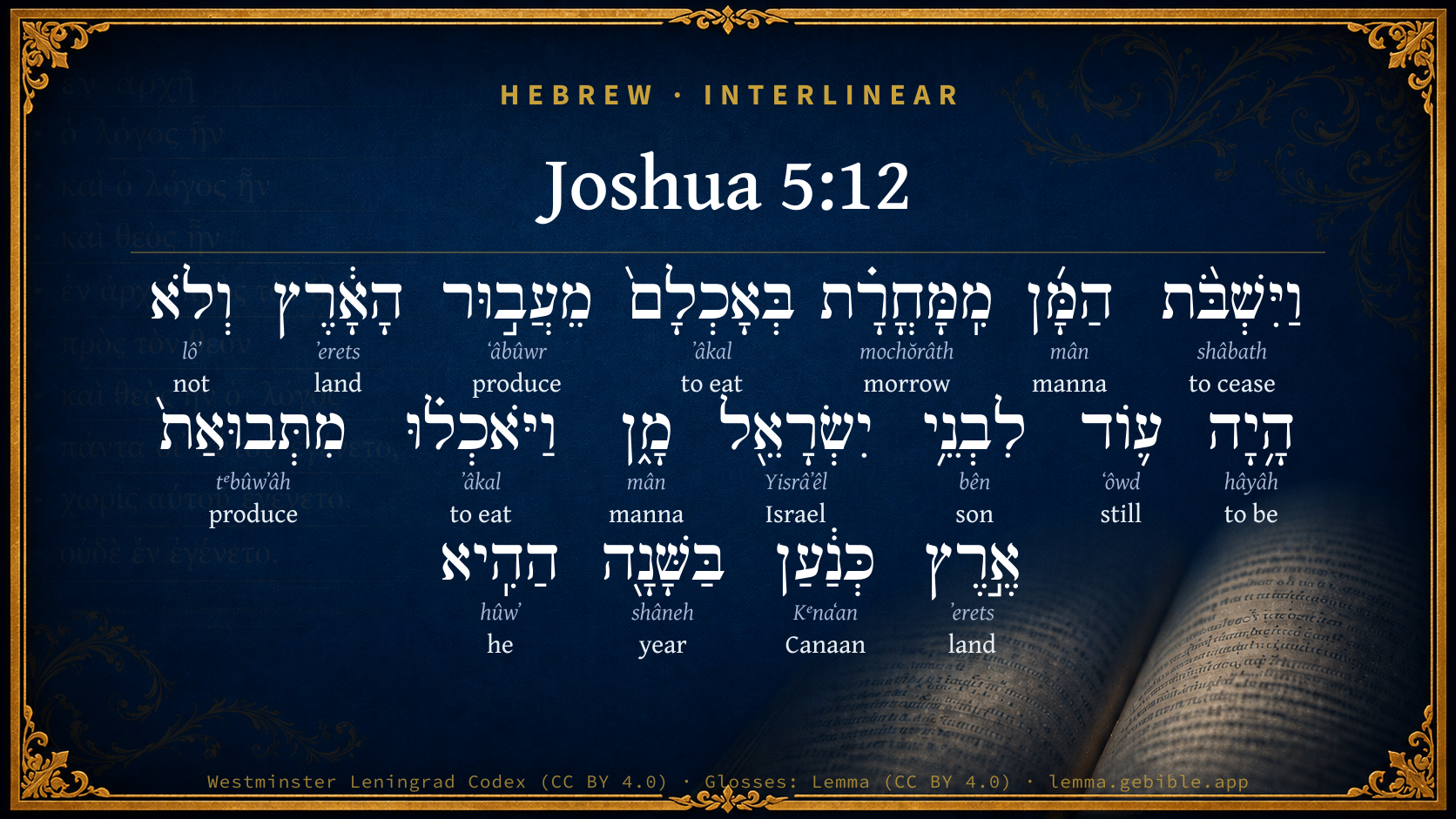
  1. וַיִּשְׁבֹּ֨ת shâbath H7673 “and · to cease” Conjunction + Verb, Qal, Sequential Imperfect, 3rd Person, Masculine, Singular
  2. הַמָּ֜ן mân H4478 “the · manna” Particle, Definite Article + Noun, Common, Masculine, Singular, Absolute
  3. מִֽמָּחֳרָ֗ת mochŏrâth H4283 “from · morrow” Preposition + Noun, Common, Feminine, Singular, Absolute
  4. בְּאָכְלָם֙ ʼâkal H398 “in/at · to eat · them” Preposition + Verb, Qal, Infinitive Construct + Suffix, Personal, 3rd Person, Masculine, Plural
  5. הָאָ֔רֶץ ʼerets H776 “the · land” Particle, Definite Article + Noun, Common, Both, Singular, Absolute
  6. וְלֹא lôʼ H3808 “and · not” Conjunction + Particle, Negative
  7. הָ֥יָה hâyâh H1961 “to be” Verb, Qal, Perfect, 3rd Person, Masculine, Singular
  8. ע֛וֹד ʻôwd H5750 “still” Adverb
  9. לִבְנֵ֥י bên H1121 “to/for · sons of” Preposition + Noun, Common, Masculine, Plural, Construct
  10. יִשְׂרָאֵ֖ל Yisrâʼêl H3478 “Israel” Noun, Proper
  11. מָ֑ן mân H4478 “manna” Noun, Common, Masculine, Singular, Absolute
  12. וַיֹּאכְל֗וּ ʼâkal H398 “and · to eat” Conjunction + Verb, Qal, Sequential Imperfect, 3rd Person, Masculine, Plural
  13. מִתְּבוּאַת֙ tᵉbûwʼâh H8393 “from · produce of” Preposition + Noun, Common, Feminine, Singular, Construct
  14. אֶ֣רֶץ ʼerets H776 “land of” Noun, Common, Both, Singular, Construct
  15. כְּנַ֔עַן Kᵉnaʻan H3667 “Canaan” Noun, Proper
  16. בַּשָּׁנָ֖ה shâneh H8141 “in/at the · year” Preposition, Determined + Noun, Common, Feminine, Singular, Absolute
  17. הַהִֽיא hûwʼ H1931 “the · he” Particle, Definite Article + Pronoun, Personal, 3rd Person, Feminine, Singular

About this verse

These counts appear in no published source. They are computed here, from the morphology-tagged text and Lemma’s own curated glosses. What Lemma adds →

18
words
15
distinct lemmas
Historical
section

Notable vocabulary

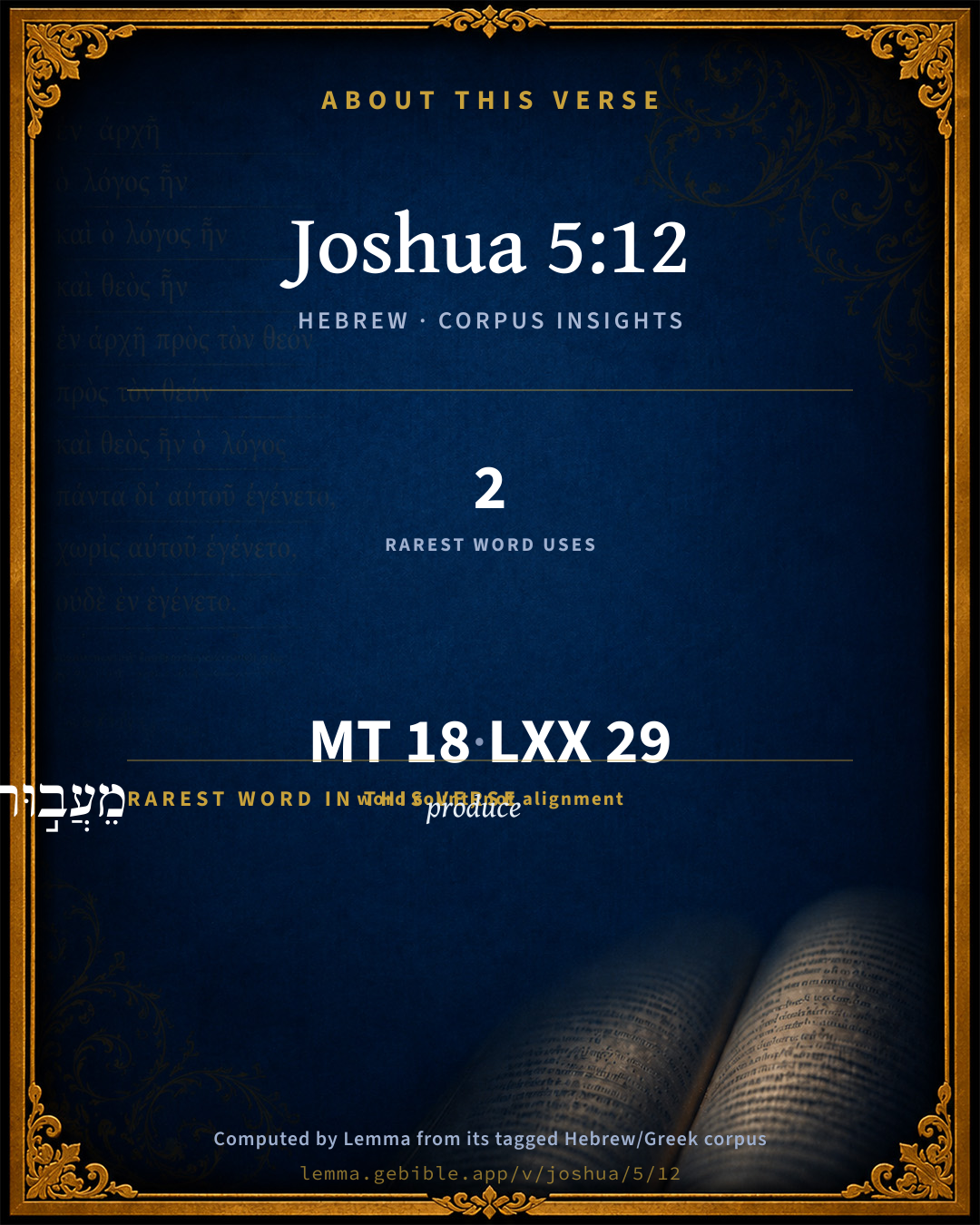
The rarest word here is מֵעֲב֣וּר produce H5669 — appearing just 2 times in the whole Hebrew Bible.

Shared distinctive vocabulary

מֵעֲב֣וּר produce H5669 occurs in 2 verses of the Hebrew Bible. Also found in:

Grammatical profile

  • 4 verbs
  • 11 nouns
  • 1 pronoun
  • 1 adverb
  • 1 particle

Verb forms

  • וַיִּשְׁבֹּ֨ת Qal · Sequential Imperfect
  • בְּאָכְלָם֙ Qal · Infinitive Construct
  • הָ֥יָה Qal · Perfect
  • וַיֹּאכְל֗וּ Qal · Sequential Imperfect

Repetition

Words recur within this verse — often emphatic in Hebrew:

  • הַמָּ֜ן manna H4478 ×2
  • בְּאָכְלָם֙ to eat H398 ×2
  • הָאָ֔רֶץ land H776 ×2

Hebrew & Septuagint length

In English translation the verse runs 39 words from the Hebrew and 39 from the Septuagint (LXX English) — the same length.

A rough comparison of the two English renderings, which tokenize alike — not a word-level alignment.

Word counts can differ between the Hebrew and the Greek without any difference in meaning — e.g. the Hebrew direct-object marker אֵת has no separate Greek word, and Greek often adds the article ὁ.

In the original languages it is 18 Hebrew tokens and 29 Greek tokens — but the two are counted differently (Hebrew bundles its prefixes and suffixes into one token; the Greek is in lemma form), so that isn’t a like-for-like length.

Cross-references

7

Topical passages linked to Joshua 5:12 in the Treasury of Scripture Knowledge — connected by theme and wording, ordered by reader-vote popularity; previews shown in the World English Bible.

  • Exodus 16:35 The children of Israel ate the manna forty years, until they came to an inhabited land. They ate the manna until they came to the borders of the land of Canaan.
  • Deuteronomy 6:10–11 It shall be, when Yahweh your God shall bring you into the land which he swore to your fathers, to Abraham, to Isaac, and to Jacob, to give you, great and goodly cities, which you didn't build,
  • Nehemiah 9:20–21 You gave also your good Spirit to instruct them, and didn't withhold your manna from their mouth, and gave them water for their thirst.
  • Proverbs 13:22 A good man leaves an inheritance to his children's children, But the wealth of the sinner is stored for the righteous.
  • Isaiah 65:13–14 Therefore thus says the Lord Yahweh, Behold, my servants shall eat, but you shall be hungry; behold, my servants shall drink, but you shall be thirsty; behold, my servants shall rejoice, but you shall be disappointed;
  • Revelation 7:16–17 They will never be hungry, neither thirsty any more; neither will the sun beat on them, nor any heat;
  • John 4:38 I sent you to reap that for which you haven't labored. Others have labored, and you have entered into their labor."

Cross-references courtesy of OpenBible.info (CC BY 4.0).

Hebrew and Greek witnesses Masoretic Hebrew ↔ Greek Septuagint

The same verse in the two great witnesses to the Old Testament, shown verse-for-verse.

These are two independent witnesses, not word-aligned to each other, and the Septuagint is shown in lemma (dictionary) form.

Hebrew Joshua 5:12 Masoretic · Westminster Leningrad Codex

וַיִּשְׁבֹּ֨ת הַמָּ֜ן מִֽמָּחֳרָ֗ת בְּאָכְלָם֙ מֵעֲב֣וּר הָאָ֔רֶץ וְלֹא הָ֥יָה ע֛וֹד לִבְנֵ֥י יִשְׂרָאֵ֖ל מָ֑ן וַיֹּאכְל֗וּ מִתְּבוּאַת֙ אֶ֣רֶץ כְּנַ֔עַן בַּשָּׁנָ֖ה הַהִֽיא

The manna ceased on the next day, after they had eaten of the produce of the land; neither had the children of Israel manna any more; but they ate of the fruit of the land of Canaan that year.

World English Bible · Public Domain

Greek LXX Joshua 5:12 Septuagint · lemma form

ἐκλείπω ὁ μαννα μετά ὁ βιβρώσκω αὐτός ἐκ ὁ σῖτος ὁ γῆ καί οὐκέτι ὑποἄρχω ὁ υἱός ἰσραήλ μαννα καρπίζομαι δέ ὁ χώρα ὁ φοινίκη ἐν ὁ ἐνιαυτός ἐκεῖνος

In this day the manna failed, after they had eaten of the corn of the land, and the children of Israel no longer had manna: and they took the fruits of the land of the Phoenicians in that year.

LXX2012 (modern English Septuagint) · Public Domain

On this verse, Haydock's Catholic Bible Commentary discusses the Septuagint’s reading. Read the note in Commentary ↓

Hebrew: Westminster Leningrad Codex (CC BY 4.0). Greek: Septuagint (public domain); English from LXX2012 (modern English Septuagint) (Public Domain). How the Septuagint differs from the Hebrew →

Targum (Aramaic paraphrase)

1

The Targum is the ancient Jewish Aramaic paraphrase of the Hebrew Scriptures — an interpretive translation, not the Hebrew text itself. Onkelos (literal) and Pseudo-Jonathan (expansive) render the Torah, and Jonathan the Prophets. Coverage is partial: where no permissively-licensed English translation exists for a verse, only the Aramaic is shown. This is verse-level text, not a word-by-word alignment to the Hebrew.

  1. Targum Jonathan Prophets (Joshua–Malachi)
    וּפְסַק מַנָא מִיוֹמָא דְבַתְרוֹהִי בְּמֵיכַלְהוֹן מֵעִיבּוּרָא דְאַרְעָא וְלָא הֲוָה עוֹד לִבְנֵי יִשְׂרָאֵל מַנָא וַאֲכַלוּ מֵעֲלְלַת אַרְעָא דִכְנַעַן בְּשַׁתָּא הַהִיא:

    (no public-domain English translation for this verse)

    Targum Jonathan — Aramaic: “Mikraot Gedolot” (public domain). English: “Sefaria Community Translation” (CC0 1.0 (public-domain dedication)); “London "Chaldee Paraphrase," 1871” (public domain). Text via Sefaria.

Commentary

Notes on Joshua 5:12 from classic Christian and Jewish commentators (each source and its license shown beneath its notes). The classic Christian expositions comment on the surrounding passage and are grouped to its opening verse, so a note may address several verses; the Jewish commentaries on the Tanakh (Rashi and others) are per-verse, so they appear only where the commentator wrote on this verse.

Lemma curates 59 commentaries, every one of them public domain or Creative Commons licensed, each selected and text-cleaned for this edition rather than reprinted as found. About our sources →

Trapp's Complete Commentary

John Trapp

Jos 5:12 And the manna ceased on the morrow after they had eaten of the old corn of the land; neither had the children of Israel manna any more; but they did eat of the fruit of the land of Canaan that year.

Ver. 12. And the manna ceased.] So do miracles where are store of other means. He that now calleth for miracles, is himself a miracle, saith Augustine.

John Trapp, A Commentary or Exposition upon All the Books of the Old and New Testament (1647–1656) — public domain. Text from a community e-Sword module.

Joseph Benson's Commentary

Jos 5:12. The manna ceased — Which God now withheld, to show that manna was not an ordinary production of nature, but an extraordinary and special gift of God to supply their necessity: and because God would not be prodigal of his favours, by working miracles where ordinary means were sufficient. The morrow — That is, on the seventeenth day. It cannot be too much taken notice of, as it is a great mark of the authenticity of the Holy Scriptures, that the miracles related therein are not a heap of wonderful stories, which have nothing to recommend them but the strangeness of them, like most of those contained in the Koran, but that they are acts of consummate wisdom, as well as of wonder. Here we see, that as soon as the Israelites came into a country where they could obtain a sufficient supply of food in the ordinary way, that miraculous provision which had been made for them in the desert wilderness, where it was absolutely necessary for their subsistence, ceased. So that it is evident the falling of the manna from heaven was not merely or chiefly a strange thing to be wondered at, but an act of great wisdom and goodness, which the circumstances of things absolutely required.

Joseph Benson's Commentary on the Old and New Testaments (1811–1818) — public domain. Text from a community e-Sword module.

Tyndale Open Study Notes

Tyndale Open Resources

5:12 Israel harvested the crops that the people of Jericho did not have time to harvest before Israel crossed the Jordan.

Tyndale Open Study Notes — © Tyndale Open Resources, licensed CC BY-SA 4.0. Text via the HelloAO Bible API.

Adam Clarke's Commentary

Verse 12. And the manna ceased - after they had eaten of the old corn] This miraculous supply continued with them as long as they needed it. While they were in the wilderness they required such a provision; nor could such a multitude, in such a place, be supported without a miracle. Now they are got into the promised land, the anathematized inhabitants of which either fall or flee before them, they find an old stock, and they are brought in just at the commencement of the harvest; hence, as there is an ample provision made in the ordinary way of Providence, there is no longer any need of a miraculous supply; therefore the manna ceased which they had enjoyed for forty years. The circumstances in which it was first given, its continuance with them through all their peregrinations in the wilderness, its accompanying them over Jordan, and ceasing as soon as they got a supply in the ordinary way of Providence, all prove that it was a preternatural gift.

"On the fourteenth of Nisan they sacrificed the paschal lamb: on the fifteenth, i.e., according to our calculation, the same day after sunset, they disposed themselves for eating it, and actually did eat it. On the morrow, the sixteenth, after having offered to God the homer, they began eating the corn of the country; and the seventeenth, the manna ceased to fall from heaven. What supports this calculation is, that the homer or sheaf was offered the sixteenth of Nisan, in broad daylight, though pretty late. Now the manna did not fall till night, or very early in the morning; so that it cannot be said to have ceased falling the same day that the Israelites began to eat of the produce of the country." - Dodd.

Adam Clarke's Commentary on the Bible (1810–1826) — public domain. Text from a community e-Sword/MySword module.

Ellicott's Commentary for English Readers

(12) The manna ceased on the morrow after they had eaten of the old corn of the land.—The date should be noticed. On the fourteenth day was the Passover; on the fifteenth, Israel ate of the produce of the land. From that day the manna fell no more—i.e., on the sixteenth day of the first month of the year of their entering the land of Canaan, it was not found. On the sixteenth day of the second month of the first year of the Exodus, it first appeared (Exo_16:1; Exo_16:7; Exo_16:13-14). Thirty-nine years and eleven months it fell, except on the Sabbath. It kept Sabbath all through the wilderness, on the seventh day of the week, and it finally ceased, kept Sabbath (vay-yishboth, Hebrew) on the very day afterwards marked by our Lord’s resurrection, which became the Lord’s day. The coincidence is too remarkable to be overlooked. It is the risen Christ who takes the place of the manna; and in the discourse wherein He calls Himself “the true bread from heaven,” He points again and again to resurrection as the end of the life which He gives: “I will raise him up at the last day” (Joh_6:39-40; Joh_6:44; Joh_6:54). Then the manna, which is the food of the wilderness, shall keep Sabbath, for “they shall hunger no more.” The food of the wilderness is that which Israel ate, not knowing what it was. Of the other world it is written, “then shall I know, even as also I am known.”

A Bible Commentary for English Readers, edited by Charles John Ellicott (1878–1897) — public domain. Text from a community e-Sword module.

The Cambridge Bible for Schools and Colleges

gen. ed. J. J. S. Perowne

12. the manna ceased] For the first time since leaving Sinai the Passover cakes were not made of manna, for the people had now arrived in Canaan, and no longer needed this “Bread of the Wilderness.” Day after day, for forty years, there had appeared “on the face of the wilderness a small round thing, as small as the hoar frost, white, like coriander seed,” the taste of which “was like wafers made with honey” (Exo_16:14-36). Day by day, except on the Sabbath, it had been gathered, and had been found sufficient for their daily wants. Now it suddenly ceased. The people no longer needed this “angels’ food” (Psa_78:25), but “they did eat of the fruit of the land of Canaan.” Comp. Joh_6:31; Joh_6:49; Joh_6:58; Rev_2:17.

The Cambridge Bible for Schools and Colleges (gen. ed. J. J. S. Perowne; Cambridge University Press, 1878–1918) — public domain. Text from a community e-Sword module.

John Gill's Exposition

And the manna ceased on the morrow after they had eaten of the old corn of the land,.... There being now no further need of it; miracles are not wrought or continued when unnecessary; for the ceasing of the manna shows, that it was not a common but an extraordinary provision. The ceasing of the manna, which was a type of Christ, may signify the cessation of Gospel ordinances, in which Christ is held forth as food for his people. These are to continue till all the spiritual Israel of God have passed over the river Jordan, or death, even until the end of the world, and then to cease, Mat 28:19; the eating of the old corn may signify the glories of the future state, the joys and happiness of the heavenly Canaan, prepared for those that love the Lord from the foundation of the world; it may denote those ancient things the saints will feed and live upon to all eternity; the eternal love of the three divine Persons, electing grace, the ancient settlements of grace, the everlasting covenant of grace, and the blessings of it; the glorious Mediator of it, that was set up from everlasting, and the grace given to them in him before the world began:

neither had the children of Israel manna any more; having no more need of it, as the saints in heaven will stand in no more need of Gospel ordinances:

but they did eat of the fruit of the land of Canaan that year; the increase of the land, not only of the fields, but of the vineyards and oliveyards, which they had neither sown nor planted, see Deu 6:10; which may denote the plenty and variety of the joys of heaven, and glories of the future state; the various fruits which grow on Christ, the tree of life, brought forth every month, or continually; all which will be enjoyed through the free grace of God, without the works or merits of men.

John Gill's Exposition of the Whole Bible (1746–1763) — public domain (CC PDM 1.0). Text via the HelloAO Bible API.

Haydock's Catholic Bible Commentary

Land. The Septuagint intimate on the 15th. The Hebrew seems to say the 16th, Nisan, "on the morrow after they had eaten of the (old) corn." (Calmet) --- Grabe’s Septuagint agrees with the Vulgate and Hebrew, and specifies that the Israelites "eat of the corn of the country on the day after the Passover, unleavened and new. On that day, the morrow, manna ceased." All depends on the determination of the first day of the festival. If we date from the eating of the paschal lamb on the 14th, or from the solemn day, which was the 15th, manna must have been withdrawn either on the 15th or 16th of the month; though Salien thinks that it ceased as soon as the Israelites had begun to eat of the fruit of the country, on the eastern side of the Jordan. This miraculous food was withholden as soon as the Israelites entered the land of promise; and so the blessed Eucharist, of which it was a figure, and all the sacraments, will cease, when the Christian people shall have taken possession of their heavenly country. (Haydock)

George Leo Haydock (1774–1849), Haydock's Catholic Family Bible and Commentary, 1859 edition — public domain. Excludes Psalms (Douay-Rheims chapter numbering differs from Protestant) and Deuterocanonical books (Catholic canon only).

Matthew Poole's English Annotations

God now withheld

the manna,

1. To show that it was not an ordinary production of nature, as by the long and constant enjoyment of it they might be prone to think; but an extraordinary and special gift of God to supply their necessity.

2. because God would not be prodigal of his favours, nor expose them to contempt by giving them superfluously, or by working miracles where ordinary means were sufficient.

On the morrow after they had eaten of the old corn, i.e. on the seventeenth day.

Matthew Poole's English Annotations on the Holy Bible (1683–1685) — public domain. Text from a community e-Sword/MySword module.

Whedon's Commentary on the Bible

Daniel D. Whedon

12. Manna — This was always regarded as a miraculous gift directly from God, and not a product of nature. It is described in Exo_16:14-36, where see notes. It fell upon the encampment six times each week during forty years. As each man had an omer — three quarts — a day, there must have been 15,000,000 pounds a week. The natural product of the Arabian deserts, the tamarisk-manna, called by the same name, differs in the following particulars: it is purgative, and not nutritious; it is produced only three or four months, and not all the year; it is found in small quantities; it can be kept good for a long time, and is not corrupted by being kept over the Sabbath; nor would a natural product cease at once and forever. It now ceased because it was no more needed. See Jos_1:11, note.

Daniel D. Whedon (gen. ed.), Commentary on the Old and New Testaments (1874–1909) — public domain. Text from a community e-Sword module.

The Pulpit Commentary

The manna ceased. It ceased when the Israelites entered a cultivated region. The eastern portion of their inheritance, though well suited for pastoral purposes, (see Jos_1:12) was not a land of agricultural produce. Therefore the manna did not cease until the Israelites had crossed the Jordan.

HOMILIES BY S.R. ALDRIDGE Ver. 12. The special and the customary.

This verse is one of the proofs that the supply of manna was miraculous, ceasing as it did at the exact moment when it was no longer needed. Other proofs are, that a double portion fell each Friday, and none on the Sabbath; and that if kept longer than a day it became corrupt and stank, except on the day of rest, when it remained pure and wholesome. Let us look at

I Manna, as A SPECIAL PROVISION FOR A SPECIAL EXIGENCY.

1. The exigency shows us that even under the guidance of God there is no exemption from trial. At first all had seemed easy and comfortable. Passing through the sea as on dry ground, the Israelites soon beheld their late tyrants dead on the seashore. The bitter waters of Marah were sweetened and Elim furnished its wells and palm trees for their refreshment. A month passed. The dough cakes were nearly finished, and provisions began to fail. The murmuring of fear and discontent was heard. Those whom the sea had not devoured quaked lest the hungry wilderness should destroy them. Forgetting the tasks and bondage of Egypt, they remembered only its fleshpots, garlic, onions, and bread, and now they could wish rather to have died in ravenous plenty than live in noble penury. The Almighty will thus prove His people. He does not always conduct them by easy roads, for He values the discipline of their spirits more than the external comfort of their bodies. Faith is to be tested that it may come forth as "gold tried in the fire.

2. The provision assures us that under the leadership of God all real wants will be supplied. The glory of the Lord had appeared in the cloud. Quails feathered fowl were sent in the evening, and in the morning, manna bread from heaven. God would not suffer His people to remain inabsolute need. He would give them the "finest of the wheat," and "honey out of the rock." They should have the bread of angels and the meat of kings. Infinite wisdom and might sit on the throne, and these are engaged for the believer"s support. The light may flicker, it shall not be extinguished; or if ordinary sources of relief raft, other springs shall be discovered. "Your heavenly Father knoweth that ye have need of all these things." The gift by God of His beloved Son to die for the world is the transcendent example of God"s benevolence. Christ is the true Manna, which satisfies the hunger of the soul. Christianity, or the scheme of redemption, is the remedy which Eternal Love has devised to meet the emergency of a sin stricken world hastening to ruin.

II THE CESSATION OF THE MIRACULOUS SUPPLY teaches us

1. Not to expect to be furnished directly from God with what He enables us to procure by our own exertions. Apparently the inhabitants of the land had fled for refuge to Jericho and the neighbouring towns, abandoning to the Israelites the harvest ripening in the fields and the old stores housed in the granaries. The Almighty economises His acts. Extraordinary occurrences are for extraordinary needs. We see in the life of Christ that He would not perform wondrous works merely to gratify inordinate curiosity or to satisfy the demands of unreasonable scepticism. The lesson of realising our responsibilities is important. It will not do to indolently expect the Divine providence and power to supply the lack of human effort. Prayer and work must go together. Not only faith is necessary, but exertion, if the Divine purposes are to be accomplished. If on a specially appointed mission our Father may take care of us as He does of the birds of the air, it is ordinarily our duty to "sow and reap and gather into barns," but without anxiety or corroding care.

2. To be thankful for a return to ordinary ways and means. The Israelites got tired even of "angels" food;" they loathed "this light bread," with all its sweetness. As at present constituted, variety is pleasing to men. Certainly man is not yet fitted for the splendours and employments of the beatific state. Moses and Elijah spent many days on the mount with God, but probably a return to earthly scenes was essential to their continued life. When glorified, man may be able to live entirely on the manna of heaven, the life hidden with Christ in God. In seasons of affliction wondrous revelations are sometimes granted; there is a support given which raises the soul above the surrounding sorrow, causing it to exclaim, "It is good to be here!" Deprived of the usual ordinances and channels of consolation, the Spirit ministers of the things of God, illumines the sacred page, makes the promise of Christ"s presence a fulfilled reality. Nevertheless, it rejoices the Christian to be permitted to resume wonted occupations and to enjoy the customary privileges. To revel for a time in the glorious scenery of the Alps does not diminish the satisfaction with which we behold again the quiet beauty of our much-loved home. As the ceremonies connected with the passover were renewed, the exchange of manna for ordinary corn was at least fitting, if not absolutely necessary.

3. The duty of keeping in remembrance past displays of the might and compassion of God. According to Exo_16:32, a (golden) pot was to be filled with manna and deposited in the ark as a memorial of grace and favour received in the wilderness. Naught more treacherous than the memory. The picture of the past is a dissolving view that grows fainter dally until it disappears from sight. To remember what the Almighty has done is pleasing to Him and beneficial to us. It rebukes ingratitude and faithlessness. Hence the need of erecting our altars, which shall call to mind continually the blessings which have been bestowed.

III THE DIFFERENT FORM WHICH GOD"S INTERPOSITIONS ASSUMED, varying according to the requirements of His people. The following verses narrate the appearance of Jehovah to Joshua, and the instructions given respecting the siege of Jericho. The stoppage of the manna nowise implied the withdrawal of the Divine presence. The tolls of the wilderness were left behind, the dangers of Palestine commenced. Help must be afforded by different means. And the Christian life calls into prominence certain principles at certain crises. Today we want food, tomorrow weapons; today strength, tomorrow guidance; now hope, then charity. We are variously tested; and manifold are the aids of the Divine Spirit; thus a perfect character is cultured. The text speaks to us of the everlasting rest into which we hope to enter. It shall be a Sabbath in which we shall live on the principles which were made ours during the working week, and it shall also be a Canaan where we shall no longer need the food of the wilderness. Faith, as trustful love, shall survive forever, whilst faith, as believing hope, shall vanish in glorious sight and full fruition. What a Passover shall that be when the Supper of the Lamb is celebrated! The intermediary dispensation shall terminate. "Then cometh the end, when he shall have delivered up the kingdom to God, even the Father." Can we anticipate with joy the renouncing of the life on earth for a life beyond the grave? "He that eateth me," said Christ, "shall live forever. "To him that overcometh will I give to eat of the hidden manna.. A.

The Pulpit Commentary (1880–1919), ed. H.D.M. Spence-Jones & Joseph S. Exell — public domain. Text from a community e-Sword module.

John Wesley's Explanatory Notes

The manna ceased - Which God now withheld, to shew that Manna was not an ordinary production of nature, but an extraordinary and special gift of God to supply their necessity. And because God would not be prodigal of his favours, by working miracles where ordinary means were sufficient. The morrow - That is, on the seventeenth day.

John Wesley, Explanatory Notes Upon the Whole Bible (1754–1765) — public domain. Text via the GEBible commentary corpus.

unfoldingWord translationNotes

Door43 World Missions Community

translationWords

manna

Israel

Canaan

unfoldingWord translationNotes — © Distant Shores Media and the Door43 World Missions Community, licensed CC BY-SA 4.0. Source: git.door43.org/Door43/en_tn.

Rashi

Rabbi Shlomo Yitzchaki (Rashi)

No longer did the Bnei Yisroel have manna. Therefore they ate of the grain of the land. If they would have had manna they would not have eaten of the grain, for the manna was agreeable to them. There is a parable for this: One says to a child, “Why are you eating barley bread?” “Because I have no wheat bread.” That is why it is said, ‘no longer did etc.’

Rashi on the Tanakh — English translations: “The Judaica Press complete Tanach with Rashi, translated by A. J. Rosenberg” (CC BY 4.0); “Pentateuch with Rashi's commentary by M. Rosenbaum and A.M. Silbermann, 1929-1934” (public domain); “The Metsudah Tanach series, Lakewood, N.J” (CC BY 4.0); and “The Book of Joshua, Metsudah Publications, 1997” (CC BY 4.0). Text via Sefaria.

Lesson kit

Teaching starters — assembled from the data on this page, not authored interpretation. Every prompt links to the verse data it draws on. Edit before teaching.

Joshua, in the Historical, opens this verse with 18 words (15 distinct Hebrew lemmas). Its most distinctive word is ʻâbûwr (“produce”). A historical commentator’s framing appears above. Read the whole chapter for the surrounding context.

Discussion questions

  1. The word ʻâbûwr carries the sense “produce.” How does it shape the verse?
  2. Joshua 5:11 shares the word «produce» with this verse. How do the two illuminate each other?
  3. “manna” occurs 2× in this one verse. What is the effect of the repetition?
  4. These translations render this verse differently; the difference is in the English rendering, not the original. What questions does that raise?
  5. The verb «וַיִּשְׁבֹּ֨ת» is Qal Sequential Imperfect. How does its form color the action?
  6. Reading how Trapp's Complete Commentary and Joseph Benson's Commentary read this verse, where do the two commentators agree and where do they part?

Things to notice

Reading settings

Reading text

Shown beneath each verse's original-language words.

Old Testament
Old Testament edition

Read the OT as the Masoretic Hebrew (MT) or the Greek Septuagint (LXX).

English shown for the Greek Septuagint (in the Hebrew ↔ Greek comparison).

Comparing translations? Open the Compare panel on any verse page to stack up to four side by side.