
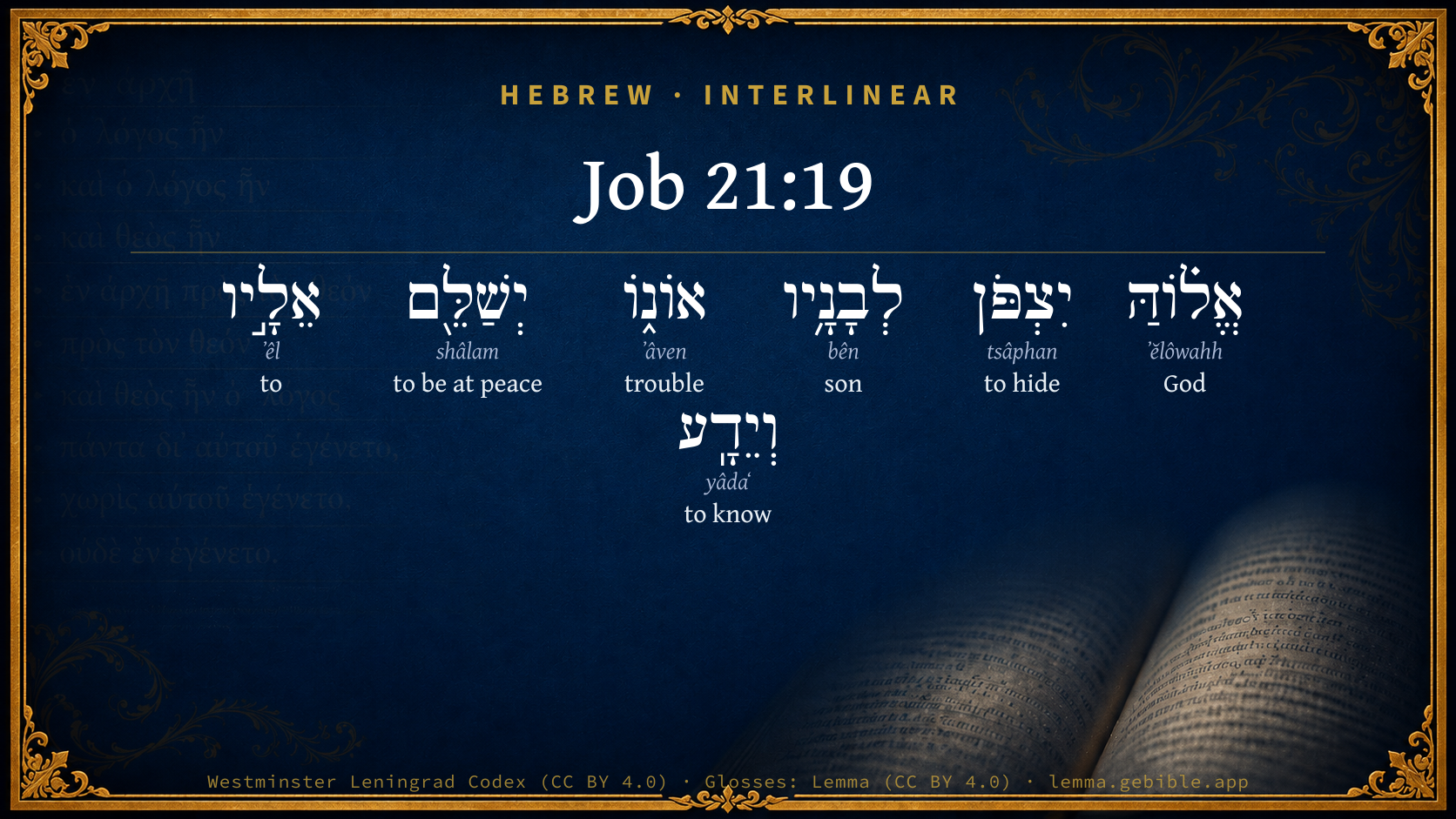
Job 21:19

Hebrew (Westminster Leningrad Codex) Job 21:19 appears in the Hebrew Old Testament. The text above is from the Westminster Leningrad Codex. Each word links to its Strong’s number, a concise gloss, and parsing drawn from the Open Scriptures Hebrew Bible morphology. Click any word for its full Brown-Driver-Briggs (BDB) entry.
Download image
Cite this verse

Job 21:19 (World English Bible). Public Domain. Lemma interlinear Bible study tool, https://lemma.gebible.app/v/job/21/19.

Show BibTeX & RIS
BibTeX
RIS
English Translation
You say, 'God lays up his iniquity for his children.' Let him recompense it to himself, that he may know it.
World English Bible · Public Domain
Download a study sheet

One document with this verse’s original text, its word-by-word gloss line, the meaning frame, cross-references with their text, attributed commentary, and full source and license credits — printable, and it pastes into notes with its structure intact.

This verse Autodidact and up

Study sheet (.html) Plain text (.txt)

A passage Seminary Student

Up to 50 verses in one chapter. A passage sheet keeps up to 6 commentary sources and 12 cross-references per verse, in the order this page ranks them, and says so on the sheet whenever that leaves anything out. Ask for a single verse and you get the Autodidact verse sheet above.

Everything on this page stays free to read, with no account — the sheet is a download of what is already on screen, not access to it.

Want to remove ads? Support Godless Engineer
Compare translations 3

The same verse in 3 English versions, stacked beneath the original-language interlinear above. Click any original word for its lexicon entry.

Each is an independent rendering of the whole verse — the interlinear is not word-aligned to these translations.

Highlighted words mark where these versions differ — a whole-verse word diff, not a word-by-word alignment.

  • World English Bible Public Domain
    You say, 'God lays up his iniquity for his children.' Let him recompense it to himself, that he may know it.
  • King James Version Public Domain
    God layeth up his iniquity for his children: he rewardeth him, and he shall know it.
  • unfoldingWord Literal Text CC BY-SA 4.0
    ‘God lays up his guilt for his sons.’ Let him repay to him, and he will know!

unfoldingWord Literal Text — © unfoldingWord, licensed CC BY-SA 4.0. Word-aligned USFM3 via Door43 (git.door43.org/unfoldingWord/en_ult).

Versions to compare (up to 4)

3 of 4 selected

Show all 18 translations

Every available English version of this verse, each an independent rendering of the whole verse.

  • World English Bible Public Domain
    You say, 'God lays up his iniquity for his children.' Let him recompense it to himself, that he may know it.
  • Berean Standard Bible Public Domain
    It is said that God lays up one’s punishment for his children. Let God repay the man himself, so he will know it.
  • Majority Standard Bible Public Domain
    It is said that God lays up one’s punishment for his children. Let God repay the man himself, so he will know it.
  • King James Version Public Domain
    God layeth up his iniquity for his children: he rewardeth him, and he shall know it.
  • American Standard Version (1901) Public Domain
    `Ye say', God layeth up his iniquity for his children. Let him recompense it unto himself, that he may know it:
  • Revised Version (1885) Public Domain
    Ye say, God layeth up his iniquity for his children. Let him recompense it unto himself, that he may know it.
  • Geneva Bible (1599) Public Domain
    God wil lay vp the sorowe of the father for his children: when he rewardeth him, hee shall knowe it.
  • Douay-Rheims (1899) Public Domain
    God shall lay up the sorrow of the father for his children: and when he shall repay, then shall he know.
  • Young's Literal Translation Public Domain
    God layeth up for his sons his sorrow, He giveth recompense unto him -- and he knoweth.
  • Literal Standard Version CC BY-SA 4.0
    God lays up for his sons his sorrow, || He gives repayment to him—and he knows.
  • Unlocked Literal Bible CC BY-SA 4.0
    You say, 'God lays up one's guilt for his children to pay.' Let him pay it himself, so that he might know his guilt.
  • unfoldingWord Literal Text CC BY-SA 4.0
    ‘God lays up his guilt for his sons.’ Let him repay to him, and he will know!
  • Darby Bible Public Domain
    +God layeth up [the punishment of] his iniquity for his children; he rewardeth him, and he shall know [it]:
  • World Messianic Bible Public Domain
    You say, ‘God lays up his iniquity for his children.’ Let him recompense it to himself, that he may know it.
  • Webster's Bible Public Domain
    God layeth up his iniquity for his children: he rewardeth him, and he shall know it.
  • Free Bible Version CC BY-SA 4.0
    Some say, ‘God saves up people's punishment for their children.’ But I say, ‘God should punish those people themselves so that they can learn from it.’
  • Bible in Basic English Public Domain
    You say, God keeps punishment stored up for his children. Let him send it on the man himself, so that he may have the punishment of it!
  • JPS Tanakh (1917) Public Domain
    'God layeth up his iniquity for his children!' — let Him recompense it unto himself, that he may know it.

Literal Standard Version (2020), Covenant Press — licensed CC BY-SA 4.0. Text via the HelloAO Bible API (eBible.org). Unlocked Literal Bible (unfoldingWord) — licensed CC BY-SA 4.0. Text via the HelloAO Bible API (eBible.org). unfoldingWord Literal Text — © unfoldingWord, licensed CC BY-SA 4.0. Word-aligned USFM3 via Door43 (git.door43.org/unfoldingWord/en_ult). Free Bible Version, Dr. Jonathan Gallagher — licensed CC BY-SA 4.0. Text via the HelloAO Bible API (eBible.org).

Word by word

More ways to search: Search by grammar → Find every occurrence → Compare this word →

Practice this passage: Drill this verse → Learn its vocabulary →

About this verse

These counts appear in no published source. They are computed here, from the morphology-tagged text and Lemma’s own curated glosses. What Lemma adds →

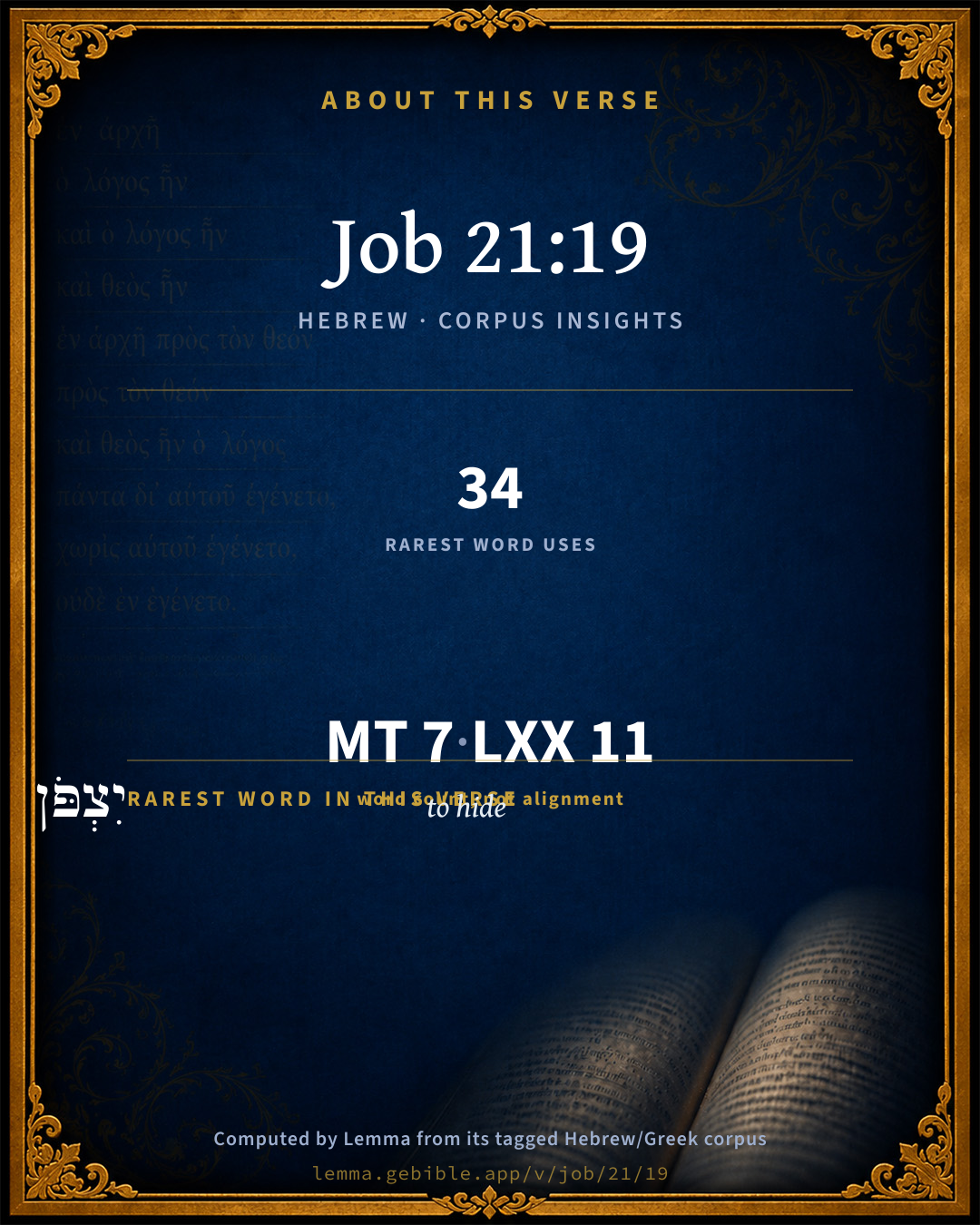
7
words
7
distinct lemmas
Wisdom
section

Shared distinctive vocabulary

יִצְפֹּן to hide H6845 occurs in 31 verses of the Hebrew Bible. Also found in:

Grammatical profile

  • 3 verbs
  • 3 nouns
  • 1 preposition

Verb forms

  • יִצְפֹּן Qal · Imperfect
  • יְשַׁלֵּ֖ם Piel · Imperfect
  • וְיֵדָֽע Qal · Imperfect

Hebrew & Septuagint length

In English translation the verse runs 21 words from the Hebrew and 17 from the Septuagint (LXX English) — closely comparable.

A rough comparison of the two English renderings, which tokenize alike — not a word-level alignment.

Word counts can differ between the Hebrew and the Greek without any difference in meaning — e.g. the Hebrew direct-object marker אֵת has no separate Greek word, and Greek often adds the article ὁ.

In the original languages it is 7 Hebrew tokens and 11 Greek tokens — but the two are counted differently (Hebrew bundles its prefixes and suffixes into one token; the Greek is in lemma form), so that isn’t a like-for-like length.

Cross-references

22

Topical passages linked to Job 21:19 in the Treasury of Scripture Knowledge — connected by theme and wording, ordered by reader-vote popularity; previews shown in the World English Bible.

  • Exodus 20:5 you shall not bow yourself down to them, nor serve them, for I, Yahweh your God, am a jealous God, visiting the iniquity of the fathers on the children, on the third and on the fourth generation of those who hate me,
  • Ezekiel 18:19–20 Yet say you, Why does not the son bear the iniquity of the father? when the son has done that which is lawful and right, and has kept all my statutes, and has done them, he shall surely live.
  • Isaiah 14:21 Prepare slaughter for his children for the iniquity of their fathers, that they not rise up, and possess the earth, and fill the surface of the world with cities.
  • Isaiah 53:4–6 Surely he has borne our sickness, and carried our suffering; yet we considered him plagued, struck by God, and afflicted.
  • Jeremiah 31:29 In those days they shall say no more, The fathers have eaten sour grapes, and the children's teeth are set on edge.
  • Ezekiel 18:2 What do you mean, that you use this proverb concerning the land of Israel, saying, The fathers have eaten sour grapes, and the children's teeth are set on edge?
  • Deuteronomy 32:34 Isn't this laid up in store with me, Sealed up among my treasures?
  • Psalms 54:5 He will repay the evil to my enemies. Destroy them in your truth.
  • Psalms 109:9–31 Let his children be fatherless, And his wife a widow.
  • Ezekiel 18:14 Now, behold, if he fathers a son, who sees all his father's sins, which he has done, and fears, and does not such like;
  • Matthew 23:31–35 Therefore you testify to yourselves that you are children of those who killed the prophets.
  • Romans 2:5 But according to your hardness and unrepentant heart you are treasuring up for yourself wrath in the day of wrath, revelation, and of the righteous judgment of God;
  • 2 Corinthians 5:21 For him who knew no sin he made to be sin on our behalf; so that in him we might become the righteousness of God.
  • 2 Timothy 4:14 Alexander, the coppersmith, did much evil to me. The Lord will repay him according to his works,
  • Revelation 18:6 Return to her just as she returned, and repay her double as she did, and according to her works. In the cup which she mixed, mix to her double.
  • Genesis 4:7 If you do well, will it not be lifted up? If you don't do well, sin crouches at the door. Its desire is for you, but you are to rule over it."
  • Deuteronomy 32:41 If I whet my glittering sword, My hand take hold on judgment; I will render vengeance to my adversaries, Will recompense those who hate me.
  • 2 Samuel 3:39 I am this day weak, though anointed king; and these men the sons of Zeruiah are too hard for me. May Yahweh reward the evil-doer according to his wickedness."
  • Job 22:24 Lay your treasure in the dust, The gold of Ophir among the stones of the brooks.
  • Malachi 3:18 Then you shall return and discern between the righteous and the wicked, between him who serves God and him who doesn't serve him.
  • Matthew 6:19–20 "Don't lay up treasures for yourselves on the earth, where moth and rust consume, and where thieves break through and steal;
  • Matthew 16:27 For the Son of Man will come in the glory of his Father with his angels, and then he will render to everyone according to his deeds.

Cross-references courtesy of OpenBible.info (CC BY 4.0).

Hebrew and Greek witnesses Masoretic Hebrew ↔ Greek Septuagint

The same verse in the two great witnesses to the Old Testament, shown verse-for-verse.

These are two independent witnesses, not word-aligned to each other, and the Septuagint is shown in lemma (dictionary) form.

Hebrew Job 21:19 Masoretic · Westminster Leningrad Codex

אֱל֗וֹהַּ יִצְפֹּן לְבָנָ֥יו אוֹנ֑וֹ יְשַׁלֵּ֖ם אֵלָ֣יו וְיֵדָֽע

You say, 'God lays up his iniquity for his children.' Let him recompense it to himself, that he may know it.

World English Bible · Public Domain

Greek LXX Job 21:19 Septuagint · lemma form

ἐκλείπω υἱός ὁ ὑποἄρχω αὐτός ἀντι ἀποδίδωμι πρός αὐτός καί γιγνώσκω

Let his substance fail to supply his children: God shall recompense him, and he shall know it.

LXX2012 (modern English Septuagint) · Public Domain

Hebrew: Westminster Leningrad Codex (CC BY 4.0). Greek: Septuagint (public domain); English from LXX2012 (modern English Septuagint) (Public Domain). How the Septuagint differs from the Hebrew →

Commentary

Notes on Job 21:19 from classic Christian and Jewish commentators (each source and its license shown beneath its notes). The classic Christian expositions comment on the surrounding passage and are grouped to its opening verse, so a note may address several verses; the Jewish commentaries on the Tanakh (Rashi and others) are per-verse, so they appear only where the commentator wrote on this verse.

Lemma curates 59 commentaries, every one of them public domain or Creative Commons licensed, each selected and text-cleaned for this edition rather than reprinted as found. About our sources →

Trapp's Complete Commentary

John Trapp

Job 21:19 God layeth up his iniquity for his children: he rewardeth him, and he shall know [it].

Ver. 19. God layeth up his iniquity for his children] That is, the punishment of his iniquity, while he visiteth the sins of the fathers upon the children to the third and fourth generation of them that hate him, Exo 20:5. Neither doth this contradict that of the prophet Ezekiel, "The son, shall not die for the iniquity of his father," Eze 18:17; nor that of the apostle, "Every man shall bear his own burden," Gal 6:5; for the meaning of those words is, that no man be damned for the sin of his father, nor one man for the sin of another, unless by commission, or approbation, or some way or other he make it his own. But for temporal punishments there is none but (by occasion of others’ sin) may have their portion in them; and wicked parents leave Job’s legacy to their children; {2Sa 3:29} yea, though they prove to be good children, 1Ki 14:12-13, for whom God layeth up their parents’ iniquity in the treasures of his justice to be produced in due tine.

He rewardeth him] For every transgression and disobedience; that is, every commission and omission "receiveth a just recompense of reward," Heb 2:2. God will abate him nothing.

And he shall know it] Know it to his cost. Vexation shall give understanding; he that, before this judgment came, would know nothing of the bitter effect of sin upon him and his, now hath his eyes forced open (as the blind mole is said to have by the pangs of death), and cry out with the lion in the snare, Si praescivissem, Oh! if I had foreknown the mischief, &c. The wicked are wise too late; the fool passeth on and is punished; he knows not the evil of sin till he feels it.

John Trapp, A Commentary or Exposition upon All the Books of the Old and New Testament (1647–1656) — public domain. Text from a community e-Sword module.

Joseph Benson's Commentary

Job 21:19-20. God layeth up — Namely, in his treasures; his iniquity —

Or rather, the punishment of his iniquity; that is, He will punish him both in his person and in his posterity. His eyes shall see his destruction — That is, he shall be destroyed, as to see death, is to die, Psa 89:48; Heb 11:5; and to see affliction, or any kind of evil, is to feel it, Psa 90:15; and to see good, is to enjoy it, Job 7:7; Job 9:25. Or, this phrase may be emphatical; he shall foresee his ruin hastening toward him, and not be able to prevent or avoid it: he shall sensibly feel himself sinking and perishing, which aggravates his misery. He shall drink of the wrath of the Almighty — Not sip or taste, but drink; which word commonly denotes receiving abundance of the thing spoken of.

Joseph Benson's Commentary on the Old and New Testaments (1811–1818) — public domain. Text from a community e-Sword module.

Tyndale Open Study Notes

Tyndale Open Resources

21:19 you say: Job was quoting and rebutting his friends’ arguments. • God will punish their children: These were the words of Eliphaz (5:4) and Zophar (20:10), but Job thought God should punish the ones who sin (see Ezek 18:19-20).

Tyndale Open Study Notes — © Tyndale Open Resources, licensed CC BY-SA 4.0. Text via the HelloAO Bible API.

Jamieson, Fausset & Brown

Robert Jamieson, A. R. Fausset & David Brown

Equally questionable is the friends' assertion that if the godless himself is not punished, the children are (Job 18:19; Job 20:10); and that God rewardeth him here for his iniquity, and that he shall know it to his cost. So "know" (Hos 9:7).

Jamieson, Fausset & Brown — Commentary Critical and Explanatory on the Whole Bible (1871) — public domain (CC PDM 1.0). Text via the HelloAO Bible API.

Adam Clarke's Commentary

Verse 19. God layeth up his iniquity for his children] This is according to the declaration of God, Ex 20:5: "Visiting the iniquity of the fathers upon the children, unto the third and fourth generation of them that hate me." This always supposes that the children, who are thus visited, have copied their parents' example; or that ill-gotten property is found in their hands, which has descended to them from their wicked fathers; and of this God, in his judgments, strips them. It is, however, very natural to suppose that children brought up without the fear of God will walk in the sight of their own eyes, and according to the imaginations of their own hearts.

He rewardeth him, and he shall know it.] He shall so visit his transgressions upon him, that he shall at last discern that it is God who hath done it. And thus they will find that there would have been profit in serving him, and safety in praying unto him. But this they have neglected, and now it is too late.

Adam Clarke's Commentary on the Bible (1810–1826) — public domain. Text from a community e-Sword/MySword module.

Ellicott's Commentary for English Readers

(19) God layeth up his iniquity (i.e., the punishment of it) for his children, may be the hypothetical reply of the antagonists in the mouth of Job, and the second clause his own retort: “Let him repay it to himself that he may know it.”

A Bible Commentary for English Readers, edited by Charles John Ellicott (1878–1897) — public domain. Text from a community e-Sword module.

The Cambridge Bible for Schools and Colleges

gen. ed. J. J. S. Perowne

19–21. A conceivable objection, and its answer by Job. The verses read,

19. God (say ye) layeth up his iniquity for his children.—

Let him recompense it unto himself, that he may know it;

20. Let his own eyes see his destruction,

And let him drink of the wrath of the Almighty;

21. For what concern hath he in his house after him,

When the number of his months is cut off?

To his argument that the wicked suffer no calamities Job supposes that his friends may object, founding on the old doctrine of retribution, that if the man himself do not suffer, his children shall be visited for his iniquity (Exo_20:5); and his answer is, Let the man himself suffer. The expression “that he may know it” means “that he may feel it.”

The word “concern” means “pleasure” as A. V., but also, interest in, care for; so Coverdale, For what careth he what become of his household after his death? The phrase “when the number of his months is cut off” means, when his life is ended. The words might also mean, when the (full) number of his months is dealt out, distributed to himself—when his own life is prolonged to its full measure. But it is not necessary to regard the wicked man as so abandoned as to be destitute of interest in his children even in his life-time, and indifferent to their fate provided his own days be prolonged. Job’s objection to the doctrine that a man’s iniquity is visited on his children is that this is no punishment of the wicked man himself, for he hath no concern in or knowledge of his children’s fate after his death (ch. Job_14:21). From the Prophetic Books of this age it appears that the ancient doctrine of retribution, the doctrine that the fathers have eaten sour grapes and the children’s teeth are set on edge (Eze_18:2), had begun to awaken questionings, cf. Jer_31:29 seq., and in this book such doubts are, naturally, brought to a point.

The Cambridge Bible for Schools and Colleges (gen. ed. J. J. S. Perowne; Cambridge University Press, 1878–1918) — public domain. Text from a community e-Sword module.

John Gill's Exposition

His eyes shall see his destruction,.... Or "should see his destruction" (b); calamities coming upon himself and upon his children; or otherwise it will not affect him: but when a man has a personal experience of affliction as punishments of his sin, or with his own eyes sees his children in distressed circumstances on his account, this must sensibly affect him, and be a sore punishment to him; as it was to Zedekiah to have his children slain before his eyes, Jer 52:10;

and he shall drink of the wrath of the Almighty; or "he should drink" (c) of it now, according to the principles of Job's friends, even he in person, and not his posterity only; the wrath of God is on account of sin, and dreadful to bear: if the wrath of a temporal king is as the roaring of a lion, what must be the wrath of the Almighty God, the King of kings, and Lord of lords? this is frequently in Scripture compared to a cup, and is called a cup of trembling, of wrath and fury: and of which all the wicked of the earth shall drink sooner or later, Psa 75:8; but this they should do now, according to the notions of Job's friends, whereas they do not; waters of a full cup, though not in wrath indeed, are wrung out to the people of God, and, as they apprehend, in wrath, when the wicked drink wine in bowls, and the cup of their prosperity overflows.

(b) "videret ejus oculi exitium suum", Beza, Cocceius. (c) "biberet", Beza, Cocceius.

John Gill's Exposition of the Whole Bible (1746–1763) — public domain (CC PDM 1.0). Text via the HelloAO Bible API.

Albert Barnes' Notes on the Bible

God layeth up his iniquity for his children - Margin, that is, “the punishment of iniquity.” This is a reference evidently to the opinion which “they” had maintained. It may be rendered, “You say that God layeth up iniquity,” etc. They had affirmed that not only did God, as a great law, punish the wicked in this life, but that the consequences of their sins passed over to their posterity; or, if “they” were not punished, yet the calamity would certainly come on their descendants; see Job 18:19-20; Job 20:10, Job 20:28. This is the objection which Job now adverts to. The statement of the objection, it seems to me, continues to Job 21:22, where Job says, that no one can teach God knowledge, or prescribe to him what he should do, and then goes on to say, that the “fact” was far different from what they maintained; that there was no such exact distribution of punishments; but that one died in full strength, and another in the bitterness of his soul, and both laid down in the dust, together. This view seems to me to give better sense than any other interpretation which I have seen proposed.

He rewardeth him, and he shall know it - That is, you maintain that God will certainly reward him in this life, and that his dealings with him shall so exactly express the divine view of his conduct, that he shall certainly know what God thinks of his character. This opinion they had maintained throughout the argument, and this Job as constantly called in question.

Albert Barnes' Notes on the Bible (1834–1885) — public domain. Text from a community e-Sword/MySword module.

Haydock's Catholic Bible Commentary

The sorrow. Protestants, "his iniquity." Marginal note, "that is the punishment." (Haydock) --- The children shall share in his punishment, (Calmet) when they have been partakers, or imitators of his injustice. (Haydock) --- Know his offence, and whether there be a God (Calmet) and Providence. (Menochius)

George Leo Haydock (1774–1849), Haydock's Catholic Family Bible and Commentary, 1859 edition — public domain. Excludes Psalms (Douay-Rheims chapter numbering differs from Protestant) and Deuterocanonical books (Catholic canon only).

Matthew Poole's English Annotations

God layeth up, to wit, in his treasures, Rom 2:5.

His iniquity, or rather, the punishment of his iniquity, i.e. he will punish him both in his person and in his posterity.

He shall know it, i.e. he shall live to see the destruction of his children.

Matthew Poole's English Annotations on the Holy Bible (1683–1685) — public domain. Text from a community e-Sword/MySword module.

Whedon's Commentary on the Bible

Daniel D. Whedon

19. Iniquity — און also signifies “calamity,” “wealth” — a network of meanings exceedingly suggestive. One of the positions taken by the friends of Job was, “God layeth up the iniquity of the wicked for his children,” (Job_5:4; Job_20:10;) if he does not visit it upon the parents, he certainly does upon the children. Horace has a similar thought:

Delicta majorum immeritus lues Romane.

Thou, O Roman, innocent

Shalt suffer for the sins of thy ancestors.

Cicero, on the other hand, denounces the principle that “if a wicked man die without suffering for his crimes, the gods should inflict a punishment on his children, his children’s children, and all his posterity.” (De Nat. Deorum, 3:38.) Job’s reply commences with the second clause, which should read: Upon him (the wicked man himself) should He (God) requite that he may know, that is, feel it — the transgressor is the proper person to suffer.

Daniel D. Whedon (gen. ed.), Commentary on the Old and New Testaments (1874–1909) — public domain. Text from a community e-Sword module.

The Pulpit Commentary

God layeth up his iniquity for his children. Job supposes his opponents to make this answer to his arguments. "God," they may say, "punishes the wicked man in his children". (comp. Exo_20:5) Job does not deny that he may do so, but suggests a better course in the next sentence. He rewardeth him; rather, let him recompense it on himself let him make the wicked man himself suffer, and then he shall know it. He shall perceive and know that he is receiving the due reward of his wickedness.

The Pulpit Commentary (1880–1919), ed. H.D.M. Spence-Jones & Joseph S. Exell — public domain. Text from a community e-Sword module.

John Wesley's Explanatory Notes

Layeth up - In his treasures, Rom. ii, 5. Iniquity - The punishment of his iniquity; he will punish him both in his person and in his posterity.

John Wesley, Explanatory Notes Upon the Whole Bible (1754–1765) — public domain. Text via the GEBible commentary corpus.

Scofield Reference Notes

C. I. Scofield

iniquity

i.e. the punishment of his iniquity.

The Scofield Reference Bible (1917 edition), notes by C. I. Scofield — public domain. Text from a community e-Sword module.

unfoldingWord translationNotes

Door43 World Missions Community

Connecting Statement:

Job continues speaking to his friends.

You say

These words are added by most versions in order to make it clear that the Job is quoting his friends in the next statement.

God lays up one's guilt for his children to pay

Guilt is spoken of as something that can be stored for later use. Here "to pay" refers to punishment for sin. AT: "God keeps a record of a person's sins, then he punishes the person's children for his wicked deeds" (See: Metaphor)

Let him pay it himself ... cut off?

Job now begins to state his own opinion. It may be helpful to state this explicitly. AT: "But I say, 'Let him pay it himself ... cut off?'" (See: Assumed Knowledge and Implicit Information)

Let his eyes see

Here "eyes" refers to the person. AT: "Let him see" (See: Synecdoche)

let him drink of the wrath of the Almighty

Here the wrath of God is spoken of as if it were a drink that a person can taste, and tasting is a metonym for experiencing the drink. Job wants the wicked person to experience God's punishment. (See: Metaphor and Metonymy)

For what does he care about his family after him when the number of his months is cut off?

Job uses this question to show that punishing the evil man's children is not effective. This can be stated in active form. AT: "For the wicked man does not care what happens to his family after he has died!" (See: Rhetorical Question and Active or Passive)

the number of his months is cut off

This is a polite way of saying that he dies. (See: Euphemism)

the number of his months

This refers to the length of his life.

translationWords

guilt

wrath

Almighty

family

cut off

unfoldingWord translationNotes — © Distant Shores Media and the Door43 World Missions Community, licensed CC BY-SA 4.0. Source: git.door43.org/Door43/en_tn.

Rashi

Rabbi Shlomo Yitzchaki (Rashi)

Should God lay away his violence for his sons This is a question. Is this just, that this one should sin all his life and die in peace, and his violence and his wickedness the Holy One, blessed be He, should lay away for his sons, to punish them?

Let Him requite him so that he should know it is a praise to the Holy One, blessed be He, that He Himself requite the wicked man his recompense so that he understand that he dealt wickedly.

Rashi on the Tanakh — English translations: “The Judaica Press complete Tanach with Rashi, translated by A. J. Rosenberg” (CC BY 4.0); “Pentateuch with Rashi's commentary by M. Rosenbaum and A.M. Silbermann, 1929-1934” (public domain); “The Metsudah Tanach series, Lakewood, N.J” (CC BY 4.0); and “The Book of Joshua, Metsudah Publications, 1997” (CC BY 4.0). Text via Sefaria.

Lesson kit

Teaching starters — assembled from the data on this page, not authored interpretation. Every prompt links to the verse data it draws on. Edit before teaching.

Job, in the Wisdom, opens this verse with 7 words (7 distinct Hebrew lemmas). Its most distinctive word is tsâphan (“to hide”). A historical commentator’s framing appears above. Read the whole chapter for the surrounding context.

Discussion questions

  1. The word tsâphan carries the sense “to hide.” How does it shape the verse?
  2. Exodus 2:2 shares the word «to hide» with this verse. How do the two illuminate each other?
  3. The translations on this page render this verse differently — a whole-verse word diff, not a word-by-word alignment. What might account for the different wordings?
  4. The verb «יִצְפֹּן» is Qal Imperfect. How does its form color the action?
  5. Reading how Trapp's Complete Commentary and Joseph Benson's Commentary read this verse, where do the two commentators agree and where do they part?

Things to notice

Reading settings

Reading text

Shown beneath each verse's original-language words.

Old Testament
Old Testament edition

Read the OT as the Masoretic Hebrew (MT) or the Greek Septuagint (LXX).

English shown for the Greek Septuagint (in the Hebrew ↔ Greek comparison).

Comparing translations? Open the Compare panel on any verse page to stack up to four side by side.