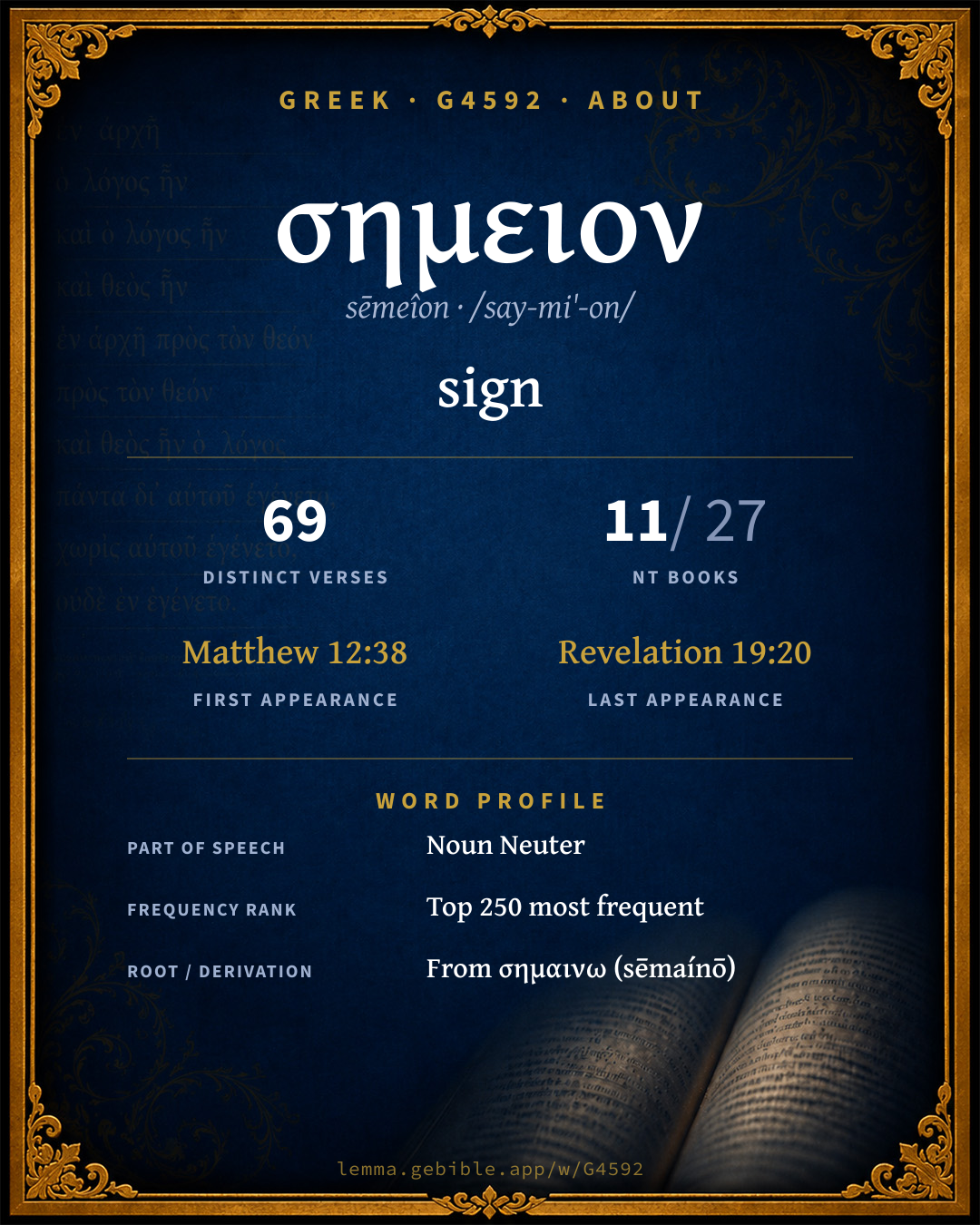
σημεῖον
sign
‘sign’ is one of 2 main senses fuller range ↓
Full lexicon entry — Thayer's Greek Lexicon
From Thayer's Greek Lexicon
Where this word appears
See every Accusative-case word in the Greek New Testament →
Grammar key — what these labels mean
Part of speech
- Noun
- A naming word — a person, place, thing, or idea.
Case
- Accusative
- The case of the direct object and of extent.
- Nominative
- The case of the subject (and the predicate nominative).
- Dative
- The case of the indirect object, means, or location — “to / for / with / in.”
- Genitive
- The case of source, possession, or “of” — answers “whose / from what.”
Gender
- Neuter
- Grammatically neuter.
Number
- Plural
- More than one.
- Singular
- One.
Grammatical forms
- Noun, Accusative, Plural, Neuter 25 times (32%)
- Noun, Accusative, Singular, Neuter 22 times (29%)
- Noun, Nominative, Singular, Neuter 16 times (21%)
- Noun, Nominative, Plural, Neuter 7 times (9%)
- Noun, Dative, Plural, Neuter 4 times (5%)
- Noun, Genitive, Plural, Neuter 3 times (4%)
Parsed forms decoded from the imported morphology (Robinson–Tischendorf, public domain), counted across 77 parsed occurrences — not distinct verses.
Every verse where G4592 appears — 69 distinct verses across 11 books. Click any verse to open its interlinear word-by-word view. Verse text shown in the World English Bible for context — . Each verse’s Greek form is shown with its reference; the English is not keyword-highlighted, since the data carries no word-level English alignment. Use “Compare translations” on any verse to read it across multiple English versions. This concordance covers the Greek New Testament; Septuagint (Greek Old Testament) occurrences of this word are not indexed here.
Matthew 9 verses
- Matthew 12:38 σημεῖον n acc sg neut Then certain of the scribes and Pharisees answered, "Teacher, we want to see a sign from you."
- Matthew 12:39 σημεῖον σημεῖον σημεῖον n acc sg neut n nom sg neut n acc sg neut But he answered them, "An evil and adulterous generation seeks after a sign, but no sign will be given it but the sign of Jonah the prophet.
- Matthew 16:1 σημεῖον n acc sg neut The Pharisees and Sadducees came, and testing him, asked him to show them a sign from heaven.
- Matthew 16:3 σημεῖα n acc pl neut In the morning, 'It will be foul weather today, for the sky is red and threatening.' Hypocrites! You know how to discern the appearance of the sky, but you can't discern the signs of the times!
- Matthew 16:4 σημεῖον σημεῖον σημεῖον n acc sg neut n nom sg neut n nom sg neut An evil and adulterous generation seeks after a sign, and there will be no sign given to it, except the sign of the prophet Jonah." He left them, and departed.
- Matthew 24:3 σημεῖον n nom sg neut As he sat on the Mount of Olives, the disciples came to him privately, saying, "Tell us, when will these things be? What is the sign of your coming, and of the end of the age?"
- Matthew 24:24 σημεῖα n acc pl neut For there will arise false christs, and false prophets, and they will show great signs and wonders, so as to lead astray, if possible, even the chosen ones.
- Matthew 24:30 σημεῖον n nom sg neut and then the sign of the Son of Man will appear in the sky. Then all the tribes of the earth will mourn, and they will see the Son of Man coming on the clouds of the sky with power and great glory.
- Matthew 26:48 σημεῖον n acc sg neut Now he who betrayed him gave them a sign, saying, "Whoever I kiss, he is the one. Seize him."
Mark 6 verses
- Mark 8:11 σημεῖον n acc sg neut The Pharisees came out and began to question him, seeking from him a sign from heaven, and testing him.
- Mark 8:12 σημεῖον σημεῖον n acc sg neut n acc sg neut He sighed deeply in his spirit, and said, "Why does this generation seek a sign? Most assuredly I tell you, no sign will be given to this generation."
- Mark 13:4 σημεῖον n nom sg neut "Tell us, when will these things be? What is the sign that these things are all about to be fulfilled?"
- Mark 13:22 σημεῖα n acc pl neut For there will arise false christs and false prophets, and will show signs and wonders, that they may lead astray, if possible, even the chosen ones.
- Mark 16:17 σημεῖα n nom pl neut These signs will accompany those who believe: in my name they will cast out demons; they will speak with new languages;
- Mark 16:20 σημείων n gen pl neut They went out, and preached everywhere, the Lord working with them, and confirming the word by the signs that followed. Amen.
Luke 9 verses
- Luke 2:12 σημεῖον n nom sg neut This is the sign to you: you will find a baby wrapped in strips of cloth, lying in a feeding trough."
- Luke 2:34 σημεῖον n acc sg neut and Simeon blessed them, and said to Mary, his mother, "Behold, this child is set for the falling and the rising of many in Israel, and for a sign which is spoken against.
- Luke 11:16 σημεῖον n acc sg neut Others, testing him, sought from him a sign from heaven.
- Luke 11:29 σημεῖον σημεῖον σημεῖον n acc sg neut n nom sg neut n nom sg neut When the multitudes were gathering together to him, he began to say, "This is an evil generation. It seeks after a sign. No sign will be given to it but the sign of Jonah, the prophet.
- Luke 11:30 σημεῖον n nom sg neut For even as Jonah became a sign to the Ninevites, so will also the Son of Man be to this generation.
- Luke 21:7 σημεῖον n nom sg neut They asked him, "Teacher, so when will these things be? What is the sign that these things are about to happen?"
- Luke 21:11 σημεῖα n nom pl neut There will be great earthquakes, famines, and plagues in various places. There will be terrors and great signs from heaven.
- Luke 21:25 σημεῖα n nom pl neut There will be signs in the sun, moon, and stars; and on the earth anxiety of nations, in perplexity for the roaring of the sea and the waves;
- Luke 23:8 σημεῖον n acc sg neut Now when Herod saw Jesus, he was exceedingly glad, for he had wanted to see him for a long time, because he had heard many things about him. He hoped to see some miracle done by him.
John 17 verses
- John 2:11 σημείων n gen pl neut This beginning of his signs Jesus did in Cana of Galilee, and revealed his glory; and his disciples believed in him.
- John 2:18 σημεῖον n acc sg neut The Jews therefore answered him, "What sign do you show us, seeing that you do these things?"
- John 2:23 σημεῖα n acc pl neut Now when he was in Jerusalem at the Passover, during the feast, many believed in his name, observing his signs which he did.
- John 3:2 σημεῖα n acc pl neut The same came to him by night, and said to him, "Rabbi, we know that you are a teacher come from God, for no one can do these signs that you do, unless God is with him."
- John 4:48 σημεῖα n acc pl neut Jesus therefore said to him, "Unless you see signs and wonders, you will in no way believe."
- John 4:54 σημεῖον n acc sg neut This is again the second sign that Jesus did, having come out of Judea into Galilee.
- John 6:2 σημεῖα n acc pl neut A great multitude followed him, because they saw his signs which he did on those who were sick.
- John 6:14 σημεῖον n acc sg neut When therefore the people saw the sign which Jesus did, they said, "This is truly the prophet who comes into the world."
- John 6:26 σημεῖα n acc pl neut Jesus answered them, "Most assuredly I tell you, you seek me, not because you saw signs, but because you ate of the loaves, and were filled.
- John 6:30 σημεῖον n acc sg neut They said therefore to him, "What then do you do for a sign, that we may see, and believe you? What work do you do?
- John 7:31 σημεῖα n acc pl neut But of the multitude, many believed in him. They said, "When the Christ comes, he won't do more signs than those which this man has done, will he?"
- John 9:16 σημεῖα n acc pl neut Some therefore of the Pharisees said, "This man is not from God, because he doesn't keep the Sabbath." Others said, "How can a man who is a sinner do such signs?" There was division among them.
- John 10:41 σημεῖον n acc sg neut Many came to him. They said, "John indeed did no sign, but everything that John said about this man is true."
- John 11:47 σημεῖα n acc pl neut The chief priests therefore and the Pharisees gathered a council, and said, "What are we doing? For this man does many signs.
- John 12:18 σημεῖον n acc sg neut For this cause also the multitude went and met him, because they heard that he had done this sign.
- John 12:37 σημεῖα n acc pl neut But though he had done so many signs before them, yet they didn't believe in him,
- John 20:30 σημεῖα n acc pl neut Therefore Jesus did many other signs in the presence of his disciples, which are not written in this book;
Acts 13 verses
- Acts 2:19 σημεῖα n acc pl neut I will show wonders in the sky above, And signs on the earth beneath; Blood, and fire, and billows of smoke.
- Acts 2:22 σημείοις n dat pl neut "Men of Israel, hear these words! Jesus of Nazareth, a man approved by God to you by mighty works and wonders and signs which God did by him in the midst of you, even as you yourselves know,
- Acts 2:43 σημεῖα n nom pl neut Fear came on every soul, and many wonders and signs were done through the apostles.
- Acts 4:16 σημεῖον n nom sg neut saying, "What shall we do to these men? Because indeed a notable miracle has been done through them, as can be plainly seen by all who dwell in Jerusalem, and we can't deny it.
- Acts 4:22 σημεῖον n nom sg neut For the man on whom this miracle of healing was performed was more than forty years old.
- Acts 4:30 σημεῖα n nom pl neut while you stretch out your hand to heal; and that signs and wonders may be done through the name of your holy Servant Jesus."
- Acts 5:12 σημεῖα n nom pl neut By the hands of the apostles many signs and wonders were done among the people. They were all with one accord in Solomon's porch.
- Acts 6:8 σημεῖα n acc pl neut Stephen, full of faith and power, performed great wonders and signs among the people.
- Acts 7:36 σημεῖα n acc pl neut This man led them out, having worked wonders and signs in Egypt, in the Red Sea, and in the wilderness for forty years.
- Acts 8:6 σημεῖα n acc pl neut The multitudes listened with one accord to the things that were spoken by Philip, when they heard and saw the signs which he did.
- Acts 8:13 σημεῖα n acc pl neut Simon himself also believed. Being baptized, he continued with Philip. Seeing signs and great miracles occuring, he was amazed.
- Acts 14:3 σημεῖα n acc pl neut Therefore they stayed there a long time, speaking boldly in the Lord, who testified to the word of his grace, granting signs and wonders to be done by their hands.
- Acts 15:12 σημεῖα n acc pl neut All the multitude kept silence, and they listened to Barnabas and Paul reporting what signs and wonders God had done among the Gentiles through them.
Romans 2 verses
- Romans 4:11 σημεῖον n acc sg neut He received the sign of circumcision, a seal of the righteousness of the faith which he had while he was in uncircumcision, that he might be the father of all those who believe, though they be in uncircumcision, that righteousness might also be accounted to them.
- Romans 15:19 σημείων n gen pl neut in the power of signs and wonders, in the power of God's Spirit; so that from Jerusalem, and around as far as to Illyricum, I have fully preached the Gospel of Christ;
1 Corinthians 2 verses
- 1 Corinthians 1:22 σημεῖα n acc pl neut For Jews ask for signs, Greeks seek after wisdom,
- 1 Corinthians 14:22 σημεῖόν n acc sg neut Therefore other languages are for a sign, not to those who believe, but to the unbelieving; but prophesying is for a sign, not to the unbelieving, but to those who believe.
2 Corinthians 1 verse
2 Thessalonians 2 verses
Hebrews 1 verse
Revelation 7 verses
- Revelation 12:1 σημεῖον n nom sg neut A great sign was seen in heaven: a woman clothed with the sun, and the moon under her feet, and on her head a crown of twelve stars.
- Revelation 12:3 σημεῖον n nom sg neut Another sign was seen in heaven. Behold, a great red dragon, having seven heads and ten horns, and on his heads seven crowns.
- Revelation 13:13 σημεῖα n acc pl neut He performs great signs, even making fire come down out of the sky to the earth in the sight of people.
- Revelation 13:14 σημεῖα n acc pl neut He deceives my own people who dwell on the earth because of the signs he was granted to do in front of the beast; saying to those who dwell on the earth, that they should make an image to the beast who had the sword wound and lived.
- Revelation 15:1 σημεῖον n acc sg neut I saw another great and marvelous sign in the sky: seven angels having the seven last plagues, for in them God's wrath is finished.
- Revelation 16:14 σημεῖα n acc pl neut for they are spirits of demons, performing signs; which go forth to the kings of the whole inhabited earth, to gather them together for the war of that great day of God, the Almighty.
- Revelation 19:20 σημεῖα n acc pl neut The beast was taken, and with him the false prophet who worked the signs in his sight, with which he deceived those who had received the mark of the beast and those who worshiped his image. These two were thrown alive into the lake of fire that burns with sulfur.
About this entry
At a glance — auto-summarized from this page’s data, not written by a person. Every figure links to its source below. This summary describes the numbers; it doesn’t interpret them.
σημειον (sēmeîon) is a Greek noun most often rendered “sign.” It first appears in Matthew 12:38. Spanning 69 verses in 11 books, it ranks among the moderately common words of the Greek New Testament. John dominates its distribution — 17 of 69 verses. Its lexical range runs to 2 senses. The sections below give every sense, occurrence, and version rendering.
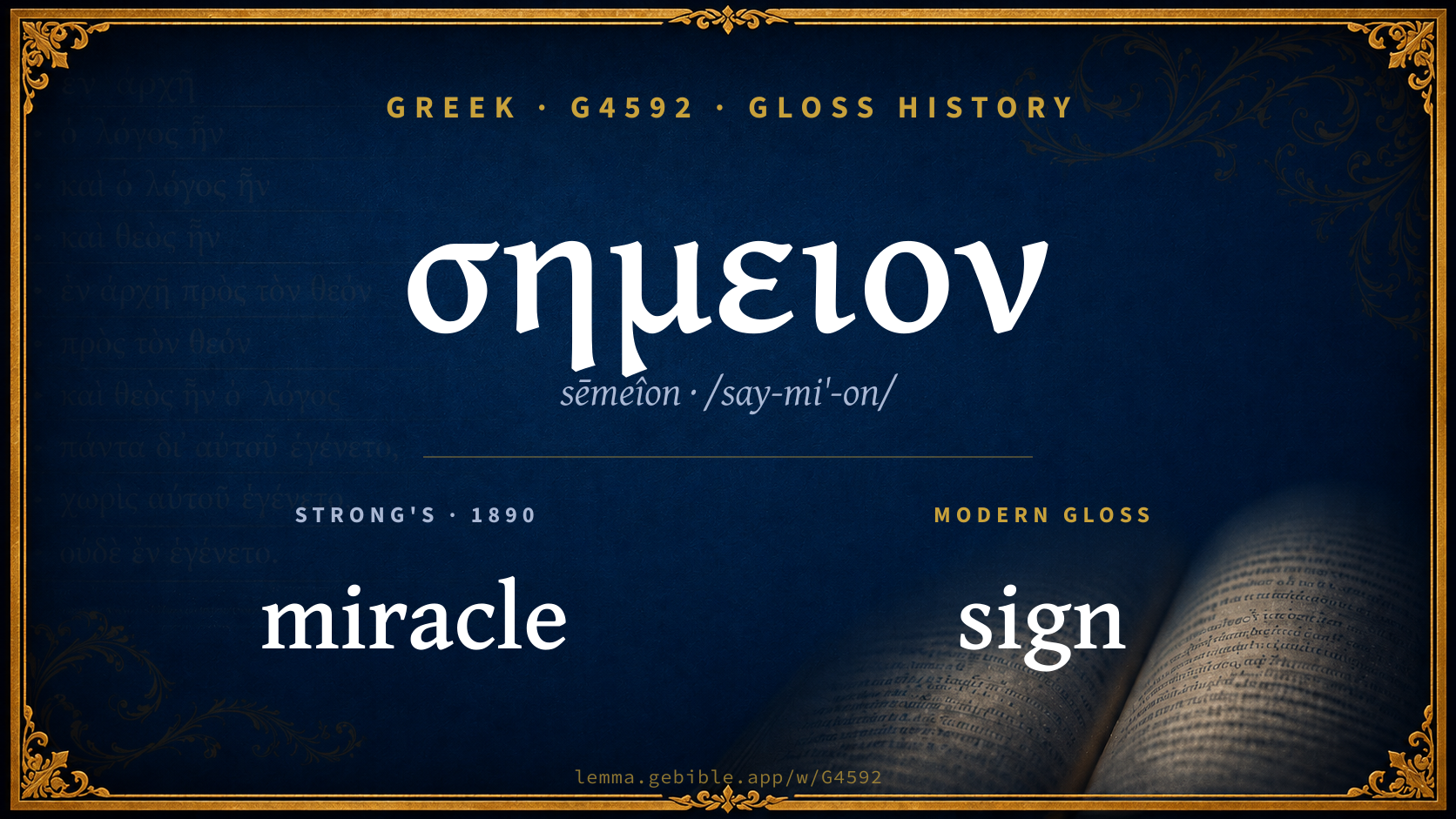
Gloss history
Strong's 1890 vs modern scholarship
About this word
Strong's G4592 catalogs a Greek word from the Greek New Testament.
These counts are not copied from any lexicon or concordance. They are computed here, from the morphology-tagged Greek New Testament. What Lemma adds →
- 69
- distinct verses
- The word appears in 69 distinct verses.
- 11 / 27
- NT books
- The word appears in 11 of 27 New Testament books.
- #220
- by frequency
- Top 250 most frequent Greek words (rank 220 of 5,347 Greek words by occurrence).
View all 69 occurrences in the concordance →
By section of the New Testament
By traditional corpus
Conventional, traditional groupings — biblical authorship is debated, so this is a traditional corpus grouping, not an authorship claim. Some books belong to more than one corpus (Luke is in both the Gospels and the Lukan corpus, and so on), so these shares overlap and need not total 100%. Each figure is a share of the word’s 69 distinct verses.
- Gospels 41 verses · 59%
- Johannine 24 verses · 35%
- Lukan (Luke–Acts) 22 verses · 32%
- Pauline corpus 7 verses · 10%
- Revelation 7 verses · 10%
- Hebrews 1 verse · 1%
How translations render this word
Counts come from each version’s own published word-to-Strong’s tagging or interlinear alignment — an approximate guide to how each version renders this word, not a word-level alignment the data otherwise carries. Because each total is that version’s own tagged count, the per-version totals vary from one another and need not match the appearance or distinct-verse counts above. These counts may also differ from a printed concordance because Lemma counts each distinctly tagged rendering and does not collapse phrase taggings into a single head-word total. This is a fixed set of word-tagged versions (KJV, ASV, BSB, ULT) and does not change with the reading translation you choose elsewhere. Each version’s license is shown beside its name below (and on Sources).
- King James Version: Sign 26×, Signs 21×, Miracles 13×
- American Standard Version: Signs 34×, Sign 30×, Miracle 3×
- Berean Standard Bible: Signs 37×, Sign 31×, Miracle 2×
- unfoldingWord Literal Text: Signs 39×, Sign 38×, A 2×
King James Version Public Domain
Renders G4592 across 76 tagged occurrences — most commonly:
Plus 5 renderings that appear only once — usually multi-word phrases or single function words the recovered tagging swept in, not distinct renderings. Not rendered by a distinct English word in 1 further occurrence.
American Standard Version Public Domain
Renders G4592 across 77 tagged occurrences — most commonly:
Plus 10 renderings that appear only once — usually multi-word phrases or single function words the recovered tagging swept in, not distinct renderings.
Berean Standard Bible Public Domain
Renders G4592 across 74 tagged occurrences — most commonly:
Plus 4 renderings that appear only once — usually multi-word phrases or single function words the recovered tagging swept in, not distinct renderings. Not rendered by a distinct English word in 2 further occurrences.
unfoldingWord Literal Text CC BY-SA 4.0
Renders G4592 across 79 tagged occurrences — most commonly:
Senses in Thayer's
The 2 senses Thayer's distinguishes for this word, in lexicon order (not ranked by frequency or importance). The full entry — with sub-senses — is in the Lexicon Entry tab.
- that by which a person or a thing is distinguished from others and is known
- a sign, prodigy, portent, i.e. an unusual occurrence, transcending the common course of nature
Word origin
Derived from σημαινω (sēmaínō) (G4591) — to signify.
Neuter of a presumed derivative of the base of G4591 ; an indication especially ceremonially or supernaturally : - miracle sign token wonder.
— Strong’s Exhaustive Concordance (1890), public domain.
Forms in the corpus
The 5 distinct written forms G4592 takes in the Greek New Testament, most frequent first — each parse links to that case’s occurrences in the concordance.
| Form | Parsing | Example | Uses |
|---|---|---|---|
| σημεῖον sēmeîon | Noun, Accusative, Singular, Neuter | Matthew 12:38 | 37 |
| σημεῖα sēmeîa | Noun, Accusative, Plural, Neuter | Matthew 16:3 | 32 |
| σημείοις sēmeíois | Noun, Dative, Plural, Neuter | Acts 2:22 | 4 |
| σημείων sēmeíōn | Noun, Genitive, Plural, Neuter | Mark 16:20 | 3 |
| σημεῖόν sēmeîón | Noun, Accusative, Singular, Neuter | 1 Corinthians 14:22 | 1 |
Same root — word family
Other Thayer's entries built from the same root as G4592, grouped by Strong’s listed origin. These share a root / origin per the lexicon — not necessarily a shared meaning. Each links to that word’s own entry.
Derives from
Derived from this word
Compare all same-root words → They share a root, not necessarily a meaning.
Septuagint usage
The same Greek word σημειον appears 97 times in the Greek Old Testament (Septuagint), across 94 verses in 16 books.
- 97
- LXX occurrences
- Tagged occurrences of this Greek word in the Septuagint.
- 94
- verses
- Distinct Septuagint verses containing this word.
- 16 / 39
- OT books
- The word appears in 16 of the 39 Old Testament books.
Sample Septuagint occurrences
- Genesis 1:14 σημεῖον
- Exodus 3:12 σημεῖον
- Numbers 14:11 σημεῖον
- Deuteronomy 4:34 σημεῖον
- Joshua 2:18 σημεῖον
- Judges 20:38 σημεῖον
- 1 Samuel 2:34 σημεῖον
- 2 Kings 19:29 σημεῖον
- 2 Chronicles 32:24 σημεῖον
- Ezra 19:10 σημεῖον
- Job 21:29 σημεῖον
- Psalms 64:9 σήμειον
Septuagint occurrences (same lexeme)
Every verse where the same Strong’s number (G4592) appears in the Greek Septuagint — showing the first 50 of 94. Verse text shown in the World English Bible for context; the Greek form is the matched word — the English is not keyword-highlighted.
- Genesis 1:14 σημεῖον God said, "Let there be lights in the expanse of sky to divide the day from the night; and let them be for signs, and for seasons, and for days and years;
- Genesis 4:15 σημεῖον Yahweh said to him, "Therefore whoever slays Cain, vengeance will be taken on him sevenfold." Yahweh appointed a sign for Cain, lest any finding him should strike him.
- Genesis 9:12 σημεῖον God said, "This is the token of the covenant which I make between me and you and every living creature that is with you, for perpetual generations:
- Genesis 9:13 σημεῖον I set my rainbow in the cloud, and it will be for a sign of a covenant between me and the earth.
- Genesis 9:17 σημεῖον God said to Noah, "This is the token of the covenant which I have established between me and all flesh that is on the earth."
- Genesis 17:11 σημεῖον You shall be circumcised in the flesh of your foreskin. It will be a token of a covenant between me and you.
- Exodus 3:12 σημεῖον He said, "Certainly I will be with you. This will be the token to you, that I have sent you: when you have brought forth the people out of Egypt, you shall serve God on this mountain."
- Exodus 4:8 σημεῖον "It will happen, if they will neither believe you nor listen to the voice of the first sign, that they will believe the voice of the latter sign.
- Exodus 4:9 σημεῖον It will happen, if they will not believe even these two signs, neither listen to your voice, that you shall take of the water of the river, and pour it on the dry land. The water which you take out of the river will become blood on the dry land."
- Exodus 4:17 σημεῖον You shall take this rod in your hand, with which you shall do the signs."
- Exodus 4:28 σημεῖον Moses told Aaron all the words of Yahweh with which he had sent him, and all the signs with which he had charged him.
- Exodus 4:30 σημεῖον Aaron spoke all the words which Yahweh had spoken to Moses, and did the signs in the sight of the people.
- Exodus 7:3 σημεῖον I will harden Pharaoh's heart, and multiply my signs and my wonders in the land of Egypt.
- Exodus 7:9 σημεῖον "When Pharaoh speaks to you, saying, 'Perform a miracle!' then you shall tell Aaron, 'Take your rod, and cast it down before Pharaoh, that it become a serpent.'"
- Exodus 8:19 σημεῖον Then the magicians said to Pharaoh, "This is the finger of God:" and Pharaoh's heart was hardened, and he didn't listen to them; as Yahweh had spoken.
- Exodus 10:1 σημεῖον Yahweh said to Moses, "Go in to Pharaoh, for I have hardened his heart, and the heart of his servants, that I may show these my signs in the midst of them,
- Exodus 10:2 σημεῖον and that you may tell in the hearing of your son, and of your son's son, what things I have done to Egypt, and my signs which I have done among them; that you may know that I am Yahweh."
- Exodus 11:9 σημεῖον Yahweh said to Moses, "Pharaoh won't listen to you, that my wonders may be multiplied in the land of Egypt."
- Exodus 11:10 σημεῖον Moses and Aaron did all these wonders before Pharaoh, and Yahweh hardened Pharaoh's heart, and he didn't let the children of Israel go out of his land.
- Exodus 12:13 σημεῖον The blood shall be to you for a token on the houses where you are: and when I see the blood, I will pass over you, and there shall no plague be on you to destroy you, when I strike the land of Egypt.
- Exodus 13:9 σημεῖον It shall be for a sign to you on your hand, and for a memorial between your eyes, that the law of Yahweh may be in your mouth; for with a strong hand Yahweh has brought you out of Egypt.
- Exodus 13:16 σημεῖον It shall be for a sign on your hand, and for symbols between your eyes: for by strength of hand Yahweh brought us forth out of Egypt."
- Exodus 31:13 σημεῖον "Speak also to the children of Israel, saying, 'Most assuredly you shall keep my Sabbaths: for it is a sign between me and you throughout your generations; that you may know that I am Yahweh who sanctifies you.
- Exodus 31:17 σημεῖον It is a sign between me and the children of Israel forever; for in six days Yahweh made heaven and earth, and on the seventh day he rested, and was refreshed.'"
- Numbers 14:11 σημεῖον Yahweh said to Moses, How long will this people despise me? and how long will they not believe in me, for all the signs which I have worked among them?
- Numbers 14:22 σημεῖον because all those men who have seen my glory, and my signs, which I worked in Egypt and in the wilderness, yet have tempted me these ten times, and have not listened to my voice;
- Numbers 17:3 σημεῖον You shall write Aaron's name on the rod of Levi; for there shall be one rod for each head of their fathers' houses.
- Numbers 17:25 σημεῖον
- Numbers 21:8 σημεῖον Yahweh said to Moses, Make you a fiery serpent, and set it on a standard: and it shall happen, that everyone who is bitten, when he sees it, shall live.
- Numbers 21:9 σημεῖον Moses made a serpent of brass, and set it on the standard: and it happened, that if a serpent had bitten any man, when he looked to the serpent of brass, he lived.
- Numbers 26:10 σημεῖον and the earth opened its mouth, and swallowed them up together with Korah, when that company died; what time the fire devoured two hundred fifty men, and they became a sign.
- Deuteronomy 4:34 σημεῖον Or has God tried to go and take him a nation from the midst of [another] nation, by trials, by signs, and by wonders, and by war, and by a mighty hand, and by an outstretched arm, and by great terrors, according to all that Yahweh your God did for you in Egypt before your eyes?
- Deuteronomy 6:8 σημεῖον You shall bind them for a sign on your hand, and they shall be for symbols between your eyes.
- Deuteronomy 6:22 σημεῖον and Yahweh shown signs and wonders, great and sore, on Egypt, on Pharaoh, and on all his house, before our eyes;
- Deuteronomy 7:19 σημεῖον the great trials which your eyes saw, and the signs, and the wonders, and the mighty hand, and the outstretched arm, by which Yahweh your God brought you out: so shall Yahweh your God do to all the peoples of whom you are afraid.
- Deuteronomy 11:3 σημεῖον and his signs, and his works, which he did in the midst of Egypt to Pharaoh the king of Egypt, and to all his land;
- Deuteronomy 11:18 σημεῖον Therefore shall you lay up these my words in your heart and in your soul; and you shall bind them for a sign on your hand, and they shall be for symbols between your eyes.
- Deuteronomy 13:2 σημεῖον and the sign or the wonder come to pass, of which he spoke to you, saying, Let us go after other gods, which you have not known, and let us serve them;
- Deuteronomy 13:3 σημεῖον you shall not listen to the words of that prophet, or to that dreamer of dreams: for Yahweh your God proves you, to know whether you love Yahweh your God with all your heart and with all your soul.
- Deuteronomy 26:8 σημεῖον and Yahweh brought us forth out of Egypt with a mighty hand, and with an outstretched arm, and with great terror, and with signs, and with wonders;
- Deuteronomy 28:46 σημεῖον and they shall be on you for a sign and for a wonder, and on your seed forever.
- Deuteronomy 29:2 σημεῖον Moses called to all Israel, and said to them, You have seen all that Yahweh did before your eyes in the land of Egypt to Pharaoh, and to all his servants, and to all his land;
- Deuteronomy 34:11 σημεῖον in all the signs and the wonders, which Yahweh sent him to do in the land of Egypt, to Pharaoh, and to all his servants, and to all his land,
- Joshua 2:18 σημεῖον Behold, when we come into the land, you shall bind this line of scarlet thread in the window which you did let us down by: and you shall gather to you into the house your father, and your mother, and your brothers, and all your father's household.
- Joshua 4:6 σημεῖον that this may be a sign among you, that when your children ask in time to come, saying, What do you mean by these stones?
- Judges 20:38 σημεῖον Now the appointed sign between the men of Israel and the liers-in-wait was that they should make a great cloud of smoke rise up out of the city.
- 1 Samuel 2:34 σημεῖον This shall be the sign to you, that shall come on your two sons, on Hophni and Phinehas: in one day they shall die both of them.
- 1 Samuel 10:1 σημεῖον Then Samuel took the vial of oil, and poured it on his head, and kissed him, and said, Isn't it that Yahweh has anointed you to be prince over his inheritance?
- 1 Samuel 10:7 σημεῖον Let it be, when these signs are come to you, that you do as occasion shall serve you; for God is with you.
- 1 Samuel 10:9 σημεῖον It was so, that when he had turned his back to go from Samuel, God gave him another heart: and all those signs happened that day.
These are occurrences of the same Greek lexeme (G4592) in the Septuagint — not a translation of any one Hebrew word. The store carries no word-level Hebrew↔Greek alignment, so no Hebrew original is asserted here. Counts come from the recovered LXX Strong's tagging — high-frequency vocabulary is well covered, while rare or late forms may be untagged — so they reflect tagged occurrences and may slightly undercount.