
John 6:30

Greek (Tischendorf 8th ed.) John 6:30 appears in the Greek New Testament. The text above is from the Tischendorf 8th edition. Each word links to its Strong’s number and a concise gloss. Click any word for its full Thayer’s Greek Lexicon entry.
Download image
Cite this verse

John 6:30 (World English Bible). Public Domain. Lemma interlinear Bible study tool, https://lemma.gebible.app/v/john/6/30.

Show BibTeX & RIS
BibTeX
RIS
English Translation
They said therefore to him, "What then do you do for a sign, that we may see, and believe you? What work do you do?
World English Bible · Public Domain
Download a study sheet

One document with this verse’s original text, its word-by-word gloss line, the meaning frame, cross-references with their text, attributed commentary, and full source and license credits — printable, and it pastes into notes with its structure intact.

This verse Autodidact and up

Study sheet (.html) Plain text (.txt)

A passage Seminary Student

Up to 50 verses in one chapter. A passage sheet keeps up to 6 commentary sources and 12 cross-references per verse, in the order this page ranks them, and says so on the sheet whenever that leaves anything out. Ask for a single verse and you get the Autodidact verse sheet above.

Everything on this page stays free to read, with no account — the sheet is a download of what is already on screen, not access to it.

Want to remove ads? Support Godless Engineer
Compare translations 3

The same verse in 3 English versions, stacked beneath the original-language interlinear above. Click any original word for its lexicon entry.

Each is an independent rendering of the whole verse — the interlinear is not word-aligned to these translations.

Highlighted words mark where these versions differ — a whole-verse word diff, not a word-by-word alignment.

  • World English Bible Public Domain
    They said therefore to him, "What then do you do for a sign, that we may see, and believe you? What work do you do?
  • King James Version Public Domain
    They said therefore unto him, What sign shewest thou then, that we may see, and believe thee? what dost thou work?
  • unfoldingWord Literal Text CC BY-SA 4.0
    So they said to him, “What sign then do you do, so that we might see and might believe you? What will you work?

unfoldingWord Literal Text — © unfoldingWord, licensed CC BY-SA 4.0. Word-aligned USFM3 via Door43 (git.door43.org/unfoldingWord/en_ult).

Versions to compare (up to 4)

3 of 4 selected

Show all 19 translations

Every available English version of this verse, each an independent rendering of the whole verse.

  • World English Bible Public Domain
    They said therefore to him, "What then do you do for a sign, that we may see, and believe you? What work do you do?
  • Berean Standard Bible Public Domain
    So they asked Him, “What sign then will You perform, so that we may see it and believe You? What will You do?
  • Majority Standard Bible Public Domain
    So they asked Him, “What sign then will You perform, so that we may see it and believe You? What will You do?
  • King James Version Public Domain
    They said therefore unto him, What sign shewest thou then, that we may see, and believe thee? what dost thou work?
  • American Standard Version (1901) Public Domain
    They said therefore unto him, What then doest thou for a sign, that we may see, and believe thee? what workest thou?
  • Revised Version (1885) Public Domain
    They said therefore unto him, What then doest thou for a sign, that we may see, and believe thee? what workest thou?
  • Geneva Bible (1599) Public Domain
    They sayde therefore vnto him, What signe shewest thou then, that we may see it, and beleeue thee? what doest thou woorke?
  • Douay-Rheims (1899) Public Domain
    They said therefore to him: What sign therefore dost thou shew, that we may see, and may believe thee? What dost thou work?
  • Young's Literal Translation Public Domain
    They said therefore to him, `What sign, then, dost thou, that we may see and may believe thee? what dost thou work?
  • Literal Standard Version CC BY-SA 4.0
    Therefore they said to Him, “What sign, then, do You do, that we may see and may believe You? What do You work?
  • Unlocked Literal Bible CC BY-SA 4.0
    So they said to him, “What sign then will you do, so that we may see and believe you? What will you do?
  • unfoldingWord Literal Text CC BY-SA 4.0
    So they said to him, “What sign then do you do, so that we might see and might believe you? What will you work?
  • Darby Bible Public Domain
    They said therefore to him, What sign then doest thou that we may see and believe thee? what dost thou work?
  • World Messianic Bible Public Domain
    They said therefore to him, “What then do you do for a sign, that we may see and believe you? What work do you do?
  • Webster's Bible Public Domain
    They said therefore to him, What sign showest thou then, that we may see, and believe thee? what dost thou work?
  • Free Bible Version CC BY-SA 4.0
    “What miracle are you going to perform for us to see so we can trust you? What are you able to do?” they asked.
  • Bible in Basic English Public Domain
    So they said, What sign do you give us, so that we may see and have faith in you? What do you do?
  • Text-Critical English NT CC BY 4.0
    So they said to him, “What sign then are yoʋ going to perform so that we may see it and believe yoʋ? What will yoʋ do?
  • Tyndale New Testament (1534) Public Domain
    They sayde vnto him: what signe shewest thou then that we maye se and beleve the? What doest thou worke?

Literal Standard Version (2020), Covenant Press — licensed CC BY-SA 4.0. Text via the HelloAO Bible API (eBible.org). Unlocked Literal Bible (unfoldingWord) — licensed CC BY-SA 4.0. Text via the HelloAO Bible API (eBible.org). unfoldingWord Literal Text — © unfoldingWord, licensed CC BY-SA 4.0. Word-aligned USFM3 via Door43 (git.door43.org/unfoldingWord/en_ult). Free Bible Version, Dr. Jonathan Gallagher — licensed CC BY-SA 4.0. Text via the HelloAO Bible API (eBible.org).

Word by word

More ways to search: Search by grammar → Find every occurrence → Compare this word →

Practice this passage: Drill this verse → Learn its vocabulary →

ἐργάζῃ
ergázomai
G2038
“to work”
Verb, Present, Middle or Passive deponent, Indicative, 2nd person, Singular
Part of Speech
Verb
Tense
Present
Voice
Middle or Passive deponent
Mood
Indicative
Person
2nd person
Number
Singular
Full Thayer's Definition

Origin: middle voice from G2041

TDNT: 12:35,3

1. to work, labour, do work 2. to trade, to make gains by trading, "do business" 3. to do, work out a. exercise, perform, commit b. to cause to exist, produce 4. to work for, earn by working, to acquire
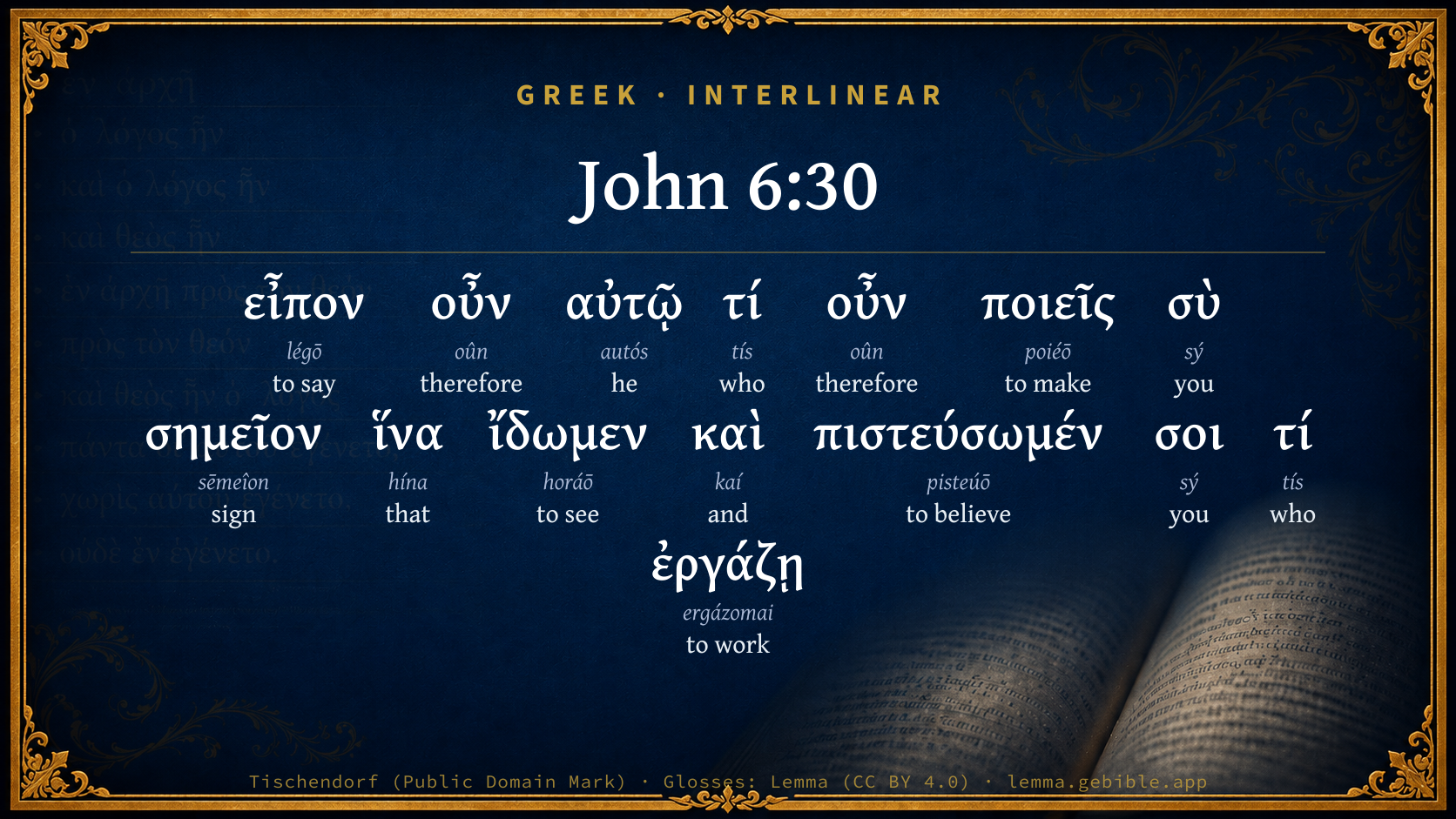
  1. εἶπον légō G3004 “to say” Verb, Aorist, Active, Indicative, 3rd person, Plural
  2. οὖν oûn G3767 “therefore” Conjunction
  3. αὐτῷ autós G846 “he” Personal pronoun, Dative, Singular, Masculine
  4. τί tís G5101 “who” Interrogative pronoun, Accusative, Singular, Neuter
  5. οὖν oûn G3767 “therefore” Conjunction
  6. ποιεῖς poiéō G4160 “to make” Verb, Present, Active, Indicative, 2nd person, Singular
  7. σὺ sý G4771 “you” Personal pronoun, 2nd person, Nominative, Singular
  8. σημεῖον sēmeîon G4592 “sign” Noun, Accusative, Singular, Neuter
  9. ἵνα hína G2443 “that” Conjunction
  10. ἴδωμεν horáō G3708 “to see” Verb, Aorist, Active, Subjunctive, 1st person, Plural
  11. καὶ kaí G2532 “and” Conjunction
  12. πιστεύσωμέν pisteúō G4100 “to believe” Verb, Aorist, Active, Subjunctive, 1st person, Plural
  13. σοι sý G4771 “you” Personal pronoun, 2nd person, Dative, Singular
  14. τί tís G5101 “who” Interrogative pronoun, Accusative, Singular, Neuter

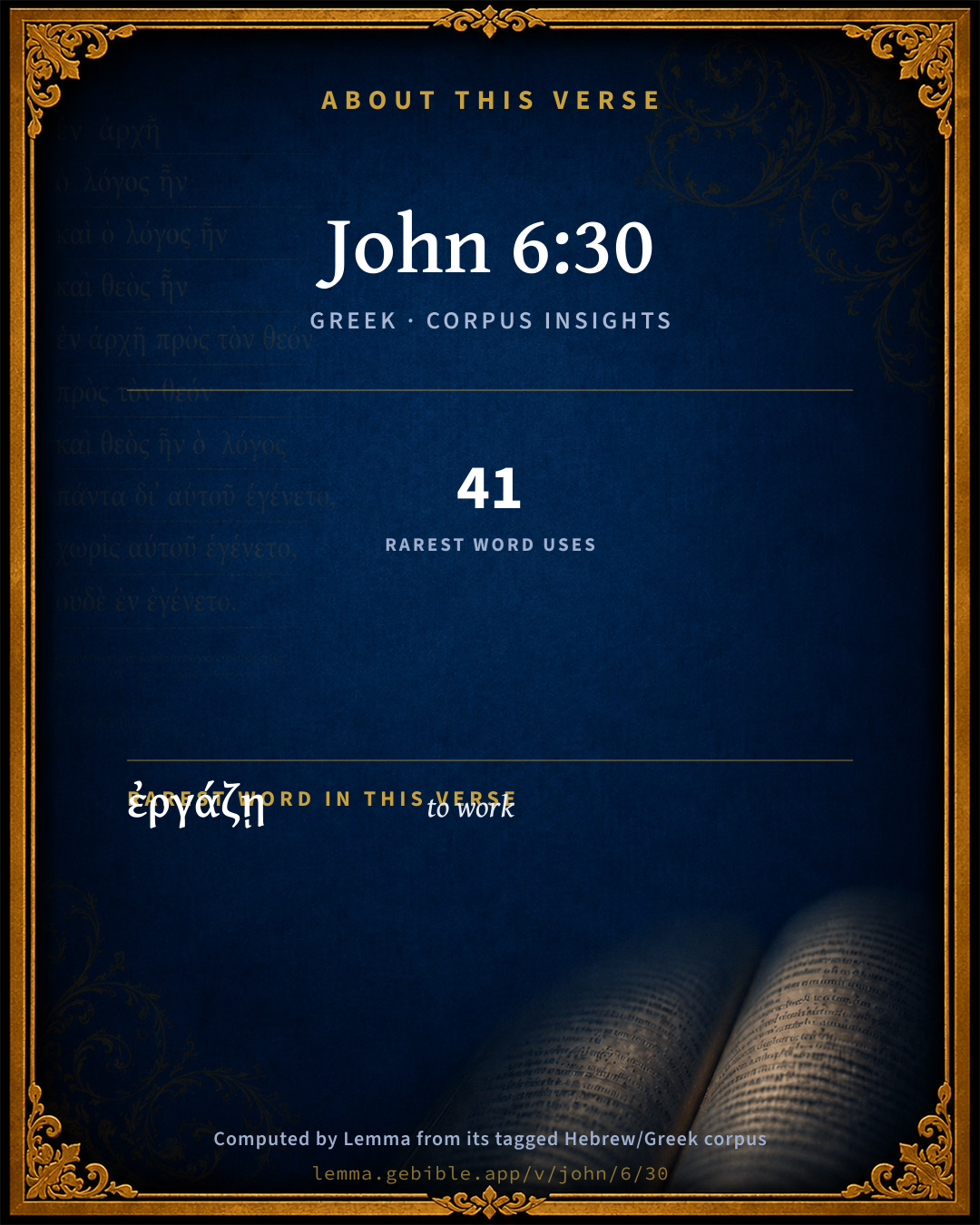
About this verse

These counts appear in no published source. They are computed here, from the morphology-tagged text and Lemma’s own curated glosses. What Lemma adds →

15
words
12
distinct lemmas
Gospels
section

Shared distinctive vocabulary

ἐργάζῃ to work G2038 occurs in 39 verses of the Greek New Testament. Also found in:
Repetition

Words recur within this verse:

Cross-references

19

Topical passages linked to John 6:30 in the Treasury of Scripture Knowledge — connected by theme and wording, ordered by reader-vote popularity; previews shown in the World English Bible.

  • John 12:37 But though he had done so many signs before them, yet they didn't believe in him,
  • John 6:36 But I told you that you have seen me, and yet you don't believe.
  • John 10:38 But if I do them, though you don't believe me, believe the works; that you may know and believe that the Father is in me, and I in the Father."
  • 1 Corinthians 1:22 For Jews ask for signs, Greeks seek after wisdom,
  • Exodus 4:8 "It will happen, if they will neither believe you nor listen to the voice of the first sign, that they will believe the voice of the latter sign.
  • 1 Kings 13:3 He gave a sign the same day, saying, This is the sign which Yahweh has spoken: Behold, the altar shall be torn, and the ashes that are on it shall be poured out.
  • 1 Kings 13:5 The altar also was torn, and the ashes poured out from the altar, according to the sign which the man of God had given by the word of Yahweh.
  • Isaiah 5:19 Who say, "Let him make speed, let him hasten his work, that we may see it; And let the counsel of the Holy One of Israel draw near and come, That we may know it!"
  • Isaiah 7:11–14 "Ask a sign of Yahweh your God; ask it either in the depth, or in the height above."
  • Matthew 12:38–39 Then certain of the scribes and Pharisees answered, "Teacher, we want to see a sign from you."
  • Matthew 16:1–4 The Pharisees and Sadducees came, and testing him, asked him to show them a sign from heaven.
  • Mark 8:11 The Pharisees came out and began to question him, seeking from him a sign from heaven, and testing him.
  • Mark 15:32 Let the Christ, the King of Israel, now come down from the cross, that we may see and believe him." Those who were crucified with him insulted him.
  • Luke 11:29–30 When the multitudes were gathering together to him, he began to say, "This is an evil generation. It seeks after a sign. No sign will be given to it but the sign of Jonah, the prophet.
  • John 2:18 The Jews therefore answered him, "What sign do you show us, seeing that you do these things?"
  • John 20:25–29 The other disciples therefore said to him, "We have seen the Lord!" But he said to them, "Unless I see in his hands the print of the nails, and put my hand into his side, I will not believe."
  • Acts 4:30 while you stretch out your hand to heal; and that signs and wonders may be done through the name of your holy Servant Jesus."
  • Hebrews 2:4 God also bearing witness with them, both by signs and wonders, and by various works of power, and by gifts of the Holy Spirit, according to his own will?
  • John 4:8 For his disciples had gone away into the city to buy food.

Cross-references courtesy of OpenBible.info (CC BY 4.0).

Commentary

Notes on John 6:30 from classic Christian and Jewish commentators (each source and its license shown beneath its notes). The classic Christian expositions comment on the surrounding passage and are grouped to its opening verse, so a note may address several verses; the Jewish commentaries on the Tanakh (Rashi and others) are per-verse, so they appear only where the commentator wrote on this verse.

Lemma curates 59 commentaries, every one of them public domain or Creative Commons licensed, each selected and text-cleaned for this edition rather than reprinted as found. About our sources →

The Biblical Illustrator

Joseph S. Exell

Joh_6:30-33

What sign showest Thou then that we may see and believe

Christ the Christians food

Hewitson writes: I think I know more of Jesus Christ than of any earthly friend.

Hence one who knew Him well remarked, One thing struck me in Mr. Hewitson. He seemed to have no gaps, no intervals in his communion with God. I used to feel, when with him, that it was being with one who was a vine watered every moment.

Christ is the true manna

Christ is heavenly meat and drink. My Father giveth you the true bread from heaven (Joh_6:32). Other meat and drink is terrene and earthly. Your bread grows out of the bowels of the earth. Your wine is the blood of an earthly grape. The flesh you eat is fed of the tender grass that springs out of the earth. If the earth should prove barren, you would soon feel a famine!, The king himself is served by the field (Ecc_5:9). It is true, the blessing comes from heaven, but all the materials of meat and drink are earthly. But Jesus Christ is the Bread of heaven and the Wine of heaven. The manna came from the clouds only; but Christ from the beautiful heaven, even from the bosom of the Father. (Ralph Robinson.)

Christ the gift of God to all men

When the Rev. Ebenezer Erskines doctrine was impugned, and his discourses complained of before the ecclesiastical courts, he was enabled to vindicate himself with great dignity and courage; and expressions sometimes fell from his lips which, for a time, overawed and confounded his enemies. On one occasion, at a meeting of the synod of Fife, according to the account of a respectable witness, when some members were denying the Fathers gift of our Lord Jesus to sinners of mankind, he rose and said, Moderator, our Lord Jesus says of Himself, My Father giveth you the true bread from heaven. This He uttered to a promiscuous multitude; and let me see the man who dares to affirm that He said wrong? This short speech, aided by the solemnity and energy with which it was delivered, made an uncommon impression on the synod, and on all that were present.

Christ gives life

Christ is such meat and drink as preserves from death. Other meat and drink cannot keep man from the grave. That rich man that fared deliciously every day was not made immortal. The rich man died and was buried (Luk_16:22). All that generation that fed on manna, and drank the water out of the rock, died (Joh_6:49). But Christ preserves the soul from death (Joh_6:50). This is the bread of God that came down from heaven, that a man may eat thereof and not die. It immortalizes the soul that feeds on it. He that believeth on Him hath eternal life (Joh_6:51). Other meat and drink cannot preserve a living body from death, much less can it give life, and restore breath to a dead body. Put the most delicate meat, the strongest drink, into the mouth of a dead man, and they will not give him life if the soul be quite departed. They may recover from a swoon, they cannot from death. But the flesh and blood of Christ quicken the dead. Christ, by putting His flesh and blood into the mouth of the dead soul, conveys life into it. His flesh and blood make the lips of the dead to speak. As the Father raiseth the dead and quickeneth them, so the Son quickeneth whom He will (Joh_5:21). If thou hast any spiritual life in thee, thou didst receive it from the enlivening virtue of Christs flesh and blood communicated to thee by the Spirit of life. (Ralph Robinson.)

Christ, like the manna, is an abundant supply

I recollect when I was able to journey through the country preaching, I for some years stayed occasionally with a fine old English farmer. He used to have a piece of beef upon the table, I do not know how many pounds it weighed, but it was enormous. I said to him one day, Why is it that whenever I come here you have such immense joints? Do you think that I can eat like a giant? If so, it is a great mistake. Look at that joint, there, I said; if I were to take it home, it might last me a month. Well, he said, if I could get a bigger bit I would, for I am so glad to see you; and if you could eat it all, you should be heartily welcome. I want everybody that comes here to-day to feel that I will do my very best for you. He did not measure my necessities to the half-ounce, but he provided on a lavish scale. I quote this homely instance of giving heartily to show you how, on a divine scale, the Lord makes ready for His guests. (C. H. Spurgeon.)

The mistakes of the Galileans

I. THE SECONDARY FOR THE PRIMARY (Joh_6:31-32). Confounding the instrument with the agent; Moses with Jehovah.

1. The man of science falls into this mistake when he talks about forces and laws otherwise than as expressions of the Divine power and will.

2. The Christian does the same when he ascribes conversion to the eloquence of a preacher instead of to the quickening influence of the Spirit Zec_4:6; Joh_6:63; Eph_2:1).

3. Every person similarly errs who forgets that every good and perfect gift comes from God (Jam_1:17).

II. THE SHADOWY FOR THE SUBSTANTIAL (verse 33). This tendency followed the Jews all through their career, and there is a like tendency when religion is made a thing of forms and ceremonies.

III. THE IMPERSONAL FOR THE PERSONAL (verse 35). The Jews imagined the bread of life to be a better sort of manna (see Joh_4:15; the samemistake). Plainly as Christ indicated this bread to be a Person they continued thinking of a thing. So do those who suppose that education, moral culture, social refinement, etc., is the bread of life.

IV. THE TRANSIENT FOR THE ETERNAL (verse 49).

1. The manna was a temporary gift; even when the Israelites ate of it they died. The bread of life on the contrary

(1) Endures into everlasting life (verse 27), and

(2) Will satisfy every want of the soul.

Lessons:

1. The men who err most in life and religion are those who walk by sight and not by faith.

2. Christ is a greater sign than any of His miracles.

3. His best recommendation is the satisfaction He imparts.

4. Men may have a desire after Christ without faith.

5. None who come to Christ in sincerity, will depart from Him in sorrow. (T. Whitelaw, D. D.)

The manna a type of Christ

I. MIRACULOUS IN THEIR ORIGIN: came down from heaven.

II. COVERED WITH NEW (2Co_4:3).

III. APPARENTLY INSIGNIFICANT (Isa_53:2).

IV. MYSTERIOUS (Isa_53:8).

V. DAILY (Exo_16:21). Give us this day is founded on this repeated miracle. Christs grace must be used continually.

VI. GATHERED BY MAN BUT GROWN BY GOD. Human and Divine meet in conversion (Joh_4:44), and Divine bounty never supersedes mans industry.

VII. ALL GATHERING HAD ENOUGH. Sincerity not the degree of faith avails Exo_16:18).

VIII. GRATUITOUS (Isa_55:1).

IX. SUFFICIENT FOR ALL.

X. OFFERED TO MURMURERS (Rom_5:8).

XI. Manna for a season the ONLY food (Act_4:12).

XII. FURNISHED IS THE WILDERNESS (Psa_78:19; Heb_6:8). (W. H. Van Doren, D. D.)

Christ the bread of life

I. Christ Is the bread of God in His personal Divine life (Joh_6:32-40).

1. The typical and the true bread of God (Joh_6:32-33).

2. The false and the true appetite for this bread (Joh_6:34-38).

3. The liberating and quickening operation of this bread (Joh_6:39-40).

II. Christ GIVES the bread of life in His giving up of His flesh in His atoning death (Joh_6:41-51).

1. He gives it not to murmurers, but to those who are drawn and taught of the Father (Joh_6:41-47).

2. He gives it with the full partaking of eternal life (Joh_6:48-50).

3. He gives it in giving Himself (Joh_6:51).

4. He gives it in giving His flesh for the life of the world (Joh_6:51).

III. Christ INSTITUTES the meal of life in making His flesh and blood a feast of thank-offering to the world (Joh_6:52-59).

1. The offence at the words concerning the flesh of Christ (Joh_6:52).

2. The heightening of the offence by the fourfold assertion concerning the flesh and blood of Christ (Joh_6:53-56).

3. The ground of this assertion; the life of Christ is in the Father (Joh_6:57).

4. The conclusion of this assertion (Joh_6:58-59).

IV. Christ TRANSFIGURES the meal of life into a meal of the Spirit (verse 60-65)

1. By His exaltation (Joh_6:62).

2. By His sending the spirit (Joh_6:63).

3. By His word (Joh_6:63).

4. By the excision of unbelievers (Joh_6:64). (J. P. Lange, D. D.)

The bread of life contrasted with manna

1. The manna could not detain for one moment the fleeting spirit of man; but the bread of life, like the tree of life, imparted immortality.

2. That was from the air; this from the real heaven of heavens.

3. That nourished the decaying body; this the never dying soul.

4. That left the multitude, after a few hours, hungry still; he who eats of this will never hunger. (W. H. Van Doren, D. D.)

Come down from heaven

I. WE HAVE A DIVINE LIFE IN CHRIST, because He has come from God to be the author of life for us.

II. THIS LIFE IS NEAR (Deu_30:12-13; Rom_10:6-8). No man could ascend up, therefore Christ came down. (John Calvin.)

I. WHAT IS IT TO LIVE.

Life in Christ

1. Anything lives when it fills up the capacity of its being. Animal life does not consist in material force but in organic vitality. In man, however, we see the added element of spiritual existence.

2. Here comes up the everlasting fact that man is not like the brute satisfied with meat and drink, but yearns for what is beyond. And as there is harmony in the universe there must be something more than the material for man.

II. THE HIGHER NATURE MUST HAVE ITS FOOD, OR IT DIES. Christ saw the spiritual nature of man in all its priceless capacity and quenchless immortality, and to that He addressed Himself when He bade His hearers eat of His flesh and drink of His blood.

III. EACH KIND OR NATURE IN THE UNIVERSE IS LINKED IN ITS OWN CHAIN OF DEPENDENCIES. The body depends on things material; but the moment we look on the spirit of man we must ascribe it to some higher source than matter. The affection of the human heart; the yearning for the beautiful and the good; the intellect; the sense of sin and moral freedom, whence came they? If you could take away every other proof of the existence of God, this spirit proves the Being of a moral and intelligent Source over and above the material world.

IV. EACH THING IS LINKED TO THINGS OF ITS OWN KIND.

1. The soul, living, intelligent, and morally conscious, is linked to an intelligent and moral God, and by Him, and in Him alone, can it live. It cannot link itself to mere sensation and matter.

2. Jesus brings men into communion with that infinite intelligence, love, and freedom by bringing mans soul into communion with Himself, so that living in Him we live in the Father, and as Christ becomes assimilated to our inner spiritual being, so we truly live.

V. WE NOT ONLY LIVE IN, BUT BY JESUS. This brings into view His essential personality. I am the Bread, the Way. He that believeth in ME, etc. No other teacher ever so spoke. Plato or Confucius may have said, Believe this truth, but never, I am the truth, believe in me. Christ saves us not merely by the truth He revealed, but by Himself.

VI. THIS LIFE IS A PRESENT EXPERIENCE. Not merely is going to live, but liveth. Religion is an end as well as a means. It is not simply something that helps us to live by and by, but something by which we live now. The great essential things are those we live by, not for. Bread, water, air--we do not live for them, but by them. So we live by religion, heaven, Christ, not for them. Conclusion:

1. See what an argument this is for the truth of the religion of Jesus, because it shows us how we truly live. We live by Jesus now because

(1) He fills up our higher faculties;

(2) draws out our best affections;

(3) gives us the truth of our higher being.

2. Have you ever really lived? (E. H. Chapin, D. D.)

Jewish traditions connecting the manna with the Messiah

There was a tradition that as the first Redeemer caused the manna to fall from heaven, even so should the second Redeemer cause the manna to fall. For this sign, then, or one like it, the people looked from Him whom they were ready to regard as Messiah (cf. Mat_16:1; Mar_8:11)

. Philo says, When the people sought what it is which feeds the soul, for they did not, as Moses says, know what it was, they discovered by learning that it is the utterance of God and the Divine Loges from which all forms of instruction and wisdom flow in a perennial stream. And this is the heavenly food which is indicated in the sacred records under the person of the First Cause, saying, Behold I rain on you bread out of heaven! (Exo_14:4). For in very truth God distils from above the supernal wisdom on noble and contemplative minds, and they, when they see and taste, in great joy, know what they experience, but do not know the power which dispenses the gift. Wherefore they ask, What is this that is sweeter than honey and whiter than snow? But they shall all be taught by the prophet that this is the Bread which the Lord gave them to eat (Exo_16:15). (Bp. Westcott.)

The Biblical Illustrator, edited by Joseph S. Exell (c. 1880s–1900s) — public domain. Text from a community e-Sword module.

Joseph Benson's Commentary

Joh 6:30-31. They said, What sign showest thou — What miracle dost thou work; that we may see and believe thee? — Since thou requirest us to give thee credit, and to regard thee as invested with a higher character than has been claimed by any one before, produce thy credentials; give some evidence of a superior kind to what has been done by others. Thus these unreasonable men speak, though they had just before seen the astonishing miracle of the loaves and fishes, one of the most extraordinary displays of creating power that could well be conceived, and though several of them lived in the neighbourhood of Capernaum, where he had long multiplied his wonders! But the greatest miracles are lost on persons who are blinded by prejudice, and whose minds are earthly, sensual, and devilish! The views and opinions, however, of those that speak to Christ in this discourse, are so various, (compare Joh 6:34; Joh 6:41-42,) and the evangelist so expressly declares that there was a debate between some and others of them, (Joh 6:52,) that it would be wrong to imagine these to have been the perverse and ungrateful sentiments of the whole multitude, who had followed him with so much eagerness from place to place, for several days. Our fathers did eat manna — By extolling the miracle of the manna, and by calling it bread from heaven, and by insinuating that it was Moses’s miracle, the Jews endeavoured to disparage both Christ’s mission and his miracle of the loaves, which they affected to despise, as no miracle in comparison. It was only a single meal of terrestrial food, at which nine or ten thousand had been fed: whereas Moses with celestial food, fed the whole Jewish nation, in number upward of two millions, and that not for a day, but during the space of forty years in the wilderness.

Joseph Benson's Commentary on the Old and New Testaments (1811–1818) — public domain. Text from a community e-Sword module.

Tyndale Open Study Notes

Tyndale Open Resources

6:30 The crowd demanded a miraculous sign to demonstrate Jesus’ status as Messiah. Jews believed that when the Messiah appeared, he would duplicate the great miracle of Moses. Manna would once again fall, and everyone would consider it a second exodus.

Tyndale Open Study Notes — © Tyndale Open Resources, licensed CC BY-SA 4.0. Text via the HelloAO Bible API.

Bengel's Gnomon

Johann Albrecht Bengel

Joh 6:30. Σύ, Thou) So they speak in antithesis to Moses, who gave them the manna, and had this sign [to show in proof of his mission]; and they demand from Jesus something greater and more immediately from heaven; which they do not think can be given by Him, nor do they recognise Jesus as one greater than Moses.—σημεῖον, sign) The seal, which is mentioned at verse 27, “Him hath God the Father sealed,” they do not recognise.—ἴδωμεν, we may see) that Thou hast been sent by God. And yet they had seen, Joh 6:14, “They had seen the miracle that Jesus did” [the feeding of the 5000]; 26, 36, “Ye also have seen Me, and believe not.”—σοί, Thee) Jesus had said, Joh 6:29, “That ye believe on Him whom God hath sent,” [i.e.] on Me. It is often all the same to say, I believe in Thee, and I believe Thee: but here the Jews lower the sentiment of the Lord.[127]—τὶ ἐργάζῃ, what dost Thou work) They reply to the Lord, retorting His own word, to work [ἐργάζεσθε, Joh 6:27]. Thou desirest us, say they, to work [labour, Joh 6:27]: what then dost Thou work Thyself?

[127] Impair it by using the less forcible σοί, instead of εἰς σέ.—E. and T.

Bengel's Gnomon of the New Testament — English translation (T&T Clark, Edinburgh, 1860) — public domain. Text from a community e-Sword module.

Meyer's Critical & Exegetical Commentary

Heinrich August Wilhelm Meyer

Joh_6:30-31. Οὖν] What doest thou, therefore, as a sign? for they knew well enough that by ὃν ἀπέστ. ἐκεῖνος He meant Himself, and that, too, as Messiah. Hence also the emphatic σύ, thou, on thy part. The question itself does not imply that it is asked by those who had not seen the miraculous feeding the day before (Grotius), or by prominent Jews in the synagogue (Kuinoel, Klee). Moreover, this demand for a sign after the miracle of the feeding must not be regarded as contradictory and unhistorical (Kern, B. Bauer, Weisse), nor as a proof of the non-Johannine origin (Schweizer), or non-miraculous procedure (Schenkel), in the account of the feeding. For the questioners, in their ἀναίσθησις (Chrysostom), indicate at once (Joh_6:31), that having been miraculously fed with earthly food, they, in their desire for miracles, require something higher to warrant their putting the required faith in Him, and expect a sign from heaven, heavenly bread, such as God had given by Moses. Thus they explain their own question, which would be strange only if Joh_6:31 did not immediately follow. Their eagerness for Messianic miraculous attestation (Joh_6:14-15) had grown during the night. This also against De Wette, who, with Weisse, concludes that this discourse was not originally connected with the miraculous feeding; see, on the contrary, Brückner.

τί ἐργάζῃ] a sarcastic retorting of the form of the requirement given, Joh_6:27; Joh_6:29. Not to be explained as if it were τί σὺ ἐργ. (De Wette), but what dost thou perform (as σημεῖον)?

γεγραμμ.] a free quotation of Psa_78:24; comp. Psa_105:40, Exo_16:4, where the subject of ἔδωκεν is God, but by the medium of Moses, this being taken for granted as known (Joh_6:32). The Jews regarded the dispensing of the manna as the greatest miracle (see Lampe). As they now regarded Moses as in general a type of Christ (Schoettgen, Hor. II. p. 475), they also hoped in particular, Redemtor prior descendere fecit pro iis manna; sic et redemtor posterior descendere faciet manna. Midrash Coheleth, f. 86. 4.

Meyer — Critical and Exegetical Commentary on the New Testament — English translation by Peter Christie, edited by Frederick Crombie (T&T Clark, 1880) — public domain. Text from a community e-Sword module.

Geneva Bible (1599)

Geneva Bible translators

The spiritual virtue of Christ is contemned of them which are desirous of earthly miracles.

Geneva Bible (1599) marginal notes — public domain. Text via Bolls.life.

Jamieson, Fausset & Brown

Robert Jamieson, A. R. Fausset & David Brown

What sign showest thou, &c.--But how could they ask "a sign," when many of them scarce a day before had witnessed such a "sign" as had never till then been vouchsafed to men; when after witnessing it, they could hardly be restrained from making Him a king; when they followed Him from the one side of the lake to the other; and when, in the opening words of this very discourse, He had chided them for seeking Him, "not because they saw the signs," but for the loaves? The truth seems to be that they were confounded by the novel claims which our Lord had just advanced. In proposing to make Him a king, it was for far other purposes than dispensing to the world the bread of an everlasting life; and when He seemed to raise His claims even higher still, by representing it as the grand "work of God," that they should believe on Himself as His Sent One, they saw very clearly that He was making a demand upon them beyond anything they were prepared to accord to Him, and beyond all that man had ever before made. Hence their question, "What dost Thou work?"

Jamieson, Fausset & Brown — Commentary Critical and Explanatory on the Whole Bible (1871) — public domain (CC PDM 1.0). Text via the HelloAO Bible API.

Adam Clarke's Commentary

Verse 30. What sign] τισημειον, What miracle; so the word is evidently used, Joh 2:11; Joh 2:23, and in many other places.

That we may see, and believe thee] That, having seen the miracle, we may believe thee to be the promised Messiah. They had already seen the miracle of the five loaves, and did not believe; and it was impossible for them to see any thing more descriptive of unlimited power and goodness. Even miracles themselves are lost on persons whose hearts are fixed on the perishing things of the world, and whose minds are filled with prejudice against the truth.

Adam Clarke's Commentary on the Bible (1810–1826) — public domain. Text from a community e-Sword/MySword module.

John Calvin's Commentaries

30. What sign doest thou? This wickedness abundantly proves how truly it is said elsewhere, This wicked generation seeketh a sign, (Matthew 12:39.) They had been at first drawn to Christ by the admiration of his miracles or signs, and afterwards, through amazement at a new sign, they acknowledged Christ to be the Messiah, and, with that conviction, wished to make him a king; but now they demand a sign from him, as if he were a man unknown to them. Whence came such sudden forgetfulness, but because they are ungrateful to God, and, through their own malice, are blind to his power, which is before their eyes? Nor can it be doubted that they treat disdainfully all the miracles which they had already beheld, because Christ does not comply with their wishes, and because they do not find him to be what they imagined him to be. If he had given them expectation of earthly happiness, he would have been highly applauded by them; they would undoubtedly have hailed him as a Prophet, and the Messiah, and the Son of God; but now, because he blames them for being too much addicted to the flesh, they think that they ought not to listen to him any more. And in the present day, how many are there who resemble them! At first, because they promise to themselves that Christ will flatter their vices, they eagerly embrace the gospel, and call for no proof of it; but when they are called to deny the flesh and to bear the cross, then do they begin to renounce Christ and ask whence the gospel came. In short, as soon as Christ does not grant their prayers, he is no longer their Master.

John Calvin's Commentaries (1540-1563) — public domain. Text from the Calvin Translation Society English edition (1840s-50s) via the Christian Classics Ethereal Library (ccel.org). Calvin's coverage is partial (roughly two-thirds of the Bible); uncommented books and verses are honest gaps, never fabricated. The 19th-century editor's footnotes and remarks are omitted so the notes are faithfully Calvin's own voice.

Ellicott's Commentary for English Readers

(30) What dost thou work?—They feel that His words are an assertion that He is the Messiah, and they demand of Him Messianic signs and works. Do they demand a sign who had seen the thousands fed, and would then have made Him a king? It was but yesterday that He was obliged to withdraw from the enthusiasm of the multitude. Do they today need a further proof? The answer is to be found partly in the fact that a feeling soon quickened is soon cooled, and that even the disciples had not learnt the true meaning of the earlier sign (Joh_6:19); and partly in the fact that He Himself had taught them since, that the work of life was spiritual and eternal, and that He too could give them that food. This seems to them a claim to a power in the world of spirit analogous to that which He had exercised in the world of matter. They demand proof of this power. Where is the sign of it? What is the work that He Himself does answering to the work of faith which He demands from them?

A Bible Commentary for English Readers, edited by Charles John Ellicott (1878–1897) — public domain. Text from a community e-Sword module.

The Cambridge Bible for Schools and Colleges

gen. ed. J. J. S. Perowne

30. What sign shewest thou then] ‘Thou’ is emphatic: ‘what dost Thou on Thy part?’ They quite understand that in the words ‘Him whom He hath sent’ Jesus is claiming to be the Messiah; but they want a proof. Their enthusiasm had cooled, their curiosity had increased, during the night. After all, the feeding of the 5000 was less marvellous than the manna, and Moses was not the Messiah. Note that whereas He uses the strong form, ‘believe on Him,’ they use the weak one, ‘believe Thee.’ See last note on Joh_1:12.

what dost thou work] They purposely choose the very word that He had used in Joh_6:29. The emphasis is on ‘what.’

The Cambridge Bible for Schools and Colleges (gen. ed. J. J. S. Perowne; Cambridge University Press, 1878–1918) — public domain. Text from a community e-Sword module.

John Gill's Exposition

Our fathers did eat manna in the wilderness,.... Which was a sort of food prepared by angels in the air, and rained down from thence about the tents of the Israelites; it was a small round thing, as small as the hoar frost on the ground; it was like a coriander seed, and the colour of it was the colour of bdellium: it was so called, either from "to prepare", because it was prepared, and got ready for the Israelites; or from the first words that were spoken upon sight of it, , "what is it?" for they knew not what it was: and this the Jewish fathers fed upon all the while they were in the wilderness, till they came to Canaan's land, and they only; it was food peculiar to them: "our fathers did eat"; and so the Jews (f) observe on those words in Exo 16:35,

""and the children of Israel did eat manna forty years"; the children of Israel, , "not another". And the children of Israel saw, and said, what is it? and not the rest of the mixed multitude.''

Now these Jews object this miracle to Christ, and intimate, that he indeed had fed five thousand of them with barley loaves, and fishes, for one meal; but their fathers, in the times of Moses, to the number of six hundred thousand, and more, were fed, and that with manna, very sweet and delightful food, and for the space of forty years; even all the white they were in the wilderness: and therefore, unless he wrought as great a miracle, or a greater than this, and that of the like kind, they should not think fit to relinquish Moses, and follow him; and in proof of what they said, they produce Scripture,

as it is written in Psa 78:24, or rather in Exo 16:15; and perhaps both places may be respected:

he gave them bread from heaven to eat; they leave out the word Lord, being willing it should be understood of Moses, to whom they ascribed it, as appears from the following words of Christ, who denies that Moses gave it; and add the phrase "from heaven", to set forth the excellent nature of it, which is taken from Exo 16:4, where the manna, as here, is called "bread from heaven".

(f) Zohar in Exod. fol. 75. 2.

John Gill's Exposition of the Whole Bible (1746–1763) — public domain (CC PDM 1.0). Text via the HelloAO Bible API.

Trapp's Complete Commentary

John Trapp

30 They said therefore unto him, What sign shewest thou then, that we may see, and believe thee? what dost thou work?

Ver. 30. What sign showest thou?] sc. From heaven; such as manna was {See Trapp on "Mat 12:38"} for otherwise, they lacked no signs. But Christ’s doctrine discontented them: and hence these peevish questions, or cavils rather, all to slip collar. In the kingdom of Congo, in Africa, the Portuguese, at their first arrival, finding the people to be heathens and without God, did induce them to a profession of Christ, and to be baptized in great abundance, allowing for the principles of religion; until such time as the priests pressed them to lead their lives according to their profession; which the most part of them in no case enduring, they returned back again to their gentilism, forgetting also soon after the very names they received when they were baptized.

John Trapp, A Commentary or Exposition upon All the Books of the Old and New Testament (1647–1656) — public domain. Text from a community e-Sword module.

Albert Barnes' Notes on the Bible

What sign showest thou? - On the word sign, compare the notes at Isa 7:14. What miracle dost thou work to prove that thou art the Messiah? They had just seen the miracle of the loaves in the desert, which was sufficient to show that he was the Messiah, and it would seem from the preceding narrative that those who crossed the lake to see him supposed that he was the Christ. It seems wonderful that they should so soon ask for further evidence that he was sent from God; but it is not improbable that this question was put by other Jews, rulers of the synagogue, who happened to be present, and who had not witnessed his miracles. Those men were continually asking for signs and proofs that he was the Messiah. See Mat 12:38-39; Mar 8:11; Luk 11:29. As Jesus claimed the right of teaching them, and as it was manifest that he would teach them differently from what they supposed Moses to teach, it was natural to ask him by what authority he claimed the right to be heard.

Albert Barnes' Notes on the Bible (1834–1885) — public domain. Text from a community e-Sword/MySword module.

Haydock's Catholic Bible Commentary

What sign then dost thou shew? And foreseeing that he might, with great propriety, allege the recent miracle, they contrast it with what Moses performed in the desert. It is true, they say, you once fed 5,000 persons with five loaves; but our fathers, to the number of 600,000 did eat, not for once, but during forty years, manna in the desert; a species of food infinitely superior to barley bread. (Bible de Vence) See Numbers i. 46.

George Leo Haydock (1774–1849), Haydock's Catholic Family Bible and Commentary, 1859 edition — public domain. Excludes Psalms (Douay-Rheims chapter numbering differs from Protestant) and Deuterocanonical books (Catholic canon only).

Matthew Poole's English Annotations

They thought it reasonable, that he who brought forth a new doctrine into the world (such as faith in him was, they having never heard any such thing from their doctors the Pharisees) should confirm his mission by some miraculous operation. But this was a strange stupidity, considering the sign he had so lately showed them, of feeding five thousand with five loaves and two fishes. So it was manifest they sought for a sign, not to promote or confirm their faith, but merely to feed their curiosity; and what our Saviour said, Mat 12:39, An evil and adulterous generation seeketh after a sign, was truly applicable to them; and those words,

believe thee, eminently confirm it; for the aforesaid miracle speaking in him a creative power, and being such as was never wrought by any creature, they were obliged to believe him, without any further sign. God ought to be believed upon his bare word.

Matthew Poole's English Annotations on the Holy Bible (1683–1685) — public domain. Text from a community e-Sword/MySword module.

Whedon's Commentary on the Bible

Daniel D. Whedon

30. What sign—Here they propose to negotiate. Can you, like Moses, furnish us a free maintenance for life from the skies? The bountiful rural repast he has already furnished induces them to think that he can. The reality of that sign they do not propose to question but to waive; and this proposal of a sign is simply an opening the way for a consent on his part, that the sign of Moses shall be accorded them, namely, manna for their future living. Let that come and he shall be their crowned Messiah. The perplexity of a Strauss, how these men should ask for a sign when they had just seen and tasted so great a sign as the miraculous bread, manifests a comprehension not much higher than theirs.

Daniel D. Whedon (gen. ed.), Commentary on the Old and New Testaments (1874–1909) — public domain. Text from a community e-Sword module.

The Pulpit Commentary

They said therefore to him, What then doest thou as a sign that we may see and believe thee? There is a kind of irony in the inquiry, "What doest thou?" There is at least some ironical mystification of the words of Jesus, "If we have not seen, as thou sayest, the sign, which we thought sufficient to induce us to hail thee as our Prophet-King, what sign wilt thou give us now? If we are to believe on thee, what sign art thou ready to show now that we may see it, and believe thee, i.e. take thy word as trustworthy, and so begin to consider whether it will be safe to believe in, to entrust ourselves to, thee?" It has been the peculiarity of the Jewish mind in all ages to seek after a sign, to desire some irresistible reason for invincible faith. In certain stages of immaturity and states of unrest we passionately ask for signs even now for something more than silent words, for more than past memories, for some voice out of heaven, some gleams of glory, that "we may see and believe." These frames of mind are no whit more reprehensible than the Greek demand for unanswerable argument, for logical harmony, or for sure demonstration. They said to him, What dost thou work? How wilt thou vindicate thy demand for such implicit trust? This very question has been made into a reason for breaking all historic connection between the miracle of the feeding and the dialogue and discourse before us (Grotius, Kuinoel, B. Bauer, Weisse, and Schenkel). It is, however, clear that they were still revolving the work of the past day, which Jesus had depreciated per se, and which, apart from the higher lesson it might have conveyed to them, and apart from the wrong conclusion they had been drawing from it, grievously perplexed them, and seemed insufficient to establish the new claim of Jesus. They, too, begin to depreciate it in comparison with a corresponding sign which Moses had wrought for their fathers. Verily if Moses had been the mediator of the portentous sign of the manna, if Moses had been its real anther, it was a much greater sign than what they witnessed at Bethsaida. For forty years the miraculous bread had been lavished upon them. Daily and weekly it proved its supernatural character. In quantity, quality, prolongation, and renewal day by day, and in its cessation when they ate the fresh corn of Canaan, they not unnaturally saw something immeasurably more vast and imposing than the offer of a single meal to a little company of five thousand men. Christ had wrought a terav , an ergon , but they had not seen the real shmeion involved in it. He himself suggested that something entirely different from that meal, and different from their conclusions concerning it was the true "sign." Let him work the same adequate sign. They are not repudiating all knowledge of the feeding of the five thousand, nor revealing their ignorance of it. They are thrown back on their ingrained passion for supernatural proof, not as yet satisfied by what Christ had done.

Vers. 30-33. The nature of the gift from heaven.

The Jews demanded "a sign from heaven.

I THEM DEMAND FOR A FRESH MIRACLE. "What sign then dost thou do, that we may see, and believe in thee? what dost thou work?

1. They thought they were entitled to demand a fresh miracle, much in advance of the miracle at Bethsaida Julius; because that was, after all, not so remarkable as the miracle of the manna in the wilderness. "Our fathers did eat manna in the desert; as it is written, He did give them bread from heaven to eat.

1. They still evidently understood the higher benefit promised by our Lord as material, and not spiritual.

2. They meant, by their seeing and believing in Christ. to reduce faith to a mere matter of sight a mere belief of truth in the testimony of their senses. They were quite unspiritual in their conceptions.

II OUR LORD"S ANSWER TO THEIR DEMAND. He corrects their misapprehensions.

1. He asserts that it was not Moses, but God, who fed the people with manna. "Moses gave you not the bread from heaven." It was a truly Divine work to feed two millions of people in the desert from day to day. Therefore there could be no comparison between Moses and Christ.

2. He asserts that the Bread he speaks of is yet material, but spiritual. "But my Father giveth you the true Bread from heaven. For the Bread of God is he who cometh down from heaven, and giveth life unto the world.

(1) Mark how gradually our Lord passes from figure to reality. The Jews think of bread like manna; Jesus speaks of himself, though he has not yet directly done so.

(2) The Bread from heaven was true Bread, because it satisfied the deepest wants of man"s nature. It had true life-giving, life-upholding virtue.

1. It was continuous in its supply of man"s wants. "It cometh down from heaven.

2. It was not limited to one people, but offered to the whole race of man. The age of Jewish particularism was past.

The Pulpit Commentary (1880–1919), ed. H.D.M. Spence-Jones & Joseph S. Exell — public domain. Text from a community e-Sword module.

John Wesley's Explanatory Notes

What sign dost thou? - Amazing, after what they had just seen!

John Wesley, Explanatory Notes Upon the Whole Bible (1754–1765) — public domain. Text via the GEBible commentary corpus.

Kretzmann's Popular Commentary

Paul E. Kretzmann

Bread from heaven:

v. 30. They said therefore unto Him, What sign showest Thou, then, that we may see, and believe Thee? What dost Thou work?

v. 31. Our fathers did eat manna in the desert; as it is written, He gave them bread from heaven to eat.

v. 32. Then Jesus said unto them, Verily, verily, I say unto you, Moses gave you not that bread from heaven; but My Father giveth you the true Bread from heaven.

v. 33. For the Bread of God is He which cometh down from heaven and giveth life unto the world.

v. 34. Then said they unto Him, Lord, evermore give us this bread.

That Jesus demanded faith in Himself as a condition of their obtaining salvation, this the Jews now understood. They therefore demanded proof of His ambassadorship and of His ministry, which, as He claimed, elevated Him to the divine rank. It is a most peculiar thing that they did not yet understand the relation between the miracles of Jesus and His divine mission, His deity. They challenge Him to produce some extraordinary sign which would convince them beyond question, which would oblige them to believe. They put the matter so as to make Him responsible for their faith or unbelief. They expect a sign from Him something like that of Moses, who produced manna for the Israelites in the wilderness. They refer to a passage from Scripture, Psa 78:24-25, which speaks of this wonderful feeding with bread from heaven. In a way, the expression "bread from heaven" could stand, since the manna had fallen down from the sky with the dew, but at best this was merely a figurative expression. Jesus therefore declares, with great emphasis: Not Moses gave you bread from heaven, but My Father gives you the true Bread from heaven. Even in the desert it was not Moses that gave the children of Israel the manna, and so, at best, Moses can be spoken of in this connection by courtesy only; he had nothing to do with the miracle. But here matters are different; here is the true Bread from heaven given to all men by the Father. He that comes down from heaven with the purpose of giving life to the world, He is the Bread of God, Jesus the Savior. He is the Bread from heaven in deed and in truth, and by His work of giving salvation He establishes that fact beyond doubt. This saying impressed the Jews very deeply; they had but a faint conception of what the Lord might mean in speaking of this wonderful Bread, something like the woman of Samaria. They begged Jesus that He would always, at all times, give them that bread. Their understanding was still not clear, but they have caught enough of His earnestness and enthusiasm, and desire plain information. Note: A great deal has been gained if we can get the unbelievers to ask questions concerning Jesus and His salvation, perhaps persuade them of the fact that Christianity in itself is worthwhile, invite them to come to church.

Paul E. Kretzmann, Popular Commentary of the Bible (1921–1924) — public domain. Text from a community e-Sword module.

Burkitt's Expository Notes on the New Testament

William Burkitt

Here the Jews tell our Saviour, that, before they will believe in him, they must see some sign from him, to confirm his doctrine, and prove him to be the Messias; they acknowledge Christ had wrought a great miracle in feeding five thousand persons with five barley loaves; but Moses fed their fathers in the wilderness, who were no less than six hundred thousand persons, with excellent manna from heaven, and this for forty years together; from whence they would seem to conclude, that they had more reason to believe Moses than Christ: not considering that Moses was but an instrument to obtain, by prayer the manna at the hands of God: but Christ was an agent, and that, by a creating power inherent in himself, he multiplied the five loaves to the feeding of five thousand.

Note, here, From the Jews requring a sign before they would believe, that he who publishes a new doctrine to the world, ought to confirm his mission by some miraculous operation.

2. That God honoured moses, his messenger, very much, and Christ his minister much more, in that both of them wrought great and special miracles for the confirmation of their mission.

3. That the Jews not believing Christ to be the true Messias, upon so many attestations, and after his divine mission was confirmed by such miraculous operations, rendered their infidelity inexcusable, and their obstinacy invincible.

William Burkitt's Expository Notes on the New Testament (1700–1703) — public domain. Text from a community e-Sword module.

The People's New Testament

B. W. Johnson

30. What sign shewest thou then, that we may see, and believe thee? He had pointed to himself as the object of faith, making his claim, such as had never been made by mortal man. He had spoken of his seal, or sign. They ask now for a sign.

B. W. Johnson's The People's New Testament with Notes (1889–1891) — public domain. Electronic text from the Christian Classics Ethereal Library (CCEL) ThML edition.

unfoldingWord translationNotes

Door43 World Missions Community

Our fathers

"Our forefathers" or "Our ancestors"

heaven

This refers to the place where God lives.

translationWords

miracle

ancestor

manna

desert

written

heaven

unfoldingWord translationNotes — © Distant Shores Media and the Door43 World Missions Community, licensed CC BY-SA 4.0. Source: git.door43.org/Door43/en_tn.

Cambridge Greek Testament for Schools and Colleges

30. τί … σὺ σημ.; Σύ is emphatic: ‘Thou urgest us to work; what doest Thou on Thy part?’ They quite see that in δν ἀπέστ. ἐκ. He is claiming to be the Messiah, and they require proof. The feeding of the 5000 was less marvellous than the manna, and the Messiah must shew greater signs than Moses. They demand ‘a sign from heaven,’ as so often in the Synoptists. Note that whereas He used the strong πιστεύειν εἰς ὅν they use the weak πιστεύειν σοι (see on Joh 1:12): πιστεύειν τινί occurs Joh 4:21, Joh 5:24; Joh 5:38; Joh 5:46, Joh 14:11; comp. Joh 2:22, Joh 4:50; it means no more than to believe a man’s statements, as distinct from trusting in his person and character.

τί ἐργάζῃ; They use the very word that He used in Joh 6:29.

Cambridge Greek Testament for Schools and Colleges (Cambridge University Press, 1896; 21 vols, various authors incl. Carr, Maclear, Plummer, Farrar, Lumby, Moule, M. R. James, Simcox) — public domain. Text from a community e-Sword module.

International Critical Commentary

30. τί οὖν ποιεῖς σὺ σημεῖον; A similar demand made by the Pharisees for a “sign from heaven” is placed in Mar 8:11 (so Mat 16:1; cf. Mat 12:38) as following on the Feeding of the Four Thousand. There, as here, Jesus is represented as having declined (and with indignation) the request. Lk. does not tell the story of this second miraculous feeding, and he puts the request for a sign in a different context (11:16; cf. also 23:8).

Like the Pharisees in Mar 8:11, the interlocutors in the Johannine story were not convinced that by the miraculous feeding Jesus had established His claim to be a messenger from God. Some, at least, of those who had seen it said that He was the expected prophet, and were for making Him a king (vv. 14, 15). But by the next day all were not so fully persuaded. If Jesus were really a Divine messenger, they expected something more. They were not satisfied as to the character of the action which had been acclaimed by them as a σημεῖον (v. 14). So, like the Jews in 2:18, who had asked τί σημεῖον δεικνύεις ἡμῖν; they now ask τί ποιεῖς σὺ σημεῖον; the emphatic word here being σύ, “What sign do you show?”

ἵνα ἴδωμεν καὶ πιστεύσωμέν σοι. They did not understand what He had meant by “believing in Him” (v. 29), for they take up the words in the altered form “believe thee.” They imply that if they saw a really convincing sign, something greater than anything they had witnessed yet (vv. 2, 14, 26), they would believe Him, that is, believe His words (cf. 8:31). But this is not what Jesus claimed of them. To believe His words would be, no doubt, the beginning of discipleship, and of faith in His Person (see on v. 29); but it would not be enough εἰς ζωὴν αἰώνιον.

τί ἐργάζῃ; They think that Jesus has been referring to manna, and they ask Him to provide it (see Introd., p. cxi). ἐργάζῃ refers back to vv. 28, 29.

International Critical Commentary — older volumes (1896–1929), various authors — public domain. Text from a community e-Sword module.

Vincent's Word Studies in the New Testament

Marvin R. Vincent

Therefore. Since He had claimed to be the One sent of God.

Marvin R. Vincent, Word Studies in the New Testament (1887–1900) — public domain. Text from a community e-Sword/MySword module.

Godet's Commentaries

Frédéric Louis Godet

3. Vv. 30-33. The way to reach faith.

Vv. 30, 31. “Then they said to Him: What sign doest thou then, that we may see, and believe in thee? What work dost thou do? 31. Our fathers ate the manna in the wilderness, according as it is written: He gave them bread from heaven to eat.”

It is difficult to imagine these words on the lips of people who had been present the day before at the multiplying of the loaves. B. Bauer saw herein a proof of the non-authenticity of the narrative. Schweizer concluded from it that the whole preceding passage was interpolated. Grotius and others think that these interlocutors who speak thus had not been present at the scene of the preceding day. De Wette and Weiss suppose that this part of the conversation is located here out of its true place. Lucke, Luthardt, Meyer find here the proof of the psychological truth that the natural man is insatiable in respect to wonders. Riggenbach, and up to a certain point Weiss, recall the scarcely apparent way in which the multiplying of the loaves had been accomplished. The creative operation had not been seen. Others think that Jesus’ hearers contrast this quite ordinary bread which Jesus had given them with the manna, manifestly falling every morning from heaven, which Moses gave to their fathers, and that they find the first of these miracles far inferior to the second. But, however true these remarks may be, it must be confessed that they do not yet explain such questions as these: “What sign doest Thou? What workest Thou?” addressed to a man who had just done such a miracle and presented by people who had, the day before, wished to proclaim Him King.

It is necessary, I think, to take account of a circumstance strongly brought out by Weiss and Keil: the dissatisfaction felt by this multitude in consequence of the absolute refusal of Jesus to consent to the great Messianic demonstration which they had planned. And, strange fact! while refusing to be proclaimed King and Messiah, He yet claimed to be recognized as the supreme messenger of God, as the object of faith, of a faith which dispensed with all the works prescribed by the law and even with every work; as the one who brought from heaven to men an imperishable life. Was the miracle wrought on the level with such pretensions? No, it did not even raise Jesus to the height of Moses, above whom He seemed nevertheless to place Himself by arrogating such a part to Himself! It is not therefore altogether without reason that they bring out the contrast between the scarcely apparent miracle of the day before and the magnificent display of power of which Moses had been the instrument before the people during forty years. Redemptor prior descendere fecit pro iis manna; sic et Redemptor posterior descendere faciet manna, said the Rabbis (see Lightfoot and Wetstein). This, at least, is what would have been expected of Him to justify pretensions such as His! The words quoted by the Jews are found in Psa 78:24-25. Comp. Exo 16:4; Exo 16:15. The verb has given has for its subject God. The expression “from heaven” denotes, in their mouth, only the miraculous origin of the divine gift, while Jesus, in His answer, thinks above all of its essence.

Frédéric Louis Godet — Commentaries on Luke, John, Romans, and 1 Corinthians — English translation (T&T Clark, Edinburgh, 1870s–1890s) — public domain. Text from a community e-Sword module.

Lesson kit

Teaching starters — assembled from the data on this page, not authored interpretation. Every prompt links to the verse data it draws on. Edit before teaching.

John, in the Gospels, opens this verse with 15 words (12 distinct Greek lemmas). Its most distinctive word is ergázomai (“to work”). A historical commentator’s framing appears above. Read the whole chapter for the surrounding context.

Discussion questions

  1. The word ergázomai carries the sense “to work.” How does it shape the verse?
  2. Matthew 7:23 shares the word «to work» with this verse. How do the two illuminate each other?
  3. “therefore” occurs 2× in this one verse. What is the effect of the repetition?
  4. These translations render this verse differently. What is at stake in choosing one wording over another?
  5. Reading how The Biblical Illustrator and Joseph Benson's Commentary read this verse, where do the two commentators agree and where do they part?

Things to notice

  • These translations choose different wording for 7 words in this verse.
  • “therefore” occurs 2× in this single verse.
  • 12 distinct Greek lemmas span 15 words in this verse.

Reading settings

Reading text

Shown beneath each verse's original-language words.

Old Testament
Old Testament edition

Read the OT as the Masoretic Hebrew (MT) or the Greek Septuagint (LXX).

English shown for the Greek Septuagint (in the Hebrew ↔ Greek comparison).

Comparing translations? Open the Compare panel on any verse page to stack up to four side by side.