
Exodus 4:17

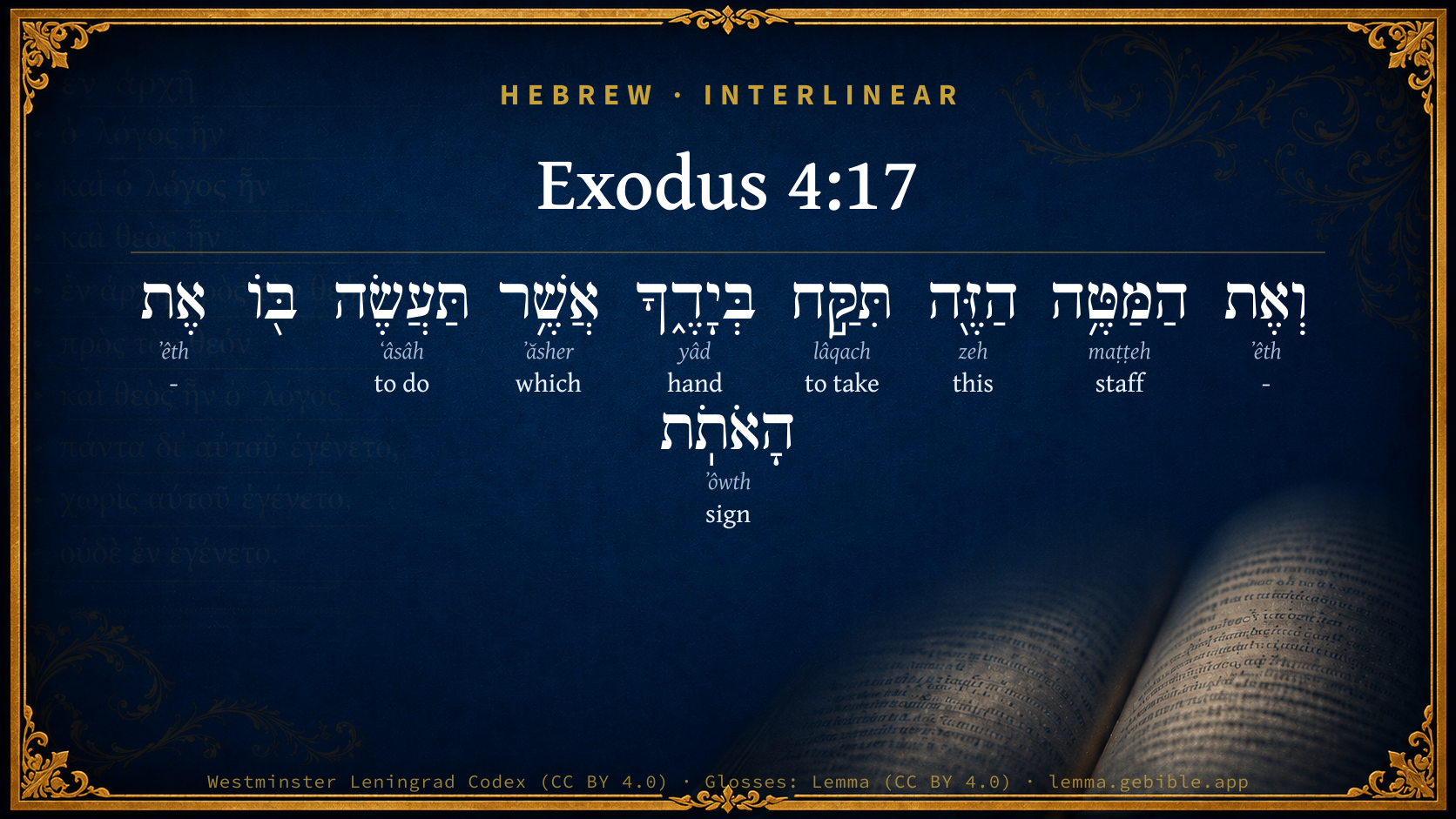
Hebrew (Westminster Leningrad Codex) Exodus 4:17 appears in the Hebrew Old Testament. The text above is from the Westminster Leningrad Codex. Each word links to its Strong’s number, a concise gloss, and parsing drawn from the Open Scriptures Hebrew Bible morphology. Click any word for its full Brown-Driver-Briggs (BDB) entry.
Download image
Cite this verse

Exodus 4:17 (World English Bible). Public Domain. Lemma interlinear Bible study tool, https://lemma.gebible.app/v/exodus/4/17.

Show BibTeX & RIS
BibTeX
RIS
English Translation
You shall take this rod in your hand, with which you shall do the signs."
World English Bible · Public Domain
Download a study sheet

One document with this verse’s original text, its word-by-word gloss line, the meaning frame, cross-references with their text, attributed commentary, and full source and license credits — printable, and it pastes into notes with its structure intact.

This verse Autodidact and up

Study sheet (.html) Plain text (.txt)

A passage Seminary Student

Up to 50 verses in one chapter. A passage sheet keeps up to 6 commentary sources and 12 cross-references per verse, in the order this page ranks them, and says so on the sheet whenever that leaves anything out. Ask for a single verse and you get the Autodidact verse sheet above.

Everything on this page stays free to read, with no account — the sheet is a download of what is already on screen, not access to it.

Want to remove ads? Support Godless Engineer
Compare translations 3

The same verse in 3 English versions, stacked beneath the original-language interlinear above. Click any original word for its lexicon entry.

Each is an independent rendering of the whole verse — the interlinear is not word-aligned to these translations.

Highlighted words mark where these versions differ — a whole-verse word diff, not a word-by-word alignment.

  • World English Bible Public Domain
    You shall take this rod in your hand, with which you shall do the signs."
  • King James Version Public Domain
    And thou shalt take this rod in thine hand, wherewith thou shalt do signs.
  • unfoldingWord Literal Text CC BY-SA 4.0
    And you shall take in your hand this staff, with which you will do the signs.”

unfoldingWord Literal Text — © unfoldingWord, licensed CC BY-SA 4.0. Word-aligned USFM3 via Door43 (git.door43.org/unfoldingWord/en_ult).

Versions to compare (up to 4)

3 of 4 selected

Show all 18 translations

Every available English version of this verse, each an independent rendering of the whole verse.

  • World English Bible Public Domain
    You shall take this rod in your hand, with which you shall do the signs."
  • Berean Standard Bible Public Domain
    But take this staff in your hand so you can perform signs with it.”
  • Majority Standard Bible Public Domain
    But take this staff in your hand so you can perform signs with it.”
  • King James Version Public Domain
    And thou shalt take this rod in thine hand, wherewith thou shalt do signs.
  • American Standard Version (1901) Public Domain
    And thou shalt take in thy hand this rod, wherewith thou shalt do the signs.
  • Revised Version (1885) Public Domain
    And thou shalt take in thine hand this rod, wherewith thou shalt do the signs.
  • Geneva Bible (1599) Public Domain
    Moreouer thou shalt take this rod in thine hand, wherewith thou shalt do miracles.
  • Douay-Rheims (1899) Public Domain
    And take this rod in thy hand, wherewith thou shalt do the signs.
  • Young's Literal Translation Public Domain
    and this rod thou dost take in thy hand, with which thou doest the signs.'
  • Literal Standard Version CC BY-SA 4.0
    and you take this rod in your hand, with which you do the signs.”
  • Unlocked Literal Bible CC BY-SA 4.0
    You will take in your hand this staff. With it you will do the signs.”
  • unfoldingWord Literal Text CC BY-SA 4.0
    And you shall take in your hand this staff, with which you will do the signs.”
  • Darby Bible Public Domain
    And thou shalt take this staff in thy hand, with which thou shalt do the signs.
  • World Messianic Bible Public Domain
    You shall take this rod in your hand, with which you shall do the signs.”
  • Webster's Bible Public Domain
    And thou shalt take this rod in thy hand, with which thou shalt perform signs.
  • Free Bible Version CC BY-SA 4.0
    Make sure to take your walking stick with you so you can use it to do the signs.”
  • Bible in Basic English Public Domain
    And take in your hand this rod with which you will do the signs.
  • JPS Tanakh (1917) Public Domain
    And thou shalt take in thy hand this rod, wherewith thou shalt do the signs.'

Literal Standard Version (2020), Covenant Press — licensed CC BY-SA 4.0. Text via the HelloAO Bible API (eBible.org). Unlocked Literal Bible (unfoldingWord) — licensed CC BY-SA 4.0. Text via the HelloAO Bible API (eBible.org). unfoldingWord Literal Text — © unfoldingWord, licensed CC BY-SA 4.0. Word-aligned USFM3 via Door43 (git.door43.org/unfoldingWord/en_ult). Free Bible Version, Dr. Jonathan Gallagher — licensed CC BY-SA 4.0. Text via the HelloAO Bible API (eBible.org).

Word by word

More ways to search: Search by grammar → Find every occurrence → Compare this word →

Practice this passage: Drill this verse → Learn its vocabulary →

הָאֹתֹֽת
ʼôwth
H226
“the · signs”
Particle, Definite Article + Noun, Common, Both, Plural, Absolute
Part of Speech
Particle + Noun
Type
Common
Gender
Both
Number
Plural
State
Absolute
Full BDB Definition

Origin: probably from H225 (in the sense of appearing)

TWOT: 41a

sign, signal - a distinguishing mark - banner - remembrance - miraculous sign - omen - warning - token, ensign, standard, miracle, proof
  1. וְאֶת ʼêth H853 “and · -” Conjunction + Particle, Direct Object
  2. הַמַּטֶּ֥ה maṭṭeh H4294 “the · staff” Particle, Definite Article + Noun, Common, Masculine, Singular, Absolute
  3. הַזֶּ֖ה zeh H2088 “the · this” Particle, Definite Article + Pronoun, Demonstrative, Masculine, Singular
  4. תִּקַּ֣ח lâqach H3947 “to take” Verb, Qal, Imperfect, 2nd Person, Masculine, Singular
  5. בְּיָדֶ֑ךָ yâd H3027 “in/at · hand · your” Preposition + Noun, Common, Both, Singular, Construct + Suffix, Personal, 2nd Person, Masculine, Singular
  6. אֲשֶׁ֥ר ʼăsher H834 “which” Particle, Relative
  7. תַּעֲשֶׂה ʻâsâh H6213 “to do” Verb, Qal, Imperfect, 2nd Person, Masculine, Singular
  8. אֶת ʼêth H853 “-” Particle, Direct Object

About this verse

These counts appear in no published source. They are computed here, from the morphology-tagged text and Lemma’s own curated glosses. What Lemma adds →

10
words
8
distinct lemmas
Pentateuch
section

Grammatical profile

  • 2 verbs
  • 3 nouns
  • 1 pronoun
  • 1 preposition
  • 3 particles

Verb forms

  • תִּקַּ֣ח Qal · Imperfect
  • תַּעֲשֶׂה Qal · Imperfect

Hebrew & Septuagint length

In English translation the verse runs 15 words from the Hebrew and 20 from the Septuagint (LXX English) — closely comparable.

A rough comparison of the two English renderings, which tokenize alike — not a word-level alignment.

Word counts can differ between the Hebrew and the Greek without any difference in meaning — e.g. the Hebrew direct-object marker אֵת has no separate Greek word, and Greek often adds the article ὁ.

Cross-references

3

Topical passages linked to Exodus 4:17 in the Treasury of Scripture Knowledge — connected by theme and wording, ordered by reader-vote popularity; previews shown in the World English Bible.

  • Exodus 4:2 Yahweh said to him, "What is that in your hand?" He said, "A rod."
  • 1 Corinthians 1:27 but God chose the foolish things of the world that he might put to shame those who are wise. God chose the weak things of the world, that he might put to shame the things that are strong;
  • Exodus 7:9–20 "When Pharaoh speaks to you, saying, 'Perform a miracle!' then you shall tell Aaron, 'Take your rod, and cast it down before Pharaoh, that it become a serpent.'"

Cross-references courtesy of OpenBible.info (CC BY 4.0).

Hebrew and Greek witnesses Masoretic Hebrew ↔ Greek Septuagint

The same verse in the two great witnesses to the Old Testament, shown verse-for-verse.

These are two independent witnesses, not word-aligned to each other, and the Septuagint is shown in lemma (dictionary) form.

Hebrew Exodus 4:17 Masoretic · Westminster Leningrad Codex

וְאֶת הַמַּטֶּ֥ה הַזֶּ֖ה תִּקַּ֣ח בְּיָדֶ֑ךָ אֲשֶׁ֥ר תַּעֲשֶׂה בּ֖וֹ אֶת הָאֹתֹֽת

You shall take this rod in your hand, with which you shall do the signs."

World English Bible · Public Domain

Greek LXX Exodus 4:17 Septuagint · lemma form

καί ὁ ῥάβδος οὗτος ὁ στρέφω εἰς ὄφις λαμβάνω ἐν ὁ χείρ σύ ἐν ὅς ποιέω ἐν αὐτός ὁ σημεῖον

And this rod that was turned into a serpent you shall take in your hand, wherewith you shall work miracles.

LXX2012 (modern English Septuagint) · Public Domain

On this verse, Ellicott's Commentary for English Readers discusses the Septuagint’s reading. Read the note in Commentary ↓

Hebrew: Westminster Leningrad Codex (CC BY 4.0). Greek: Septuagint (public domain); English from LXX2012 (modern English Septuagint) (Public Domain). How the Septuagint differs from the Hebrew →

Targum (Aramaic paraphrase)

2

The Targum is the ancient Jewish Aramaic paraphrase of the Hebrew Scriptures — an interpretive translation, not the Hebrew text itself. Onkelos (literal) and Pseudo-Jonathan (expansive) render the Torah, and Jonathan the Prophets. Coverage is partial: where no permissively-licensed English translation exists for a verse, only the Aramaic is shown. This is verse-level text, not a word-by-word alignment to the Hebrew.

  1. Targum Onkelos Torah (Genesis–Deuteronomy)
    וְיָת חֻטְרָא הָדֵין תִּסַב בִּידָךְ דְתַעְבֵּד בֵּהּ יָת אָתַיָא:

    (no public-domain English translation for this verse)

    Targum Onkelos — Aramaic: “Onkelos Genesis” (public domain); “Onkelos Exodus” (public domain); “Onkelos Leviticus” (public domain); “Onkelos Numbers” (public domain); “Onkelos Deuteronomy” (public domain). English: “Sefaria Community Translation” (CC0 1.0 (public-domain dedication)); “J.W. Etheridge. The Targums of Onkelos and Jonathan Ben Uzziel on the Pentateuch. London: Longmans, Green, 1862” (public domain). Text via Sefaria.

  2. Targum Pseudo-Jonathan Torah (Genesis–Deuteronomy)
    וְיַת חוּטְרָא הָדֵין תִּיסַב בִּידָךְ דִתַעֲבֵיד בֵּיהּ יַת אָתַיָיא

    And this rod take thou in thy hand to work therewith the signs.

    Targum Pseudo-Jonathan — Aramaic: “Targum Jonathan on Genesis” (public domain); “Targum Jonathan on Exodus” (public domain); “Targum Jonathan on Leviticus” (public domain); “Targum Jonathan on Numbers” (public domain); “Targum Jonathan on Deuteronomy” (public domain). English: “The Targum of Jonathan ben Uzziel, trans. J. W. Etheridge, London, 1862” (public domain). Text via Sefaria.

Commentary

Notes on Exodus 4:17 from classic Christian and Jewish commentators (each source and its license shown beneath its notes). The classic Christian expositions comment on the surrounding passage and are grouped to its opening verse, so a note may address several verses; the Jewish commentaries on the Tanakh (Rashi and others) are per-verse, so they appear only where the commentator wrote on this verse.

Lemma curates 59 commentaries, every one of them public domain or Creative Commons licensed, each selected and text-cleaned for this edition rather than reprinted as found. About our sources →

The Cambridge Bible for Schools and Colleges

gen. ed. J. J. S. Perowne

17–21. Here vv. 17–18, 20b–21 are assigned to E on account of their imperfect connexion with the context: Exo_4:17 speaks of ‘the signs’ to be done with the rod, whereas only one sign to be performed with it has been enjoined in vv. 1–9; Exo_4:21 mentions ‘portents’ to be done before the Pharaoh, whereas vv. 1–9 speak only of wonders to be wrought for the satisfaction of the people. Further, v. 19, from its contents, is not fitted to be the sequel of v. 18; it in fact states an alternative ground for Moses’ return into Egypt; and the name Jether (Jethro) makes it probable that v. 18 belongs to the same current of narrative as Exo_3:1 and ch. 18 (i.e. E); hence v. 19 will be referred to J. V. 20b goes naturally with v. 17 (the rod).

17 (E). this rod, &c.] Not the rod of vv. 2–4 (with which only one sign was to be wrought), but the rod often mentioned in E as borne by Moses (v. 20b, Exo_7:15; Exo_7:17; Exo_7:20, Exo_9:23, Exo_10:13, Exo_14:16, Exo_17:5; Exo_17:9). In a previous part of E, which has not been preserved, it must have been told how Moses was equipped with a wonder-working rod, and what ‘the signs’ were which he was to perform with it before Pharaoh (so Di.).

The Cambridge Bible for Schools and Colleges (gen. ed. J. J. S. Perowne; Cambridge University Press, 1878–1918) — public domain. Text from a community e-Sword module.

Trapp's Complete Commentary

John Trapp

Exo 4:17 And thou shalt take this rod in thine hand, wherewith thou shalt do signs.

Ver. 17. Wherewith thou shalt do signs.] God, of his freewill, joining his operation thereunto; as likewise he doth to the outward signs in the two sacraments: and hence their energy, which else would be none.

John Trapp, A Commentary or Exposition upon All the Books of the Old and New Testament (1647–1656) — public domain. Text from a community e-Sword module.

Joseph Benson's Commentary

Exo 4:17. Take this rod — The staff or crook he carried as a shepherd, that he might not be ashamed of the mean condition out of which God called him. “This rod must be his staff of authority, and must be to him instead of both sword and sceptre.

Joseph Benson's Commentary on the Old and New Testaments (1811–1818) — public domain. Text from a community e-Sword module.

Adam Clarke's Commentary

Verse 17. Thou shalt take this rod] From the story of Moses's rod the heathens have invented the fables of the thyrsus of Bacchus, and the caduceus of Mercury. Cicero reckons five Bacchuses, one of which, according to Orpheus, was born of the river Nile; but, according to the common opinion, he was born on the banks of that river. Bacchus is expressly said to have been exposed on the river Nile, hence he is called Nilus, both by Diodorus and Macrobius; and in the hymns of Orpheus he is named Myses, because he was drawn out of the water. He is represented by the poets as being very beautiful, and an illustrious warrior; they report him to have overrun all Arabia with a numerous army both of men and women. He is said also to have been an eminent law-giver, and to have written his laws on two tables. He always carried in his hand the thyrsus, a rod wreathed with serpents, and by which he is reported to have wrought many miracles. Any person acquainted with the birth and exploits of the poetic Bacchus will at once perceive them to be all borrowed from the life and acts of Moses, as recorded in the Pentateuch; and it would be losing time to show the parallel, by quoting passages from the book of Exodus.

The caduceus or rod of Mercury is well known in poetic fables. It is another copy Of the rod of Moses. He also is reported to have wrought a multitude of miracles by this rod; and particularly he is said to kill and make alive, to send souls to the invisible world and bring them back from thence. Homer represents Mercury taking his rod to work miracles precisely in the same way as God commands Moses to take his.

Ἑρμης δε ψυχας Κυλληνιος εξεκαλειτο

Ανδρων μνηστηρων· εχε δε ῬΑΒΔΟΝ μετα χερσιν

Καλην, χρυσειην, τῃ τ' ανδρων ομματα θελγει,

Ὡν εθελει, τους δ' αυτε και ὑπνωοντας εγειρει.

Odyss., lib. xxiv., ver. 1.

Cyllenian Hermes now call'd forth the souls

Of all the suitors; with his golden WAND

Of power, to seal in balmy sleep whose eyes

Soe'er he will, and open them again. COWPER.

Virgil copies Homer, but carries the parallel farther, tradition having probably furnished him with more particulars; but in both we may see a disguised copy of the sacred history, from which indeed the Greek and Roman poets borrowed most of their beauties.

TUM VIRGAM CAPIT: hac animas ille evocat Orco

Pallentes, alias sub tristia Tartara mittit;

Dat somnos, adimitque, et lumina morte resignat

ILLA fretus agit, ventos, et turbida tranat.

AEneid, lib. iv., ver. 242.

But first he grasps within his awful hand

The mark of sovereign power, the magic wand;

With this he draws the ghosts from hollow graves,

With this he drives them down the Stygian waves;

With this he seals in sleep the wakeful sight,

And eyes, though closed in death, restores to light.

Thus arm'd, the god begins his airy race,

And drives the racking clouds along the liquid space.

DRYDEN.

Many other resemblances between the rod of the poets and that of Moses, the learned reader will readily recollect. These specimens may be deemed sufficient.

Adam Clarke's Commentary on the Bible (1810–1826) — public domain. Text from a community e-Sword/MySword module.

Ellicott's Commentary for English Readers

(17) This rod, i.e., “the rod that had been changed into a serpent,” as the LXX. paraphrase.

(18) Signs.—Rather, “the signs” (τὰ σημεῖα, LXX.); i.e., the signs which thou wilt have to perform, as already implied in Exo_3:20.

A Bible Commentary for English Readers, edited by Charles John Ellicott (1878–1897) — public domain. Text from a community e-Sword module.

John Gill's Exposition

And thou shall take this rod in thine hand,.... Which he then had in his hand, and was no other than his shepherd's staff:

wherewith thou shall do signs: wondrous things, meaning the ten plagues inflicted on Egypt.

John Gill's Exposition of the Whole Bible (1746–1763) — public domain (CC PDM 1.0). Text via the HelloAO Bible API.

Haydock's Catholic Bible Commentary

Rod. So the devil taught Mercury and Bacchus to mimic Moses, and to carry a wand. Tum virgam capit, hac animas ille evocat orco. (Virgil, iv.) (Calmet)

George Leo Haydock (1774–1849), Haydock's Catholic Family Bible and Commentary, 1859 edition — public domain. Excludes Psalms (Douay-Rheims chapter numbering differs from Protestant) and Deuterocanonical books (Catholic canon only).

Matthew Poole's English Annotations

Both those which I have already made thee to do, and others as I shall direct and enable thee.

Matthew Poole's English Annotations on the Holy Bible (1683–1685) — public domain. Text from a community e-Sword/MySword module.

Whedon's Commentary on the Bible

Daniel D. Whedon

17. This rod — This simple shepherd’s crook shall break the sceptre of Egypt, shall break the crook and flail of Osiris. So, long after, a shepherd’s sling delivered Israel; a Galilean fisher’s net enclosed the Gospel multitudes; and a Cilician tentmaker spread the gospel tabernacle over the Gentile nations. Thus the Dispensations ever harmonize. With this decisive command Jehovah closes the interview, and Moses humbly submits and obeys.

THE RETURN OF MOSES TO EGYPT, 18-31.

Moses, as far as we can see, says nothing at this time to Jethro about his divine commission, for as yet, probably, he could not have understood it.

Daniel D. Whedon (gen. ed.), Commentary on the Old and New Testaments (1874–1909) — public domain. Text from a community e-Sword module.

The Pulpit Commentary

Thou shalt take this rod. Not any rod, but the particular one which had already once become a serpent. Wherewith thou shalt do signs. Rather, "the signs," i.e. the signs which thou wilt have to do, as already declared in Exo_3:20. It is quite gratuitous to suppose that God had already particularised them

The rod.

The rod a fit emblem of "the word of the truth of the Gospel.

1. The rod was something definite. "This rod." Not any rod, but the onewhich God gives us.

2. The rod was perhaps the instrument of a despised calling. So is thepreaching of the Cross "foolishness". (1Co_1:21-25)

3. The rod was to be grasped and used: "in thine hand" Study, preach,expound, apply.

4. By the rod, Moses was to do signs: "wherewith thou shalt do signs."Spiritual miracles wrought by the preaching of the word.

5. The rod was efficient only as accompanied by Divine power. J.O. (1Co_2:4)

The importance of the rod: God guards Moses against a very natural oversight.

shalt take this rod in thine hand." Was Moses, then, likely to forget it? That rod had just been pointed out to him as connected with his favourable reception by Israel. It was to be the instrument for helping to deliver him from one of his chief apprehensions. And yet it was as likely as not that in the hurry of gathering his household goods together, the rod would be thrown into a corner of the fold as a mere bit of wood that could easily be replaced if Moses had once again to become a shepherd. Notice

1. That other things seemed, to the natural eye, of a great deal more consequence. As Martha, when Jesus came to her house, was cumbered with much serving, and in the middle of it all was unwittingly neglecting the one thing needful, so Moses, amid the distracting questions that filled his mind, had no inducement to regard the rod with such attention as corresponded to its real importance. Here is one of the great difficulties in bringing the natural man to discern the things of the Spirit of God. Not only is man, by nature, indifferent to spiritual things, but he is absorbingly occupied in the desires, cares, and apprehensions of the natural life. When the disciples of Christ had their minds filled with carnal anticipations of the kingdom of heaven, they heard even such glorious news as that of the resurrection of their Master as if they heard it not.

2. This rod seemed a thing of particularly little consequence. Were not a thousand such within easy reach? Might not God be trusted to turn any rod Moses took up just as he had turned this? If it had only been some precious stone, something costly, elaborate, and rare, he would not have forgotten it.

3. The real consequence of the rod appeared dearly in the light of after events. Suppose Moses had left the rod behind him. The likelihood is that he would very quickly have been stopped on the way, even as he was stopped and threatened because of his uncircumcised son. And if he had been allowed to go on, assuredly he would have been put to shame on coming into the presence of Israel. God was beginning to teach Moses that strict, unflagging attention to details would be necessary when he again came to this mountain to take his part in serving God on it.

4. The rod itself was a great sign that Israel was to be delivered not by human but by Divine operations. It was probably not only the companion of Moses, but the constant companion. Ever in his hand, it was something by which he could readily turn his thoughts away from his own inability to the all-sufficing power of God. It is our folly, both as concerns our own salvation and the salvation of our fellow-men, that we go out without the rod. When the Israelites saw Moses coming among them with his rod, clinging to it, though there seemed no use for it, some of them perhaps said, "Throw that rod aside; why cumber yourself with it, and become a laughingstock and a puzzle to beholders." And in like manner how often have those put in trust with the Gospel been exhorted to lay aside those elements which to the natural man appear mere excrescences and deformities. We may well believe that to the first apostles, it was one of the hardest things in the world to keep firm to the essential parts of their message. What the rod was to Moses, going forth with it and working signs, that must the doctrine of the Cross be to all apostles. Christ crucified is to the Jews a stumblingblock and to the Greeks foolishness, but to them which are called, Christ the power of God and the wisdom of God. Y.

The Pulpit Commentary (1880–1919), ed. H.D.M. Spence-Jones & Joseph S. Exell — public domain. Text from a community e-Sword module.

John Wesley's Explanatory Notes

Take this rod - The staff or crook he carried as a shepherd, that he might not be ashamed of that mean condition out of which God called him. This rod must be his staff of authority, and must be to him instead, both of sword and scepter.

John Wesley, Explanatory Notes Upon the Whole Bible (1754–1765) — public domain. Text via the GEBible commentary corpus.

Ramban (Nachmanides)

Rabbi Moshe ben Nachman (Ramban / Nachmanides)

AND THOU SHALT TAKE IN THY HAND THIS ROD, WHEREWITH THOU SHALT DO THE SIGNS. Concerning the rod, only one sign — that it turn into a serpent — has thus far been mentioned. But the [plural] expression “the signs” means “the signs which I will tell you.”It appears to me that when G-d said to Moses, With all My wonders which I will do in his midst, He informed him of all the wonders in detail, but Scripture speaks briefly, and this is the intent of the expression here, wherewith thou shalt do the signs.

Ramban (Nachmanides) on the Tanakh — English translation: “Commentary on the Torah by Ramban (Nachmanides). Translated and annotated by Charles B. Chavel. New York, Shilo Pub. House, 1971-1976” (CC BY 4.0). Text via Sefaria.

Lesson kit

Teaching starters — assembled from the data on this page, not authored interpretation. Every prompt links to the verse data it draws on. Edit before teaching.

Exodus, in the Pentateuch, opens this verse with 10 words (8 distinct Hebrew lemmas). Its most distinctive word is ʼôwth (“sign”). A historical commentator’s framing appears above. Read the whole chapter for the surrounding context.

Discussion questions

  1. What does “sign” (ʼôwth) contribute to the verse as a whole?
  2. Exodus 4:2 shares this passage’s theme. How do the two illuminate each other?
  3. These translations render this verse differently; the difference is in the English rendering, not the original. What questions does that raise?
  4. The verb «תִּקַּ֣ח» is Qal Imperfect. How does its form color the action?
  5. Reading how The Cambridge Bible for Schools and Colleges and Trapp's Complete Commentary read this verse, where do the two commentators agree and where do they part?

Things to notice

Reading settings

Reading text

Shown beneath each verse's original-language words.

Old Testament
Old Testament edition

Read the OT as the Masoretic Hebrew (MT) or the Greek Septuagint (LXX).

English shown for the Greek Septuagint (in the Hebrew ↔ Greek comparison).

Comparing translations? Open the Compare panel on any verse page to stack up to four side by side.